




Sequence
Objectives
1. Define Arithmetic
   Sequence
2. Determine if a sequence
   is an Arithmetic
3. Determine the first term
   and common difference
A sequence in which
a constant (d) can
be added to each
term to get the
next term is called
an
 Arithmetic
 Sequence.
The
constant (d)
is called the
  COMMON
DIFFERENCE.
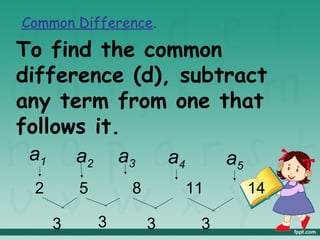
Common Difference.

To find the common
difference (d), subtract
any term from one that
follows it.
 a1       a2       a3       a4        a5
 2        5         8            11        14

      3        3        3         3
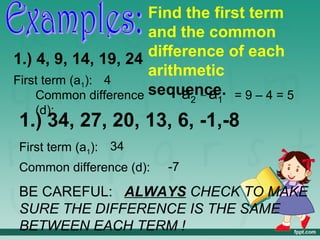
Find the first term
                      and the common
1.) 4, 9, 14, 19, 24  difference of each
                      arithmetic
First term (a1): 4
    Common difference sequence. = 9 – 4 = 5
                           a2 _ a1
   (d):
1.) 34, 27, 20, 13, 6, -1,-8
First term (a1): 34
Common difference (d):   -7

BE CAREFUL: ALWAYS CHECK TO MAKE
SURE THE DIFFERENCE IS THE SAME
BETWEEN EACH TERM !
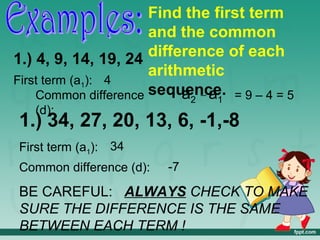
Find the first term
                      and the common
1.) 4, 9, 14, 19, 24  difference of each
                      arithmetic
First term (a1): 4
    Common difference sequence. = 9 – 4 = 5
                           a2 _ a1
   (d):
1.) 34, 27, 20, 13, 6, -1,-8
First term (a1): 34
Common difference (d):   -7

BE CAREFUL: ALWAYS CHECK TO MAKE
SURE THE DIFFERENCE IS THE SAME
BETWEEN EACH TERM !
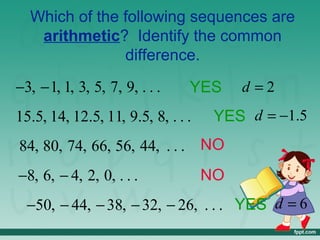
Which of the following sequences are
   arithmetic? Identify the common
               difference.
−3, − 1, 1, 3, 5, 7, 9, . . .   YES      d =2
15.5, 14, 12.5, 11, 9.5, 8, . . .    YES d = −1.5
84, 80, 74, 66, 56, 44, . . . NO
−8, 6, − 4, 2, 0, . . .             NO
  −50, − 44, − 38, − 32, − 26, . . . YES d = 6
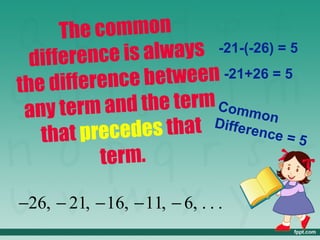
The common
  d ifference is always -21-(-26) = 5
the difference   between -21+26 = 5
  any term   and the term Common
    that precedes tha   t Difference =
                                       5
            term.

−26, − 21, − 16, − 11, − 6, . . .
An Arithmetic Sequence is
 defined as a sequence in
 which there is a common
    difference between
    consecutive terms.
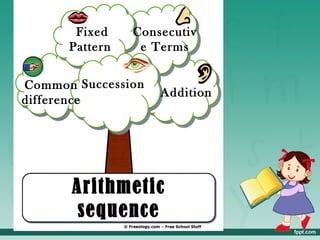
Fixed    Consecutiv
      Pattern    e Terms


Common Succession
                    Addition
difference


      Arithmetic
       sequence
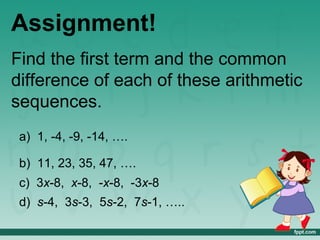
Assignment!
Find the first term and the common
difference of each of these arithmetic
sequences.
 a) 1, -4, -9, -14, ….

 b) 11, 23, 35, 47, ….
 c) 3x-8, x-8, -x-8, -3x-8
 d) s-4, 3s-3, 5s-2, 7s-1, …..
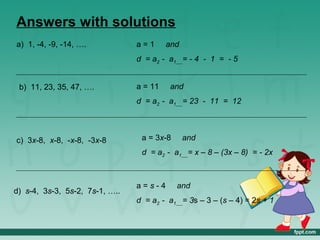
Answers with solutions
a) 1, -4, -9, -14, ….           a=1      and
                                d = a2 - a1 = - 4 - 1 = - 5


 b) 11, 23, 35, 47, ….          a = 11   and
                                d = a2 - a1 = 23 - 11 = 12


c) 3x-8, x-8, -x-8, -3x-8        a = 3x-8      and
                                 d = a2 - a1 = x – 8 – (3x – 8) = - 2x


                                a=s-4       and
d) s-4, 3s-3, 5s-2, 7s-1, …..
                                d = a2 - a1 = 3s – 3 – (s – 4) = 2s + 1
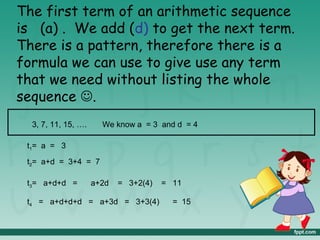
The first term of an arithmetic sequence
is (a) . We add (d) to get the next term.
There is a pattern, therefore there is a
formula we can use to give use any term
that we need without listing the whole
sequence .
  3, 7, 11, 15, ….     We know a = 3 and d = 4

 t1= a = 3

 t2= a+d = 3+4 = 7

 t3= a+d+d =         a+2d   = 3+2(4)   = 11

 t4 = a+d+d+d = a+3d = 3+3(4)            = 15
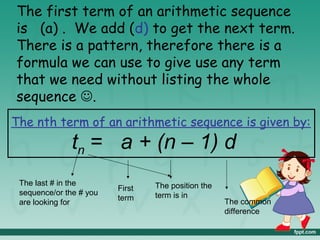
The first term of an arithmetic sequence
is (a) . We add (d) to get the next term.
There is a pattern, therefore there is a
formula we can use to give use any term
that we need without listing the whole
sequence .
The nth term of an arithmetic sequence is given by:
              tn = a + (n – 1) d
 The last # in the               The position the
                         First
 sequence/or the # you           term is in
                         term                       The common
 are looking for
                                                    difference
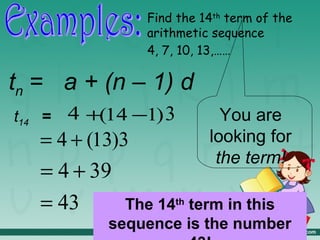
Find the 14th term of the
                 arithmetic sequence
                 4, 7, 10, 13,……

tn = a + (n – 1) d
t14 =   4 +(14 −1) 3         You are
   = 4 + (13)3             looking for
                            the term!
   = 4 + 39
   = 43       The 14th term in this
            sequence is the number
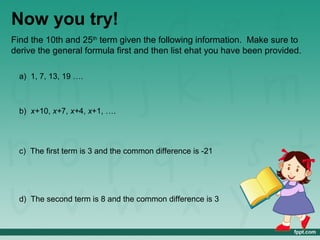
Now you try!
Find the 10th and 25th term given the following information. Make sure to
derive the general formula first and then list ehat you have been provided.

  a) 1, 7, 13, 19 ….


  b) x+10, x+7, x+4, x+1, ….


  c) The first term is 3 and the common difference is -21


  d) The second term is 8 and the common difference is 3
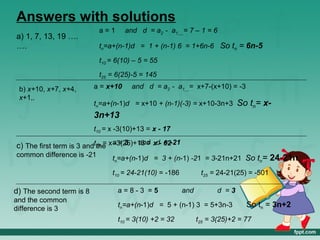
Answers with solutions
                           a=1       and d = a2 - a1 = 7 – 1 = 6
a) 1, 7, 13, 19 ….
….                         tn=a+(n-1)d = 1 + (n-1) 6 = 1+6n-6 So tn = 6n-5

                           t10 = 6(10) – 5 = 55
                           t25 = 6(25)-5 = 145

 b) x+10, x+7, x+4,       a = x+10    and d = a2 - a1 = x+7-(x+10) = -3
 x+1,.
                          tn=a+(n-1)d = x+10 + (n-1)(-3) = x+10-3n+3        So tn= x-
                          3n+13
                          t10 = x -3(10)+13 = x - 17

c) The first term is 3 andt25 = x a = 3 and xd- 62-21
                           the -3(25)+13 =
                                                =
common difference is -21        tn=a+(n-1)d = 3 + (n-1) -21 = 3-21n+21 So tn=            24-21n
                                t10 = 24-21(10) = -186          t25 = 24-21(25) = -501

d) The second term is 8           a=8-3 =5               and         d =3
and the common
difference is 3
                                  tn=a+(n-1)d = 5 + (n-1) 3 = 5+3n-3           So tn = 3n+2
                                  t10 = 3(10) +2 = 32          t25 = 3(25)+2 = 77
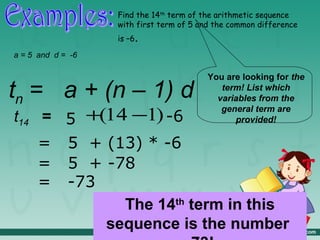
Find the 14th term of the arithmetic sequence
                   with first term of 5 and the common difference
                   is –6.

a = 5 and d = -6

                                         You are looking for the

tn = a + (n – 1) d                          term! List which
                                           variables from the

t14 = 5 +(14 −1) -6
                                            general term are
                                               provided!

    = 5 + (13) * -6
    = 5 + -78
    = -73
            The 14th term in this
          sequence is the number
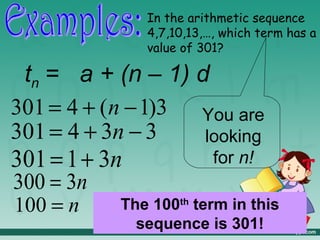
In the arithmetic sequence
              4,7,10,13,…, which term has a
              value of 301?

 tn = a + (n – 1) d
301 = 4 + ( n − 1)3 You are
301 = 4 + 3n − 3    looking
301 = 1 + 3n         for n!
300 = 3n
100 = n    The 100th term in this
             sequence is 301!
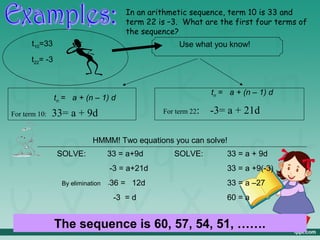
In an arithmetic sequence, term 10 is 33 and
                                           term 22 is –3. What are the first four terms of
                                           the sequence?
       t10=33                                            Use what you know!
      t22= -3


                                                                   tn = a + (n – 1) d
                tn = a + (n – 1) d

For term 10:   33= a + 9d                           For term 22:   -3= a + 21d

                             HMMM! Two equations you can solve!
                SOLVE:             33 = a+9d           SOLVE:          33 = a + 9d
                                       -3 = a+21d                      33 = a +9(-3)
                  By elimination   -   36 = 12d                        33 = a –27
                                       -3 = d                          60 = a


                The sequence is 60, 57, 54, 51, …….
Review
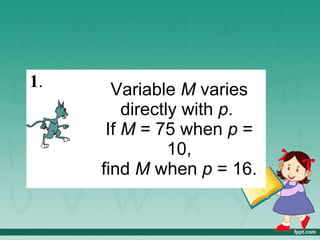
1.     Variable M varies
         directly with p.
      If M = 75 when p =
                10,
     find M when p = 16.
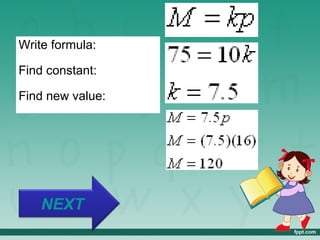
Write formula:

Find constant:

Find new value:


    NEXT
Drill

Arithmetic seqence

  • 1.
  • 3.
    Objectives 1. Define Arithmetic Sequence 2. Determine if a sequence is an Arithmetic 3. Determine the first term and common difference
  • 4.
    A sequence inwhich a constant (d) can be added to each term to get the next term is called an Arithmetic Sequence.
  • 5.
    The constant (d) is calledthe COMMON DIFFERENCE.
  • 6.
    Common Difference. To findthe common difference (d), subtract any term from one that follows it. a1 a2 a3 a4 a5 2 5 8 11 14 3 3 3 3
  • 7.
    Find the firstterm and the common 1.) 4, 9, 14, 19, 24 difference of each arithmetic First term (a1): 4 Common difference sequence. = 9 – 4 = 5 a2 _ a1 (d): 1.) 34, 27, 20, 13, 6, -1,-8 First term (a1): 34 Common difference (d): -7 BE CAREFUL: ALWAYS CHECK TO MAKE SURE THE DIFFERENCE IS THE SAME BETWEEN EACH TERM !
  • 8.
    Find the firstterm and the common 1.) 4, 9, 14, 19, 24 difference of each arithmetic First term (a1): 4 Common difference sequence. = 9 – 4 = 5 a2 _ a1 (d): 1.) 34, 27, 20, 13, 6, -1,-8 First term (a1): 34 Common difference (d): -7 BE CAREFUL: ALWAYS CHECK TO MAKE SURE THE DIFFERENCE IS THE SAME BETWEEN EACH TERM !
  • 9.
    Which of thefollowing sequences are arithmetic? Identify the common difference. −3, − 1, 1, 3, 5, 7, 9, . . . YES d =2 15.5, 14, 12.5, 11, 9.5, 8, . . . YES d = −1.5 84, 80, 74, 66, 56, 44, . . . NO −8, 6, − 4, 2, 0, . . . NO −50, − 44, − 38, − 32, − 26, . . . YES d = 6
  • 10.
    The common d ifference is always -21-(-26) = 5 the difference between -21+26 = 5 any term and the term Common that precedes tha t Difference = 5 term. −26, − 21, − 16, − 11, − 6, . . .
  • 11.
    An Arithmetic Sequenceis defined as a sequence in which there is a common difference between consecutive terms.
  • 12.
    Fixed Consecutiv Pattern e Terms Common Succession Addition difference Arithmetic sequence
  • 13.
    Assignment! Find the firstterm and the common difference of each of these arithmetic sequences. a) 1, -4, -9, -14, …. b) 11, 23, 35, 47, …. c) 3x-8, x-8, -x-8, -3x-8 d) s-4, 3s-3, 5s-2, 7s-1, …..
  • 14.
    Answers with solutions a)1, -4, -9, -14, …. a=1 and d = a2 - a1 = - 4 - 1 = - 5 b) 11, 23, 35, 47, …. a = 11 and d = a2 - a1 = 23 - 11 = 12 c) 3x-8, x-8, -x-8, -3x-8 a = 3x-8 and d = a2 - a1 = x – 8 – (3x – 8) = - 2x a=s-4 and d) s-4, 3s-3, 5s-2, 7s-1, ….. d = a2 - a1 = 3s – 3 – (s – 4) = 2s + 1
  • 15.
    The first termof an arithmetic sequence is (a) . We add (d) to get the next term. There is a pattern, therefore there is a formula we can use to give use any term that we need without listing the whole sequence . 3, 7, 11, 15, …. We know a = 3 and d = 4 t1= a = 3 t2= a+d = 3+4 = 7 t3= a+d+d = a+2d = 3+2(4) = 11 t4 = a+d+d+d = a+3d = 3+3(4) = 15
  • 16.
    The first termof an arithmetic sequence is (a) . We add (d) to get the next term. There is a pattern, therefore there is a formula we can use to give use any term that we need without listing the whole sequence . The nth term of an arithmetic sequence is given by: tn = a + (n – 1) d The last # in the The position the First sequence/or the # you term is in term The common are looking for difference
  • 17.
    Find the 14thterm of the arithmetic sequence 4, 7, 10, 13,…… tn = a + (n – 1) d t14 = 4 +(14 −1) 3 You are = 4 + (13)3 looking for the term! = 4 + 39 = 43 The 14th term in this sequence is the number
  • 18.
    Now you try! Findthe 10th and 25th term given the following information. Make sure to derive the general formula first and then list ehat you have been provided. a) 1, 7, 13, 19 …. b) x+10, x+7, x+4, x+1, …. c) The first term is 3 and the common difference is -21 d) The second term is 8 and the common difference is 3
  • 19.
    Answers with solutions a=1 and d = a2 - a1 = 7 – 1 = 6 a) 1, 7, 13, 19 …. …. tn=a+(n-1)d = 1 + (n-1) 6 = 1+6n-6 So tn = 6n-5 t10 = 6(10) – 5 = 55 t25 = 6(25)-5 = 145 b) x+10, x+7, x+4, a = x+10 and d = a2 - a1 = x+7-(x+10) = -3 x+1,. tn=a+(n-1)d = x+10 + (n-1)(-3) = x+10-3n+3 So tn= x- 3n+13 t10 = x -3(10)+13 = x - 17 c) The first term is 3 andt25 = x a = 3 and xd- 62-21 the -3(25)+13 = = common difference is -21 tn=a+(n-1)d = 3 + (n-1) -21 = 3-21n+21 So tn= 24-21n t10 = 24-21(10) = -186 t25 = 24-21(25) = -501 d) The second term is 8 a=8-3 =5 and d =3 and the common difference is 3 tn=a+(n-1)d = 5 + (n-1) 3 = 5+3n-3 So tn = 3n+2 t10 = 3(10) +2 = 32 t25 = 3(25)+2 = 77
  • 20.
    Find the 14thterm of the arithmetic sequence with first term of 5 and the common difference is –6. a = 5 and d = -6 You are looking for the tn = a + (n – 1) d term! List which variables from the t14 = 5 +(14 −1) -6 general term are provided! = 5 + (13) * -6 = 5 + -78 = -73 The 14th term in this sequence is the number
  • 21.
    In the arithmeticsequence 4,7,10,13,…, which term has a value of 301? tn = a + (n – 1) d 301 = 4 + ( n − 1)3 You are 301 = 4 + 3n − 3 looking 301 = 1 + 3n for n! 300 = 3n 100 = n The 100th term in this sequence is 301!
  • 22.
    In an arithmeticsequence, term 10 is 33 and term 22 is –3. What are the first four terms of the sequence? t10=33 Use what you know! t22= -3 tn = a + (n – 1) d tn = a + (n – 1) d For term 10: 33= a + 9d For term 22: -3= a + 21d HMMM! Two equations you can solve! SOLVE: 33 = a+9d SOLVE: 33 = a + 9d -3 = a+21d 33 = a +9(-3) By elimination - 36 = 12d 33 = a –27 -3 = d 60 = a The sequence is 60, 57, 54, 51, …….
  • 23.
  • 24.
    1. Variable M varies directly with p. If M = 75 when p = 10, find M when p = 16.
  • 25.
  • 27.