COORDINATE
GEOMETRY
 Distance and Midpoint Formula
 Placing Figures in the Coordinate
Plane
 Coordinates in Proof
 Equation of a Circle
COORDINATE/ANALYTIC
GEOMETRY
-is the study of geometric figures
using algebra.
HOW USEFUL IS
COORDINATE
GEOMETRY?
“in what sense?”
DISTANCE
FORMULA
 Derive the distance formula
 Apply the distance formula to prove some geometric
properties
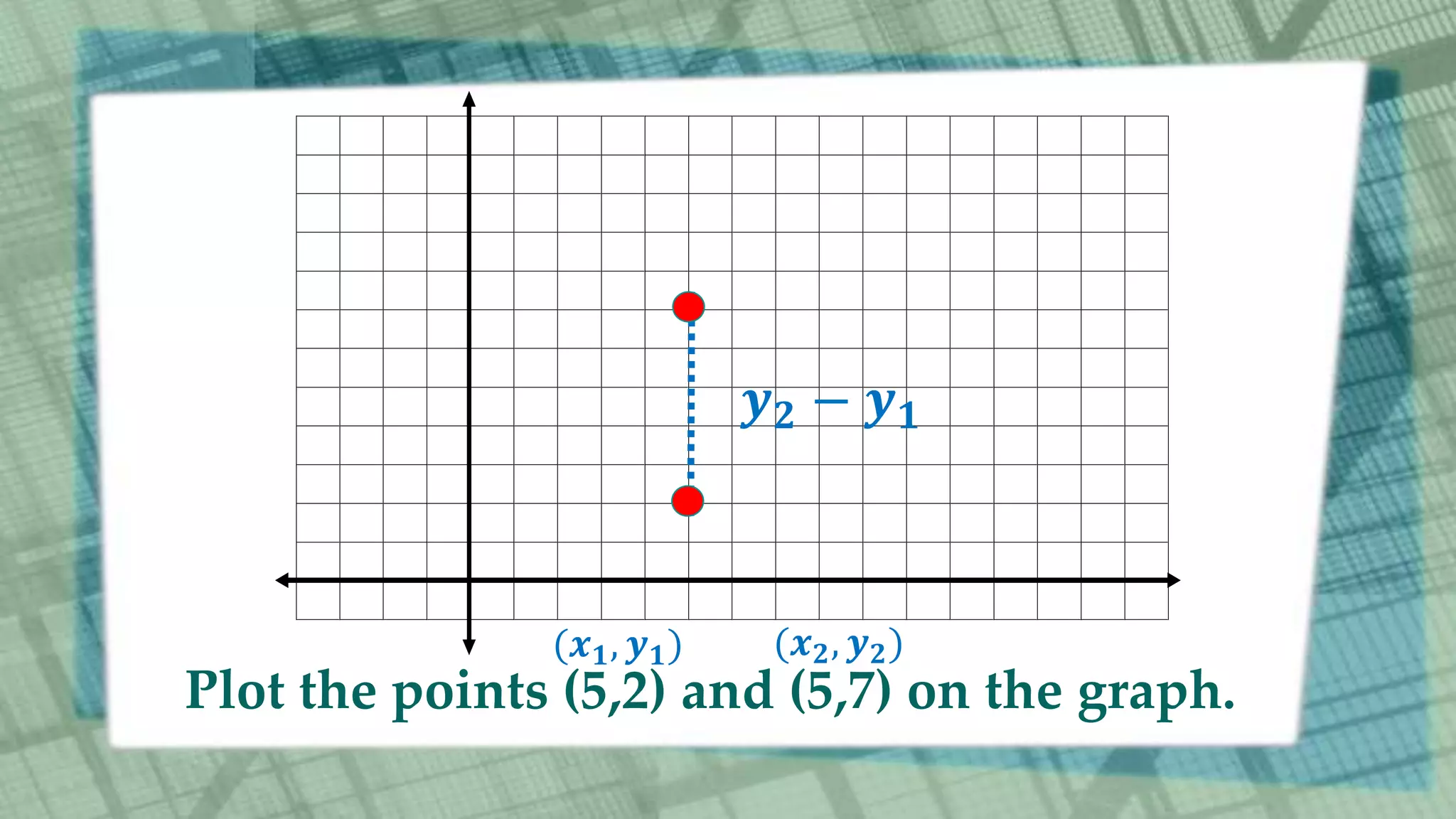
Plot the points (5,2) and (5,7) on the graph.
𝒚𝟐 − 𝒚𝟏
(𝒙𝟏, 𝒚𝟏) (𝒙𝟐, 𝒚𝟐)
Plot the points (-1,2) and (5,2) on the graph.
𝒙𝟐 − 𝒙𝟏
Connect the points (5,7) and (-1,2) on the graph.
𝒙𝟐 − 𝒙𝟏
𝒚𝟐 − 𝒚𝟏
𝒉𝒚𝒑𝒐𝒕𝒆𝒏𝒖𝒔𝒆
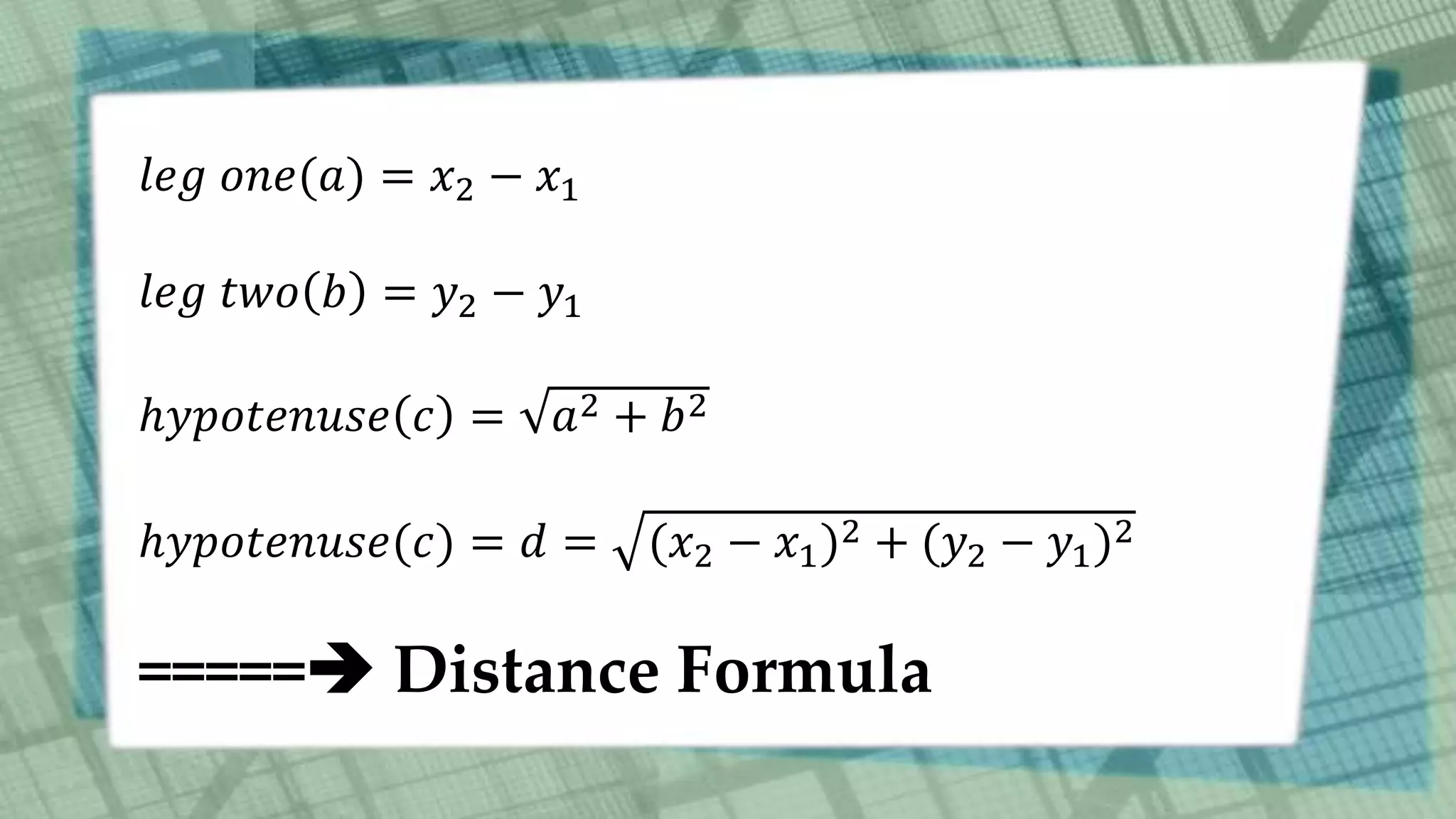
𝑙𝑒𝑔 𝑜𝑛𝑒(𝑎) = 𝑥2 − 𝑥1
𝑙𝑒𝑔 𝑡𝑤𝑜 𝑏 = 𝑦2 − 𝑦1
ℎ𝑦𝑝𝑜𝑡𝑒𝑛𝑢𝑠𝑒 𝑐 = 𝑎2 + 𝑏2
ℎ𝑦𝑝𝑜𝑡𝑒𝑛𝑢𝑠𝑒(𝑐) = 𝑑 = (𝑥2 − 𝑥1)2 + (𝑦2 − 𝑦1)2
===== Distance Formula
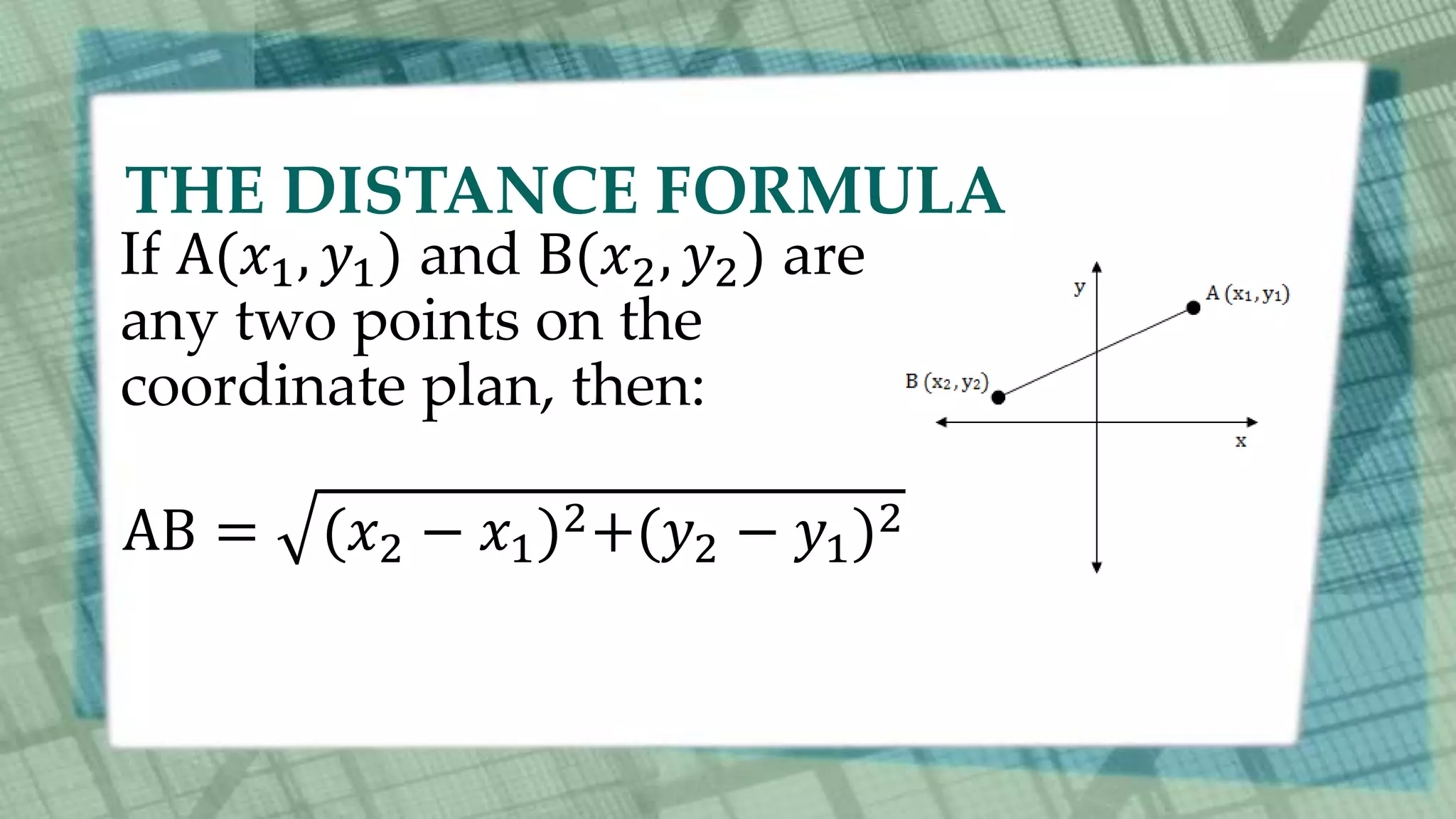
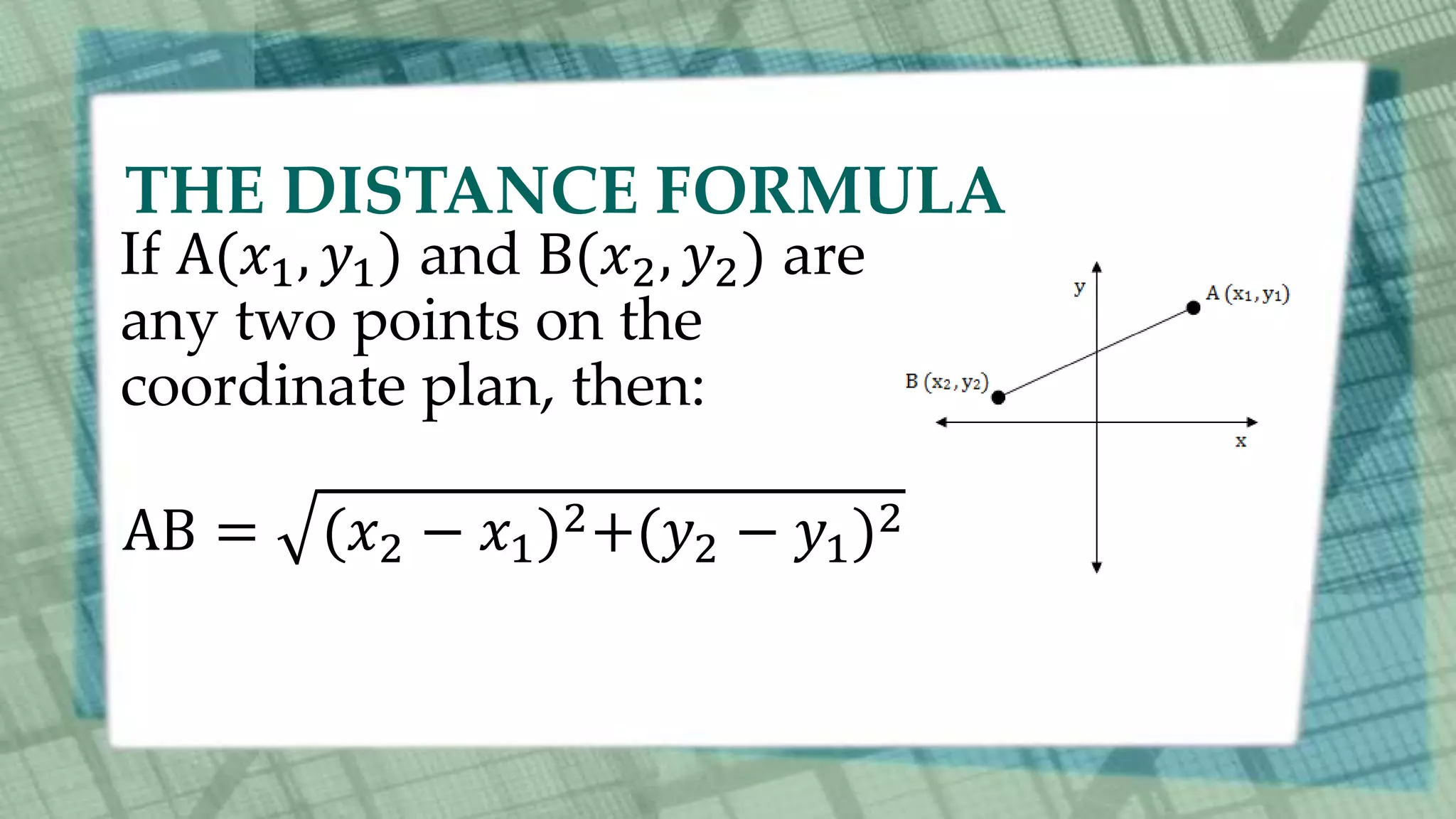
If A(𝑥1, 𝑦1) and B(𝑥2, 𝑦2) are
any two points on the
coordinate plan, then:
AB = (𝑥2 − 𝑥1)2+(𝑦2 − 𝑦1)2
THE DISTANCE FORMULA
Let: 𝒙𝟏 = 𝟎, 𝒙𝟐 = 𝟔, 𝒚𝟏 = 𝟎, 𝒚𝟐 = 𝟖
AB = (𝑥2 − 𝑥1)2+(𝑦2 − 𝑦1)2
= (6 − 0)2+(8 − 0)2
= 36 + 64
= 100
𝑨𝑩 = 𝟏𝟎
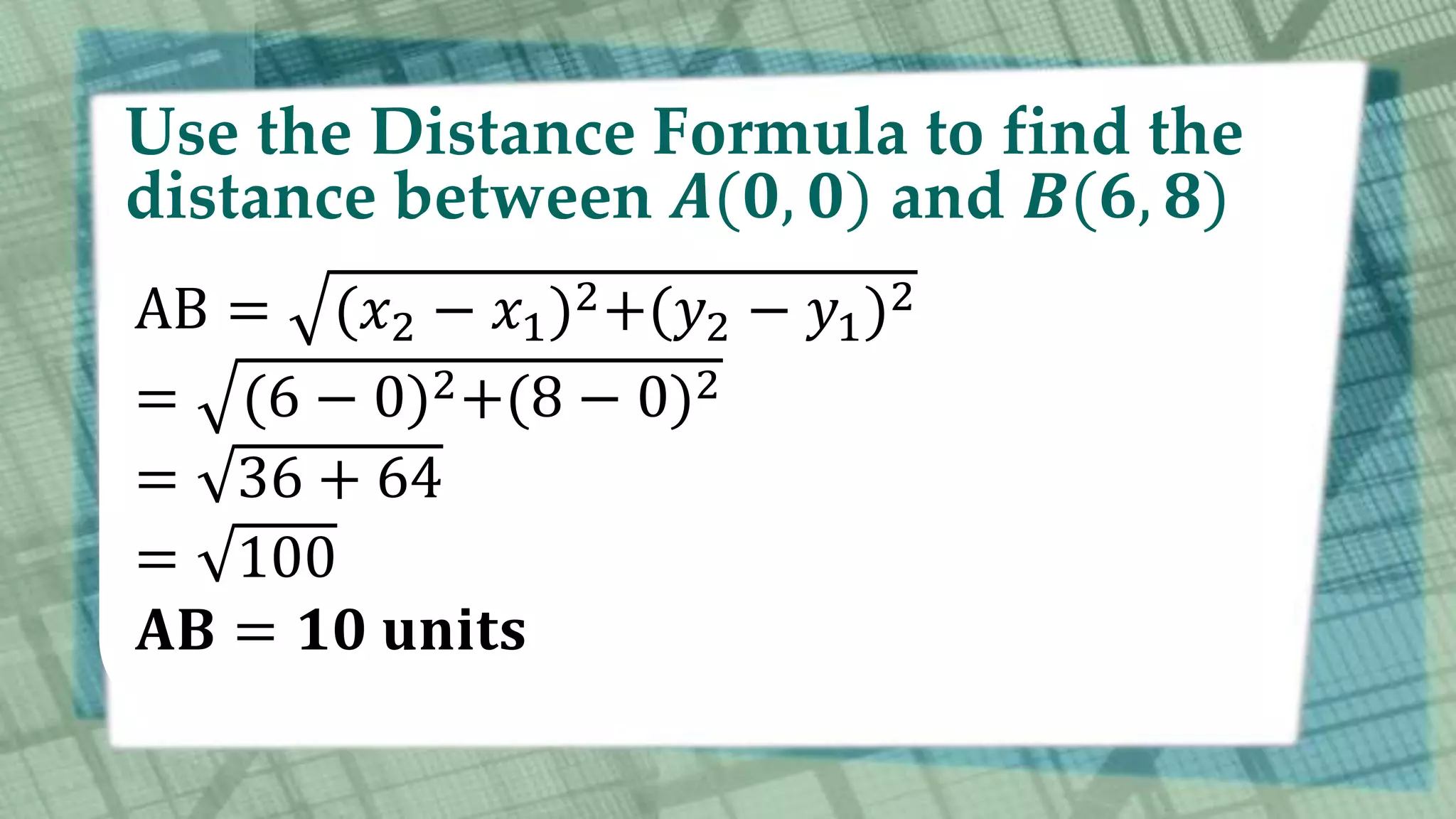
Use the Distance Formula to find the
distance between 𝑨(𝟎, 𝟎) and 𝑩(𝟔, 𝟖)
AB = (𝑥2 − 𝑥1)2+(𝑦2 − 𝑦1)2
= (6 − 0)2+(8 − 0)2
= 36 + 64
= 100
𝐀𝐁 = 𝟏𝟎 𝐮𝐧𝐢𝐭𝐬
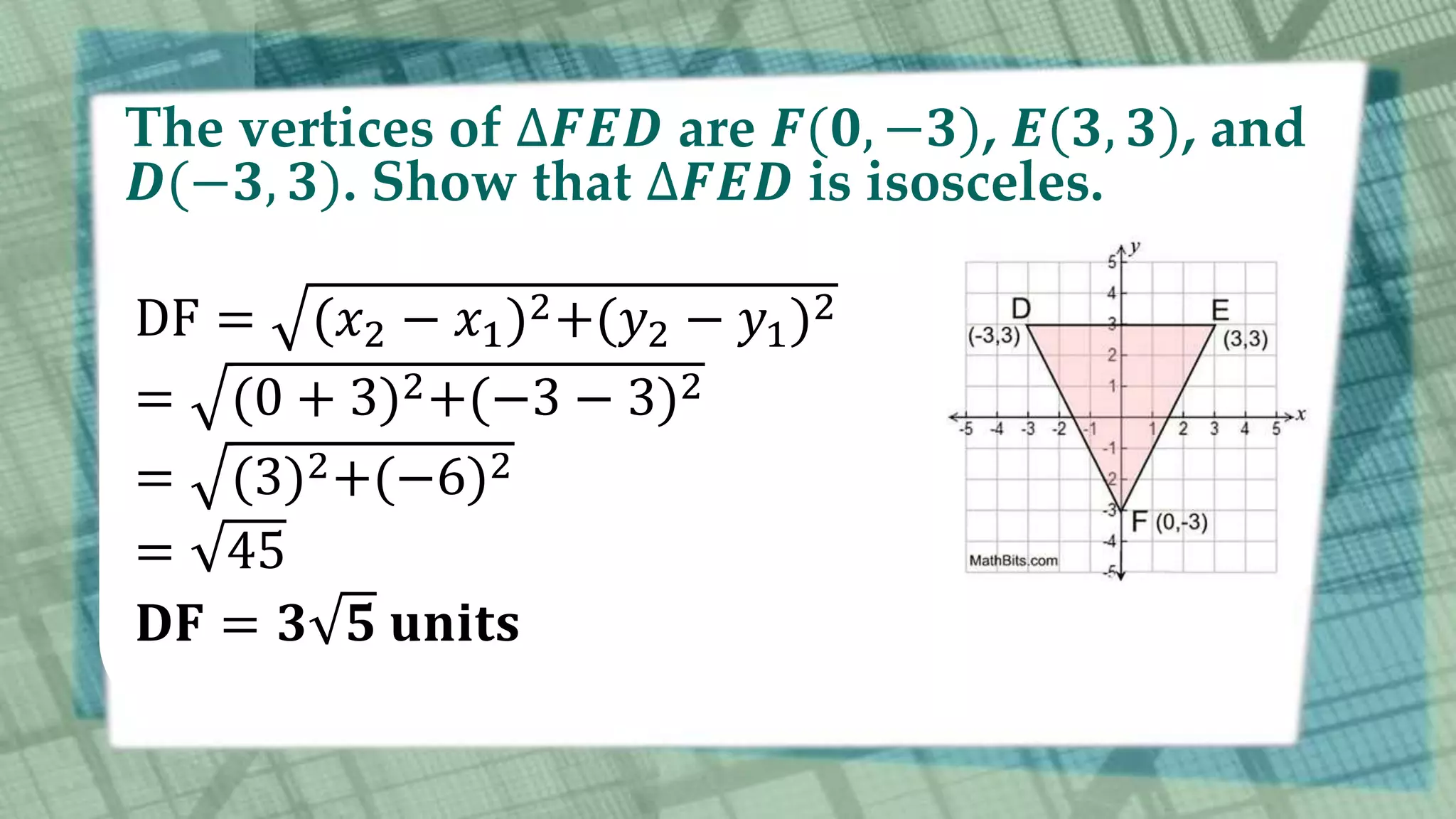
The vertices of ∆𝑭𝑬𝑫 are 𝑭(𝟎, −𝟑), 𝑬(𝟑, 𝟑), and
𝑫(−𝟑, 𝟑). Show that ∆𝑭𝑬𝑫 is isosceles.
EF = (𝑥2 − 𝑥1)2+(𝑦2 − 𝑦1)2
= (0 − 3)2+(−3 − 3)2
= 9 + 81
= 90
𝑬𝑭 = 𝟑 𝟏𝟎
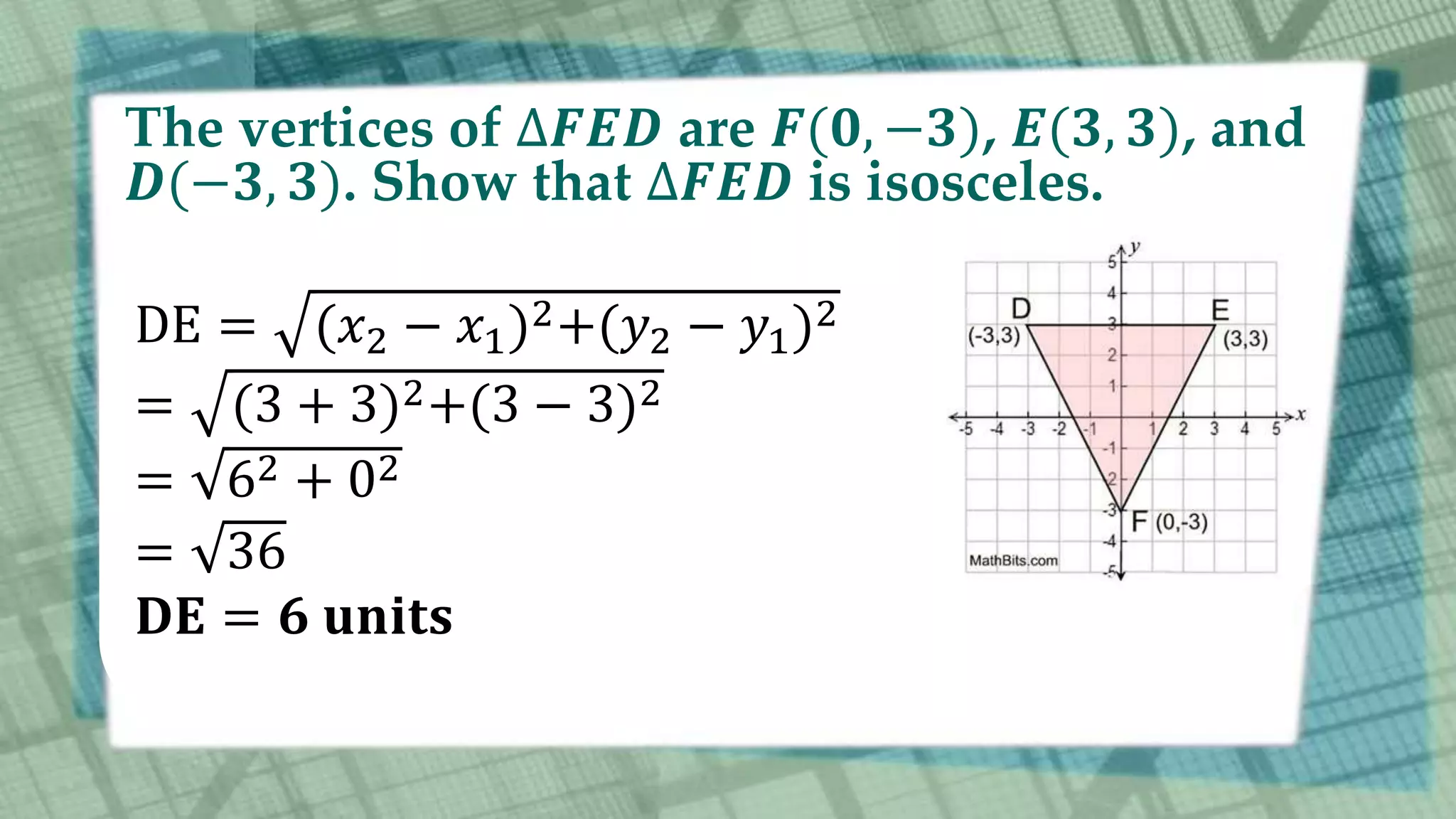
The vertices of ∆𝑭𝑬𝑫 are 𝑭(𝟎, −𝟑), 𝑬(𝟑, 𝟑), and
𝑫(−𝟑, 𝟑). Show that ∆𝑭𝑬𝑫 is isosceles.
DE = (𝑥2 − 𝑥1)2+(𝑦2 − 𝑦1)2
= (3 + 3)2+(3 − 3)2
= 62 + 02
= 36
𝐃𝐄 = 𝟔 𝐮𝐧𝐢𝐭𝐬
EF = (𝑥2 − 𝑥1)2+(𝑦2 − 𝑦1)2
= (0 − 3)2+(−3 − 3)2
= 9 + 81
= 90
𝑬𝑭 = 𝟑 𝟏𝟎
The vertices of ∆𝑭𝑬𝑫 are 𝑭(𝟎, −𝟑), 𝑬(𝟑, 𝟑), and
𝑫(−𝟑, 𝟑). Show that ∆𝑭𝑬𝑫 is isosceles.
EF = (𝑥2 − 𝑥1)2+(𝑦2 − 𝑦1)2
= (0 − 3)2+(−3 − 3)2
= (−3)2+(−6)2
= 45
𝐄𝐅 = 𝟑 𝟓 𝐮𝐧𝐢𝐭𝐬
EF = (𝑥2 − 𝑥1)2+(𝑦2 − 𝑦1)2
= (0 − 3)2+(−3 − 3)2
= 9 + 81
= 90
𝑬𝑭 = 𝟑 𝟏𝟎
The vertices of ∆𝑭𝑬𝑫 are 𝑭(𝟎, −𝟑), 𝑬(𝟑, 𝟑), and
𝑫(−𝟑, 𝟑). Show that ∆𝑭𝑬𝑫 is isosceles.
DF = (𝑥2 − 𝑥1)2+(𝑦2 − 𝑦1)2
= (0 + 3)2+(−3 − 3)2
= (3)2+(−6)2
= 45
𝐃𝐅 = 𝟑 𝟓 𝐮𝐧𝐢𝐭𝐬
Since
𝑬𝑭 = 𝑭𝑫 = 𝟑 𝟓
units, ∆𝑭𝑬𝑫 is an
isosceles triangle.
6
3 𝟓 3 𝟓
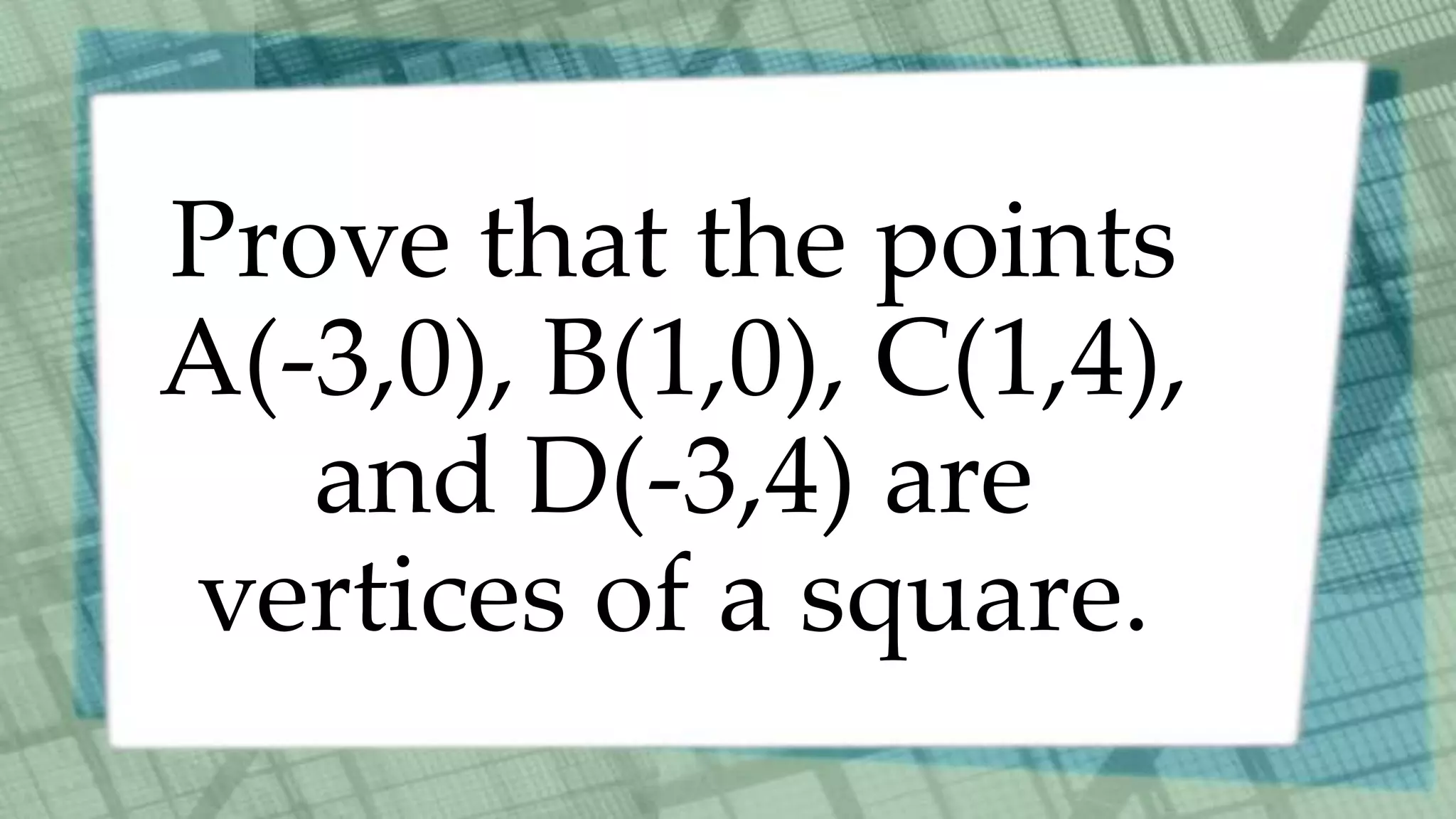
Prove that the points
A(-3,0), B(1,0), C(1,4),
and D(-3,4) are
vertices of a square.
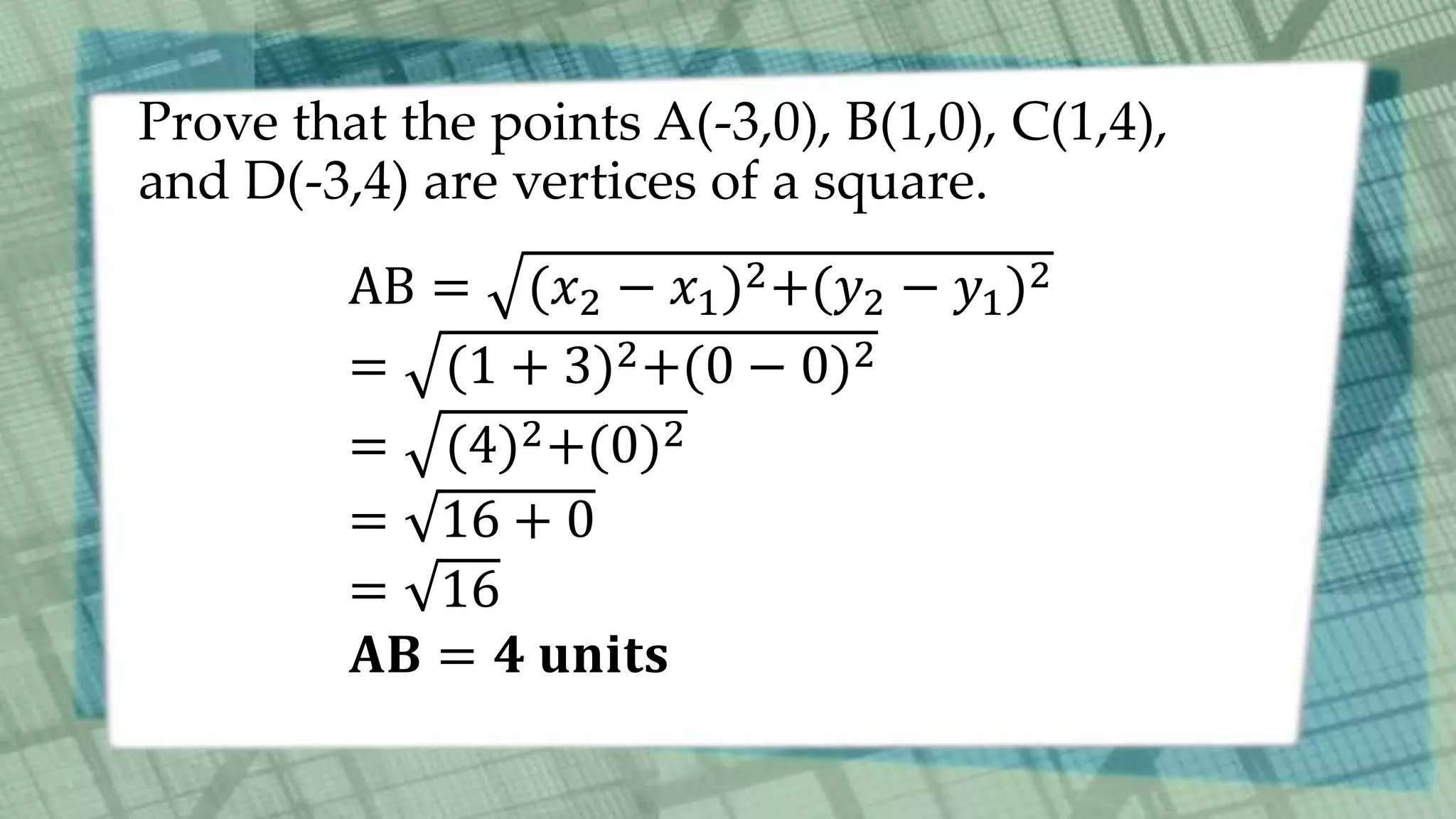
Prove that the points A(-3,0), B(1,0), C(1,4),
and D(-3,4) are vertices of a square.
AB = (𝑥2 − 𝑥1)2+(𝑦2 − 𝑦1)2
= (1 + 3)2+(0 − 0)2
= (4)2+(0)2
= 16 + 0
= 16
𝐀𝐁 = 𝟒 𝐮𝐧𝐢𝐭𝐬
Prove that the points A(-3,0), B(1,0), C(1,4),
and D(-3,4) are vertices of a square.
BC = (𝑥2 − 𝑥1)2+(𝑦2 − 𝑦1)2
= (1 − 1)2+(4 − 0)2
= (0)2+(4)2
= 0 + 16
= 16
𝐁𝐂 = 𝟒 𝐮𝐧𝐢𝐭𝐬
Prove that the points A(-3,0), B(1,0), C(1,4),
and D(-3,4) are vertices of a square.
CD = (𝑥2 − 𝑥1)2+(𝑦2 − 𝑦1)2
= (−3 − 1)2+(4 − 4)2
= (−4)2+(0)2
= 16 + 0
= 16
𝐂𝐃 = 𝟒 𝐮𝐧𝐢𝐭𝐬
Prove that the points A(-3,0), B(1,0), C(1,4),
and D(-3,4) are vertices of a square.
AD = (𝑥2 − 𝑥1)2+(𝑦2 − 𝑦1)2
= (−3 + 3)2+(4 − 0)2
= (0)2+(4)2
= 0 + 16
= 16
𝐀𝐃 = 𝟒 𝐮𝐧𝐢𝐭𝐬
Prove that the points A(-3,0), B(1,0), C(1,4),
and D(-3,4) are vertices of a square.
Since
𝑨𝑩 = 𝑩𝑪 = 𝑪𝑫 = 𝑨𝑫 = 𝟒 units,
the given points are vertices of
a square.
If A(𝑥1, 𝑦1) and B(𝑥2, 𝑦2) are
any two points on the
coordinate plan, then:
AB = (𝑥2 − 𝑥1)2+(𝑦2 − 𝑦1)2
THE DISTANCE FORMULA
ASSIGNMENT
In a graphing paper, answer
numbers 11, 21, 26, and 32 on
pages 353-354. Be able to show
your complete process.

Distance Formula - PPT Presentation.pptx

  • 3.
    COORDINATE GEOMETRY  Distance andMidpoint Formula  Placing Figures in the Coordinate Plane  Coordinates in Proof  Equation of a Circle
  • 4.
    COORDINATE/ANALYTIC GEOMETRY -is the studyof geometric figures using algebra.
  • 5.
  • 12.
    DISTANCE FORMULA  Derive thedistance formula  Apply the distance formula to prove some geometric properties
  • 13.
    Plot the points(5,2) and (5,7) on the graph. 𝒚𝟐 − 𝒚𝟏 (𝒙𝟏, 𝒚𝟏) (𝒙𝟐, 𝒚𝟐)
  • 14.
    Plot the points(-1,2) and (5,2) on the graph. 𝒙𝟐 − 𝒙𝟏
  • 15.
    Connect the points(5,7) and (-1,2) on the graph. 𝒙𝟐 − 𝒙𝟏 𝒚𝟐 − 𝒚𝟏 𝒉𝒚𝒑𝒐𝒕𝒆𝒏𝒖𝒔𝒆
  • 16.
    𝑙𝑒𝑔 𝑜𝑛𝑒(𝑎) =𝑥2 − 𝑥1 𝑙𝑒𝑔 𝑡𝑤𝑜 𝑏 = 𝑦2 − 𝑦1 ℎ𝑦𝑝𝑜𝑡𝑒𝑛𝑢𝑠𝑒 𝑐 = 𝑎2 + 𝑏2 ℎ𝑦𝑝𝑜𝑡𝑒𝑛𝑢𝑠𝑒(𝑐) = 𝑑 = (𝑥2 − 𝑥1)2 + (𝑦2 − 𝑦1)2 ===== Distance Formula
  • 17.
    If A(𝑥1, 𝑦1)and B(𝑥2, 𝑦2) are any two points on the coordinate plan, then: AB = (𝑥2 − 𝑥1)2+(𝑦2 − 𝑦1)2 THE DISTANCE FORMULA
  • 18.
    Let: 𝒙𝟏 =𝟎, 𝒙𝟐 = 𝟔, 𝒚𝟏 = 𝟎, 𝒚𝟐 = 𝟖 AB = (𝑥2 − 𝑥1)2+(𝑦2 − 𝑦1)2 = (6 − 0)2+(8 − 0)2 = 36 + 64 = 100 𝑨𝑩 = 𝟏𝟎 Use the Distance Formula to find the distance between 𝑨(𝟎, 𝟎) and 𝑩(𝟔, 𝟖) AB = (𝑥2 − 𝑥1)2+(𝑦2 − 𝑦1)2 = (6 − 0)2+(8 − 0)2 = 36 + 64 = 100 𝐀𝐁 = 𝟏𝟎 𝐮𝐧𝐢𝐭𝐬
  • 19.
    The vertices of∆𝑭𝑬𝑫 are 𝑭(𝟎, −𝟑), 𝑬(𝟑, 𝟑), and 𝑫(−𝟑, 𝟑). Show that ∆𝑭𝑬𝑫 is isosceles.
  • 20.
    EF = (𝑥2− 𝑥1)2+(𝑦2 − 𝑦1)2 = (0 − 3)2+(−3 − 3)2 = 9 + 81 = 90 𝑬𝑭 = 𝟑 𝟏𝟎 The vertices of ∆𝑭𝑬𝑫 are 𝑭(𝟎, −𝟑), 𝑬(𝟑, 𝟑), and 𝑫(−𝟑, 𝟑). Show that ∆𝑭𝑬𝑫 is isosceles. DE = (𝑥2 − 𝑥1)2+(𝑦2 − 𝑦1)2 = (3 + 3)2+(3 − 3)2 = 62 + 02 = 36 𝐃𝐄 = 𝟔 𝐮𝐧𝐢𝐭𝐬
  • 21.
    EF = (𝑥2− 𝑥1)2+(𝑦2 − 𝑦1)2 = (0 − 3)2+(−3 − 3)2 = 9 + 81 = 90 𝑬𝑭 = 𝟑 𝟏𝟎 The vertices of ∆𝑭𝑬𝑫 are 𝑭(𝟎, −𝟑), 𝑬(𝟑, 𝟑), and 𝑫(−𝟑, 𝟑). Show that ∆𝑭𝑬𝑫 is isosceles. EF = (𝑥2 − 𝑥1)2+(𝑦2 − 𝑦1)2 = (0 − 3)2+(−3 − 3)2 = (−3)2+(−6)2 = 45 𝐄𝐅 = 𝟑 𝟓 𝐮𝐧𝐢𝐭𝐬
  • 22.
    EF = (𝑥2− 𝑥1)2+(𝑦2 − 𝑦1)2 = (0 − 3)2+(−3 − 3)2 = 9 + 81 = 90 𝑬𝑭 = 𝟑 𝟏𝟎 The vertices of ∆𝑭𝑬𝑫 are 𝑭(𝟎, −𝟑), 𝑬(𝟑, 𝟑), and 𝑫(−𝟑, 𝟑). Show that ∆𝑭𝑬𝑫 is isosceles. DF = (𝑥2 − 𝑥1)2+(𝑦2 − 𝑦1)2 = (0 + 3)2+(−3 − 3)2 = (3)2+(−6)2 = 45 𝐃𝐅 = 𝟑 𝟓 𝐮𝐧𝐢𝐭𝐬
  • 23.
    Since 𝑬𝑭 = 𝑭𝑫= 𝟑 𝟓 units, ∆𝑭𝑬𝑫 is an isosceles triangle. 6 3 𝟓 3 𝟓
  • 24.
    Prove that thepoints A(-3,0), B(1,0), C(1,4), and D(-3,4) are vertices of a square.
  • 25.
    Prove that thepoints A(-3,0), B(1,0), C(1,4), and D(-3,4) are vertices of a square. AB = (𝑥2 − 𝑥1)2+(𝑦2 − 𝑦1)2 = (1 + 3)2+(0 − 0)2 = (4)2+(0)2 = 16 + 0 = 16 𝐀𝐁 = 𝟒 𝐮𝐧𝐢𝐭𝐬
  • 26.
    Prove that thepoints A(-3,0), B(1,0), C(1,4), and D(-3,4) are vertices of a square. BC = (𝑥2 − 𝑥1)2+(𝑦2 − 𝑦1)2 = (1 − 1)2+(4 − 0)2 = (0)2+(4)2 = 0 + 16 = 16 𝐁𝐂 = 𝟒 𝐮𝐧𝐢𝐭𝐬
  • 27.
    Prove that thepoints A(-3,0), B(1,0), C(1,4), and D(-3,4) are vertices of a square. CD = (𝑥2 − 𝑥1)2+(𝑦2 − 𝑦1)2 = (−3 − 1)2+(4 − 4)2 = (−4)2+(0)2 = 16 + 0 = 16 𝐂𝐃 = 𝟒 𝐮𝐧𝐢𝐭𝐬
  • 28.
    Prove that thepoints A(-3,0), B(1,0), C(1,4), and D(-3,4) are vertices of a square. AD = (𝑥2 − 𝑥1)2+(𝑦2 − 𝑦1)2 = (−3 + 3)2+(4 − 0)2 = (0)2+(4)2 = 0 + 16 = 16 𝐀𝐃 = 𝟒 𝐮𝐧𝐢𝐭𝐬
  • 29.
    Prove that thepoints A(-3,0), B(1,0), C(1,4), and D(-3,4) are vertices of a square. Since 𝑨𝑩 = 𝑩𝑪 = 𝑪𝑫 = 𝑨𝑫 = 𝟒 units, the given points are vertices of a square.
  • 30.
    If A(𝑥1, 𝑦1)and B(𝑥2, 𝑦2) are any two points on the coordinate plan, then: AB = (𝑥2 − 𝑥1)2+(𝑦2 − 𝑦1)2 THE DISTANCE FORMULA
  • 33.
    ASSIGNMENT In a graphingpaper, answer numbers 11, 21, 26, and 32 on pages 353-354. Be able to show your complete process.

Editor's Notes

  • #14 What is the distance between these two points without counting the squares?
  • #15 What is the distance between these two points without counting the squares?
  • #16 Describe the triangle formed, and justify your reasoning.