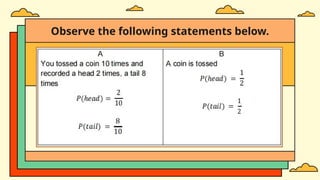
Observe the following statements below.
Grade 8- 4th Quarter Mathematics
EXPERIMENTAL AND
THEORITICA L
PROBABILITY AND
PROBLEM SOLVING
INVOVING PROBABILITY
EXPERIMENTAL VS. THEORITICAL PROBABILITY
EXPERIMENTAL
is found by repeating the experiment
and observing the outcomes.
THEORITICAL
is what is expected to happen based
on mathematics.
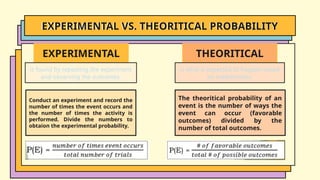
Conduct an experiment and record the
number of times the event occurs and
the number of times the activity is
performed. Divide the numbers to
obtaion the experimental probability.
The theoritical probability of an
event is the number of ways the
event can occur (favorable
outcomes) divided by the
number of total outcomes.
EXPERIMENTAL VS. THEORITICAL PROBABILITY
EXPERIMENTAL
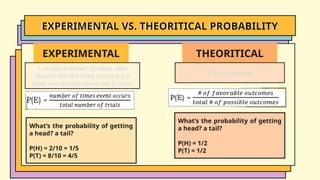
1. A coin is tossed 10 times. Let’s
assume that the head comes out 2
times and the tail comes out 8 times.
THEORITICAL
A coin is tossed.
What’s the probability of getting
a head? a tail?
P(H) = 2/10 = 1/5
P(T) = 8/10 = 4/5
What’s the probability of getting
a head? a tail?
P(H) = 1/2
P(T) = 1/2
EXPERIMENTAL VS. THEORITICAL PROBABILITY
EXPERIMENTAL
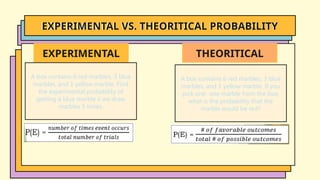
A box contains 6 red marbles, 3 blue
marbles, and 1 yellow marble. Find
the experimental probability of
getting a blue marble ii we draw
marbles 5 times.
THEORITICAL
A box contains 6 red marbles, 3 blue
marbles, and 1 yellow marble. If you
pick one one marble from the box,
what is the probability that the
marble would be red?
EXPERIMENTAL VS. THEORITICAL PROBABILITY
EXPERIMENTAL
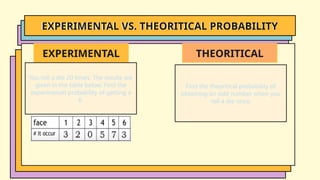
You roll a die 20 times. The results are
given in the table below. Find the
experimenatl probability of getting a
6.
THEORITICAL
Find the theoritical probability of
obtaining an odd number when you
roll a die once.
EXAMPLE
Probability Type: Experimental 0001
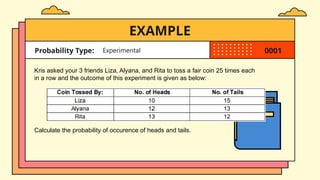
Kris asked your 3 friends Liza, Alyana, and Rita to toss a fair coin 25 times each
in a row and the outcome of this experiment is given as below:
Calculate the probability of occurence of heads and tails.
EXAMPLE (Answer)
Probability Type: Experimental 0001
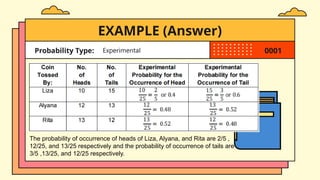
The probability of occurrence of heads of Liza, Alyana, and Rita are 2/5 ,
12/25, and 13/25 respectively and the probability of occurrence of tails are
3/5 ,13/25, and 12/25 respectively.
EXAMPLE
Probability Type: Theoritical 0001
You randomly choose one of the letters from the word DISCOVER.
What is the theoretical probability of choosing a vowel?
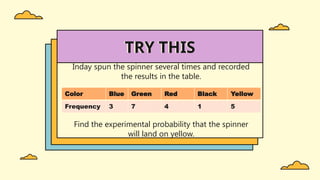
Inday spun the spinner several times and recorded
the results in the table.
Find the experimental probability that the spinner
will land on yellow.
TRY THIS
Color Blue Green Red Black Yellow
Frequency 3 7 4 1 5
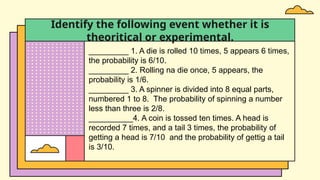
Identify the following event whether it is
theoritical or experimental.
_________ 1. A die is rolled 10 times, 5 appears 6 times,
the probability is 6/10.
_________ 2. Rolling na die once, 5 appears, the
probability is 1/6.
_________ 3. A spinner is divided into 8 equal parts,
numbered 1 to 8. The probability of spinning a number
less than three is 2/8.
__________4. A coin is tossed ten times. A head is
recorded 7 times, and a tail 3 times, the probability of
getting a head is 7/10 and the probability of gettig a tail
is 3/10.

Q4 MATH 8 EXPERIMENTAL PROBABILITY.pptx

  • 1.
    Observe the followingstatements below.
  • 2.
    Grade 8- 4thQuarter Mathematics EXPERIMENTAL AND THEORITICA L PROBABILITY AND PROBLEM SOLVING INVOVING PROBABILITY
  • 3.
    EXPERIMENTAL VS. THEORITICALPROBABILITY EXPERIMENTAL is found by repeating the experiment and observing the outcomes. THEORITICAL is what is expected to happen based on mathematics. Conduct an experiment and record the number of times the event occurs and the number of times the activity is performed. Divide the numbers to obtaion the experimental probability. The theoritical probability of an event is the number of ways the event can occur (favorable outcomes) divided by the number of total outcomes.
  • 4.
    EXPERIMENTAL VS. THEORITICALPROBABILITY EXPERIMENTAL 1. A coin is tossed 10 times. Let’s assume that the head comes out 2 times and the tail comes out 8 times. THEORITICAL A coin is tossed. What’s the probability of getting a head? a tail? P(H) = 2/10 = 1/5 P(T) = 8/10 = 4/5 What’s the probability of getting a head? a tail? P(H) = 1/2 P(T) = 1/2
  • 5.
    EXPERIMENTAL VS. THEORITICALPROBABILITY EXPERIMENTAL A box contains 6 red marbles, 3 blue marbles, and 1 yellow marble. Find the experimental probability of getting a blue marble ii we draw marbles 5 times. THEORITICAL A box contains 6 red marbles, 3 blue marbles, and 1 yellow marble. If you pick one one marble from the box, what is the probability that the marble would be red?
  • 6.
    EXPERIMENTAL VS. THEORITICALPROBABILITY EXPERIMENTAL You roll a die 20 times. The results are given in the table below. Find the experimenatl probability of getting a 6. THEORITICAL Find the theoritical probability of obtaining an odd number when you roll a die once.
  • 7.
    EXAMPLE Probability Type: Experimental0001 Kris asked your 3 friends Liza, Alyana, and Rita to toss a fair coin 25 times each in a row and the outcome of this experiment is given as below: Calculate the probability of occurence of heads and tails.
  • 8.
    EXAMPLE (Answer) Probability Type:Experimental 0001 The probability of occurrence of heads of Liza, Alyana, and Rita are 2/5 , 12/25, and 13/25 respectively and the probability of occurrence of tails are 3/5 ,13/25, and 12/25 respectively.
  • 9.
    EXAMPLE Probability Type: Theoritical0001 You randomly choose one of the letters from the word DISCOVER. What is the theoretical probability of choosing a vowel?
  • 10.
    Inday spun thespinner several times and recorded the results in the table. Find the experimental probability that the spinner will land on yellow. TRY THIS Color Blue Green Red Black Yellow Frequency 3 7 4 1 5
  • 11.
    Identify the followingevent whether it is theoritical or experimental. _________ 1. A die is rolled 10 times, 5 appears 6 times, the probability is 6/10. _________ 2. Rolling na die once, 5 appears, the probability is 1/6. _________ 3. A spinner is divided into 8 equal parts, numbered 1 to 8. The probability of spinning a number less than three is 2/8. __________4. A coin is tossed ten times. A head is recorded 7 times, and a tail 3 times, the probability of getting a head is 7/10 and the probability of gettig a tail is 3/10.

Editor's Notes

  • #1 Guide Questions: 1. What do you think is the difference between the two? 2. Which of the two is an experimental probability? 3. Which of the two is a theoretical framework probability? 4. How can you tell which is experimental and which is theoretical probability?
  • #2 Probability is the mathematics of chance. It tells us the relative frequency with which we can expect an event to occur. The greater the probability the more likely the event will occur. It can be written as a fraction, decimal, percent, or ratio. There are different ways of finding probability depending on the kind of event.
  • #3 theoritical- what we expect to happen based on math. p(e) = number of ways the event can happen/total outcomes Experimental- what actual happens when we do test the experiment. P(E)= frequency of the event/ total number of trials
  • #4 theoritical- what we expect to happen based on math. p(e) = number of ways the event can happen/total outcomes Experimental- what actual happens when we do test the experiment. P(E)= frequency of the event/ total number of trials
  • #5 P(blue) = 4/5 P(red) = 6/10 or 3/5
  • #6 P(6) = 3/20