MODULE 3: ARITHMETIC MEANS AND NTH
TERM OF AN ARITHMETIC SEQUENCE
• Lesson 1: Find the nth term of an Arithmetic
Sequence
•Lesson 2: Computing Arithmetic Means
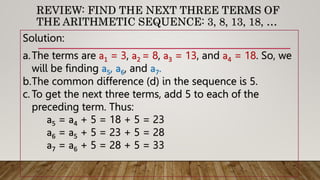
REVIEW: FIND THE NEXT THREE TERMS OF
THE ARITHMETIC SEQUENCE: 3, 8, 13, 18, …
Solution:
a.The terms are a1 = 3, a2 = 8, a3 = 13, and a4 = 18. So, we
will be finding a5, a6, and a7.
b.The common difference (d) in the sequence is 5.
c. To get the next three terms, add 5 to each of the
preceding term. Thus:
a5 = a4 + 5 = 18 + 5 = 23
a6 = a5 + 5 = 23 + 5 = 28
a7 = a6 + 5 = 28 + 5 = 33
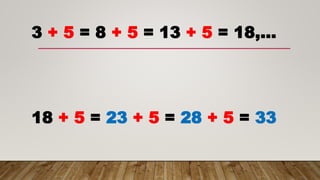
3 + 5 = 8 + 5 = 13 + 5 = 18,…
18 + 5 = 23 + 5 = 28 + 5 = 33
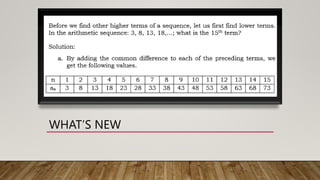
WHAT ABOUT IF THE PROBLEM IS TO FIND THE 100TH TERM OR THE
250TH TERM? CAN YOU FIND THE TERMS?
Using the process that is illustrated above will take
much of your time and effort. There is a short cut in
doing this and that is one of the focus of this
module.
WHAT’S NEW
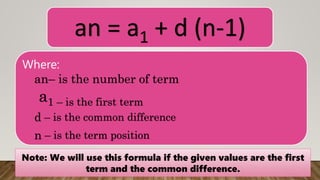
Where:
an– is the number of term
a1 – is the first term
d – is the common difference
n – is the term position
Note: We will use this formula if the given values are the first
term and the common difference.
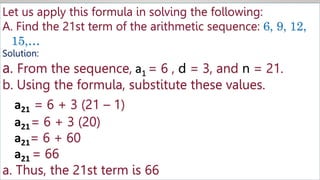
Let us apply this formula in solving the following:
A. Find the 21st term of the arithmetic sequence: 6, 9, 12,
15,…
Solution:
a. From the sequence, a1 = 6 , d = 3, and n = 21.
b. Using the formula, substitute these values.
a21 = 6 + 3 (21 – 1)
a21= 6 + 3 (20)
a21= 6 + 60
a21 = 66
a. Thus, the 21st term is 66
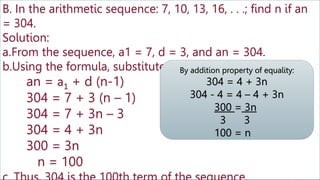
B. In the arithmetic sequence: 7, 10, 13, 16, . . .; find n if an
= 304.
Solution:
a.From the sequence, a1 = 7, d = 3, and an = 304.
b.Using the formula, substitute these values.
an = a1 + d (n-1)
304 = 7 + 3 (n – 1)
304 = 7 + 3n – 3
304 = 4 + 3n
300 = 3n
n = 100
By addition property of equality:
304 = 4 + 3n
304 - 4 = 4 – 4 + 3n
300 = 3n
3 3
100 = n
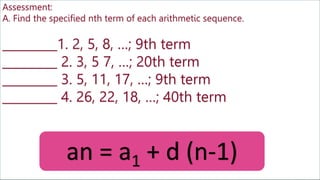
Assessment:
A. Find the specified nth term of each arithmetic sequence.
_________1. 2, 5, 8, …; 9th term
_________ 2. 3, 5 7, …; 20th term
_________ 3. 5, 11, 17, …; 9th term
_________ 4. 26, 22, 18, …; 40th term
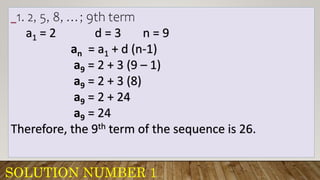
SOLUTION NUMBER 1
_1. 2, 5, 8, …; 9th term
a1 = 2 d = 3 n = 9
an = a1 + d (n-1)
a9 = 2 + 3 (9 – 1)
a9 = 2 + 3 (8)
a9 = 2 + 24
a9 = 24
Therefore, the 9th term of the sequence is 26.
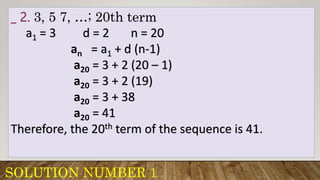
SOLUTION NUMBER 1
_ 2. 3, 5 7, …; 20th term
a1 = 3 d = 2 n = 20
an = a1 + d (n-1)
a20 = 3 + 2 (20 – 1)
a20 = 3 + 2 (19)
a20 = 3 + 38
a20 = 41
Therefore, the 20th term of the sequence is 41.
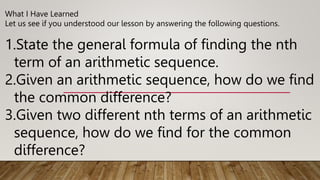
What I Have Learned
Let us see if you understood our lesson by answering the following questions.
1.State the general formula of finding the nth
term of an arithmetic sequence.
2.Given an arithmetic sequence, how do we find
the common difference?
3.Given two different nth terms of an arithmetic
sequence, how do we find for the common
difference?
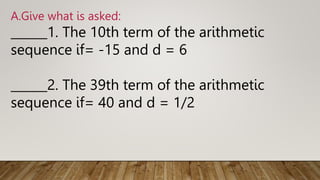
A.Give what is asked:
______1. The 10th term of the arithmetic
sequence if= -15 and d = 6
______2. The 39th term of the arithmetic
sequence if= 40 and d = 1/2

MODULE 3.pptx

  • 1.
    MODULE 3: ARITHMETICMEANS AND NTH TERM OF AN ARITHMETIC SEQUENCE • Lesson 1: Find the nth term of an Arithmetic Sequence •Lesson 2: Computing Arithmetic Means
  • 2.
    REVIEW: FIND THENEXT THREE TERMS OF THE ARITHMETIC SEQUENCE: 3, 8, 13, 18, … Solution: a.The terms are a1 = 3, a2 = 8, a3 = 13, and a4 = 18. So, we will be finding a5, a6, and a7. b.The common difference (d) in the sequence is 5. c. To get the next three terms, add 5 to each of the preceding term. Thus: a5 = a4 + 5 = 18 + 5 = 23 a6 = a5 + 5 = 23 + 5 = 28 a7 = a6 + 5 = 28 + 5 = 33
  • 3.
    3 + 5= 8 + 5 = 13 + 5 = 18,… 18 + 5 = 23 + 5 = 28 + 5 = 33
  • 4.
    WHAT ABOUT IFTHE PROBLEM IS TO FIND THE 100TH TERM OR THE 250TH TERM? CAN YOU FIND THE TERMS? Using the process that is illustrated above will take much of your time and effort. There is a short cut in doing this and that is one of the focus of this module.
  • 5.
  • 6.
    Where: an– is thenumber of term a1 – is the first term d – is the common difference n – is the term position Note: We will use this formula if the given values are the first term and the common difference.
  • 7.
    Let us applythis formula in solving the following: A. Find the 21st term of the arithmetic sequence: 6, 9, 12, 15,… Solution: a. From the sequence, a1 = 6 , d = 3, and n = 21. b. Using the formula, substitute these values. a21 = 6 + 3 (21 – 1) a21= 6 + 3 (20) a21= 6 + 60 a21 = 66 a. Thus, the 21st term is 66
  • 8.
    B. In thearithmetic sequence: 7, 10, 13, 16, . . .; find n if an = 304. Solution: a.From the sequence, a1 = 7, d = 3, and an = 304. b.Using the formula, substitute these values. an = a1 + d (n-1) 304 = 7 + 3 (n – 1) 304 = 7 + 3n – 3 304 = 4 + 3n 300 = 3n n = 100 By addition property of equality: 304 = 4 + 3n 304 - 4 = 4 – 4 + 3n 300 = 3n 3 3 100 = n
  • 9.
    Assessment: A. Find thespecified nth term of each arithmetic sequence. _________1. 2, 5, 8, …; 9th term _________ 2. 3, 5 7, …; 20th term _________ 3. 5, 11, 17, …; 9th term _________ 4. 26, 22, 18, …; 40th term
  • 10.
    SOLUTION NUMBER 1 _1.2, 5, 8, …; 9th term a1 = 2 d = 3 n = 9 an = a1 + d (n-1) a9 = 2 + 3 (9 – 1) a9 = 2 + 3 (8) a9 = 2 + 24 a9 = 24 Therefore, the 9th term of the sequence is 26.
  • 11.
    SOLUTION NUMBER 1 _2. 3, 5 7, …; 20th term a1 = 3 d = 2 n = 20 an = a1 + d (n-1) a20 = 3 + 2 (20 – 1) a20 = 3 + 2 (19) a20 = 3 + 38 a20 = 41 Therefore, the 20th term of the sequence is 41.
  • 12.
    What I HaveLearned Let us see if you understood our lesson by answering the following questions. 1.State the general formula of finding the nth term of an arithmetic sequence. 2.Given an arithmetic sequence, how do we find the common difference? 3.Given two different nth terms of an arithmetic sequence, how do we find for the common difference?
  • 13.
    A.Give what isasked: ______1. The 10th term of the arithmetic sequence if= -15 and d = 6 ______2. The 39th term of the arithmetic sequence if= 40 and d = 1/2