Illustrating an
Arithmetic
Sequence
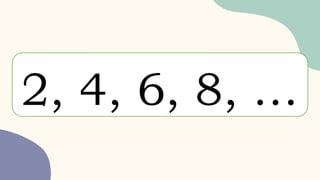
2, 4, 6, 8, …
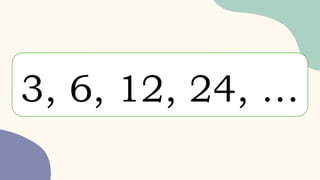
3, 6, 12, 24, …
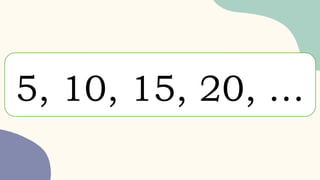
5, 10, 15, 20, …
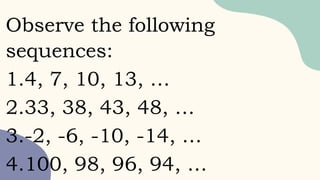
Observe the following
sequences:
1.4, 7, 10, 13, …
2.33, 38, 43, 48, …
3.-2, -6, -10, -14, …
4.100, 98, 96, 94, …
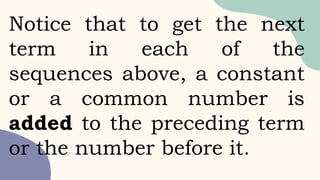
Notice that to get the next
term in each of the
sequences above, a constant
or a common number is
added to the preceding term
or the number before it.
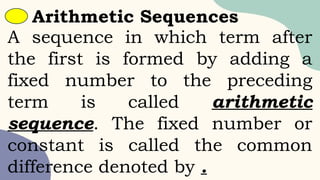
A sequence in which term after
the first is formed by adding a
fixed number to the preceding
term is called arithmetic
sequence. The fixed number or
constant is called the common
difference denoted by .
Arithmetic Sequences
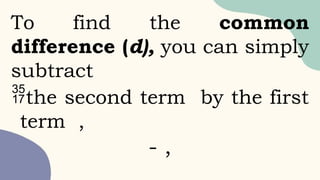
To find the common
difference (d), you can simply
subtract
the second term by the first
term ,
- ,
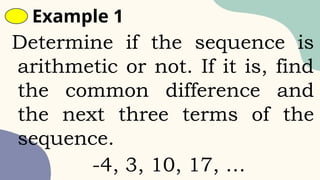
Example 1
Determine if the sequence is
arithmetic or not. If it is, find
the common difference and
the next three terms of the
sequence.
-4, 3, 10, 17, …
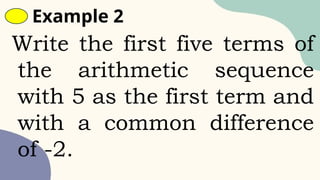
Example 2
Write the first five terms of
the arithmetic sequence
with 5 as the first term and
with a common difference
of -2.
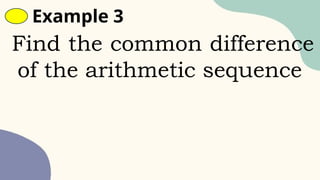
Example 3
Find the common difference
of the arithmetic sequence
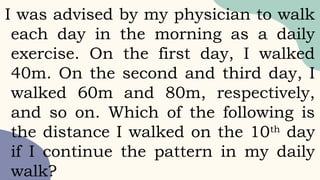
I was advised by my physician to walk
each day in the morning as a daily
exercise. On the first day, I walked
40m. On the second and third day, I
walked 60m and 80m, respectively,
and so on. Which of the following is
the distance I walked on the 10th
day
if I continue the pattern in my daily
walk?
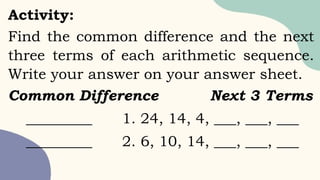
Activity:
Find the common difference and the next
three terms of each arithmetic sequence.
Write your answer on your answer sheet.
Common Difference Next 3 Terms
_________ 1. 24, 14, 4, ___, ___, ___
_________ 2. 6, 10, 14, ___, ___, ___
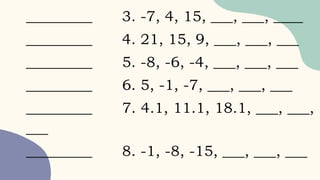
_________ 3. -7, 4, 15, ___, ___, ____
_________ 4. 21, 15, 9, ___, ___, ___
_________ 5. -8, -6, -4, ___, ___, ___
_________ 6. 5, -1, -7, ___, ___, ___
_________ 7. 4.1, 11.1, 18.1, ___, ___,
___
_________ 8. -1, -8, -15, ___, ___, ___
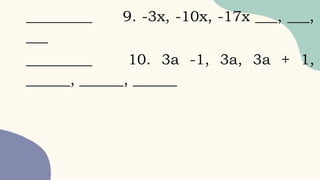
_________ 9. -3x, -10x, -17x ___, ___,
___
_________ 10. 3a -1, 3a, 3a + 1,
______, ______, ______
Arithmetic Means
and Term of an
Arithmetic
Sequence
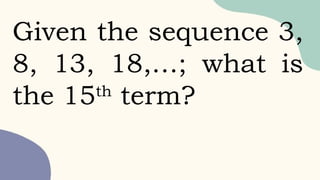
Given the sequence 3,
8, 13, 18,…; what is
the 15th
term?
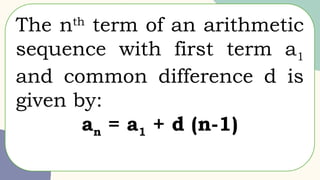
The nth
term of an arithmetic
sequence with first term a1
and common difference d is
given by:
an = a1 + d (n-1)
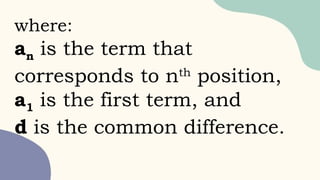
where:
an is the term that
corresponds to nth
position,
a1 is the first term, and
d is the common difference.
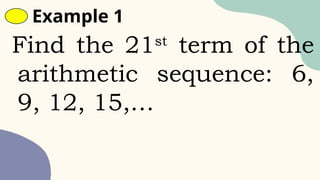
Example 1
Find the 21st
term of the
arithmetic sequence: 6,
9, 12, 15,…
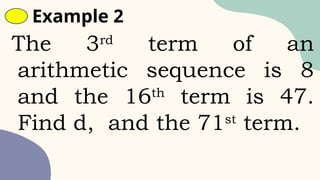
Example 2
The 3rd
term of an
arithmetic sequence is 8
and the 16th
term is 47.
Find d, and the 71st
term.
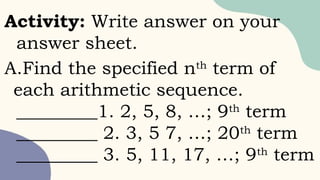
Activity: Write answer on your
answer sheet.
A.Find the specified nth
term of
each arithmetic sequence.
_________1. 2, 5, 8, …; 9th
term
_________ 2. 3, 5 7, …; 20th
term
_________ 3. 5, 11, 17, …; 9th
term
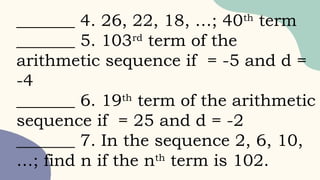
_______ 4. 26, 22, 18, …; 40th
term
_______ 5. 103rd
term of the
arithmetic sequence if = -5 and d =
-4
_______ 6. 19th
term of the arithmetic
sequence if = 25 and d = -2
_______ 7. In the sequence 2, 6, 10,
…; find n if the nth
term is 102.
Computing
Arithmetic
Means
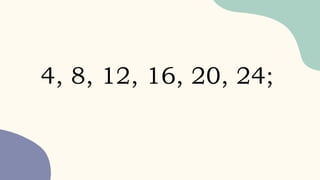
4, 8, 12, 16, 20, 24;
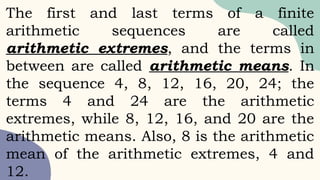
The first and last terms of a finite
arithmetic sequences are called
arithmetic extremes, and the terms in
between are called arithmetic means. In
the sequence 4, 8, 12, 16, 20, 24; the
terms 4 and 24 are the arithmetic
extremes, while 8, 12, 16, and 20 are the
arithmetic means. Also, 8 is the arithmetic
mean of the arithmetic extremes, 4 and
12.
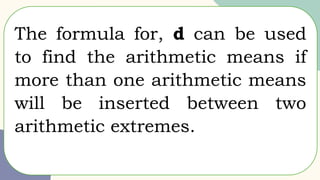
The formula for, d can be used
to find the arithmetic means if
more than one arithmetic means
will be inserted between two
arithmetic extremes.
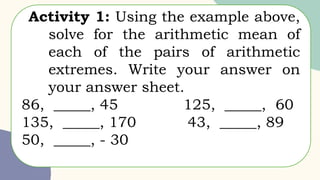
Activity 1: Using the example above,
solve for the arithmetic mean of
each of the pairs of arithmetic
extremes. Write your answer on
your answer sheet.
86, _____, 45 125, _____, 60
135, _____, 170 43, _____, 89
50, _____, - 30
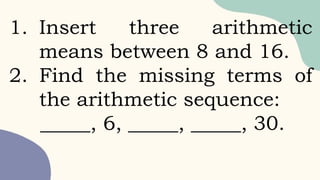
1. Insert three arithmetic
means between 8 and 16.
2. Find the missing terms of
the arithmetic sequence:
_____, 6, _____, _____, 30.
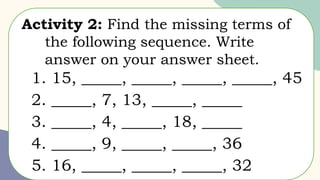
Activity 2: Find the missing terms of
the following sequence. Write
answer on your answer sheet.
1. 15, _____, _____, _____, _____, 45
2. _____, 7, 13, _____, _____
3. _____, 4, _____, 18, _____
4. _____, 9, _____, _____, 36
5. 16, _____, _____, _____, 32
grade 10 mathematics arithmetic sequence.pptx

grade 10 mathematics arithmetic sequence.pptx

  • 1.
  • 2.
    2, 4, 6,8, …
  • 3.
    3, 6, 12,24, …
  • 4.
    5, 10, 15,20, …
  • 5.
    Observe the following sequences: 1.4,7, 10, 13, … 2.33, 38, 43, 48, … 3.-2, -6, -10, -14, … 4.100, 98, 96, 94, …
  • 6.
    Notice that toget the next term in each of the sequences above, a constant or a common number is added to the preceding term or the number before it.
  • 7.
    A sequence inwhich term after the first is formed by adding a fixed number to the preceding term is called arithmetic sequence. The fixed number or constant is called the common difference denoted by . Arithmetic Sequences
  • 8.
    To find thecommon difference (d), you can simply subtract the second term by the first term , - ,
  • 9.
    Example 1 Determine ifthe sequence is arithmetic or not. If it is, find the common difference and the next three terms of the sequence. -4, 3, 10, 17, …
  • 10.
    Example 2 Write thefirst five terms of the arithmetic sequence with 5 as the first term and with a common difference of -2.
  • 11.
    Example 3 Find thecommon difference of the arithmetic sequence
  • 12.
    I was advisedby my physician to walk each day in the morning as a daily exercise. On the first day, I walked 40m. On the second and third day, I walked 60m and 80m, respectively, and so on. Which of the following is the distance I walked on the 10th day if I continue the pattern in my daily walk?
  • 13.
    Activity: Find the commondifference and the next three terms of each arithmetic sequence. Write your answer on your answer sheet. Common Difference Next 3 Terms _________ 1. 24, 14, 4, ___, ___, ___ _________ 2. 6, 10, 14, ___, ___, ___
  • 14.
    _________ 3. -7,4, 15, ___, ___, ____ _________ 4. 21, 15, 9, ___, ___, ___ _________ 5. -8, -6, -4, ___, ___, ___ _________ 6. 5, -1, -7, ___, ___, ___ _________ 7. 4.1, 11.1, 18.1, ___, ___, ___ _________ 8. -1, -8, -15, ___, ___, ___
  • 15.
    _________ 9. -3x,-10x, -17x ___, ___, ___ _________ 10. 3a -1, 3a, 3a + 1, ______, ______, ______
  • 16.
    Arithmetic Means and Termof an Arithmetic Sequence
  • 17.
    Given the sequence3, 8, 13, 18,…; what is the 15th term?
  • 18.
    The nth term ofan arithmetic sequence with first term a1 and common difference d is given by: an = a1 + d (n-1)
  • 19.
    where: an is theterm that corresponds to nth position, a1 is the first term, and d is the common difference.
  • 20.
    Example 1 Find the21st term of the arithmetic sequence: 6, 9, 12, 15,…
  • 21.
    Example 2 The 3rd termof an arithmetic sequence is 8 and the 16th term is 47. Find d, and the 71st term.
  • 22.
    Activity: Write answeron your answer sheet. A.Find the specified nth term of each arithmetic sequence. _________1. 2, 5, 8, …; 9th term _________ 2. 3, 5 7, …; 20th term _________ 3. 5, 11, 17, …; 9th term
  • 23.
    _______ 4. 26,22, 18, …; 40th term _______ 5. 103rd term of the arithmetic sequence if = -5 and d = -4 _______ 6. 19th term of the arithmetic sequence if = 25 and d = -2 _______ 7. In the sequence 2, 6, 10, …; find n if the nth term is 102.
  • 24.
  • 25.
    4, 8, 12,16, 20, 24;
  • 26.
    The first andlast terms of a finite arithmetic sequences are called arithmetic extremes, and the terms in between are called arithmetic means. In the sequence 4, 8, 12, 16, 20, 24; the terms 4 and 24 are the arithmetic extremes, while 8, 12, 16, and 20 are the arithmetic means. Also, 8 is the arithmetic mean of the arithmetic extremes, 4 and 12.
  • 27.
    The formula for,d can be used to find the arithmetic means if more than one arithmetic means will be inserted between two arithmetic extremes.
  • 28.
    Activity 1: Usingthe example above, solve for the arithmetic mean of each of the pairs of arithmetic extremes. Write your answer on your answer sheet. 86, _____, 45 125, _____, 60 135, _____, 170 43, _____, 89 50, _____, - 30
  • 29.
    1. Insert threearithmetic means between 8 and 16. 2. Find the missing terms of the arithmetic sequence: _____, 6, _____, _____, 30.
  • 30.
    Activity 2: Findthe missing terms of the following sequence. Write answer on your answer sheet. 1. 15, _____, _____, _____, _____, 45 2. _____, 7, 13, _____, _____ 3. _____, 4, _____, 18, _____ 4. _____, 9, _____, _____, 36 5. 16, _____, _____, _____, 32