Contd….
• Remember, research is only valuable and useful
when it is valid, accurate and reliable. Relying
on imperfect research is dangerous; incorrect
results can lead to customer churn and a
decrease in sales.
Analyze and Understand Your
Research
• The analysis of the data can vary from simple
and direct steps to technical and complex
processes.
• Adopt an approach, and choose the method
of data analysis based on the research
methods you have carried out.
Keep the Findings Ready
• Choose a spreadsheet that allows you to easily
enter your data.
• If you do not have a large amount of data, you
should be able to manage them with the use of
basic tools available in the software.
• If you have collected more complete and
complex data, you may have to consider using
specific programs or tools that will help you
manage your data.
Review and Interpret the Information
to Draw Conclusions
• Once you have gathered all the data, you can
scan your information and interpret it to draw
conclusions and make informed decisions. You
should review the data and then:
• Identify the main trends and issues,
opportunities and problems you observe, and
write a sentence about each one
• Keep track of the frequency with which each of
the main findings appears.
Contd…
• Make a list of your findings from the most
common to the least common
• Evaluate and perform separately a list of the
strengths, weaknesses, opportunities, and
threats that have been identified in a SWOT
analysis.
• Preparation of conclusions and
recommendations about your research.
RESEARCH METHODOLOGY.
MA English: Semester III
CODE: ENGL 4145
Session: 23-25
Area/s to be discussed.
• Comparative analysis: Difference between
Qualitative and Quantitative Research.
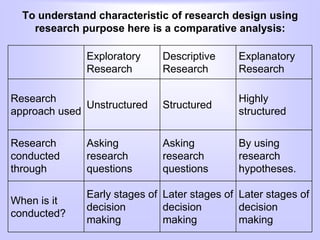
To understand characteristic of research design using
research purpose here is a comparative analysis:
Exploratory
Research
Descriptive
Research
Explanatory
Research
Research
approach used
Unstructured Structured
Highly
structured
Research
conducted
through
Asking
research
questions
Asking
research
questions
By using
research
hypotheses.
When is it
conducted?
Early stages of
decision
making
Later stages of
decision
making
Later stages of
decision
making
Difference between Qualitative and
Quantitative Research
• Research is the most widely used tool to
increase and brush-up the stock of knowledge
about something and someone.
• In the field of marketing, business, sociology,
psychology, science & technology, economics,
etc. there are two standard ways of conducting
research, i.e. qualitative research or quantitative
research.
Contd…
• While the qualitative research relies on verbal
narrative like spoken or written data,
the quantitative research uses logical or
statistical observations to draw conclusions.
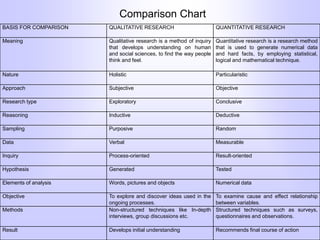
Comparison Chart
BASIS FOR COMPARISON QUALITATIVE RESEARCH QUANTITATIVE RESEARCH
Meaning Qualitative research is a method of inquiry
that develops understanding on human
and social sciences, to find the way people
think and feel.
Quantitative research is a research method
that is used to generate numerical data
and hard facts, by employing statistical,
logical and mathematical technique.
Nature Holistic Particularistic
Approach Subjective Objective
Research type Exploratory Conclusive
Reasoning Inductive Deductive
Sampling Purposive Random
Data Verbal Measurable
Inquiry Process-oriented Result-oriented
Hypothesis Generated Tested
Elements of analysis Words, pictures and objects Numerical data
Objective To explore and discover ideas used in the
ongoing processes.
To examine cause and effect relationship

between variables.
Methods Non-structured techniques like In-depth
interviews, group discussions etc.
Structured techniques such as surveys,
questionnaires and observations.
Result Develops initial understanding Recommends final course of action
Key Differences between Qualitative And
Quantitative Research
• The differences between qualitative and
quantitative research are provided can be drawn
clearly on the next grounds:
Contd…
• Qualitative research is a method of inquiry that
develops understanding on human and social
sciences, to find the way people think and feel.
• A scientific and empirical research method that
is used to generate numerical data, by
employing statistical, logical and mathematical
technique is called quantitative research.
• Qualitative research is holistic in nature while
quantitative research is particularistic.
Contd
• The qualitative research follows a subjective
approach as the researcher is intimately
involved, whereas the approach of quantitative
research is objective, as the researcher is
uninvolved and attempts to precise the
observations and analysis on the topic to answer
the inquiry.
• Qualitative research is exploratory. As opposed
to quantitative research which is conclusive.
Contd…
• The reasoning used to synthesise data in
qualitative research is inductive whereas in the
case of quantitative research the reasoning is
deductive.
Contd…
• Qualitative research is based on purposive
sampling, where a small sample size is selected
with a view to get a thorough understanding of
the target concept.
• On the other hand, quantitative research relies
on random sampling; wherein a large
representative sample is chosen in order to
extrapolate the results to the whole population.
Contd…
• Verbal data are collected in qualitative research.
Conversely, in quantitative research measurable
data is gathered.
• Inquiry in qualitative research is a process-
oriented, which is not in the case of quantitative
research.
Contd…
• Elements used in the analysis of qualitative
research are words, pictures, and objects while
that of quantitative research is numerical data.
• Qualitative Research is conducted with the aim
of exploring and discovering ideas used in the
ongoing processes.
• As opposed to quantitative research the purpose
is to examine cause and effect relationship

between variables.
Contd…
• Lastly, the methods used in qualitative research
are in-depth interviews, focus groups, etc. In
contrast, the methods of conducting quantitative
research are structured interviews and
observations.
• Qualitative Research develops the initial
understanding whereas quantitative research
recommends a final course of action.
RESEARCH METHODOLOGY.
MA English: Semester III
CODE: ENGL 4145
Session: 26-28
Area/s to be discussed.
• Identifying the Research Problem.
Identifying the Research Problem
• The research problem is the heart of a study.
• It is a clear, definite statement of the area of
concern or investigation and is backed by
evidence (Bryman, 2007).
Contd…
• It drives the research questions and processes
and provides the framework for understanding
the research findings.
• To begin, you will need to know where to look for
your research problem and how to evaluate
when a research problem for success.
Where to Find a Research Problem?
• Ideas for research problems tend to come from
two sources: real life and the scholarly arena.
• First, identifying a research problem can be as
simple as observing the complications and
issues in your local workplace.
Contd…
• You may encounter ongoing issues on a daily
basis in your workplace or observe your
colleagues struggle with major issues or
questions in your field.
• These ongoing obstacles and issues in the
workplace can be the catalyst for developing a
research problem.
Contd…
• Alternatively, research problems can be
identified by reviewing recent literature, reports,
or databases in your field.
• Often the section of “recommendations for the
future studies” provided at the end of journal
articles or doctoral dissertations suggest
potential research problems.
Contd…
• In addition, major reports and databases in the
field may reveal findings or data-based facts that
call for additional investigation or suggest
potential issues to be addressed.
• Looking at what theories need to be tested is
another opportunity to develop a research
problem.
How to Evaluate a Research Problem?
• Once you find your potential research problem,
you will need to evaluate the problem and
ensure that it is appropriate for research.
• A research problem is deemed appropriate
when it is supported by the literature, and
considered significant, timely, novel, specific,
and researchable.
• Stronger research problems are more likely to
succeed in publication, presentation, and
application.
Supported by the Literature
• Your research problem should be relevant to the
field and supported by a number of recent peer-
reviewed studies in the field.
• Even if you identify the problem based on the
recommendation of one journal article or
dissertation, you will still need to conduct a
literature search and ensure that other
researchers support the problem and need for
conducting research to further address the
problem.
Significant
• Your research problem should have a positive
impact on the field.
• The impact can be practical, in the form of direct
application of the results in the field, or
conceptual, where the work advances the field
by filling a knowledge gap.
Novel
• Your research problem should be original and
unique.
• It should seek to address a gap in our
knowledge or application.
• An exhaustive review of literature can help you
identify whether the problem has already been
addressed with your particular sample and/or
context.
Contd…
• Talking to experts in the research area can
illuminate a problem.
• Replication of an existing study warrants
discussion of value elsewhere, but novelty can
be found in determining if an already-resolved
problem holds in a new sample and/or context.
Specific and Clear
• Your research problem should be specific
enough to set the direction of the study, raise
research question(s), and determine an
appropriate research method and design.
• Vague research problems may not be useful to
specify the direction of the study or develop
research questions.
Researchable
• Research problems are solved through the
scientific method.
• This means research-ability, or feasibility of the
problem, is more important than all of the above
characteristics.
• You as the researcher should be able to solve
the problem with your abilities and available
research methods, designs, research sites,
resources, and timeframe.
Contd…
• If a research problem retains all of
aforementioned characteristics but it is not
researchable, it may not be an appropriate
research problem.
RESEARCH METHODOLOGY.
MA English: Semester III
CODE: ENGL 4145
Session: 29-31
Area/s to be discussed.
• Literature Review.
Literature Review as Sources of
Information and its Procedure
• Any research, no matter at what scale, requires
reading about what other people have done in
the area of your interest, how they have done it,
and what are the gaps in the research in that
area.
• Any new production of knowledge is necessarily
based on previous and existing knowledge.
Contd…
• You need information to support or refute your
arguments and write about your findings.
• You need to provide evidence that you are
aware of the current trends and issues in your
area of interest and are cognizant of the current
state of knowledge on the subject.
• Ideally this reading should form the basis for
choosing your research methodology.
Contd…
• Moreover, every new article/book you read will
have a cumulative effect on the existing body of
knowledge in your mind, pushing you to
reinterpret or rethink some of your previous
assumptions or ideas.
• But there is a limit to the changes you can make
in your literature review.

Rm17 45 81-120

  • 1.
    Contd…. • Remember, researchis only valuable and useful when it is valid, accurate and reliable. Relying on imperfect research is dangerous; incorrect results can lead to customer churn and a decrease in sales.
  • 2.
    Analyze and UnderstandYour Research • The analysis of the data can vary from simple and direct steps to technical and complex processes. • Adopt an approach, and choose the method of data analysis based on the research methods you have carried out.
  • 3.
    Keep the FindingsReady • Choose a spreadsheet that allows you to easily enter your data. • If you do not have a large amount of data, you should be able to manage them with the use of basic tools available in the software. • If you have collected more complete and complex data, you may have to consider using specific programs or tools that will help you manage your data.
  • 4.
    Review and Interpretthe Information to Draw Conclusions • Once you have gathered all the data, you can scan your information and interpret it to draw conclusions and make informed decisions. You should review the data and then: • Identify the main trends and issues, opportunities and problems you observe, and write a sentence about each one • Keep track of the frequency with which each of the main findings appears.
  • 5.
    Contd… • Make alist of your findings from the most common to the least common • Evaluate and perform separately a list of the strengths, weaknesses, opportunities, and threats that have been identified in a SWOT analysis. • Preparation of conclusions and recommendations about your research.
  • 6.
    RESEARCH METHODOLOGY. MA English:Semester III CODE: ENGL 4145 Session: 23-25
  • 7.
    Area/s to bediscussed. • Comparative analysis: Difference between Qualitative and Quantitative Research.
  • 8.
    To understand characteristicof research design using research purpose here is a comparative analysis: Exploratory Research Descriptive Research Explanatory Research Research approach used Unstructured Structured Highly structured Research conducted through Asking research questions Asking research questions By using research hypotheses. When is it conducted? Early stages of decision making Later stages of decision making Later stages of decision making
  • 9.
    Difference between Qualitativeand Quantitative Research • Research is the most widely used tool to increase and brush-up the stock of knowledge about something and someone. • In the field of marketing, business, sociology, psychology, science & technology, economics, etc. there are two standard ways of conducting research, i.e. qualitative research or quantitative research.
  • 10.
    Contd… • While thequalitative research relies on verbal narrative like spoken or written data, the quantitative research uses logical or statistical observations to draw conclusions.
  • 11.
    Comparison Chart BASIS FORCOMPARISON QUALITATIVE RESEARCH QUANTITATIVE RESEARCH Meaning Qualitative research is a method of inquiry that develops understanding on human and social sciences, to find the way people think and feel. Quantitative research is a research method that is used to generate numerical data and hard facts, by employing statistical, logical and mathematical technique. Nature Holistic Particularistic Approach Subjective Objective Research type Exploratory Conclusive Reasoning Inductive Deductive Sampling Purposive Random Data Verbal Measurable Inquiry Process-oriented Result-oriented Hypothesis Generated Tested Elements of analysis Words, pictures and objects Numerical data Objective To explore and discover ideas used in the ongoing processes. To examine cause and effect relationship between variables. Methods Non-structured techniques like In-depth interviews, group discussions etc. Structured techniques such as surveys, questionnaires and observations. Result Develops initial understanding Recommends final course of action
  • 12.
    Key Differences betweenQualitative And Quantitative Research • The differences between qualitative and quantitative research are provided can be drawn clearly on the next grounds:
  • 13.
    Contd… • Qualitative researchis a method of inquiry that develops understanding on human and social sciences, to find the way people think and feel. • A scientific and empirical research method that is used to generate numerical data, by employing statistical, logical and mathematical technique is called quantitative research. • Qualitative research is holistic in nature while quantitative research is particularistic.
  • 14.
    Contd • The qualitativeresearch follows a subjective approach as the researcher is intimately involved, whereas the approach of quantitative research is objective, as the researcher is uninvolved and attempts to precise the observations and analysis on the topic to answer the inquiry. • Qualitative research is exploratory. As opposed to quantitative research which is conclusive.
  • 15.
    Contd… • The reasoningused to synthesise data in qualitative research is inductive whereas in the case of quantitative research the reasoning is deductive.
  • 16.
    Contd… • Qualitative researchis based on purposive sampling, where a small sample size is selected with a view to get a thorough understanding of the target concept. • On the other hand, quantitative research relies on random sampling; wherein a large representative sample is chosen in order to extrapolate the results to the whole population.
  • 17.
    Contd… • Verbal dataare collected in qualitative research. Conversely, in quantitative research measurable data is gathered. • Inquiry in qualitative research is a process- oriented, which is not in the case of quantitative research.
  • 18.
    Contd… • Elements usedin the analysis of qualitative research are words, pictures, and objects while that of quantitative research is numerical data. • Qualitative Research is conducted with the aim of exploring and discovering ideas used in the ongoing processes. • As opposed to quantitative research the purpose is to examine cause and effect relationship between variables.
  • 19.
    Contd… • Lastly, themethods used in qualitative research are in-depth interviews, focus groups, etc. In contrast, the methods of conducting quantitative research are structured interviews and observations. • Qualitative Research develops the initial understanding whereas quantitative research recommends a final course of action.
  • 20.
    RESEARCH METHODOLOGY. MA English:Semester III CODE: ENGL 4145 Session: 26-28
  • 21.
    Area/s to bediscussed. • Identifying the Research Problem.
  • 22.
    Identifying the ResearchProblem • The research problem is the heart of a study. • It is a clear, definite statement of the area of concern or investigation and is backed by evidence (Bryman, 2007).
  • 23.
    Contd… • It drivesthe research questions and processes and provides the framework for understanding the research findings. • To begin, you will need to know where to look for your research problem and how to evaluate when a research problem for success.
  • 24.
    Where to Finda Research Problem? • Ideas for research problems tend to come from two sources: real life and the scholarly arena. • First, identifying a research problem can be as simple as observing the complications and issues in your local workplace.
  • 25.
    Contd… • You mayencounter ongoing issues on a daily basis in your workplace or observe your colleagues struggle with major issues or questions in your field. • These ongoing obstacles and issues in the workplace can be the catalyst for developing a research problem.
  • 26.
    Contd… • Alternatively, researchproblems can be identified by reviewing recent literature, reports, or databases in your field. • Often the section of “recommendations for the future studies” provided at the end of journal articles or doctoral dissertations suggest potential research problems.
  • 27.
    Contd… • In addition,major reports and databases in the field may reveal findings or data-based facts that call for additional investigation or suggest potential issues to be addressed. • Looking at what theories need to be tested is another opportunity to develop a research problem.
  • 28.
    How to Evaluatea Research Problem? • Once you find your potential research problem, you will need to evaluate the problem and ensure that it is appropriate for research. • A research problem is deemed appropriate when it is supported by the literature, and considered significant, timely, novel, specific, and researchable. • Stronger research problems are more likely to succeed in publication, presentation, and application.
  • 29.
    Supported by theLiterature • Your research problem should be relevant to the field and supported by a number of recent peer- reviewed studies in the field. • Even if you identify the problem based on the recommendation of one journal article or dissertation, you will still need to conduct a literature search and ensure that other researchers support the problem and need for conducting research to further address the problem.
  • 30.
    Significant • Your researchproblem should have a positive impact on the field. • The impact can be practical, in the form of direct application of the results in the field, or conceptual, where the work advances the field by filling a knowledge gap.
  • 31.
    Novel • Your researchproblem should be original and unique. • It should seek to address a gap in our knowledge or application. • An exhaustive review of literature can help you identify whether the problem has already been addressed with your particular sample and/or context.
  • 32.
    Contd… • Talking toexperts in the research area can illuminate a problem. • Replication of an existing study warrants discussion of value elsewhere, but novelty can be found in determining if an already-resolved problem holds in a new sample and/or context.
  • 33.
    Specific and Clear •Your research problem should be specific enough to set the direction of the study, raise research question(s), and determine an appropriate research method and design. • Vague research problems may not be useful to specify the direction of the study or develop research questions.
  • 34.
    Researchable • Research problemsare solved through the scientific method. • This means research-ability, or feasibility of the problem, is more important than all of the above characteristics. • You as the researcher should be able to solve the problem with your abilities and available research methods, designs, research sites, resources, and timeframe.
  • 35.
    Contd… • If aresearch problem retains all of aforementioned characteristics but it is not researchable, it may not be an appropriate research problem.
  • 36.
    RESEARCH METHODOLOGY. MA English:Semester III CODE: ENGL 4145 Session: 29-31
  • 37.
    Area/s to bediscussed. • Literature Review.
  • 38.
    Literature Review asSources of Information and its Procedure • Any research, no matter at what scale, requires reading about what other people have done in the area of your interest, how they have done it, and what are the gaps in the research in that area. • Any new production of knowledge is necessarily based on previous and existing knowledge.
  • 39.
    Contd… • You needinformation to support or refute your arguments and write about your findings. • You need to provide evidence that you are aware of the current trends and issues in your area of interest and are cognizant of the current state of knowledge on the subject. • Ideally this reading should form the basis for choosing your research methodology.
  • 40.
    Contd… • Moreover, everynew article/book you read will have a cumulative effect on the existing body of knowledge in your mind, pushing you to reinterpret or rethink some of your previous assumptions or ideas. • But there is a limit to the changes you can make in your literature review.