
Culture	
  of	
  Research	
  and	
  Educa2on	
  (CORE):	


  Quan%ta%ve	
  Research	
  Methodology:	
  An	
  Overview	


1
Dr. Carlos Cardillo
PhD Mentor, Health Sciences Program
2
Posi2on:	
  
PhD	
  Mentor,	
  Health	
  Sciences	
  Program	
  
Professor	
  of	
  Health	
  Sciences	


Exper2se/Experience:	
  	
  
Health	
  Science	
  and	
  Human	
  Factor	
  Research	
  
Electroneurophysiological	
  Research	
  and	
  Biosta>s>cs	
  	
  
Research	
  Design,	
  Data	
  Management	
  and	
  Sta>s>cal	
  Analysis	


Educa2on/Training:	
  
PhD,	
  Health	
  Science	
  Research/Educator,	
  Trident	
  University	
  Interna>onal,	
  Cypress,	
  CA	
  
MS,	
  Biosta>s>cs,	
  New	
  York	
  Medical	
  College	
  	
  
BS,	
  Computer	
  Systems	
  Engineering,	
  North	
  East	
  University,	
  Argen>na	


Accomplishments:	
  	
  
Authored	
  and	
  co-­‐authored	
  publica>ons	
  and	
  book	
  chapters	
  
Principal	
  and	
  co-­‐inves>gator	
  in	
  large	
  research	
  projects	
  	
  
3
We	
  can	
  classify	
  research	
  methods	
  in	
  two	
  main	
  categories:	
  
Quan>ta>ve	
  and	
  Qualita>ve	


This	
  webinar	
  will	
  provide	
  an	
  overview	
  of	
  quan>ta>ve	
  
methods	
  with	
  a	
  brief	
  dis>nc>on	
  between	
  quan>ta>ve	
  and	
  
qualita>ve	
  methods.	


We	
  will	
  focus	
  on	
  when	
  and	
  how	
  to	
  use	
  quan>ta>ve	
  research	
  
and	
  discuss	
  the	
  role	
  and	
  type	
  of	
  variables	
  and	
  sta>s>cal	
  
analysis.	
  
4
Quan>ta>ve	
  research	
  is	
  ‘Explaining	
  phenomena	
  by	
  collec>ng	
  
numerical	
  data	
  that	
  are	
  analyzed	
  using	
  mathema>cally	
  based	
  
methods	
  (in	
  par>cular	
  sta>s>cs)’.	


  Aliaga	
  and	
  Gunderson	
  (2000)	
  
5
Quantitative research is ‘Explaining phenomena by collecting numerical data that are analyzed using
mathematically based methods (in particular statistics)’.
Aliaga and Gunderson (2000)
Quan>ta>ve	
  research	
  is	
  used	
  to	
  acquire	
  informa>on	
  about	
  a	
  
phenomenon	
  (or	
  phenomena)	
  using	
  numerical	
  (quan>ta>ve)	
  
data	


The	
  process	
  is	
  Formal	
  –	
  Objec>ve	
  -­‐	
  Systema>c	


It	
  is	
  used	
  to	
  describe	
  variables	
  	
  by	
  examining	
  rela>onships	
  
among	
  variables	
  -­‐	
  determine	
  cause-­‐and-­‐effect	
  interac>ons	
  
6
Qualita>ve	
  research	
  a^empt	
  to	
  understand	
  specific	
  
organiza>on	
  or	
  event	
  and	
  do	
  not	
  involve	
  descrip>on	
  of	
  a	
  
sample	
  from	
  a	
  popula>on.	
  It	
  can	
  provide	
  an	
  explicit	
  
representa>on	
  of	
  a	
  structure,	
  order	
  and	
  general	
  pa^erns	
  
from	
  a	
  group	
  of	
  par>cipants	
  and	
  generates	
  data	
  about	
  human	
  
groups	
  in	
  social	
  se`ngs.	


7
Qualita>ve	
  research	
  a^empt	
  to	
  understand	
  specific	
  organiza>on	
  or	
  event	
  and	
  do	
  not	
  involve	
  descrip>on	
  of	
  
a	
  sample	
  from	
  a	
  popula>on.	
  Can	
  provide	
  an	
  explicit	
  representa>on	
  of	
  a	
  structure,	
  order	
  and	
  general	
  
pa^erns	
  from	
  a	
  group	
  of	
  par>cipants	
  and	
  generates	
  data	
  about	
  human	
  groups	
  in	
  social	
  se`ngs.	


No	
  treatments	
  or	
  manipulate	
  variables.	


Interpreta>on	
  emerge	
  from	
  the	
  par>cipants.	


Concepts,	
  data	
  collec>on	
  tools,	
  and	
  methods	
  can	
  be	
  adjusted	
  
as	
  the	
  research	
  progresses.	


Provides	
  an	
  	
  understanding	
  through	
  direct	
  experience,	
  
repor>ng	
  	
  and	
  interpreta>on	
  from	
  direct	
  conversa>ons.	


8
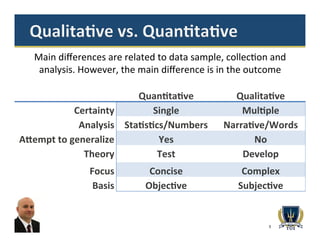
Quan2ta2ve	
   Qualita2ve	
  
Certainty	
   Single	
   Mul2ple	
  
Analysis	
   Sta2s2cs/Numbers	
   Narra2ve/Words	
  
AHempt	
  to	
  generalize	
  	
   Yes	
   No	
  
Theory	
   Test	
   Develop	
  
Focus	
   Concise	
   Complex	
  
Basis	
   Objec2ve	
   Subjec2ve	
  
.
Main	
  differences	
  are	
  related	
  to	
  data	
  sample,	
  collec>on	
  and	
  
analysis.	
  However,	
  the	
  main	
  difference	
  is	
  in	
  the	
  outcome	
  
9
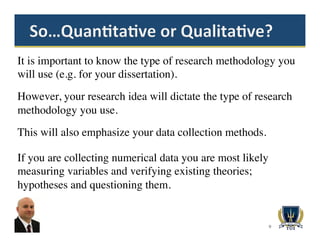
It is important to know the type of research methodology you
will use (e.g. for your dissertation).
However, your research idea will dictate the type of research
methodology you use.
This will also emphasize your data collection methods.
If you are collecting numerical data you are most likely
measuring variables and verifying existing theories;
hypotheses and questioning them.
10
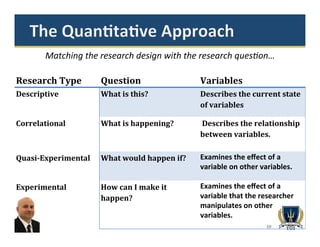
Matching	
  the	
  research	
  design	
  with	
  the	
  research	
  ques1on…	
  
Research	
  Type	
  	
   Question	
  	
   Variables	
  	
  
Descriptive	
  	
   What	
  is	
  this?	
  	
   Describes	
  the	
  current	
  state	
  
of	
  variables	
  	
  
Correlational	
  	
   What	
  is	
  happening?	
  	
   	
  Describes	
  the	
  relationship	
  
between	
  variables.	
  	
  
Quasi-­‐Experimental	
  	
   What	
  would	
  happen	
  if?	
  	
   Examines	
  the	
  effect	
  of	
  a	
  
variable	
  on	
  other	
  variables.	


Experimental	
  	
   How	
  can	
  I	
  make	
  it	
  
happen?	
  	
  
Examines	
  the	
  effect	
  of	
  a	
  
variable	
  that	
  the	
  researcher	
  
manipulates	
  on	
  other	
  
variables.	


11
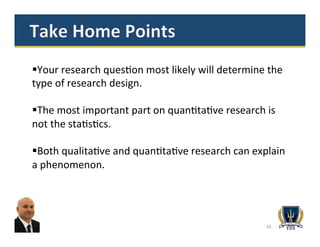
§ Your	
  research	
  ques>on	
  most	
  likely	
  will	
  determine	
  the	
  
type	
  of	
  research	
  design.	
  
§ The	
  most	
  important	
  part	
  on	
  quan>ta>ve	
  research	
  is	
  
not	
  the	
  sta>s>cs.	
  
§ Both	
  qualita>ve	
  and	
  quan>ta>ve	
  research	
  can	
  explain	
  
a	
  phenomenon.	
  	
  
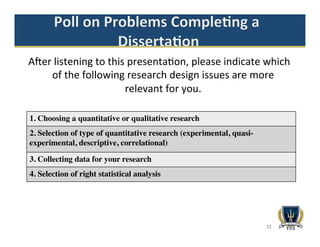
Aaer	
  listening	
  to	
  this	
  presenta>on,	
  please	
  indicate	
  which	
  
of	
  the	
  following	
  research	
  design	
  issues	
  are	
  more	
  
relevant	
  for	
  you.	


12
1. Choosing a quantitative or qualitative research
2. Selection of type of quantitative research (experimental, quasi-
experimental, descriptive, correlational)
3. Collecting data for your research
4. Selection of right statistical analysis
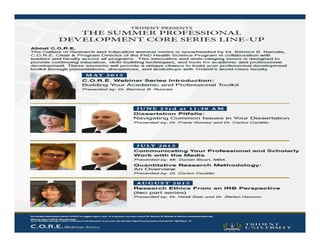
Visit	
  h^ps://www.trident.edu/webinars/core/	
  to	
  Register	
  
13
14
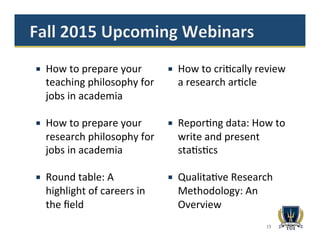
¡  How	
  to	
  prepare	
  your	
  
teaching	
  philosophy	
  for	
  
jobs	
  in	
  academia	
  
¡  How	
  to	
  prepare	
  your	
  
research	
  philosophy	
  for	
  
jobs	
  in	
  academia	
  
¡  Round	
  table:	
  A	
  
highlight	
  of	
  careers	
  in	
  
the	
  field	
  
¡  How	
  to	
  cri>cally	
  review	
  
a	
  research	
  ar>cle	
  
¡  Repor>ng	
  data:	
  How	
  to	
  
write	
  and	
  present	
  
sta>s>cs	
  
¡  Qualita>ve	
  Research	
  
Methodology:	
  An	
  
Overview	
  
15
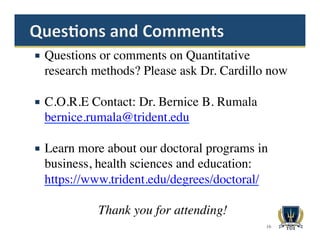
¡  Questions or comments on Quantitative
research methods? Please ask Dr. Cardillo now
¡  C.O.R.E Contact: Dr. Bernice B. Rumala
bernice.rumala@trident.edu
¡  Learn more about our doctoral programs in
business, health sciences and education:
https://www.trident.edu/degrees/doctoral/
Thank you for attending!
16

CORE: Quantitative Research Methodology: An Overview

  • 1.
                Culture  of  Research  and  Educa2on  (CORE):      Quan%ta%ve  Research  Methodology:  An  Overview     1 Dr. Carlos Cardillo PhD Mentor, Health Sciences Program
  • 2.
    2 Posi2on:   PhD  Mentor,  Health  Sciences  Program   Professor  of  Health  Sciences     Exper2se/Experience:     Health  Science  and  Human  Factor  Research   Electroneurophysiological  Research  and  Biosta>s>cs     Research  Design,  Data  Management  and  Sta>s>cal  Analysis     Educa2on/Training:   PhD,  Health  Science  Research/Educator,  Trident  University  Interna>onal,  Cypress,  CA   MS,  Biosta>s>cs,  New  York  Medical  College     BS,  Computer  Systems  Engineering,  North  East  University,  Argen>na     Accomplishments:     Authored  and  co-­‐authored  publica>ons  and  book  chapters   Principal  and  co-­‐inves>gator  in  large  research  projects    
  • 3.
    3 We  can  classify  research  methods  in  two  main  categories:   Quan>ta>ve  and  Qualita>ve     This  webinar  will  provide  an  overview  of  quan>ta>ve   methods  with  a  brief  dis>nc>on  between  quan>ta>ve  and   qualita>ve  methods.       We  will  focus  on  when  and  how  to  use  quan>ta>ve  research   and  discuss  the  role  and  type  of  variables  and  sta>s>cal   analysis.  
  • 4.
    4 Quan>ta>ve  research  is  ‘Explaining  phenomena  by  collec>ng   numerical  data  that  are  analyzed  using  mathema>cally  based   methods  (in  par>cular  sta>s>cs)’.                          Aliaga  and  Gunderson  (2000)  
  • 5.
    5 Quantitative research is‘Explaining phenomena by collecting numerical data that are analyzed using mathematically based methods (in particular statistics)’. Aliaga and Gunderson (2000) Quan>ta>ve  research  is  used  to  acquire  informa>on  about  a   phenomenon  (or  phenomena)  using  numerical  (quan>ta>ve)   data     The  process  is  Formal  –  Objec>ve  -­‐  Systema>c       It  is  used  to  describe  variables    by  examining  rela>onships   among  variables  -­‐  determine  cause-­‐and-­‐effect  interac>ons  
  • 6.
    6 Qualita>ve  research  a^empt  to  understand  specific   organiza>on  or  event  and  do  not  involve  descrip>on  of  a   sample  from  a  popula>on.  It  can  provide  an  explicit   representa>on  of  a  structure,  order  and  general  pa^erns   from  a  group  of  par>cipants  and  generates  data  about  human   groups  in  social  se`ngs.                        
  • 7.
    7 Qualita>ve  research  a^empt  to  understand  specific  organiza>on  or  event  and  do  not  involve  descrip>on  of   a  sample  from  a  popula>on.  Can  provide  an  explicit  representa>on  of  a  structure,  order  and  general   pa^erns  from  a  group  of  par>cipants  and  generates  data  about  human  groups  in  social  se`ngs.                 No  treatments  or  manipulate  variables.     Interpreta>on  emerge  from  the  par>cipants.       Concepts,  data  collec>on  tools,  and  methods  can  be  adjusted   as  the  research  progresses.     Provides  an    understanding  through  direct  experience,   repor>ng    and  interpreta>on  from  direct  conversa>ons.      
  • 8.
    8 Quan2ta2ve   Qualita2ve   Certainty   Single   Mul2ple   Analysis   Sta2s2cs/Numbers   Narra2ve/Words   AHempt  to  generalize     Yes   No   Theory   Test   Develop   Focus   Concise   Complex   Basis   Objec2ve   Subjec2ve   . Main  differences  are  related  to  data  sample,  collec>on  and   analysis.  However,  the  main  difference  is  in  the  outcome  
  • 9.
    9 It is importantto know the type of research methodology you will use (e.g. for your dissertation). However, your research idea will dictate the type of research methodology you use. This will also emphasize your data collection methods. If you are collecting numerical data you are most likely measuring variables and verifying existing theories; hypotheses and questioning them.
  • 10.
    10 Matching  the  research  design  with  the  research  ques1on…   Research  Type     Question     Variables     Descriptive     What  is  this?     Describes  the  current  state   of  variables     Correlational     What  is  happening?      Describes  the  relationship   between  variables.     Quasi-­‐Experimental     What  would  happen  if?     Examines  the  effect  of  a   variable  on  other  variables.     Experimental     How  can  I  make  it   happen?     Examines  the  effect  of  a   variable  that  the  researcher   manipulates  on  other   variables.    
  • 11.
    11 § Your  research  ques>on  most  likely  will  determine  the   type  of  research  design.   § The  most  important  part  on  quan>ta>ve  research  is   not  the  sta>s>cs.   § Both  qualita>ve  and  quan>ta>ve  research  can  explain   a  phenomenon.    
  • 12.
    Aaer  listening  to  this  presenta>on,  please  indicate  which   of  the  following  research  design  issues  are  more   relevant  for  you.       12 1. Choosing a quantitative or qualitative research 2. Selection of type of quantitative research (experimental, quasi- experimental, descriptive, correlational) 3. Collecting data for your research 4. Selection of right statistical analysis
  • 13.
  • 14.
  • 15.
    ¡  How  to  prepare  your   teaching  philosophy  for   jobs  in  academia   ¡  How  to  prepare  your   research  philosophy  for   jobs  in  academia   ¡  Round  table:  A   highlight  of  careers  in   the  field   ¡  How  to  cri>cally  review   a  research  ar>cle   ¡  Repor>ng  data:  How  to   write  and  present   sta>s>cs   ¡  Qualita>ve  Research   Methodology:  An   Overview   15
  • 16.
    ¡  Questions orcomments on Quantitative research methods? Please ask Dr. Cardillo now ¡  C.O.R.E Contact: Dr. Bernice B. Rumala bernice.rumala@trident.edu ¡  Learn more about our doctoral programs in business, health sciences and education: https://www.trident.edu/degrees/doctoral/ Thank you for attending! 16