ARCHITECTURE OF DBMS
& DATA MODELS
PRSENTED BY :- MRS. SURKHAB SHELLY
ASSISTANT PROFESSOR IN COMP. SCI.
DATA HIERARCHY
Data Hierarchy refers to the systematic organization of
data, often in a hierarchical form. A computer system
organizes data in a hierarchy that starts with bits and bytes
and progresses to fields, records, files, and databases. A bit
represents the smallest unit of data a computer can handle.
A group of bits, called a byte, represents a single
character, which can be a letter, a number, or another
symbol
Data organization involves fields, records, files and so on.
 A field holds a single fact - Consider a date field, e.g.
"September 19, 2004". This can be treated as a single date
field (eg birthdate), or 3 fields, namely, month, day of
month and year.
 A record a collection of related fields. An Employee record
may contain a name field(s), address fields, birthdate field
DATA HIERARCHY
 A file is a collection of related records. If there are 100
employees, then each employee would have a record (e.g.
called Employee Personal Details record) and the collection
of 100 such records would constitute a file (in this
case, called Employee Personal Details file).
 Files are integrated into a Database. This is done using a
Database Management System. If there are other facets of
employee data that we wish to capture, then other files
such as Employee Training History file and Employee Work
History file could be created as well.
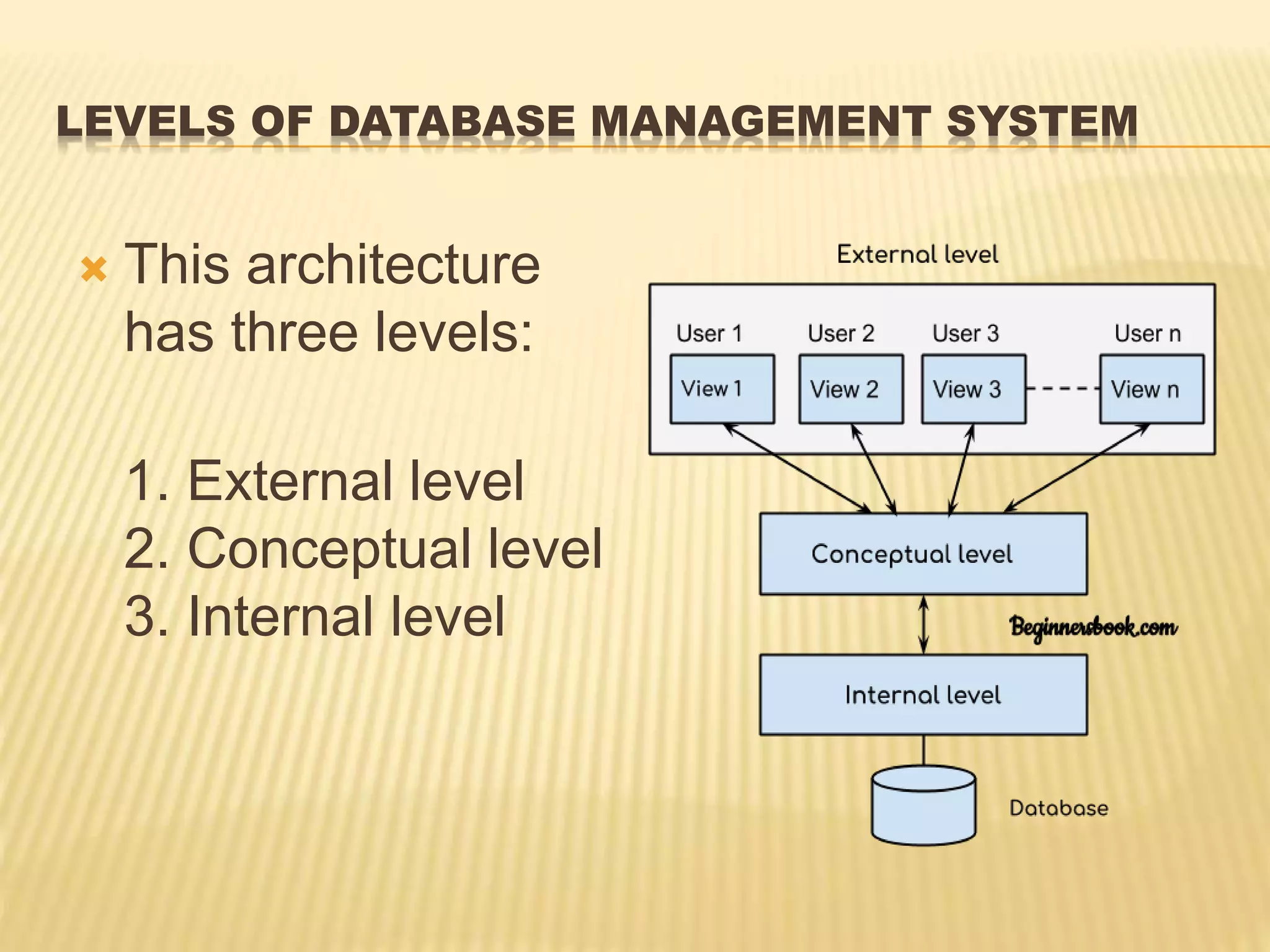
LEVELS OF DATABASE MANAGEMENT SYSTEM
 This architecture
has three levels:
1. External level
2. Conceptual level
3. Internal level
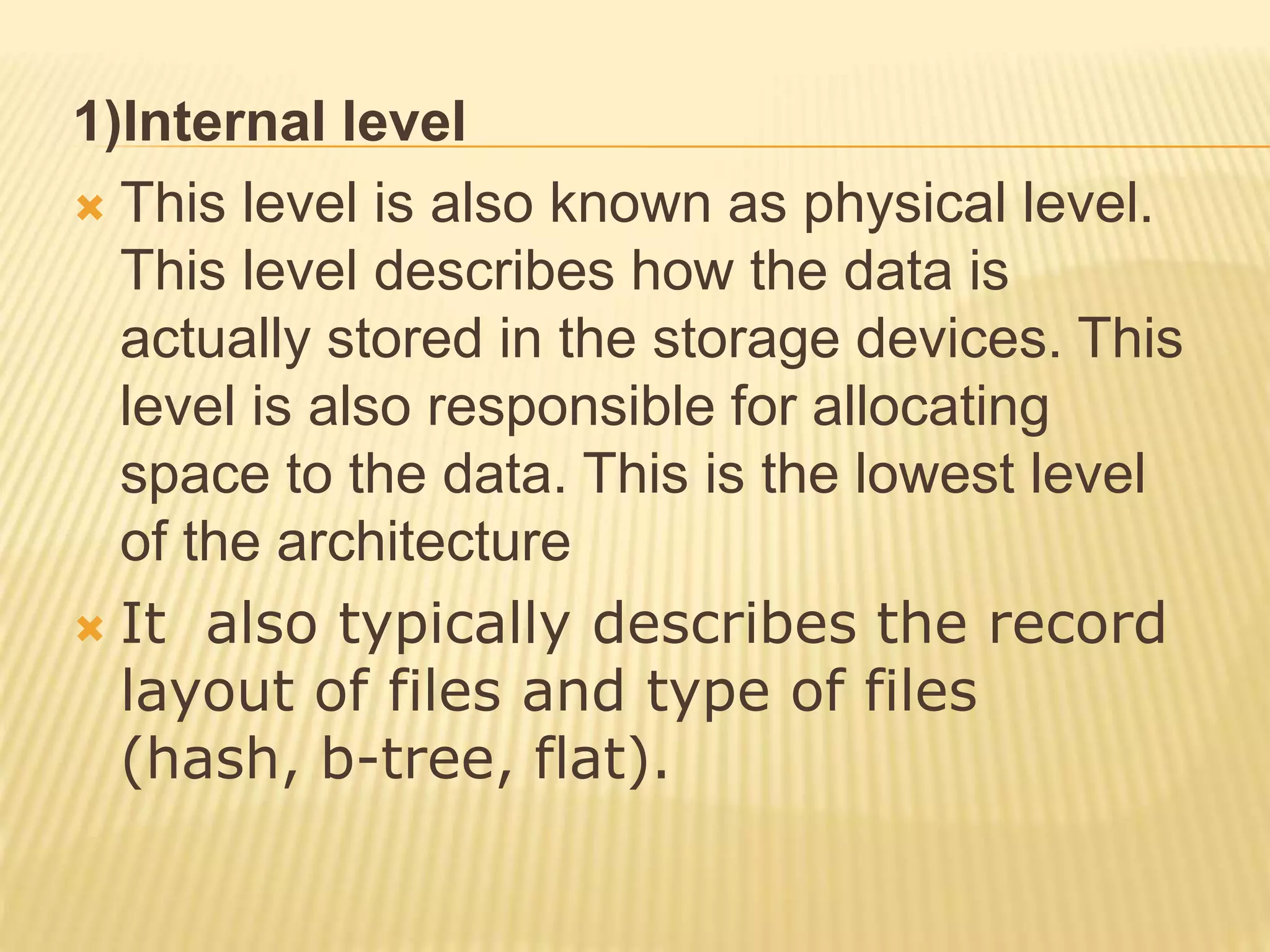
1)Internal level
 This level is also known as physical level.
This level describes how the data is
actually stored in the storage devices. This
level is also responsible for allocating
space to the data. This is the lowest level
of the architecture
 It also typically describes the record
layout of files and type of files
(hash, b-tree, flat).
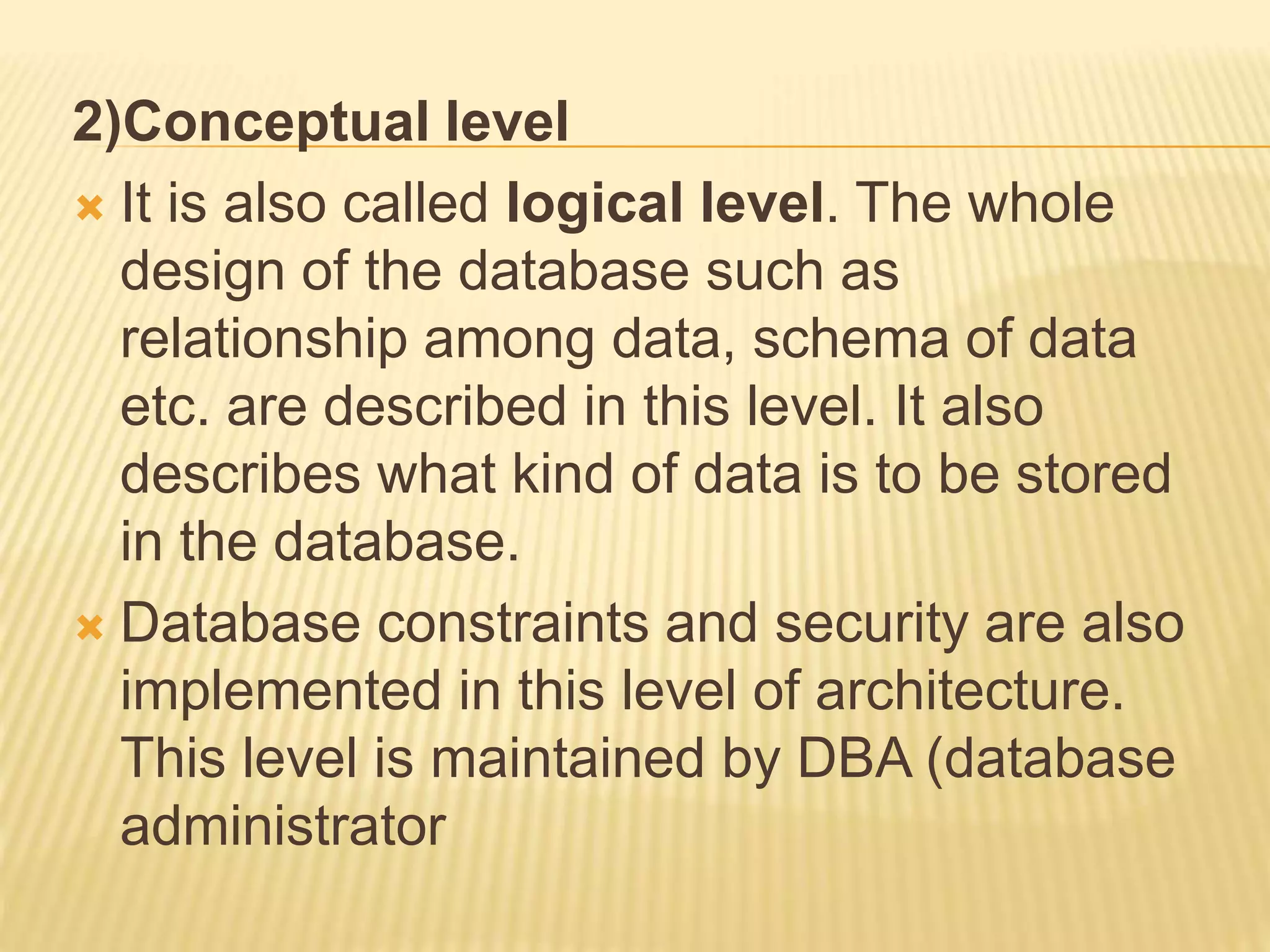
2)Conceptual level
 It is also called logical level. The whole
design of the database such as
relationship among data, schema of data
etc. are described in this level. It also
describes what kind of data is to be stored
in the database.
 Database constraints and security are also
implemented in this level of architecture.
This level is maintained by DBA (database
administrator
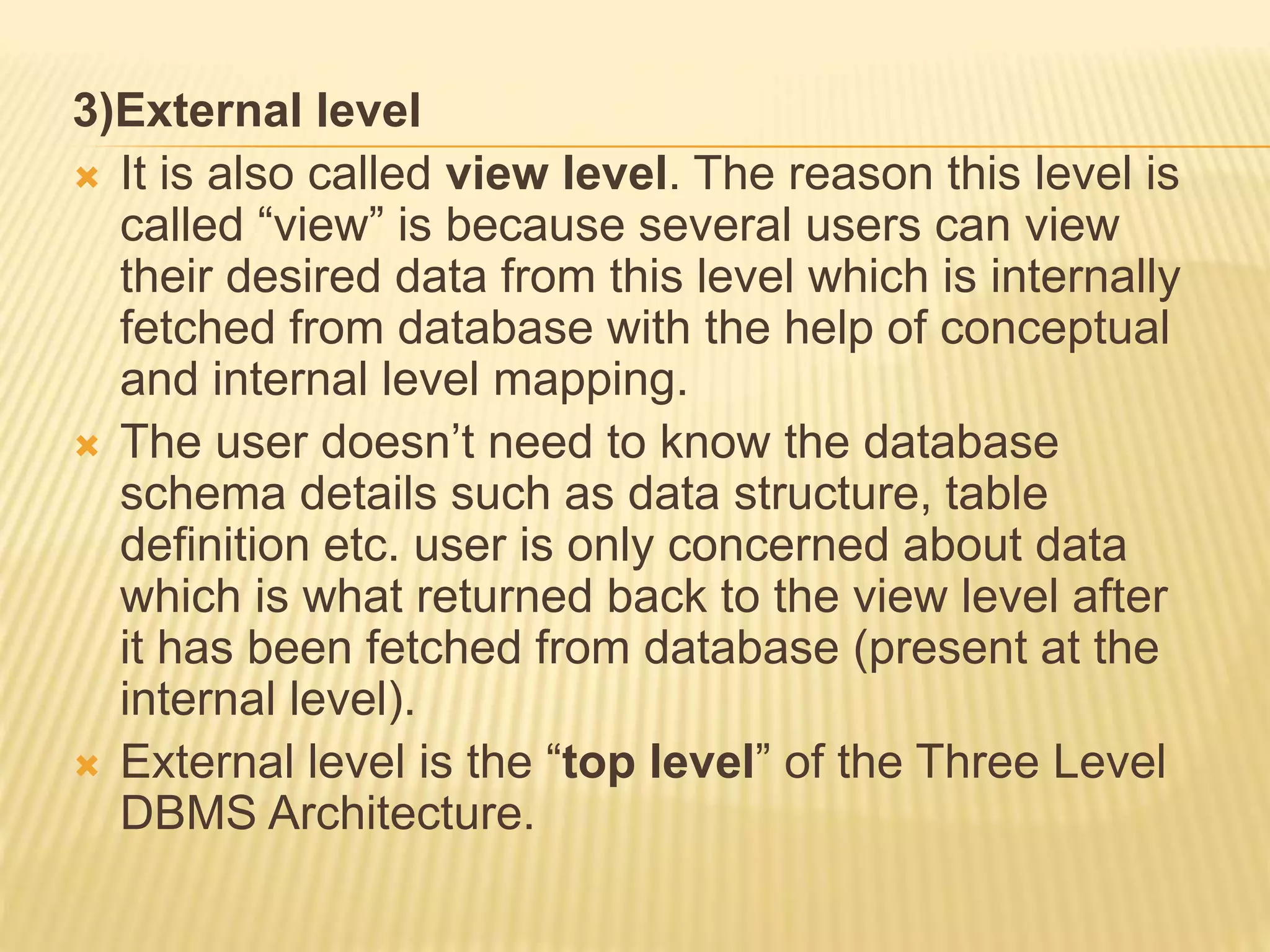
3)External level
 It is also called view level. The reason this level is
called “view” is because several users can view
their desired data from this level which is internally
fetched from database with the help of conceptual
and internal level mapping.
 The user doesn’t need to know the database
schema details such as data structure, table
definition etc. user is only concerned about data
which is what returned back to the view level after
it has been fetched from database (present at the
internal level).
 External level is the “top level” of the Three Level
DBMS Architecture.
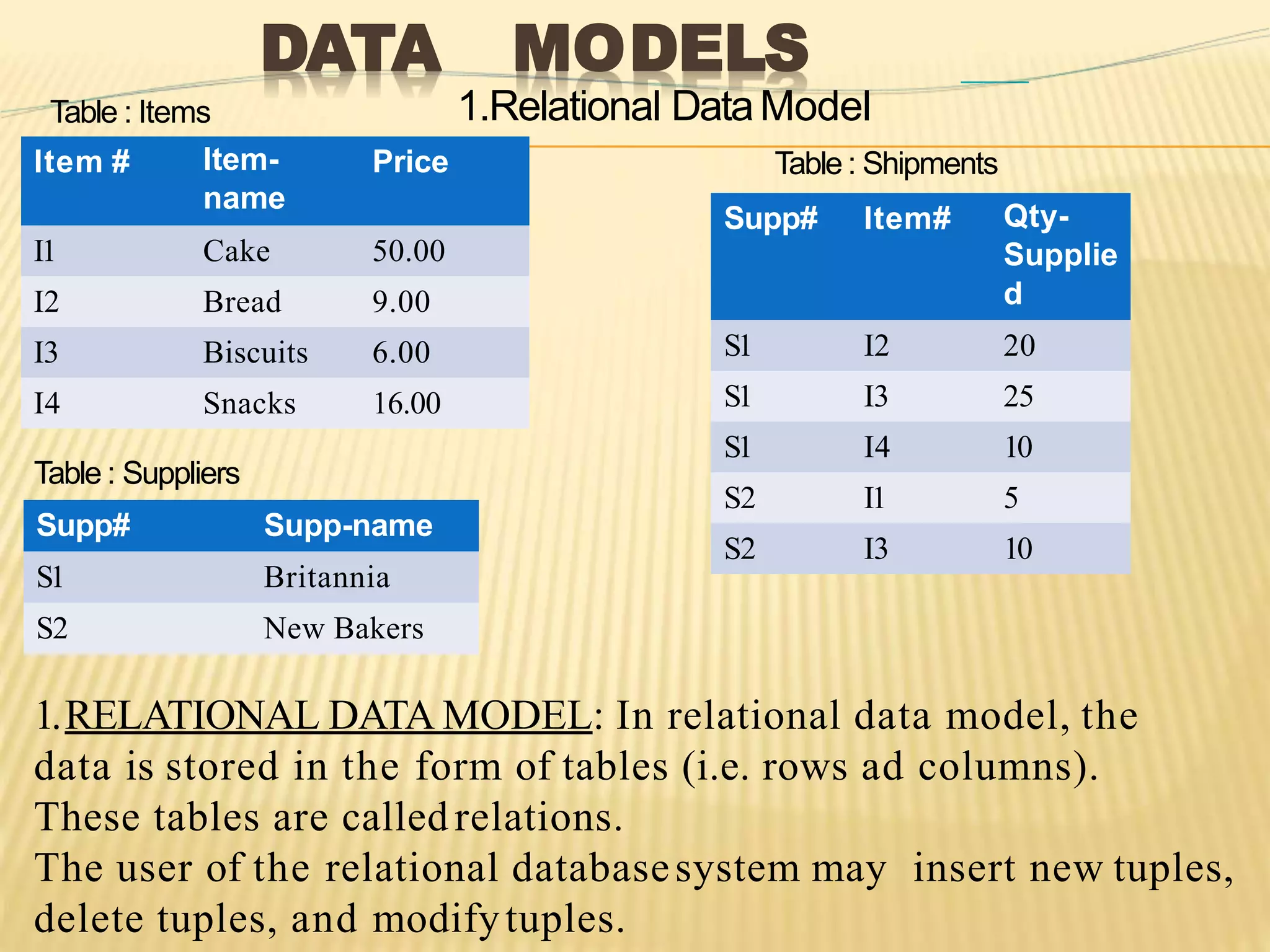
Item # Item-
name
Price
I1 Cake 50.00
I2 Bread 9.00
I3 Biscuits 6.00
I4 Snacks 16.00
1.Relational DataModel
Supp# Supp-name
S1 Britannia
S2 New Bakers
Supp# Item# Qty-
Supplie
d
S1 I2 20
S1 I3 25
S1 I4 10
S2 I1 5
S2 I3 10
Table : Items
Table : Suppliers
Table : Shipments
1.RELATIONAL DATA MODEL: In relational data model, the
data is stored in the form of tables (i.e. rows ad columns).
These tables are calledrelations.
The user of the relational databasesystem may insert new tuples,
delete tuples, and modifytuples.
DATA MODELS
RELATIONAL MODEL
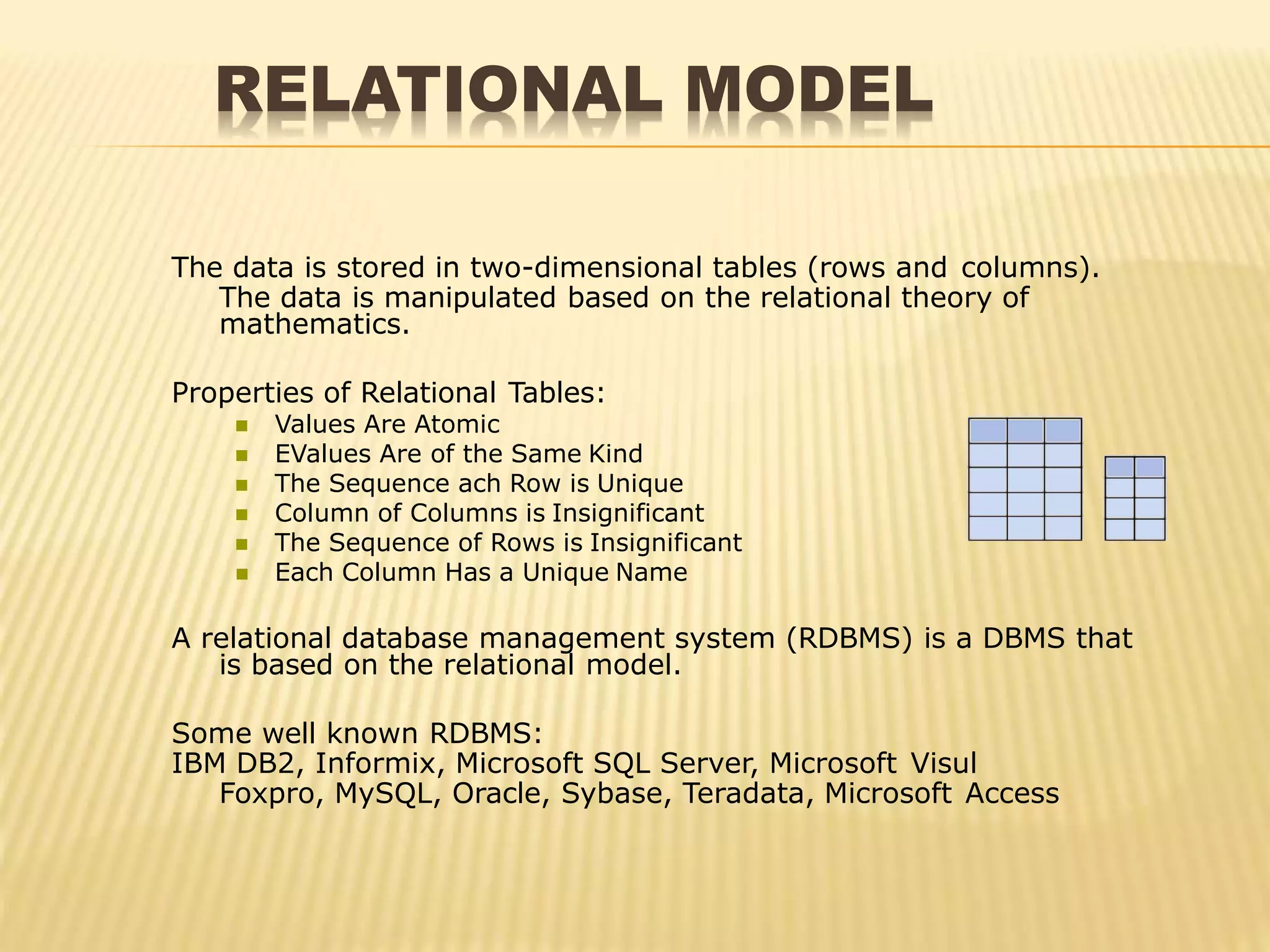
The data is stored in two-dimensional tables (rows and columns).
The data is manipulated based on the relational theory of
mathematics.
Properties of Relational Tables:
 Values Are Atomic
 EValues Are of the Same Kind
 The Sequence ach Row is Unique
 Column of Columns is Insignificant
 The Sequence of Rows is Insignificant
 Each Column Has a Unique Name
A relational database management system (RDBMS) is a DBMS that
is based on the relational model.
Some well known RDBMS:
IBM DB2, Informix, Microsoft SQL Server, Microsoft Visul
Foxpro, MySQL, Oracle, Sybase, Teradata, Microsoft Access
I2
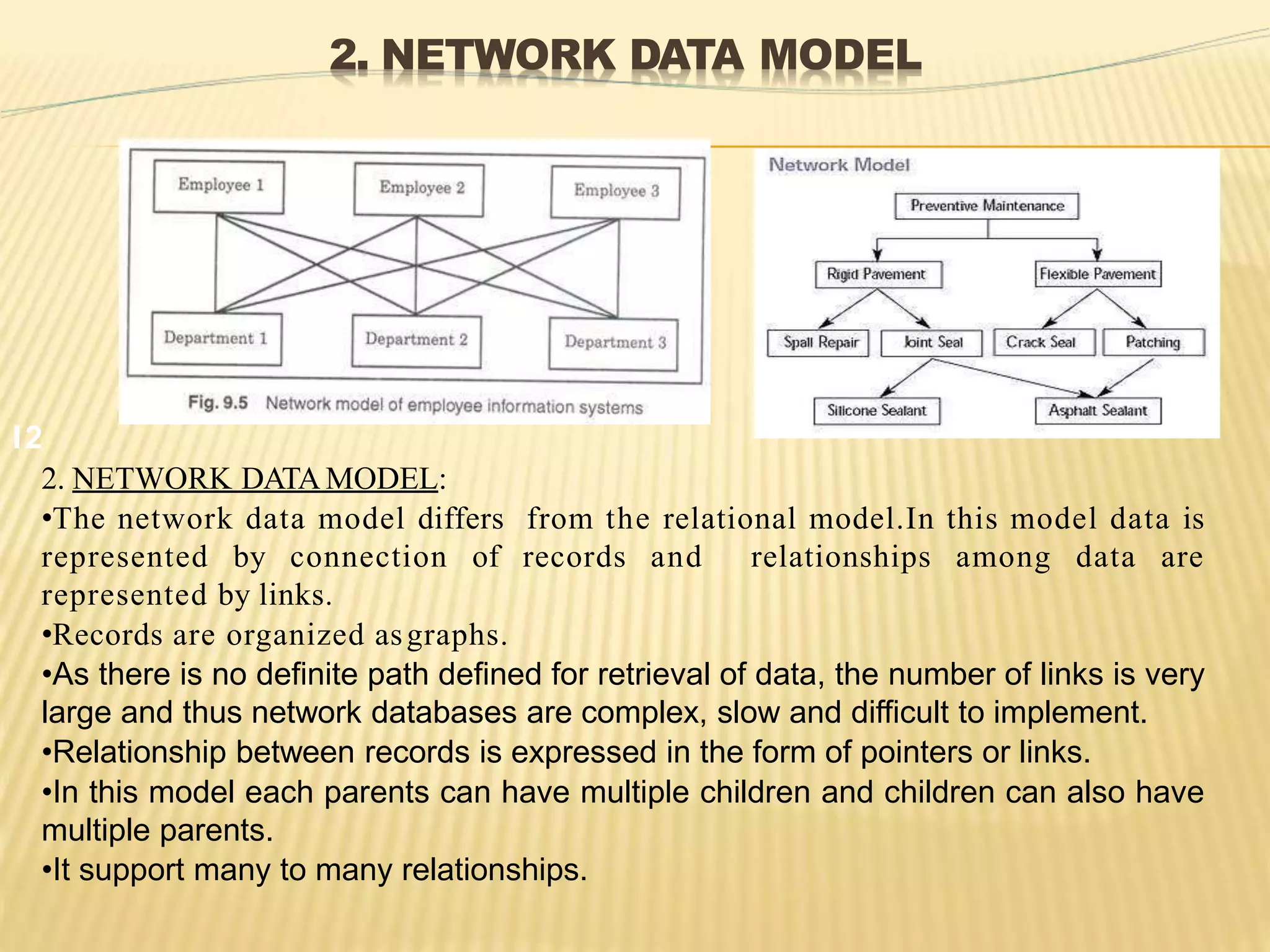
2. NETWORK DATA MODEL
2. NETWORK DATA MODEL:
•The network data model differs from the relational model.In this model data is
represented by connection of records and relationships among data are
represented by links.
•Records are organized asgraphs.
•As there is no definite path defined for retrieval of data, the number of links is very
large and thus network databases are complex, slow and difficult to implement.
•Relationship between records is expressed in the form of pointers or links.
•In this model each parents can have multiple children and children can also have
multiple parents.
•It support many to many relationships.
S1
I3
3. HIERARCHICAL DATA MODEL
3. HIERARCHICAL DATA MODEL:
•Data is represented by collection of records and relationships
among data by links.
Records are organized as trees rather than graphs.
•Represents relationship among its records through parent
child relationships.
•This model supports one-to-one and one-to-many relationships.
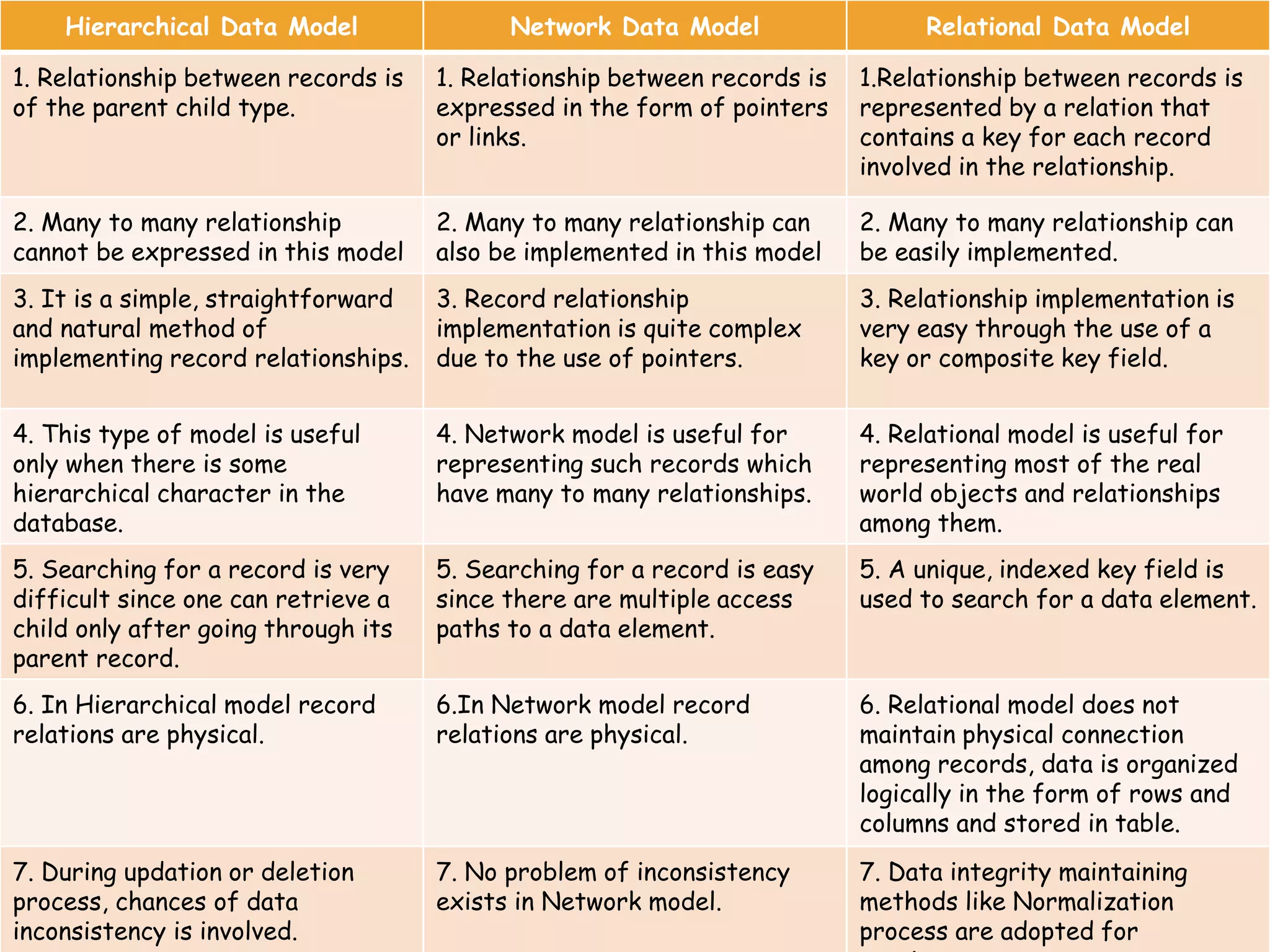
Hierarchical Data Model Network Data Model Relational Data Model
1. Relationship between records is
of the parent child type.
1. Relationship between records is
expressed in the form of pointers
or links.
1.Relationship between records is
represented by a relation that
contains a key for each record
involved in the relationship.
2. Many to many relationship
cannot be expressed in this model
2. Many to many relationship can
also be implemented in this model
2. Many to many relationship can
be easily implemented.
3. It is a simple, straightforward
and natural method of
implementing record relationships.
3. Record relationship
implementation is quite complex
due to the use of pointers.
3. Relationship implementation is
very easy through the use of a
key or composite key field.
4. This type of model is useful
only when there is some
hierarchical character in the
database.
4. Network model is useful for
representing such records which
have many to many relationships.
4. Relational model is useful for
representing most of the real
world objects and relationships
among them.
5. Searching for a record is very
difficult since one can retrieve a
child only after going through its
parent record.
5. Searching for a record is easy
since there are multiple access
paths to a data element.
5. A unique, indexed key field is
used to search for a data element.
6. In Hierarchical model record
relations are physical.
6.In Network model record
relations are physical.
6. Relational model does not
maintain physical connection
among records, data is organized
logically in the form of rows and
columns and stored in table.
7. During updation or deletion
process, chances of data
inconsistency is involved.
7. No problem of inconsistency
exists in Network model.
7. Data integrity maintaining
methods like Normalization
process are adopted for
Architecture of dbms

Architecture of dbms

  • 1.
    ARCHITECTURE OF DBMS &DATA MODELS PRSENTED BY :- MRS. SURKHAB SHELLY ASSISTANT PROFESSOR IN COMP. SCI.
  • 2.
    DATA HIERARCHY Data Hierarchyrefers to the systematic organization of data, often in a hierarchical form. A computer system organizes data in a hierarchy that starts with bits and bytes and progresses to fields, records, files, and databases. A bit represents the smallest unit of data a computer can handle. A group of bits, called a byte, represents a single character, which can be a letter, a number, or another symbol Data organization involves fields, records, files and so on.  A field holds a single fact - Consider a date field, e.g. "September 19, 2004". This can be treated as a single date field (eg birthdate), or 3 fields, namely, month, day of month and year.  A record a collection of related fields. An Employee record may contain a name field(s), address fields, birthdate field
  • 3.
    DATA HIERARCHY  Afile is a collection of related records. If there are 100 employees, then each employee would have a record (e.g. called Employee Personal Details record) and the collection of 100 such records would constitute a file (in this case, called Employee Personal Details file).  Files are integrated into a Database. This is done using a Database Management System. If there are other facets of employee data that we wish to capture, then other files such as Employee Training History file and Employee Work History file could be created as well.
  • 4.
    LEVELS OF DATABASEMANAGEMENT SYSTEM  This architecture has three levels: 1. External level 2. Conceptual level 3. Internal level
  • 5.
    1)Internal level  Thislevel is also known as physical level. This level describes how the data is actually stored in the storage devices. This level is also responsible for allocating space to the data. This is the lowest level of the architecture  It also typically describes the record layout of files and type of files (hash, b-tree, flat).
  • 6.
    2)Conceptual level  Itis also called logical level. The whole design of the database such as relationship among data, schema of data etc. are described in this level. It also describes what kind of data is to be stored in the database.  Database constraints and security are also implemented in this level of architecture. This level is maintained by DBA (database administrator
  • 7.
    3)External level  Itis also called view level. The reason this level is called “view” is because several users can view their desired data from this level which is internally fetched from database with the help of conceptual and internal level mapping.  The user doesn’t need to know the database schema details such as data structure, table definition etc. user is only concerned about data which is what returned back to the view level after it has been fetched from database (present at the internal level).  External level is the “top level” of the Three Level DBMS Architecture.
  • 8.
    Item # Item- name Price I1Cake 50.00 I2 Bread 9.00 I3 Biscuits 6.00 I4 Snacks 16.00 1.Relational DataModel Supp# Supp-name S1 Britannia S2 New Bakers Supp# Item# Qty- Supplie d S1 I2 20 S1 I3 25 S1 I4 10 S2 I1 5 S2 I3 10 Table : Items Table : Suppliers Table : Shipments 1.RELATIONAL DATA MODEL: In relational data model, the data is stored in the form of tables (i.e. rows ad columns). These tables are calledrelations. The user of the relational databasesystem may insert new tuples, delete tuples, and modifytuples. DATA MODELS
  • 9.
    RELATIONAL MODEL The datais stored in two-dimensional tables (rows and columns). The data is manipulated based on the relational theory of mathematics. Properties of Relational Tables:  Values Are Atomic  EValues Are of the Same Kind  The Sequence ach Row is Unique  Column of Columns is Insignificant  The Sequence of Rows is Insignificant  Each Column Has a Unique Name A relational database management system (RDBMS) is a DBMS that is based on the relational model. Some well known RDBMS: IBM DB2, Informix, Microsoft SQL Server, Microsoft Visul Foxpro, MySQL, Oracle, Sybase, Teradata, Microsoft Access
  • 10.
    I2 2. NETWORK DATAMODEL 2. NETWORK DATA MODEL: •The network data model differs from the relational model.In this model data is represented by connection of records and relationships among data are represented by links. •Records are organized asgraphs. •As there is no definite path defined for retrieval of data, the number of links is very large and thus network databases are complex, slow and difficult to implement. •Relationship between records is expressed in the form of pointers or links. •In this model each parents can have multiple children and children can also have multiple parents. •It support many to many relationships.
  • 11.
    S1 I3 3. HIERARCHICAL DATAMODEL 3. HIERARCHICAL DATA MODEL: •Data is represented by collection of records and relationships among data by links. Records are organized as trees rather than graphs. •Represents relationship among its records through parent child relationships. •This model supports one-to-one and one-to-many relationships.
  • 12.
    Hierarchical Data ModelNetwork Data Model Relational Data Model 1. Relationship between records is of the parent child type. 1. Relationship between records is expressed in the form of pointers or links. 1.Relationship between records is represented by a relation that contains a key for each record involved in the relationship. 2. Many to many relationship cannot be expressed in this model 2. Many to many relationship can also be implemented in this model 2. Many to many relationship can be easily implemented. 3. It is a simple, straightforward and natural method of implementing record relationships. 3. Record relationship implementation is quite complex due to the use of pointers. 3. Relationship implementation is very easy through the use of a key or composite key field. 4. This type of model is useful only when there is some hierarchical character in the database. 4. Network model is useful for representing such records which have many to many relationships. 4. Relational model is useful for representing most of the real world objects and relationships among them. 5. Searching for a record is very difficult since one can retrieve a child only after going through its parent record. 5. Searching for a record is easy since there are multiple access paths to a data element. 5. A unique, indexed key field is used to search for a data element. 6. In Hierarchical model record relations are physical. 6.In Network model record relations are physical. 6. Relational model does not maintain physical connection among records, data is organized logically in the form of rows and columns and stored in table. 7. During updation or deletion process, chances of data inconsistency is involved. 7. No problem of inconsistency exists in Network model. 7. Data integrity maintaining methods like Normalization process are adopted for