OUTPUT DEVICES
PRESENTED BY:- Mrs. Surkhab Shelly
Assistant Professor In CS
MONITORS
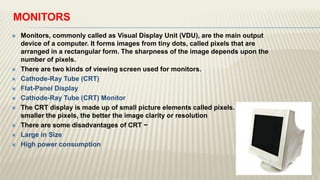
 Monitors, commonly called as Visual Display Unit (VDU), are the main output
device of a computer. It forms images from tiny dots, called pixels that are
arranged in a rectangular form. The sharpness of the image depends upon the
number of pixels.
 There are two kinds of viewing screen used for monitors.
 Cathode-Ray Tube (CRT)
 Flat-Panel Display
 Cathode-Ray Tube (CRT) Monitor
 The CRT display is made up of small picture elements called pixels. The
smaller the pixels, the better the image clarity or resolution
 There are some disadvantages of CRT −
 Large in Size
 High power consumption
 Flat-Panel Display Monitor
 The flat-panel display refers to a class of video devices that have
reduced volume, weight and power requirement in comparison to
the CRT. You can hang them on walls or wear them on your
wrists. Current uses of flat-panel displays include calculators,
video games, monitors, laptop computer, and graphics display.
The flat-panel display is divided into two categories −
 Emissive Displays − Emissive displays are devices that convert
electrical energy into light. For example, plasma panel and LED
(Light-Emitting Diodes).
 Non-Emissive Displays − Non-emissive displays use optical
effects to convert sunlight or light from some other source into
graphics patterns. For example, LCD (Liquid-Crystal Device).
PRINTERS
 Printer is an output device, which is used to print information on paper.
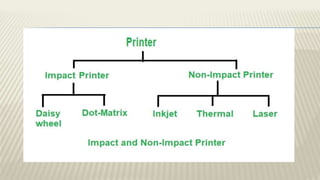
 There are two types of printers −
 Impact Printers
 Non-Impact Printers
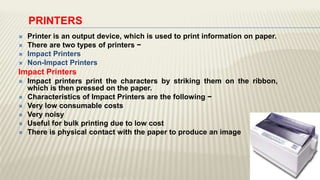
Impact Printers
 Impact printers print the characters by striking them on the ribbon,
which is then pressed on the paper.
 Characteristics of Impact Printers are the following −
 Very low consumable costs
 Very noisy
 Useful for bulk printing due to low cost
 There is physical contact with the paper to produce an image
 Non-impact Printers
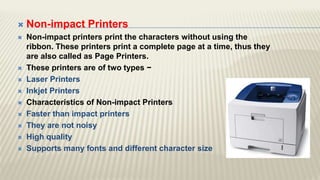
 Non-impact printers print the characters without using the
ribbon. These printers print a complete page at a time, thus they
are also called as Page Printers.
 These printers are of two types −
 Laser Printers
 Inkjet Printers
 Characteristics of Non-impact Printers
 Faster than impact printers
 They are not noisy
 High quality
 Supports many fonts and different character size
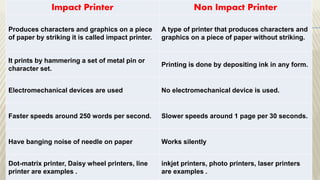
Impact Printer Non Impact Printer
Produces characters and graphics on a piece
of paper by striking it is called impact printer.
A type of printer that produces characters and
graphics on a piece of paper without striking.
It prints by hammering a set of metal pin or
character set.
Printing is done by depositing ink in any form.
Electromechanical devices are used No electromechanical device is used.
Faster speeds around 250 words per second. Slower speeds around 1 page per 30 seconds.
Have banging noise of needle on paper Works silently
Dot-matrix printer, Daisy wheel printers, line
printer are examples .
inkjet printers, photo printers, laser printers
are examples .
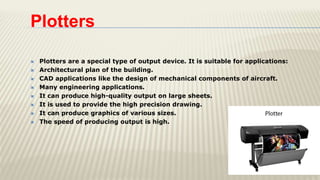
Plotters
 Plotters are a special type of output device. It is suitable for applications:
 Architectural plan of the building.
 CAD applications like the design of mechanical components of aircraft.
 Many engineering applications.
 It can produce high-quality output on large sheets.
 It is used to provide the high precision drawing.
 It can produce graphics of various sizes.
 The speed of producing output is high.
Types of Plotters
 The different types of plotters include:
 Drum plotters: A drum plotter draws on paper that is wrapped
around a drum. The drum turns and produces one direction of the
plot, while at the same time the pens move to produce the other
direction.
 Flatbed plotters: A flatbed plotter draws on paper that is placed on
a flat surface.
 Electrostatic plotter: An electrostatic plotter draws on paper that
has a negative charge with a toner that has a positive charge.
 Roller Plotter: A roller plotter prints out the drawing while the payer
gets moved through the plotter.
 Voice Response Unit (VRU)
 A Voice Response Unit (VRU) is an automated telephone system that uses pre-
recorded voice messages that provide options or information to the caller. A
Voice Response Unit (VRU) is typically used by companies with call centres,
such as banks that wish to provide customers with access to accounts, or
companies who provide customer service through this unit.
 Previous Voice Response Units (VRUs) use touch tone keypads to
communicate, whereas modern Voice Response Units (VRUs) additionally
have the ability to communicate through spoken words using voice
recognition software. This system is designed to deal with high call volumes
and to better a customer’s experience.

Output devices

  • 1.
    OUTPUT DEVICES PRESENTED BY:-Mrs. Surkhab Shelly Assistant Professor In CS
  • 2.
    MONITORS  Monitors, commonlycalled as Visual Display Unit (VDU), are the main output device of a computer. It forms images from tiny dots, called pixels that are arranged in a rectangular form. The sharpness of the image depends upon the number of pixels.  There are two kinds of viewing screen used for monitors.  Cathode-Ray Tube (CRT)  Flat-Panel Display  Cathode-Ray Tube (CRT) Monitor  The CRT display is made up of small picture elements called pixels. The smaller the pixels, the better the image clarity or resolution  There are some disadvantages of CRT −  Large in Size  High power consumption
  • 3.
     Flat-Panel DisplayMonitor  The flat-panel display refers to a class of video devices that have reduced volume, weight and power requirement in comparison to the CRT. You can hang them on walls or wear them on your wrists. Current uses of flat-panel displays include calculators, video games, monitors, laptop computer, and graphics display. The flat-panel display is divided into two categories −  Emissive Displays − Emissive displays are devices that convert electrical energy into light. For example, plasma panel and LED (Light-Emitting Diodes).  Non-Emissive Displays − Non-emissive displays use optical effects to convert sunlight or light from some other source into graphics patterns. For example, LCD (Liquid-Crystal Device).
  • 5.
    PRINTERS  Printer isan output device, which is used to print information on paper.  There are two types of printers −  Impact Printers  Non-Impact Printers Impact Printers  Impact printers print the characters by striking them on the ribbon, which is then pressed on the paper.  Characteristics of Impact Printers are the following −  Very low consumable costs  Very noisy  Useful for bulk printing due to low cost  There is physical contact with the paper to produce an image
  • 6.
     Non-impact Printers Non-impact printers print the characters without using the ribbon. These printers print a complete page at a time, thus they are also called as Page Printers.  These printers are of two types −  Laser Printers  Inkjet Printers  Characteristics of Non-impact Printers  Faster than impact printers  They are not noisy  High quality  Supports many fonts and different character size
  • 7.
    Impact Printer NonImpact Printer Produces characters and graphics on a piece of paper by striking it is called impact printer. A type of printer that produces characters and graphics on a piece of paper without striking. It prints by hammering a set of metal pin or character set. Printing is done by depositing ink in any form. Electromechanical devices are used No electromechanical device is used. Faster speeds around 250 words per second. Slower speeds around 1 page per 30 seconds. Have banging noise of needle on paper Works silently Dot-matrix printer, Daisy wheel printers, line printer are examples . inkjet printers, photo printers, laser printers are examples .
  • 8.
    Plotters  Plotters area special type of output device. It is suitable for applications:  Architectural plan of the building.  CAD applications like the design of mechanical components of aircraft.  Many engineering applications.  It can produce high-quality output on large sheets.  It is used to provide the high precision drawing.  It can produce graphics of various sizes.  The speed of producing output is high.
  • 9.
    Types of Plotters The different types of plotters include:  Drum plotters: A drum plotter draws on paper that is wrapped around a drum. The drum turns and produces one direction of the plot, while at the same time the pens move to produce the other direction.  Flatbed plotters: A flatbed plotter draws on paper that is placed on a flat surface.  Electrostatic plotter: An electrostatic plotter draws on paper that has a negative charge with a toner that has a positive charge.  Roller Plotter: A roller plotter prints out the drawing while the payer gets moved through the plotter.
  • 10.
     Voice ResponseUnit (VRU)  A Voice Response Unit (VRU) is an automated telephone system that uses pre- recorded voice messages that provide options or information to the caller. A Voice Response Unit (VRU) is typically used by companies with call centres, such as banks that wish to provide customers with access to accounts, or companies who provide customer service through this unit.  Previous Voice Response Units (VRUs) use touch tone keypads to communicate, whereas modern Voice Response Units (VRUs) additionally have the ability to communicate through spoken words using voice recognition software. This system is designed to deal with high call volumes and to better a customer’s experience.