ARCHITECTURAL THEORY
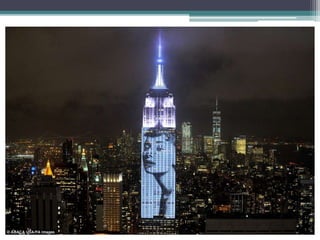
THE EMPIRE STATE BUILDING
NEW YORK, USA
ANIKA MOMIN
MU1538
RIZVI COLLEGE OF ARCHITECTURE
www.mentalfloss.com
INTRODUCTION
‱ The building is born of entrepreneurs Walter Chrysler, owner of Chrysler and John
Jakob Raskob, executive of the General Motors Company to raise the highest
building in the world and designed by William F. Lamb, Gregory Johnson,
Yasuo Matsui.
‱ The Empire State Building was a record building, averaging 4.5 stories per
week. The excavation of the site began on January 22, 1930, construction on March
17, and after a year and 45 days of construction, the building was inaugurated
on May 1, 1931, becoming for 40 years the highest building in the world, to the
completion of the World Trade Center Twin Towers in 1977.
‱ It measures 443.20 meters including the antenna of 62 meters and built area of
254.385 square meters.
‱ After 11 months the main building of 85 floors was finished, and in March
1931 the interior was finished. On the opening night of May 1, US President Herbert
Hoover pressed a button in the White House and at that moment the Empire State
was lit for the first time in Manhattan.
HISTORICAL TIMELINE
‱ 1799: The City of New York sells a virgin tract (now bounded by Broadway and
Sixth Avenue on the west, Madison Avenue on the east, 33rd Street on the south and
36th Street on the north) for $2,600 to John Thompson for farming.
‱ 1825: Thompson sells the farm to Charles Lawton for $10,000.
‱ 1827: William Backhouse Astor buys the farm for $20,500 as an investment.
‱ 1893: The Waldorf Hotel was erected on the corner of Fifth Avenue and 33rd Street.
‱ 1897: Mrs. William Backhouse Astor razes her mansion at Fifth Avenue and 34th
Street and the Astoria Hotel is erected on the site. The new complex is known as the
Waldorf Astoria Hotel.
‱ 1928: The Waldorf Astoria Hotel is sold to Bethlehem Engineering
Corporation for an estimated $20 million.
‱ 1929: John Jakob Raskob (former General Motors executive), Coleman du Pont,
Pierre S. du Pont, Louis G. Kaufman and Ellis P. Earle, form Empire State, Inc. and
name Alfred E. Smith, former Governor of New York to head the corporation.
‱ 1930: On March 17, construction of the Empire State Building begins. Under
the direction of architects Shreve, Lamb & Harmon Associates, the framework rises 4
œ stories per week.
HISTORICAL TIMELINE
‱ 1931: On May 1, President Hoover presses a button in Washington, D.C. officially
opening and turning on the Empire State Building’s lights.
‱ 1945: A B-25 Bomber crashes into the 79th floor of ESB during heavy fog
on a Saturday morning. The building’s construction limits the spread of fire and
despite a 20-foot gash, the Empire State Building is open for business-as-usual on
Monday.
‱ 1951: The John J. Raskob estate sells the building for $34 million to a
syndicate including Roger I. Stevens and the Chicago Crown family who
immediately sell the building to Prudential Insurance Company of
America for $17 million, which then enters into a long-term ground lease with the
Stevens syndicate.
‱ 1955: The American Society of Civil Engineers selects ESB as one of the seven
greatest engineering achievements in America’s history.
‱ 1961: August 23, Lawrence A. Wien, Peter L. Malkin, and Harry B.
Helmsley buy the building for $65 million. The price, which does not include the
land, is the highest ever paid for a single building.
‱ 1966: The manually operated high-speed elevators on the first 80 floors of the
building are refit for automatic operation.
HISTORICAL TIMELINE
‱ 1980: The Empire State Building gets its own zip code: 10118.
‱ 1981: On May 18, the New York City Landmarks Preservation Commission declares
the building a Landmark.
‱ 1982: On December 20, the Empire State Building is listed on the State and National
Register of Historic Places.
‱ 1986: The Empire State Building is recognized as a National Historic Landmark
by the National Parks Services, U.S. Department of the Interior and a
commemorative plaque is awarded.
‱ 2002: Peter L. Malkin and Anthony E. Malkin led the purchase of the land under
the Empire State Building.
‱ 2006: ESB celebrates its 75th anniversary and ownership presents a
plan for the Empire State ReBuilding program, including a complete
restoration and recreation of ESB’s landmarked, Art Deco masterpiece lobby
and the faithful recreation of the original gold and aluminum ceiling.
‱ 2007: The Empire State Building is ranked number one on the list of
America’s Favorite Architecture by the American Institute of Architects.
HISTORICAL TIMELINE
‱ 2009: President Bill Clinton, Mayor Michael Bloomberg, and Anthony Malkin
announced the Empire State Building's groundbreaking energy efficiency
retrofit program, making it the global model for retrofitting existing
buildings.
‱ 2009: September 29, the newly renovated ceiling in the ESB lobby is
unveiled. The renovation takes longer to complete than the original
construction of the building.
‱ 2011: ESB receives 2011 Green Power Leadership Award from the
U.S. Environmental Protection Agency (EPA).
‱ 2012: The Empire State Building unveiled its new LED lighting system,
driven by high speed computers and capable of 16,000,000 different colors.
‱ 2012: Monitoring and verification prove ESB’s retrofit project exceeds
projected energy savings for the second straight year and reduces
costs by millions of dollars.
BUILDING
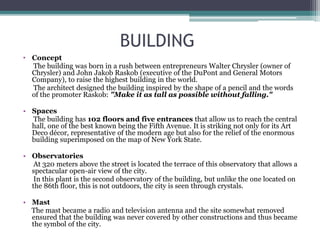
‱ Concept
The building was born in a rush between entrepreneurs Walter Chrysler (owner of
Chrysler) and John Jakob Raskob (executive of the DuPont and General Motors
Company), to raise the highest building in the world.
The architect designed the building inspired by the shape of a pencil and the words
of the promoter Raskob: "Make it as tall as possible without falling."
‱ Spaces
The building has 102 floors and five entrances that allow us to reach the central
hall, one of the best known being the Fifth Avenue. It is striking not only for its Art
Deco décor, representative of the modern age but also for the relief of the enormous
building superimposed on the map of New York State.
‱ Observatories
At 320 meters above the street is located the terrace of this observatory that allows a
spectacular open-air view of the city.
In this plant is the second observatory of the building, but unlike the one located on
the 86th floor, this is not outdoors, the city is seen through crystals.
‱ Mast
The mast became a radio and television antenna and the site somewhat removed
ensured that the building was never covered by other constructions and thus became
the symbol of the city.
BUILDING
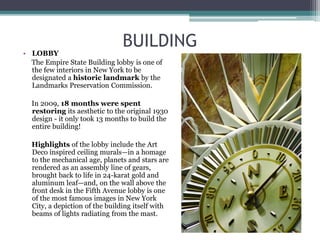
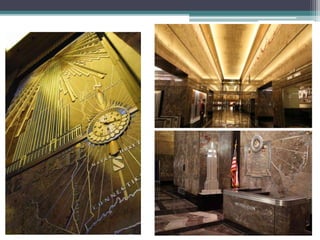
‱ LOBBY
The Empire State Building lobby is one of
the few interiors in New York to be
designated a historic landmark by the
Landmarks Preservation Commission.
In 2009, 18 months were spent
restoring its aesthetic to the original 1930
design - it only took 13 months to build the
entire building!
Highlights of the lobby include the Art
Deco inspired ceiling murals—in a homage
to the mechanical age, planets and stars are
rendered as an assembly line of gears,
brought back to life in 24-karat gold and
aluminum leaf—and, on the wall above the
front desk in the Fifth Avenue lobby is one
of the most famous images in New York
City, a depiction of the building itself with
beams of lights radiating from the mast.
BUILDING
‱ SUSTAINABILITY EXHIBIT
Being a world icon means setting a world-class example. That’s why, in 2009, the Empire
State Building began an award-winning sustainability retrofit. Upon completion of the
program, ESB will reduce total energy usage by more than 38 percent energy
costs by $4.4 million annually and carbon emissions by 105,000 metric tons
over the next 15 years!
To educate visitors about the retrofit, they’ve installed a Sustainability Exhibit in the
2nd floor queue. The exhibit showcases the state-of-the-art technology and processes that
went into the overhaul. It tells the story of the remarkable renovation process in a fun,
comprehensible way, using a combination of digital displays, sculptures, and actual
building materials, sure to inspire visitors of all ages.
BUILDING
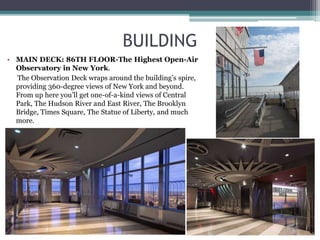
‱ MAIN DECK: 86TH FLOOR-The Highest Open-Air
Observatory in New York.
The Observation Deck wraps around the building’s spire,
providing 360-degree views of New York and beyond.
From up here you’ll get one-of-a-kind views of Central
Park, The Hudson River and East River, The Brooklyn
Bridge, Times Square, The Statue of Liberty, and much
more.
BUILDING
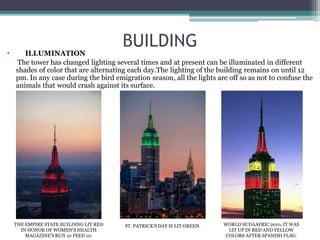
‱ ILLUMINATION
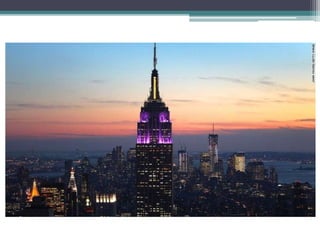
The tower has changed lighting several times and at present can be illuminated in different
shades of color that are alternating each day.The lighting of the building remains on until 12
pm. In any case during the bird emigration season, all the lights are off so as not to confuse the
animals that would crash against its surface.
THE EMPIRE STATE BUILDING LIT RED
IN HONOR OF WOMEN'S HEALTH
MAGAZINE'S RUN 10 FEED 10.
ST. PATRICK’S DAY IS LIT GREEN. WORLD SUDAAFRIC 2010, IT WAS
LIT UP IN RED AND YELLOW
COLORS AFTER SPANISH FLAG.
BUILDING
‱ Other spaces
In the building we can also find offices of different companies that occupy most of its
surface, 2 restaurants, a sushi bar, 3 cafes, 1 post office, 2 banks,
boutiques, and even shows like simulations of helicopter flights.
To access its 102 floors the Empire State has 73 elevators, eight of which are
high-speed and take 45 seconds to climb to the 80 floor or using the stairway that has
1860 steps to the 102 floor. It also has eight escalators that connect the lobby and
second floor areas.
The top 30 floors are illuminated with different colors depending on the
seasons and the various celebrations.
‱ Materials
650,000 square meters of useful area for whose construction were necessary:
‱ 10 million bricks
‱ 200,000 cubic feet of stone
‱ 410 days for construction
‱ $ 41 million cost
‱ 6,500 windows throughout the building
‱ 120 km of pipe
BUILDING
‱ 60,000 tons of steel were used for the structure,
‱ 40 million kw / hour of energy consumed
‱ 2,000 km of telephone cables
‱ At the entrance to Fifth Avenue, the lobby is lined with Hauteville marble pieces
and adorned with Art Deco decorations. In the exterior decoration of the
building used 930 square meters of marble Famosa and Strallante marble and
27,900 mÂČ of marble Hauteville and Rocheron for the hallways of elevators and
corridors in the office plants.
All of this involved 3,000 workers.
‱ Services
1. Fire Safety-
A special water system feeds 400 hose connections throughout the building.
2. Heating-
The local utility company facilitates steam using the 80 km of radiator tubes.
3. Air conditioner-
It is provided by 7,450 tons of refrigeration equipment (air conditioning was
installed in 1950 and renovated in 1984 and 1997).
4. Water supply-
120 km of pipes supply water to the tanks of various levels of floors, the highest
being the 101 floor, satisfying the average daily demand of 780 cubic meters.
5. Electrical supply-
750,000 meters of electrical wiring supply the 40 million kilowatt hours used by the
building and its tenants annually.
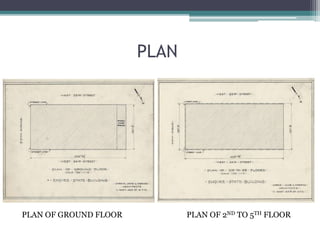
PLAN
PLAN OF GROUND FLOOR PLAN OF 2ND TO 5TH FLOOR
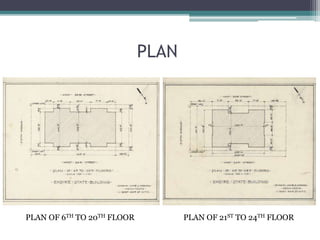
PLAN
PLAN OF 6TH TO 20TH FLOOR PLAN OF 21ST TO 24TH FLOOR
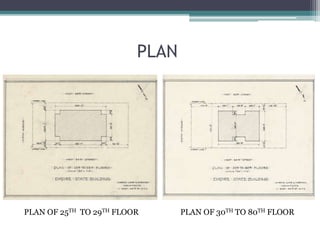
PLAN
PLAN OF 25TH TO 29TH FLOOR PLAN OF 30TH TO 80TH FLOOR
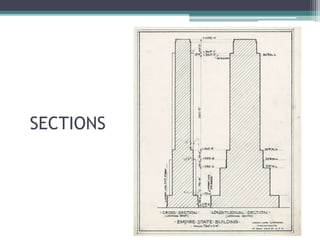
SECTIONS
Architectural theory- The Empire State Building

Architectural theory- The Empire State Building

  • 1.
    ARCHITECTURAL THEORY THE EMPIRESTATE BUILDING NEW YORK, USA ANIKA MOMIN MU1538 RIZVI COLLEGE OF ARCHITECTURE
  • 3.
  • 4.
    INTRODUCTION ‱ The buildingis born of entrepreneurs Walter Chrysler, owner of Chrysler and John Jakob Raskob, executive of the General Motors Company to raise the highest building in the world and designed by William F. Lamb, Gregory Johnson, Yasuo Matsui. ‱ The Empire State Building was a record building, averaging 4.5 stories per week. The excavation of the site began on January 22, 1930, construction on March 17, and after a year and 45 days of construction, the building was inaugurated on May 1, 1931, becoming for 40 years the highest building in the world, to the completion of the World Trade Center Twin Towers in 1977. ‱ It measures 443.20 meters including the antenna of 62 meters and built area of 254.385 square meters. ‱ After 11 months the main building of 85 floors was finished, and in March 1931 the interior was finished. On the opening night of May 1, US President Herbert Hoover pressed a button in the White House and at that moment the Empire State was lit for the first time in Manhattan.
  • 5.
    HISTORICAL TIMELINE ‱ 1799:The City of New York sells a virgin tract (now bounded by Broadway and Sixth Avenue on the west, Madison Avenue on the east, 33rd Street on the south and 36th Street on the north) for $2,600 to John Thompson for farming. ‱ 1825: Thompson sells the farm to Charles Lawton for $10,000. ‱ 1827: William Backhouse Astor buys the farm for $20,500 as an investment. ‱ 1893: The Waldorf Hotel was erected on the corner of Fifth Avenue and 33rd Street. ‱ 1897: Mrs. William Backhouse Astor razes her mansion at Fifth Avenue and 34th Street and the Astoria Hotel is erected on the site. The new complex is known as the Waldorf Astoria Hotel. ‱ 1928: The Waldorf Astoria Hotel is sold to Bethlehem Engineering Corporation for an estimated $20 million. ‱ 1929: John Jakob Raskob (former General Motors executive), Coleman du Pont, Pierre S. du Pont, Louis G. Kaufman and Ellis P. Earle, form Empire State, Inc. and name Alfred E. Smith, former Governor of New York to head the corporation. ‱ 1930: On March 17, construction of the Empire State Building begins. Under the direction of architects Shreve, Lamb & Harmon Associates, the framework rises 4 œ stories per week.
  • 6.
    HISTORICAL TIMELINE ‱ 1931:On May 1, President Hoover presses a button in Washington, D.C. officially opening and turning on the Empire State Building’s lights. ‱ 1945: A B-25 Bomber crashes into the 79th floor of ESB during heavy fog on a Saturday morning. The building’s construction limits the spread of fire and despite a 20-foot gash, the Empire State Building is open for business-as-usual on Monday. ‱ 1951: The John J. Raskob estate sells the building for $34 million to a syndicate including Roger I. Stevens and the Chicago Crown family who immediately sell the building to Prudential Insurance Company of America for $17 million, which then enters into a long-term ground lease with the Stevens syndicate. ‱ 1955: The American Society of Civil Engineers selects ESB as one of the seven greatest engineering achievements in America’s history. ‱ 1961: August 23, Lawrence A. Wien, Peter L. Malkin, and Harry B. Helmsley buy the building for $65 million. The price, which does not include the land, is the highest ever paid for a single building. ‱ 1966: The manually operated high-speed elevators on the first 80 floors of the building are refit for automatic operation.
  • 7.
    HISTORICAL TIMELINE ‱ 1980:The Empire State Building gets its own zip code: 10118. ‱ 1981: On May 18, the New York City Landmarks Preservation Commission declares the building a Landmark. ‱ 1982: On December 20, the Empire State Building is listed on the State and National Register of Historic Places. ‱ 1986: The Empire State Building is recognized as a National Historic Landmark by the National Parks Services, U.S. Department of the Interior and a commemorative plaque is awarded. ‱ 2002: Peter L. Malkin and Anthony E. Malkin led the purchase of the land under the Empire State Building. ‱ 2006: ESB celebrates its 75th anniversary and ownership presents a plan for the Empire State ReBuilding program, including a complete restoration and recreation of ESB’s landmarked, Art Deco masterpiece lobby and the faithful recreation of the original gold and aluminum ceiling. ‱ 2007: The Empire State Building is ranked number one on the list of America’s Favorite Architecture by the American Institute of Architects.
  • 8.
    HISTORICAL TIMELINE ‱ 2009:President Bill Clinton, Mayor Michael Bloomberg, and Anthony Malkin announced the Empire State Building's groundbreaking energy efficiency retrofit program, making it the global model for retrofitting existing buildings. ‱ 2009: September 29, the newly renovated ceiling in the ESB lobby is unveiled. The renovation takes longer to complete than the original construction of the building. ‱ 2011: ESB receives 2011 Green Power Leadership Award from the U.S. Environmental Protection Agency (EPA). ‱ 2012: The Empire State Building unveiled its new LED lighting system, driven by high speed computers and capable of 16,000,000 different colors. ‱ 2012: Monitoring and verification prove ESB’s retrofit project exceeds projected energy savings for the second straight year and reduces costs by millions of dollars.
  • 9.
    BUILDING ‱ Concept The buildingwas born in a rush between entrepreneurs Walter Chrysler (owner of Chrysler) and John Jakob Raskob (executive of the DuPont and General Motors Company), to raise the highest building in the world. The architect designed the building inspired by the shape of a pencil and the words of the promoter Raskob: "Make it as tall as possible without falling." ‱ Spaces The building has 102 floors and five entrances that allow us to reach the central hall, one of the best known being the Fifth Avenue. It is striking not only for its Art Deco dĂ©cor, representative of the modern age but also for the relief of the enormous building superimposed on the map of New York State. ‱ Observatories At 320 meters above the street is located the terrace of this observatory that allows a spectacular open-air view of the city. In this plant is the second observatory of the building, but unlike the one located on the 86th floor, this is not outdoors, the city is seen through crystals. ‱ Mast The mast became a radio and television antenna and the site somewhat removed ensured that the building was never covered by other constructions and thus became the symbol of the city.
  • 10.
    BUILDING ‱ LOBBY The EmpireState Building lobby is one of the few interiors in New York to be designated a historic landmark by the Landmarks Preservation Commission. In 2009, 18 months were spent restoring its aesthetic to the original 1930 design - it only took 13 months to build the entire building! Highlights of the lobby include the Art Deco inspired ceiling murals—in a homage to the mechanical age, planets and stars are rendered as an assembly line of gears, brought back to life in 24-karat gold and aluminum leaf—and, on the wall above the front desk in the Fifth Avenue lobby is one of the most famous images in New York City, a depiction of the building itself with beams of lights radiating from the mast.
  • 12.
    BUILDING ‱ SUSTAINABILITY EXHIBIT Beinga world icon means setting a world-class example. That’s why, in 2009, the Empire State Building began an award-winning sustainability retrofit. Upon completion of the program, ESB will reduce total energy usage by more than 38 percent energy costs by $4.4 million annually and carbon emissions by 105,000 metric tons over the next 15 years! To educate visitors about the retrofit, they’ve installed a Sustainability Exhibit in the 2nd floor queue. The exhibit showcases the state-of-the-art technology and processes that went into the overhaul. It tells the story of the remarkable renovation process in a fun, comprehensible way, using a combination of digital displays, sculptures, and actual building materials, sure to inspire visitors of all ages.
  • 13.
    BUILDING ‱ MAIN DECK:86TH FLOOR-The Highest Open-Air Observatory in New York. The Observation Deck wraps around the building’s spire, providing 360-degree views of New York and beyond. From up here you’ll get one-of-a-kind views of Central Park, The Hudson River and East River, The Brooklyn Bridge, Times Square, The Statue of Liberty, and much more.
  • 14.
    BUILDING ‱ ILLUMINATION The towerhas changed lighting several times and at present can be illuminated in different shades of color that are alternating each day.The lighting of the building remains on until 12 pm. In any case during the bird emigration season, all the lights are off so as not to confuse the animals that would crash against its surface. THE EMPIRE STATE BUILDING LIT RED IN HONOR OF WOMEN'S HEALTH MAGAZINE'S RUN 10 FEED 10. ST. PATRICK’S DAY IS LIT GREEN. WORLD SUDAAFRIC 2010, IT WAS LIT UP IN RED AND YELLOW COLORS AFTER SPANISH FLAG.
  • 15.
    BUILDING ‱ Other spaces Inthe building we can also find offices of different companies that occupy most of its surface, 2 restaurants, a sushi bar, 3 cafes, 1 post office, 2 banks, boutiques, and even shows like simulations of helicopter flights. To access its 102 floors the Empire State has 73 elevators, eight of which are high-speed and take 45 seconds to climb to the 80 floor or using the stairway that has 1860 steps to the 102 floor. It also has eight escalators that connect the lobby and second floor areas. The top 30 floors are illuminated with different colors depending on the seasons and the various celebrations. ‱ Materials 650,000 square meters of useful area for whose construction were necessary: ‱ 10 million bricks ‱ 200,000 cubic feet of stone ‱ 410 days for construction ‱ $ 41 million cost ‱ 6,500 windows throughout the building ‱ 120 km of pipe
  • 16.
    BUILDING ‱ 60,000 tonsof steel were used for the structure, ‱ 40 million kw / hour of energy consumed ‱ 2,000 km of telephone cables ‱ At the entrance to Fifth Avenue, the lobby is lined with Hauteville marble pieces and adorned with Art Deco decorations. In the exterior decoration of the building used 930 square meters of marble Famosa and Strallante marble and 27,900 mÂČ of marble Hauteville and Rocheron for the hallways of elevators and corridors in the office plants. All of this involved 3,000 workers. ‱ Services 1. Fire Safety- A special water system feeds 400 hose connections throughout the building. 2. Heating- The local utility company facilitates steam using the 80 km of radiator tubes. 3. Air conditioner- It is provided by 7,450 tons of refrigeration equipment (air conditioning was installed in 1950 and renovated in 1984 and 1997). 4. Water supply- 120 km of pipes supply water to the tanks of various levels of floors, the highest being the 101 floor, satisfying the average daily demand of 780 cubic meters. 5. Electrical supply- 750,000 meters of electrical wiring supply the 40 million kilowatt hours used by the building and its tenants annually.
  • 17.
    PLAN PLAN OF GROUNDFLOOR PLAN OF 2ND TO 5TH FLOOR
  • 18.
    PLAN PLAN OF 6THTO 20TH FLOOR PLAN OF 21ST TO 24TH FLOOR
  • 19.
    PLAN PLAN OF 25THTO 29TH FLOOR PLAN OF 30TH TO 80TH FLOOR
  • 20.