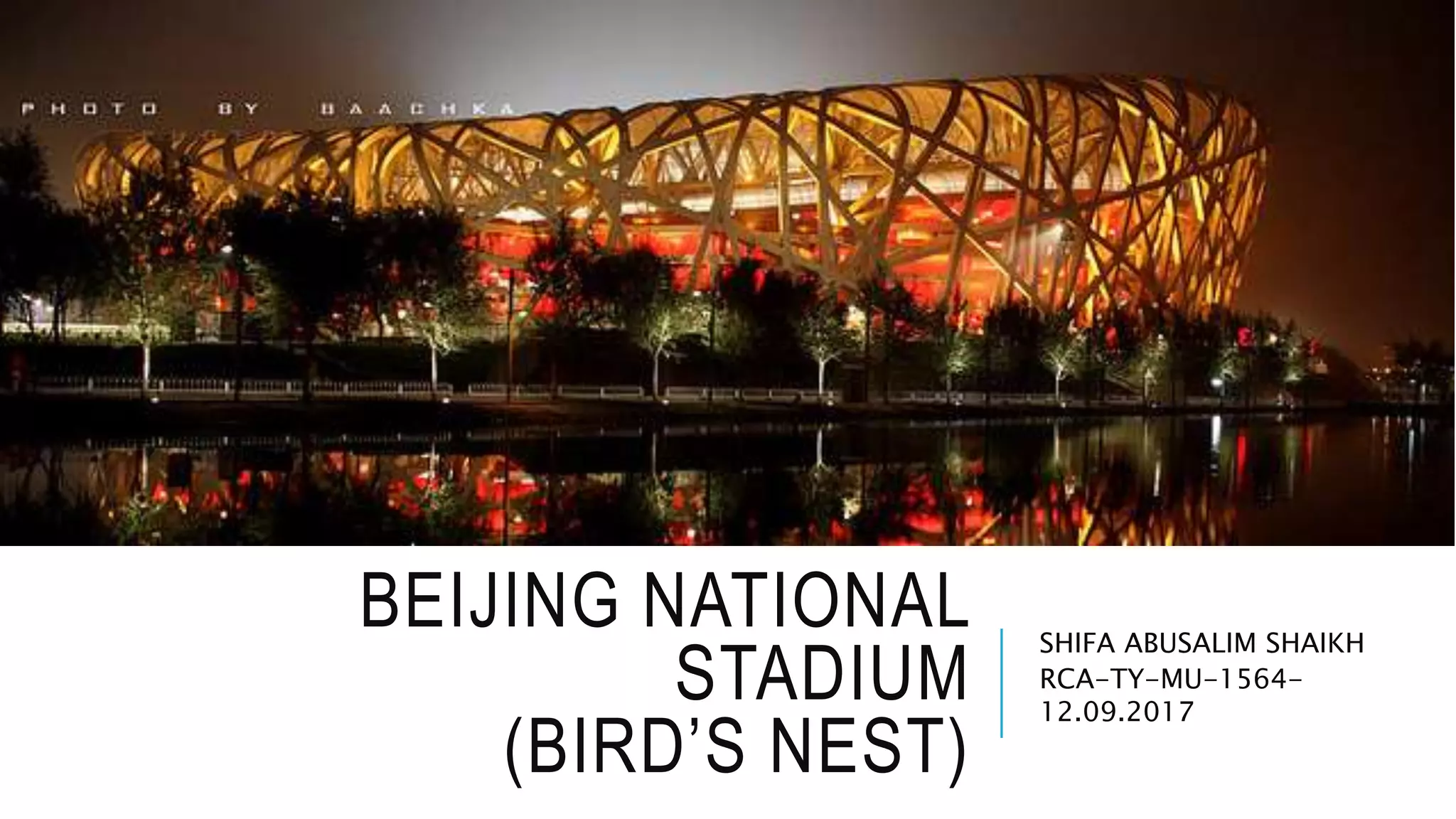
BEIJING NATIONAL
STADIUM
(BIRD’S NEST)
SHIFA ABUSALIM SHAIKH
RCA-TY-MU-1564-
12.09.2017
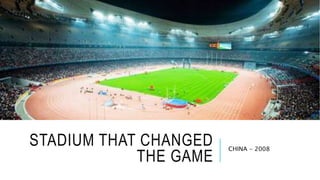
STADIUM THAT CHANGED
THE GAME
CHINA - 2008
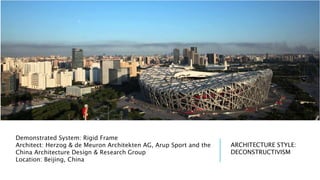
Demonstrated System: Rigid Frame
Architect: Herzog & de Meuron Architekten AG, Arup Sport and the
China Architecture Design & Research Group
Location: Beijing, China
ARCHITECTURE STYLE:
DECONSTRUCTIVISM
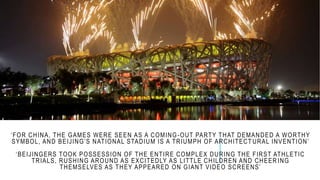
‘FOR CHINA, THE GAMES WERE SEEN AS A COMING-OUT PARTY THAT DEMANDED A WORTHY
SYMBOL, AND BEIJING’S NATIONAL STADIUM IS A TRIUMPH OF ARCHITECT URAL INVENTION’
‘BEIJINGERS TOOK POSSESSION OF THE ENTIRE COMPLEX DURING THE FIRST ATHLETIC
TRIALS, RUSHING AROUND AS EXCITEDLY AS LITTLE CHILDREN AND CHEER ING
THEMSELVES AS THEY APPEARED ON GIANT VIDEO SCREENS’
FACT FILE
SEATING 100,000 PEOPLE - WITH A GROSS FLOOR AREA OF APPROXIMATELY 250,000 SQUARE METERS, THIS
70 METER HIGH STRUCTURE RESEMBLES A BIRD’S NEST, WHICH IS SYMBOLICALLY IMPORTANT IN CHINESE
CULTURE.
THE CONSTRUCTION WAS HALTED ONCE IN 2004 BECAUSE OF EXTREMELY HIGH CONSTRUCTION COSTS, AND
AFTER ABANDONING THE RETRACTABLE CEILING OPENING, RESUMED IN 2005.
THE EXTERIOR STRUCTURE CONSISTS OF 36 KM OF UNWRAPPED STEEL, WITH A COMBINED WEIGHT OF 45,000
TONS.
THESE TWISTED STEEL MEMBERS ARE ALL UNIQUE, EVERY MEMBER WAS INDIVIDUALLY CAST OFF SITE AND
PICKED IN PLACE.
THE MOMENT CONNECTIONS CREATED BY THIS STRUCTURE ARE VERY SENSITIVE; EVERY MEMBER RELIES ON
THE INTEGRITY OF ALL THE OTHER MEMBERS IT TOUCHES - SHOULD ONE MEMBER FAIL, THE ENTIRE
STRUCTURE COULD EASILY COLLAPSE.
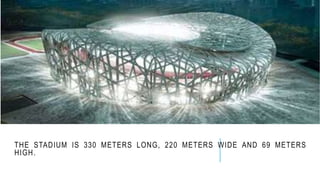
THE STADIUM IS 330 METERS LONG, 220 METERS WIDE AND 69 METERS
HIGH.
STADIUM DESIGN
In 2002, the Beijing Municipal Planning Commission held an international competition for the design
of the main stadium for the 29th Olympic Games. As the building is intended to house the opening
and closing ceremonies, as well as the track and field events, the original competition program
included the following main criteria (Beijing, 2002):
• A stadium capacity of approximately 100 000 people during the games (to be
reduced to approximately 80 000 afterwards),
• A retractable roof,
• A multi-functional design, to efficiently incorporate a range of uses in the future; and
• An emphasis on green building and advanced technology.
After passing through two rounds of adjudication, Herzog and de Meuron’s proposal emerged as the
The stadium consists of an inner bowl of concrete seating surrounded by a façade of twisted steel,
with a public concourse area sandwiched between the two. The elliptical building footprint is
dictated by “the constraints of seating 100 000 people around an athletics track and field”.
Meanwhile, the variation in the height of the stands between the major and minor axes of the
ellipse allows for the majority of spectators to be seated along the longest length of the track, and
“ensures that all spectators are within the same radius of view from the corners of the field”.
In all, the structure encloses a volume approximately 333 meters long by 284 meters wide and 69
meters tall.
The circular shape of the stadium represents heaven, but has been described as a bird's nest, with
its pattern inspired by Chinese-style crazed pottery. A series of cantilevered trusses has been
designed to support the roof, shading the seats. While designing the stadium, architects and
engineers also ensured comfortable seats and optimum view for all spectators.
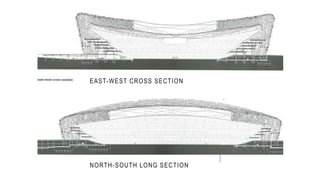
EAST-WEST CROSS SECTION
NORTH-SOUTH LONG SECTION
FEATURES
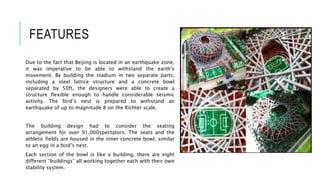
Due to the fact that Beijing is located in an earthquake zone,
it was imperative to be able to withstand the earth’s
movement. By building the stadium in two separate parts,
including a steel lattice structure and a concrete bowl
separated by 50ft, the designers were able to create a
structure flexible enough to handle considerable seismic
activity. The bird’s nest is prepared to withstand an
earthquake of up to magnitude 8 on the Richter scale.
The building design had to consider the seating
arrangement for over 91,000spectators. The seats and the
athletic fields are housed in the inner concrete bowl, similar
to an egg in a bird’s nest.
Each section of the bowl is like a building, there are eight
different “buildings” all working together each with their own
stability system.
BIOMIMICRY
Drawing from the structural strength and beauty of natural objects is a growing trend as architects
and designers become increasingly interested in the efficient use of energy and materials. According
to janine benyus this movement is known as biomimicry; “a new science that studies nature’s models
and then imitates or takes inspiration from these designs and processes to solve human problems.”
The concept of biomimicry in itself is nothing new. Human structures have borrowed from nature
throughout history. Our first shelters, for example, were little more than upturned bird’s nests;
formed of branches and insulated against the elements by whatever materials were readily available. In
fact, it could be argued that biomimicry is not a new movement, but a return to our earliest
inspirations. New technologies, however, have allowed us to investigate and replicate systems that our
ancestors were unable to exploit on a grand scale.
USE OF STEEL
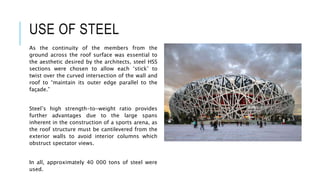
As the continuity of the members from the
ground across the roof surface was essential to
the aesthetic desired by the architects, steel HSS
sections were chosen to allow each ‘stick’ to
twist over the curved intersection of the wall and
roof to “maintain its outer edge parallel to the
façade.”
Steel’s high strength-to-weight ratio provides
further advantages due to the large spans
inherent in the construction of a sports arena, as
the roof structure must be cantilevered from the
exterior walls to avoid interior columns which
obstruct spectator views.
In all, approximately 40 000 tons of steel were
used.
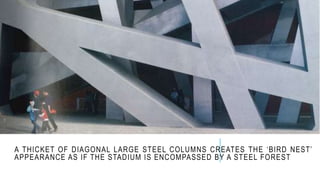
A THICKET OF DIAGONAL LARGE STEEL COLUMNS CREATES THE ‘BIRD NEST’
APPEARANCE AS IF THE STADIUM IS ENCOMPASSED BY A STEEL FOREST
GREEN FEATURES
Aside from the structural advantages provided by steel, it has the added benefit of being easily recyclable,
and thus ties in with the Beijing Olympic organizers’ focus on sustainable design, and the driving
principles of biometric design.
Beijing’s Olympic Stadium draws directly from nature, as elements of the bird nest are exposed as its
major aesthetic motive, with little material wasted to disguise the structure. In keeping with the bird’s nest
analogy, the façade is in-filled with translucent ETFE panels in much the same way that a nest is insulated
by stuffing small pieces of material between the twigs that make up the structure.
The ETFE panels serve to protect spectators from the elements and provide acoustic insulation, while
allowing sunlight to filter through to feed the natural grass field. Furthermore, the panels are lighter than
either glass or aluminum panels would be, reducing the dead load supported by the roof. The panels are
also self-cleaning and durable, reducing costly maintenance.
Openings in the façade allow natural ventilation as air filters through the public concourse, into the
CHALLENGES
The team wanted an optimum balance between making sure every spectator had a good view,
creating a good atmosphere and designing an elegant building. It also needed to be aware of
the different uses of the stadium; for example, when used as an athletics stadium, the most
important view is at the finish line of the running track but when used for football, the best
views are at the center line.
Getting everyone close enough in such a big venue was a real challenge and getting the
calculations right was an immense task. For example, changing the height of the first row of
seating by just 100mm would make the stadium significantly larger and higher and increase the
cost by several million pounds.
While the surface of the structure is simple, the geometry is complex – the calculations were so
numerous and complicated that they could not be solved manually. Software was needed to
make sure that the web of twisting steel sections fitted together, as they have to twist and bend
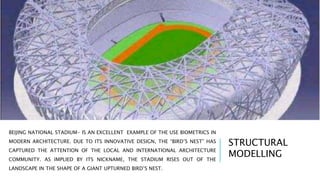
BEIJING NATIONAL STADIUM- IS AN EXCELLENT EXAMPLE OF THE USE BIOMETRICS IN
MODERN ARCHITECTURE. DUE TO ITS INNOVATIVE DESIGN, THE “BIRD’S NEST” HAS
CAPTURED THE ATTENTION OF THE LOCAL AND INTERNATIONAL ARCHITECTURE
COMMUNITY. AS IMPLIED BY ITS NICKNAME, THE STADIUM RISES OUT OF THE
LANDSCAPE IN THE SHAPE OF A GIANT UPTURNED BIRD’S NEST.
STRUCTURAL
MODELLING
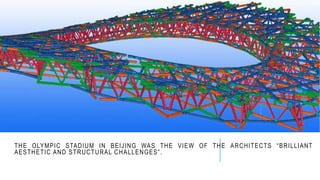
THE OLYMPIC STADIUM IN BEIJING WAS THE VIEW OF THE ARCHITECTS “BRILLIANT
AESTHETIC AND STRUCTURAL CHALLENGES”.
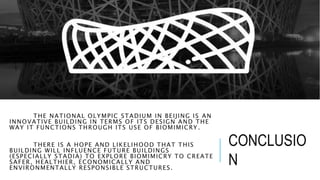
THE NATIONAL OLYMPIC STADIUM IN BEIJING IS AN
INNOVATIVE BUILDING IN TERMS OF ITS DESIGN AND THE
WAY IT FUNCTIONS THROUGH ITS USE OF BIOMIMICRY .
THERE IS A HOPE AND LIKELIHOOD THAT THIS
BUILDING WILL INFLUENCE FUTURE BUILDINGS
(ESPECIALLY STADIA) TO EXPLORE BIOMIMICRY TO CREATE
SAFER, HEALTHIER, ECONOMICALLY AND
ENVIRONMENTALLY RESPONSIBLE STRUCTURES.
CONCLUSIO
N
FUTURE TRENDS IN BIOMIMICRY
Most cities built in the near past seem to separate man from nature. An office building in Tokyo may
look like and office building in Munich or in Chicago despite the fact that these cities have different
cultures, climates and topographies. Thanks to growing interest in sustainability, and the growing
trend of biomimicry, there is hope that in the future, buildings will be better adapted to their
environmental and cultural context.
They may not necessarily look like flowers and trees, but try to operate like them instead. Buildings in
hot, dry climates may focus on ways of recycling water while buildings in cold climates would try to
find ways to conserve heat.
Beijing National Stadium is only one contemporary example of the use of biomimicry in Architecture.
More and more architects see the benefits of using biomimicry in architecture and plans for buildings
are being made that incorporate this science. The national swimming center, also being built for the
2008 Olympic Games in Beijing, is further example of sustainable architecture using biomimetic
THANK-YOU
SHIFA ABUSALIM SHAIKH
RCA-TY-MU-1564-
12.09.2017

Beijing national stadium

  • 1.
    BEIJING NATIONAL STADIUM (BIRD’S NEST) SHIFAABUSALIM SHAIKH RCA-TY-MU-1564- 12.09.2017
  • 2.
    STADIUM THAT CHANGED THEGAME CHINA - 2008
  • 3.
    Demonstrated System: RigidFrame Architect: Herzog & de Meuron Architekten AG, Arup Sport and the China Architecture Design & Research Group Location: Beijing, China ARCHITECTURE STYLE: DECONSTRUCTIVISM
  • 4.
    ‘FOR CHINA, THEGAMES WERE SEEN AS A COMING-OUT PARTY THAT DEMANDED A WORTHY SYMBOL, AND BEIJING’S NATIONAL STADIUM IS A TRIUMPH OF ARCHITECT URAL INVENTION’ ‘BEIJINGERS TOOK POSSESSION OF THE ENTIRE COMPLEX DURING THE FIRST ATHLETIC TRIALS, RUSHING AROUND AS EXCITEDLY AS LITTLE CHILDREN AND CHEER ING THEMSELVES AS THEY APPEARED ON GIANT VIDEO SCREENS’
  • 5.
    FACT FILE SEATING 100,000PEOPLE - WITH A GROSS FLOOR AREA OF APPROXIMATELY 250,000 SQUARE METERS, THIS 70 METER HIGH STRUCTURE RESEMBLES A BIRD’S NEST, WHICH IS SYMBOLICALLY IMPORTANT IN CHINESE CULTURE. THE CONSTRUCTION WAS HALTED ONCE IN 2004 BECAUSE OF EXTREMELY HIGH CONSTRUCTION COSTS, AND AFTER ABANDONING THE RETRACTABLE CEILING OPENING, RESUMED IN 2005. THE EXTERIOR STRUCTURE CONSISTS OF 36 KM OF UNWRAPPED STEEL, WITH A COMBINED WEIGHT OF 45,000 TONS. THESE TWISTED STEEL MEMBERS ARE ALL UNIQUE, EVERY MEMBER WAS INDIVIDUALLY CAST OFF SITE AND PICKED IN PLACE. THE MOMENT CONNECTIONS CREATED BY THIS STRUCTURE ARE VERY SENSITIVE; EVERY MEMBER RELIES ON THE INTEGRITY OF ALL THE OTHER MEMBERS IT TOUCHES - SHOULD ONE MEMBER FAIL, THE ENTIRE STRUCTURE COULD EASILY COLLAPSE.
  • 6.
    THE STADIUM IS330 METERS LONG, 220 METERS WIDE AND 69 METERS HIGH.
  • 7.
    STADIUM DESIGN In 2002,the Beijing Municipal Planning Commission held an international competition for the design of the main stadium for the 29th Olympic Games. As the building is intended to house the opening and closing ceremonies, as well as the track and field events, the original competition program included the following main criteria (Beijing, 2002): • A stadium capacity of approximately 100 000 people during the games (to be reduced to approximately 80 000 afterwards), • A retractable roof, • A multi-functional design, to efficiently incorporate a range of uses in the future; and • An emphasis on green building and advanced technology. After passing through two rounds of adjudication, Herzog and de Meuron’s proposal emerged as the
  • 8.
    The stadium consistsof an inner bowl of concrete seating surrounded by a façade of twisted steel, with a public concourse area sandwiched between the two. The elliptical building footprint is dictated by “the constraints of seating 100 000 people around an athletics track and field”. Meanwhile, the variation in the height of the stands between the major and minor axes of the ellipse allows for the majority of spectators to be seated along the longest length of the track, and “ensures that all spectators are within the same radius of view from the corners of the field”. In all, the structure encloses a volume approximately 333 meters long by 284 meters wide and 69 meters tall. The circular shape of the stadium represents heaven, but has been described as a bird's nest, with its pattern inspired by Chinese-style crazed pottery. A series of cantilevered trusses has been designed to support the roof, shading the seats. While designing the stadium, architects and engineers also ensured comfortable seats and optimum view for all spectators.
  • 9.
  • 10.
    FEATURES Due to thefact that Beijing is located in an earthquake zone, it was imperative to be able to withstand the earth’s movement. By building the stadium in two separate parts, including a steel lattice structure and a concrete bowl separated by 50ft, the designers were able to create a structure flexible enough to handle considerable seismic activity. The bird’s nest is prepared to withstand an earthquake of up to magnitude 8 on the Richter scale. The building design had to consider the seating arrangement for over 91,000spectators. The seats and the athletic fields are housed in the inner concrete bowl, similar to an egg in a bird’s nest. Each section of the bowl is like a building, there are eight different “buildings” all working together each with their own stability system.
  • 11.
    BIOMIMICRY Drawing from thestructural strength and beauty of natural objects is a growing trend as architects and designers become increasingly interested in the efficient use of energy and materials. According to janine benyus this movement is known as biomimicry; “a new science that studies nature’s models and then imitates or takes inspiration from these designs and processes to solve human problems.” The concept of biomimicry in itself is nothing new. Human structures have borrowed from nature throughout history. Our first shelters, for example, were little more than upturned bird’s nests; formed of branches and insulated against the elements by whatever materials were readily available. In fact, it could be argued that biomimicry is not a new movement, but a return to our earliest inspirations. New technologies, however, have allowed us to investigate and replicate systems that our ancestors were unable to exploit on a grand scale.
  • 12.
    USE OF STEEL Asthe continuity of the members from the ground across the roof surface was essential to the aesthetic desired by the architects, steel HSS sections were chosen to allow each ‘stick’ to twist over the curved intersection of the wall and roof to “maintain its outer edge parallel to the façade.” Steel’s high strength-to-weight ratio provides further advantages due to the large spans inherent in the construction of a sports arena, as the roof structure must be cantilevered from the exterior walls to avoid interior columns which obstruct spectator views. In all, approximately 40 000 tons of steel were used.
  • 13.
    A THICKET OFDIAGONAL LARGE STEEL COLUMNS CREATES THE ‘BIRD NEST’ APPEARANCE AS IF THE STADIUM IS ENCOMPASSED BY A STEEL FOREST
  • 14.
    GREEN FEATURES Aside fromthe structural advantages provided by steel, it has the added benefit of being easily recyclable, and thus ties in with the Beijing Olympic organizers’ focus on sustainable design, and the driving principles of biometric design. Beijing’s Olympic Stadium draws directly from nature, as elements of the bird nest are exposed as its major aesthetic motive, with little material wasted to disguise the structure. In keeping with the bird’s nest analogy, the façade is in-filled with translucent ETFE panels in much the same way that a nest is insulated by stuffing small pieces of material between the twigs that make up the structure. The ETFE panels serve to protect spectators from the elements and provide acoustic insulation, while allowing sunlight to filter through to feed the natural grass field. Furthermore, the panels are lighter than either glass or aluminum panels would be, reducing the dead load supported by the roof. The panels are also self-cleaning and durable, reducing costly maintenance. Openings in the façade allow natural ventilation as air filters through the public concourse, into the
  • 15.
    CHALLENGES The team wantedan optimum balance between making sure every spectator had a good view, creating a good atmosphere and designing an elegant building. It also needed to be aware of the different uses of the stadium; for example, when used as an athletics stadium, the most important view is at the finish line of the running track but when used for football, the best views are at the center line. Getting everyone close enough in such a big venue was a real challenge and getting the calculations right was an immense task. For example, changing the height of the first row of seating by just 100mm would make the stadium significantly larger and higher and increase the cost by several million pounds. While the surface of the structure is simple, the geometry is complex – the calculations were so numerous and complicated that they could not be solved manually. Software was needed to make sure that the web of twisting steel sections fitted together, as they have to twist and bend
  • 16.
    BEIJING NATIONAL STADIUM-IS AN EXCELLENT EXAMPLE OF THE USE BIOMETRICS IN MODERN ARCHITECTURE. DUE TO ITS INNOVATIVE DESIGN, THE “BIRD’S NEST” HAS CAPTURED THE ATTENTION OF THE LOCAL AND INTERNATIONAL ARCHITECTURE COMMUNITY. AS IMPLIED BY ITS NICKNAME, THE STADIUM RISES OUT OF THE LANDSCAPE IN THE SHAPE OF A GIANT UPTURNED BIRD’S NEST. STRUCTURAL MODELLING
  • 17.
    THE OLYMPIC STADIUMIN BEIJING WAS THE VIEW OF THE ARCHITECTS “BRILLIANT AESTHETIC AND STRUCTURAL CHALLENGES”.
  • 18.
    THE NATIONAL OLYMPICSTADIUM IN BEIJING IS AN INNOVATIVE BUILDING IN TERMS OF ITS DESIGN AND THE WAY IT FUNCTIONS THROUGH ITS USE OF BIOMIMICRY . THERE IS A HOPE AND LIKELIHOOD THAT THIS BUILDING WILL INFLUENCE FUTURE BUILDINGS (ESPECIALLY STADIA) TO EXPLORE BIOMIMICRY TO CREATE SAFER, HEALTHIER, ECONOMICALLY AND ENVIRONMENTALLY RESPONSIBLE STRUCTURES. CONCLUSIO N
  • 19.
    FUTURE TRENDS INBIOMIMICRY Most cities built in the near past seem to separate man from nature. An office building in Tokyo may look like and office building in Munich or in Chicago despite the fact that these cities have different cultures, climates and topographies. Thanks to growing interest in sustainability, and the growing trend of biomimicry, there is hope that in the future, buildings will be better adapted to their environmental and cultural context. They may not necessarily look like flowers and trees, but try to operate like them instead. Buildings in hot, dry climates may focus on ways of recycling water while buildings in cold climates would try to find ways to conserve heat. Beijing National Stadium is only one contemporary example of the use of biomimicry in Architecture. More and more architects see the benefits of using biomimicry in architecture and plans for buildings are being made that incorporate this science. The national swimming center, also being built for the 2008 Olympic Games in Beijing, is further example of sustainable architecture using biomimetic
  • 20.