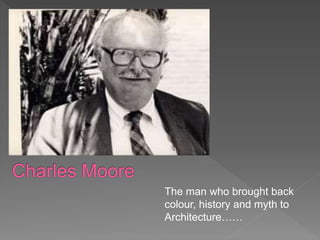




The man who brought back
colour, history and myth to
Architecture……
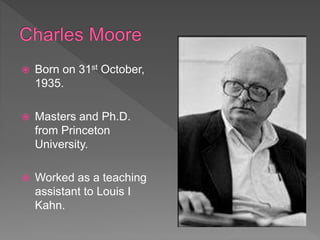
 Born on 31st October,
1935.
 Masters and Ph.D.
from Princeton
University.
 Worked as a teaching
assistant to Louis I
Kahn.
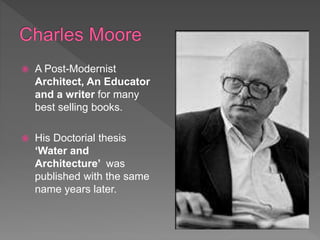
 A Post-Modernist
Architect, An Educator
and a writer for many
best selling books.
 His Doctorial thesis
‘Water and
Architecture’ was
published with the same
name years later.
 Design features having,
- Historical detail,
- -Ornament,
- - Fictional treatments,
- - Ironic significations
made Moore one of the chief innovators of Post-
Modern Architecture.
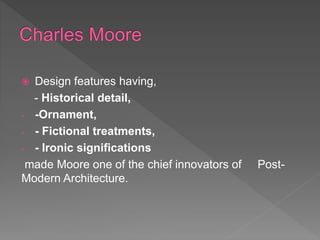
 Charles Moore believed that architecture must elicit
responses from all the senses, not only the visual.
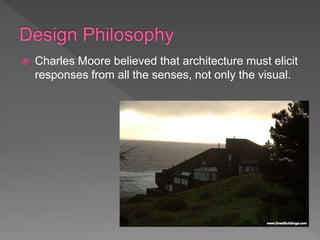
 He developed humanistic approach to architecture
in which each design attempts to engage users
within a clearly defined spatial environment.
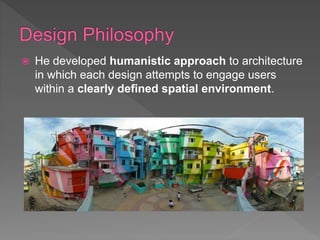
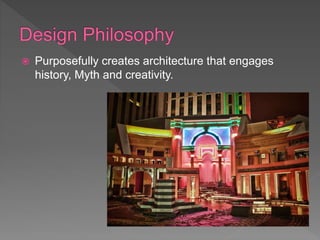
 Purposefully creates architecture that engages
history, Myth and creativity.
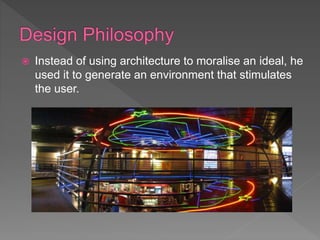
 Instead of using architecture to moralise an ideal, he
used it to generate an environment that stimulates
the user.
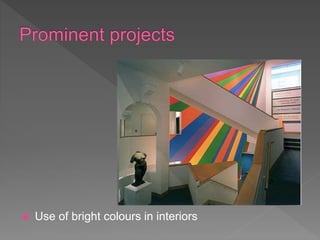
 Loud colours
 Super graphics stylistic collisions
 Re-use of historical design solutions.
 Use of non-traditional materials
 Materials like platinum tiles and Neon signs were used.
 Sea Ranch Condominium
 Piazza d’Italia
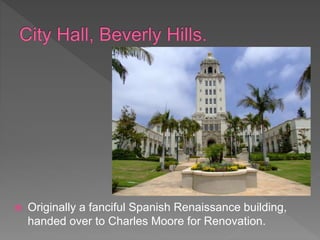
 City Hall, Beverly Hills,
 Haas school of business
 Washington state History Museum,
 Moore House, Orinda.
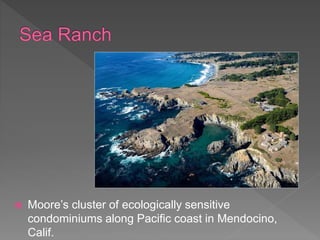
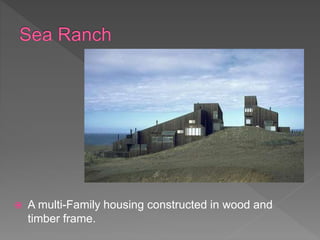
 Moore’s cluster of ecologically sensitive
condominiums along Pacific coast in Mendocino,
Calif.
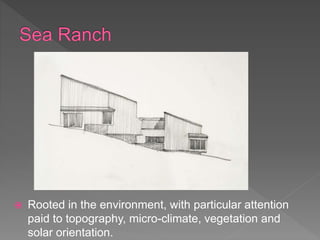
 Rooted in the environment, with particular attention
paid to topography, micro-climate, vegetation and
solar orientation.
 A multi-Family housing constructed in wood and
timber frame.
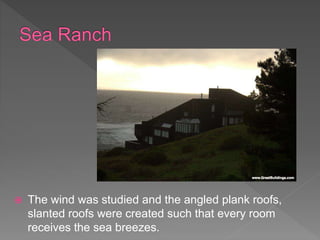
 The wind was studied and the angled plank roofs,
slanted roofs were created such that every room
receives the sea breezes.
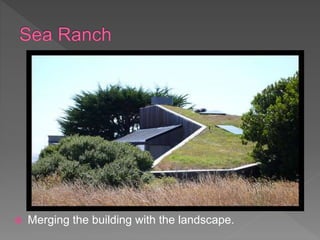
 Merging the building with the landscape.
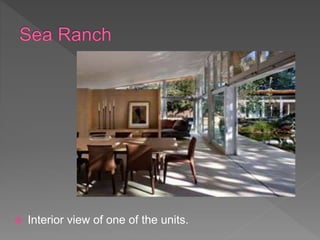
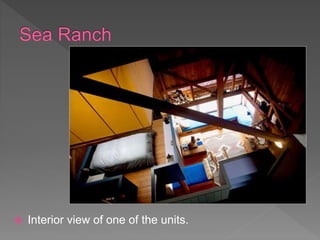
 Interior view of one of the units.
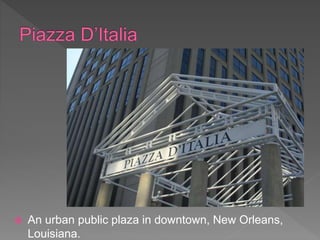
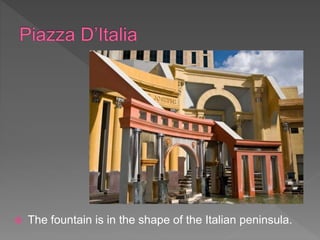
 An urban public plaza in downtown, New Orleans,
Louisiana.
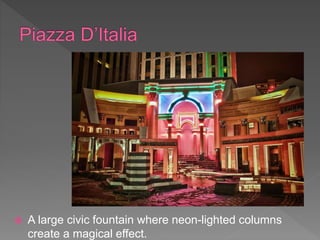
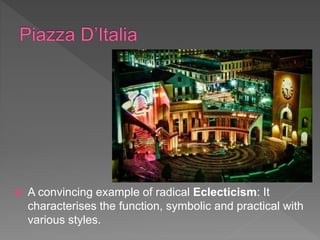
 A large civic fountain where neon-lighted columns
create a magical effect.
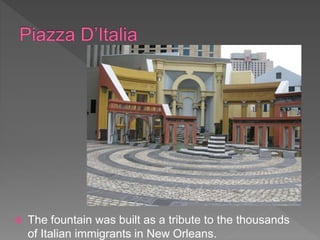
 The fountain was built as a tribute to the thousands
of Italian immigrants in New Orleans.
 The fountain is in the shape of the Italian peninsula.
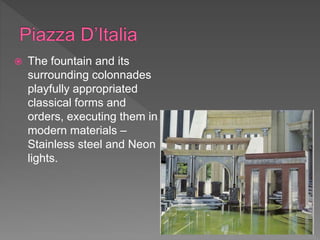
 The fountain and its
surrounding colonnades
playfully appropriated
classical forms and
orders, executing them in
modern materials –
Stainless steel and Neon
lights.
 A convincing example of radical Eclecticism: It
characterises the function, symbolic and practical with
various styles.
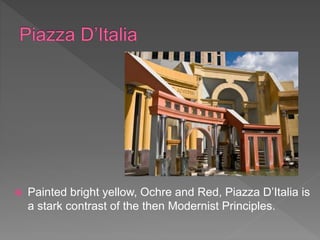
 Painted bright yellow, Ochre and Red, Piazza D’Italia is
a stark contrast of the then Modernist Principles.
 Originally a fanciful Spanish Renaissance building,
handed over to Charles Moore for Renovation.
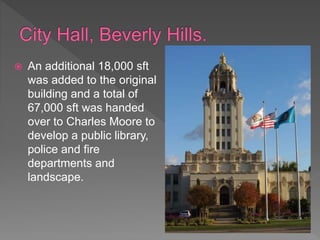
 An additional 18,000 sft
was added to the original
building and a total of
67,000 sft was handed
over to Charles Moore to
develop a public library,
police and fire
departments and
landscape.
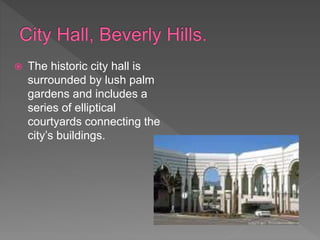
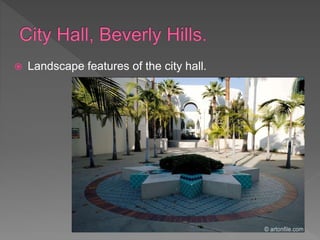
 The historic city hall is
surrounded by lush palm
gardens and includes a
series of elliptical
courtyards connecting the
city’s buildings.
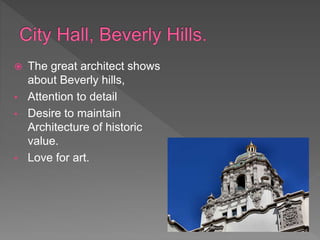
 The great architect shows
about Beverly hills,
• Attention to detail
• Desire to maintain
Architecture of historic
value.
• Love for art.
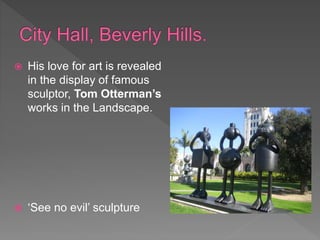
 His love for art is revealed
in the display of famous
sculptor, Tom Otterman’s
works in the Landscape.
 ‘See no evil’ sculpture
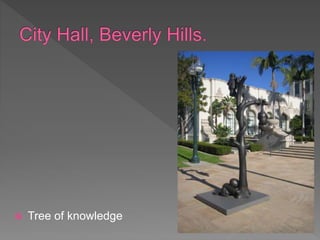
 Tree of knowledge
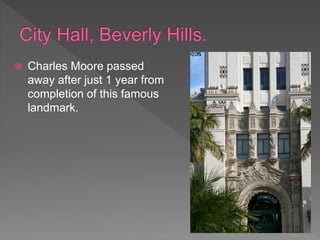
 Charles Moore passed
away after just 1 year from
completion of this famous
landmark.
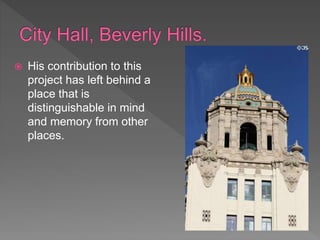
 His contribution to this
project has left behind a
place that is
distinguishable in mind
and memory from other
places.
 Landscape features of the city hall.
 New Orleans house
 Use of bright colours in interiors
 Use of bright colours in a slum housing exteriors
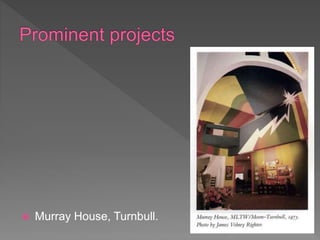
 Murray House, Turnbull.
Charles moore

Charles moore

  • 2.
    The man whobrought back colour, history and myth to Architecture……
  • 3.
     Born on31st October, 1935.  Masters and Ph.D. from Princeton University.  Worked as a teaching assistant to Louis I Kahn.
  • 4.
     A Post-Modernist Architect,An Educator and a writer for many best selling books.  His Doctorial thesis ‘Water and Architecture’ was published with the same name years later.
  • 5.
     Design featureshaving, - Historical detail, - -Ornament, - - Fictional treatments, - - Ironic significations made Moore one of the chief innovators of Post- Modern Architecture.
  • 6.
     Charles Moorebelieved that architecture must elicit responses from all the senses, not only the visual.
  • 7.
     He developedhumanistic approach to architecture in which each design attempts to engage users within a clearly defined spatial environment.
  • 8.
     Purposefully createsarchitecture that engages history, Myth and creativity.
  • 9.
     Instead ofusing architecture to moralise an ideal, he used it to generate an environment that stimulates the user.
  • 10.
     Loud colours Super graphics stylistic collisions  Re-use of historical design solutions.  Use of non-traditional materials  Materials like platinum tiles and Neon signs were used.
  • 11.
     Sea RanchCondominium  Piazza d’Italia  City Hall, Beverly Hills,  Haas school of business  Washington state History Museum,  Moore House, Orinda.
  • 12.
     Moore’s clusterof ecologically sensitive condominiums along Pacific coast in Mendocino, Calif.
  • 13.
     Rooted inthe environment, with particular attention paid to topography, micro-climate, vegetation and solar orientation.
  • 14.
     A multi-Familyhousing constructed in wood and timber frame.
  • 15.
     The windwas studied and the angled plank roofs, slanted roofs were created such that every room receives the sea breezes.
  • 16.
     Merging thebuilding with the landscape.
  • 17.
     Interior viewof one of the units.
  • 18.
     Interior viewof one of the units.
  • 19.
     An urbanpublic plaza in downtown, New Orleans, Louisiana.
  • 20.
     A largecivic fountain where neon-lighted columns create a magical effect.
  • 21.
     The fountainwas built as a tribute to the thousands of Italian immigrants in New Orleans.
  • 22.
     The fountainis in the shape of the Italian peninsula.
  • 23.
     The fountainand its surrounding colonnades playfully appropriated classical forms and orders, executing them in modern materials – Stainless steel and Neon lights.
  • 24.
     A convincingexample of radical Eclecticism: It characterises the function, symbolic and practical with various styles.
  • 25.
     Painted brightyellow, Ochre and Red, Piazza D’Italia is a stark contrast of the then Modernist Principles.
  • 26.
     Originally afanciful Spanish Renaissance building, handed over to Charles Moore for Renovation.
  • 27.
     An additional18,000 sft was added to the original building and a total of 67,000 sft was handed over to Charles Moore to develop a public library, police and fire departments and landscape.
  • 28.
     The historiccity hall is surrounded by lush palm gardens and includes a series of elliptical courtyards connecting the city’s buildings.
  • 29.
     The greatarchitect shows about Beverly hills, • Attention to detail • Desire to maintain Architecture of historic value. • Love for art.
  • 30.
     His lovefor art is revealed in the display of famous sculptor, Tom Otterman’s works in the Landscape.  ‘See no evil’ sculpture
  • 31.
     Tree ofknowledge
  • 32.
     Charles Moorepassed away after just 1 year from completion of this famous landmark.
  • 33.
     His contributionto this project has left behind a place that is distinguishable in mind and memory from other places.
  • 34.
     Landscape featuresof the city hall.
  • 35.
  • 36.
     Use ofbright colours in interiors
  • 37.
     Use ofbright colours in a slum housing exteriors
  • 38.