Facts
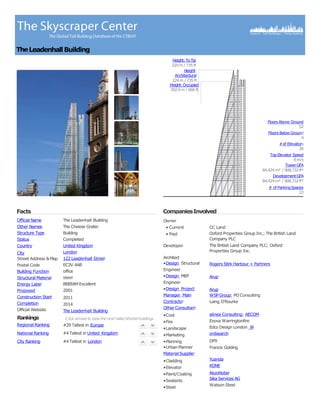
The Leadenhall Building
The Cheese Grater
Building
Completed
United Kingdom
London
122 Leadenhall Street
EC3V 4AB
office
steel
BREEAM Excellent
2001
2011
2014
The Leadenhall Building
Official Name
Other Names
Structure Type
Status
Country
City
Street Address &Map
Postal Code
Building Function
Structural Material
Energy Label
Proposed
Construction Start
Completion
Official Website
Rankings
Regional Ranking
Click arrows toview thenext taller/shorterbuildings
#29 Tallest in Europe
National Ranking #4 Tallest in United Kingdom
City Ranking #4 Tallest in London
CompaniesInvolved
Owner
• Current
• Past
Developer
CC Land
Oxford Properties Group Inc.; The British Land
Company PLC
The British Land Company PLC; Oxford
Properties Group Inc.
Rogers Stirk Harbour + Partners
Arup
Arup
WSPGroup; M3 Consulting
Laing O'Rourke
alinea Consulting; AECOM
Exova Warringtonfire
Edco Design London W
ordsearch
DP9
Francis Golding
Architect
•Design Structural
Engineer
•Design MEP
Engineer
•Design Project
Manager Main
Contractor
OtherConsultant
•Cost
•Fire
•Landscape
•Marketing
•Planning
•Urban Planner
MaterialSupplier
•Cladding
•Elevator
•Paint/Coating
•Sealants
•Steel
Yuanda
KONE
AkzoNobel
Sika Services AG
Watson Steel
TheLeadenhallBuilding
Height:ToTip
224m / 735 ft
Height:
Architectural
224m / 735 ft
Height:Occupied
202.9m / 666 ft
Floors Above Ground
52
Floors Below Ground
4
#of Elevators
26
TopElevator Speed
8m/s
TowerGFA
84,424m² / 908,732ft²
DevelopmentGFA
84,424m² / 908,732ft²
# of ParkingSpaces
22
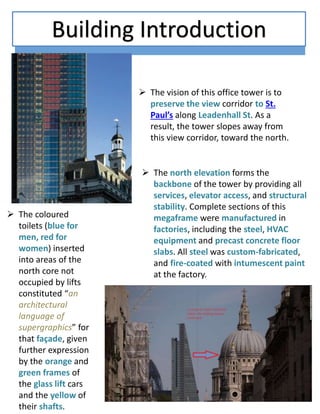
 The vision of this office tower is to
preserve the view corridor to St.
Paul’s along Leadenhall St. As a
result, the tower slopes away from
this view corridor, toward the north.
 The north elevation forms the
backbone of the tower by providing all
services, elevator access, and structural
stability. Complete sections of this
megaframe were manufactured in
factories, including the steel, HVAC
equipment and precast concrete floor
slabs. All steel was custom-fabricated,
and fire-coated with intumescent paint
at the factory.
 The coloured
toilets (blue for
men, red for
women) inserted
into areas of the
north core not
occupied by lifts
constituted “an
architectural
language of
supergraphics” for
that façade, given
further expression
by the orange and
green frames of
the glass lift cars
and the yellow of
their shafts.
Building Introduction
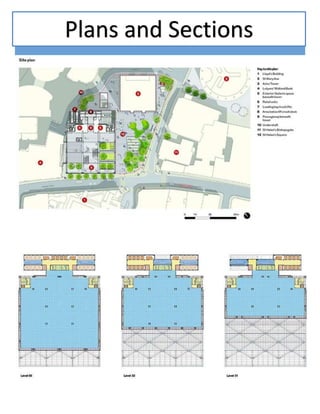
Plans and Sections
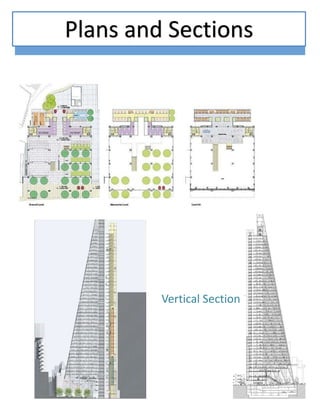
Plans and Sections
Vertical Section
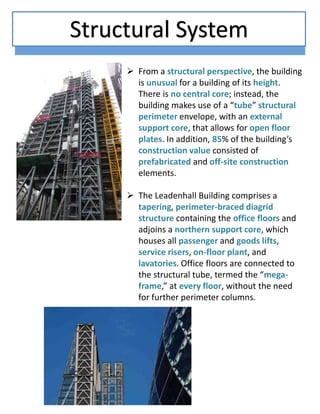
 From a structural perspective, the building
is unusual for a building of its height.
There is no central core; instead, the
building makes use of a “tube” structural
perimeter envelope, with an external
support core, that allows for open floor
plates. In addition, 85% of the building’s
construction value consisted of
prefabricated and off-site construction
elements.
 The Leadenhall Building comprises a
tapering, perimeter-braced diagrid
structure containing the office floors and
adjoins a northern support core, which
houses all passenger and goods lifts,
service risers, on-floor plant, and
lavatories. Office floors are connected to
the structural tube, termed the “mega-
frame,” at every floor, without the need
for further perimeter columns.
Structural System
Structural System
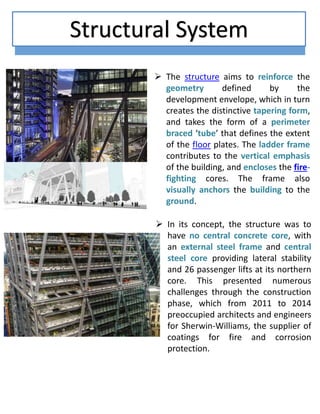
 The structure aims to reinforce the
geometry defined by the
development envelope, which in turn
creates the distinctive tapering form,
and takes the form of a perimeter
braced ‘tube’ that defines the extent
of the floor plates. The ladder frame
contributes to the vertical emphasis
of the building, and encloses the fire-
fighting cores. The frame also
visually anchors the building to the
ground.
 In its concept, the structure was to
have no central concrete core, with
an external steel frame and central
steel core providing lateral stability
and 26 passenger lifts at its northern
core. This presented numerous
challenges through the construction
phase, which from 2011 to 2014
preoccupied architects and engineers
for Sherwin-Williams, the supplier of
coatings for fire and corrosion
protection.
BIM Implementation
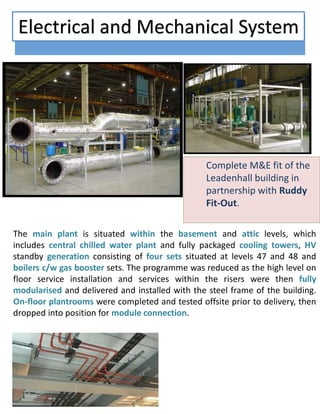
Complete M&E fit of the
Leadenhall building in
partnership with Ruddy
Fit-Out.
The main plant is situated within the basement and attic levels, which
includes central chilled water plant and fully packaged cooling towers, HV
standby generation consisting of four sets situated at levels 47 and 48 and
boilers c/w gas booster sets. The programme was reduced as the high level on
floor service installation and services within the risers were then fully
modularised and delivered and installed with the steel frame of the building.
On-floor plantrooms were completed and tested offsite prior to delivery, then
dropped into position for module connection.
Electrical and Mechanical System
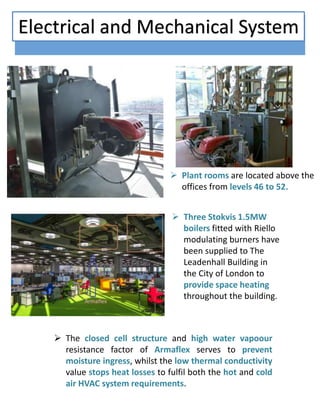
 Three Stokvis 1.5MW
boilers fitted with Riello
modulating burners have
been supplied to The
Leadenhall Building in
the City of London to
provide space heating
throughout the building.
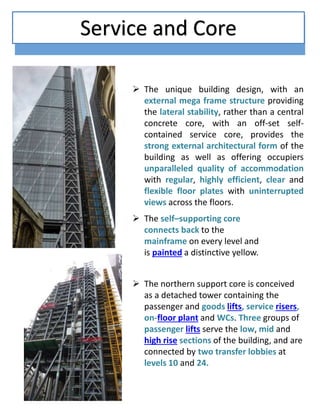
 Plant rooms are located above the
offices from levels 46 to 52.
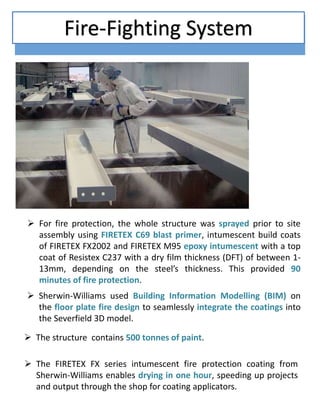
 The closed cell structure and high water vapoour
resistance factor of Armaflex serves to prevent
moisture ingress, whilst the low thermal conductivity
value stops heat losses to fulfil both the hot and cold
air HVAC system requirements.
Electrical and Mechanical System
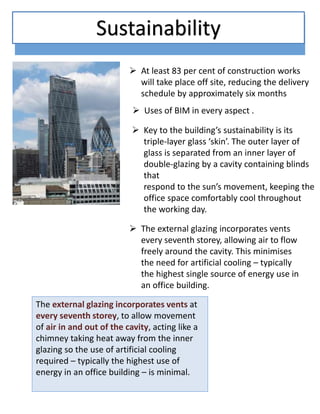
 The unique building design, with an
external mega frame structure providing
the lateral stability, rather than a central
concrete core, with an off-set self-
contained service core, provides the
strong external architectural form of the
building as well as offering occupiers
unparalleled quality of accommodation
with regular, highly efficient, clear and
flexible floor plates with uninterrupted
views across the floors.
 The northern support core is conceived
as a detached tower containing the
passenger and goods lifts, service risers,
on-floor plant and WCs. Three groups of
passenger lifts serve the low, mid and
high rise sections of the building, and are
connected by two transfer lobbies at
levels 10 and 24.
 The self–supporting core
connects back to the
mainframe on every level and
is painted a distinctive yellow.
Service and Core
 For fire protection, the whole structure was sprayed prior to site
assembly using FIRETEX C69 blast primer, intumescent build coats
of FIRETEX FX2002 and FIRETEX M95 epoxy intumescent with a top
coat of Resistex C237 with a dry film thickness (DFT) of between 1-
13mm, depending on the steel’s thickness. This provided 90
minutes of fire protection.
 Sherwin-Williams used Building Information Modelling (BIM) on
the floor plate fire design to seamlessly integrate the coatings into
the Severfield 3D model.
 The FIRETEX FX series intumescent fire protection coating from
Sherwin-Williams enables drying in one hour, speeding up projects
and output through the shop for coating applicators.
 The structure contains 500 tonnes of paint.
Fire-Fighting System
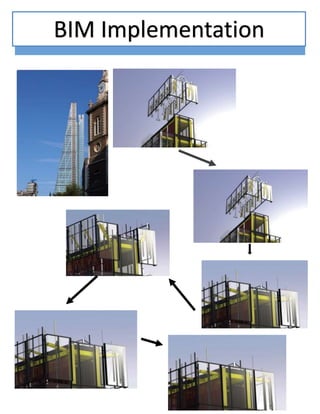
 At least 83 per cent of construction works
will take place off site, reducing the delivery
schedule by approximately six months
 Uses of BIM in every aspect .
 The external glazing incorporates vents
every seventh storey, allowing air to flow
freely around the cavity. This minimises
the need for artificial cooling – typically
the highest single source of energy use in
an office building.
 Key to the building’s sustainability is its
triple-layer glass ‘skin’. The outer layer of
glass is separated from an inner layer of
double-glazing by a cavity containing blinds
that
respond to the sun’s movement, keeping the
office space comfortably cool throughout
the working day.
Sustainability
The external glazing incorporates vents at
every seventh storey, to allow movement
of air in and out of the cavity, acting like a
chimney taking heat away from the inner
glazing so the use of artificial cooling
required – typically the highest use of
energy in an office building – is minimal.
 The lean-to tower enjoys a sunny
southern aspect, an amenity that is
exploited for passive solar heating as
well as daylighting.
 At the same time, the envelope
has been designed to control the
amount of sun entering the
building so as to not overheat the
interior and avoid glare. For speed and ease of construction,
the components of the north core
were largely prefabricated in
“tables”, three per level and each
consisting of a floor level with
columns attached.
 The building minimises its water
usage – it has low-flow water
fixtures and fittings.
 Design and engineering elements have
been deliberately chosen to make
efficient use of energy and resources.
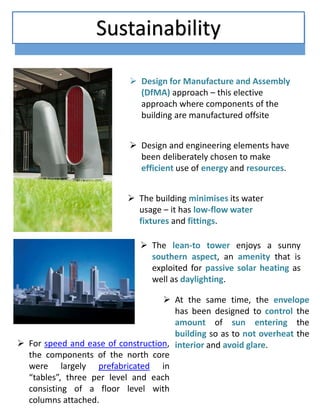
 Design for Manufacture and Assembly
(DfMA) approach – this elective
approach where components of the
building are manufactured offsite
Sustainability
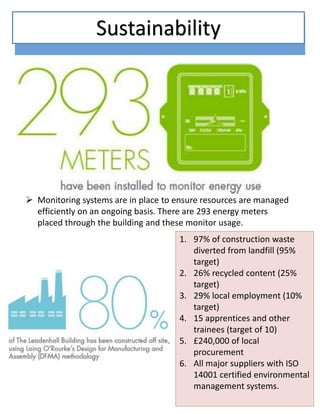
 Monitoring systems are in place to ensure resources are managed
efficiently on an ongoing basis. There are 293 energy meters
placed through the building and these monitor usage.
1. 97% of construction waste
diverted from landfill (95%
target)
2. 26% recycled content (25%
target)
3. 29% local employment (10%
target)
4. 15 apprentices and other
trainees (target of 10)
5. £240,000 of local
procurement
6. All major suppliers with ISO
14001 certified environmental
management systems.
Sustainability

Case study on Leadenhall Building KUET BECM 2k15

  • 1.
    Facts The Leadenhall Building TheCheese Grater Building Completed United Kingdom London 122 Leadenhall Street EC3V 4AB office steel BREEAM Excellent 2001 2011 2014 The Leadenhall Building Official Name Other Names Structure Type Status Country City Street Address &Map Postal Code Building Function Structural Material Energy Label Proposed Construction Start Completion Official Website Rankings Regional Ranking Click arrows toview thenext taller/shorterbuildings #29 Tallest in Europe National Ranking #4 Tallest in United Kingdom City Ranking #4 Tallest in London CompaniesInvolved Owner • Current • Past Developer CC Land Oxford Properties Group Inc.; The British Land Company PLC The British Land Company PLC; Oxford Properties Group Inc. Rogers Stirk Harbour + Partners Arup Arup WSPGroup; M3 Consulting Laing O'Rourke alinea Consulting; AECOM Exova Warringtonfire Edco Design London W ordsearch DP9 Francis Golding Architect •Design Structural Engineer •Design MEP Engineer •Design Project Manager Main Contractor OtherConsultant •Cost •Fire •Landscape •Marketing •Planning •Urban Planner MaterialSupplier •Cladding •Elevator •Paint/Coating •Sealants •Steel Yuanda KONE AkzoNobel Sika Services AG Watson Steel TheLeadenhallBuilding Height:ToTip 224m / 735 ft Height: Architectural 224m / 735 ft Height:Occupied 202.9m / 666 ft Floors Above Ground 52 Floors Below Ground 4 #of Elevators 26 TopElevator Speed 8m/s TowerGFA 84,424m² / 908,732ft² DevelopmentGFA 84,424m² / 908,732ft² # of ParkingSpaces 22
  • 2.
     The visionof this office tower is to preserve the view corridor to St. Paul’s along Leadenhall St. As a result, the tower slopes away from this view corridor, toward the north.  The north elevation forms the backbone of the tower by providing all services, elevator access, and structural stability. Complete sections of this megaframe were manufactured in factories, including the steel, HVAC equipment and precast concrete floor slabs. All steel was custom-fabricated, and fire-coated with intumescent paint at the factory.  The coloured toilets (blue for men, red for women) inserted into areas of the north core not occupied by lifts constituted “an architectural language of supergraphics” for that façade, given further expression by the orange and green frames of the glass lift cars and the yellow of their shafts. Building Introduction
  • 3.
  • 4.
  • 5.
     From astructural perspective, the building is unusual for a building of its height. There is no central core; instead, the building makes use of a “tube” structural perimeter envelope, with an external support core, that allows for open floor plates. In addition, 85% of the building’s construction value consisted of prefabricated and off-site construction elements.  The Leadenhall Building comprises a tapering, perimeter-braced diagrid structure containing the office floors and adjoins a northern support core, which houses all passenger and goods lifts, service risers, on-floor plant, and lavatories. Office floors are connected to the structural tube, termed the “mega- frame,” at every floor, without the need for further perimeter columns. Structural System
  • 6.
    Structural System  Thestructure aims to reinforce the geometry defined by the development envelope, which in turn creates the distinctive tapering form, and takes the form of a perimeter braced ‘tube’ that defines the extent of the floor plates. The ladder frame contributes to the vertical emphasis of the building, and encloses the fire- fighting cores. The frame also visually anchors the building to the ground.  In its concept, the structure was to have no central concrete core, with an external steel frame and central steel core providing lateral stability and 26 passenger lifts at its northern core. This presented numerous challenges through the construction phase, which from 2011 to 2014 preoccupied architects and engineers for Sherwin-Williams, the supplier of coatings for fire and corrosion protection.
  • 7.
  • 8.
    Complete M&E fitof the Leadenhall building in partnership with Ruddy Fit-Out. The main plant is situated within the basement and attic levels, which includes central chilled water plant and fully packaged cooling towers, HV standby generation consisting of four sets situated at levels 47 and 48 and boilers c/w gas booster sets. The programme was reduced as the high level on floor service installation and services within the risers were then fully modularised and delivered and installed with the steel frame of the building. On-floor plantrooms were completed and tested offsite prior to delivery, then dropped into position for module connection. Electrical and Mechanical System
  • 9.
     Three Stokvis1.5MW boilers fitted with Riello modulating burners have been supplied to The Leadenhall Building in the City of London to provide space heating throughout the building.  Plant rooms are located above the offices from levels 46 to 52.  The closed cell structure and high water vapoour resistance factor of Armaflex serves to prevent moisture ingress, whilst the low thermal conductivity value stops heat losses to fulfil both the hot and cold air HVAC system requirements. Electrical and Mechanical System
  • 10.
     The uniquebuilding design, with an external mega frame structure providing the lateral stability, rather than a central concrete core, with an off-set self- contained service core, provides the strong external architectural form of the building as well as offering occupiers unparalleled quality of accommodation with regular, highly efficient, clear and flexible floor plates with uninterrupted views across the floors.  The northern support core is conceived as a detached tower containing the passenger and goods lifts, service risers, on-floor plant and WCs. Three groups of passenger lifts serve the low, mid and high rise sections of the building, and are connected by two transfer lobbies at levels 10 and 24.  The self–supporting core connects back to the mainframe on every level and is painted a distinctive yellow. Service and Core
  • 11.
     For fireprotection, the whole structure was sprayed prior to site assembly using FIRETEX C69 blast primer, intumescent build coats of FIRETEX FX2002 and FIRETEX M95 epoxy intumescent with a top coat of Resistex C237 with a dry film thickness (DFT) of between 1- 13mm, depending on the steel’s thickness. This provided 90 minutes of fire protection.  Sherwin-Williams used Building Information Modelling (BIM) on the floor plate fire design to seamlessly integrate the coatings into the Severfield 3D model.  The FIRETEX FX series intumescent fire protection coating from Sherwin-Williams enables drying in one hour, speeding up projects and output through the shop for coating applicators.  The structure contains 500 tonnes of paint. Fire-Fighting System
  • 12.
     At least83 per cent of construction works will take place off site, reducing the delivery schedule by approximately six months  Uses of BIM in every aspect .  The external glazing incorporates vents every seventh storey, allowing air to flow freely around the cavity. This minimises the need for artificial cooling – typically the highest single source of energy use in an office building.  Key to the building’s sustainability is its triple-layer glass ‘skin’. The outer layer of glass is separated from an inner layer of double-glazing by a cavity containing blinds that respond to the sun’s movement, keeping the office space comfortably cool throughout the working day. Sustainability The external glazing incorporates vents at every seventh storey, to allow movement of air in and out of the cavity, acting like a chimney taking heat away from the inner glazing so the use of artificial cooling required – typically the highest use of energy in an office building – is minimal.
  • 13.
     The lean-totower enjoys a sunny southern aspect, an amenity that is exploited for passive solar heating as well as daylighting.  At the same time, the envelope has been designed to control the amount of sun entering the building so as to not overheat the interior and avoid glare. For speed and ease of construction, the components of the north core were largely prefabricated in “tables”, three per level and each consisting of a floor level with columns attached.  The building minimises its water usage – it has low-flow water fixtures and fittings.  Design and engineering elements have been deliberately chosen to make efficient use of energy and resources.  Design for Manufacture and Assembly (DfMA) approach – this elective approach where components of the building are manufactured offsite Sustainability
  • 14.
     Monitoring systemsare in place to ensure resources are managed efficiently on an ongoing basis. There are 293 energy meters placed through the building and these monitor usage. 1. 97% of construction waste diverted from landfill (95% target) 2. 26% recycled content (25% target) 3. 29% local employment (10% target) 4. 15 apprentices and other trainees (target of 10) 5. £240,000 of local procurement 6. All major suppliers with ISO 14001 certified environmental management systems. Sustainability