Issues and Challenges of the Conservation of
Buildings in Malaysia
Architectural Conservation
The research investigates and describes the challenges and issues that
occur in architecture conservation in Malaysia. The study examines the
types of issues that they belong to and how it affect its context and how
government bodies such as UNESCO help to solve conservation issues
and whether they are effective in solving them. Case studies are done to
compare between conservation methods and what are the solutions that
are provided to counter the issues that incurred.
Abstract
Introduction
Malaysia’s history is largely embedded in its architecture, social and
cultural fabric, and of these the architectural fabric is probably the most
enduring one. In fact, heritage building is an important element in town
development which can be seen in some cities in the world. It plays an
important role in defining the landmark within the urban area as well as
generating income and boosting the tourism industry.
Objective of Study
1. To understand issues that occur during conservation activities in
Malaysia
2. To identify the cause of these issues and how to prevent them in the
future of conservation
3. To identify solutions through comparison of case studies of other
successful model of architectural conservation in Malaysia
What is
Architecture
Conservation?
Architectural conservation
describes the process through
which the material, history and
design integrity of mankind’s
built heritage are prolonged
through carefully planned
interventions.
Architectural conservation deals
with issues of prolonging the life
and integrity of architectural
character and integrity, such as
form and style, and/or its
constituent materials, such as
stone, brick, glass, metal and
wood.
Data Collection (Survey)
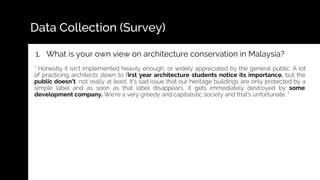
1. What is your own view on architecture conservation in Malaysia?
“ Honestly it isn't implemented heavily enough, or widely appreciated by the general public. A lot
of practicing architects down to first year architecture students notice its importance, but the
public doesn't, not really at least. It's sad issue that our heritage buildings are only protected by a
simple label and as soon as that label disappears, it gets immediately destroyed by some
development company. We're a very greedy and capitalistic society and that's unfortunate. “
Data Collection (Survey)
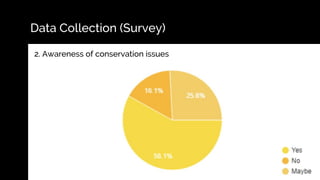
2. Awareness of conservation issues in Malaysia
Common Issues
Architectural Conservation
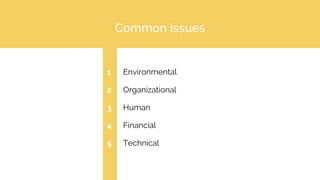
Common Issues
Environmental
Organizational
Human
Financial
Technical
1
2
3
4
5
Data Collection (Survey)
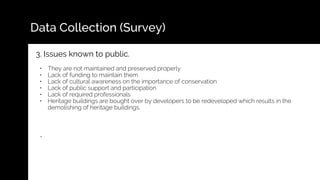
3. Issues known to public.
• They are not maintained and preserved properly
• Lack of funding to maintain them
• Lack of cultural awareness on the importance of conservation
• Lack of public support and participation
• Lack of required professionals
• Heritage buildings are bought over by developers to be redeveloped which results in the
demolishing of heritage buildings.
•
Data Collection (Survey)
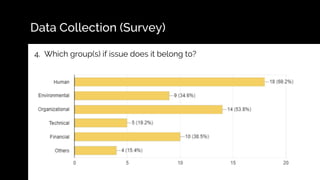
4. Which group(s) if issue does it belong to?
Data Collection (Survey)
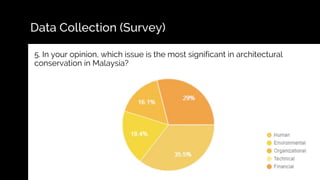
5. In your opinion, which issue is the most significant in architectural
conservation in Malaysia?
Data Collection (Survey)
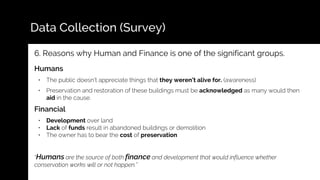
6. Reasons why Human and Finance is one of the significant groups.
Humans
• The public doesn’t appreciate things that they weren’t alive for. (awareness)
• Preservation and restoration of these buildings must be acknowledged as many would then
aid in the cause.
Financial
• Development over land
• Lack of funds result in abandoned buildings or demolition
• The owner has to bear the cost of preservation
“Humans are the source of both finance and development that would influence whether
conservation works will or not happen.”
Data Collection (Survey)
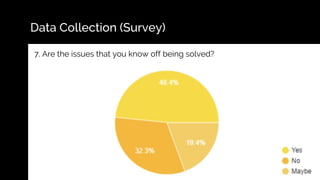
7. Are the issues that you know off being solved?
Data Collection (Survey)
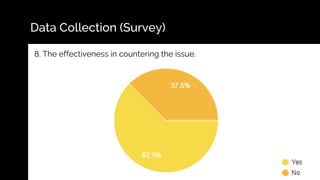
8. The effectiveness in countering the issue.
Data Collection (Survey)
9. Suggestions to resolve the issues that are not being solved.
• Having a significant united design into incorporating greenery
• Organize a fundraising campaign
• Reinforcement of laws
Environmental
Economic Pressure
Building Condition
Building Location
Business Opportunity
Third Party Influence
1
2
3
4
5
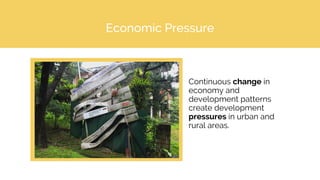
Economic Pressure
Continuous change in
economy and
development patterns
create development
pressures in urban and
rural areas.
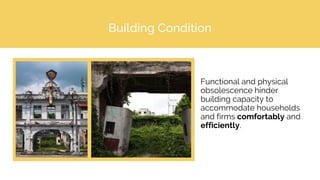
Building Condition
Functional and physical
obsolescence hinder
building capacity to
accommodate households
and firms comfortably and
efficiently.
Building Location and Business Opportunity
Buildings outside central areas are faced with issues of survival in terms
of business efficiency. While poor relative location may ease the threat
of redevelopment, poor proximity to markets, competitors and
pedestrian volumes will make it more difficult for customer-oriented
businesses to survive.
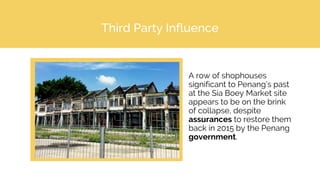
Third Party Influence
A row of shophouses
significant to Penang’s past
at the Sia Boey Market site
appears to be on the brink
of collapse, despite
assurances to restore them
back in 2015 by the Penang
government.
Case Study
Murals and Graffiti
Penang VS Klang
Case Study
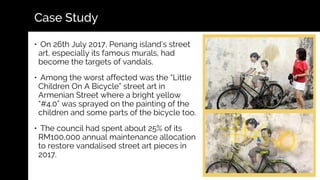
• On 26th July 2017, Penang island’s street
art, especially its famous murals, had
become the targets of vandals.
• Among the worst affected was the “Little
Children On A Bicycle” street art in
Armenian Street where a bright yellow
“#4.0” was sprayed on the painting of the
children and some parts of the bicycle too.
• The council had spent about 25% of its
RM100,000 annual maintenance allocation
to restore vandalised street art pieces in
2017.
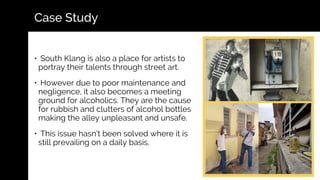
• South Klang is also a place for artists to
portray their talents through street art.
• However due to poor maintenance and
negligence, it also becomes a meeting
ground for alcoholics. They are the cause
for rubbish and clutters of alcohol bottles
making the alley unpleasant and unsafe.
• This issue hasn’t been solved where it is
still prevailing on a daily basis.
Case Study
Organizational
Opposing Conservation Philosophies
Confusing Laws and Guidelines
No Standard Method of Conservation
1
2
3
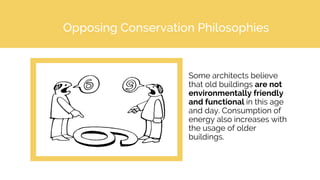
Opposing Conservation Philosophies
Some architects believe
that old buildings are not
environmentally friendly
and functional in this age
and day. Consumption of
energy also increases with
the usage of older
buildings.
Confusing Laws and Guidelines
The change of guidelines
are not standardized
between international
organizations and local
organizations. Also,
architects that are trained
specifically for
conservation are lacks in
number.
No Standard Method of Conservation
The resultant of different
laws and regulations create
a realm of a variety of
methods used in
conservation which are not
standardized. Many
problems arise such as
materiality issues,
decaying of materials due
to the chemical reaction,
etc.
Types of Organizations
Jabatan Warisan Negara
Badan Warisan Negara
UNESCO
1
2
3
Jabatan Warisan Negara
(Local Government)
• National Heritage Department was established on 1st March 2006 to
conserve, maintain, protect and promote the rich treasures of Malaysia’s
heritage.
• The department plays a role in accordance to the National Heritage Act, Akta
Warisan Kebangsaan 2005 (Akta 645).
• Based on this act, the department executed researches, archeological
studies, conservation of buildings and monuments, publicising and
reinforcing the intangible and natural heritages.
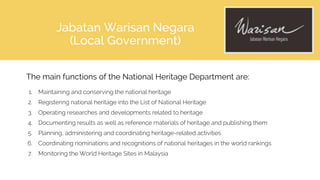
The main functions of the National Heritage Department are:
1. Maintaining and conserving the national heritage
2. Registering national heritage into the List of National Heritage
3. Operating researches and developments related to heritage
4. Documenting results as well as reference materials of heritage and publishing them
5. Planning, administering and coordinating heritage-related activities
6. Coordinating nominations and recognitions of national heritages in the world rankings
7. Monitoring the World Heritage Sites in Malaysia
Jabatan Warisan Negara
(Local Government)
Badan Warisan Negara
(Local Private)
• Badan Warisan Malaysia (The Heritage of Malaysia Trust) is the
leading national heritage NGO with a reputation for excellence
services spanning nearly 30 years.
• As an independent registered charity our role is to raise awareness of
heritage issues and advocate for a conversation-friendly
environment in Malaysia.
UNESCO
(International)
• A World Heritage Site is a landmark or area which is selected by the
UNESCO as having cultural, historical, scientific or other form of
significance, and is legally protected by international treaties.
• To be selected, a World Heritage Site must be an already classified
landmark, unique in some respect as a geographically and
historically identifiable place having special cultural or physical
significance
• As of July 2017, 1,073 sites are listed: 832 cultural, 206 natural, and 35
mixed properties, in 167 states
UNESCO Heritage Sites: Penang and Malacca
Inscription Year: 2008 Type of Site: Cultural Inscription Criteria: II, III, IV
The properties were celebrated for the following outstanding universal value:
1. Melaka and George Town represent exceptional examples of multicultural trading towns in East and
Southeast Asia. They were established by trading activities that result in the blending of Malay, Chinese
and Indian cultures with three successive European colonial powers, over a period of 500 years. This
creates a lasting imprint on their architecture and urban form.
2. Melaka and George Town are a living testimony to the multi-cultural heritage and tradition of Asia, and
of the European colonial influences. The tangible as well as intangible heritage of the two cities are
expressed in its religious buildings of different faiths, ethnic enclaves, spoken dialects, festivities,
dances, attire, artform, cuisine and lifestyle.
3. Melaka and George Town reflect the blend of influences that result in a unique form of architecture,
culture and cityscape incomparable elsewhere in East and South Asia. The cities showcase an
exceptional range of shophouses and townhouses from differing eras, providing snapshots of building
styles and types.
Inscription Criteria
1. "Represents a masterpiece of human creative genius and cultural significance"
2. "Exhibits an important interchange of human values, over a span of time, or within a cultural
area of the world, on developments in architecture or technology, monumental arts,
town-planning, or landscape design"
3. "To bear a unique or at least exceptional testimony to a cultural tradition or to a civilization
which is living or which has disappeared"
4. "Is an outstanding example of a type of building, architectural, or technological ensemble or
landscape which illustrates a significant stage in human history"
5. "Is an outstanding example of a traditional human settlement, land-use, or sea-use which is
representative of a culture, or human interaction with the environment especially when it has
become vulnerable under the impact of irreversible change"
6. "Is directly or tangibly associated with events or living traditions, with ideas, or with beliefs, with
artistic and literary works of outstanding universal significance"
Data Collection (Survey)
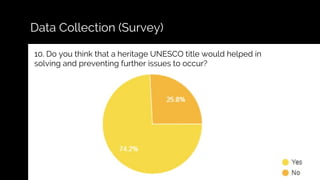
10. Do you think that a heritage UNESCO title would helped in
solving and preventing further issues to occur?
Data Collection (Survey)
11. Why.
Yes
• “ I think it draws the right attention and saliency/relevance to the public. ”
• UNESCO provides firmer strategies towards conservation
• “ It is not easy to earn the UNESCO title, so people would try to conserve “
• UNESCO helps to put a certain value upon the building and this will in turn raises public
awareness.
• UNESCO provides world-wide recognition to the area, turning it into a tourism spot, which
helps to fund conservation practices.
No
• Achieving the title doesn’t mean it can’t be revoke if the criteria is not up to par. Hence, once
the title is achieved many would abused the UNESCO title to profit from them instead of
conserving and raising awareness.
Case Study
Street Life by UNESCO
Penang VS Klang
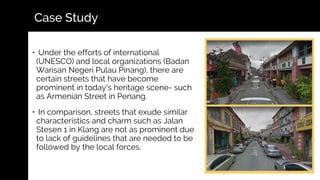
• Under the efforts of international
(UNESCO) and local organizations (Badan
Warisan Negeri Pulau Pinang), there are
certain streets that have become
prominent in today's heritage scene- such
as Armenian Street in Penang.
• In comparison, streets that exude similar
characteristics and charm such as Jalan
Stesen 1 in Klang are not as prominent due
to lack of guidelines that are needed to be
followed by the local forces.
Case Study
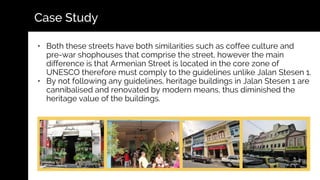
• Both these streets have both similarities such as coffee culture and
pre-war shophouses that comprise the street, however the main
difference is that Armenian Street is located in the core zone of
UNESCO therefore must comply to the guidelines unlike Jalan Stesen 1.
• By not following any guidelines, heritage buildings in Jalan Stesen 1 are
cannibalised and renovated by modern means, thus diminished the
heritage value of the buildings.
Case Study
Human
Poor Communication
Poor Knowledge
Stringent Bylaws Requirement
1
2
3
Poor Communication
Miscommunication
between professionals,
craftsmen and general
labourers. The complicated
and unpredictable nature of
a conservation project
creates a fertile ground for
disputes.
Poor Knowledge
Blurred boundaries
between what is
conservation,
preservation, restoration,
maintenance and
refurbishment. Lack of
awareness in conservation
knowledge.
Stringent Bylaws Requirement
While bylaw requirements,
building codes, and
conservation guidelines are
intended to ease the
conservation process with
minimum interventions, many
organisations and individuals
found adhering to these a
hassling feat without suitable
experience and expertise.
Who’s Involved?
Tourism Operators
Heritage Managers
Local Community
1
2
3
Tourism Operators
• Need to make a profit
• Need for a competitive advantage over other products
• Size of investment required and difficulties in raising finance
• Cost of establishing and managing operations
• Long lead time to receive approvals Long lead time to foster and
develop a target market especially an international market and reach
profitability
• Cost of providing service infrastructure in remote locations
• Cost of continuing to develop and service markets.
Heritage Managers
• Tension between the need to protect the site and the pressure to provide for
public access
• Pressure for scant resources for conservation to be diverted to managing
tourism
• Assessment of the impacts tourism might have on the site and fear for the
impacts that may be difficult to predict
• Sensitivity regarding the information about the location, direction of heritage
site which public access may be undesirable
• The effect of increasing visitor to the surrounding areas, wildlife and
vegetation
• The physical capacity of the site to handle visitor
Heritage Managers
• Cumulative effects of tourism growth over time
• The need to provide visitor facilities
• Fears of loss of control of interpretation and inaccuracy and
manipulation of messages
• Effect and influence of volunteers and sponsors on the management of
the site
• The cultural and intellectual property implications of tourism such as
respect for sensitive information, copyright and use of images in
marketing and promotion
Local Community
• Whether the visitor attraction is presenting a local community perspective
• Whether community leaders have been identified and actively consulted
• Whether religious or cultural sensitivities associated with the use or
presentation of heritage site have been adequately taken into account
• How local people can take an active role in negotiating the presentation,
management and operation of the attraction
• How tourism industry give benefits for local people in maximized
• How negative impacts of tourism development can be reduced
Financial
The unpredictable nature of
conservation work, the final
cost of conservation projects
is often difficult to ascertain.
Unless the right support is
provided for conservation
projects, the financial stakes
are usually high and
therefore, unattractive from
a business point of view.
Technical
Poor Financial Support
Shortage of Material and Labour
1
2
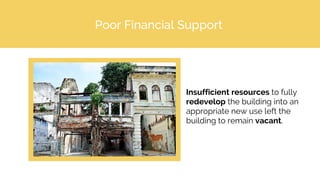
Insufficient resources to fully
redevelop the building into an
appropriate new use left the
building to remain vacant.
Poor Financial Support
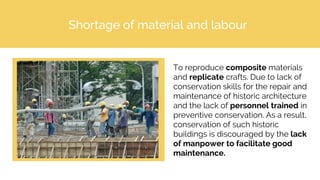
Shortage of material and labour
To reproduce composite materials
and replicate crafts. Due to lack of
conservation skills for the repair and
maintenance of historic architecture
and the lack of personnel trained in
preventive conservation. As a result,
conservation of such historic
buildings is discouraged by the lack
of manpower to facilitate good
maintenance.
Reversible Intervention
Architectural Conservation
Reversible Intervention
• Reversible Intervention is the ability to remove any infrastructure that
has been added onto site.
• Reversible Intervention must be able to be portable and removable in
a short period of time if requested.
• It is used as a way to save time, cut cost whilst simultaneously caring
for the surrounding environment and context.
Case Study
Reversible Intervention
Penang VS Malacca
• In the core and buffer zones of a UNESCO Heritage Site, deep piling
and construction is not permitted due to the extreme vibrations caused
that may cause destruction to the surrounding context.
• Reversible Intervention is a way to overcome this problem as we may
improve facilities without the probability of damage to other buildings.
Case Study
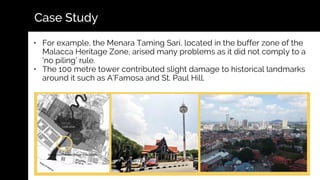
• For example, the Menara Taming Sari, located in the buffer zone of the
Malacca Heritage Zone, arised many problems as it did not comply to a
‘no piling’ rule.
• The 100 metre tower contributed slight damage to historical landmarks
around it such as A’Famosa and St. Paul Hill.
Case Study
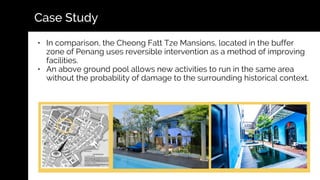
• In comparison, the Cheong Fatt Tze Mansions, located in the buffer
zone of Penang uses reversible intervention as a method of improving
facilities.
• An above ground pool allows new activities to run in the same area
without the probability of damage to the surrounding historical context.
Case Study
Approaches on Countering Issues
Architectural Conservation
Approaches on Countering Issues
Adaptive Reuse
Restoration and Preservation
Campaigns
1
2
3
Adaptive Reuse
• Adaptive reuse refers to the process of reusing an old site or building
for a purpose other than which it was built or designed for.
• It can be regarded as a compromise between historic preservation
and demolition.
• It is seen as an effective to reduce overcrowding of buildings,
reducing urban sprawl and environmental impact.
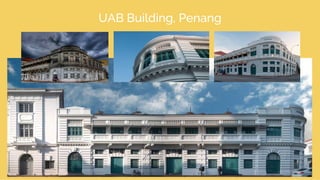
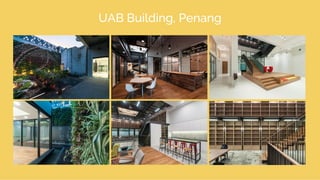
UAB Building, Penang
UAB Building
• Previously used as a bank then a warehouse, The UAB Building is the
home of Khazanah Nasional Penang Branch and the Penang Office for
Think City.
• The UAB Building won a LEEDS Gold Certification for its usage in
passive design strategies; one of the first heritage buildings in the
world to be given this award.
• The UAB Building is a perfect blend- a space for modern times in a
place of historical means.
ThinkCity
• Established in 2009, its first task was to rejuvenate the historic city of
George Town, Penang.
• The success of this led to the expansion into 3 other cities,
Butterworth, Kuala Lumpur, and most recently Johor Bahru.
• Today, Think City works closely with local governments, international
agencies and various local communities, building effective
partnerships and enhancing capacity along the way.
• Through this, they hope to be able to deliver long-term holistic and
sustainable solutions for generations of today and tomorrow.
UAB Building, Penang
Restoration and
Preservation
• Conservation is the pure process by which individuals or groups
attempt to protect valued buildings from unwanted change.
• It is a pure act of protection and maintenance of a building in their
usual state.
• Unlike adaptive reuse, conservation of a building is to maintain the
same function as it previously was.
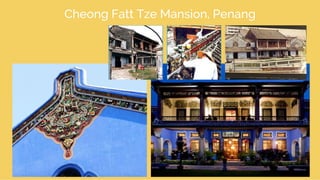
Cheong Fatt Tze Mansion, Penang
Cheong Fatt Tze Mansion, Penang.
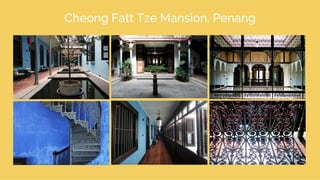
• Built by the merchant Cheong Fatt Tze at the end of the 19th century,
the mansion has 38 rooms, 5 granite-paved courtyards, 7 staircases
and 220 vernacular timber louvre windows.
• Previously used as a resident for his 7th wife but was then used to
house 30 different squatter families
• It took six years for the conservationists to repair The Blue Mansion
through a tedious process to preserve and restore as much of its
original fabric and structure.
Cheong Fatt Tze Mansion, Penang.
In line with the restorative philosophy of ‘treading lightly and touching
softly’, the following methods were implemented with strict and detailed
attention:
● Restrained repairs – changing only what required changing
● Replication of the old – using only traditional methods and materials
● Re-use and recycling – little was discarded, particularly the timber and tiles
● Practicality and attention to details
● Research, consultation and networking with other conservation consultants and artisans
Cheong Fatt Tze Mansion, Penang
Campaigns
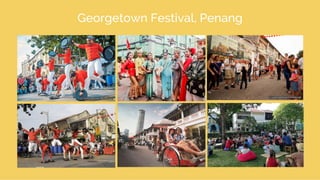
• Conservation Campaigns are political and public advocacy campaigns to
generate funding and policy outcomes.
• Penang Heritage Trail consists mainly of physical routes that a tourist can
take to explore historical areas in the city on foot. The trail is divided into
several routes and they are given descriptive names such as Food Trail,
Heritage Building Trail, Chinese Kongsi Trail, Old Trades Trail, The Clan
Jetties and Muslim Heritage Trail.
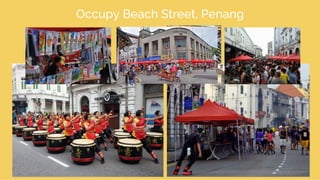
• Project Occupy Beach Street initiatives temporarily close streets to
automobile traffic so that people may use them for healthy and fun
physical activities like walking, jogging, biking dancing and social activities-
this project occupies many spaces of the Penang Heritage trail.
Occupy Beach Street, Penang
Georgetown Festival, Penang
12. Model example of architecture conservation in Malaysia that are
known to public.
• Kota A Famosa. It protects the history and brings more value to the state.
• Central Market. It's probably because there's an abundance of souvenir shops and clothes;
which attracts tourists.
• Jalan Laksamana old shophouses, they are well preserved by the organisation with some
modern architectural elements added.
• Cheong Fatt Tze Mansion. Despite being almost demolished, this building was restored
from its poor condition and is now in use as a museum, guesthouse, etc.
• In Ipoh and Muar. The amount of restoration and efforts to conserve the architecture has
been amazing and effective in drawing tourists.
• Khoo Kong Si Temple in Penang, serves as a function and a heritage momento.
Data Collection (Survey)
The Board
Architectural Conservation
In conclusion, the study has proven that issues and challenges are
sourced mainly from the lack of availability in conservation
knowledge. More factors should be taken into when concerning the
issues of conservation such as educate the public about heritage
conservation, especially with those who are involved in the fields of
architects, engineers, historians, archaeologists, chemists and
environmentalists
Conclusion
References
1) Debopam Roy & Satyanarayana N. Kalidindi. (2017). Accounting: Critical challenges in management of heritage conservation
projects in India.
Retrieved May 2, 2018 from Emerald Insight website:
https://www.emeraldinsight.com/doi/abs/10.1108/JCHMSD-03-2017-0012
2) Esther H.K.Yung & Edwin H.W.Chan. (February 5, 2011). Accounting: Problem issues of public participation in built-heritage
conservation: Two controversial cases in Hong Kong. Retrieved May 2, 2018 from Science Direct website:
https://www.sciencedirect.com/science/article/pii/S0197397510000871
3) Irene C. (May 2, 2016). Accounting: Facing up to challenges in preservation of heritage.
Retrieved May 2, 2018 from:
http://www.theborneopost.com/2016/05/02/facing-up-to-challenges-in-preservation-of-heritage/
4) World Heritage Challenges for the Millennium.
Retrieved May 2, 2018 from:
http://uis.unesco.org/sites/default/files/documents/world-heritage-challenges-for-the-millennium-2007-en.pdf
5) Recurring Issues in Historic Building Conservation. (June 23, 2016).
Retrieved May 2, 2018 from Science Direct website:
https://www.sciencedirect.com/science/article/pii/S1877042816302944
6) Cultural Heritage Tourism in Malaysia: Issues and Challenges. (2014).
Retrieved May 2, 2018 from:
https://www.shs-conferences.org/articles/shsconf/pdf/2014/09/shsconf_4ictr2014_01059.pdf
7) Penang’s street art a recent target of vandals. (July 26, 2017
Retrieved May 2, 2018 from:
https://www.thestar.com.my/news/nation/2017/07/26/penangs-street-art-a-recent-target-of-vandals/
Chang Jing Jun 0326762
Chin Shee Wei 0322499
Foo Ji Sun 0323550
Lim Woo Leon 0322180
Premdyl Singh Shadan 0321979
Quah Keng Yew 0322893

Architectural conservation.pptx

  • 1.
    Issues and Challengesof the Conservation of Buildings in Malaysia Architectural Conservation
  • 2.
    The research investigatesand describes the challenges and issues that occur in architecture conservation in Malaysia. The study examines the types of issues that they belong to and how it affect its context and how government bodies such as UNESCO help to solve conservation issues and whether they are effective in solving them. Case studies are done to compare between conservation methods and what are the solutions that are provided to counter the issues that incurred. Abstract
  • 3.
    Introduction Malaysia’s history islargely embedded in its architecture, social and cultural fabric, and of these the architectural fabric is probably the most enduring one. In fact, heritage building is an important element in town development which can be seen in some cities in the world. It plays an important role in defining the landmark within the urban area as well as generating income and boosting the tourism industry.
  • 4.
    Objective of Study 1.To understand issues that occur during conservation activities in Malaysia 2. To identify the cause of these issues and how to prevent them in the future of conservation 3. To identify solutions through comparison of case studies of other successful model of architectural conservation in Malaysia
  • 5.
    What is Architecture Conservation? Architectural conservation describesthe process through which the material, history and design integrity of mankind’s built heritage are prolonged through carefully planned interventions. Architectural conservation deals with issues of prolonging the life and integrity of architectural character and integrity, such as form and style, and/or its constituent materials, such as stone, brick, glass, metal and wood.
  • 6.
    Data Collection (Survey) 1.What is your own view on architecture conservation in Malaysia? “ Honestly it isn't implemented heavily enough, or widely appreciated by the general public. A lot of practicing architects down to first year architecture students notice its importance, but the public doesn't, not really at least. It's sad issue that our heritage buildings are only protected by a simple label and as soon as that label disappears, it gets immediately destroyed by some development company. We're a very greedy and capitalistic society and that's unfortunate. “
  • 7.
    Data Collection (Survey) 2.Awareness of conservation issues in Malaysia
  • 8.
  • 9.
  • 10.
    Data Collection (Survey) 3.Issues known to public. • They are not maintained and preserved properly • Lack of funding to maintain them • Lack of cultural awareness on the importance of conservation • Lack of public support and participation • Lack of required professionals • Heritage buildings are bought over by developers to be redeveloped which results in the demolishing of heritage buildings. •
  • 11.
    Data Collection (Survey) 4.Which group(s) if issue does it belong to?
  • 12.
    Data Collection (Survey) 5.In your opinion, which issue is the most significant in architectural conservation in Malaysia?
  • 13.
    Data Collection (Survey) 6.Reasons why Human and Finance is one of the significant groups. Humans • The public doesn’t appreciate things that they weren’t alive for. (awareness) • Preservation and restoration of these buildings must be acknowledged as many would then aid in the cause. Financial • Development over land • Lack of funds result in abandoned buildings or demolition • The owner has to bear the cost of preservation “Humans are the source of both finance and development that would influence whether conservation works will or not happen.”
  • 14.
    Data Collection (Survey) 7.Are the issues that you know off being solved?
  • 15.
    Data Collection (Survey) 8.The effectiveness in countering the issue.
  • 16.
    Data Collection (Survey) 9.Suggestions to resolve the issues that are not being solved. • Having a significant united design into incorporating greenery • Organize a fundraising campaign • Reinforcement of laws
  • 17.
    Environmental Economic Pressure Building Condition BuildingLocation Business Opportunity Third Party Influence 1 2 3 4 5
  • 18.
    Economic Pressure Continuous changein economy and development patterns create development pressures in urban and rural areas.
  • 19.
    Building Condition Functional andphysical obsolescence hinder building capacity to accommodate households and firms comfortably and efficiently.
  • 20.
    Building Location andBusiness Opportunity Buildings outside central areas are faced with issues of survival in terms of business efficiency. While poor relative location may ease the threat of redevelopment, poor proximity to markets, competitors and pedestrian volumes will make it more difficult for customer-oriented businesses to survive.
  • 21.
    Third Party Influence Arow of shophouses significant to Penang’s past at the Sia Boey Market site appears to be on the brink of collapse, despite assurances to restore them back in 2015 by the Penang government.
  • 22.
    Case Study Murals andGraffiti Penang VS Klang
  • 23.
    Case Study • On26th July 2017, Penang island’s street art, especially its famous murals, had become the targets of vandals. • Among the worst affected was the “Little Children On A Bicycle” street art in Armenian Street where a bright yellow “#4.0” was sprayed on the painting of the children and some parts of the bicycle too. • The council had spent about 25% of its RM100,000 annual maintenance allocation to restore vandalised street art pieces in 2017.
  • 24.
    • South Klangis also a place for artists to portray their talents through street art. • However due to poor maintenance and negligence, it also becomes a meeting ground for alcoholics. They are the cause for rubbish and clutters of alcohol bottles making the alley unpleasant and unsafe. • This issue hasn’t been solved where it is still prevailing on a daily basis. Case Study
  • 25.
    Organizational Opposing Conservation Philosophies ConfusingLaws and Guidelines No Standard Method of Conservation 1 2 3
  • 26.
    Opposing Conservation Philosophies Somearchitects believe that old buildings are not environmentally friendly and functional in this age and day. Consumption of energy also increases with the usage of older buildings.
  • 27.
    Confusing Laws andGuidelines The change of guidelines are not standardized between international organizations and local organizations. Also, architects that are trained specifically for conservation are lacks in number.
  • 28.
    No Standard Methodof Conservation The resultant of different laws and regulations create a realm of a variety of methods used in conservation which are not standardized. Many problems arise such as materiality issues, decaying of materials due to the chemical reaction, etc.
  • 29.
    Types of Organizations JabatanWarisan Negara Badan Warisan Negara UNESCO 1 2 3
  • 30.
    Jabatan Warisan Negara (LocalGovernment) • National Heritage Department was established on 1st March 2006 to conserve, maintain, protect and promote the rich treasures of Malaysia’s heritage. • The department plays a role in accordance to the National Heritage Act, Akta Warisan Kebangsaan 2005 (Akta 645). • Based on this act, the department executed researches, archeological studies, conservation of buildings and monuments, publicising and reinforcing the intangible and natural heritages.
  • 31.
    The main functionsof the National Heritage Department are: 1. Maintaining and conserving the national heritage 2. Registering national heritage into the List of National Heritage 3. Operating researches and developments related to heritage 4. Documenting results as well as reference materials of heritage and publishing them 5. Planning, administering and coordinating heritage-related activities 6. Coordinating nominations and recognitions of national heritages in the world rankings 7. Monitoring the World Heritage Sites in Malaysia Jabatan Warisan Negara (Local Government)
  • 32.
    Badan Warisan Negara (LocalPrivate) • Badan Warisan Malaysia (The Heritage of Malaysia Trust) is the leading national heritage NGO with a reputation for excellence services spanning nearly 30 years. • As an independent registered charity our role is to raise awareness of heritage issues and advocate for a conversation-friendly environment in Malaysia.
  • 33.
    UNESCO (International) • A WorldHeritage Site is a landmark or area which is selected by the UNESCO as having cultural, historical, scientific or other form of significance, and is legally protected by international treaties. • To be selected, a World Heritage Site must be an already classified landmark, unique in some respect as a geographically and historically identifiable place having special cultural or physical significance • As of July 2017, 1,073 sites are listed: 832 cultural, 206 natural, and 35 mixed properties, in 167 states
  • 34.
    UNESCO Heritage Sites:Penang and Malacca Inscription Year: 2008 Type of Site: Cultural Inscription Criteria: II, III, IV The properties were celebrated for the following outstanding universal value: 1. Melaka and George Town represent exceptional examples of multicultural trading towns in East and Southeast Asia. They were established by trading activities that result in the blending of Malay, Chinese and Indian cultures with three successive European colonial powers, over a period of 500 years. This creates a lasting imprint on their architecture and urban form. 2. Melaka and George Town are a living testimony to the multi-cultural heritage and tradition of Asia, and of the European colonial influences. The tangible as well as intangible heritage of the two cities are expressed in its religious buildings of different faiths, ethnic enclaves, spoken dialects, festivities, dances, attire, artform, cuisine and lifestyle. 3. Melaka and George Town reflect the blend of influences that result in a unique form of architecture, culture and cityscape incomparable elsewhere in East and South Asia. The cities showcase an exceptional range of shophouses and townhouses from differing eras, providing snapshots of building styles and types.
  • 35.
    Inscription Criteria 1. "Representsa masterpiece of human creative genius and cultural significance" 2. "Exhibits an important interchange of human values, over a span of time, or within a cultural area of the world, on developments in architecture or technology, monumental arts, town-planning, or landscape design" 3. "To bear a unique or at least exceptional testimony to a cultural tradition or to a civilization which is living or which has disappeared" 4. "Is an outstanding example of a type of building, architectural, or technological ensemble or landscape which illustrates a significant stage in human history" 5. "Is an outstanding example of a traditional human settlement, land-use, or sea-use which is representative of a culture, or human interaction with the environment especially when it has become vulnerable under the impact of irreversible change" 6. "Is directly or tangibly associated with events or living traditions, with ideas, or with beliefs, with artistic and literary works of outstanding universal significance"
  • 36.
    Data Collection (Survey) 10.Do you think that a heritage UNESCO title would helped in solving and preventing further issues to occur?
  • 37.
    Data Collection (Survey) 11.Why. Yes • “ I think it draws the right attention and saliency/relevance to the public. ” • UNESCO provides firmer strategies towards conservation • “ It is not easy to earn the UNESCO title, so people would try to conserve “ • UNESCO helps to put a certain value upon the building and this will in turn raises public awareness. • UNESCO provides world-wide recognition to the area, turning it into a tourism spot, which helps to fund conservation practices. No • Achieving the title doesn’t mean it can’t be revoke if the criteria is not up to par. Hence, once the title is achieved many would abused the UNESCO title to profit from them instead of conserving and raising awareness.
  • 38.
    Case Study Street Lifeby UNESCO Penang VS Klang
  • 39.
    • Under theefforts of international (UNESCO) and local organizations (Badan Warisan Negeri Pulau Pinang), there are certain streets that have become prominent in today's heritage scene- such as Armenian Street in Penang. • In comparison, streets that exude similar characteristics and charm such as Jalan Stesen 1 in Klang are not as prominent due to lack of guidelines that are needed to be followed by the local forces. Case Study
  • 40.
    • Both thesestreets have both similarities such as coffee culture and pre-war shophouses that comprise the street, however the main difference is that Armenian Street is located in the core zone of UNESCO therefore must comply to the guidelines unlike Jalan Stesen 1. • By not following any guidelines, heritage buildings in Jalan Stesen 1 are cannibalised and renovated by modern means, thus diminished the heritage value of the buildings. Case Study
  • 42.
  • 43.
    Poor Communication Miscommunication between professionals, craftsmenand general labourers. The complicated and unpredictable nature of a conservation project creates a fertile ground for disputes.
  • 44.
    Poor Knowledge Blurred boundaries betweenwhat is conservation, preservation, restoration, maintenance and refurbishment. Lack of awareness in conservation knowledge.
  • 45.
    Stringent Bylaws Requirement Whilebylaw requirements, building codes, and conservation guidelines are intended to ease the conservation process with minimum interventions, many organisations and individuals found adhering to these a hassling feat without suitable experience and expertise.
  • 46.
    Who’s Involved? Tourism Operators HeritageManagers Local Community 1 2 3
  • 47.
    Tourism Operators • Needto make a profit • Need for a competitive advantage over other products • Size of investment required and difficulties in raising finance • Cost of establishing and managing operations • Long lead time to receive approvals Long lead time to foster and develop a target market especially an international market and reach profitability • Cost of providing service infrastructure in remote locations • Cost of continuing to develop and service markets.
  • 48.
    Heritage Managers • Tensionbetween the need to protect the site and the pressure to provide for public access • Pressure for scant resources for conservation to be diverted to managing tourism • Assessment of the impacts tourism might have on the site and fear for the impacts that may be difficult to predict • Sensitivity regarding the information about the location, direction of heritage site which public access may be undesirable • The effect of increasing visitor to the surrounding areas, wildlife and vegetation • The physical capacity of the site to handle visitor
  • 49.
    Heritage Managers • Cumulativeeffects of tourism growth over time • The need to provide visitor facilities • Fears of loss of control of interpretation and inaccuracy and manipulation of messages • Effect and influence of volunteers and sponsors on the management of the site • The cultural and intellectual property implications of tourism such as respect for sensitive information, copyright and use of images in marketing and promotion
  • 50.
    Local Community • Whetherthe visitor attraction is presenting a local community perspective • Whether community leaders have been identified and actively consulted • Whether religious or cultural sensitivities associated with the use or presentation of heritage site have been adequately taken into account • How local people can take an active role in negotiating the presentation, management and operation of the attraction • How tourism industry give benefits for local people in maximized • How negative impacts of tourism development can be reduced
  • 51.
    Financial The unpredictable natureof conservation work, the final cost of conservation projects is often difficult to ascertain. Unless the right support is provided for conservation projects, the financial stakes are usually high and therefore, unattractive from a business point of view.
  • 52.
  • 53.
    Insufficient resources tofully redevelop the building into an appropriate new use left the building to remain vacant. Poor Financial Support
  • 54.
    Shortage of materialand labour To reproduce composite materials and replicate crafts. Due to lack of conservation skills for the repair and maintenance of historic architecture and the lack of personnel trained in preventive conservation. As a result, conservation of such historic buildings is discouraged by the lack of manpower to facilitate good maintenance.
  • 55.
  • 56.
    Reversible Intervention • ReversibleIntervention is the ability to remove any infrastructure that has been added onto site. • Reversible Intervention must be able to be portable and removable in a short period of time if requested. • It is used as a way to save time, cut cost whilst simultaneously caring for the surrounding environment and context.
  • 57.
  • 58.
    • In thecore and buffer zones of a UNESCO Heritage Site, deep piling and construction is not permitted due to the extreme vibrations caused that may cause destruction to the surrounding context. • Reversible Intervention is a way to overcome this problem as we may improve facilities without the probability of damage to other buildings. Case Study
  • 59.
    • For example,the Menara Taming Sari, located in the buffer zone of the Malacca Heritage Zone, arised many problems as it did not comply to a ‘no piling’ rule. • The 100 metre tower contributed slight damage to historical landmarks around it such as A’Famosa and St. Paul Hill. Case Study
  • 60.
    • In comparison,the Cheong Fatt Tze Mansions, located in the buffer zone of Penang uses reversible intervention as a method of improving facilities. • An above ground pool allows new activities to run in the same area without the probability of damage to the surrounding historical context. Case Study
  • 61.
    Approaches on CounteringIssues Architectural Conservation
  • 62.
    Approaches on CounteringIssues Adaptive Reuse Restoration and Preservation Campaigns 1 2 3
  • 63.
    Adaptive Reuse • Adaptivereuse refers to the process of reusing an old site or building for a purpose other than which it was built or designed for. • It can be regarded as a compromise between historic preservation and demolition. • It is seen as an effective to reduce overcrowding of buildings, reducing urban sprawl and environmental impact.
  • 64.
  • 65.
    UAB Building • Previouslyused as a bank then a warehouse, The UAB Building is the home of Khazanah Nasional Penang Branch and the Penang Office for Think City. • The UAB Building won a LEEDS Gold Certification for its usage in passive design strategies; one of the first heritage buildings in the world to be given this award. • The UAB Building is a perfect blend- a space for modern times in a place of historical means.
  • 66.
    ThinkCity • Established in2009, its first task was to rejuvenate the historic city of George Town, Penang. • The success of this led to the expansion into 3 other cities, Butterworth, Kuala Lumpur, and most recently Johor Bahru. • Today, Think City works closely with local governments, international agencies and various local communities, building effective partnerships and enhancing capacity along the way. • Through this, they hope to be able to deliver long-term holistic and sustainable solutions for generations of today and tomorrow.
  • 67.
  • 68.
    Restoration and Preservation • Conservationis the pure process by which individuals or groups attempt to protect valued buildings from unwanted change. • It is a pure act of protection and maintenance of a building in their usual state. • Unlike adaptive reuse, conservation of a building is to maintain the same function as it previously was.
  • 69.
    Cheong Fatt TzeMansion, Penang
  • 70.
    Cheong Fatt TzeMansion, Penang. • Built by the merchant Cheong Fatt Tze at the end of the 19th century, the mansion has 38 rooms, 5 granite-paved courtyards, 7 staircases and 220 vernacular timber louvre windows. • Previously used as a resident for his 7th wife but was then used to house 30 different squatter families • It took six years for the conservationists to repair The Blue Mansion through a tedious process to preserve and restore as much of its original fabric and structure.
  • 71.
    Cheong Fatt TzeMansion, Penang. In line with the restorative philosophy of ‘treading lightly and touching softly’, the following methods were implemented with strict and detailed attention: ● Restrained repairs – changing only what required changing ● Replication of the old – using only traditional methods and materials ● Re-use and recycling – little was discarded, particularly the timber and tiles ● Practicality and attention to details ● Research, consultation and networking with other conservation consultants and artisans
  • 72.
    Cheong Fatt TzeMansion, Penang
  • 73.
    Campaigns • Conservation Campaignsare political and public advocacy campaigns to generate funding and policy outcomes. • Penang Heritage Trail consists mainly of physical routes that a tourist can take to explore historical areas in the city on foot. The trail is divided into several routes and they are given descriptive names such as Food Trail, Heritage Building Trail, Chinese Kongsi Trail, Old Trades Trail, The Clan Jetties and Muslim Heritage Trail. • Project Occupy Beach Street initiatives temporarily close streets to automobile traffic so that people may use them for healthy and fun physical activities like walking, jogging, biking dancing and social activities- this project occupies many spaces of the Penang Heritage trail.
  • 74.
  • 75.
  • 76.
    12. Model exampleof architecture conservation in Malaysia that are known to public. • Kota A Famosa. It protects the history and brings more value to the state. • Central Market. It's probably because there's an abundance of souvenir shops and clothes; which attracts tourists. • Jalan Laksamana old shophouses, they are well preserved by the organisation with some modern architectural elements added. • Cheong Fatt Tze Mansion. Despite being almost demolished, this building was restored from its poor condition and is now in use as a museum, guesthouse, etc. • In Ipoh and Muar. The amount of restoration and efforts to conserve the architecture has been amazing and effective in drawing tourists. • Khoo Kong Si Temple in Penang, serves as a function and a heritage momento. Data Collection (Survey)
  • 77.
  • 81.
    In conclusion, thestudy has proven that issues and challenges are sourced mainly from the lack of availability in conservation knowledge. More factors should be taken into when concerning the issues of conservation such as educate the public about heritage conservation, especially with those who are involved in the fields of architects, engineers, historians, archaeologists, chemists and environmentalists Conclusion
  • 82.
    References 1) Debopam Roy& Satyanarayana N. Kalidindi. (2017). Accounting: Critical challenges in management of heritage conservation projects in India. Retrieved May 2, 2018 from Emerald Insight website: https://www.emeraldinsight.com/doi/abs/10.1108/JCHMSD-03-2017-0012 2) Esther H.K.Yung & Edwin H.W.Chan. (February 5, 2011). Accounting: Problem issues of public participation in built-heritage conservation: Two controversial cases in Hong Kong. Retrieved May 2, 2018 from Science Direct website: https://www.sciencedirect.com/science/article/pii/S0197397510000871 3) Irene C. (May 2, 2016). Accounting: Facing up to challenges in preservation of heritage. Retrieved May 2, 2018 from: http://www.theborneopost.com/2016/05/02/facing-up-to-challenges-in-preservation-of-heritage/ 4) World Heritage Challenges for the Millennium. Retrieved May 2, 2018 from: http://uis.unesco.org/sites/default/files/documents/world-heritage-challenges-for-the-millennium-2007-en.pdf 5) Recurring Issues in Historic Building Conservation. (June 23, 2016). Retrieved May 2, 2018 from Science Direct website: https://www.sciencedirect.com/science/article/pii/S1877042816302944 6) Cultural Heritage Tourism in Malaysia: Issues and Challenges. (2014). Retrieved May 2, 2018 from: https://www.shs-conferences.org/articles/shsconf/pdf/2014/09/shsconf_4ictr2014_01059.pdf 7) Penang’s street art a recent target of vandals. (July 26, 2017 Retrieved May 2, 2018 from: https://www.thestar.com.my/news/nation/2017/07/26/penangs-street-art-a-recent-target-of-vandals/
  • 83.
    Chang Jing Jun0326762 Chin Shee Wei 0322499 Foo Ji Sun 0323550 Lim Woo Leon 0322180 Premdyl Singh Shadan 0321979 Quah Keng Yew 0322893