Towards executable models within BPM Dr Alexander Samarin www.samarin.biz
Overview Vision –  enterprise architecture  is a (semi-)exact science which provides  guidance and practical help  for the transformation of an enterprise to achieve certain desired characteristics (e.g. level of maturity, greater agility, better collaboration) Common understanding of artefacts Modelling of executable business processes IT governance as a BPM system
Architecting an enterprise BPM system (with systems thinking) A BPM system is a dynamic set of artefacts  Artefacts are interconnected and interdependent We have to anticipate potential changes:  policies, priorities, compliance, technology, etc. Implementation of such changes necessitates the evolution of some artefacts and the relationships between them It must be easy to modify all artefacts and relationships without causing any negative effects
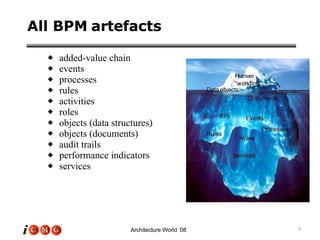
All BPM artefacts added-value chain events processes rules activities roles objects (data structures) objects (documents) audit trails performance indicators services
Main architecting principles All artefacts must be evolved to become  digital ,  external  and  virtual All artefacts must be  versionable  throughout their lifecycle All relationships between these artefacts are  modelled   explicitly  All models are made to be  executable
Relationships between artefacts Reveal all hidden relationships and structure them – examples: static (in design phase) dynamic (in execution phase) composition (from atomic artefacts to a composite artefact) instantiation (from a template to instances) compatibility (between different versions) If possible, model relationships as formal, explicit, traceable, testable, secure, SLA aware and executable
Knowledge about artefacts For each artefact definition and categories, if any naming convention, if any attributes volume dependencies security (e.g. ownership) life-cycle versioning  examples
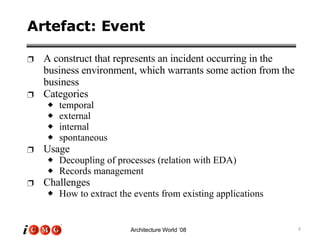
Artefact: Event A construct that represents an incident occurring in the business environment, which warrants some action from the business Categories temporal external internal spontaneous Usage Decoupling of processes (relation with EDA) Records management Challenges How to extract the events from existing applications
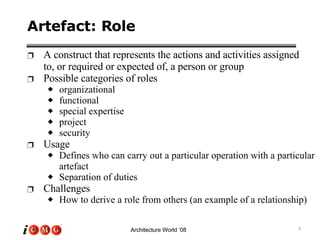
Artefact: Role A construct that represents the actions and activities assigned to, or required or expected of, a person or group Possible categories of roles organizational functional special expertise project  security Usage Defines who can carry out a particular operation with a particular artefact Separation of duties Challenges How to derive a role from others (an example of a relationship)
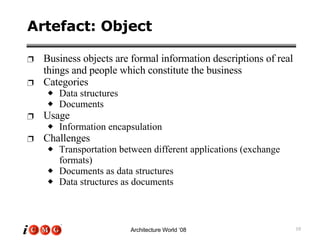
Artefact :  Object  Business objects are formal information descriptions of real things and people which constitute the business Categories Data structures Documents Usage Information encapsulation Challenges Transportation between different applications (exchange formats) Documents as data structures Data structures as documents
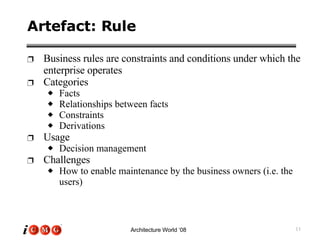
Artefact: Rule Business rules are constraints and conditions under which the enterprise operates  Categories Facts Relationships between facts Constraints Derivations Usage Decision management Challenges How to enable maintenance by the business owners (i.e. the users)
Artefact: Audit trail Record of some information about a BPM system to be able to analyse its behaviour at a later date Categories Technical  Business Usage Traceability Performance measurement Post-mortem analysis Challenges How to embed explicitly an audit trail into a process
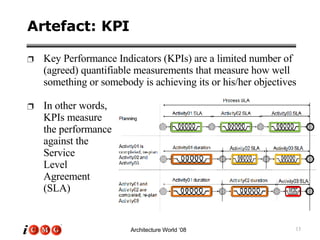
Artefact: KPI Key Performance Indicators (KPIs) are a limited number of (agreed) quantifiable measurements that measure how well something or somebody is achieving its or his/her objectives In other words,  KPIs measure  the performance  against the  Service Level Agreement (SLA)
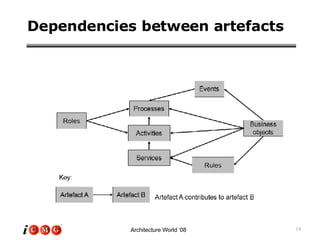
Dependencies between artefacts
Modelling of executable business processes Diagramming style in BPMN A dozen practical patterns Structuring for better “executability”  Modelling procedure  Use a common tool (business and IT) for prototyping – Intalio BPM suite
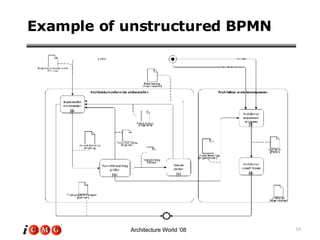
Example of unstructured BPMN
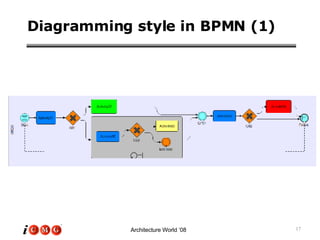
Diagramming style in BPMN (1)
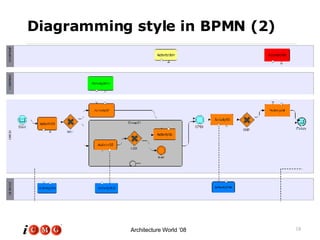
Diagramming style in BPMN (2)
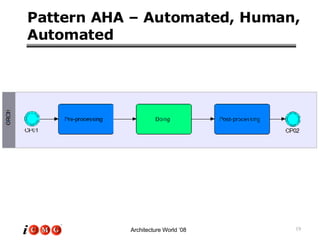
Pattern AHA – Automated, Human, Automated
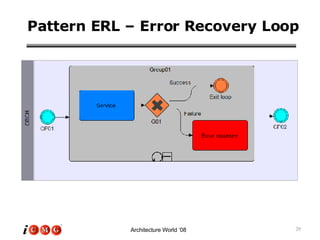
Pattern ERL – Error Recovery Loop
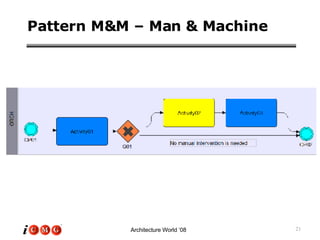
Pattern M&M – Man & Machine
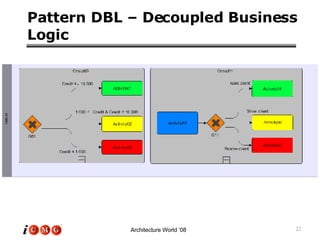
Pattern DBL – Decoupled Business Logic
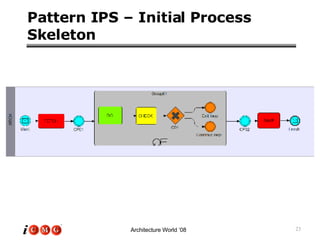
Pattern IPS – Initial Process Skeleton
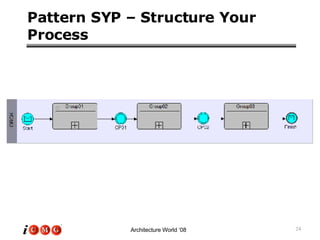
Pattern SYP – Structure Your Process
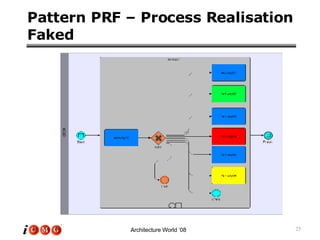
Pattern PRF – Process Realisation Faked
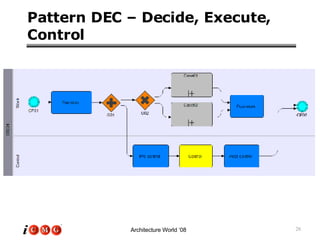
Pattern DEC – Decide, Execute, Control
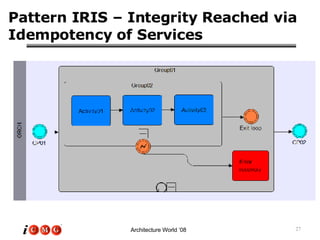
Pattern IRIS – Integrity Reached via Idempotency of Services
Principles of the modelling procedure it treats human and automated activities equally it is primarily for capturing the flow of control within a building block, and not for optimisation it is a tool for both the business and the IT (maybe with coaching by a process analyst) it provides validation by simulation it provides validation by quick prototyping – real services can be invoked it is “visual programming”
The modelling procedure Its purpose is to analyse a building block (what it is supposed to do)  to synthesise its implementation (how it does this) as the explicit coordination of other building blocks (processes or activities) It is iterative – we can apply it until we have left only indivisible building blocks (i.e. activities) Artefacts are constructed recursively, like Russian dolls
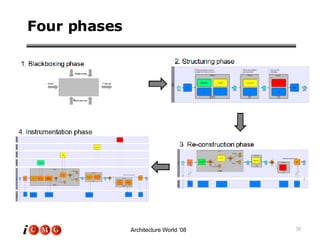
Four phases
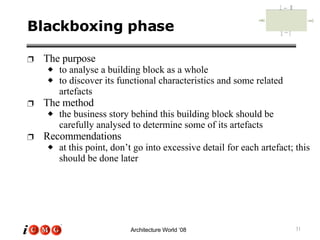
Blackboxing phase The purpose  to analyse a building block as a whole to discover its functional characteristics and some related artefacts The method the business story behind this building block should be carefully analysed to determine some of its artefacts  Recommendations at this point, don’t go into excessive detail for each artefact; this should be done later
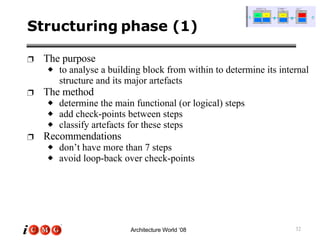
Structuring phase (1) The purpose  to analyse a building block from within to determine its internal structure and its major artefacts The method determine the main functional (or logical) steps add check-points between steps classify artefacts for these steps Recommendations don’t have more than 7 steps avoid loop-back over check-points
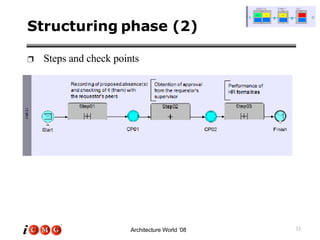
Structuring phase (2) Steps and check points
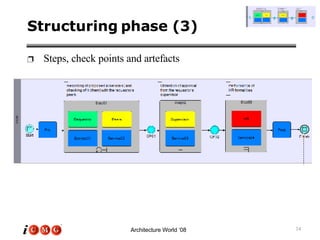
Structuring phase (3) Steps, check points and artefacts
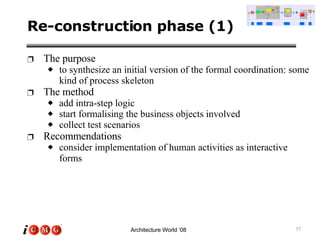
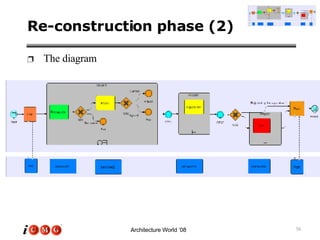
Re-construction phase (1) The purpose  to synthesize an initial version of the formal coordination: some kind of process skeleton The method add intra-step logic start formalising the business objects involved collect test scenarios Recommendations consider implementation of human activities as interactive forms
Re-construction phase (2) The diagram
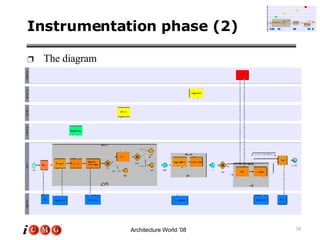
Instrumentation phase (1) The purpose  to enrich the process skeleton by adding more automated activities The method add pools apply different practical patterns use a business rule engine if available collect test scenarios Recommendations work iteratively (step-by-step)
Instrumentation phase (2) The diagram
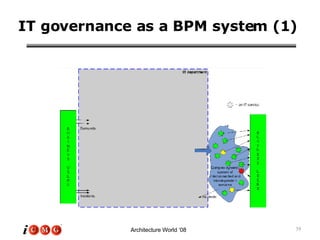
IT governance as a BPM system (1)
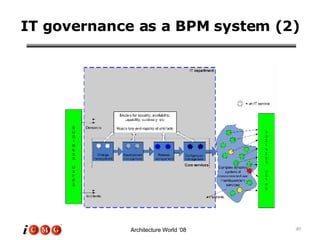
IT governance as a BPM system (2)
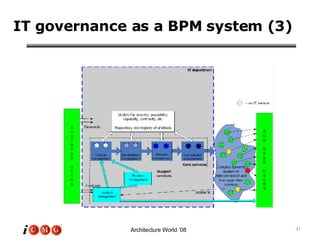
IT governance as a BPM system (3)
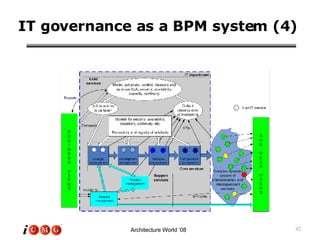
IT governance as a BPM system (4)
Summary The formal expression of relationships enables their automated validation The aggregation or assembly of services becomes the main implementation activity Small cycles “model–implement–test–refactor” considerably simplify both modelling and implementation There is a good match between BPM (provision of the context for services) and SOA
Towards executable models within BPM

  • 1.
    Towards executable modelswithin BPM Dr Alexander Samarin www.samarin.biz
  • 2.
    Overview Vision – enterprise architecture is a (semi-)exact science which provides guidance and practical help for the transformation of an enterprise to achieve certain desired characteristics (e.g. level of maturity, greater agility, better collaboration) Common understanding of artefacts Modelling of executable business processes IT governance as a BPM system
  • 3.
    Architecting an enterpriseBPM system (with systems thinking) A BPM system is a dynamic set of artefacts Artefacts are interconnected and interdependent We have to anticipate potential changes: policies, priorities, compliance, technology, etc. Implementation of such changes necessitates the evolution of some artefacts and the relationships between them It must be easy to modify all artefacts and relationships without causing any negative effects
  • 4.
    All BPM artefactsadded-value chain events processes rules activities roles objects (data structures) objects (documents) audit trails performance indicators services
  • 5.
    Main architecting principlesAll artefacts must be evolved to become digital , external and virtual All artefacts must be versionable throughout their lifecycle All relationships between these artefacts are modelled explicitly All models are made to be executable
  • 6.
    Relationships between artefactsReveal all hidden relationships and structure them – examples: static (in design phase) dynamic (in execution phase) composition (from atomic artefacts to a composite artefact) instantiation (from a template to instances) compatibility (between different versions) If possible, model relationships as formal, explicit, traceable, testable, secure, SLA aware and executable
  • 7.
    Knowledge about artefactsFor each artefact definition and categories, if any naming convention, if any attributes volume dependencies security (e.g. ownership) life-cycle versioning examples
  • 8.
    Artefact: Event Aconstruct that represents an incident occurring in the business environment, which warrants some action from the business Categories temporal external internal spontaneous Usage Decoupling of processes (relation with EDA) Records management Challenges How to extract the events from existing applications
  • 9.
    Artefact: Role Aconstruct that represents the actions and activities assigned to, or required or expected of, a person or group Possible categories of roles organizational functional special expertise project security Usage Defines who can carry out a particular operation with a particular artefact Separation of duties Challenges How to derive a role from others (an example of a relationship)
  • 10.
    Artefact : Object Business objects are formal information descriptions of real things and people which constitute the business Categories Data structures Documents Usage Information encapsulation Challenges Transportation between different applications (exchange formats) Documents as data structures Data structures as documents
  • 11.
    Artefact: Rule Businessrules are constraints and conditions under which the enterprise operates Categories Facts Relationships between facts Constraints Derivations Usage Decision management Challenges How to enable maintenance by the business owners (i.e. the users)
  • 12.
    Artefact: Audit trailRecord of some information about a BPM system to be able to analyse its behaviour at a later date Categories Technical Business Usage Traceability Performance measurement Post-mortem analysis Challenges How to embed explicitly an audit trail into a process
  • 13.
    Artefact: KPI KeyPerformance Indicators (KPIs) are a limited number of (agreed) quantifiable measurements that measure how well something or somebody is achieving its or his/her objectives In other words, KPIs measure the performance against the Service Level Agreement (SLA)
  • 14.
  • 15.
    Modelling of executablebusiness processes Diagramming style in BPMN A dozen practical patterns Structuring for better “executability” Modelling procedure Use a common tool (business and IT) for prototyping – Intalio BPM suite
  • 16.
  • 17.
  • 18.
  • 19.
    Pattern AHA –Automated, Human, Automated
  • 20.
    Pattern ERL –Error Recovery Loop
  • 21.
    Pattern M&M –Man & Machine
  • 22.
    Pattern DBL –Decoupled Business Logic
  • 23.
    Pattern IPS –Initial Process Skeleton
  • 24.
    Pattern SYP –Structure Your Process
  • 25.
    Pattern PRF –Process Realisation Faked
  • 26.
    Pattern DEC –Decide, Execute, Control
  • 27.
    Pattern IRIS –Integrity Reached via Idempotency of Services
  • 28.
    Principles of themodelling procedure it treats human and automated activities equally it is primarily for capturing the flow of control within a building block, and not for optimisation it is a tool for both the business and the IT (maybe with coaching by a process analyst) it provides validation by simulation it provides validation by quick prototyping – real services can be invoked it is “visual programming”
  • 29.
    The modelling procedureIts purpose is to analyse a building block (what it is supposed to do) to synthesise its implementation (how it does this) as the explicit coordination of other building blocks (processes or activities) It is iterative – we can apply it until we have left only indivisible building blocks (i.e. activities) Artefacts are constructed recursively, like Russian dolls
  • 30.
  • 31.
    Blackboxing phase Thepurpose to analyse a building block as a whole to discover its functional characteristics and some related artefacts The method the business story behind this building block should be carefully analysed to determine some of its artefacts Recommendations at this point, don’t go into excessive detail for each artefact; this should be done later
  • 32.
    Structuring phase (1)The purpose to analyse a building block from within to determine its internal structure and its major artefacts The method determine the main functional (or logical) steps add check-points between steps classify artefacts for these steps Recommendations don’t have more than 7 steps avoid loop-back over check-points
  • 33.
    Structuring phase (2)Steps and check points
  • 34.
    Structuring phase (3)Steps, check points and artefacts
  • 35.
    Re-construction phase (1)The purpose to synthesize an initial version of the formal coordination: some kind of process skeleton The method add intra-step logic start formalising the business objects involved collect test scenarios Recommendations consider implementation of human activities as interactive forms
  • 36.
  • 37.
    Instrumentation phase (1)The purpose to enrich the process skeleton by adding more automated activities The method add pools apply different practical patterns use a business rule engine if available collect test scenarios Recommendations work iteratively (step-by-step)
  • 38.
  • 39.
    IT governance asa BPM system (1)
  • 40.
    IT governance asa BPM system (2)
  • 41.
    IT governance asa BPM system (3)
  • 42.
    IT governance asa BPM system (4)
  • 43.
    Summary The formalexpression of relationships enables their automated validation The aggregation or assembly of services becomes the main implementation activity Small cycles “model–implement–test–refactor” considerably simplify both modelling and implementation There is a good match between BPM (provision of the context for services) and SOA