ICEIMT 2009 BLED WORKSHOP, DECEMBER 2009 ACHIEVING  SYNERGY  BETWEEN  BPM, SOA AND EA Dr Alexander Samarin www.samarin.biz
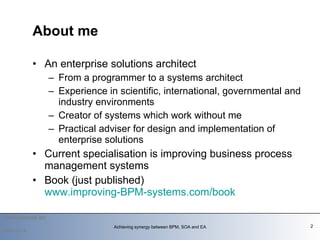
About me An enterprise solutions architect From a programmer to a systems architect  Experience in scientific, international, governmental and industry environments Creator of systems which work without me Practical adviser for design and implementation of enterprise solutions Current specialisation is improving business process management systems Book (just published) www.improving-BPM-systems.com/book     2009-12-14 Achieving synergy between BPM, SOA and EA
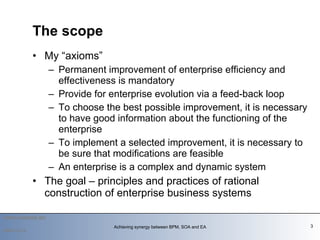
My “axioms” Permanent improvement of enterprise efficiency and effectiveness is mandatory Provide for enterprise evolution via a feed-back loop To choose the best possible improvement, it is necessary to have good information about the functioning of the enterprise To implement a selected improvement, it is necessary to be sure that modifications are feasible An enterprise is a complex and dynamic system The goal – principles and practices of rational construction of enterprise business systems The scope   2009-12-14 Achieving synergy between BPM, SOA and EA
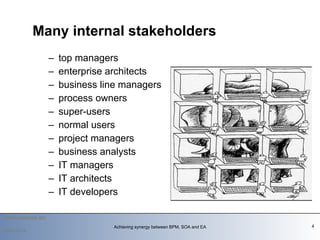
top managers enterprise architects business line managers process owners super-users normal users project managers business analysts IT managers IT architects IT developers Many internal stakeholders 2009-12-14 Achieving synergy between BPM, SOA and EA
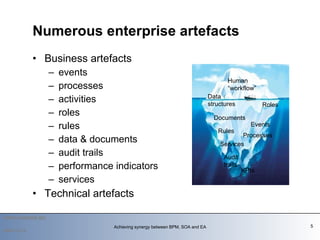
Business artefacts events processes activities roles rules data & documents audit trails performance indicators services Technical artefacts Numerous enterprise artefacts   2009-12-14 Achieving synergy between BPM, SOA and EA KPIs  Processes  Services  Events  Roles  Data structures Documents  Rules  Human “workflow”  Audit trails
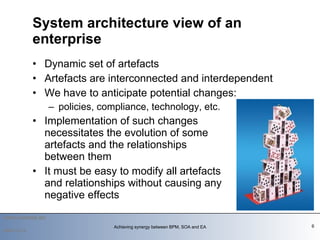
Dynamic set of artefacts Artefacts are interconnected and interdependent We have to anticipate potential changes:  policies, compliance, technology, etc. Implementation of such changes  necessitates the evolution of some  artefacts and the relationships  between them It must be easy to modify all artefacts  and relationships without causing any  negative effects  System architecture view of an enterprise 2009-12-14 Achieving synergy between BPM, SOA and EA
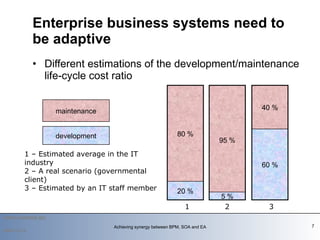
Different estimations of the development/maintenance life-cycle cost ratio Enterprise business systems need to be adaptive  2009-12-14 Achieving synergy between BPM, SOA and EA 95 % 5 % 40 % 60 % 80 % 20 % 1 – Estimated average in the IT industry 2 – A real scenario (governmental client) 3 – Estimated by an IT staff member maintenance development 1 3 2
All artefacts must be  versionable  throughout their life-cycle All artefacts must be evolved to become  digital   externalised  virtual   components of clouds All relationships between these artefacts are modelled  explicitly  All models are made to be  executable Main principles   2009-12-14 Achieving synergy between BPM, SOA and EA
More knowledge about the functioning of the enterprise More predictable results More rational decisions More comprehensive optimisation Executable models are also testable platform-independent Advantages of executable models   2009-12-14 Achieving synergy between BPM, SOA and EA
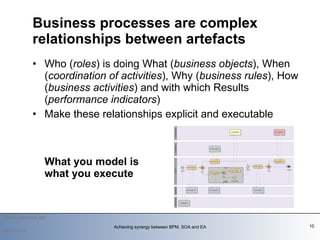
Who ( roles ) is doing What ( business objects ), When ( coordination of activities ), Why ( business rules ), How ( business activities ) and with which Results ( performance indicators )  Make these relationships explicit and executable   What you model is  what you execute Business processes are complex relationships between artefacts 2009-12-14 Achieving synergy between BPM, SOA and EA
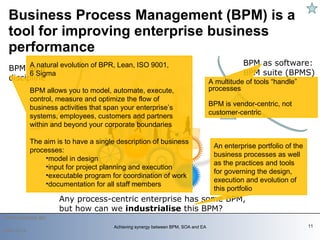
Business Process Management (BPM) is a tool for improving enterprise business performance    2009-12-14 Achieving synergy between BPM, SOA and EA BPM as a  discipline BPM as software: BPM suite (BPMS) Any process-centric enterprise has some BPM, but how can we  industrialise  this BPM? A natural evolution of BPR, Lean, ISO 9001,  6 Sigma BPM allows you to model, automate, execute, control, measure and optimize the flow of business activities that span your enterprise’s systems, employees, customers and partners within and beyond your corporate boundaries The aim is to have a single description   of business processes: model in design input for project planning and execution executable program for coordination of work documentation for all staff members An enterprise portfolio of the business processes as well as the practices and tools for governing the design, execution and evolution of this portfolio A multitude of tools “handle” processes BPM is vendor-centric, not customer-centric
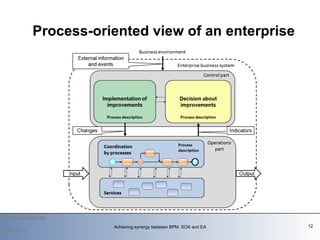
Process-oriented view of an enterprise 2009-12-14 Achieving synergy between BPM, SOA and EA
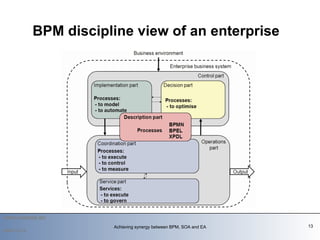
BPM discipline view of an enterprise    2009-12-14 Achieving synergy between BPM, SOA and EA
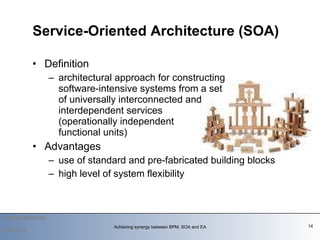
Definition architectural approach for constructing software-intensive systems from a set of universally interconnected and  interdependent services  ( operationally independent  functional units ) Advantages use of standard and pre-fabricated building blocks high level of system flexibility Service-Oriented Architecture  (SOA)   2009-12-14 Achieving synergy between BPM, SOA and EA
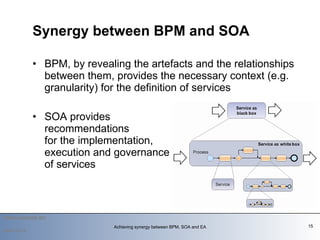
BPM, by revealing the artefacts and the relationships between them, provides the necessary context (e.g. granularity) for the definition of services SOA provides  recommendations for the implementation,  execution and governance  of services Synergy between BPM and SOA 2009-12-14 Achieving synergy between BPM, SOA and EA
Definition set of principles, practices, and tools which provides guidance and practical help for the design and evolution of en enterprise to achieve its vision and strategy “ Enterprise genotype” (a full  nomenclature of enterprise  artefacts) – classic EA “ Enterprise phenotype” (a set of observable characteristics such as performance) Formal genotype–phenotype link via “enterprise executable model” – EA enhanced by BPM and SOA Enterprise architecture (EA) is a tool for the design of future states   2009-12-14 Achieving synergy between BPM, SOA and EA
Main technologies Business Process Management (BPM) Service-Oriented Architecture (SOA) Other technologies ECM,  BEM, BI, BRM, MDM, ESB, BAM, ITIL, … Organic integration with Enterprise architecture (EA) Project management practices Principles for design of flexible systems Architectural framework – a coherent set of existing technologies   2009-12-14 Achieving synergy between BPM, SOA and EA
Situation (year 1999) 3 000 complex technical documents per year Word + SGML/XML + PDF publishing in-house system: usine à gaz with several repositories a lot of “manual” integration and coordination work  most of the IT staff are busy with BUG2000 Tasks reduce amount of “manual” work  simplify work – make suitable for less-qualified staff members maintain the same quality work without classic user specifications progress via small iterations of new system Example – a complex production system in place for several years (1)   2009-12-14 Achieving synergy between BPM, SOA and EA
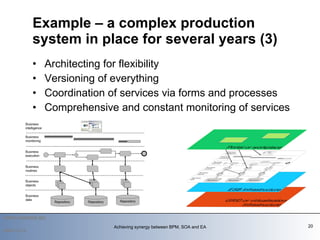
A “BPM” tool workflow engine from an off-the-shelf product mixture of human and automated tasks  external agents for carrying out automated tasks use of a dynamic language (Jython) An “SOA” tool CORBA implementation in Java standard interface for most services composition of services in Java, Jython, shell Externalisation of events (from existing repositories) Example – a complex production system in place for several years (2)   2009-12-14 Achieving synergy between BPM, SOA and EA
Architecting for flexibility Versioning of everything Coordination of services via forms and processes Comprehensive and constant monitoring of services Example – a complex production system in place for several years (3)   2009-12-14 Achieving synergy between BPM, SOA and EA
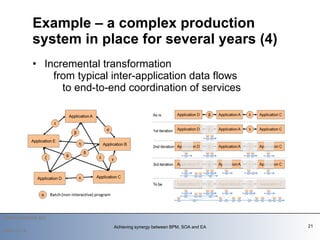
Incremental transformation    from typical inter-application data flows   to end-to-end coordination of services  Example – a complex production system in place for several years (4)   2009-12-14 Achieving synergy between BPM, SOA and EA
Result high user satisfaction faster and better ROI several times less resources required for maintenance and evolution migrations made easy – several successfully undertaken real agility achieved micro-projects – agile implementations of new features meta-projects – architectural framework governance for the management of many micro-projects in production now for 10 years Example – a complex production system in place for several years (5)
Situation 30 different tools in use for electronic publishing 2 years of heated discussions without a decision Task define criteria for the selection of a  single  tool Action modelling of business processes to determine common services Result (after several meetings) an agreed list of services acting as selection criteria Example – selection of a single tool   2009-12-14 Achieving synergy between BPM, SOA and EA
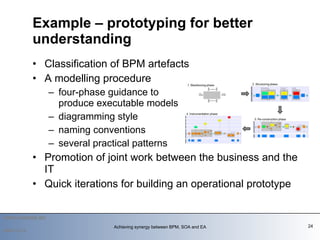
Classification of BPM artefacts  A modelling procedure four-phase guidance to  produce executable models diagramming style naming conventions several practical patterns Promotion of joint work between the business and the IT Quick iterations for building an operational prototype Example – prototyping for better understanding    2009-12-14 Achieving synergy between BPM, SOA and EA
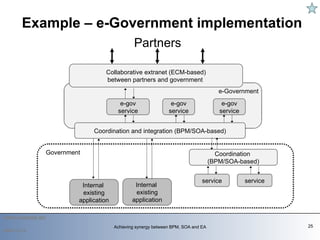
Example – e-Government implementation   2009-12-14 Achieving synergy between BPM, SOA and EA Government  Partners Internal  existing application Coordination and integration (BPM/SOA-based) e-Government Collaborative extranet (ECM-based) between partners and government  e-gov service e-gov service e-gov service Internal  existing application Coordination  (BPM/SOA-based) service service
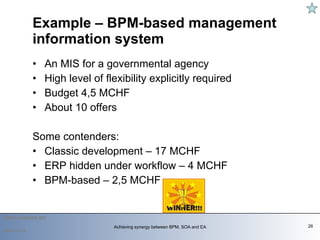
An MIS for a governmental agency  High level of flexibility explicitly required Budget 4,5 MCHF About 10 offers Some contenders: Classic development – 17 MCHF ERP hidden under workflow – 4 MCHF  BPM-based – 2,5 MCHF Example – BPM-based management information system   2009-12-14 Achieving synergy between BPM, SOA and EA
Use of the architectural framework  reduces the complexity  Based on a   BPM reference model Addresses the needs of the most difficult  aspect – people Use of explicit and executable models Business process modelling in BPMN Quick prototyping Guidelines for usage of different technologies Link with enterprise architecture Main advantages of the architectural framework   2009-12-14 Achieving synergy between BPM, SOA and EA
Thank you! Contact information: Alexander   Samarin [email_address] www.improving-BPM-systems.com 2009-12-14   Achieving synergy between BPM, SOA and EA

Achieving synergy between BPM, SOA and EA

  • 1.
    ICEIMT 2009 BLEDWORKSHOP, DECEMBER 2009 ACHIEVING SYNERGY BETWEEN BPM, SOA AND EA Dr Alexander Samarin www.samarin.biz
  • 2.
    About me Anenterprise solutions architect From a programmer to a systems architect Experience in scientific, international, governmental and industry environments Creator of systems which work without me Practical adviser for design and implementation of enterprise solutions Current specialisation is improving business process management systems Book (just published) www.improving-BPM-systems.com/book 2009-12-14 Achieving synergy between BPM, SOA and EA
  • 3.
    My “axioms” Permanentimprovement of enterprise efficiency and effectiveness is mandatory Provide for enterprise evolution via a feed-back loop To choose the best possible improvement, it is necessary to have good information about the functioning of the enterprise To implement a selected improvement, it is necessary to be sure that modifications are feasible An enterprise is a complex and dynamic system The goal – principles and practices of rational construction of enterprise business systems The scope 2009-12-14 Achieving synergy between BPM, SOA and EA
  • 4.
    top managers enterprisearchitects business line managers process owners super-users normal users project managers business analysts IT managers IT architects IT developers Many internal stakeholders 2009-12-14 Achieving synergy between BPM, SOA and EA
  • 5.
    Business artefacts eventsprocesses activities roles rules data & documents audit trails performance indicators services Technical artefacts Numerous enterprise artefacts 2009-12-14 Achieving synergy between BPM, SOA and EA KPIs Processes Services Events Roles Data structures Documents Rules Human “workflow” Audit trails
  • 6.
    Dynamic set ofartefacts Artefacts are interconnected and interdependent We have to anticipate potential changes: policies, compliance, technology, etc. Implementation of such changes necessitates the evolution of some artefacts and the relationships between them It must be easy to modify all artefacts and relationships without causing any negative effects System architecture view of an enterprise 2009-12-14 Achieving synergy between BPM, SOA and EA
  • 7.
    Different estimations ofthe development/maintenance life-cycle cost ratio Enterprise business systems need to be adaptive 2009-12-14 Achieving synergy between BPM, SOA and EA 95 % 5 % 40 % 60 % 80 % 20 % 1 – Estimated average in the IT industry 2 – A real scenario (governmental client) 3 – Estimated by an IT staff member maintenance development 1 3 2
  • 8.
    All artefacts mustbe versionable throughout their life-cycle All artefacts must be evolved to become digital externalised virtual components of clouds All relationships between these artefacts are modelled explicitly All models are made to be executable Main principles 2009-12-14 Achieving synergy between BPM, SOA and EA
  • 9.
    More knowledge aboutthe functioning of the enterprise More predictable results More rational decisions More comprehensive optimisation Executable models are also testable platform-independent Advantages of executable models 2009-12-14 Achieving synergy between BPM, SOA and EA
  • 10.
    Who ( roles) is doing What ( business objects ), When ( coordination of activities ), Why ( business rules ), How ( business activities ) and with which Results ( performance indicators ) Make these relationships explicit and executable What you model is what you execute Business processes are complex relationships between artefacts 2009-12-14 Achieving synergy between BPM, SOA and EA
  • 11.
    Business Process Management(BPM) is a tool for improving enterprise business performance 2009-12-14 Achieving synergy between BPM, SOA and EA BPM as a discipline BPM as software: BPM suite (BPMS) Any process-centric enterprise has some BPM, but how can we industrialise this BPM? A natural evolution of BPR, Lean, ISO 9001, 6 Sigma BPM allows you to model, automate, execute, control, measure and optimize the flow of business activities that span your enterprise’s systems, employees, customers and partners within and beyond your corporate boundaries The aim is to have a single description of business processes: model in design input for project planning and execution executable program for coordination of work documentation for all staff members An enterprise portfolio of the business processes as well as the practices and tools for governing the design, execution and evolution of this portfolio A multitude of tools “handle” processes BPM is vendor-centric, not customer-centric
  • 12.
    Process-oriented view ofan enterprise 2009-12-14 Achieving synergy between BPM, SOA and EA
  • 13.
    BPM discipline viewof an enterprise 2009-12-14 Achieving synergy between BPM, SOA and EA
  • 14.
    Definition architectural approachfor constructing software-intensive systems from a set of universally interconnected and interdependent services ( operationally independent functional units ) Advantages use of standard and pre-fabricated building blocks high level of system flexibility Service-Oriented Architecture (SOA) 2009-12-14 Achieving synergy between BPM, SOA and EA
  • 15.
    BPM, by revealingthe artefacts and the relationships between them, provides the necessary context (e.g. granularity) for the definition of services SOA provides recommendations for the implementation, execution and governance of services Synergy between BPM and SOA 2009-12-14 Achieving synergy between BPM, SOA and EA
  • 16.
    Definition set ofprinciples, practices, and tools which provides guidance and practical help for the design and evolution of en enterprise to achieve its vision and strategy “ Enterprise genotype” (a full nomenclature of enterprise artefacts) – classic EA “ Enterprise phenotype” (a set of observable characteristics such as performance) Formal genotype–phenotype link via “enterprise executable model” – EA enhanced by BPM and SOA Enterprise architecture (EA) is a tool for the design of future states 2009-12-14 Achieving synergy between BPM, SOA and EA
  • 17.
    Main technologies BusinessProcess Management (BPM) Service-Oriented Architecture (SOA) Other technologies ECM, BEM, BI, BRM, MDM, ESB, BAM, ITIL, … Organic integration with Enterprise architecture (EA) Project management practices Principles for design of flexible systems Architectural framework – a coherent set of existing technologies 2009-12-14 Achieving synergy between BPM, SOA and EA
  • 18.
    Situation (year 1999)3 000 complex technical documents per year Word + SGML/XML + PDF publishing in-house system: usine à gaz with several repositories a lot of “manual” integration and coordination work most of the IT staff are busy with BUG2000 Tasks reduce amount of “manual” work simplify work – make suitable for less-qualified staff members maintain the same quality work without classic user specifications progress via small iterations of new system Example – a complex production system in place for several years (1) 2009-12-14 Achieving synergy between BPM, SOA and EA
  • 19.
    A “BPM” toolworkflow engine from an off-the-shelf product mixture of human and automated tasks external agents for carrying out automated tasks use of a dynamic language (Jython) An “SOA” tool CORBA implementation in Java standard interface for most services composition of services in Java, Jython, shell Externalisation of events (from existing repositories) Example – a complex production system in place for several years (2) 2009-12-14 Achieving synergy between BPM, SOA and EA
  • 20.
    Architecting for flexibilityVersioning of everything Coordination of services via forms and processes Comprehensive and constant monitoring of services Example – a complex production system in place for several years (3) 2009-12-14 Achieving synergy between BPM, SOA and EA
  • 21.
    Incremental transformation from typical inter-application data flows to end-to-end coordination of services Example – a complex production system in place for several years (4) 2009-12-14 Achieving synergy between BPM, SOA and EA
  • 22.
    Result high usersatisfaction faster and better ROI several times less resources required for maintenance and evolution migrations made easy – several successfully undertaken real agility achieved micro-projects – agile implementations of new features meta-projects – architectural framework governance for the management of many micro-projects in production now for 10 years Example – a complex production system in place for several years (5)
  • 23.
    Situation 30 differenttools in use for electronic publishing 2 years of heated discussions without a decision Task define criteria for the selection of a single tool Action modelling of business processes to determine common services Result (after several meetings) an agreed list of services acting as selection criteria Example – selection of a single tool 2009-12-14 Achieving synergy between BPM, SOA and EA
  • 24.
    Classification of BPMartefacts A modelling procedure four-phase guidance to produce executable models diagramming style naming conventions several practical patterns Promotion of joint work between the business and the IT Quick iterations for building an operational prototype Example – prototyping for better understanding 2009-12-14 Achieving synergy between BPM, SOA and EA
  • 25.
    Example – e-Governmentimplementation 2009-12-14 Achieving synergy between BPM, SOA and EA Government Partners Internal existing application Coordination and integration (BPM/SOA-based) e-Government Collaborative extranet (ECM-based) between partners and government e-gov service e-gov service e-gov service Internal existing application Coordination (BPM/SOA-based) service service
  • 26.
    An MIS fora governmental agency High level of flexibility explicitly required Budget 4,5 MCHF About 10 offers Some contenders: Classic development – 17 MCHF ERP hidden under workflow – 4 MCHF BPM-based – 2,5 MCHF Example – BPM-based management information system 2009-12-14 Achieving synergy between BPM, SOA and EA
  • 27.
    Use of thearchitectural framework reduces the complexity Based on a BPM reference model Addresses the needs of the most difficult aspect – people Use of explicit and executable models Business process modelling in BPMN Quick prototyping Guidelines for usage of different technologies Link with enterprise architecture Main advantages of the architectural framework 2009-12-14 Achieving synergy between BPM, SOA and EA
  • 28.
    Thank you! Contactinformation: Alexander Samarin [email_address] www.improving-BPM-systems.com 2009-12-14 Achieving synergy between BPM, SOA and EA