
MDBE for Change Management 
and Adaptation
Harris Apostolopoulos BEng(Hons), MSc, MBA, MIET, FITSE
harris.apostolopoulos@gmail.com
Agenda
Introduction to Change and Adaptationg p
Significance
Change Management and AdaptationChange Management and Adaptation 
models
MDBE for Change and Adaptation
Summaryy
Types of Change
Two major categories, individual change management and organisational
change management.g g
Especially in multinational companies, cross‐cultural issues can affectEspecially in multinational companies, cross cultural issues can affect
planned changes and the process can get complicated.
However, the transitional period of change (which may lead to adaptation)
is not only a time consuming but also a risky process; due to cultural or
even organisational reasons the whole process is subject to fail.even organisational reasons the whole process is subject to fail.
Types of Change (Cont.)
Duck (1993) argued that change is intensely personal
Luecke (2003) separated change into four types; structural, cost cutting,Luecke (2003) separated change into four types; structural, cost cutting,
process and cultural
Cultural change mainly concerns the organisation’s general approach to
doing business or the relationship between managers and employees.
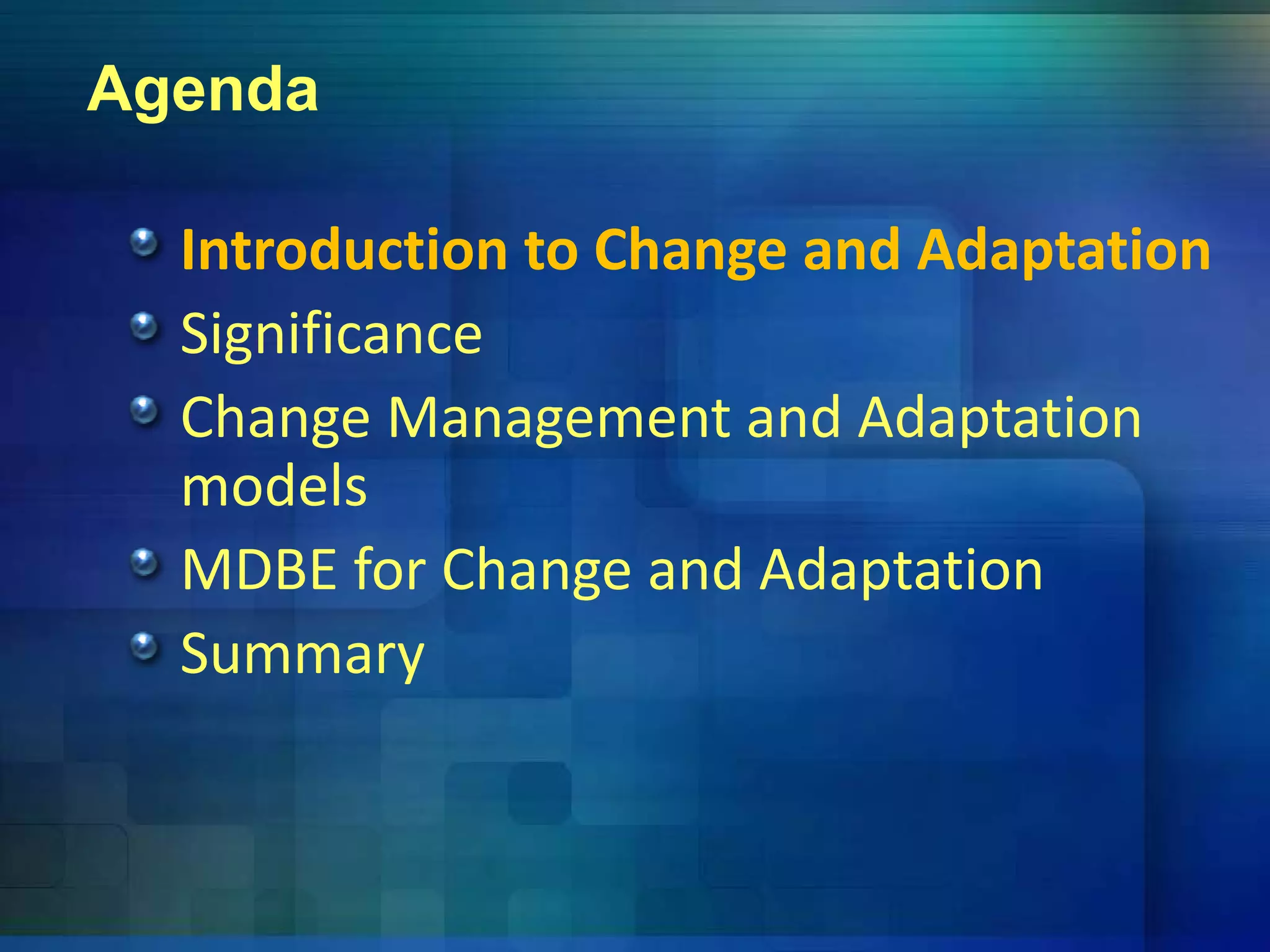
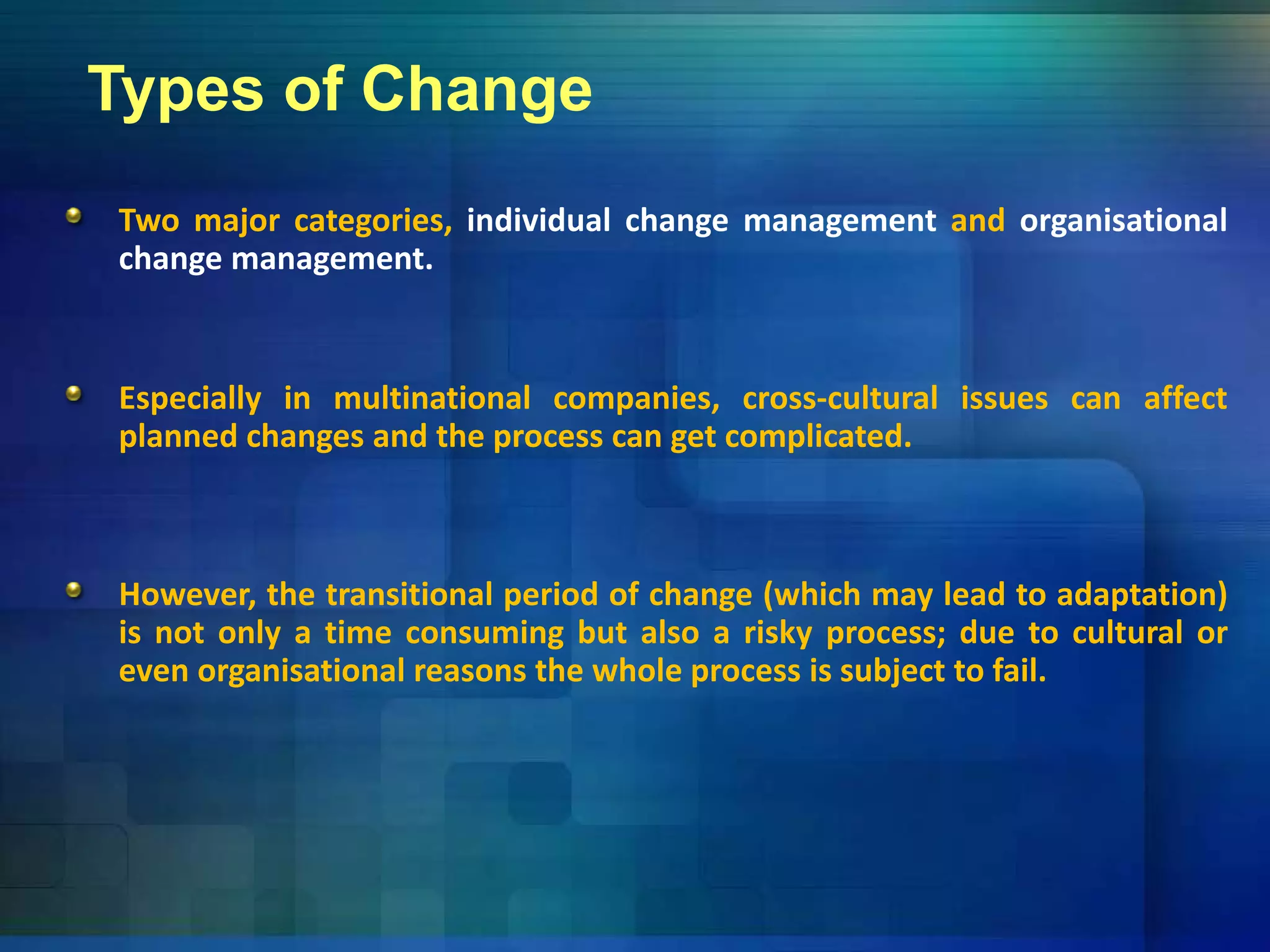
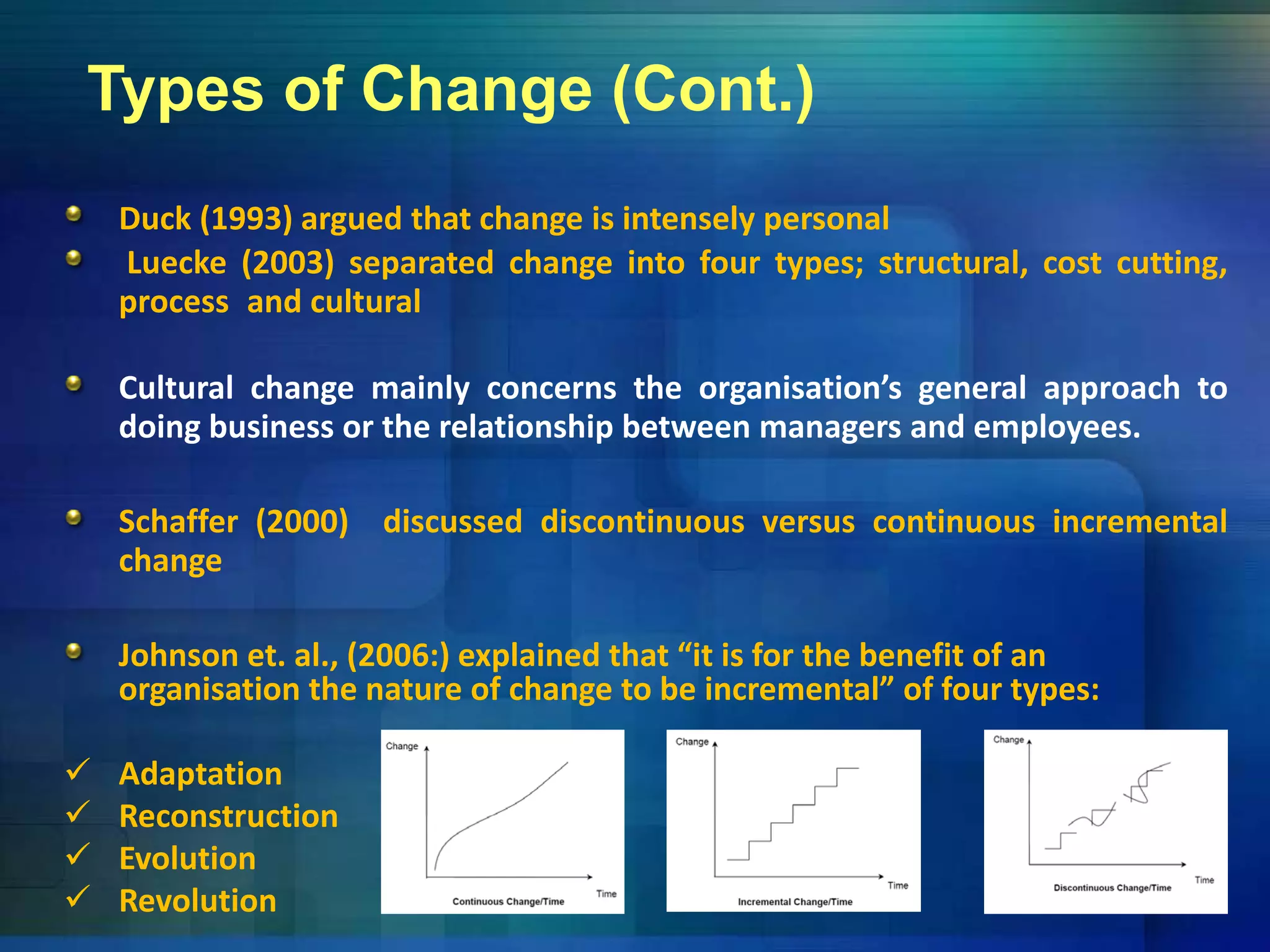
Schaffer (2000) discussed discontinuous versus continuous incremental
change
Johnson et. al., (2006:) explained that “it is for the benefit of an 
i ti th t f h t b i t l” f f torganisation the nature of change to be incremental” of four types:
 Adaptation
 Reconstruction Reconstruction
 Evolution
 Revolution 
Agenda
Introduction to Change and Adaptationg p
Significance
Change Management and AdaptationChange Management and Adaptation 
models
f h d dMDBE for Change and Adaptation
Summaryy
Significance
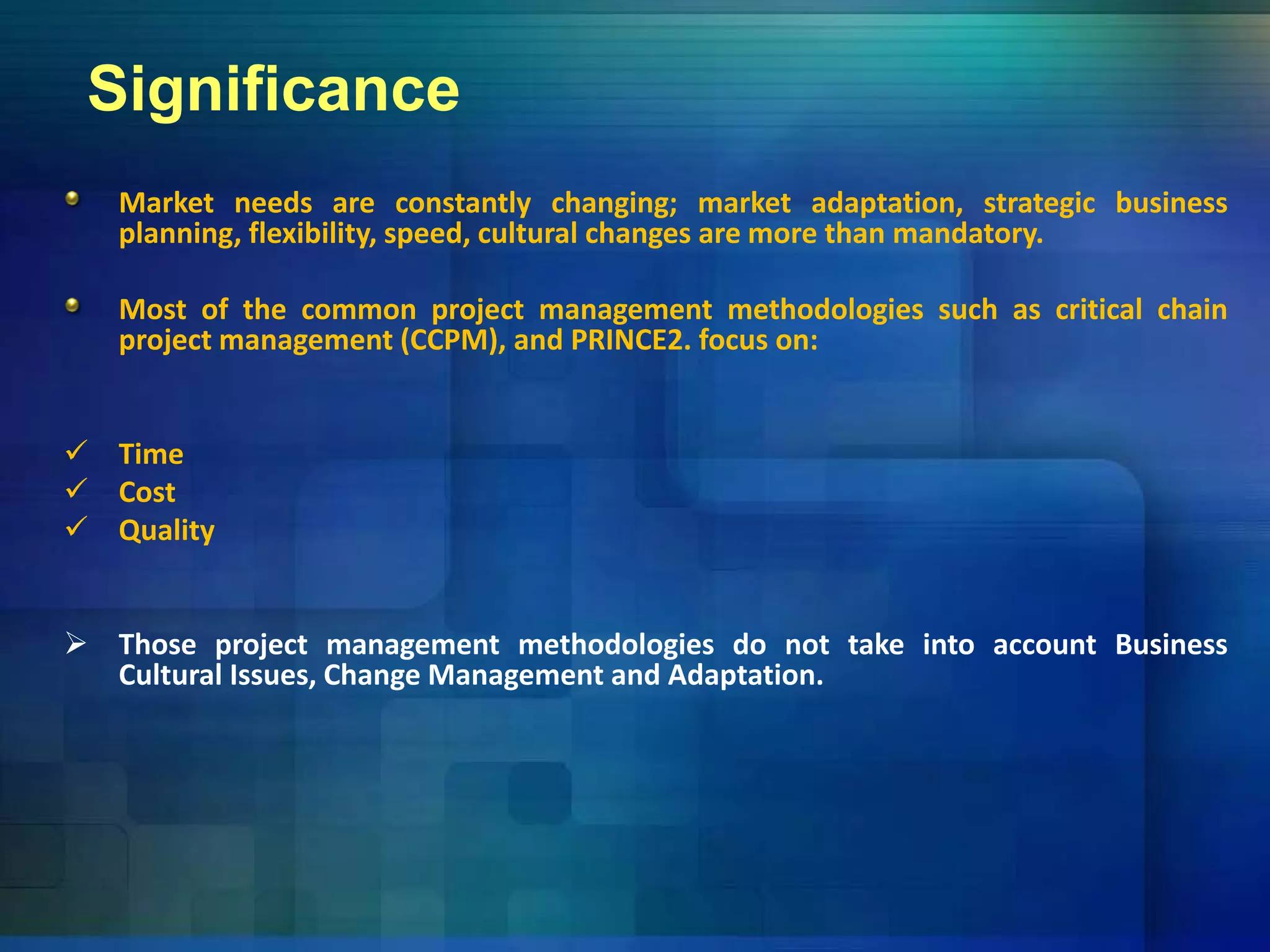
Market needs are constantly changing; market adaptation, strategic business
planning, flexibility, speed, cultural changes are more than mandatory.
Most of the common project management methodologies such as critical chain
project management (CCPM), and PRINCE2. focus on:
 Time
 Cost
 Qualityy
 Those project management methodologies do not take into account Business
Cultural Issues Change Management and AdaptationCultural Issues, Change Management and Adaptation.
Significance (Cont.)
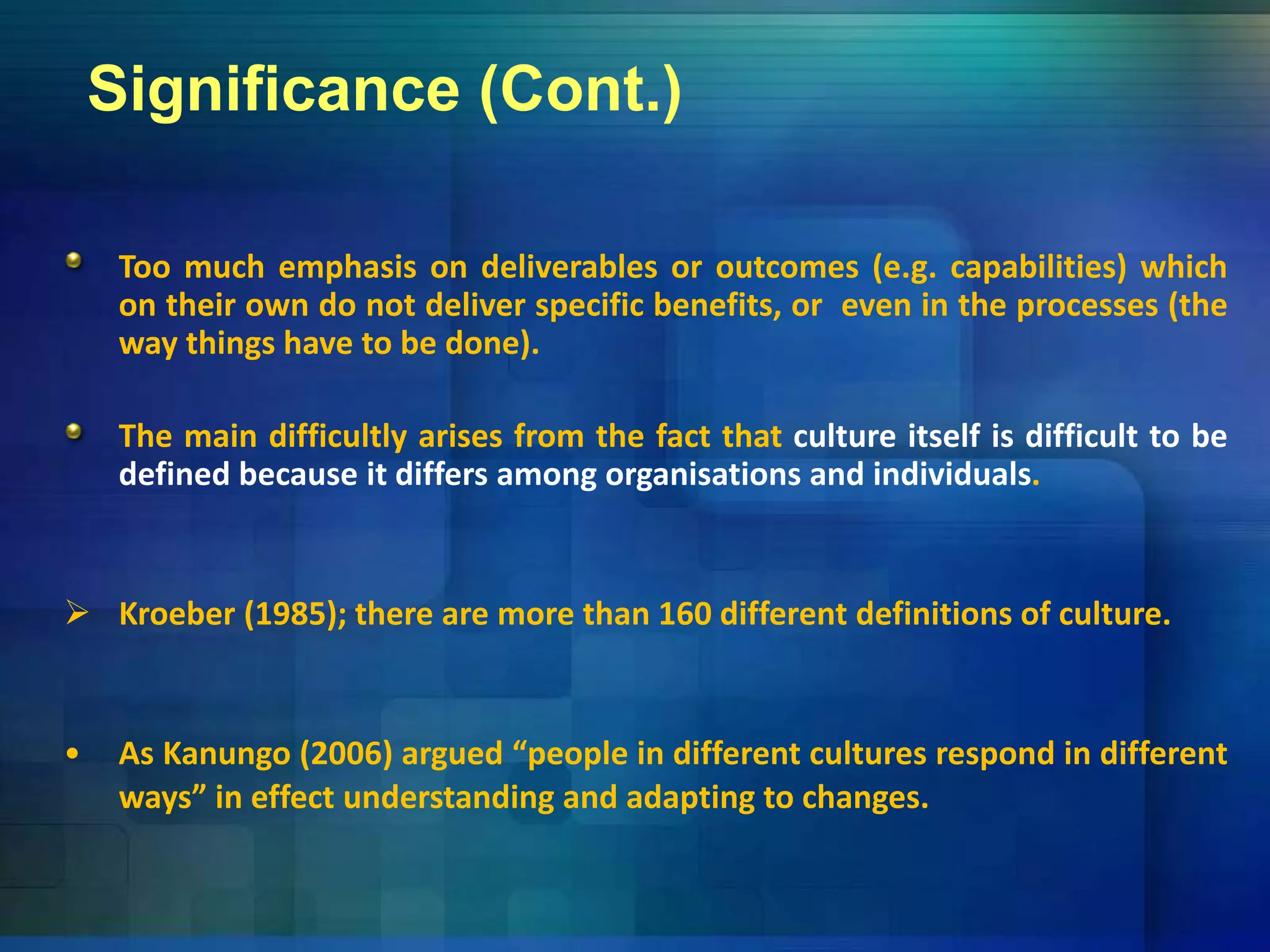
Too much emphasis on deliverables or outcomes (e g capabilities) whichToo much emphasis on deliverables or outcomes (e.g. capabilities) which
on their own do not deliver specific benefits, or even in the processes (the
way things have to be done).
The main difficultly arises from the fact that culture itself is difficult to be
defined because it differs among organisations and individuals.
 Kroeber (1985); there are more than 160 different definitions of culture.
• As Kanungo (2006) argued “people in different cultures respond in different
ways” in effect understanding and adapting to changes.
Agenda
Introduction to Change and Adaptationg p
Significance
Change Management and AdaptationChange Management and Adaptation 
models
MDBE for Change and Adaptation
Summaryy
Change and Adaptation
Pascale (1990); “change requires that businesses continuously reinvent
themselves”themselves
Sinclair (1993);culture can be managed and this is a responsibility of the
management itself.management itself.
Tichy (1983);“we are all beings of habit and tend to repeat what we are
comfortable with.”
Schlossberg (1981) , Successful adaptation might involve establishing a
structured methodology for responding to changes such as new policies, or
technologies.
Parkes (1971); “First, abandoning one set of assumptions and then
l f h f h h hdeveloping a fresher frame, so as the person to cope with the new
changes”.
Cultural Change
Hofstede (1980) argued that the cultural differences between nationalities
were evident when employees of the same organisation were spread overp y g p
many countries.
Stuttard (2000) concluded that “one common mistake is that, foreign
managers fail to realize how pervasive it is”.
Pitta et.al, (1999); managers’ business behaviour is directly related to the , ( ); g y
country’s culture. 
Dealing with culture has the difficulty to define it universally.
Models of Change
Briefly, Lewin (1951)described change as a three‐stage process:
 Unfreezingg
 Confusion
 Refreezing
• Bridges (1991) come up with a similar model:
 Ending
 N t l Neutral
 New beginning
Bullock and Baten (1985) named their model stages as:Bullock and Baten (1985) named their model stages as:
 Exploration
 Planning Planning
 Action
 Integration
Agenda
Introduction to Change and Adaptationg p
Significance
Change Management and AdaptationChange Management and Adaptation 
models
MDBE for Change and Adaptation
Summaryy
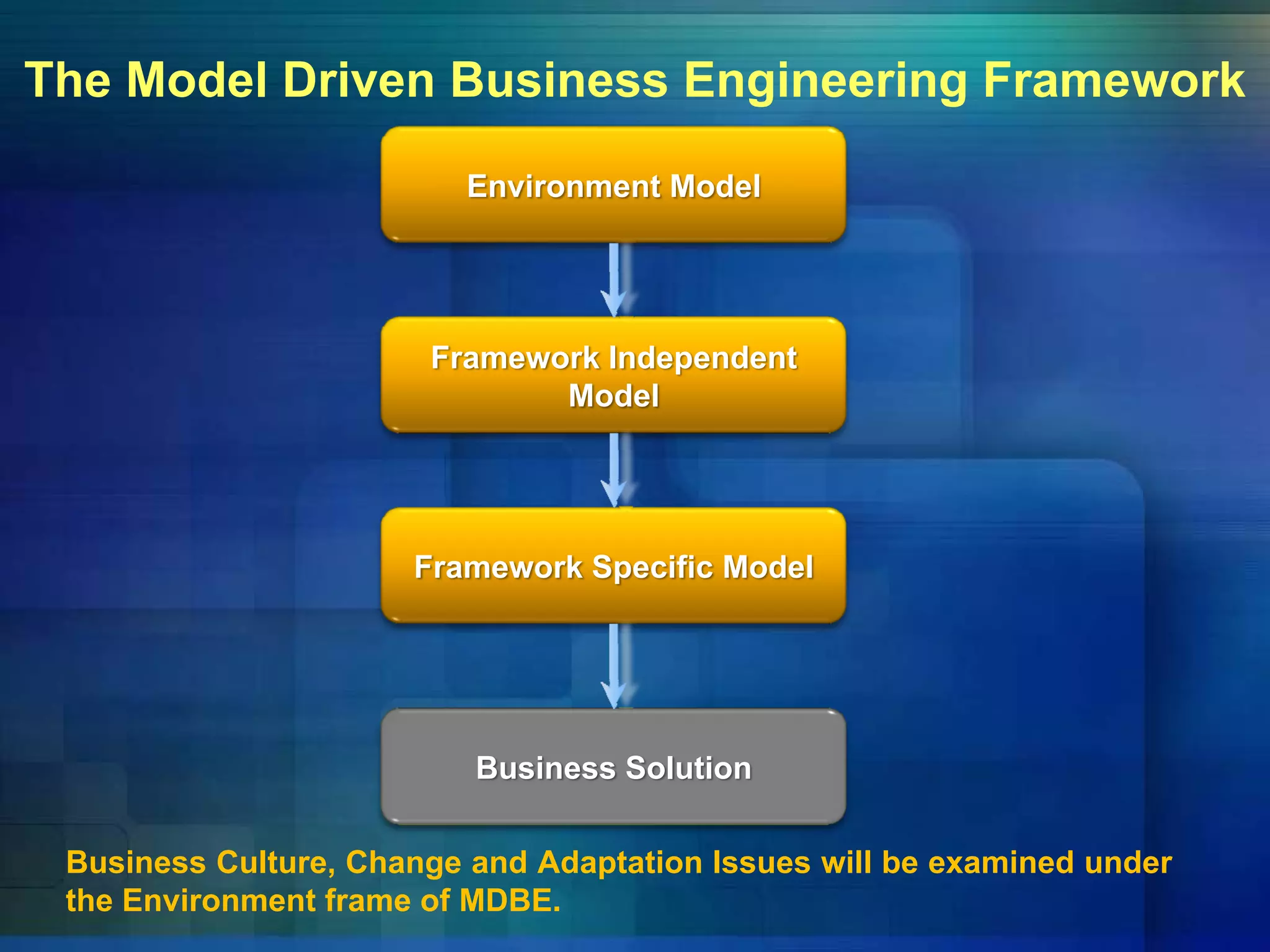
The Model Driven Business Engineering Framework
Environment Model
Framework Independent
Model
Framework Specific Model
Business Solution
Business Culture, Change and Adaptation Issues will be examined under
the Environment frame of MDBE.
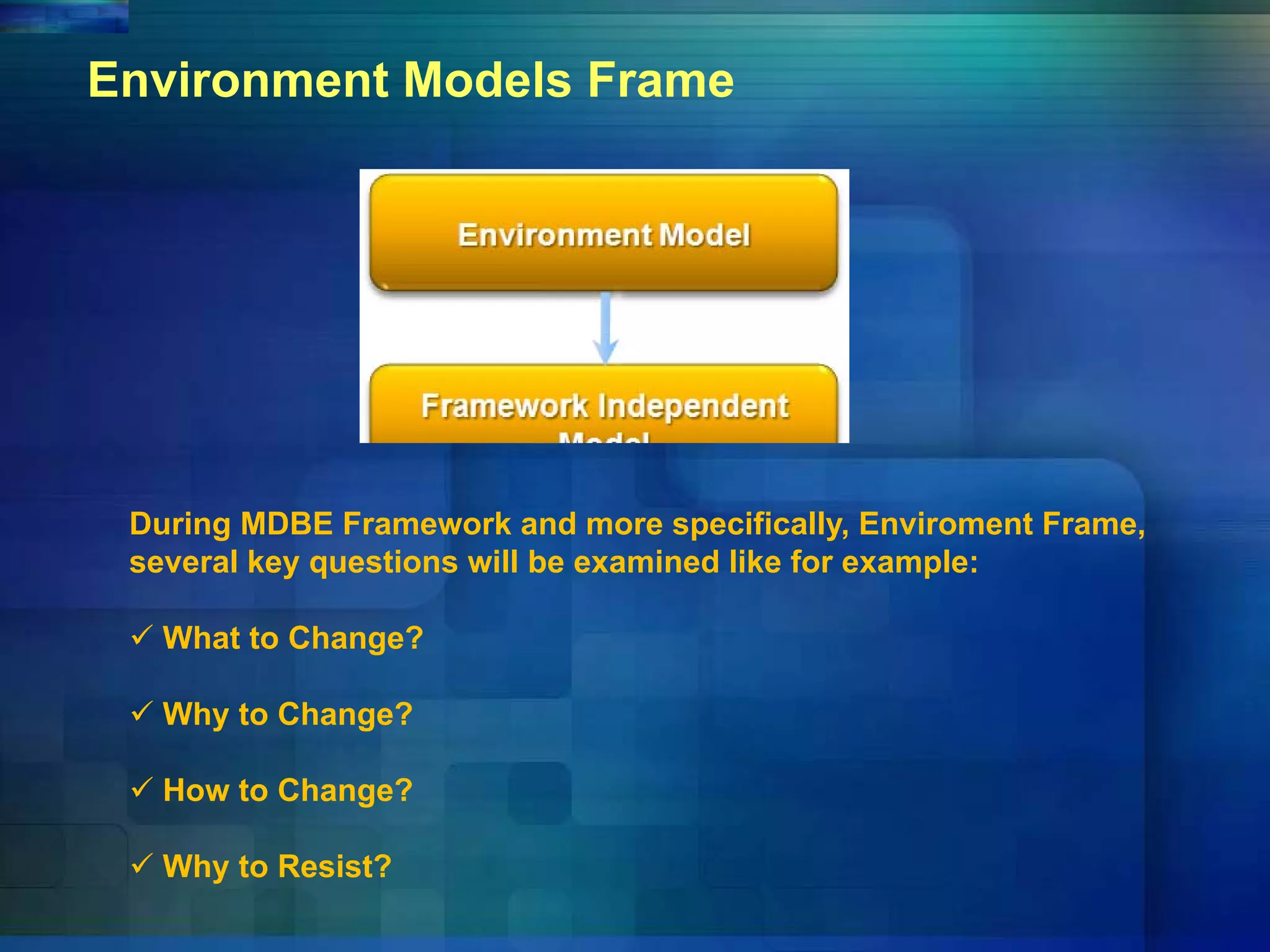
Environment Models Frame
During MDBE Framework and more specifically, Enviroment Frame,
several key questions will be examined like for example:
 What to Change?
 Why to Change?
 How to Change?
 Why to Resist?
Agenda
Introduction to Change and Adaptationg p
Significance
Change Management and AdaptationChange Management and Adaptation 
models
MDBE for Change and Adaptation
Summaryy
Summary
Modern business processes usually demand the utilization of a variety of business frameworks
and methodologies in order to offer a concrete business solution.
Most of project management methodologies do not take into account Business Cultural Issues,
Change Management and Adaptation.
Especially in multinational companies, cross‐cultural issues can affect planned changes and the
process can get complicated.
As Kanungo (2006) argued “people in different cultures respond in different ways” in effectAs Kanungo (2006) argued people in different cultures respond in different ways in effect
understanding and adapting to changes.
Hofstede (1980) argued that the cultural differences between nationalities were evident when
employees of the same organisation were spread over many countries.employees of the same organisation were spread over many countries.
MDBE can be utilised as a solution generation tool to offer optimum results given the 
appropriate meta model or pool of meta models, transformation models and reusable 
framework specific solutions.
“Everything is constantly changing
All is flux, nothing stays still…
Τa πάντα ῥεῖ καὶ οὐδὲν μένει”
Heraclitus, (540 BC - 480 BC)
Thank You!

Model Driven Business Engineering for Change Management and Adaptation

  • 1.
    MDBE for Change Management  and Adaptation Harris Apostolopoulos BEng(Hons),MSc, MBA, MIET, FITSE harris.apostolopoulos@gmail.com
  • 2.
    Agenda Introduction to Change and Adaptationg p Significance Change Managementand AdaptationChange Management and Adaptation  models MDBE for Change and Adaptation Summaryy
  • 3.
    Types of Change Twomajor categories, individual change management and organisational change management.g g Especially in multinational companies, cross‐cultural issues can affectEspecially in multinational companies, cross cultural issues can affect planned changes and the process can get complicated. However, the transitional period of change (which may lead to adaptation) is not only a time consuming but also a risky process; due to cultural or even organisational reasons the whole process is subject to fail.even organisational reasons the whole process is subject to fail.
  • 4.
    Types of Change(Cont.) Duck (1993) argued that change is intensely personal Luecke (2003) separated change into four types; structural, cost cutting,Luecke (2003) separated change into four types; structural, cost cutting, process and cultural Cultural change mainly concerns the organisation’s general approach to doing business or the relationship between managers and employees. Schaffer (2000) discussed discontinuous versus continuous incremental change Johnson et. al., (2006:) explained that “it is for the benefit of an  i ti th t f h t b i t l” f f torganisation the nature of change to be incremental” of four types:  Adaptation  Reconstruction Reconstruction  Evolution  Revolution 
  • 5.
    Agenda Introduction to Change and Adaptationg p Significance Change Managementand AdaptationChange Management and Adaptation  models f h d dMDBE for Change and Adaptation Summaryy
  • 6.
    Significance Market needs areconstantly changing; market adaptation, strategic business planning, flexibility, speed, cultural changes are more than mandatory. Most of the common project management methodologies such as critical chain project management (CCPM), and PRINCE2. focus on:  Time  Cost  Qualityy  Those project management methodologies do not take into account Business Cultural Issues Change Management and AdaptationCultural Issues, Change Management and Adaptation.
  • 7.
    Significance (Cont.) Too muchemphasis on deliverables or outcomes (e g capabilities) whichToo much emphasis on deliverables or outcomes (e.g. capabilities) which on their own do not deliver specific benefits, or even in the processes (the way things have to be done). The main difficultly arises from the fact that culture itself is difficult to be defined because it differs among organisations and individuals.  Kroeber (1985); there are more than 160 different definitions of culture. • As Kanungo (2006) argued “people in different cultures respond in different ways” in effect understanding and adapting to changes.
  • 8.
    Agenda Introduction to Change and Adaptationg p Significance Change Managementand AdaptationChange Management and Adaptation  models MDBE for Change and Adaptation Summaryy
  • 9.
    Change and Adaptation Pascale(1990); “change requires that businesses continuously reinvent themselves”themselves Sinclair (1993);culture can be managed and this is a responsibility of the management itself.management itself. Tichy (1983);“we are all beings of habit and tend to repeat what we are comfortable with.” Schlossberg (1981) , Successful adaptation might involve establishing a structured methodology for responding to changes such as new policies, or technologies. Parkes (1971); “First, abandoning one set of assumptions and then l f h f h h hdeveloping a fresher frame, so as the person to cope with the new changes”.
  • 10.
    Cultural Change Hofstede (1980)argued that the cultural differences between nationalities were evident when employees of the same organisation were spread overp y g p many countries. Stuttard (2000) concluded that “one common mistake is that, foreign managers fail to realize how pervasive it is”. Pitta et.al, (1999); managers’ business behaviour is directly related to the , ( ); g y country’s culture.  Dealing with culture has the difficulty to define it universally.
  • 11.
    Models of Change Briefly,Lewin (1951)described change as a three‐stage process:  Unfreezingg  Confusion  Refreezing • Bridges (1991) come up with a similar model:  Ending  N t l Neutral  New beginning Bullock and Baten (1985) named their model stages as:Bullock and Baten (1985) named their model stages as:  Exploration  Planning Planning  Action  Integration
  • 12.
    Agenda Introduction to Change and Adaptationg p Significance Change Managementand AdaptationChange Management and Adaptation  models MDBE for Change and Adaptation Summaryy
  • 13.
    The Model DrivenBusiness Engineering Framework Environment Model Framework Independent Model Framework Specific Model Business Solution Business Culture, Change and Adaptation Issues will be examined under the Environment frame of MDBE.
  • 14.
    Environment Models Frame DuringMDBE Framework and more specifically, Enviroment Frame, several key questions will be examined like for example:  What to Change?  Why to Change?  How to Change?  Why to Resist?
  • 15.
    Agenda Introduction to Change and Adaptationg p Significance Change Managementand AdaptationChange Management and Adaptation  models MDBE for Change and Adaptation Summaryy
  • 16.
    Summary Modern business processesusually demand the utilization of a variety of business frameworks and methodologies in order to offer a concrete business solution. Most of project management methodologies do not take into account Business Cultural Issues, Change Management and Adaptation. Especially in multinational companies, cross‐cultural issues can affect planned changes and the process can get complicated. As Kanungo (2006) argued “people in different cultures respond in different ways” in effectAs Kanungo (2006) argued people in different cultures respond in different ways in effect understanding and adapting to changes. Hofstede (1980) argued that the cultural differences between nationalities were evident when employees of the same organisation were spread over many countries.employees of the same organisation were spread over many countries. MDBE can be utilised as a solution generation tool to offer optimum results given the  appropriate meta model or pool of meta models, transformation models and reusable  framework specific solutions.
  • 17.
    “Everything is constantlychanging All is flux, nothing stays still… Τa πάντα ῥεῖ καὶ οὐδὲν μένει” Heraclitus, (540 BC - 480 BC) Thank You!