AArrcchhiimmeeddeess 
PPrriinncciippllee
Archimedes principle indicates 
that the upward bouyant force 
that is exerted on a body 
immersed in a fluid, whether fully 
or partially submerged, is equal to 
the weight of the fluid that the 
body displaces. Archimedes' 
principle is a law of physics 
fundamental to fluid mechanies. 
Archimedes Syeacuse formulated 
this principle, which bears his 
name.
The pressure difference between the bottom and the top face is directly proportional to 
the height (difference in depth). Multiplying the pressure difference with the area of a 
face gives the net force on the cube - the buoyancy, or the weight of the fluid 
displaced. Whatever the shape of the submerged body, the buoyant force is equal to 
the weight of the fluid displaced. 
The weight of the displaced fluid is directly proportional to the volume of the displaced 
fluid (if the surrounding fluid is of uniform density) the weight of the object in water is 
less than the weight of object in air, because of the force acting on it which is called as 
up-thrust. In simple terms, the principle states that the buoyant force on an object is 
equal to the weight of the fluid displaced by the object, or the density of the fluid 
multiplied by the submerged volume times the gravitational constant, g. Thus, among 
completely submerged objects with equal masses, objects with greater volume have 
greater buoyancy. 
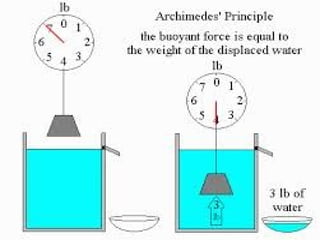
Suppose a rock's weight is measured as 10 Newton when suspended by a string in a 
vacuum with gravity acting upon it. Suppose that when the rock is lowered into water, 
it displaces water of weight 3 newtons. The force it then exerts on the string from 
which it hangs would be 10 newtons minus the 3 newtons of buoyant force: 10 − 3 = 7 
newtons. Buoyancy reduces the apparent weight of objects that have sunk completely 
to the sea floor. It is generally easier to lift an object up through the water than it is to 
pull it out of the water. 
For a fully submerged object, Archimedes' principle can be reformulated as follows, 
Apparent immersed weight = weight of object – weight of displaced fluid
What Is Archimedes Principle?

What Is Archimedes Principle?

  • 1.
  • 2.
    Archimedes principle indicates that the upward bouyant force that is exerted on a body immersed in a fluid, whether fully or partially submerged, is equal to the weight of the fluid that the body displaces. Archimedes' principle is a law of physics fundamental to fluid mechanies. Archimedes Syeacuse formulated this principle, which bears his name.
  • 3.
    The pressure differencebetween the bottom and the top face is directly proportional to the height (difference in depth). Multiplying the pressure difference with the area of a face gives the net force on the cube - the buoyancy, or the weight of the fluid displaced. Whatever the shape of the submerged body, the buoyant force is equal to the weight of the fluid displaced. The weight of the displaced fluid is directly proportional to the volume of the displaced fluid (if the surrounding fluid is of uniform density) the weight of the object in water is less than the weight of object in air, because of the force acting on it which is called as up-thrust. In simple terms, the principle states that the buoyant force on an object is equal to the weight of the fluid displaced by the object, or the density of the fluid multiplied by the submerged volume times the gravitational constant, g. Thus, among completely submerged objects with equal masses, objects with greater volume have greater buoyancy. Suppose a rock's weight is measured as 10 Newton when suspended by a string in a vacuum with gravity acting upon it. Suppose that when the rock is lowered into water, it displaces water of weight 3 newtons. The force it then exerts on the string from which it hangs would be 10 newtons minus the 3 newtons of buoyant force: 10 − 3 = 7 newtons. Buoyancy reduces the apparent weight of objects that have sunk completely to the sea floor. It is generally easier to lift an object up through the water than it is to pull it out of the water. For a fully submerged object, Archimedes' principle can be reformulated as follows, Apparent immersed weight = weight of object – weight of displaced fluid

Editor's Notes