CONTENTS....
(I) INTRODUCTION
(II) FIRST WORLD WAR,KHILAFAT AND NON
COOPERATION
(III) DIFFERING STRANDS WITHING THE
MOVEMENT
(IV)CIVIL DISOBEDINCE MOVEMENT
(V) THE SENSE OF COLLECTIVE BELONGING
INTRODU
CTION
INTRODUCTION
• Nationalism is loyalty and devotion to a
nation.
• In this chapter we will pick up the story from
the 1920s and the study the non cooperation
movement and civil disobedience movements
• We will learn that how different social groups
participated in the movement .
THE FIRST
WORLD WAR
KHILAFAT AND
NON
COOPERATION
MOVEMENT
THE FIRST WORLD WAR..
• “WORLD WAR I” broke out in 1914.
• India was under British rule.
• Increase in defense expenditure led to
increase in taxes in India.
• Income taxes was introduced.
• Custom duties were increased.
• Crops failed in many parts of India.
• This led to shortage of food.
THE FIRST WORLD WAR..
• Through the war years increased doubling
between 1913 and 1918 leading to the
extreme hardship for the common people.
• People hoped that hard ship would end after
the war was over.
• But that did not happen.
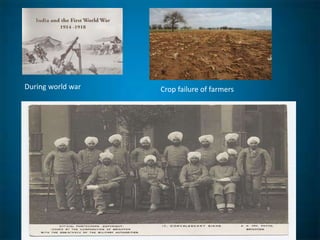
Crop failure of farmersDuring world war
IDEA OF SATYAGRAHA..
• Satyagraha is an idea ,by which a fight for true
cause or against injustice is fought without any
violence.
• Mahatma Gandhi came back to India in 1915.
• He introduced this concept his stay in south
Africa.
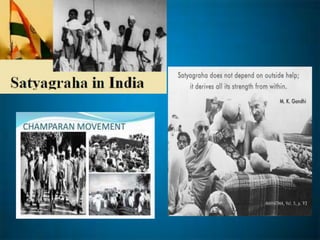
• He organized several satygrahs in India.
• E.G Champaran satyagrah in 1916.
• Ahmedabad mill strike in 1918.
ROWLATT ACT..
• The act authorized the British officers to
imprison any Indian political leader for 2 years
without any trial.
• M.K Gandhi came out with Rowlatt
satyagraha in 1919.
• Shops were closed down.
• Rallies were organized.
• People went on strikes.
ROWLATT ACT..
• To crush the movement, British government
imposed martial law.
• General dyer took command.
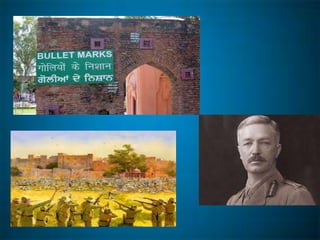
• On the day of 13 April 1919, baisakhi fair was
organized in jallianwala bagh in Amritsar.
• General dyer ordered to close all exit gates.
• He opened fire on the crowd.
• Hundreds of Indian died.
• Indians started to attack the government
buildings.
• This violence forced to stop the movement.
NON-COOPERATION MOVEMENT
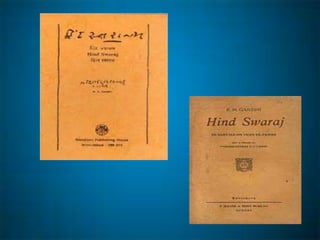
• Gandhiji wrote a book “Hind Swaraj”.
• In which he wrote that if Indians started to
non cooperate with Britishers than India will
be independent in 1 year.
• To bring Hindus and Muslims together,gandhiji
met Muhammad Ali and Shaukat Ali.
• Further, the movement was renamed as non
cooperation khilafat movement.
DIFFERING
STRANDS
WITHIN THE
MOVEMENT
NON-COOPERATION KHILAFAT
MOVEMENT
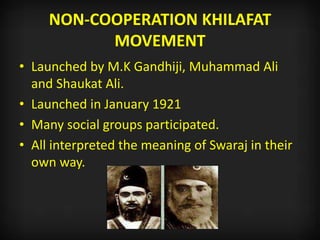
• Launched by M.K Gandhiji, Muhammad Ali
and Shaukat Ali.
• Launched in January 1921
• Many social groups participated.
• All interpreted the meaning of Swaraj in their
own way.
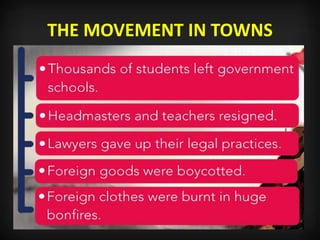
THE MOVEMENT IN TOWNS
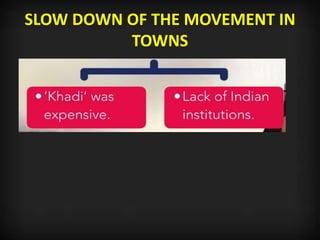
SLOW DOWN OF THE MOVEMENT IN
TOWNS
REBELLION IN COUNTRYSDIDE
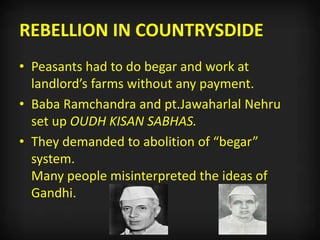
• Peasants had to do begar and work at
landlord’s farms without any payment.
• Baba Ramchandra and pt.Jawaharlal Nehru
set up OUDH KISAN SABHAS.
• They demanded to abolition of “begar”
system.
Many people misinterpreted the ideas of
Gandhi.
SWARAJ IN PLANATATIONS
• The government had passed the Inland
Emigration Act I of 1859 under which
plantation workers were not permitted to
leave the fields.
• Workers interpreted the Gandhi raj.
• They violated the act.
• Hence they were beaten by the police.
FEBRUARY 1922…
• In February 1922, Gandhi withdrew this
movement.
• He decided to train Indians before any other
mass struggle.
CIVIL
DISOBEDIEN
CE
MOVEMENT
THE SWARAJ PARTY
• Many political leader suggested the idea of
fighting the Britishers from within the
legislative council.
• CR Das and Motilal Nehru formed Swaraj
Party in 1922.
• Leaders like Jawarlal Nehru and Subhash
Chandra Bose pressed for a more radical
agititation.
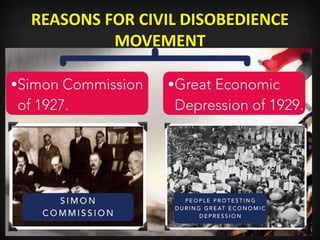
REASONS FOR CIVIL DISOBEDIENCE
MOVEMENT
SIMON COMMISION
• The Indian members of the central legislative
assembly exposed some draw backs in the
government of the India act of 1919.
• As a result of it, the Simon commission was
appointed in 1927, to suggest any further
reforms.
• This commission consisted of 7 members and its
chairman was sir John Simon.
• Indian boycotted it, as they were no Indian
members in it.
SIMON COMMISION
• Moreover, there was no indication of swaraj,
which was the first priority of Indians.
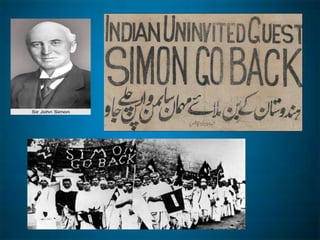
• Which this commission arrived in 1928, it was
met with demonstration with banners.
GREAT DEPRESSION
• The depression had deep impact on the
agricultural and industrial goods.
• Poverty increased by 1930 due to high taxes.
CIVIL DISOBEDIENCE MOVEMENT
• Civil disobedience is the active, professed
refusal to obey certain laws, demands, and
commands of a government, or of an
occupying international power. Civil
disobedience is a symbolic or ritualistic
violation of the law, rather than a rejection of
the system as a whole
SALT MARCH
• Mahatma Gandhi believed that salt could be a
powerful symbol to unite the whole nation.
Most of the people; including the British
scoffed at the idea.
• Abolition of the salt tax was among many
demands which were raised by Gandhiji
through a letter to Viceroy Irwin.
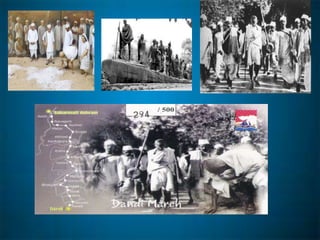
• The Salt March or Dandi March was started by
Gandhiji on 12th March 1930.
SALT MARCH
• He was accompanied by 78 volunteers. They
walked for 24 days to cover a distance of 240
miles from Sabaramati to Dandi.
• Many more joined them in the way. On 6th
April 1930, Gandhiji ceremonially violated the
law by taking a fistful of salt.
• The Salt March marked the beginning of the
Civil Disobedience Movement
SALT MARCH
• Thousands of people broke the salt law in
different parts of country.
• People demonstrated in front of government
salt factories.
• Foreign cloth was boycotted. Peasants
refused to pay revenue. Village officials
resigned. Tribal people violated forest laws.
RESOPNSE OF BRITSHERS
• The colonial government began to arrest the
Congress leaders.
• This led to violent clashes in many places.
Mahatma Gandhi was arrested about a month
later.
• People began to attack the symbols of British
rule; such as police posts, municipal buildings,
law courts and railway stations.
• Even women and children were beaten up. About
100,000 people were arrested.
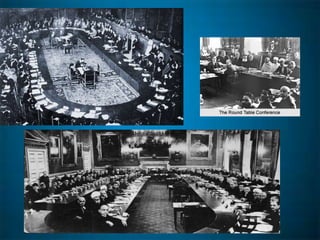
Round Table Conference
• When things began to take a violent turn,
Mahatma Gandhi called off the movement. He
signed a pact with Irwin on 5th March 1931.
This was called the Gandhi-Irwin Pact. As per
the Pact, Gandhiji agreed to participate in the
Round Table Conference in London. In lieu of
that, the government agreed to release the
political prisoners.
• Gandhiji went to London in December 1931.
The negotiations broke down and Gandhiji
had to return with disappointment.
Round Table Conference
• When Gandhiji came back to India, he found
that most of the leaders were put in jail.
• Congress had been declared illegal. Many
measures were taken to prevent meetings,
demonstrations and boycotts.
• Mahatma Gandhi relaunched the Civil
Disobedience Movement. By 1934, the
movement had lost its momentum.
People’s Perception Of The
Movement
• Farmers: For the farmers, the fight for swaraj
was a struggle against high revenues. When
the movement was called off in 1931; without
the revenue rates being revised; the farmers
were highly disappointed. Many of them
refused to participate when the movement
was re-launched in 1932.
People’s Perception Of The
Movement
• Businessmen: . The Indian Industrial and
Commercial Congress was formed in 1920 and
the Federation of the Indian Chamber of
Commerce and Industries (FICCI) was formed in
1927. These were the results of attempts to bring
the common business interests on a common
platform. For the businessmen, swaraj meant an
end to oppressive colonial policies. They wanted
an environment which could allow the business
to flourish. They were apprehensive of militant
activities and of growing influence of socialism
among the younger members of the Congress.
People’s Perception Of The
Movement
• Industrial Workers: The industrial workers
showed lukewarm response to the Civil
Disobedience Movement. Since industrialists
were closer to the Congress, workers kept a
distance from the movement. But some
workers selectively participated in the
Movement. Congress did not want to alienate
the industrialists and hence preferred to keep
the workers’ demands at bay.
WOMEN’S PARTICIPATION
• Women also participated in the Civil
Disobedience Movement in large numbers.
However, most of the women were from high-
caste families in the urban areas and from rich
peasant households in the rural areas. But for
a long time, the Congress was reluctant to give
any position of authority to women within the
organization. The Congress was just keen on
the symbolic presence of women
THE LIMITS OF CIVIL DISOBEDIENCE
MOVEMENTS
• Participation of Dalits…
• Many dalit leaders wanted a different political
solution to the problems of the dalit community.
• They demanded reserved seats in educational
institutions and separate electorate for dalits. Dalit
participation in the Civil Disobedience Movement
was limited.
• Dr. B R Ambedkar organized the dalits into the
Depressed Classes Association in 1930. He clashed
with Mahatma Gandhi; during the second Round
Table Conference; on the issue of separate
electorate for dalits.
THE LIMITS OF CIVIL DISOBEDIENCE
MOVEMENTS
• Participation of muslims..
• After the decline of the Non-Cooperation-Khilafat
Movement, a large section of Muslims became
alienated from the Congress. From the mid-
1920s, the Congress was more visibly associated
with the Hindu religious nationalist
groups. Muhammad Ali Jinnah was an important
leader of the Muslim League. He was willing to
give up the demand for separate electorate. But
he wanted reserved seats for Muslims in the
Central Assembly.
THE SENSE
OF
COLLECTIVE
BELONGING
THE SENSE OF COLLECTIVE
BELONGING
• Nationalism spreads when people begin to
believe that they are all part of the same
nation, when they discover some unity that
binds them together. The united struggles for
independence helped in building the sense of
collective belonging. Additionally, a variety of
cultural processes also captured the spirit of
nationalism.
NATION DEPICTED IN IMAGES
• The identity of the nation is most often
symbolised in a figure or image; with which
people can identify the nation.
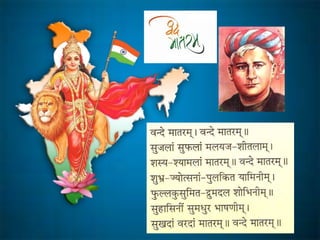
• The image of Bharat Mata was the pictorial
representation of the mother land.
• Vande Mataram’ the national song was
written by Bankim Chandra Chattopadhyay in
1870s. This was sung during the Swadeshi
movement in Bengal. Different artists
projected their own version of Bharat Mata.
FOLKLORES
• Many nationalist leaders took help of folk
tales to spread the idea of nationalism. It was
believed that the folk tales revealed the true
picture of traditional culture.
NATIONAL FLAG
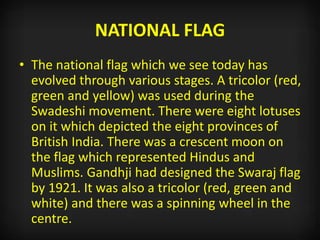
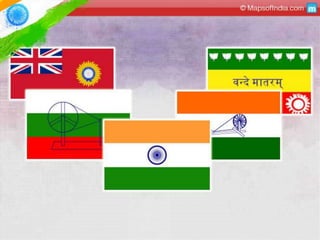
• The national flag which we see today has
evolved through various stages. A tricolor (red,
green and yellow) was used during the
Swadeshi movement. There were eight lotuses
on it which depicted the eight provinces of
British India. There was a crescent moon on
the flag which represented Hindus and
Muslims. Gandhji had designed the Swaraj flag
by 1921. It was also a tricolor (red, green and
white) and there was a spinning wheel in the
centre.
REINTERPRETATION OF HISTORY
• Many Indians felt that the British had given a
different interpretation of the Indian history.
• They felt that it was important to interpret the
history from an Indian perspective.
• They wanted to glorify the rich past of India so
that the Indians could feel proud of their
history.
THANKS
FOR
WATCHIN
G !!!
BHARAT
MAATA KI JAI
!!