ArchiMate 2.1 
“An Introduction” 
1
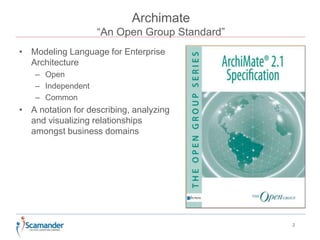
Archimate 
“An Open Group Standard” 
2 
• Modeling Language for Enterprise 
Architecture 
– Open 
– Independent 
– Common 
• A notation for describing, analyzing 
and visualizing relationships 
amongst business domains
Enterprise, Architecture and EA 
• Enterprise 
– Any Collection of Organizations that has a Common Set of Goals 
• Architecture 
– A formal Description of a System, or a Detailed Plan of the System at 
Component Level to Guide its Implementation. 
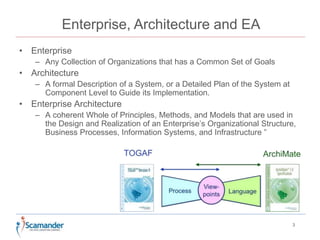
• Enterprise Architecture 
– A coherent Whole of Principles, Methods, and Models that are used in 
the Design and Realization of an Enterprise’s Organizational Structure, 
Business Processes, Information Systems, and Infrastructure ” 
3
Where TOGAF meets Archimate 
4 
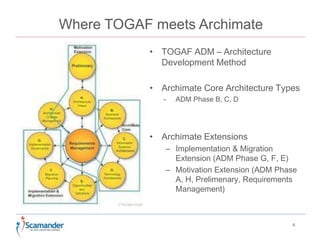
• TOGAF ADM – Architecture 
Development Method 
• Archimate Core Architecture Types 
- ADM Phase B, C, D 
• Archimate Extensions 
– Implementation & Migration 
Extension (ADM Phase G, F, E) 
– Motivation Extension (ADM Phase 
A, H, Prelimenary, Requirements 
Management)
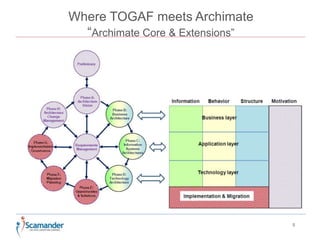
Where TOGAF meets Archimate 
“Archimate Core & Extensions” 
5
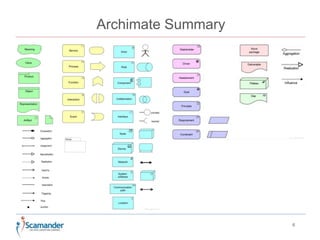
Archimate Summary 
6
ArchiMate 
“Notation” 
7 
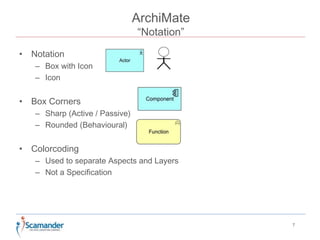
• Notation 
– Box with Icon 
– Icon 
• Box Corners 
– Sharp (Active / Passive) 
– Rounded (Behavioural) 
• Colorcoding 
– Used to separate Aspects and Layers 
– Not a Specification
ArchiMate 2.1 
• ArchiMate Core 
• Relationships 
• Business Layer 
• Application Layer 
• Technology Layer 
• Language Extensions 
• ArchiMate Metamodel 
• ArchiMate Viewpoints 
• ArchiMate Standard Viewpoints 
• ArchiMate Extension Viewpoints 
8
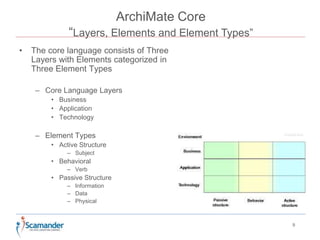
ArchiMate Core 
“Layers, Elements and Element Types” 
• The core language consists of Three 
Layers with Elements categorized in 
Three Element Types 
– Core Language Layers 
• Business 
• Application 
• Technology 
– Element Types 
• Active Structure 
– Subject 
• Behavioral 
– Verb 
• Passive Structure 
– Information 
– Data 
– Physical 
9
ArchiMate Core 
“Element Types” 
• Active Structure Element 
– an Entity that is capable of Performing Behavior 
• Behavior Element 
– a Unit of Activity Performed by one or more Active Structure Elements. 
• Passive Structure Element 
– an Object on which Behavior is Performed. 
10
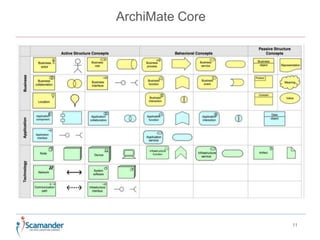
ArchiMate Core 
11
ArchiMate 2.1 
• ArchiMate Core 
• Relationships 
• Business Layer 
• Application Layer 
• Technology Layer 
• Language Extensions 
• ArchiMate Metamodel 
• ArchiMate Viewpoints 
• ArchiMate Standard Viewpoints 
• ArchiMate Extension Viewpoints 
12
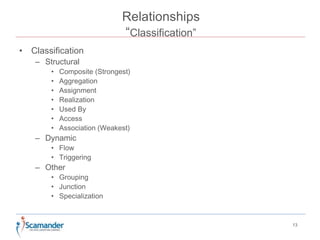
Relationships 
“Classification” 
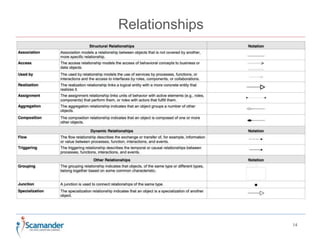
• Classification 
– Structural 
• Composite (Strongest) 
• Aggregation 
• Assignment 
• Realization 
• Used By 
• Access 
• Association (Weakest) 
– Dynamic 
• Flow 
• Triggering 
– Other 
• Grouping 
• Junction 
• Specialization 
13
Relationships 
14
ArchiMate 2.1 
• ArchiMate Core 
• Relationships 
• Business Layer 
• Application Layer 
• Technology Layer 
• Language Extensions 
• ArchiMate Metamodel 
• ArchiMate Viewpoints 
• ArchiMate Standard Viewpoints 
• ArchiMate Extension Viewpoints 
15
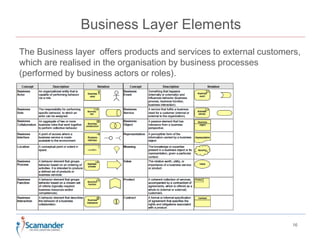
Business Layer Elements 
The Business layer offers products and services to external customers, 
which are realised in the organisation by business processes 
(performed by business actors or roles). 
16
ArchiMate 2.1 
• ArchiMate Core 
• Relationships 
• Business Layer 
• Application Layer 
• Technology Layer 
• Language Extensions 
• ArchiMate Metamodel 
• ArchiMate Viewpoints 
• ArchiMate Standard Viewpoints 
• ArchiMate Extension Viewpoints 
17
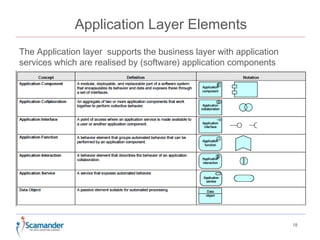
Application Layer Elements 
The Application layer supports the business layer with application 
services which are realised by (software) application components 
18
ArchiMate 2.1 
• ArchiMate Core 
• Relationships 
• Business Layer 
• Application Layer 
• Technology Layer 
• Language Extensions 
• ArchiMate Metamodel 
• ArchiMate Viewpoints 
• ArchiMate Standard Viewpoints 
• ArchiMate Extension Viewpoints 
19
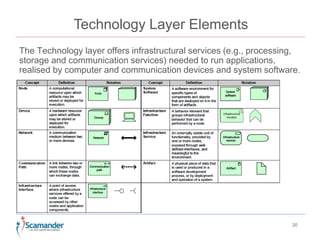
Technology Layer Elements 
The Technology layer offers infrastructural services (e.g., processing, 
storage and communication services) needed to run applications, 
realised by computer and communication devices and system software. 
20
ArchiMate 2.1 
• ArchiMate Core 
• Relationships 
• Business Layer 
• Application Layer 
• Technology Layer 
• Language Extensions 
• ArchiMate Metamodel 
• ArchiMate Viewpoints 
• ArchiMate Standard Viewpoints 
• ArchiMate Extension Viewpoints 
21
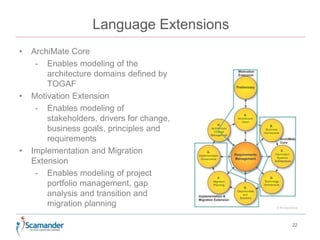
Language Extensions 
22 
• ArchiMate Core 
- Enables modeling of the 
architecture domains defined by 
TOGAF 
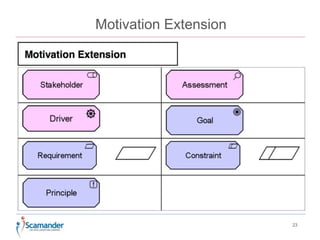
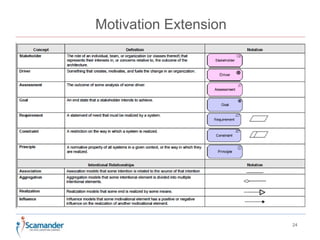
• Motivation Extension 
- Enables modeling of 
stakeholders, drivers for change, 
business goals, principles and 
requirements 
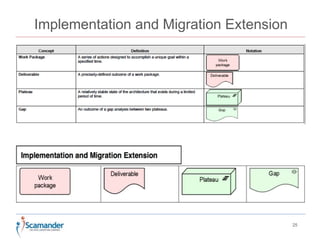
• Implementation and Migration 
Extension 
- Enables modeling of project 
portfolio management, gap 
analysis and transition and 
migration planning
Motivation Extension 
23
Motivation Extension 
24
Implementation and Migration Extension 
25
ArchiMate 2.1 
• ArchiMate Core 
• Relationships 
• Business Layer 
• Application Layer 
• Technology Layer 
• Language Extensions 
• ArchiMate Metamodel 
• ArchiMate Viewpoints 
• ArchiMate Standard Viewpoints 
• ArchiMate Extension Viewpoints 
26
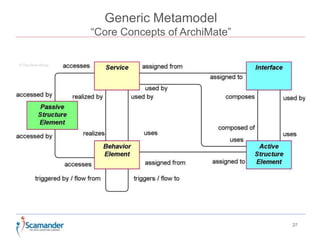
Generic Metamodel 
“Core Concepts of ArchiMate” 
27
ArchiMate Metamodels 
• Archimate Core 
– Business Layer Metamodel 
– Application Layer Metamodel 
– Technology Layer Metamodel 
• Language Extensions 
– Motivation Extension Metamodel 
– Implementation & Migration Extension Metamodel 
28
ArchiMate 2.1 
• ArchiMate Core 
• Relationships 
• Business Layer 
• Application Layer 
• Technology Layer 
• Language Extensions 
• ArchiMate Metamodel 
• ArchiMate Viewpoints 
– ArchiMate Standard Viewpoints 
– ArchiMate Extension Viewpoints 
29
ArchiMate Viewpoint 
“Classification” 
30 
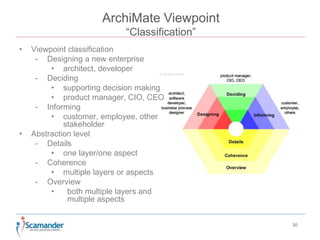
• Viewpoint classification 
- Designing a new enterprise 
• architect, developer 
- Deciding 
• supporting decision making 
• product manager, CIO, CEO 
- Informing 
• customer, employee, other 
stakeholder 
• Abstraction level 
- Details 
• one layer/one aspect 
- Coherence 
• multiple layers or aspects 
- Overview 
• both multiple layers and 
multiple aspects
ArchiMate 2.1 
• ArchiMate Core 
• Relationships 
• Business Layer 
• Application Layer 
• Technology Layer 
• Language Extensions 
• ArchiMate Metamodel 
• ArchiMate Viewpoints 
– ArchiMate Standard Viewpoints 
– ArchiMate Extension Viewpoints 
31
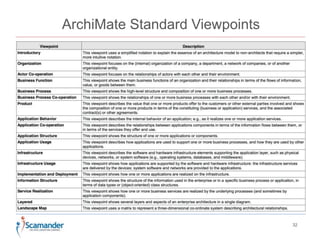
ArchiMate Standard Viewpoints 
32
ArchiMate 2.1 
• ArchiMate Core 
• Relationships 
• Business Layer 
• Application Layer 
• Technology Layer 
• Language Extensions 
• ArchiMate Metamodel 
• ArchiMate Viewpoints 
– ArchiMate Standard Viewpoints 
– ArchiMate Extension Viewpoints 
33
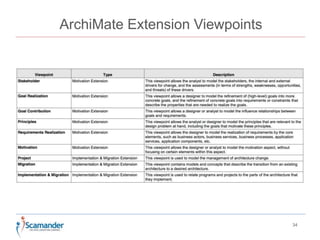
ArchiMate Extension Viewpoints 
34
Inspiration 
This content is inspired and based on (online) content from the following 
parties 
The Open Group (http://www.opengroup.org/archimate/) 
The Unit (Joost Bleijenberg - http://bit.ly/ArchiMateSpeedModelling) 
Bizz Design (http://bit.ly/TOGAF91_Archimate21_BizzDesign) 
35

Archimate 2.1 an introduction

  • 1.
    ArchiMate 2.1 “AnIntroduction” 1
  • 2.
    Archimate “An OpenGroup Standard” 2 • Modeling Language for Enterprise Architecture – Open – Independent – Common • A notation for describing, analyzing and visualizing relationships amongst business domains
  • 3.
    Enterprise, Architecture andEA • Enterprise – Any Collection of Organizations that has a Common Set of Goals • Architecture – A formal Description of a System, or a Detailed Plan of the System at Component Level to Guide its Implementation. • Enterprise Architecture – A coherent Whole of Principles, Methods, and Models that are used in the Design and Realization of an Enterprise’s Organizational Structure, Business Processes, Information Systems, and Infrastructure ” 3
  • 4.
    Where TOGAF meetsArchimate 4 • TOGAF ADM – Architecture Development Method • Archimate Core Architecture Types - ADM Phase B, C, D • Archimate Extensions – Implementation & Migration Extension (ADM Phase G, F, E) – Motivation Extension (ADM Phase A, H, Prelimenary, Requirements Management)
  • 5.
    Where TOGAF meetsArchimate “Archimate Core & Extensions” 5
  • 6.
  • 7.
    ArchiMate “Notation” 7 • Notation – Box with Icon – Icon • Box Corners – Sharp (Active / Passive) – Rounded (Behavioural) • Colorcoding – Used to separate Aspects and Layers – Not a Specification
  • 8.
    ArchiMate 2.1 •ArchiMate Core • Relationships • Business Layer • Application Layer • Technology Layer • Language Extensions • ArchiMate Metamodel • ArchiMate Viewpoints • ArchiMate Standard Viewpoints • ArchiMate Extension Viewpoints 8
  • 9.
    ArchiMate Core “Layers,Elements and Element Types” • The core language consists of Three Layers with Elements categorized in Three Element Types – Core Language Layers • Business • Application • Technology – Element Types • Active Structure – Subject • Behavioral – Verb • Passive Structure – Information – Data – Physical 9
  • 10.
    ArchiMate Core “ElementTypes” • Active Structure Element – an Entity that is capable of Performing Behavior • Behavior Element – a Unit of Activity Performed by one or more Active Structure Elements. • Passive Structure Element – an Object on which Behavior is Performed. 10
  • 11.
  • 12.
    ArchiMate 2.1 •ArchiMate Core • Relationships • Business Layer • Application Layer • Technology Layer • Language Extensions • ArchiMate Metamodel • ArchiMate Viewpoints • ArchiMate Standard Viewpoints • ArchiMate Extension Viewpoints 12
  • 13.
    Relationships “Classification” •Classification – Structural • Composite (Strongest) • Aggregation • Assignment • Realization • Used By • Access • Association (Weakest) – Dynamic • Flow • Triggering – Other • Grouping • Junction • Specialization 13
  • 14.
  • 15.
    ArchiMate 2.1 •ArchiMate Core • Relationships • Business Layer • Application Layer • Technology Layer • Language Extensions • ArchiMate Metamodel • ArchiMate Viewpoints • ArchiMate Standard Viewpoints • ArchiMate Extension Viewpoints 15
  • 16.
    Business Layer Elements The Business layer offers products and services to external customers, which are realised in the organisation by business processes (performed by business actors or roles). 16
  • 17.
    ArchiMate 2.1 •ArchiMate Core • Relationships • Business Layer • Application Layer • Technology Layer • Language Extensions • ArchiMate Metamodel • ArchiMate Viewpoints • ArchiMate Standard Viewpoints • ArchiMate Extension Viewpoints 17
  • 18.
    Application Layer Elements The Application layer supports the business layer with application services which are realised by (software) application components 18
  • 19.
    ArchiMate 2.1 •ArchiMate Core • Relationships • Business Layer • Application Layer • Technology Layer • Language Extensions • ArchiMate Metamodel • ArchiMate Viewpoints • ArchiMate Standard Viewpoints • ArchiMate Extension Viewpoints 19
  • 20.
    Technology Layer Elements The Technology layer offers infrastructural services (e.g., processing, storage and communication services) needed to run applications, realised by computer and communication devices and system software. 20
  • 21.
    ArchiMate 2.1 •ArchiMate Core • Relationships • Business Layer • Application Layer • Technology Layer • Language Extensions • ArchiMate Metamodel • ArchiMate Viewpoints • ArchiMate Standard Viewpoints • ArchiMate Extension Viewpoints 21
  • 22.
    Language Extensions 22 • ArchiMate Core - Enables modeling of the architecture domains defined by TOGAF • Motivation Extension - Enables modeling of stakeholders, drivers for change, business goals, principles and requirements • Implementation and Migration Extension - Enables modeling of project portfolio management, gap analysis and transition and migration planning
  • 23.
  • 24.
  • 25.
  • 26.
    ArchiMate 2.1 •ArchiMate Core • Relationships • Business Layer • Application Layer • Technology Layer • Language Extensions • ArchiMate Metamodel • ArchiMate Viewpoints • ArchiMate Standard Viewpoints • ArchiMate Extension Viewpoints 26
  • 27.
    Generic Metamodel “CoreConcepts of ArchiMate” 27
  • 28.
    ArchiMate Metamodels •Archimate Core – Business Layer Metamodel – Application Layer Metamodel – Technology Layer Metamodel • Language Extensions – Motivation Extension Metamodel – Implementation & Migration Extension Metamodel 28
  • 29.
    ArchiMate 2.1 •ArchiMate Core • Relationships • Business Layer • Application Layer • Technology Layer • Language Extensions • ArchiMate Metamodel • ArchiMate Viewpoints – ArchiMate Standard Viewpoints – ArchiMate Extension Viewpoints 29
  • 30.
    ArchiMate Viewpoint “Classification” 30 • Viewpoint classification - Designing a new enterprise • architect, developer - Deciding • supporting decision making • product manager, CIO, CEO - Informing • customer, employee, other stakeholder • Abstraction level - Details • one layer/one aspect - Coherence • multiple layers or aspects - Overview • both multiple layers and multiple aspects
  • 31.
    ArchiMate 2.1 •ArchiMate Core • Relationships • Business Layer • Application Layer • Technology Layer • Language Extensions • ArchiMate Metamodel • ArchiMate Viewpoints – ArchiMate Standard Viewpoints – ArchiMate Extension Viewpoints 31
  • 32.
  • 33.
    ArchiMate 2.1 •ArchiMate Core • Relationships • Business Layer • Application Layer • Technology Layer • Language Extensions • ArchiMate Metamodel • ArchiMate Viewpoints – ArchiMate Standard Viewpoints – ArchiMate Extension Viewpoints 33
  • 34.
  • 35.
    Inspiration This contentis inspired and based on (online) content from the following parties The Open Group (http://www.opengroup.org/archimate/) The Unit (Joost Bleijenberg - http://bit.ly/ArchiMateSpeedModelling) Bizz Design (http://bit.ly/TOGAF91_Archimate21_BizzDesign) 35