TOGAF	9	Components	
Module	2
Module	Objec8ves	
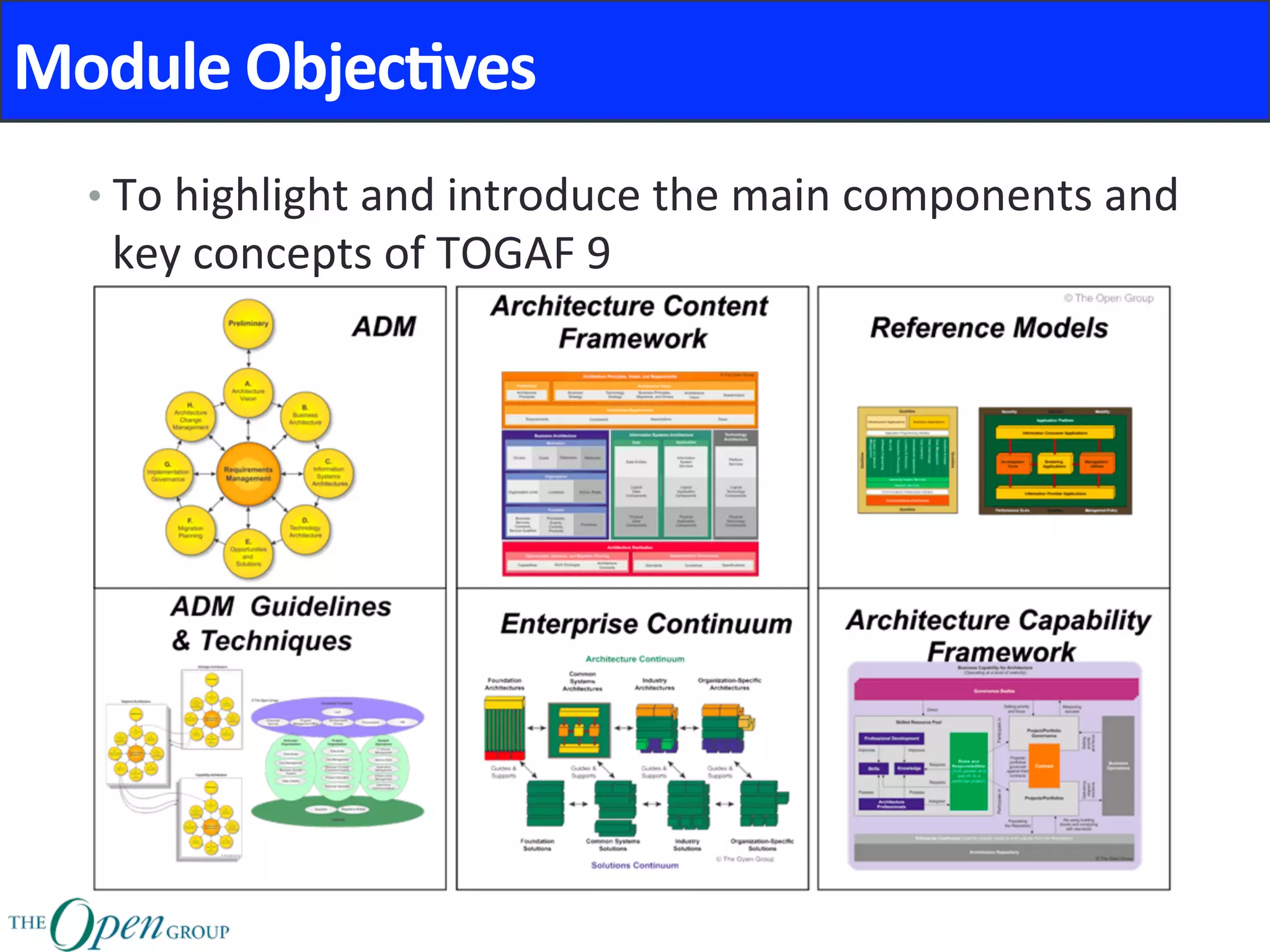
• To	highlight	and	introduce	the	main	components	and	
key	concepts	of	TOGAF	9
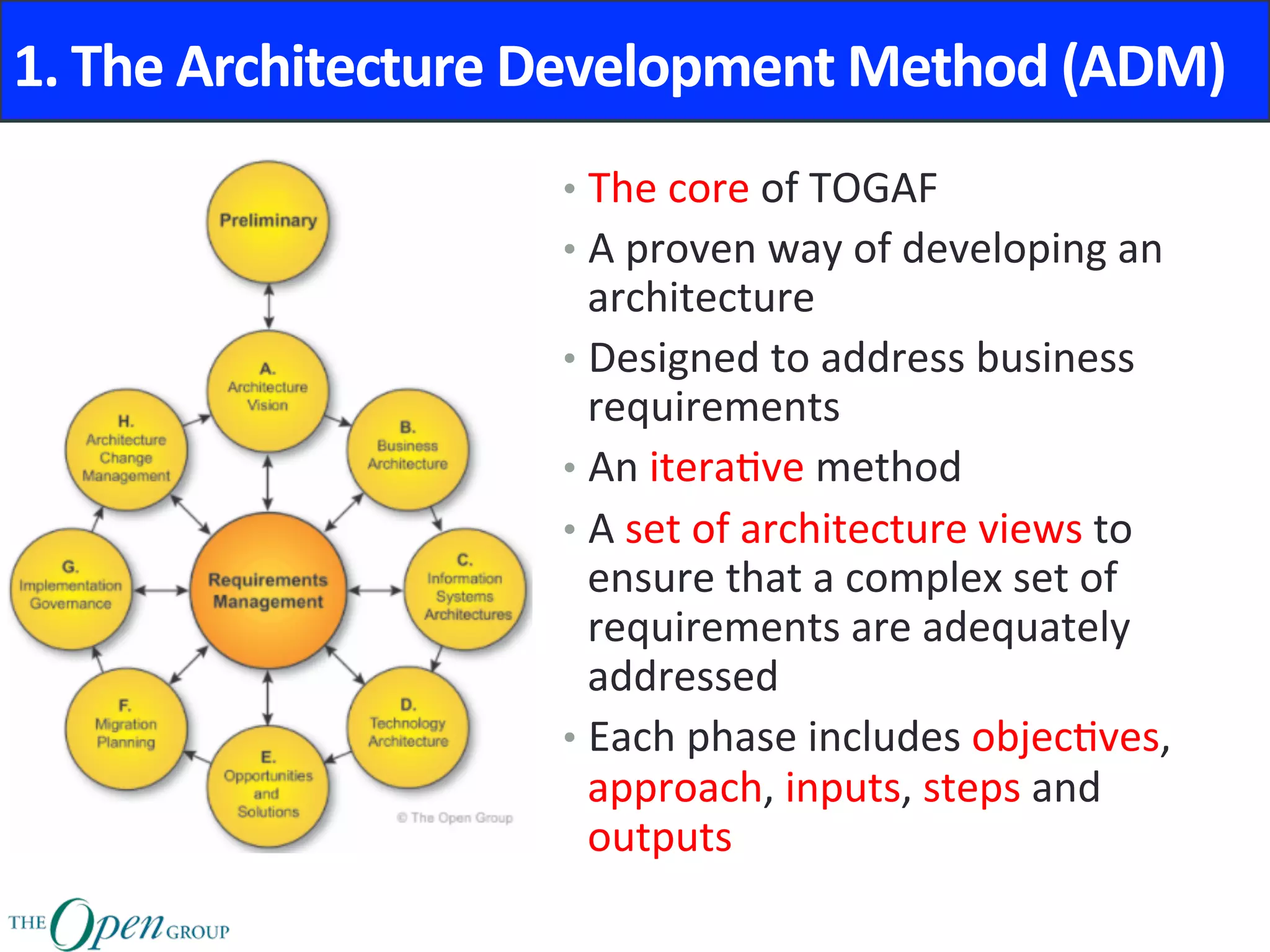
1.	The	Architecture	Development	Method	(ADM)	
•  The	core	of	TOGAF	
•  A	proven	way	of	developing	an	
architecture	
•  Designed	to	address	business	
requirements	
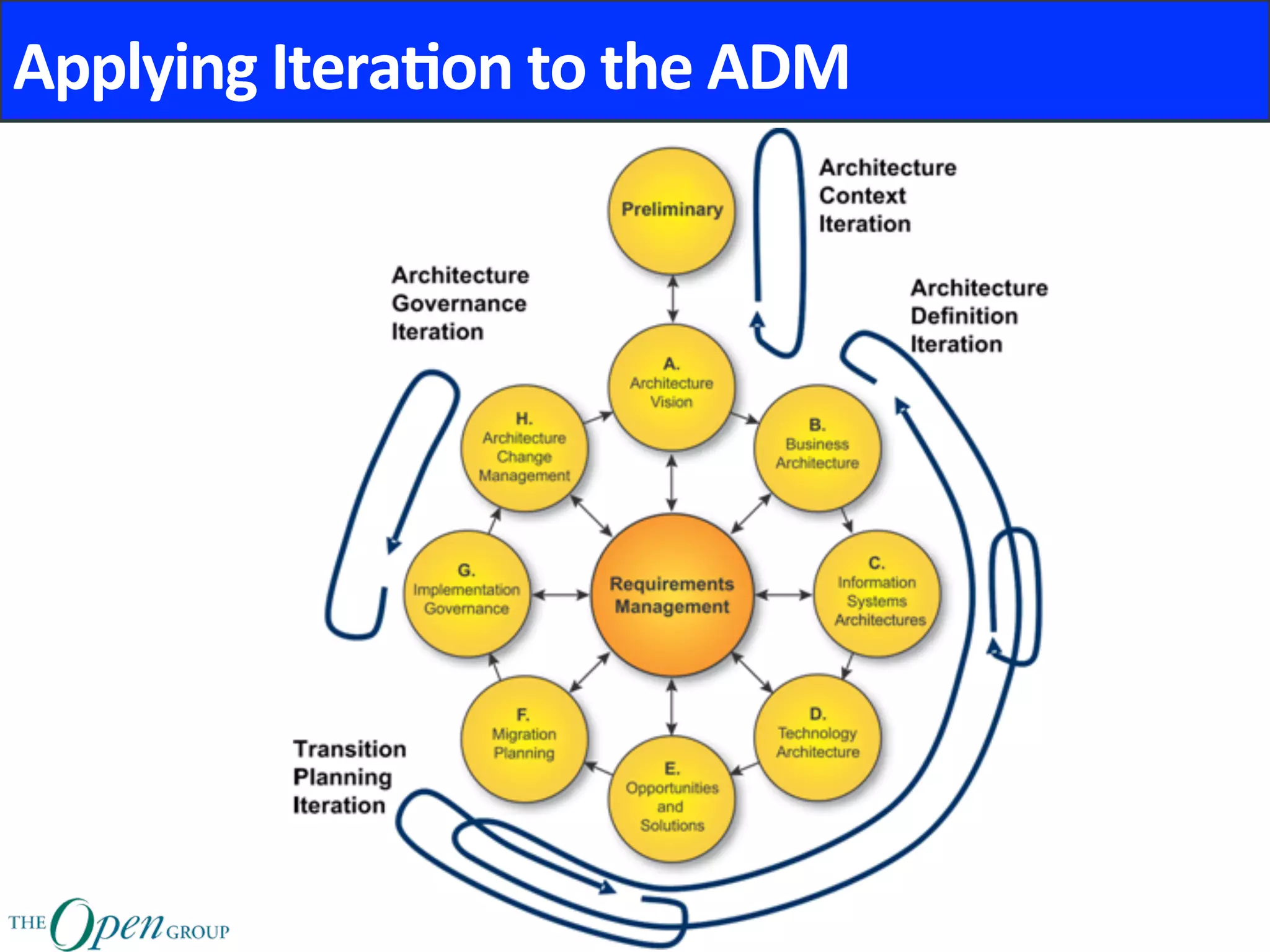
•  An	itera@ve	method	
•  A	set	of	architecture	views	to	
ensure	that	a	complex	set	of	
requirements	are	adequately	
addressed	
•  Each	phase	includes	objec@ves,	
approach,	inputs,	steps	and	
outputs
2.	ADM	Guidelines	and	Techniques	
• A	set	of	guidelines	and	techniques	to	support	the	
applica@on	of	the	ADM	
• The	guidelines	help	to	adapt	the	ADM	to	deal	with	
different	scenarios,	including	different	process	styles	
(e.g.	itera@ons)	and	also	specific	requirements	(e.g.	
security)	
• The	techniques	support	specific	tasks	within	the	
ADM	(e.g.	defining	principles,	business	scenarios,	gap	
analysis,	migra@on	planning,	risk	management,	etc)
Applying	Itera8on	to	the	ADM
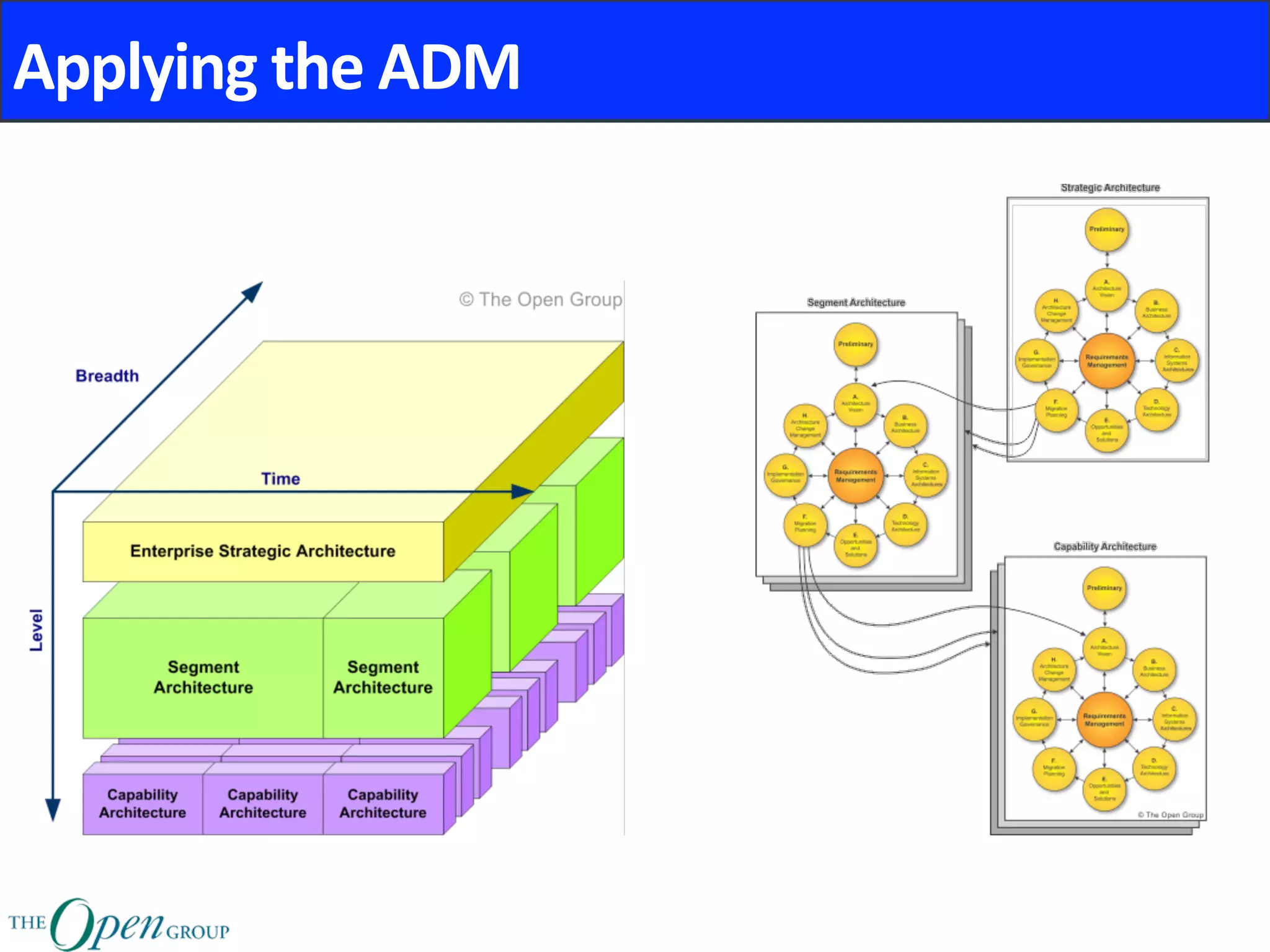
Applying	the	ADM
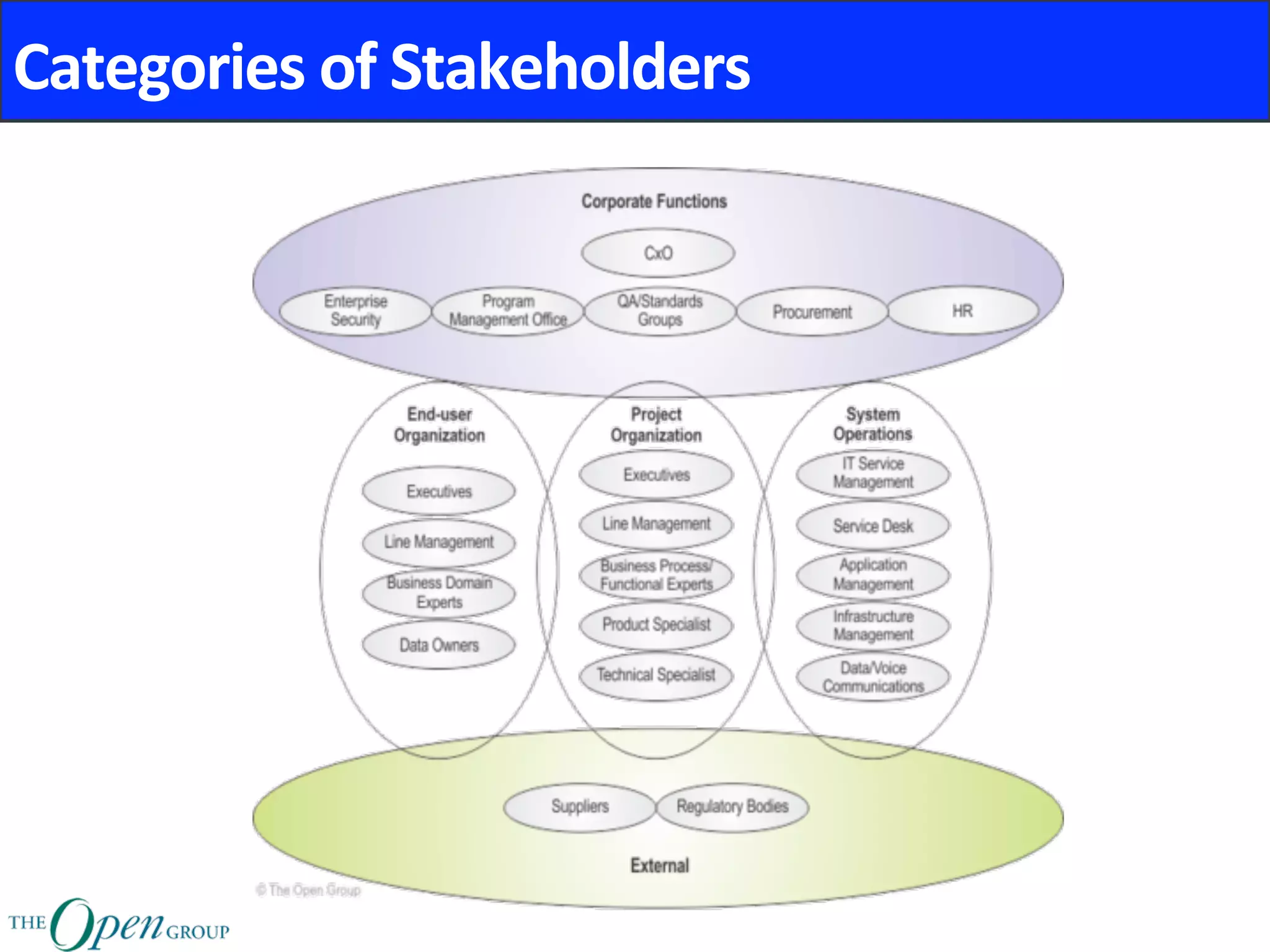
Categories	of	Stakeholders
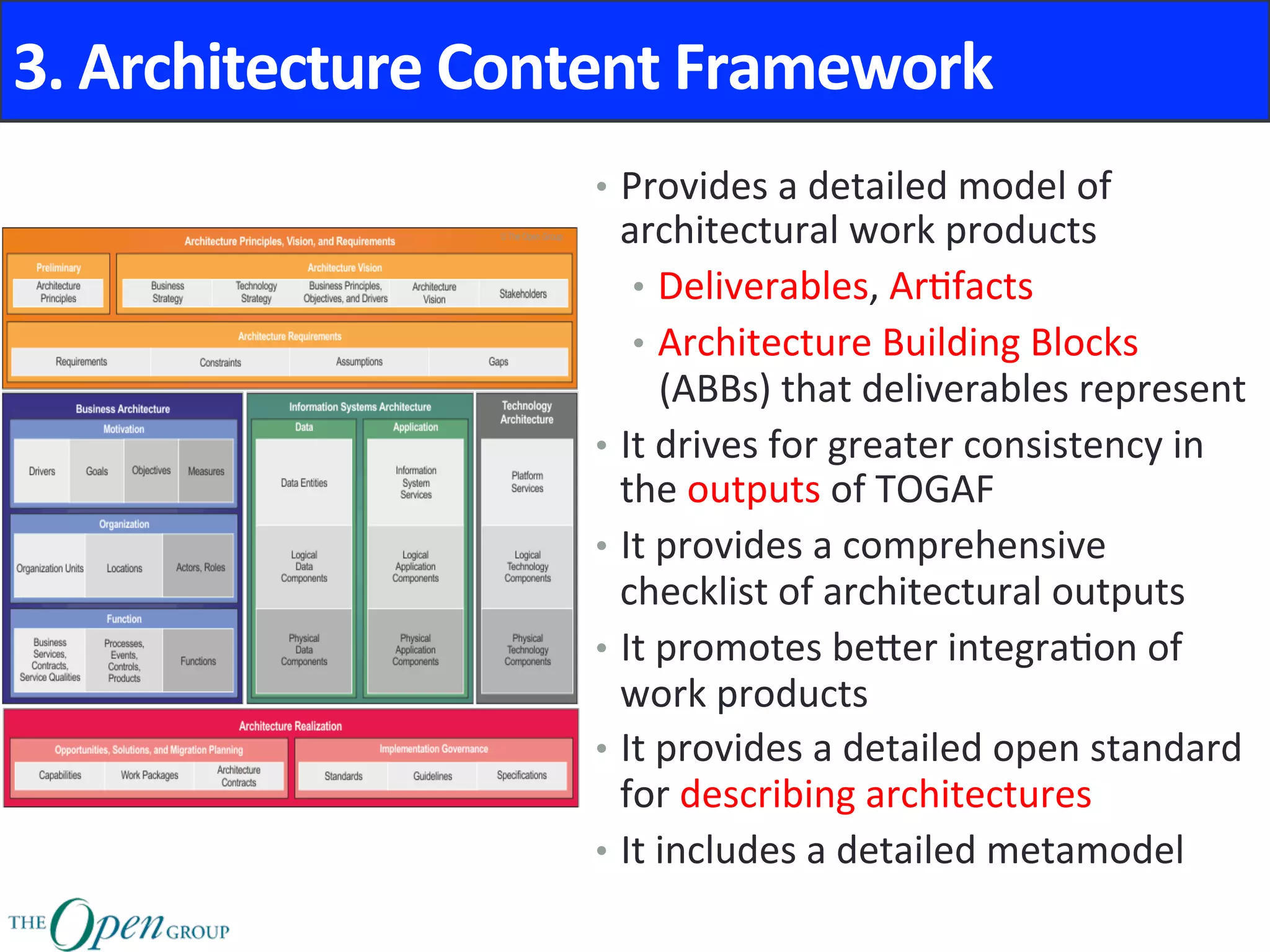
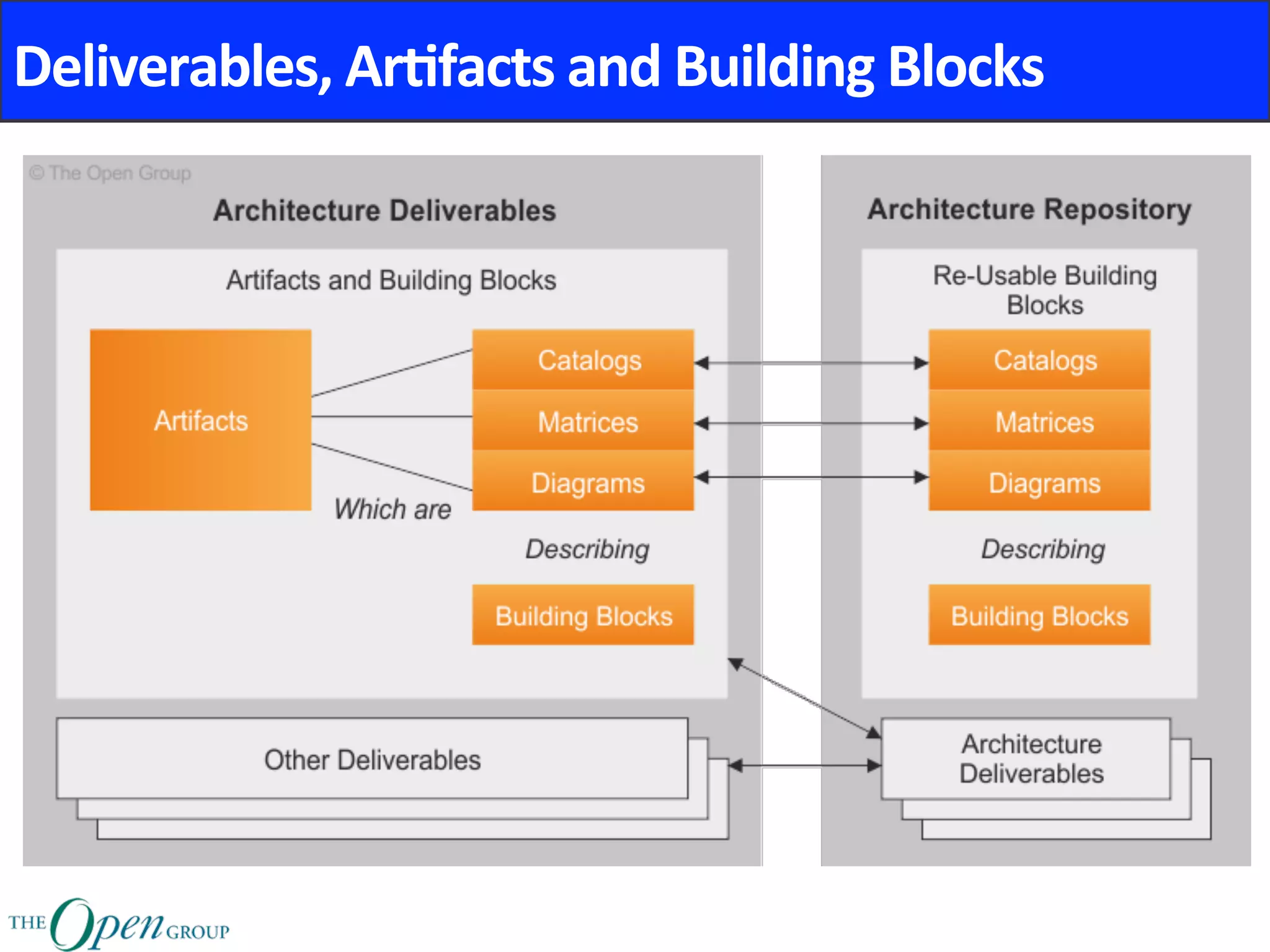
3.	Architecture	Content	Framework	
•  Provides	a	detailed	model	of	
architectural	work	products	
•  Deliverables,	Ar@facts	
•  Architecture	Building	Blocks	
(ABBs)	that	deliverables	represent	
•  It	drives	for	greater	consistency	in	
the	outputs	of	TOGAF	
•  It	provides	a	comprehensive	
checklist	of	architectural	outputs	
•  It	promotes	beNer	integra@on	of	
work	products	
•  It	provides	a	detailed	open	standard	
for	describing	architectures	
•  It	includes	a	detailed	metamodel
Deliverables,	Ar8facts	and	Building	Blocks
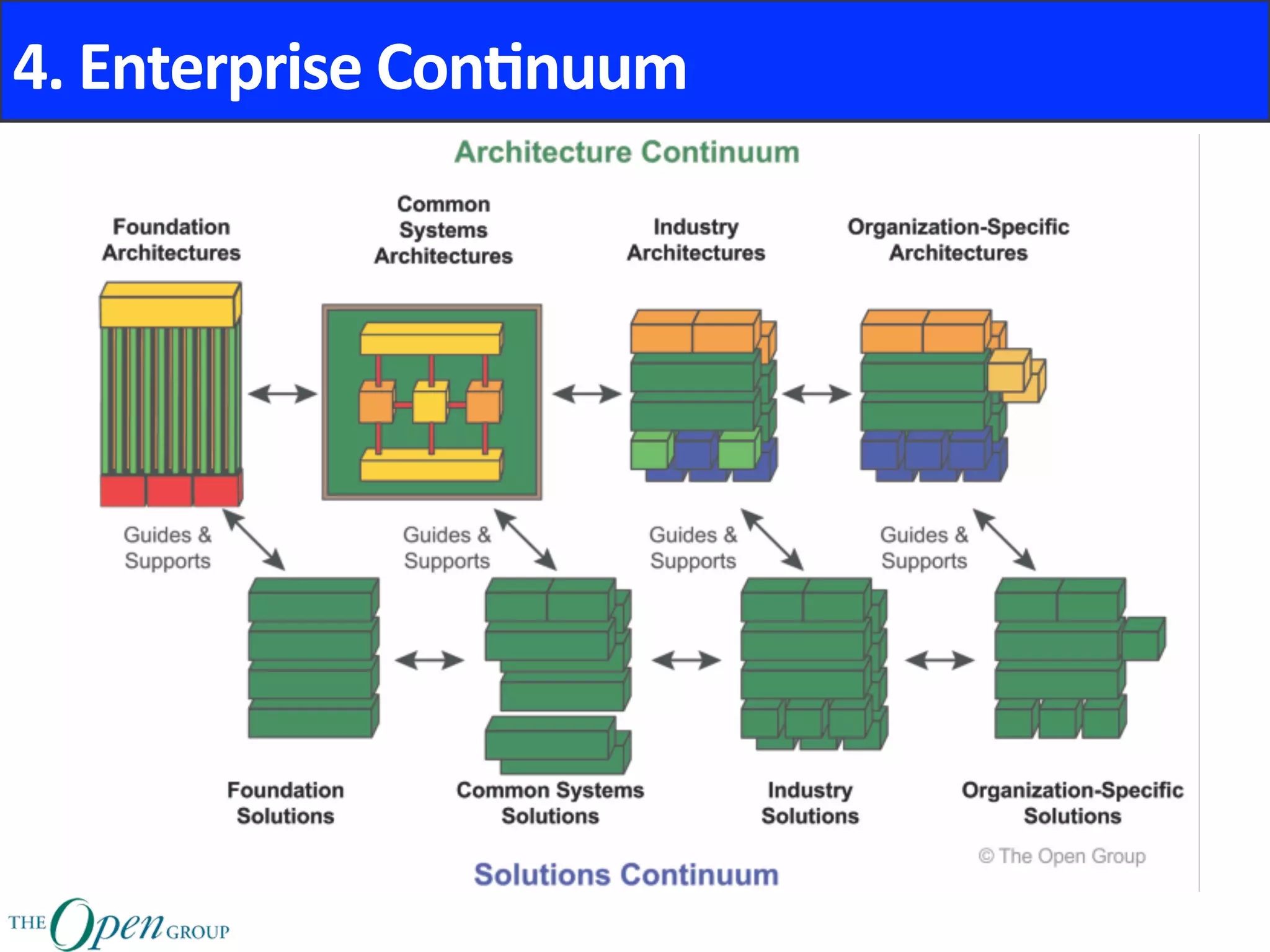
4.	Enterprise	Con8nuum
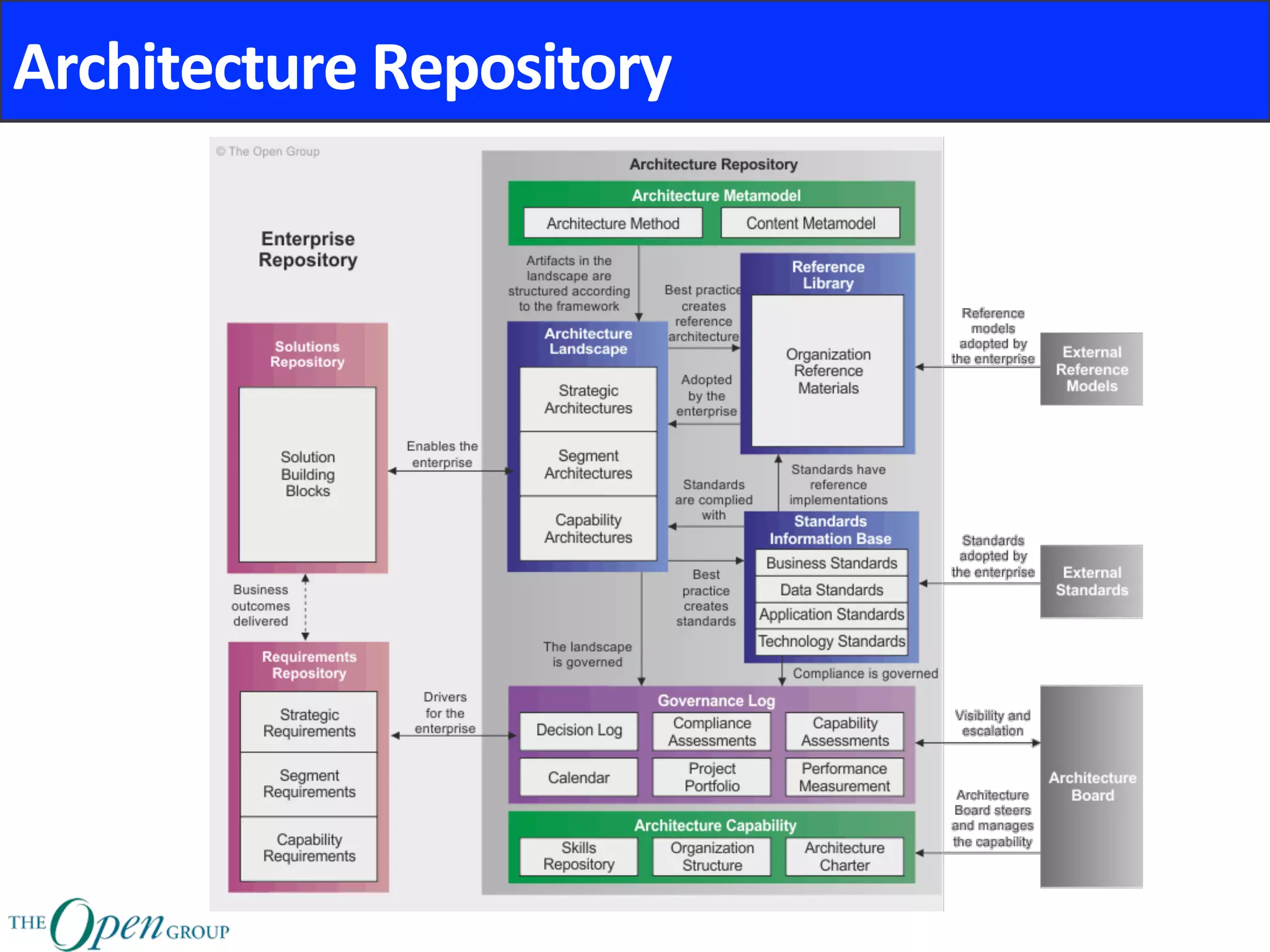
Architecture	Repository
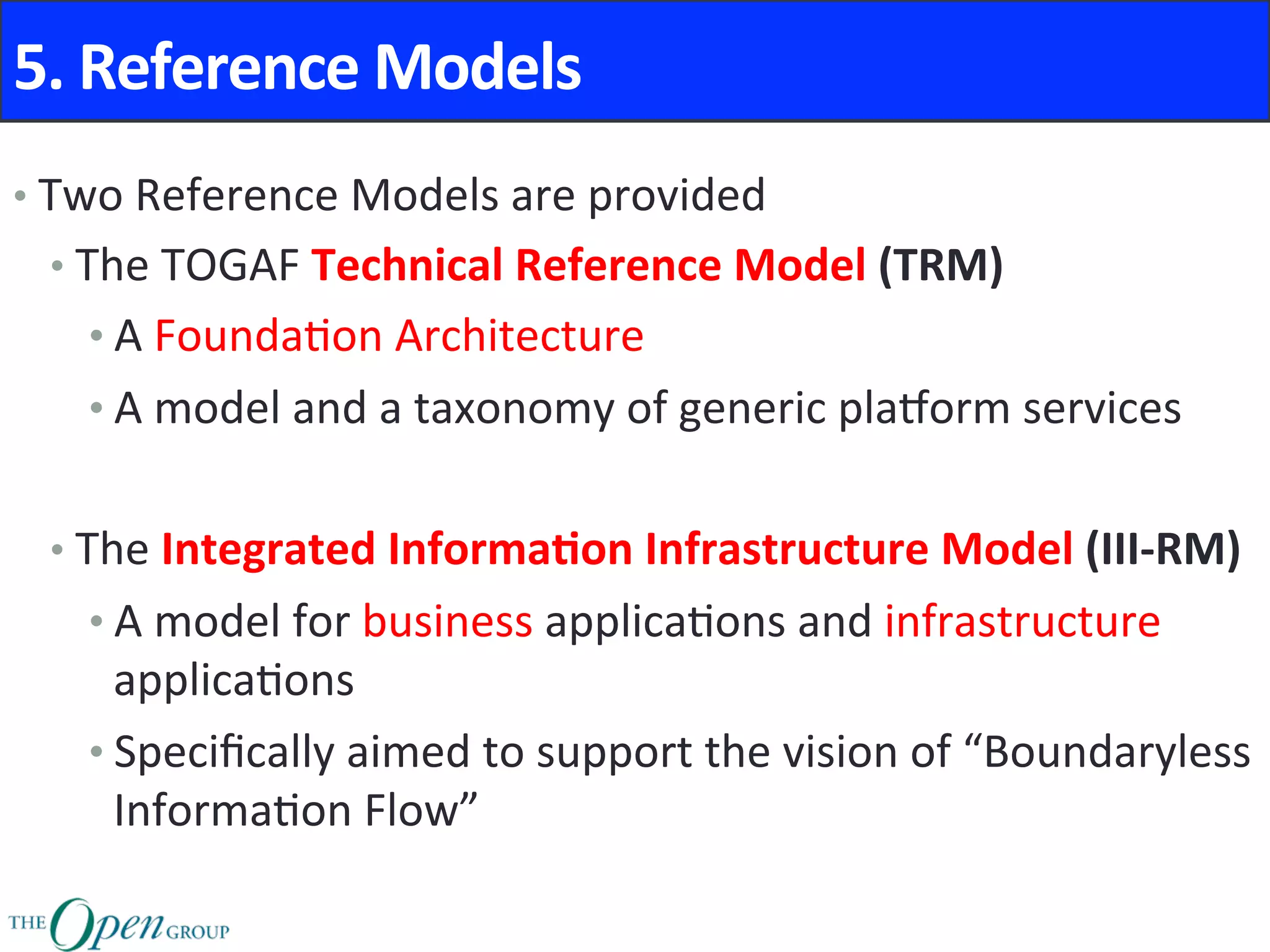
5.	Reference	Models	
• Two	Reference	Models	are	provided	
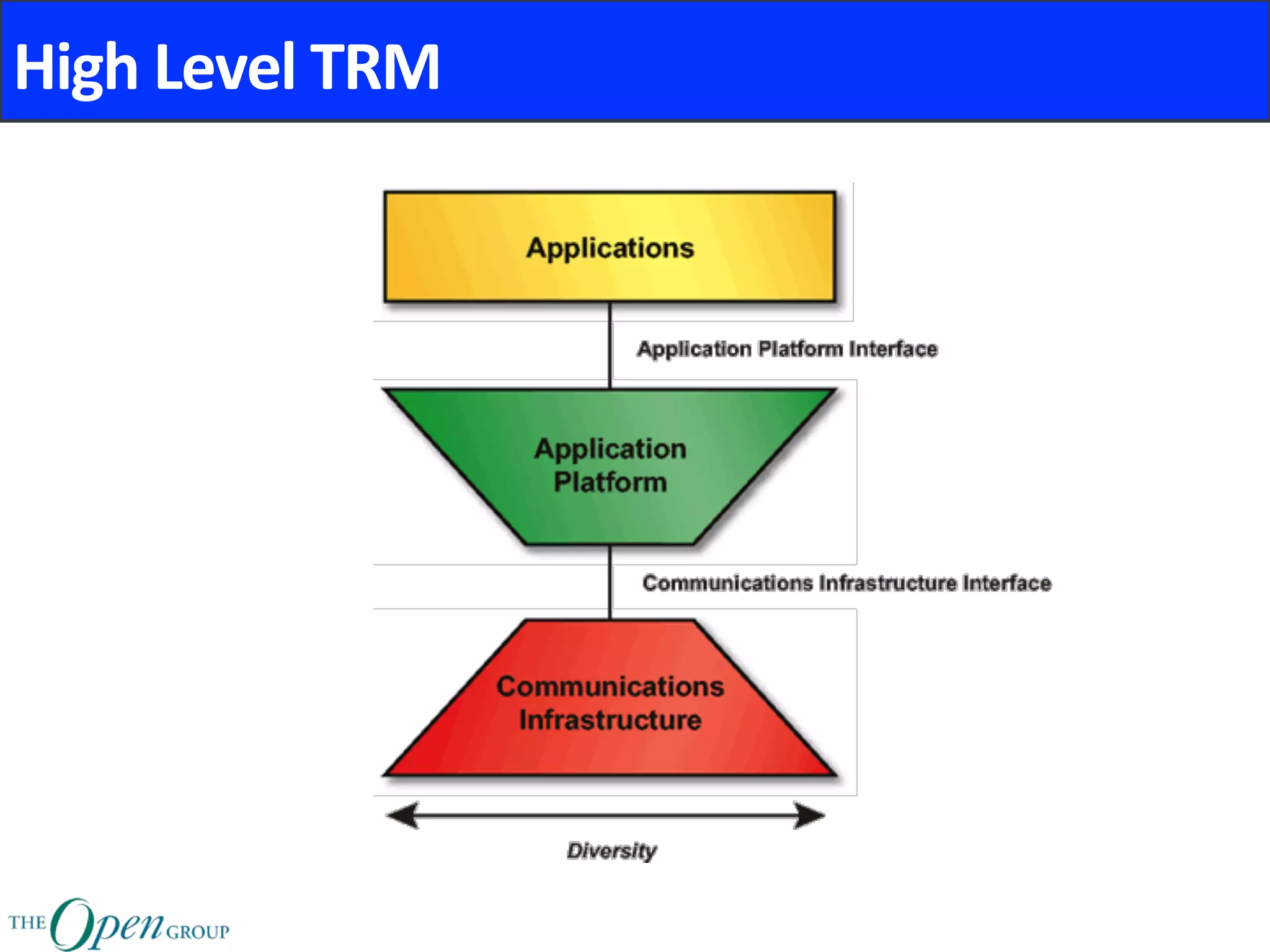
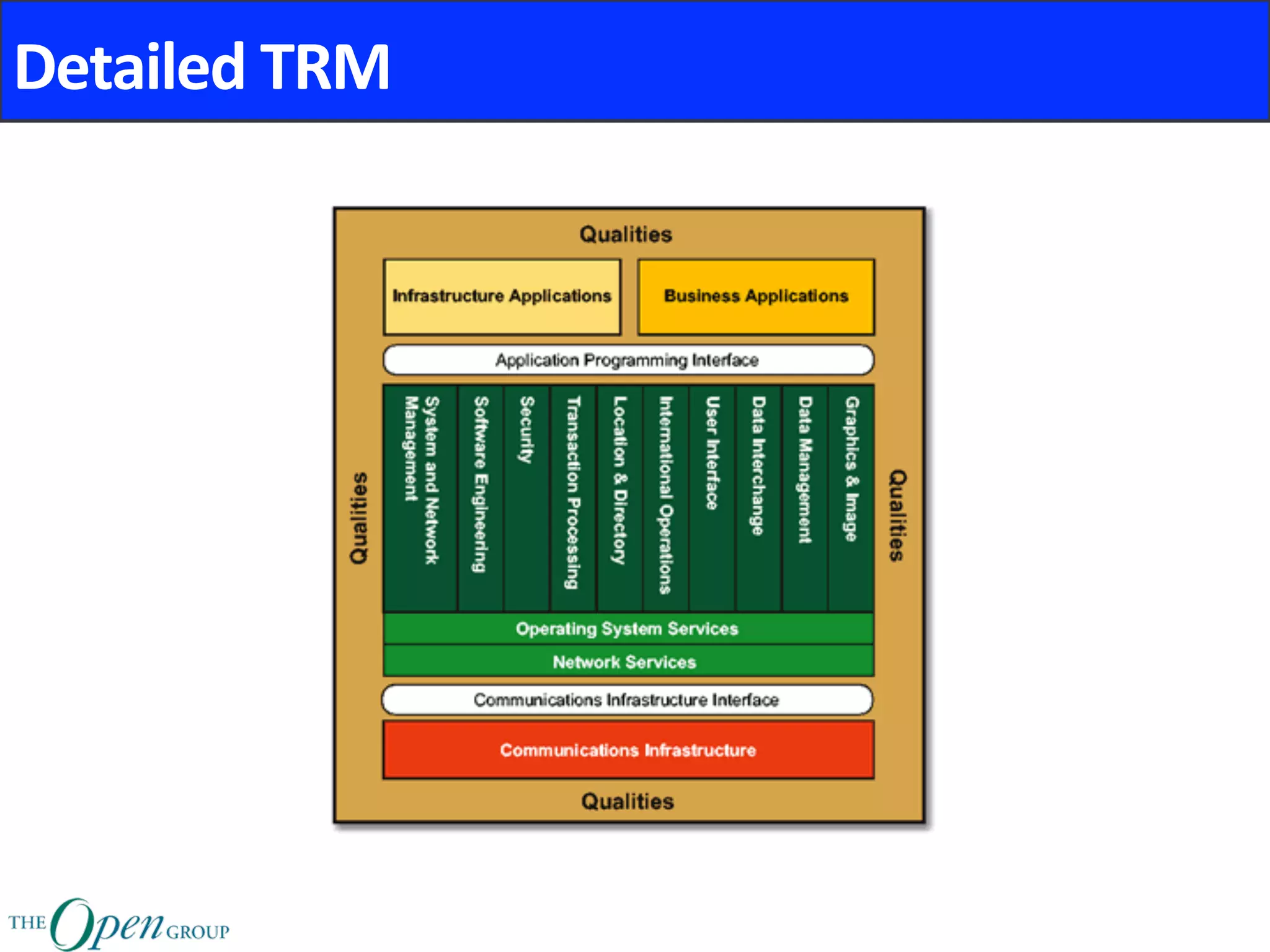
• The	TOGAF	Technical	Reference	Model	(TRM)	
• A	Founda@on	Architecture	
• A	model	and	a	taxonomy	of	generic	plaPorm	services	
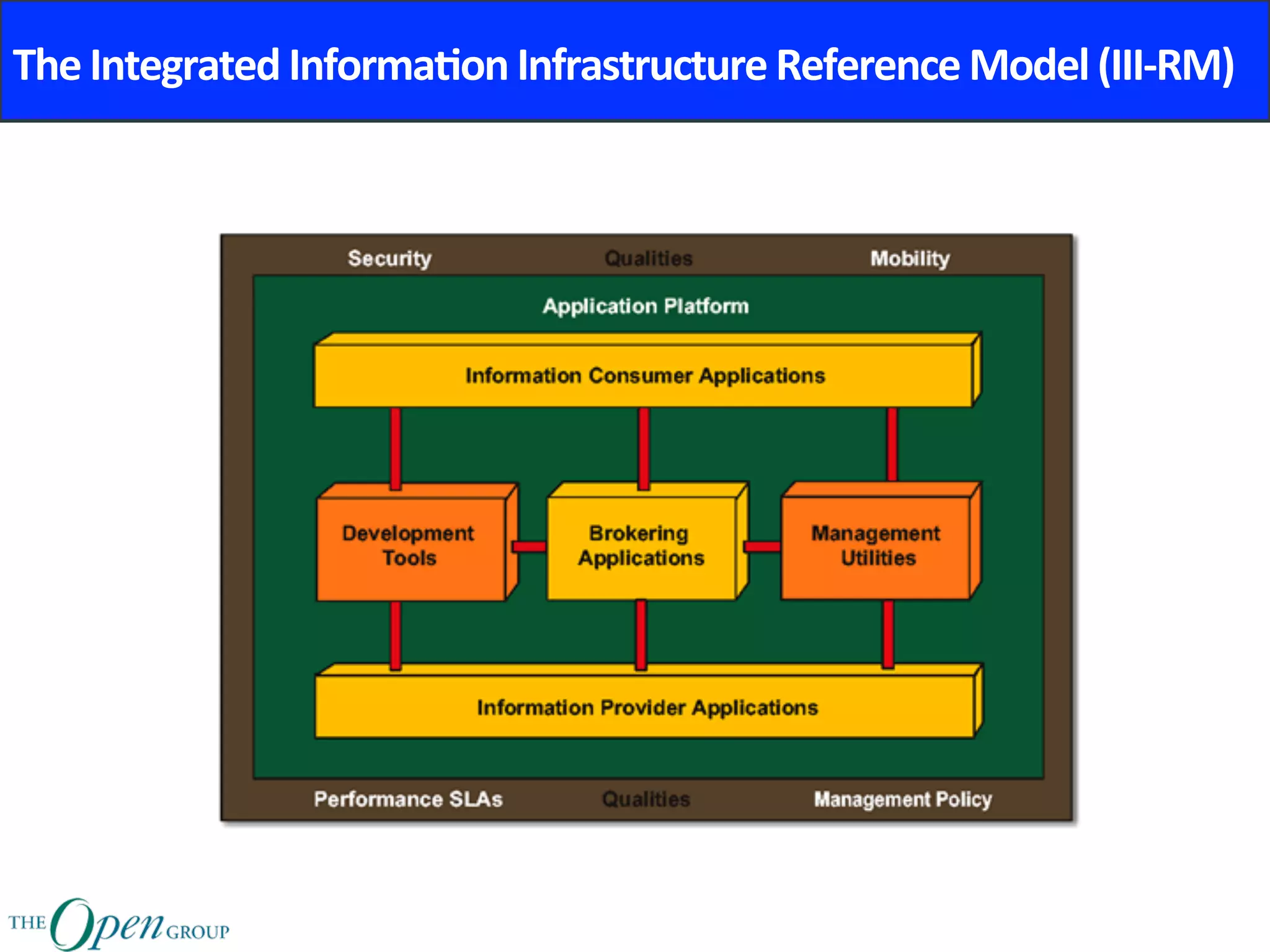
• The	Integrated	Informa8on	Infrastructure	Model	(III-RM)	
• A	model	for	business	applica@ons	and	infrastructure	
applica@ons	
• Specifically	aimed	to	support	the	vision	of	“Boundaryless	
Informa@on	Flow”
High	Level	TRM
Detailed	TRM
The	Integrated	Informa8on	Infrastructure	Reference	Model	(III-RM)
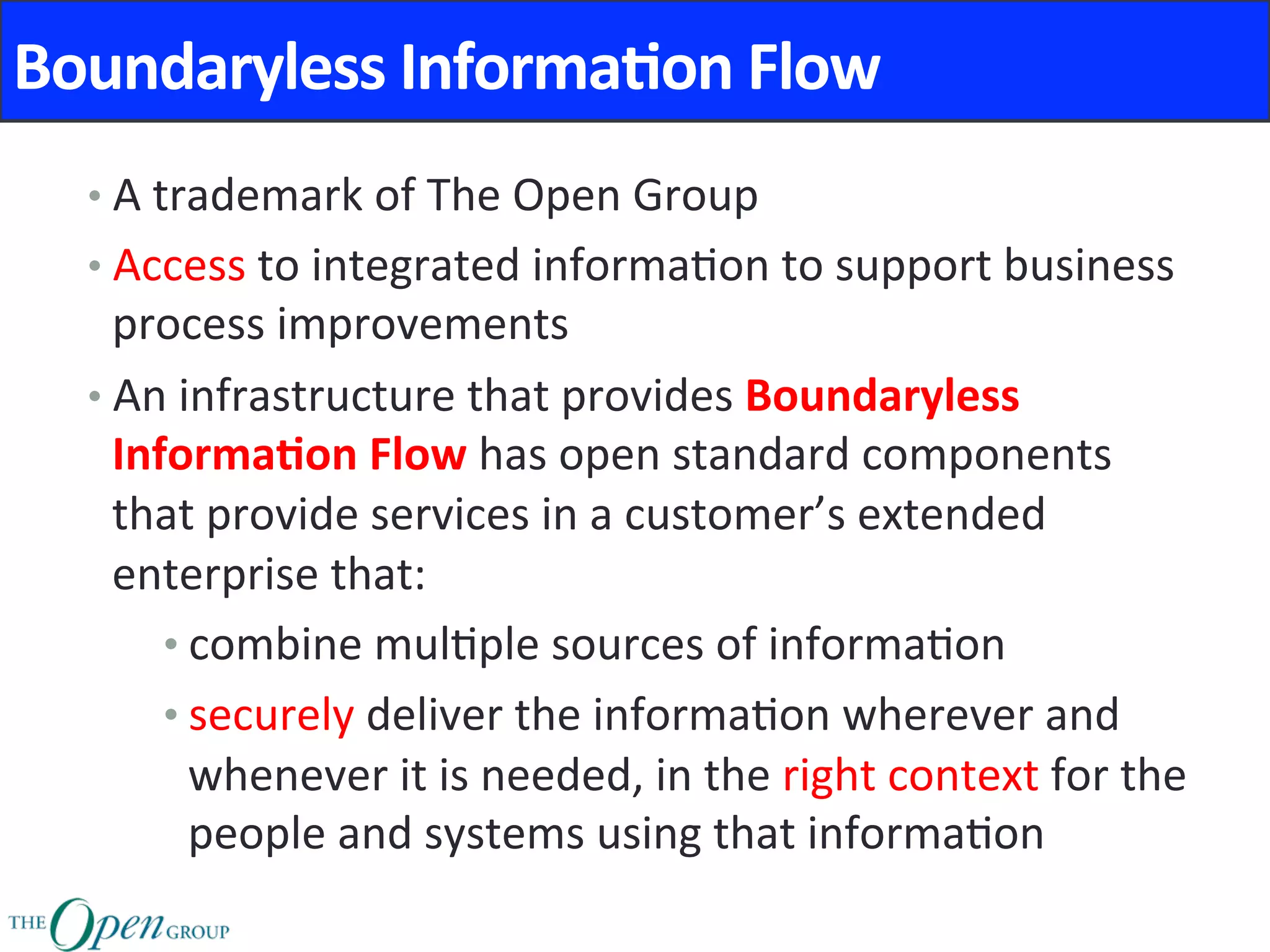
Boundaryless	Informa8on	Flow	
• A	trademark	of	The	Open	Group	
• Access	to	integrated	informa@on	to	support	business	
process	improvements	
• An	infrastructure	that	provides	Boundaryless	
Informa8on	Flow	has	open	standard	components	
that	provide	services	in	a	customer’s	extended	
enterprise	that:	
• combine	mul@ple	sources	of	informa@on	
• securely	deliver	the	informa@on	wherever	and	
whenever	it	is	needed,	in	the	right	context	for	the	
people	and	systems	using	that	informa@on
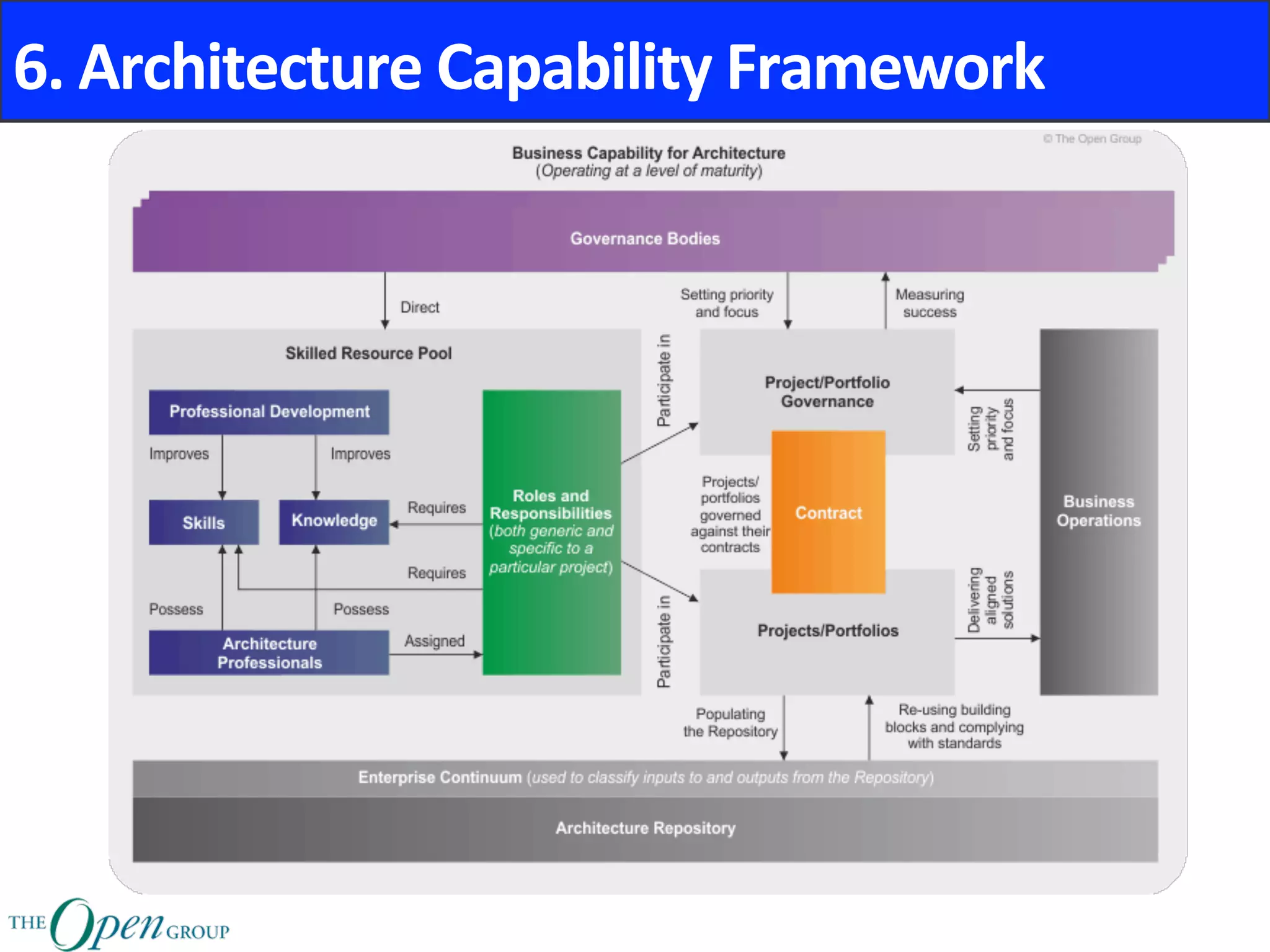
6.	Architecture	Capability	Framework
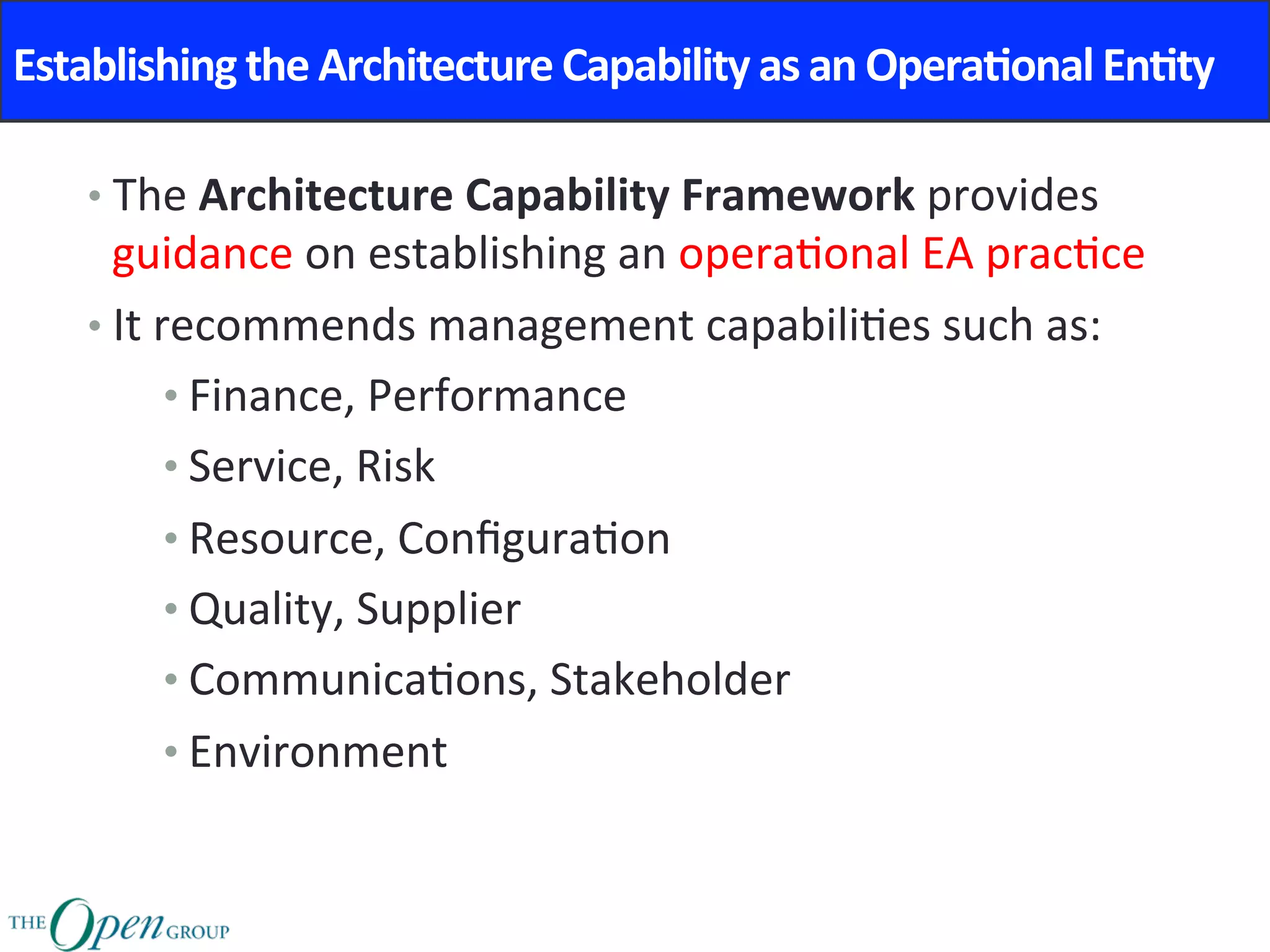
Establishing	the	Architecture	Capability	as	an	Opera8onal	En8ty	
• The	Architecture	Capability	Framework	provides	
guidance	on	establishing	an	opera@onal	EA	prac@ce	
• It	recommends	management	capabili@es	such	as:	
• Finance,	Performance	
• Service,	Risk	
• Resource,	Configura@on		
• Quality,	Supplier	
• Communica@ons,	Stakeholder	
• Environment
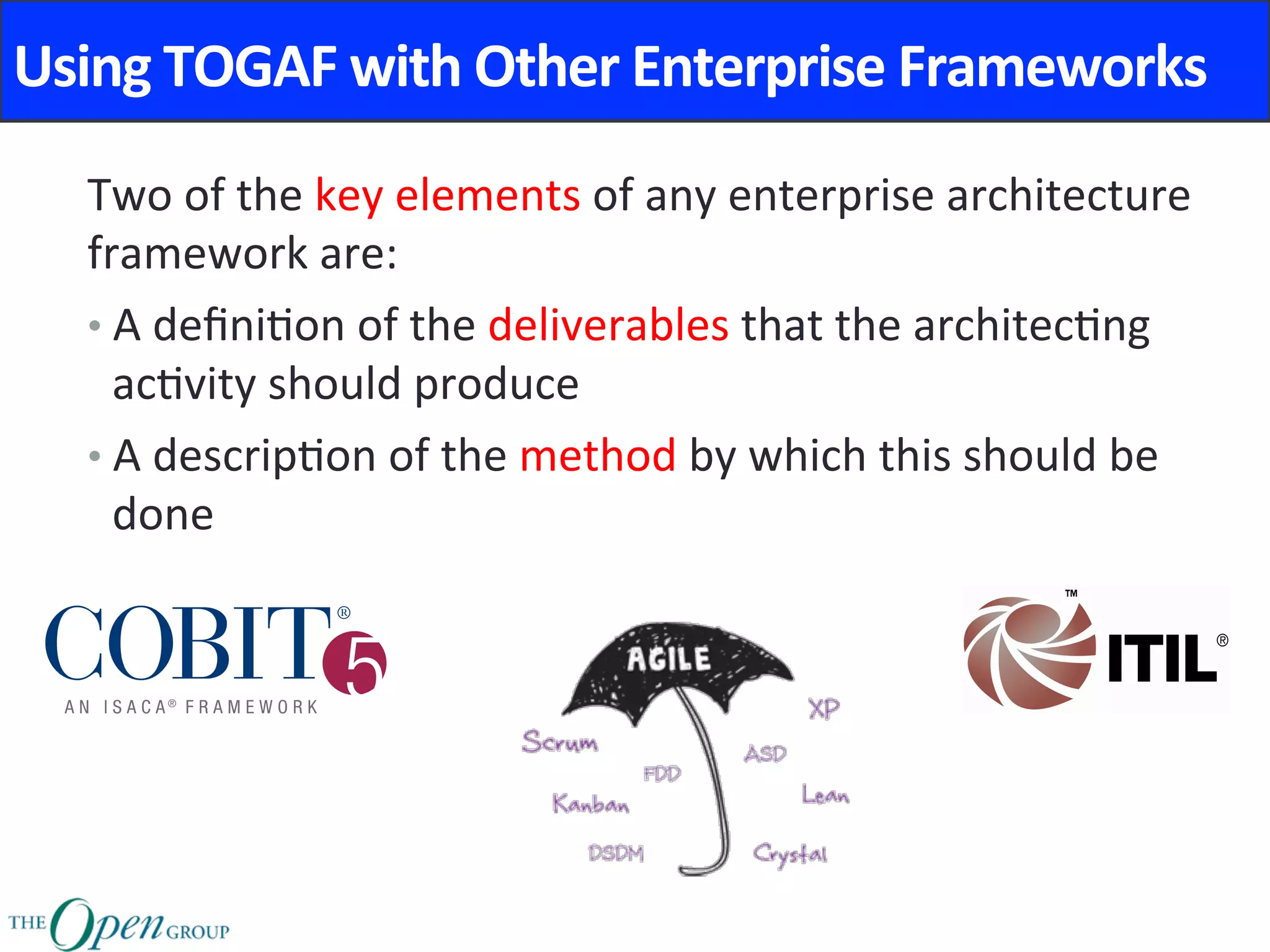
Using	TOGAF	with	Other	Enterprise	Frameworks	
Two	of	the	key	elements	of	any	enterprise	architecture	
framework	are:	
• A	defini@on	of	the	deliverables	that	the	architec@ng	
ac@vity	should	produce	
• A	descrip@on	of	the	method	by	which	this	should	be	
done
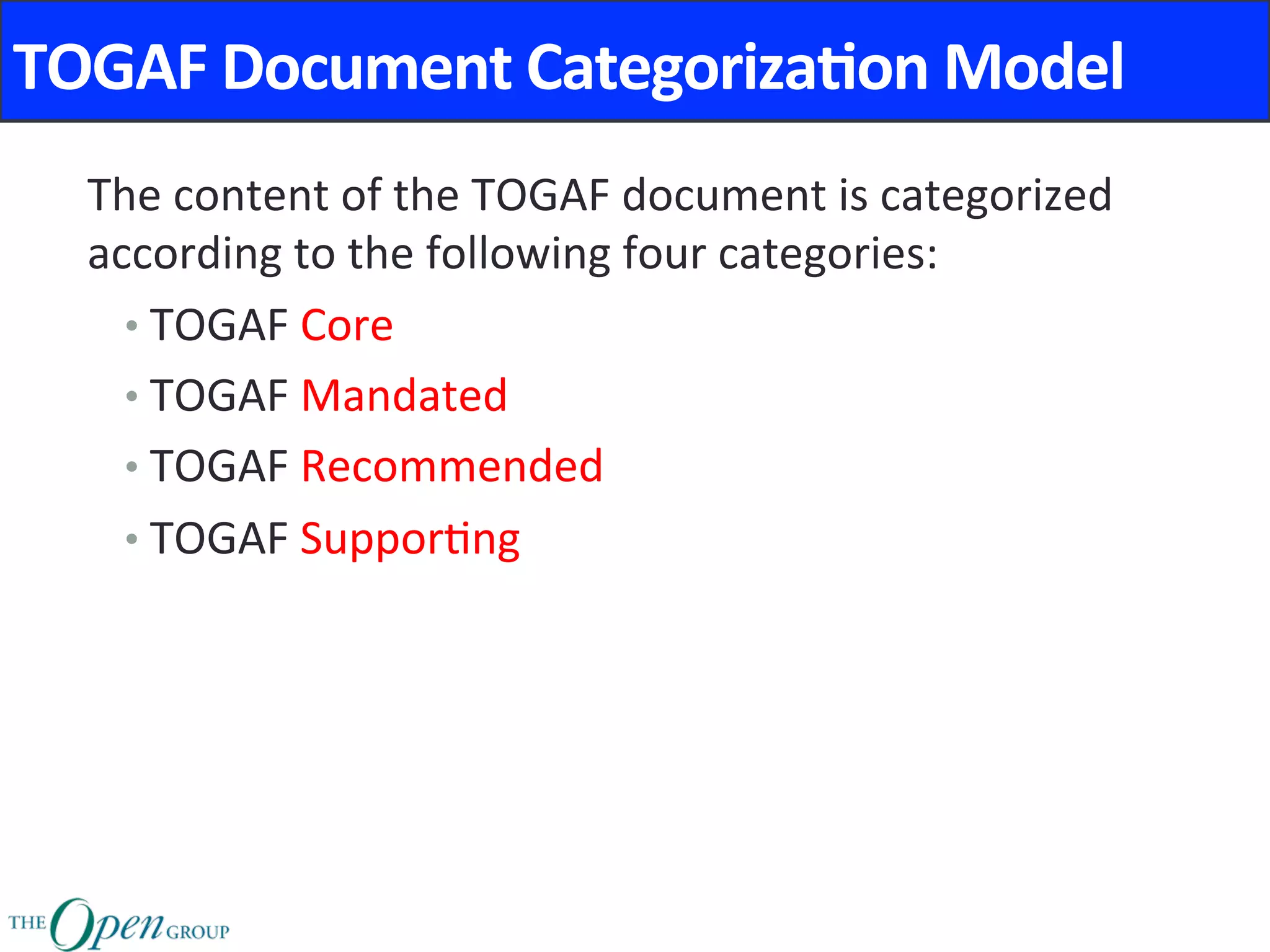
TOGAF	Document	Categoriza8on	Model	
The	content	of	the	TOGAF	document	is	categorized	
according	to	the	following	four	categories:	
• TOGAF	Core		
• TOGAF	Mandated		
• TOGAF	Recommended		
• TOGAF	Suppor@ng
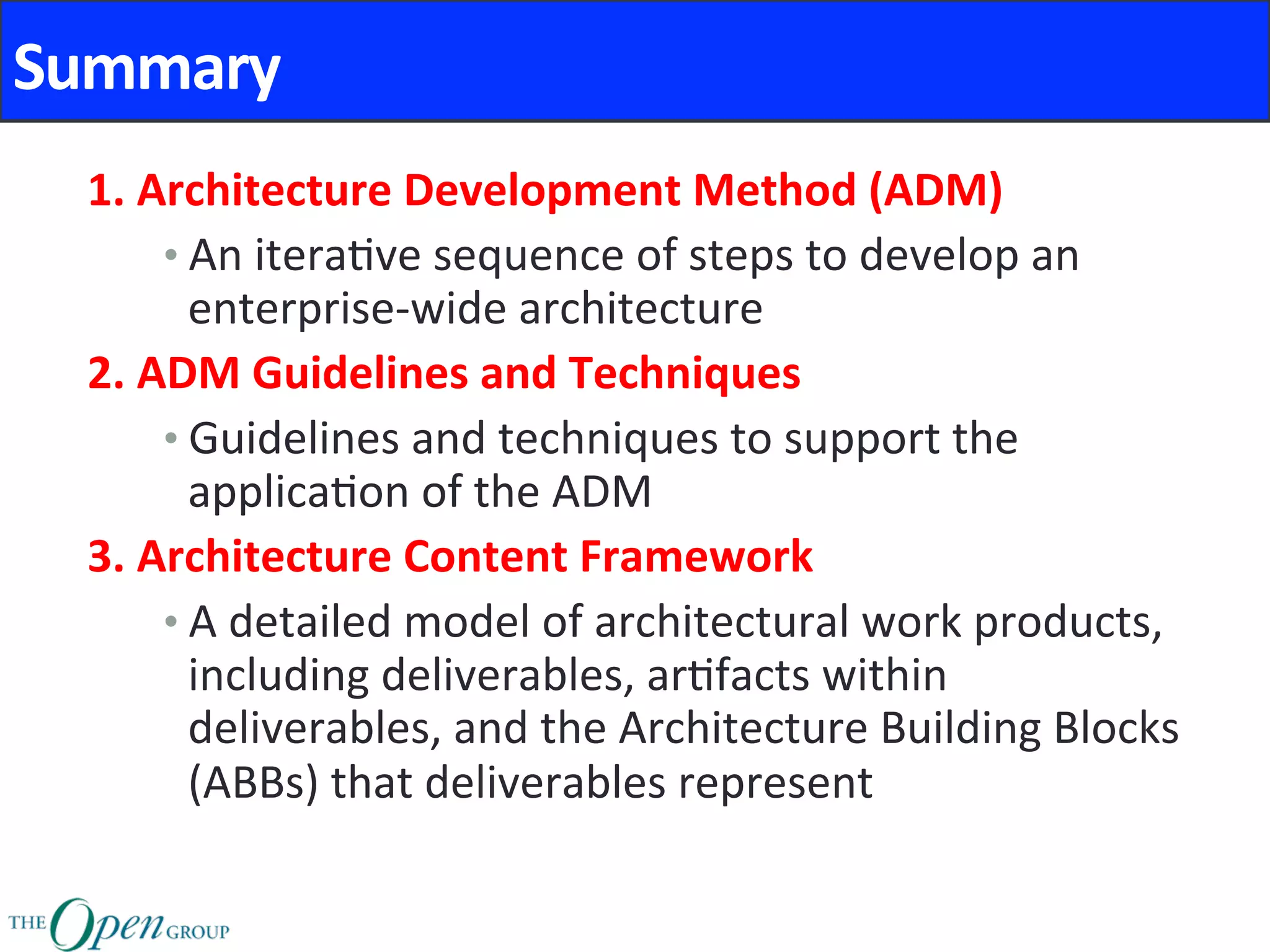
Summary	
1.	Architecture	Development	Method	(ADM)	
• An	itera@ve	sequence	of	steps	to	develop	an	
enterprise-wide	architecture	
2.	ADM	Guidelines	and	Techniques	
• Guidelines	and	techniques	to	support	the	
applica@on	of	the	ADM	
3.	Architecture	Content	Framework	
• A	detailed	model	of	architectural	work	products,	
including	deliverables,	ar@facts	within	
deliverables,	and	the	Architecture	Building	Blocks	
(ABBs)	that	deliverables	represent
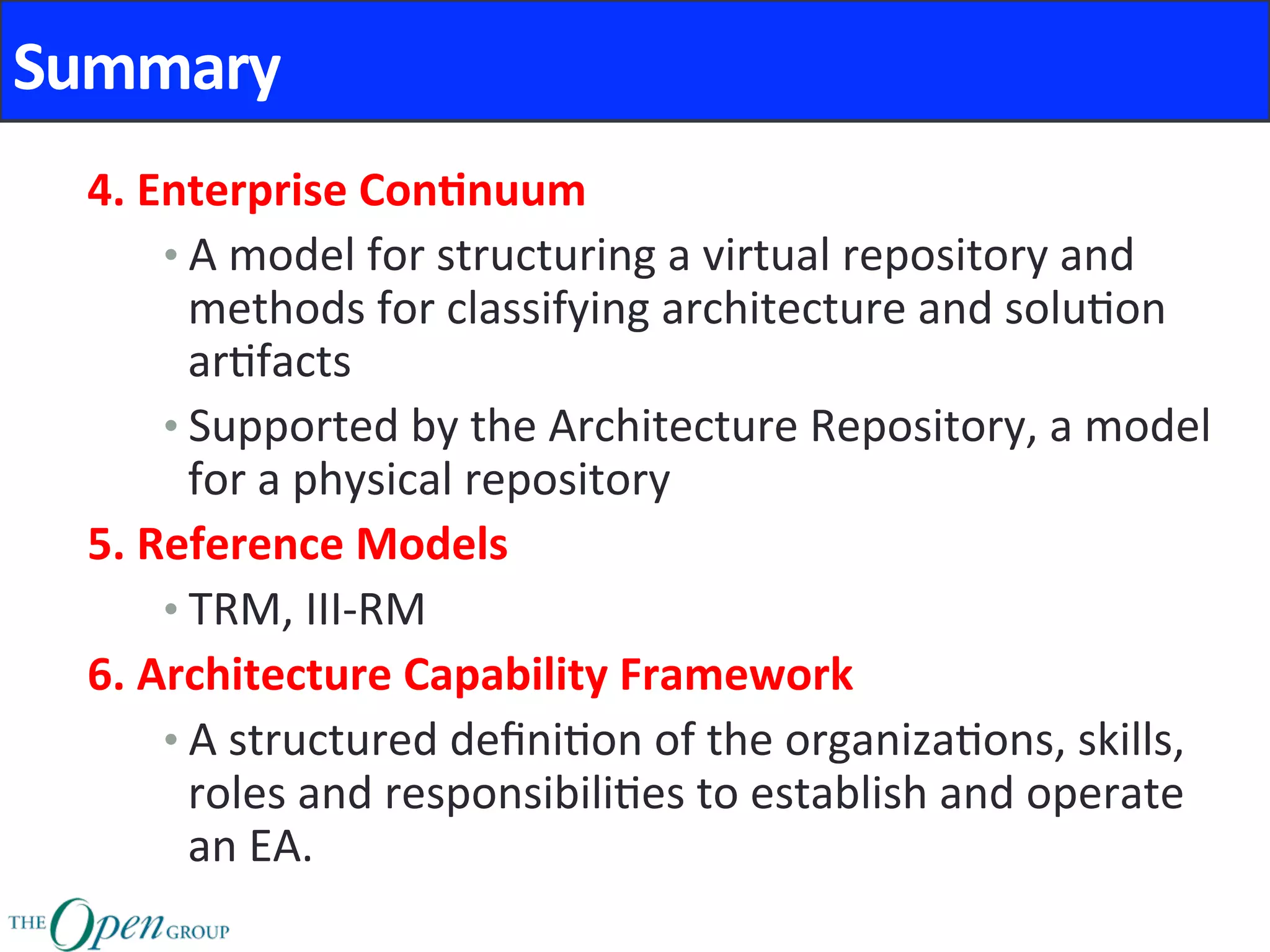
Summary	
4.	Enterprise	Con8nuum	
• A	model	for	structuring	a	virtual	repository	and	
methods	for	classifying	architecture	and	solu@on	
ar@facts	
• Supported	by	the	Architecture	Repository,	a	model	
for	a	physical	repository	
5.	Reference	Models	
• TRM,	III-RM	
6.	Architecture	Capability	Framework	
• A	structured	defini@on	of	the	organiza@ons,	skills,	
roles	and	responsibili@es	to	establish	and	operate	
an	EA.

TOGAF Classroom Series - M2 togaf-9-components