Views and Viewpoints 
Henry Muccini 
henry.muccini@univaq.it 
DISIM 
Dep.nt of Information Engineering, Computer Science and Mathematics 
University of L’Aquila, Italy
The material in these slides may be freely reproduced 
and distributed, partially or totally, as far as an explicit 
reference or acknowledge to the material author is 
preserved. 
SEA Group 
Henry Muccini
Intro to SA 
SA Case study 
SA style 
ADLs 
Design Decisions 
Views/Viewpoints 
SEA Group 
Non Functional S.E. 
Performance modeling 
Performance analysis 
UML 
UML Profiling 
Lab
Software Architecture 
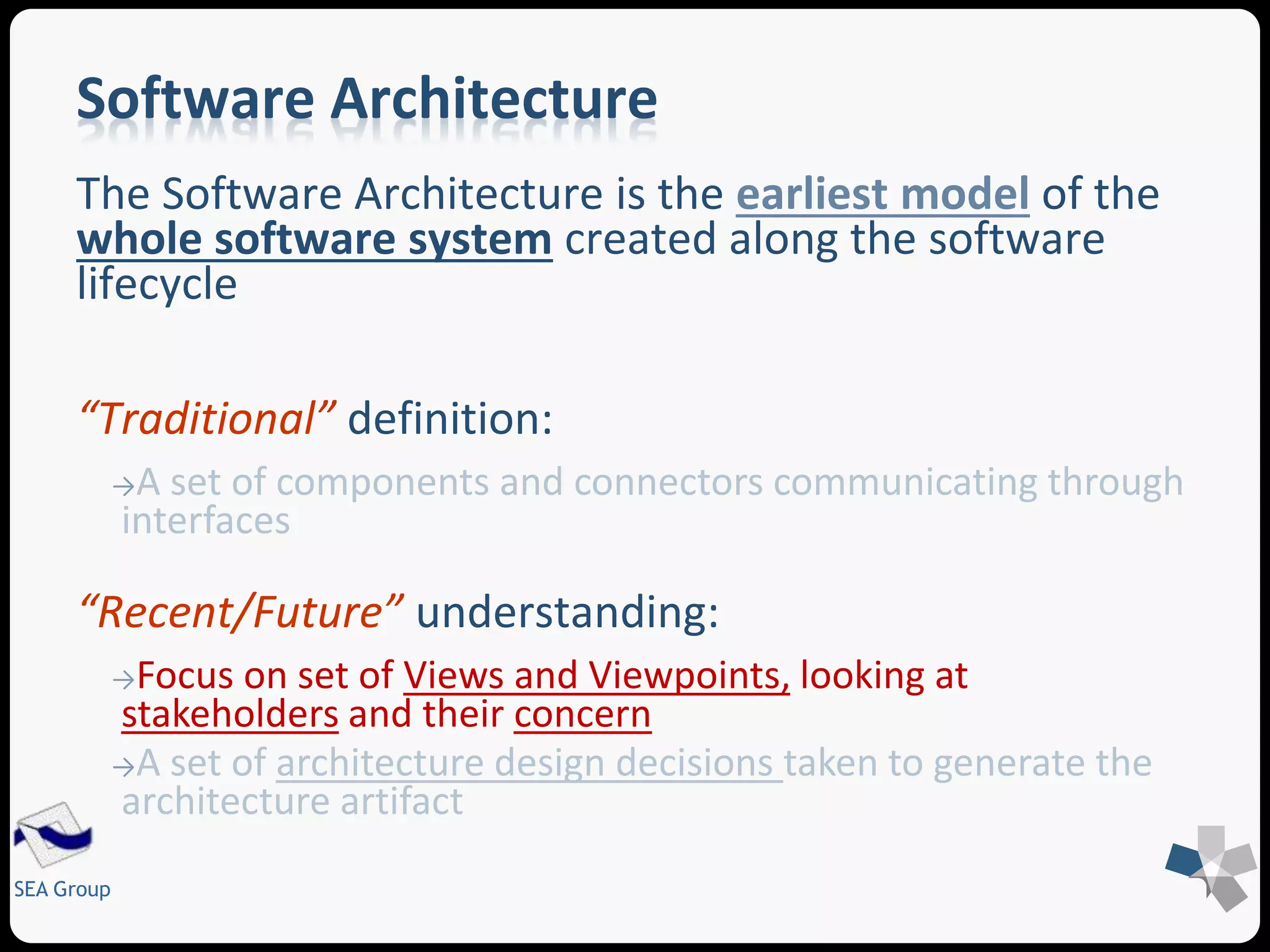
The Software Architecture is the earliest model of the 
whole software system created along the software 
lifecycle 
“Traditional” definition: 
→A set of components and connectors communicating through 
interfaces 
“Recent/Future” understanding: 
SEA Group 
→Focus on set of Views and Viewpoints, looking at 
stakeholders and their concern 
→A set of architecture design decisions taken to generate the 
architecture artifact
SEA Group 
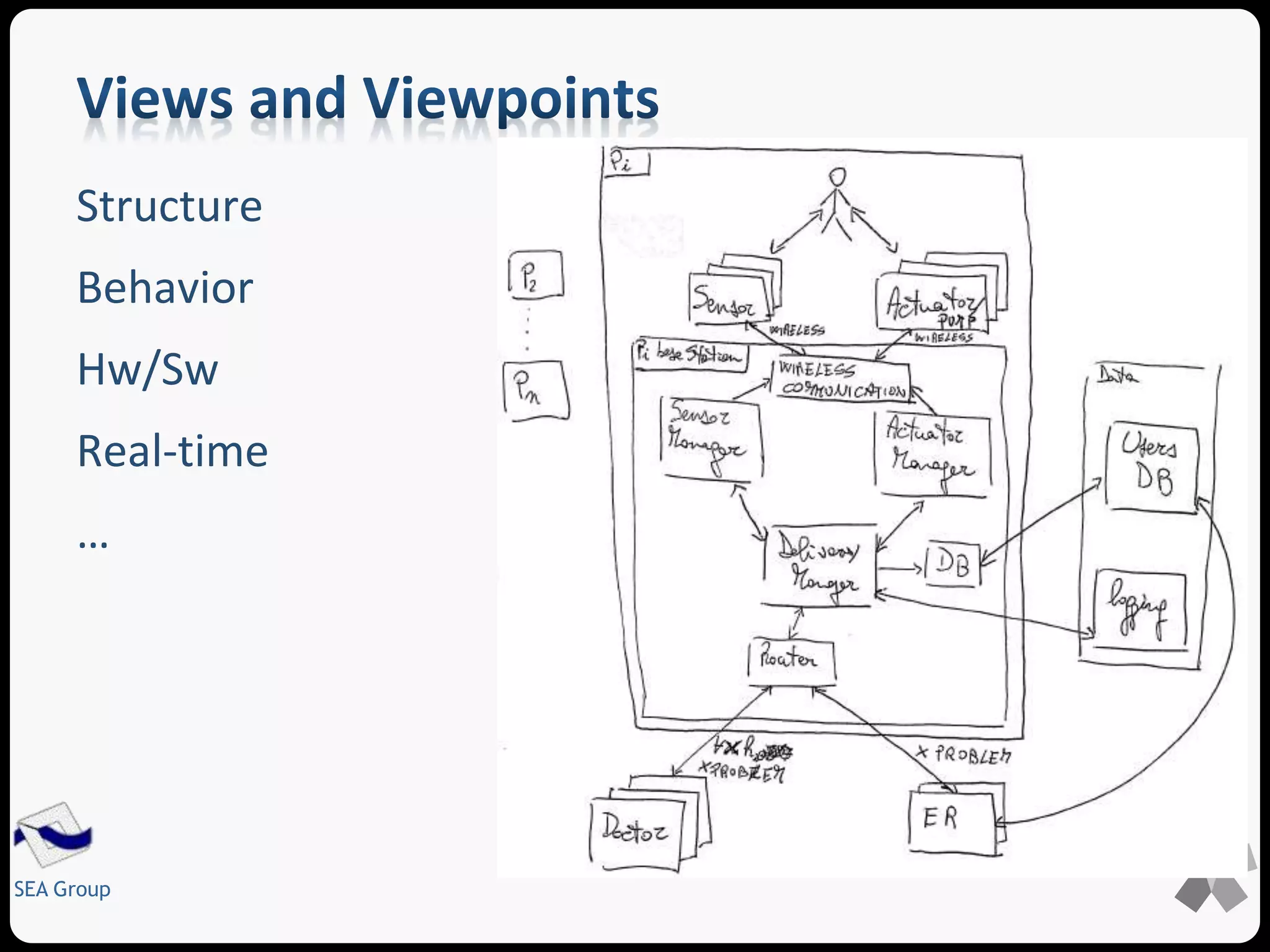
Architecture as a set of Viewpoints
Structure 
Behavior 
Hw/Sw 
Real-time 
… 
SEA Group
SEA Group
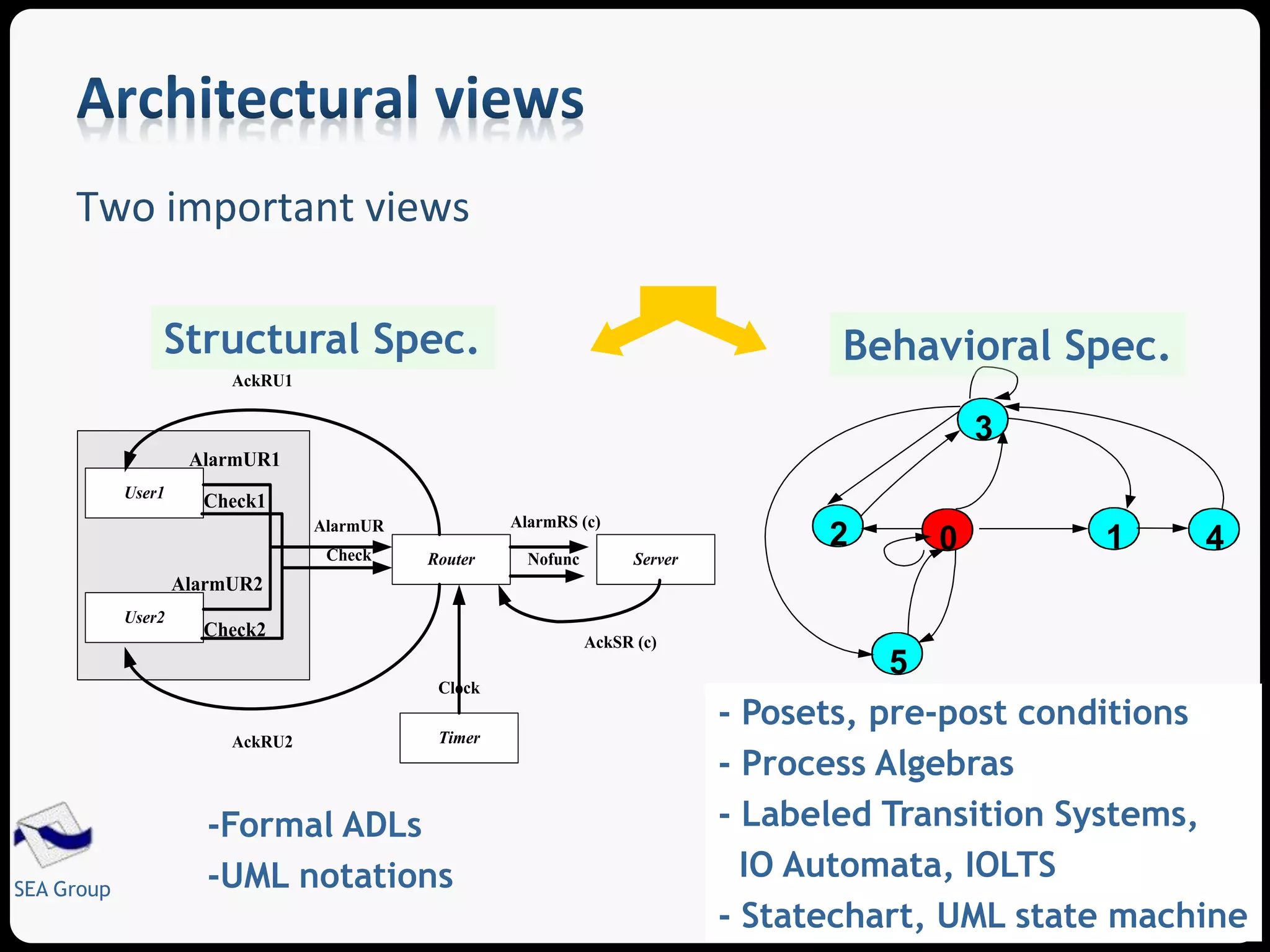
Two important views 
SEA Group 
Structural Spec. Behavioral Spec. 
User1 
AlarmUR AlarmRS (c) 
Router Server 
Timer 
Check1 
Nofunc 
Clock 
AckSR (c) 
AckRU1 
User2 
AlarmUR1 
AlarmUR2 
Check2 
Check 
AckRU2 
3 
2 0 1 
4 
5 
-Formal ADLs 
-UML notations 
- Posets, pre-post conditions 
- Process Algebras 
- Labeled Transition Systems, 
IO Automata, IOLTS 
- Statechart, UML state machine
SEA Group
SEA Group
SEA Group
SEA Group
SEA Group
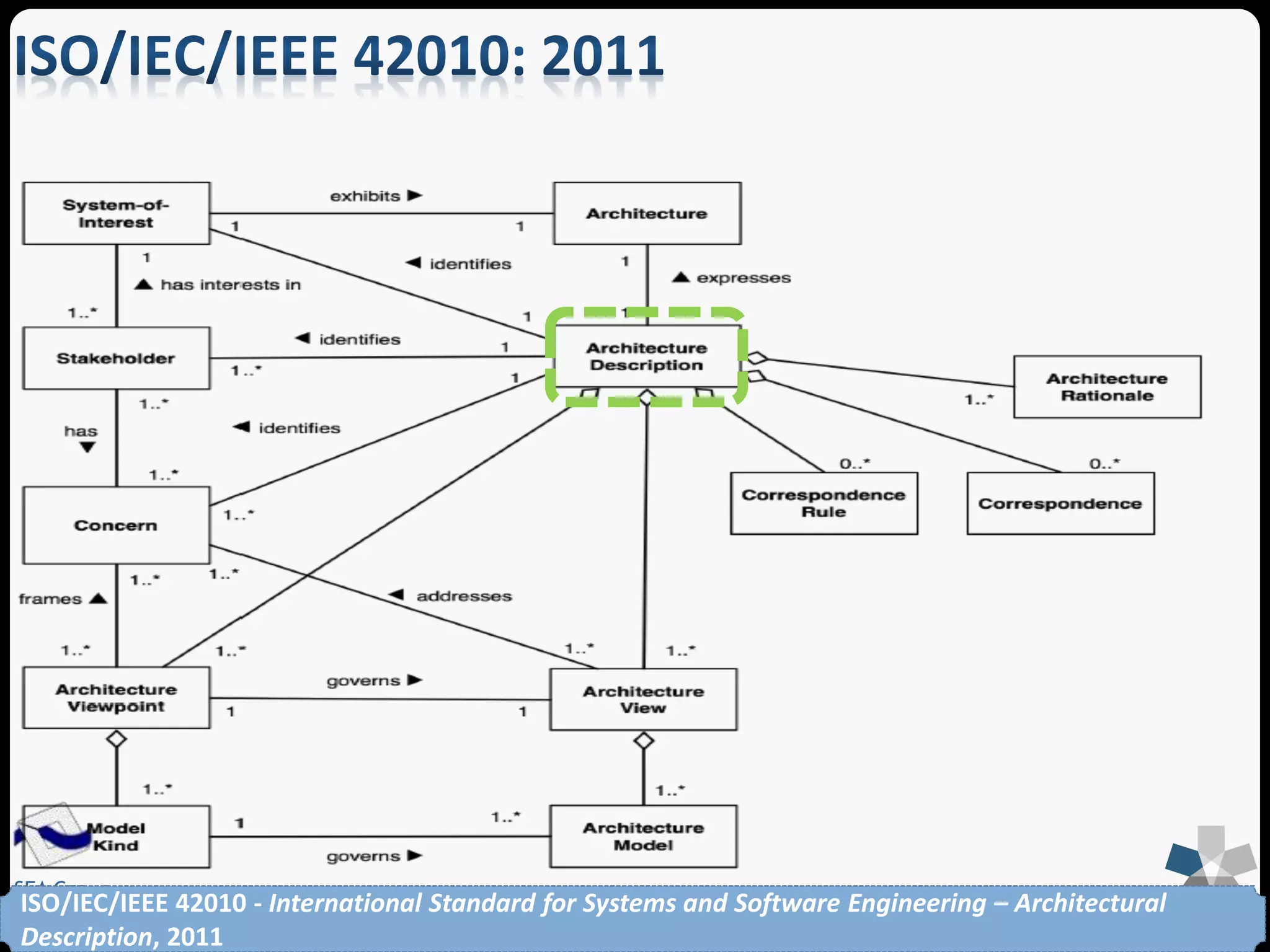
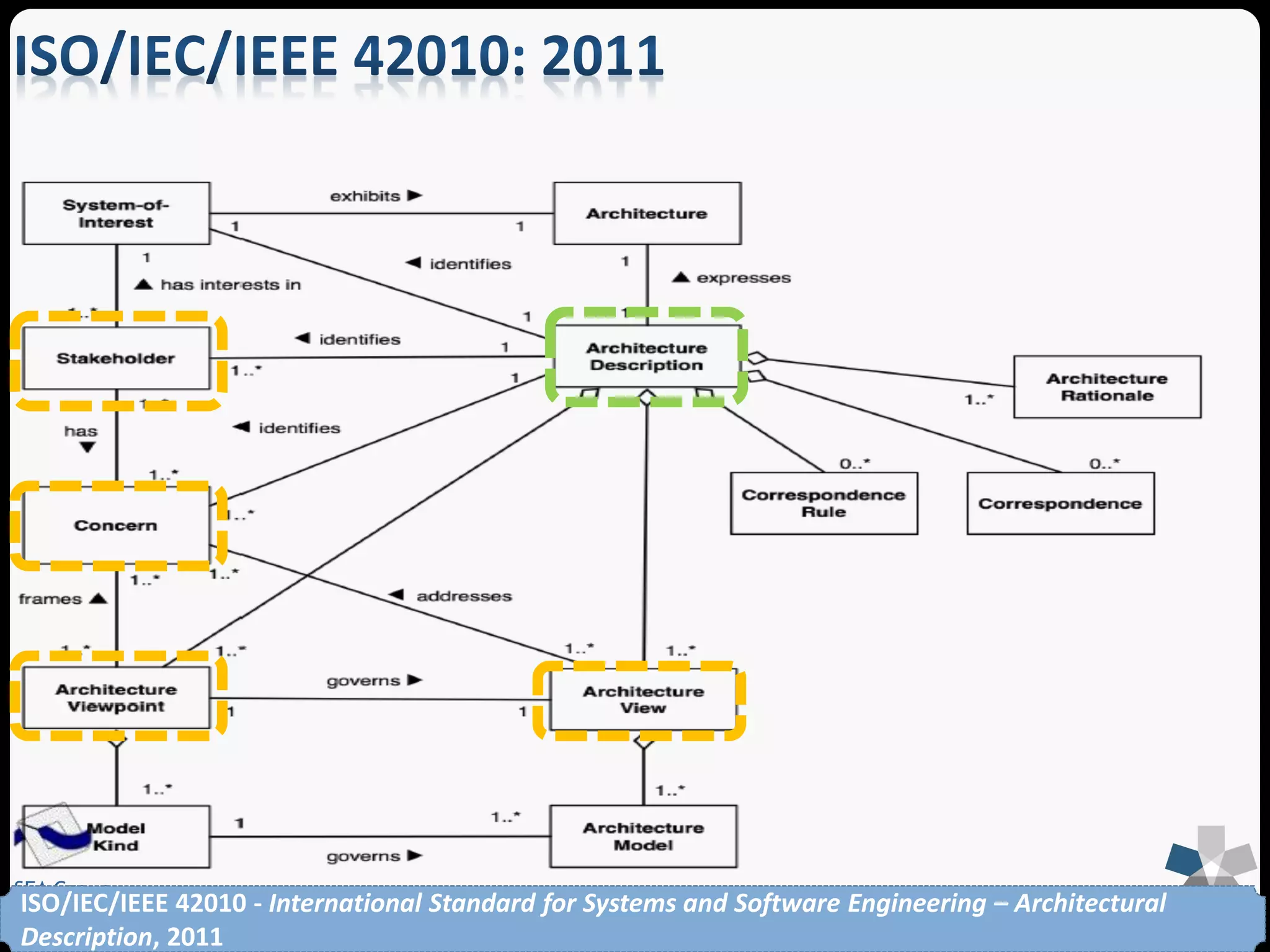
SEA Group ISO/IEC/IEEE 42010 - International Standard for Systems and Software Engineering – Architectural 
Description, 2011
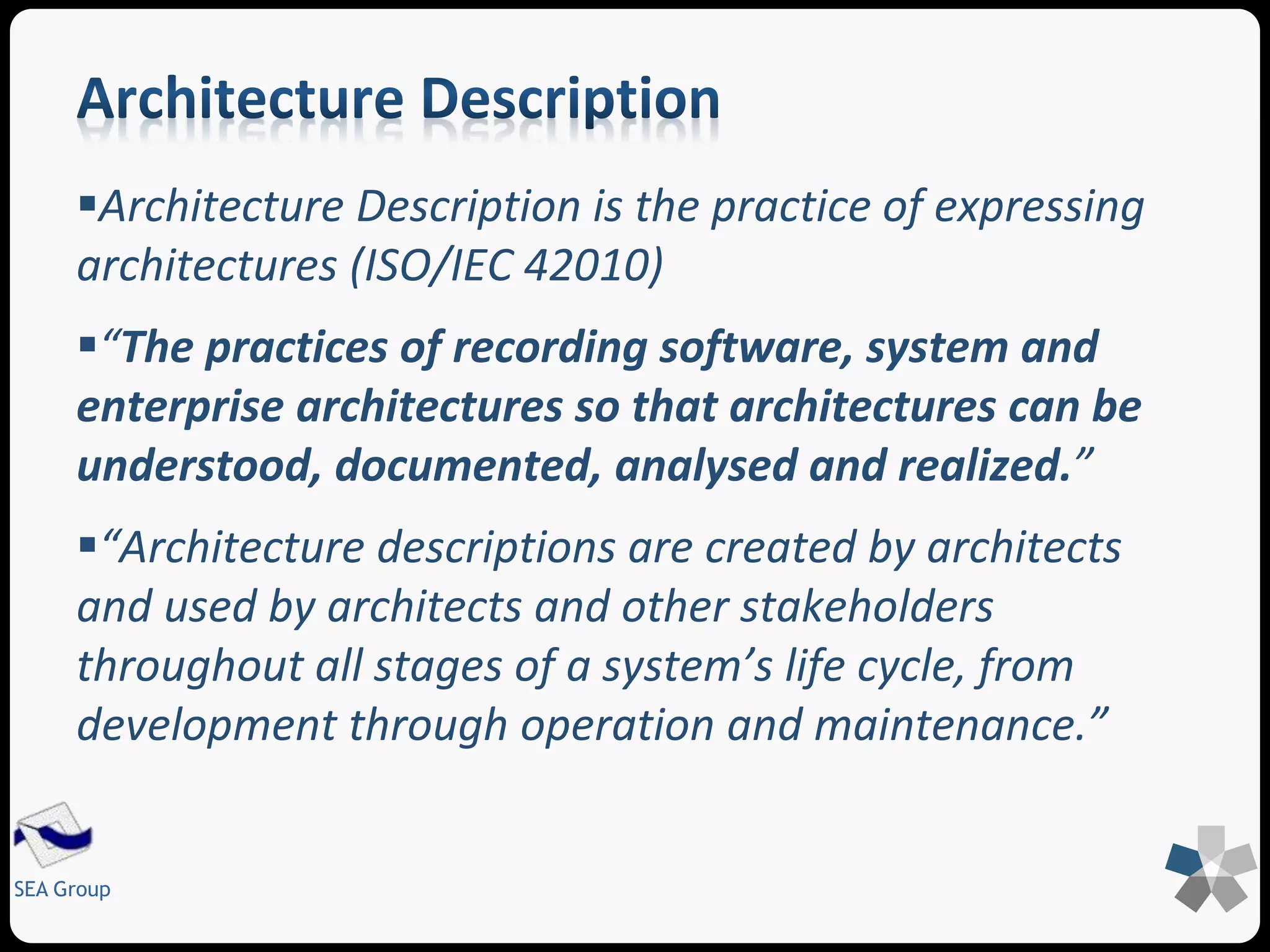
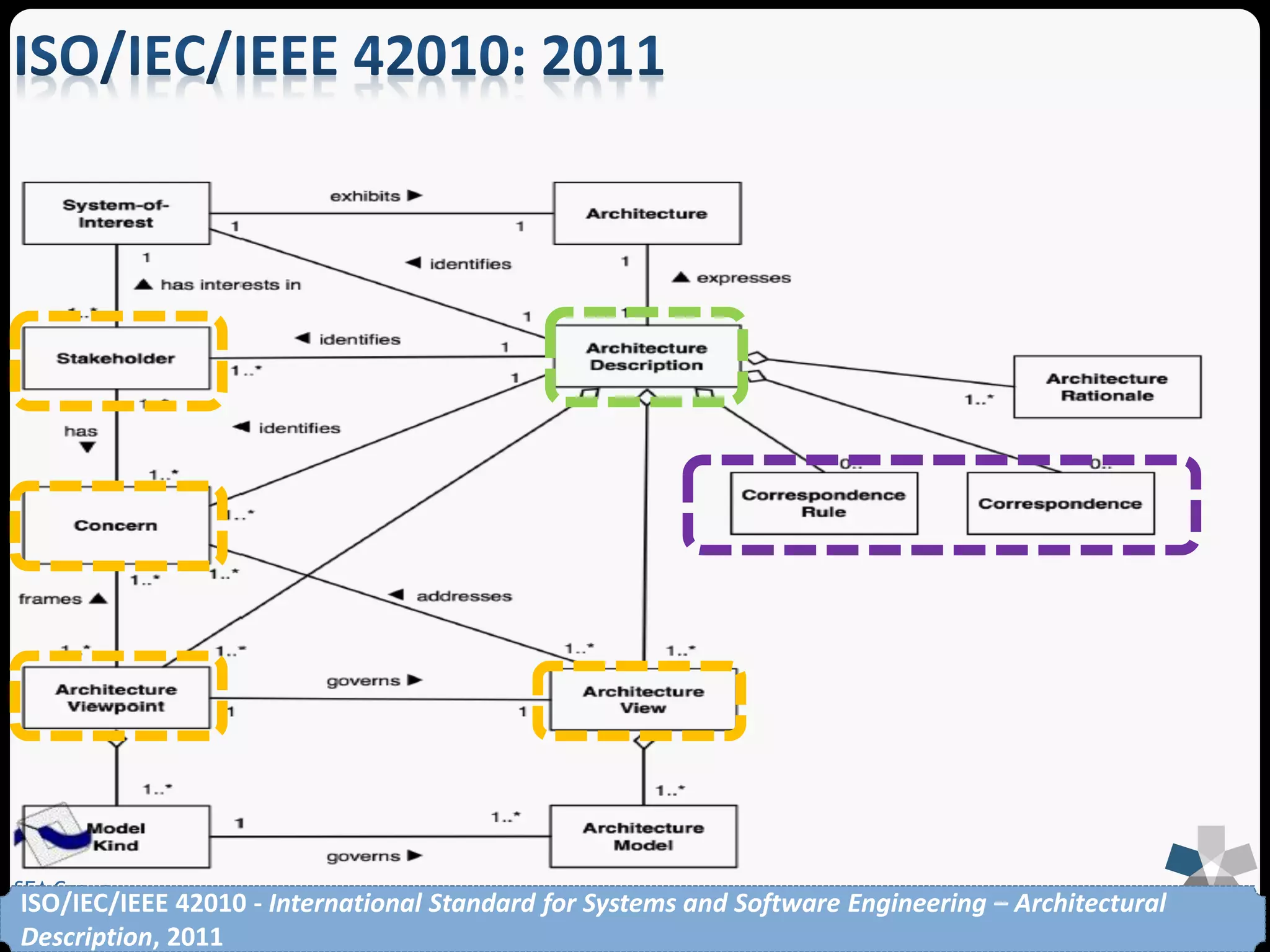
Architecture Description is the practice of expressing 
architectures (ISO/IEC 42010) 
“The practices of recording software, system and 
enterprise architectures so that architectures can be 
understood, documented, analysed and realized.” 
“Architecture descriptions are created by architects 
and used by architects and other stakeholders 
throughout all stages of a system’s life cycle, from 
development through operation and maintenance.” 
SEA Group
SEA Group 
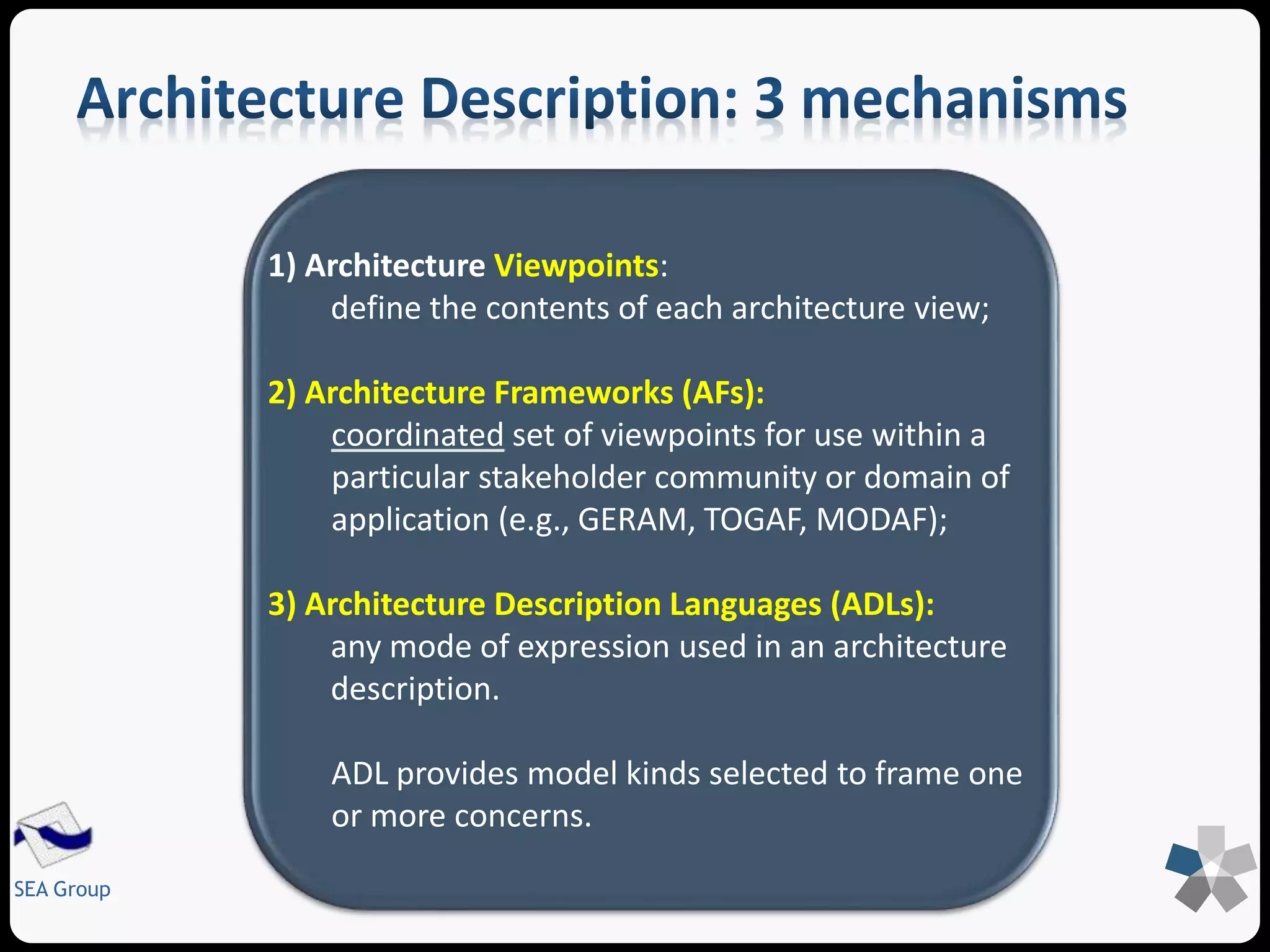
1) Architecture Viewpoints: 
define the contents of each architecture view; 
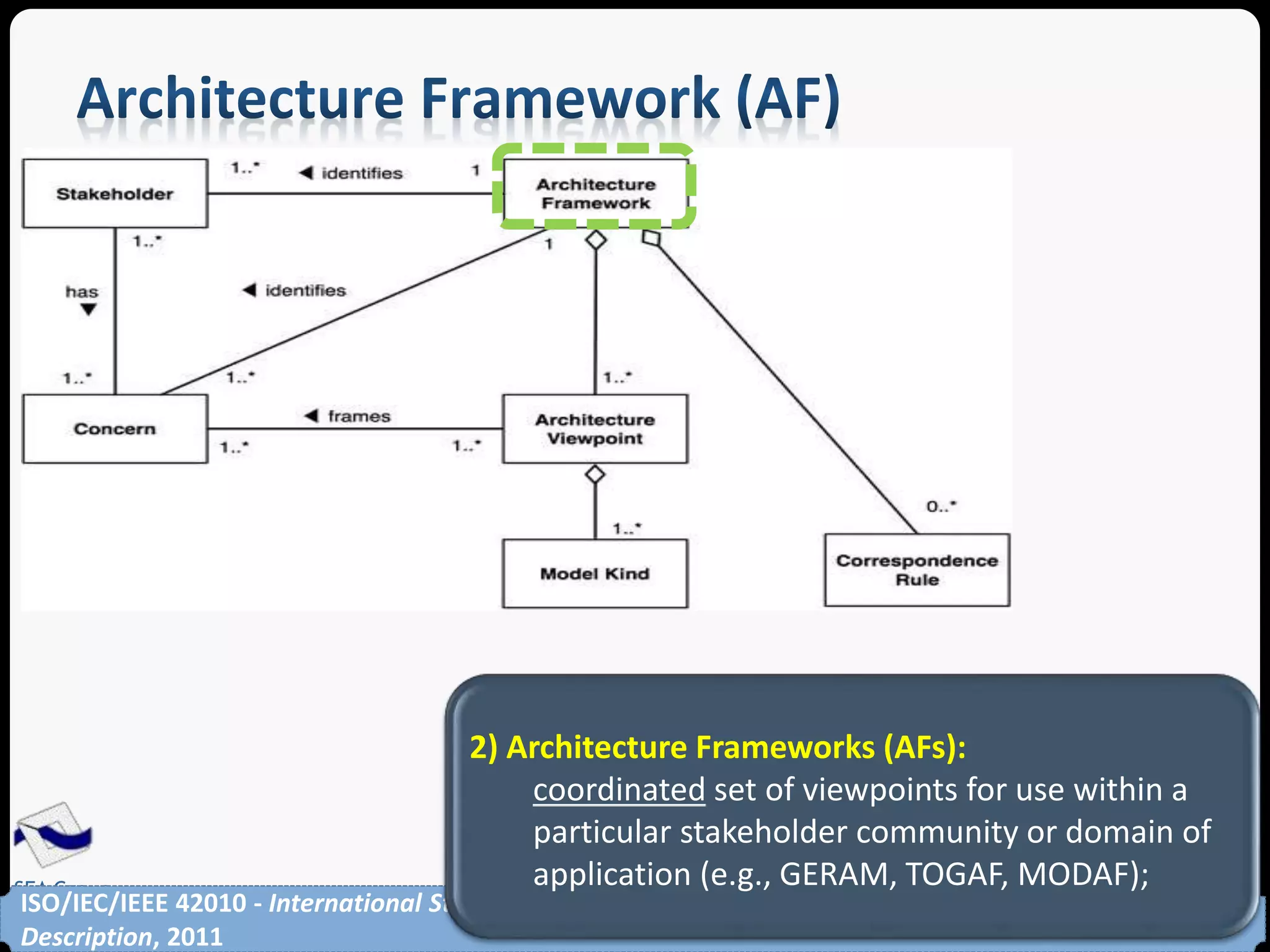
2) Architecture Frameworks (AFs): 
coordinated set of viewpoints for use within a 
particular stakeholder community or domain of 
application (e.g., GERAM, TOGAF, MODAF); 
3) Architecture Description Languages (ADLs): 
any mode of expression used in an architecture 
description. 
ADL provides model kinds selected to frame one 
or more concerns.
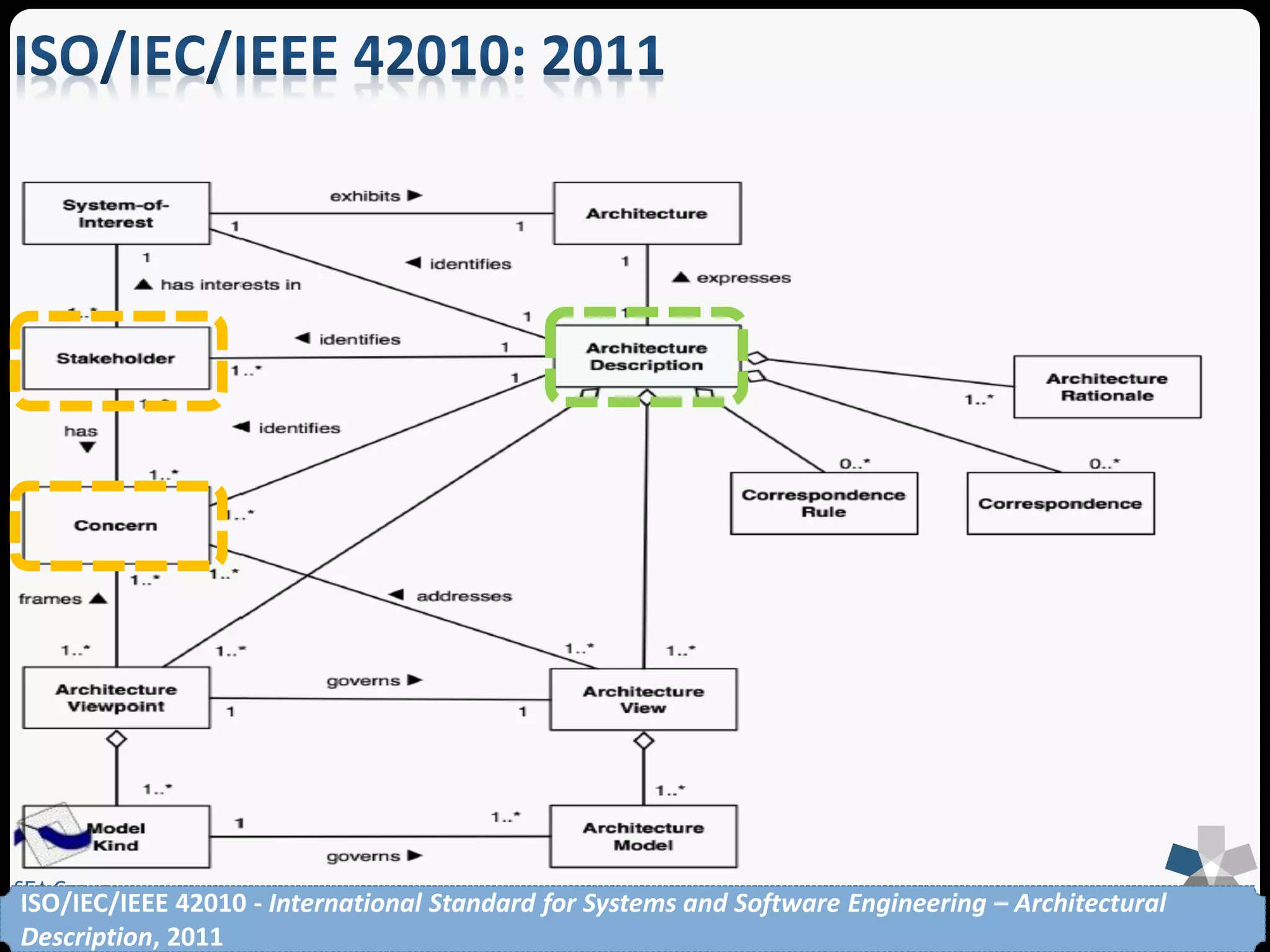
SEA Group ISO/IEC/IEEE 42010 - International Standard for Systems and Software Engineering – Architectural 
Description, 2011
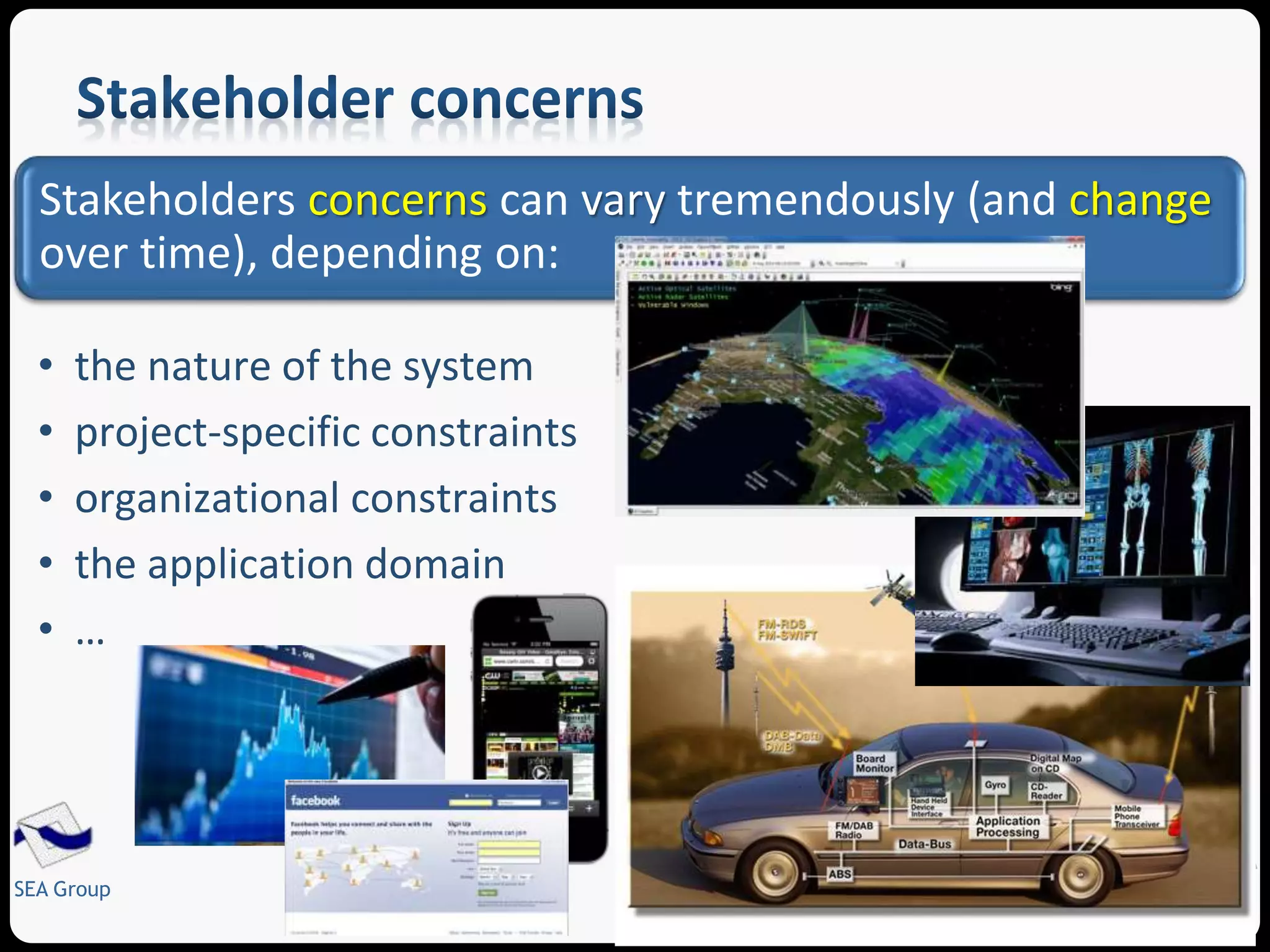
Stakeholders concerns can vary tremendously (and change 
over time), depending on: 
• the nature of the system 
• project-specific constraints 
• organizational constraints 
• the application domain 
• … 
SEA Group
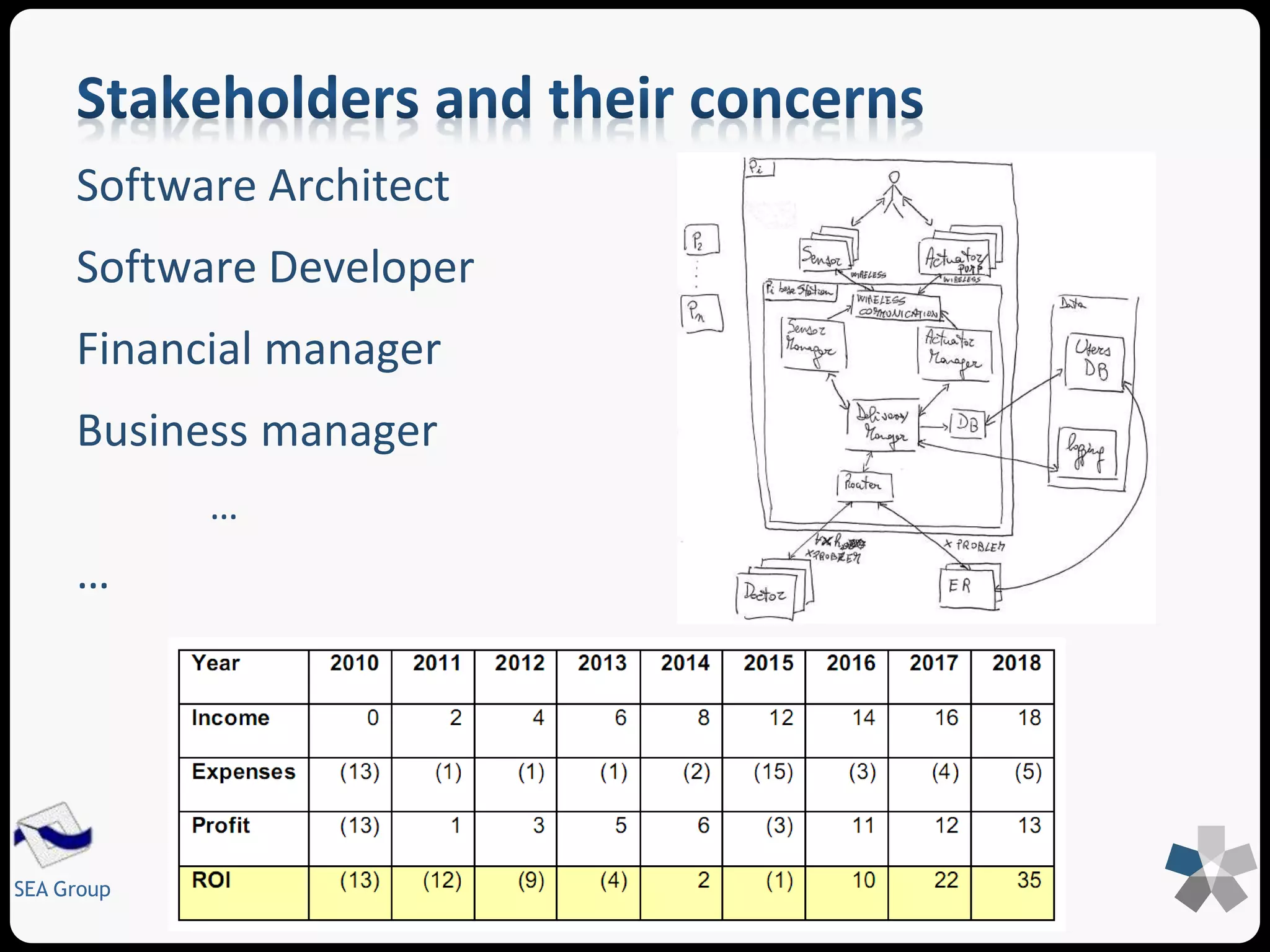
Software Architect 
Software Developer 
Financial manager 
Business manager 
SEA Group 
… 
…
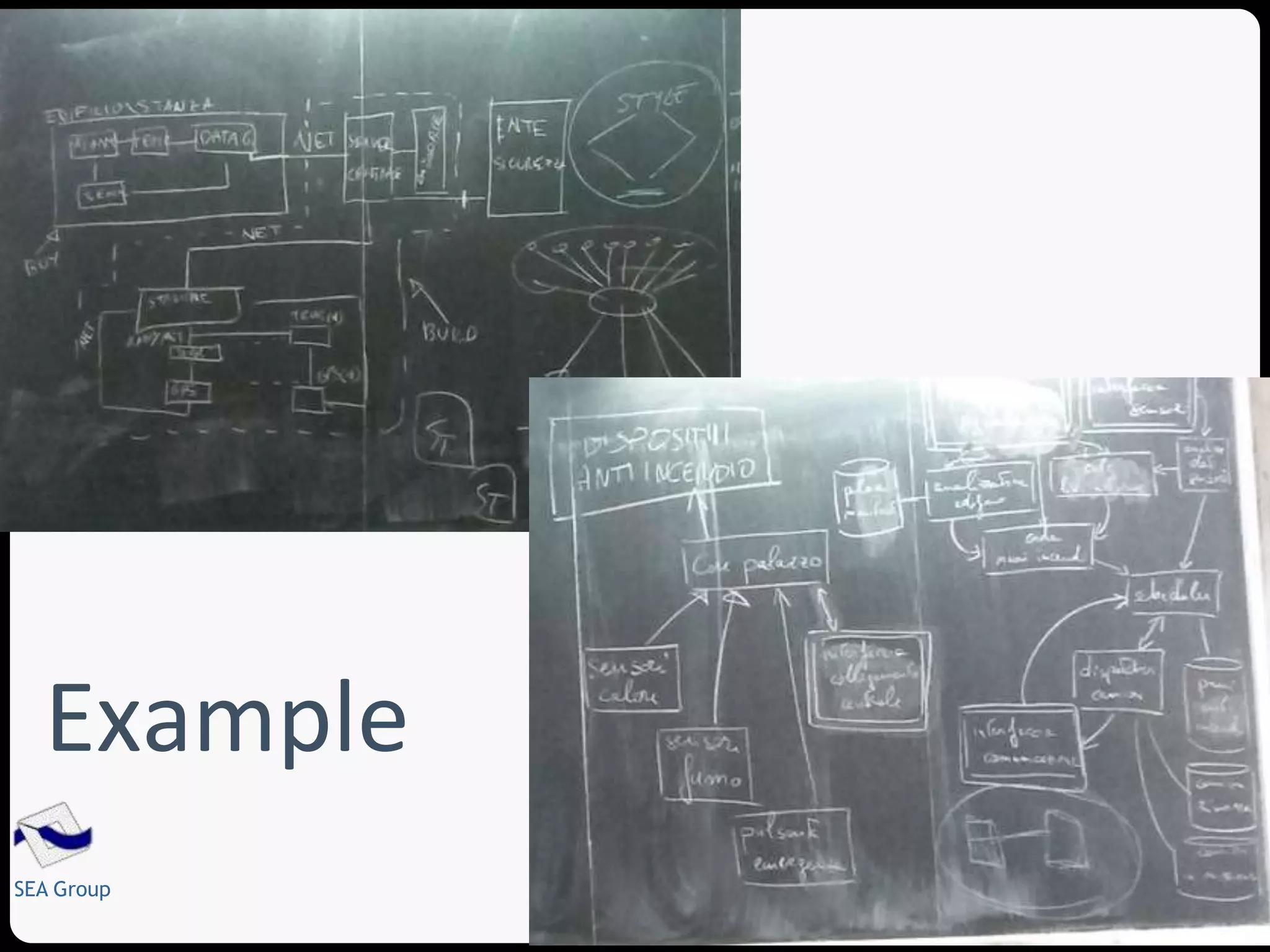
Example 
SEA Group
SEA Group ISO/IEC/IEEE 42010 - International Standard for Systems and Software Engineering – Architectural 
Description, 2011
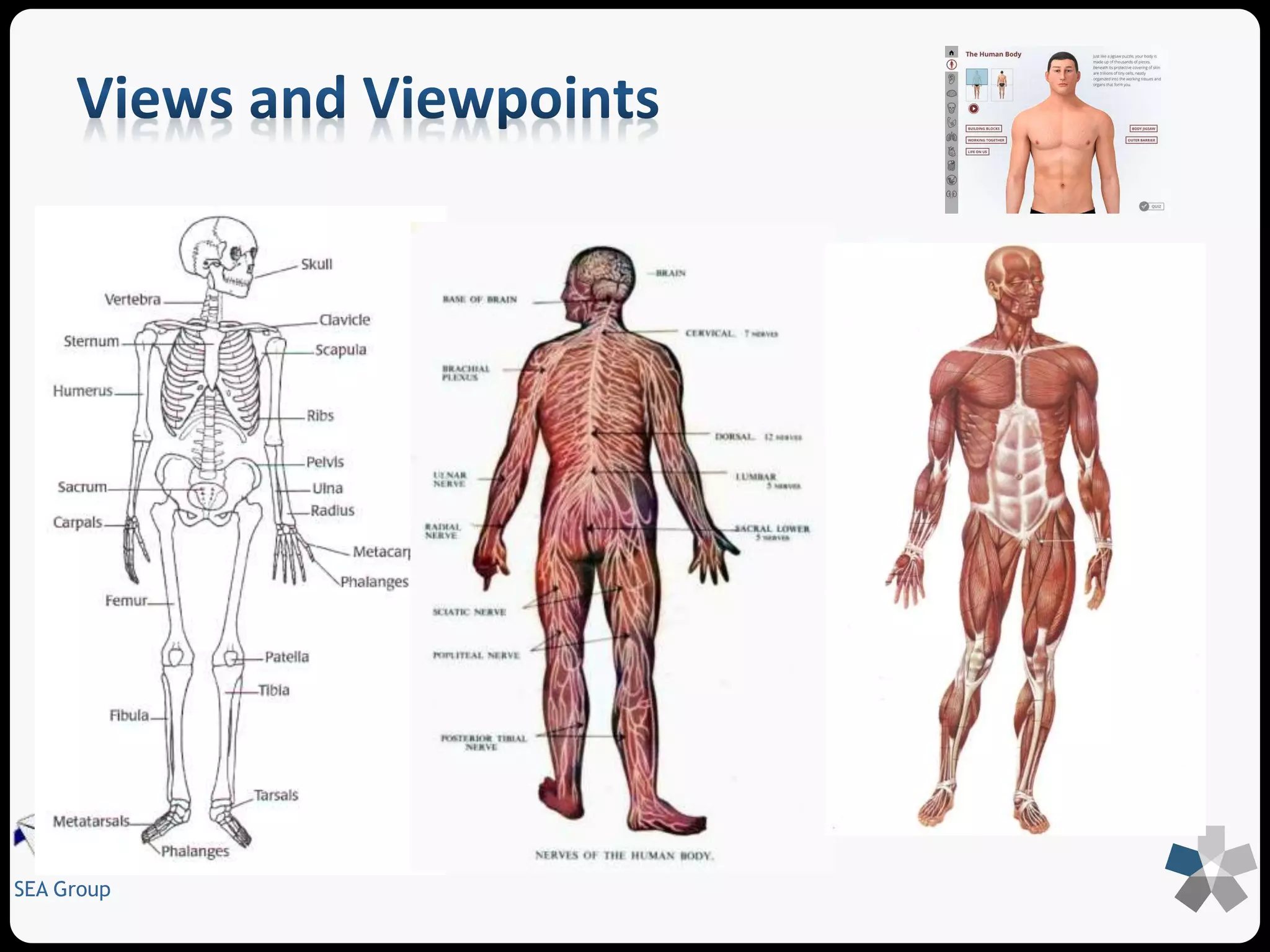
[…] “a viewpoint is a way of looking at a system; a view is what you see” 
“A viewpoint defines the conventions (such as notations, languages and 
types of models) for constructing a certain kind of view” 
[…]”viewpoint refers to the conventions for representing an architecture 
relative to one set of concerns.” 
“A view is the result of applying a viewpoint to a particular system of 
interest” 
[…] “viewpoints as first-class entities of architecture descriptions.” 
view : viewpoint :: program : programming language 
SEA Group 
From the ISO/IEC/IEEE 42010
SEA Group ISO/IEC/IEEE 42010 - International Standard for Systems and Software Engineering – Architectural 
Description, 2011
2) Architecture Frameworks (AFs): 
coordinated set of viewpoints for use within a 
particular stakeholder community or domain of 
application (e.g., GERAM, TOGAF, MODAF); 
SEA Group ISO/IEC/IEEE 42010 - International Standard for Systems and Software Engineering – Architectural 
Description, 2011
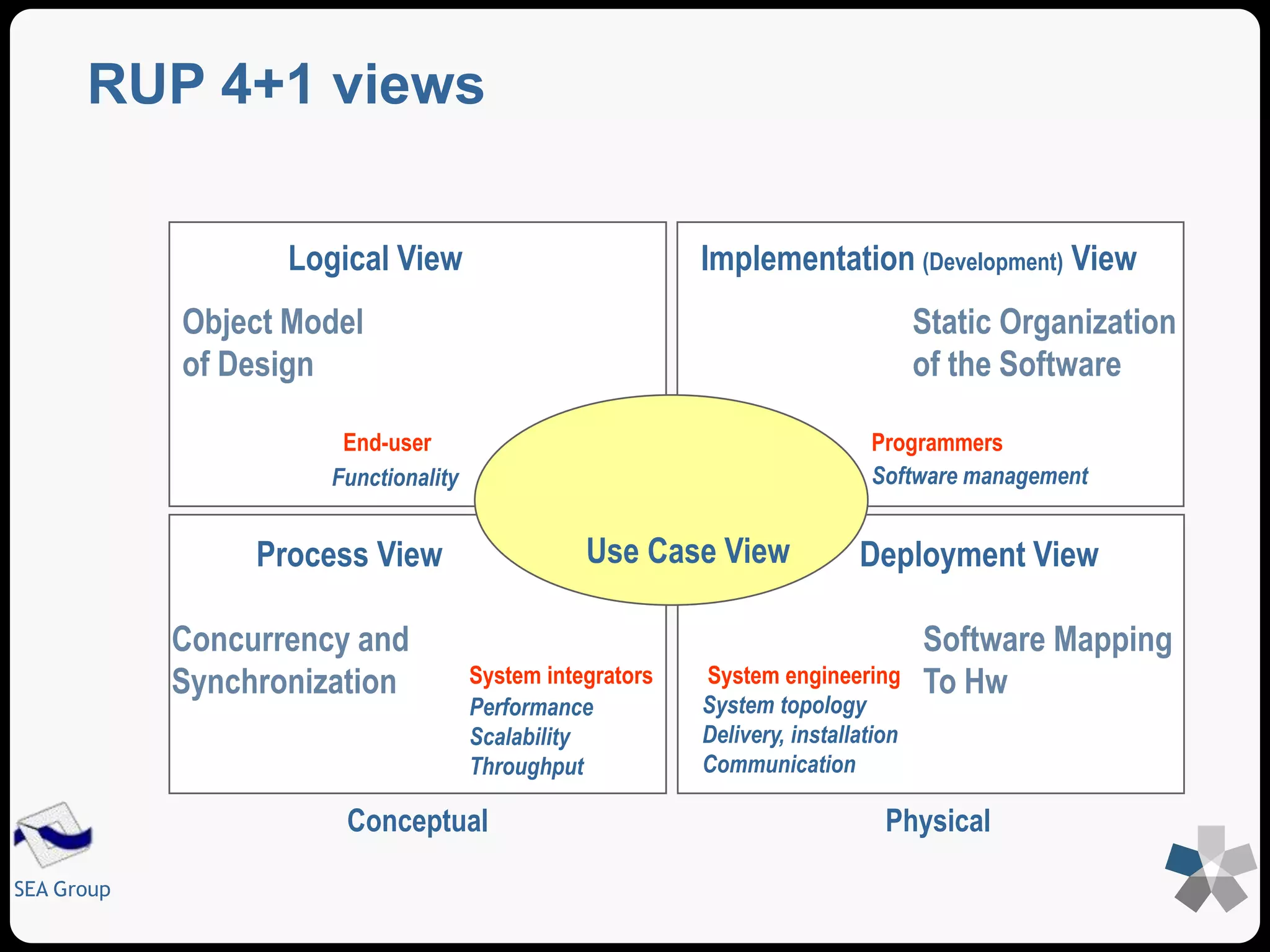
RUP 4+1 views 
SEA Group 
Logical View 
Object Model 
of Design 
End-user 
Functionality 
Implementation (Development) View 
Static Organization 
of the Software 
Programmers 
Software management 
Process View 
Use Case View 
System integrators 
Performance 
Scalability 
Throughput 
Deployment View 
Concurrency and 
Synchronization 
Software Mapping 
System engineering To Hw 
System topology 
Delivery, installation 
Communication 
Conceptual Physical
SEA Group 
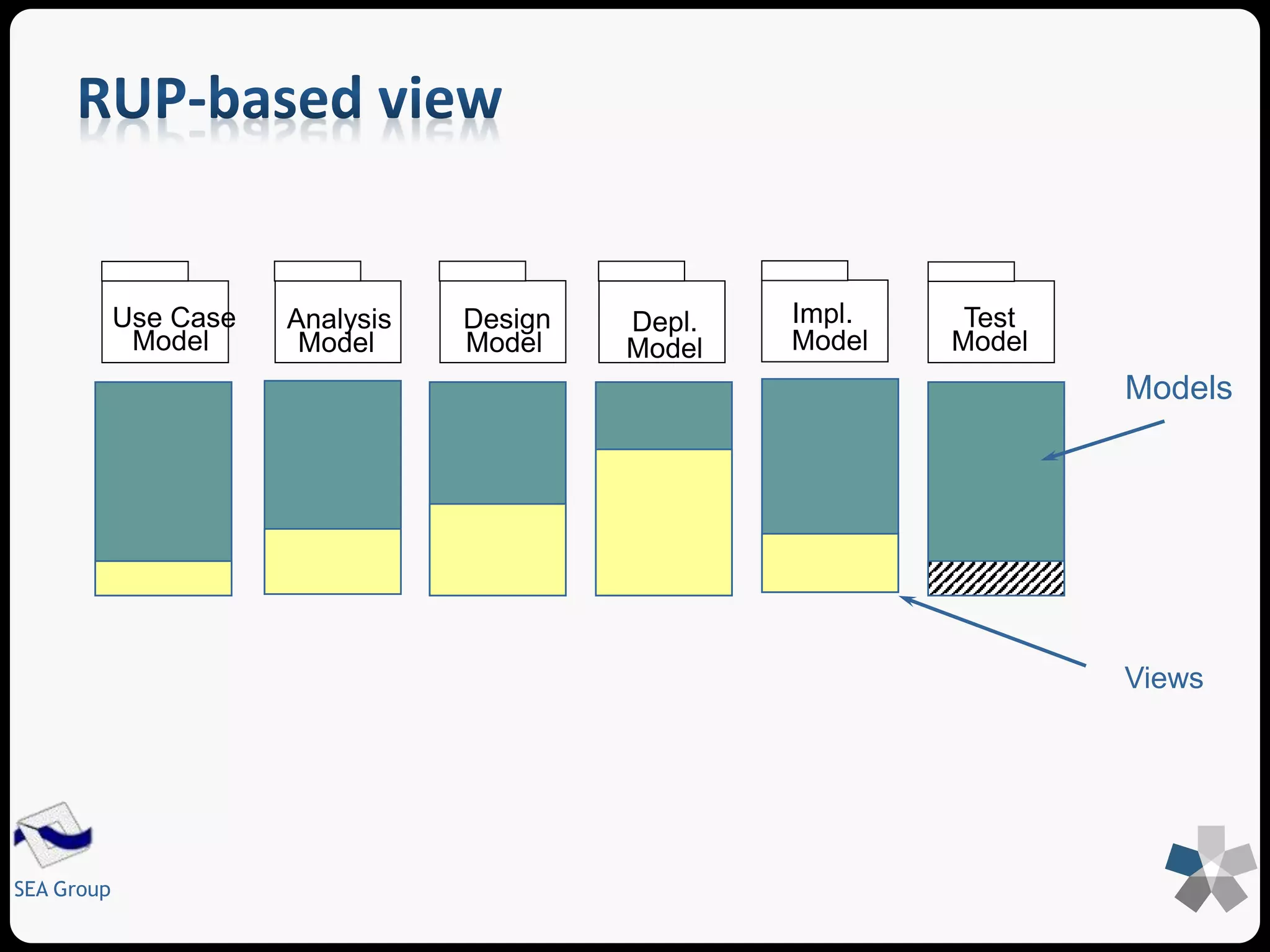
Models 
Views 
Use Case 
Model 
Design 
Model 
Depl. 
Model 
Impl. 
Model 
Test 
Model 
Analysis 
Model
Architectural views: Applied SA [Applied] & UML Process [UMLProcess] 
[Applied] 
Still based on Architectural views… 
SEA Group 
→Conceptual 
→Module 
→Execution 
→Code 
… but more Diagrams for each view 
[UMLProcess] 
[Applied] C. Hofmeister, R. Nord 
and D. Soni. Applied Software 
Architecture. Addison-Wesley. 
1998. 
[UMLProcess] I. Jacobson, G. 
Booch and J. Rumbaugh. 
The Unified Software Development 
Process. Addison Wesley, 
Object Technology Series, 1999.
Using multiple views has become standard practice in 
industry 
SEA Group 
• IEEE Std 1471 (2000) -> … -> ISO/IEC/IEEE 42010 (2011) 
• Based on a survey we conducted with 48 practitioners 
[Survey2012], and about the usage of ALs in industry 
 85% uses multiple views 
[Survey2012] “What Industry needs from Architectural Languages: A Survey”, I. Malavolta, P. Lago, H. 
Muccini, P. Pelliccione, A. Tang (under review)
Views and Viewpoints 
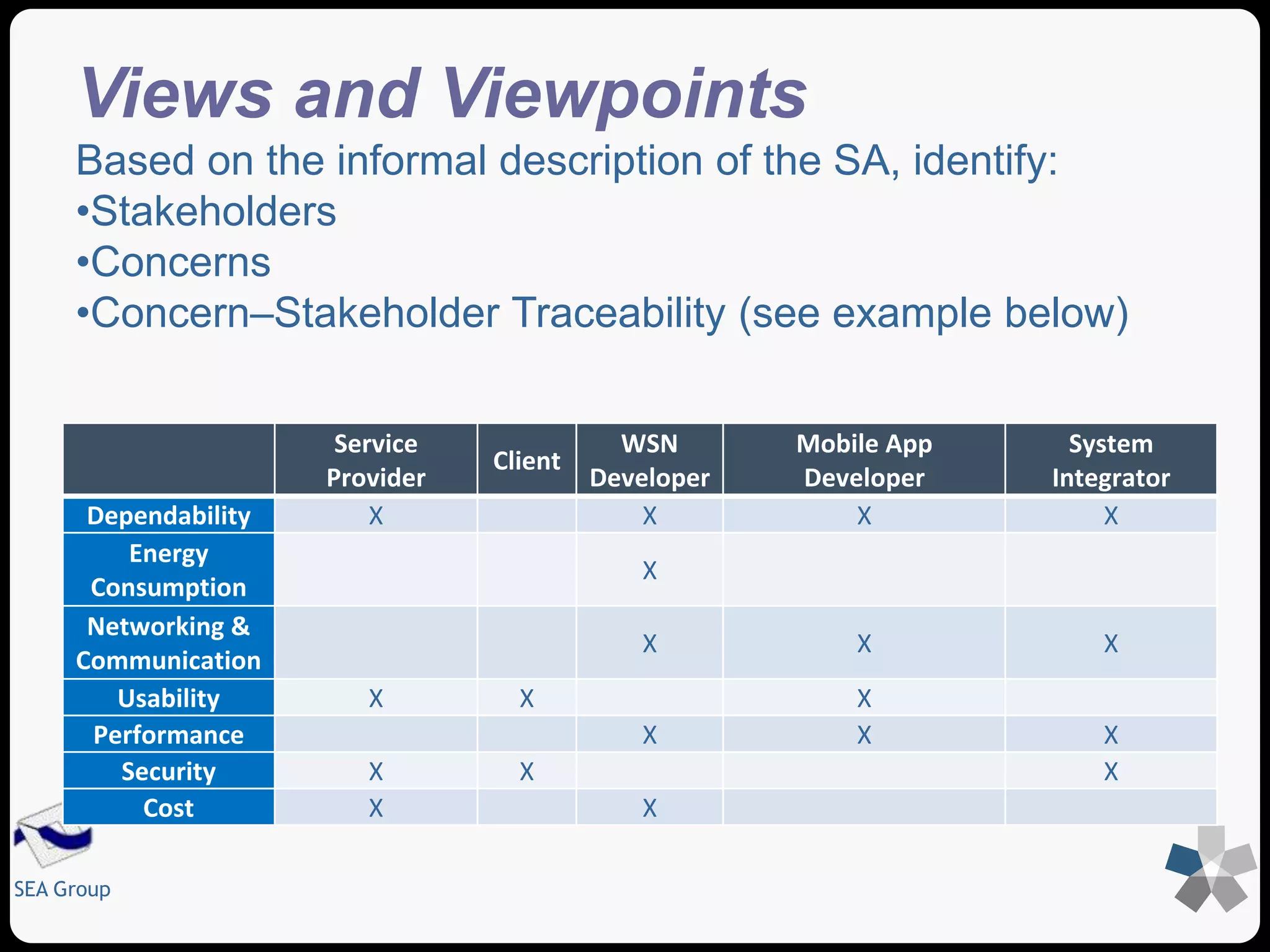
Based on the informal description of the SA, identify: 
•Stakeholders 
•Concerns 
•Concern–Stakeholder Traceability (see example below) 
SEA Group 
Service 
Provider 
Client 
WSN 
Developer 
Mobile App 
Developer 
System 
Integrator 
Dependability X X X X 
Energy 
Consumption 
X 
Networking & 
Communication 
X X X 
Usability X X X 
Performance X X X 
Security X X X 
Cost X X
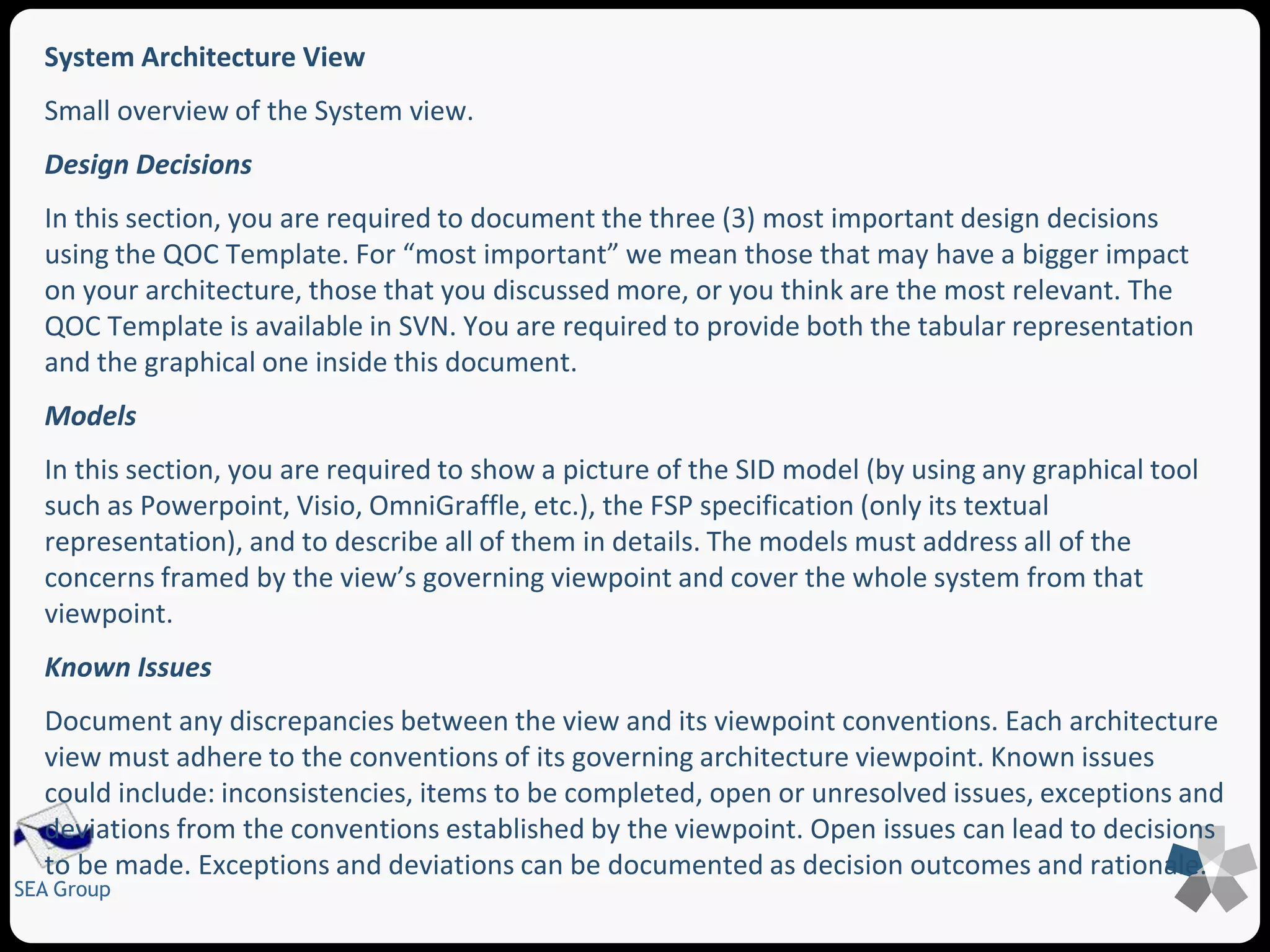
System Architecture View 
Small overview of the System view. 
Design Decisions 
In this section, you are required to document the three (3) most important design decisions 
using the QOC Template. For “most important” we mean those that may have a bigger impact 
on your architecture, those that you discussed more, or you think are the most relevant. The 
QOC Template is available in SVN. You are required to provide both the tabular representation 
and the graphical one inside this document. 
Models 
In this section, you are required to show a picture of the SID model (by using any graphical tool 
such as Powerpoint, Visio, OmniGraffle, etc.), the FSP specification (only its textual 
representation), and to describe all of them in details. The models must address all of the 
concerns framed by the view’s governing viewpoint and cover the whole system from that 
viewpoint. 
Known Issues 
Document any discrepancies between the view and its viewpoint conventions. Each architecture 
view must adhere to the conventions of its governing architecture viewpoint. Known issues 
could include: inconsistencies, items to be completed, open or unresolved issues, exceptions and 
deviations from the conventions established by the viewpoint. Open issues can lead to decisions 
to be made. Exceptions and deviations can be documented as decision outcomes and rationale. 
SEA Group

Software Architecture Views and Viewpoints

  • 1.
    Views and Viewpoints Henry Muccini henry.muccini@univaq.it DISIM Dep.nt of Information Engineering, Computer Science and Mathematics University of L’Aquila, Italy
  • 2.
    The material inthese slides may be freely reproduced and distributed, partially or totally, as far as an explicit reference or acknowledge to the material author is preserved. SEA Group Henry Muccini
  • 3.
    Intro to SA SA Case study SA style ADLs Design Decisions Views/Viewpoints SEA Group Non Functional S.E. Performance modeling Performance analysis UML UML Profiling Lab
  • 4.
    Software Architecture TheSoftware Architecture is the earliest model of the whole software system created along the software lifecycle “Traditional” definition: →A set of components and connectors communicating through interfaces “Recent/Future” understanding: SEA Group →Focus on set of Views and Viewpoints, looking at stakeholders and their concern →A set of architecture design decisions taken to generate the architecture artifact
  • 5.
    SEA Group Architectureas a set of Viewpoints
  • 6.
    Structure Behavior Hw/Sw Real-time … SEA Group
  • 7.
  • 8.
    Two important views SEA Group Structural Spec. Behavioral Spec. User1 AlarmUR AlarmRS (c) Router Server Timer Check1 Nofunc Clock AckSR (c) AckRU1 User2 AlarmUR1 AlarmUR2 Check2 Check AckRU2 3 2 0 1 4 5 -Formal ADLs -UML notations - Posets, pre-post conditions - Process Algebras - Labeled Transition Systems, IO Automata, IOLTS - Statechart, UML state machine
  • 9.
  • 10.
  • 11.
  • 12.
  • 13.
  • 14.
    SEA Group ISO/IEC/IEEE42010 - International Standard for Systems and Software Engineering – Architectural Description, 2011
  • 15.
    Architecture Description isthe practice of expressing architectures (ISO/IEC 42010) “The practices of recording software, system and enterprise architectures so that architectures can be understood, documented, analysed and realized.” “Architecture descriptions are created by architects and used by architects and other stakeholders throughout all stages of a system’s life cycle, from development through operation and maintenance.” SEA Group
  • 16.
    SEA Group 1)Architecture Viewpoints: define the contents of each architecture view; 2) Architecture Frameworks (AFs): coordinated set of viewpoints for use within a particular stakeholder community or domain of application (e.g., GERAM, TOGAF, MODAF); 3) Architecture Description Languages (ADLs): any mode of expression used in an architecture description. ADL provides model kinds selected to frame one or more concerns.
  • 17.
    SEA Group ISO/IEC/IEEE42010 - International Standard for Systems and Software Engineering – Architectural Description, 2011
  • 18.
    Stakeholders concerns canvary tremendously (and change over time), depending on: • the nature of the system • project-specific constraints • organizational constraints • the application domain • … SEA Group
  • 19.
    Software Architect SoftwareDeveloper Financial manager Business manager SEA Group … …
  • 20.
  • 21.
    SEA Group ISO/IEC/IEEE42010 - International Standard for Systems and Software Engineering – Architectural Description, 2011
  • 22.
    […] “a viewpointis a way of looking at a system; a view is what you see” “A viewpoint defines the conventions (such as notations, languages and types of models) for constructing a certain kind of view” […]”viewpoint refers to the conventions for representing an architecture relative to one set of concerns.” “A view is the result of applying a viewpoint to a particular system of interest” […] “viewpoints as first-class entities of architecture descriptions.” view : viewpoint :: program : programming language SEA Group From the ISO/IEC/IEEE 42010
  • 23.
    SEA Group ISO/IEC/IEEE42010 - International Standard for Systems and Software Engineering – Architectural Description, 2011
  • 24.
    2) Architecture Frameworks(AFs): coordinated set of viewpoints for use within a particular stakeholder community or domain of application (e.g., GERAM, TOGAF, MODAF); SEA Group ISO/IEC/IEEE 42010 - International Standard for Systems and Software Engineering – Architectural Description, 2011
  • 25.
    RUP 4+1 views SEA Group Logical View Object Model of Design End-user Functionality Implementation (Development) View Static Organization of the Software Programmers Software management Process View Use Case View System integrators Performance Scalability Throughput Deployment View Concurrency and Synchronization Software Mapping System engineering To Hw System topology Delivery, installation Communication Conceptual Physical
  • 26.
    SEA Group Models Views Use Case Model Design Model Depl. Model Impl. Model Test Model Analysis Model
  • 27.
    Architectural views: AppliedSA [Applied] & UML Process [UMLProcess] [Applied] Still based on Architectural views… SEA Group →Conceptual →Module →Execution →Code … but more Diagrams for each view [UMLProcess] [Applied] C. Hofmeister, R. Nord and D. Soni. Applied Software Architecture. Addison-Wesley. 1998. [UMLProcess] I. Jacobson, G. Booch and J. Rumbaugh. The Unified Software Development Process. Addison Wesley, Object Technology Series, 1999.
  • 28.
    Using multiple viewshas become standard practice in industry SEA Group • IEEE Std 1471 (2000) -> … -> ISO/IEC/IEEE 42010 (2011) • Based on a survey we conducted with 48 practitioners [Survey2012], and about the usage of ALs in industry  85% uses multiple views [Survey2012] “What Industry needs from Architectural Languages: A Survey”, I. Malavolta, P. Lago, H. Muccini, P. Pelliccione, A. Tang (under review)
  • 29.
    Views and Viewpoints Based on the informal description of the SA, identify: •Stakeholders •Concerns •Concern–Stakeholder Traceability (see example below) SEA Group Service Provider Client WSN Developer Mobile App Developer System Integrator Dependability X X X X Energy Consumption X Networking & Communication X X X Usability X X X Performance X X X Security X X X Cost X X
  • 30.
    System Architecture View Small overview of the System view. Design Decisions In this section, you are required to document the three (3) most important design decisions using the QOC Template. For “most important” we mean those that may have a bigger impact on your architecture, those that you discussed more, or you think are the most relevant. The QOC Template is available in SVN. You are required to provide both the tabular representation and the graphical one inside this document. Models In this section, you are required to show a picture of the SID model (by using any graphical tool such as Powerpoint, Visio, OmniGraffle, etc.), the FSP specification (only its textual representation), and to describe all of them in details. The models must address all of the concerns framed by the view’s governing viewpoint and cover the whole system from that viewpoint. Known Issues Document any discrepancies between the view and its viewpoint conventions. Each architecture view must adhere to the conventions of its governing architecture viewpoint. Known issues could include: inconsistencies, items to be completed, open or unresolved issues, exceptions and deviations from the conventions established by the viewpoint. Open issues can lead to decisions to be made. Exceptions and deviations can be documented as decision outcomes and rationale. SEA Group