



Climate architypo
VERNACULAR
• Vernaculus is a term used to identify the language of the origin. The
word coming from the latin VERNUS, an asian (sanskrit) term, used by
romans to identify a slave and, in particular, the one who, parents
from abroad, has born in the master’s house.
So in latin time, they used to speak about vernacula vocabula as well
as festivitas, to identify slaves’ homeland traditions.
VERNACULAR ARCHITECTURE
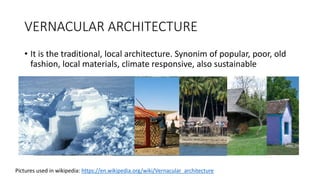
• It is the traditional, local architecture. Synonim of popular, poor, old
fashion, local materials, climate responsive, also sustainable
Pictures used in wikipedia: https://en.wikipedia.org/wiki/Vernacular_architecture
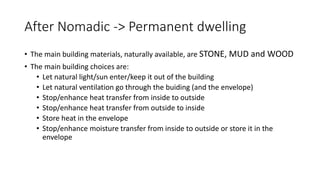
After Nomadic -> Permanent dwelling
• The main building materials, naturally available, are STONE, MUD and WOOD
• The main building choices are:
• Let natural light/sun enter/keep it out of the building
• Let natural ventilation go through the buiding (and the envelope)
• Stop/enhance heat transfer from inside to outside
• Stop/enhance heat transfer from outside to inside
• Store heat in the envelope
• Stop/enhance moisture transfer from inside to outside or store it in the
envelope
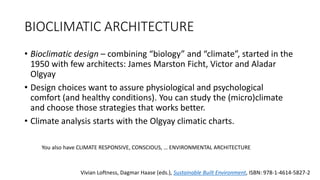
BIOCLIMATIC ARCHITECTURE
• Bioclimatic design – combining “biology” and “climate”, started in the
1950 with few architects: James Marston Ficht, Victor and Aladar
Olgyay
• Design choices want to assure physiological and psychological
comfort (and healthy conditions). You can study the (micro)climate
and choose those strategies that works better.
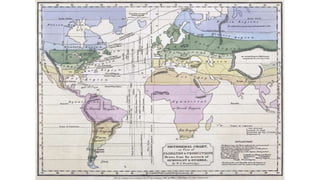
• Climate analysis starts with the Olgyay climatic charts.
Vivian Loftness, Dagmar Haase (eds.), Sustainable Built Environment, ISBN: 978-1-4614-5827-2
You also have CLIMATE RESPONSIVE, CONSCIOUS, … ENVIRONMENTAL ARCHITECTURE
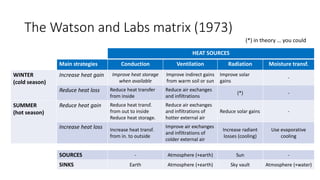
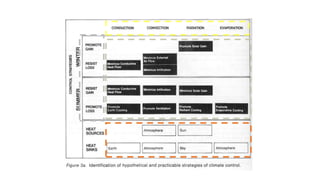
The Watson and Labs matrix (1973)
HEAT SOURCES
Main strategies Conduction Ventilation Radiation Moisture transf.
WINTER
(cold season)
Increase heat gain Improve heat storage
when available
Improve indirect gains
from warm soil or sun
Improve solar
gains
-
Reduce heat loss Reduce heat transfer
from inside
Reduce air exchanges
and infiltrations
(*) -
SUMMER
(hot season)
Reduce heat gain Reduce heat transf.
from out to inside
Reduce heat storage.
Reduce air exchanges
and infiltrations of
hotter external air
Reduce solar gains -
Increase heat loss Increase heat transf.
from in. to outside
Improve air exchanges
and infiltrations of
colder external air
Increase radiant
losses (cooling)
Use evaporative
cooling
SOURCES - Atmosphere (+earth) Sun -
SINKS Earth Atmosphere (+earth) Sky vault Atmosphere (+water)
(*) in theory … you could
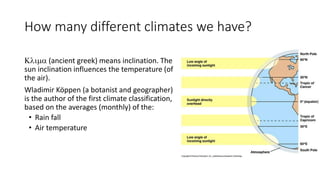
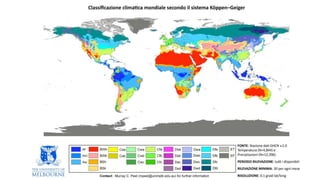
How many different climates we have?
Klima (ancient greek) means inclination. The
sun inclination influences the temperature (of
the air).
Wladimir Köppen (a botanist and geographer)
is the author of the first climate classification,
based on the averages (monthly) of the:
• Rain fall
• Air temperature
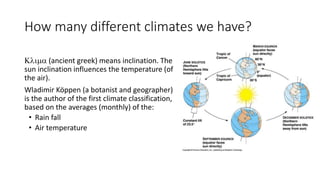
How many different climates we have?
Klima (ancient greek) means inclination. The
sun inclination influences the temperature (of
the air).
Wladimir Köppen (a botanist and geographer)
is the author of the first climate classification,
based on the averages (monthly) of the:
• Rain fall
• Air temperature
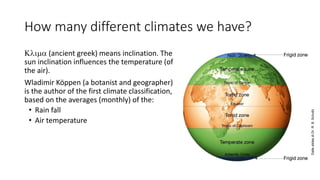
How many different climates we have?
Klima (ancient greek) means inclination. The
sun inclination influences the temperature (of
the air).
Wladimir Köppen (a botanist and geographer)
is the author of the first climate classification,
based on the averages (monthly) of the:
• Rain fall
• Air temperature
DalleslidesdiDr.R.B.Schultz
PASSIVE + SOLAR ARCHITECTURE
• Passive means non-active, i.e. without plants using non renewable
energy (we may have solar plants, using few NRenergy to work and to
exploit solar sources) … the main renewable source being the SUN.
• End of 80ies the PASSIVHAUS movement become an institution
supporting a building signature and certification
Mazria (1979) The passive solar energy book
Bo Adamson, Sweden
+Wolfgang Feist, Germany
GREEN and SUSTAINABLE ARCHITECTURE
• Climate change perception (not only energy security or saving)
• More complex approach: life cycle impact (embodied energy, disposal
after end of life …)
14
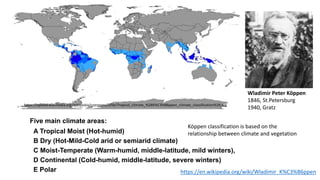
Wladimir Peter Köppen
1846, St.Petersburg
1940, Gratz
https://en.wikipedia.org/wiki/Wladimir_K%C3%B6ppen
Köppen classification is based on the
relationship between climate and vegetation
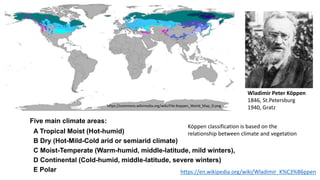
Five main climate areas:
A Tropical Moist (Hot-humid)
B Dry (Hot-Mild-Cold arid or semiarid climate)
C Moist-Temperate (Warm-humid, middle-latitude, mild winters),
D Continental (Cold-humid, middle-latitude, severe winters)
E Polar
https://upload.wikimedia.org/wikipedia/commons/0/0e/Tropical_climate_%28K%C3%B6ppen_climate_classification%29.svg
15
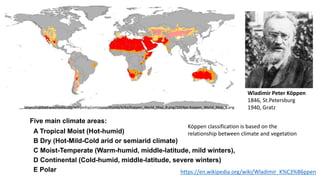
Wladimir Peter Köppen
1846, St.Petersburg
1940, Gratz
https://en.wikipedia.org/wiki/Wladimir_K%C3%B6ppen
Köppen classification is based on the
relationship between climate and vegetation
Five main climate areas:
A Tropical Moist (Hot-humid)
B Dry (Hot-Mild-Cold arid or semiarid climate)
C Moist-Temperate (Warm-humid, middle-latitude, mild winters),
D Continental (Cold-humid, middle-latitude, severe winters)
E Polar
https://upload.wikimedia.org/wikipedia/commons/thumb/4/4a/Koppen_World_Map_B.png/1024px-Koppen_World_Map_B.png
16
Wladimir Peter Köppen
1846, St.Petersburg
1940, Gratz
https://en.wikipedia.org/wiki/Wladimir_K%C3%B6ppen
Köppen classification is based on the
relationship between climate and vegetation
Five main climate areas:
A Tropical Moist (Hot-humid)
B Dry (Hot-Mild-Cold arid or semiarid climate)
C Moist-Temperate (Warm-humid, middle-latitude, mild winters),
D Continental (Cold-humid, middle-latitude, severe winters)
E Polar
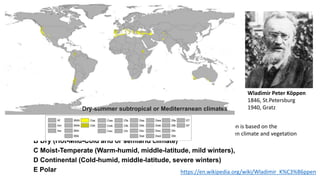
Dry-summer subtropical or Mediterranean climates
17
Wladimir Peter Köppen
1846, St.Petersburg
1940, Gratz
https://en.wikipedia.org/wiki/Wladimir_K%C3%B6ppen
Köppen classification is based on the
relationship between climate and vegetation
Five main climate areas:
A Tropical Moist (Hot-humid)
B Dry (Hot-Mild-Cold arid or semiarid climate)
C Moist-Temperate (Warm-humid, middle-latitude, mild winters),
D Continental (Cold-humid, middle-latitude, severe winters)
E Polar
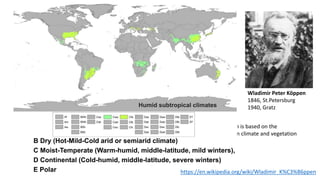
Humid subtropical climates
18
Wladimir Peter Köppen
1846, St.Petersburg
1940, Gratz
https://en.wikipedia.org/wiki/Wladimir_K%C3%B6ppen
Köppen classification is based on the
relationship between climate and vegetation
Five main climate areas:
A Tropical Moist (Hot-humid)
B Dry (Hot-Mild-Cold arid or semiarid climate)
C Moist-Temperate (Warm-humid, middle-latitude, mild winters),
D Continental (Cold-humid, middle-latitude, severe winters)
E Polar
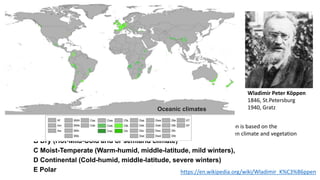
Oceanic climates
19
Wladimir Peter Köppen
1846, St.Petersburg
1940, Gratz
https://en.wikipedia.org/wiki/Wladimir_K%C3%B6ppen
Köppen classification is based on the
relationship between climate and vegetation
Five main climate areas:
A Tropical Moist (Hot-humid)
B Dry (Hot-Mild-Cold arid or semiarid climate)
C Moist-Temperate (Warm-humid, middle-latitude, mild winters),
D Continental (Cold-humid, middle-latitude, severe winters)
E Polar
https://commons.wikimedia.org/wiki/File:Koppen_World_Map_D.png
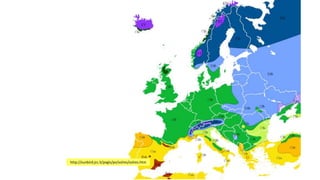
L’europa
http://sunbird.jrc.it/pvgis/pv/solres/solres.htm
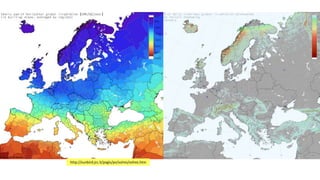
L’europa
http://sunbird.jrc.it/pvgis/pv/solres/solres.htm
Design/operation choices
• Urban form/relation between buildings
• Orientation
• Form
• Air permeability
• Solar openings
• Colours
• Materials
• Use of the building
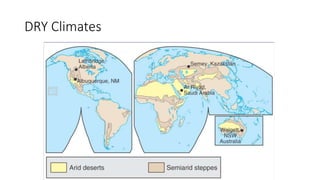
DRY ClimatesDry, Arid, and Semiarid Climates
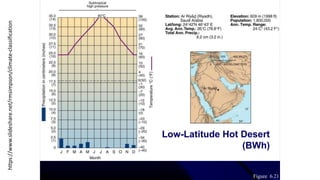
https://www.slideshare.net/rmsimpson/climate-classification
Low-Latitude Hot Desert
(BWh)
Figure 6.21
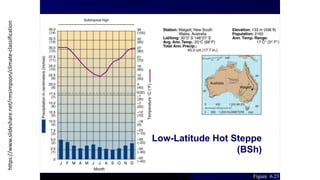
https://www.slideshare.net/rmsimpson/climate-classification
Low-Latitude Hot Steppe
(BSh)
Figure 6.23
https://www.slideshare.net/rmsimpson/climate-classification
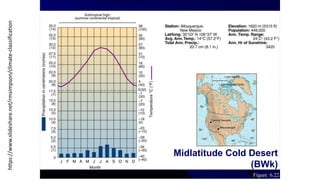
Midlatitude Cold Desert
(BWk)
Figure 6.22
https://www.slideshare.net/rmsimpson/climate-classification
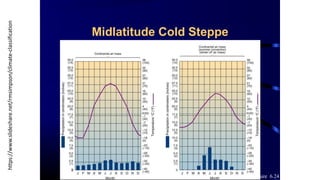
Midlatitude Cold Steppe
Figure 6.24
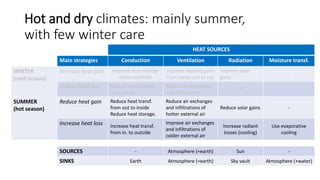
Hot and dry climates: mainly summer,
with few winter care
HEAT SOURCES
Main strategies Conduction Ventilation Radiation Moisture transf.
WINTER
(cold season)
Increase heat gain Improve heat storage
when available
Improve indirect gains
from warm soil or sun
Improve solar
gains
-
Reduce heat loss Reduce heat transfer
from inside
Reduce air exchanges
and infiltrations
(*) -
SUMMER
(hot season)
Reduce heat gain Reduce heat transf.
from out to inside
Reduce heat storage.
Reduce air exchanges
and infiltrations of
hotter external air
Reduce solar gains -
Increase heat loss Increase heat transf.
from in. to outside
Improve air exchanges
and infiltrations of
colder external air
Increase radiant
losses (cooling)
Use evaporative
cooling
SOURCES - Atmosphere (+earth) Sun -
SINKS Earth Atmosphere (+earth) Sky vault Atmosphere (+water)
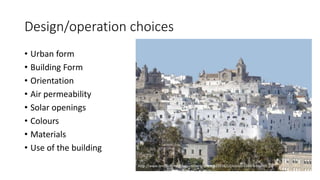
Design/operation choices
• Urban form
• Building Form
• Orientation
• Air permeability
• Solar openings
• Colours
• Materials
• Use of the building
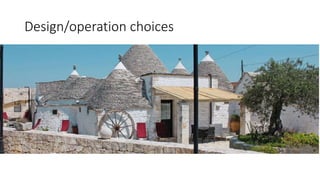
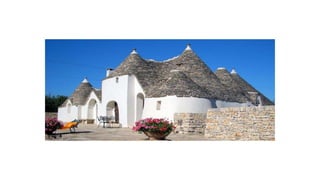
http://www.brindisitime.it/wp-content/uploads/2016/12/ostuni-Centro-Storico.jpg
Design/operation choices
• Urban form
• Building Form
• Orientation
• Air permeability
• Solar openings
• Colours
• Materials
• Use of the building
Design/operation choices
• Urban form: Compact, with vegetation (if possible)
• Building Form: Compact (if w/low internal gains)
• Orientation: Avoid west (and east), consider winds
• Air permeability: modifiable
• Solar openings: small and with mobile shadows
• Colours: Clear/white
• Materials: depends on the temperature cycle (annual and daily)
• Use of the building: close when too warm, open when cooler
Design/operation choices
• Roof: Pitched if double, flat but as clear as possible or shadowed or
green
• Wall: thick high conductivity to reduce the temperature variability
• Windows: Little, size to have enough winter solar gains and to
minimize summers. Openable, with movable shade. If possible south
facing, other orientations to catch wind during night and days.
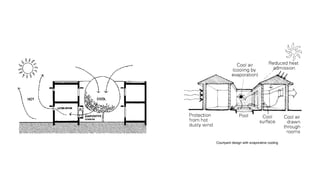
• Water: If any water, courtyard gardens and patio fountains
(evapotranspiration), street trees, evaporation sprays …
• Balconies: may work to give shade on south facing walls
• Internal walls and doors: if acoustical privacy is not so important, with
openings to let transverse ventilation take actions
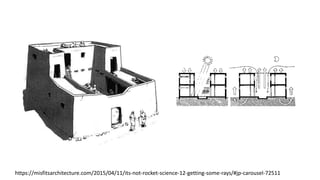
https://misfitsarchitecture.com/2015/04/11/its-not-rocket-science-12-getting-some-rays/#jp-carousel-72511
• The
a co
• Inter
cool
• Mo
exte
Cour
o u td o o r p la n n in g
Outdoor spaces:
• Asmost day-to-day activitiestake place outside, it is
important to treat the external spacesjust ascarefully as
the indoors.
• Adjacent buildings, pavements, roadsheat up quickly and
cause a glare onto the building during the day and
at night, they radiate the heat stored during the day.
• One way to avoid thisisto place wallsprotecting external
spaces, to keep out dust and winds.
• Also, landscaping like trees, plantsand water in enclosed
spaceswill cool the air by evaporation.
• But the best solution iscourtyards. In these a pool of night
air isretained, asthisisheavier than surrounding warmair
• A small courtyard isexcellent asa thermal regulator.
Courtyard design with evaporative cooling
e courtyard isprovided with water and plants, it actsas
cooling source.
ernal courtyardsprovidescrossventilation& natural
urtyard
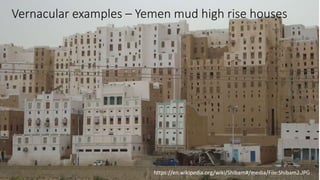
Vernacular examples – Yemen mud high rise houses
https://en.wikipedia.org/wiki/Shibam#/media/File:Shibam2.JPG
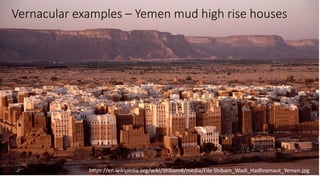
Vernacular examples – Yemen mud high rise houses
https://en.wikipedia.org/wiki/Shibam#/media/File:Shibam_Wadi_Hadhramaut_Yemen.jpg
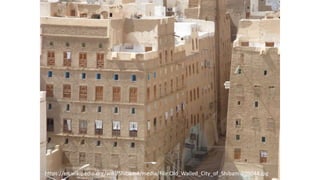
https://en.wikipedia.org/wiki/Shibam#/media/File:Old_Walled_City_of_Shibam-109044.jpg
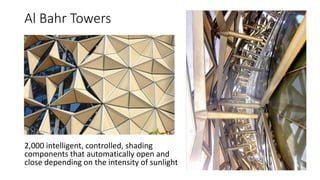
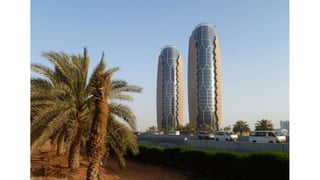
Al Bahr Towers
2,000 intelligent, controlled, shading
components that automatically open and
close depending on the intensity of sunlight
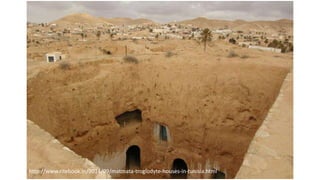
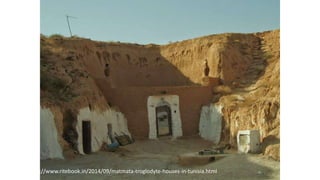
http://www.ritebook.in/2014/09/matmata-troglodyte-houses-in-tunisia.html
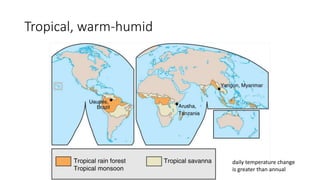
Tropical, warm-humidTropical Climates
daily temperature change
is greater than annual
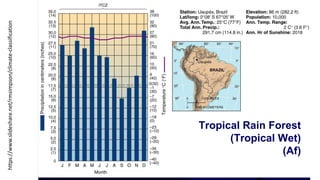
https://www.slideshare.net/rmsimpson/climate-classification
Tropical Rain Forest
(Tropical Wet)
(Af)
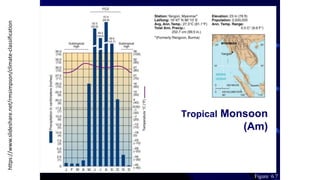
https://www.slideshare.net/rmsimpson/climate-classification
Tropical Monsoon
(Am)
Figure 6.7
https://www.slideshare.net/rmsimpson/climate-classification
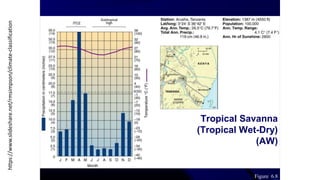
Figure 6.8
Tropical Savanna
(Tropical Wet-Dry)
(AW)
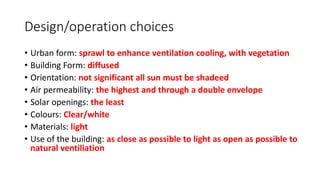
Design/operation choices
• Urban form: sprawl to enhance ventilation cooling, with vegetation
• Building Form: diffused
• Orientation: not significant all sun must be shadeed
• Air permeability: the highest and through a double envelope
• Solar openings: the least
• Colours: Clear/white
• Materials: light
• Use of the building: as close as possible to light as open as possible to
natural ventiliation
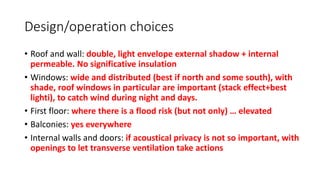
Design/operation choices
• Roof and wall: double, light envelope external shadow + internal
permeable. No significative insulation
• Windows: wide and distributed (best if north and some south), with
shade, roof windows in particular are important (stack effect+best
lighti), to catch wind during night and days.
• First floor: where there is a flood risk (but not only) … elevated
• Balconies: yes everywhere
• Internal walls and doors: if acoustical privacy is not so important, with
openings to let transverse ventilation take actions
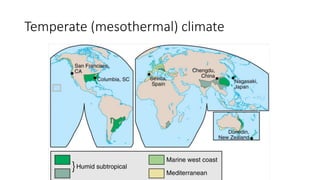
Temperate (mesothermal) climateMesothermal Climates
https://www.slideshare.net/rmsimpson/climate-classification
Figure 6.9
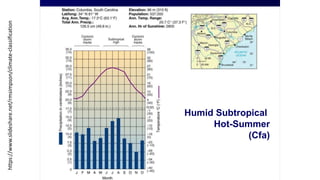
Humid Subtropical
Hot-Summer
(Cfa)
https://www.slideshare.net/rmsimpson/climate-classification
Figure 6.11
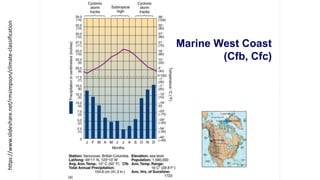
Marine West Coast
(Cfb, Cfc)
https://www.slideshare.net/rmsimpson/climate-classification
Figure 6.12
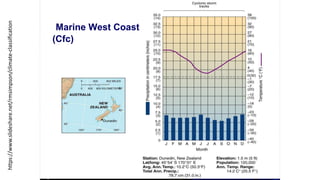
Marine West Coast
(Cfc)
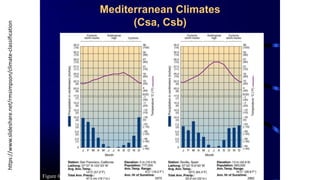
https://www.slideshare.net/rmsimpson/climate-classification Mediterranean Climates
(Csa, Csb)
Figure 6.14
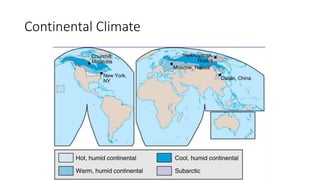
Continental Climate
Microthermal Climates
https://www.slideshare.net/rmsimpson/climate-classification
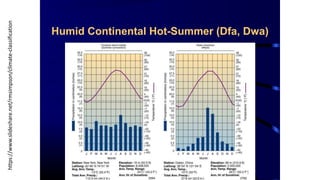
Humid Continental Hot-Summer (Dfa, Dwa)
https://www.slideshare.net/rmsimpson/climate-classification
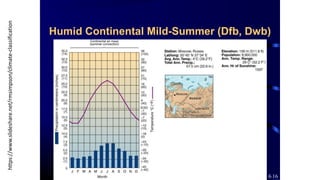
Humid Continental Mild-Summer (Dfb, Dwb)
Figure 6.16
https://www.slideshare.net/rmsimpson/climate-classification
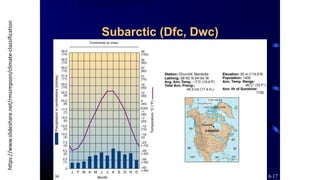
Subarctic (Dfc, Dwc)
Figure 6.17
https://www.slideshare.net/rmsimpson/climate-classification
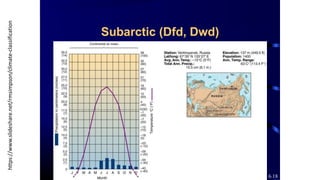
Subarctic (Dfd, Dwd)
Figure 6.18
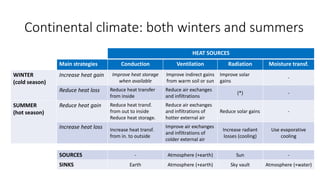
Continental climate: both winters and summers
HEAT SOURCES
Main strategies Conduction Ventilation Radiation Moisture transf.
WINTER
(cold season)
Increase heat gain Improve heat storage
when available
Improve indirect gains
from warm soil or sun
Improve solar
gains
-
Reduce heat loss Reduce heat transfer
from inside
Reduce air exchanges
and infiltrations
(*) -
SUMMER
(hot season)
Reduce heat gain Reduce heat transf.
from out to inside
Reduce heat storage.
Reduce air exchanges
and infiltrations of
hotter external air
Reduce solar gains -
Increase heat loss Increase heat transf.
from in. to outside
Improve air exchanges
and infiltrations of
colder external air
Increase radiant
losses (cooling)
Use evaporative
cooling
SOURCES - Atmosphere (+earth) Sun -
SINKS Earth Atmosphere (+earth) Sky vault Atmosphere (+water)
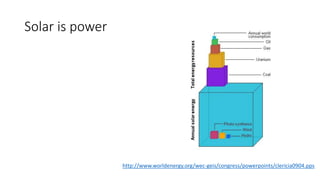
Solar is power
http://www.worldenergy.org/wec-geis/congress/powerpoints/clericia0904.pps
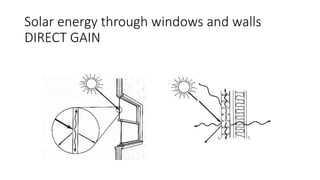
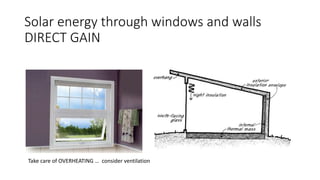
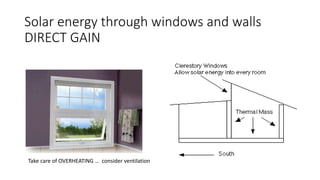
Solar energy through windows and walls
DIRECT GAIN
Solar energy through windows and walls
DIRECT GAIN
Take care of OVERHEATING … consider ventilation
Solar energy through windows and walls
DIRECT GAIN
Take care of OVERHEATING … consider ventilation
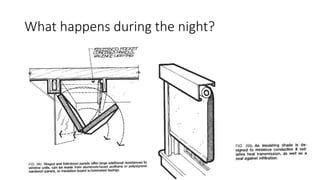
What happens during the night?
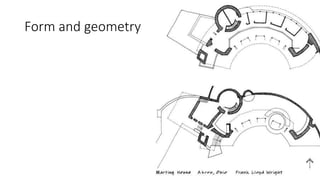
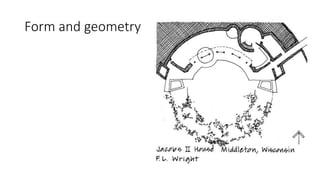
Form and geometry
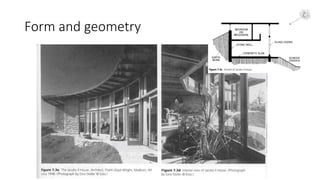
Form and geometry
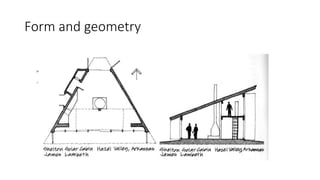
Form and geometry
Form and geometry
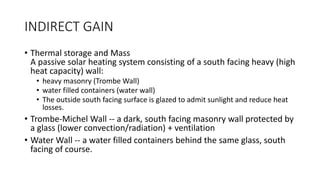
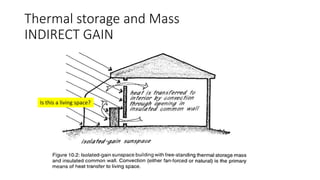
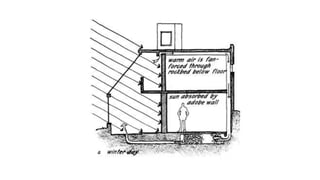
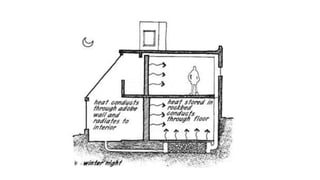
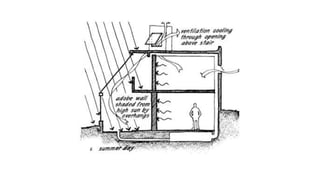
INDIRECT GAIN
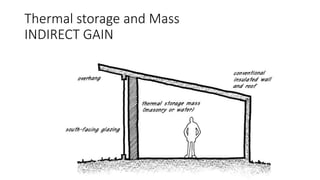
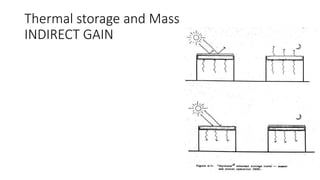
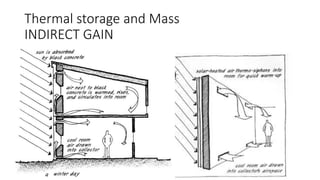
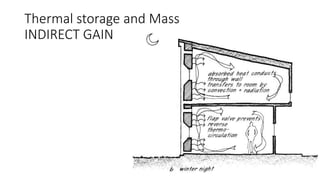
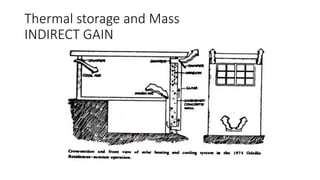
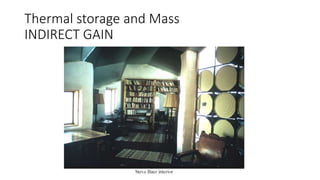
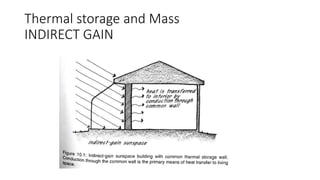
• Thermal storage and Mass
A passive solar heating system consisting of a south facing heavy (high
heat capacity) wall:
• heavy masonry (Trombe Wall)
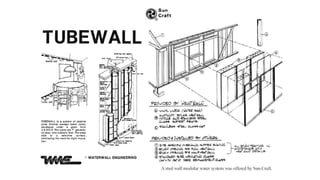
• water filled containers (water wall)
• The outside south facing surface is glazed to admit sunlight and reduce heat
losses.
• Trombe-Michel Wall -- a dark, south facing masonry wall protected by
a glass (lower convection/radiation) + ventilation
• Water Wall -- a water filled containers behind the same glass, south
facing of course.
Thermal storage and Mass
INDIRECT GAIN
Thermal storage and Mass
INDIRECT GAIN
Thermal storage and Mass
INDIRECT GAIN
Thermal storage and Mass
INDIRECT GAIN
Thermal storage and Mass
INDIRECT GAIN
Thermal storage and Mass
INDIRECT GAIN
Thermal storage and Mass
INDIRECT GAIN
Thermal storage and Mass
INDIRECT GAIN
Is this a living space?
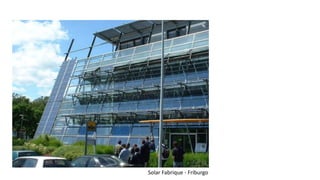
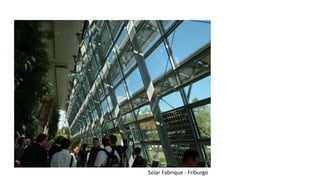
Solar Fabrique - Friburgo
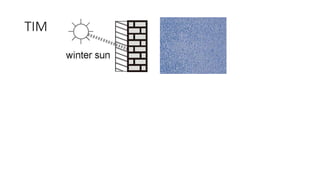
TIM
PCM Phase Change Materials
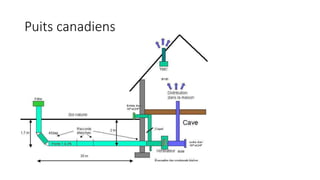
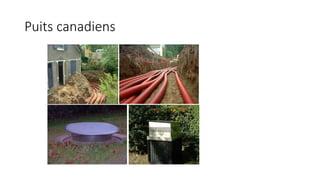
Puits canadiens
Puits canadiens
Some wiki-pages and other open (not always) resources:
• https://en.wikipedia.org/wiki/K%C3%B6ppen_climate_classification
• https://en.wikipedia.org/wiki/List_of_countries_by_average_yearly_temperature
• https://www.slideshare.net/rmsimpson/climate-classification
• Vivian Loftness, Dagmar Haase (eds), Sustainable Built Environments, Springer, 2013
• http://www.solaripedia.com/
• National design handbook prototype on passive solar heating and natural cooling of
buildings, UN Centre for Human Settlements, Nairobi, 1990, available here
• Paul Gut, Dieter Ackerknecht, Climate responsive building. Appropriate Building
Construction in Tropical and Subtropical Regions, SKAT 1993, available here
• Hassan Fathy, Natural Energy and Vernacular Architecture: Principles and Examples
with Reference to Hot Arid Climates (1986), available here.
Archi types

Archi types

  • 1.
  • 2.
    VERNACULAR • Vernaculus isa term used to identify the language of the origin. The word coming from the latin VERNUS, an asian (sanskrit) term, used by romans to identify a slave and, in particular, the one who, parents from abroad, has born in the master’s house. So in latin time, they used to speak about vernacula vocabula as well as festivitas, to identify slaves’ homeland traditions.
  • 3.
    VERNACULAR ARCHITECTURE • Itis the traditional, local architecture. Synonim of popular, poor, old fashion, local materials, climate responsive, also sustainable Pictures used in wikipedia: https://en.wikipedia.org/wiki/Vernacular_architecture
  • 4.
    After Nomadic ->Permanent dwelling • The main building materials, naturally available, are STONE, MUD and WOOD • The main building choices are: • Let natural light/sun enter/keep it out of the building • Let natural ventilation go through the buiding (and the envelope) • Stop/enhance heat transfer from inside to outside • Stop/enhance heat transfer from outside to inside • Store heat in the envelope • Stop/enhance moisture transfer from inside to outside or store it in the envelope
  • 5.
    BIOCLIMATIC ARCHITECTURE • Bioclimaticdesign – combining “biology” and “climate”, started in the 1950 with few architects: James Marston Ficht, Victor and Aladar Olgyay • Design choices want to assure physiological and psychological comfort (and healthy conditions). You can study the (micro)climate and choose those strategies that works better. • Climate analysis starts with the Olgyay climatic charts. Vivian Loftness, Dagmar Haase (eds.), Sustainable Built Environment, ISBN: 978-1-4614-5827-2 You also have CLIMATE RESPONSIVE, CONSCIOUS, … ENVIRONMENTAL ARCHITECTURE
  • 6.
    The Watson andLabs matrix (1973) HEAT SOURCES Main strategies Conduction Ventilation Radiation Moisture transf. WINTER (cold season) Increase heat gain Improve heat storage when available Improve indirect gains from warm soil or sun Improve solar gains - Reduce heat loss Reduce heat transfer from inside Reduce air exchanges and infiltrations (*) - SUMMER (hot season) Reduce heat gain Reduce heat transf. from out to inside Reduce heat storage. Reduce air exchanges and infiltrations of hotter external air Reduce solar gains - Increase heat loss Increase heat transf. from in. to outside Improve air exchanges and infiltrations of colder external air Increase radiant losses (cooling) Use evaporative cooling SOURCES - Atmosphere (+earth) Sun - SINKS Earth Atmosphere (+earth) Sky vault Atmosphere (+water) (*) in theory … you could
  • 8.
    How many differentclimates we have? Klima (ancient greek) means inclination. The sun inclination influences the temperature (of the air). Wladimir Köppen (a botanist and geographer) is the author of the first climate classification, based on the averages (monthly) of the: • Rain fall • Air temperature
  • 9.
    How many differentclimates we have? Klima (ancient greek) means inclination. The sun inclination influences the temperature (of the air). Wladimir Köppen (a botanist and geographer) is the author of the first climate classification, based on the averages (monthly) of the: • Rain fall • Air temperature
  • 10.
    How many differentclimates we have? Klima (ancient greek) means inclination. The sun inclination influences the temperature (of the air). Wladimir Köppen (a botanist and geographer) is the author of the first climate classification, based on the averages (monthly) of the: • Rain fall • Air temperature DalleslidesdiDr.R.B.Schultz
  • 12.
    PASSIVE + SOLARARCHITECTURE • Passive means non-active, i.e. without plants using non renewable energy (we may have solar plants, using few NRenergy to work and to exploit solar sources) … the main renewable source being the SUN. • End of 80ies the PASSIVHAUS movement become an institution supporting a building signature and certification Mazria (1979) The passive solar energy book Bo Adamson, Sweden +Wolfgang Feist, Germany
  • 13.
    GREEN and SUSTAINABLEARCHITECTURE • Climate change perception (not only energy security or saving) • More complex approach: life cycle impact (embodied energy, disposal after end of life …)
  • 14.
    14 Wladimir Peter Köppen 1846,St.Petersburg 1940, Gratz https://en.wikipedia.org/wiki/Wladimir_K%C3%B6ppen Köppen classification is based on the relationship between climate and vegetation Five main climate areas: A Tropical Moist (Hot-humid) B Dry (Hot-Mild-Cold arid or semiarid climate) C Moist-Temperate (Warm-humid, middle-latitude, mild winters), D Continental (Cold-humid, middle-latitude, severe winters) E Polar https://upload.wikimedia.org/wikipedia/commons/0/0e/Tropical_climate_%28K%C3%B6ppen_climate_classification%29.svg
  • 15.
    15 Wladimir Peter Köppen 1846,St.Petersburg 1940, Gratz https://en.wikipedia.org/wiki/Wladimir_K%C3%B6ppen Köppen classification is based on the relationship between climate and vegetation Five main climate areas: A Tropical Moist (Hot-humid) B Dry (Hot-Mild-Cold arid or semiarid climate) C Moist-Temperate (Warm-humid, middle-latitude, mild winters), D Continental (Cold-humid, middle-latitude, severe winters) E Polar https://upload.wikimedia.org/wikipedia/commons/thumb/4/4a/Koppen_World_Map_B.png/1024px-Koppen_World_Map_B.png
  • 16.
    16 Wladimir Peter Köppen 1846,St.Petersburg 1940, Gratz https://en.wikipedia.org/wiki/Wladimir_K%C3%B6ppen Köppen classification is based on the relationship between climate and vegetation Five main climate areas: A Tropical Moist (Hot-humid) B Dry (Hot-Mild-Cold arid or semiarid climate) C Moist-Temperate (Warm-humid, middle-latitude, mild winters), D Continental (Cold-humid, middle-latitude, severe winters) E Polar Dry-summer subtropical or Mediterranean climates
  • 17.
    17 Wladimir Peter Köppen 1846,St.Petersburg 1940, Gratz https://en.wikipedia.org/wiki/Wladimir_K%C3%B6ppen Köppen classification is based on the relationship between climate and vegetation Five main climate areas: A Tropical Moist (Hot-humid) B Dry (Hot-Mild-Cold arid or semiarid climate) C Moist-Temperate (Warm-humid, middle-latitude, mild winters), D Continental (Cold-humid, middle-latitude, severe winters) E Polar Humid subtropical climates
  • 18.
    18 Wladimir Peter Köppen 1846,St.Petersburg 1940, Gratz https://en.wikipedia.org/wiki/Wladimir_K%C3%B6ppen Köppen classification is based on the relationship between climate and vegetation Five main climate areas: A Tropical Moist (Hot-humid) B Dry (Hot-Mild-Cold arid or semiarid climate) C Moist-Temperate (Warm-humid, middle-latitude, mild winters), D Continental (Cold-humid, middle-latitude, severe winters) E Polar Oceanic climates
  • 19.
    19 Wladimir Peter Köppen 1846,St.Petersburg 1940, Gratz https://en.wikipedia.org/wiki/Wladimir_K%C3%B6ppen Köppen classification is based on the relationship between climate and vegetation Five main climate areas: A Tropical Moist (Hot-humid) B Dry (Hot-Mild-Cold arid or semiarid climate) C Moist-Temperate (Warm-humid, middle-latitude, mild winters), D Continental (Cold-humid, middle-latitude, severe winters) E Polar https://commons.wikimedia.org/wiki/File:Koppen_World_Map_D.png
  • 22.
  • 23.
  • 24.
    Design/operation choices • Urbanform/relation between buildings • Orientation • Form • Air permeability • Solar openings • Colours • Materials • Use of the building
  • 25.
    DRY ClimatesDry, Arid,and Semiarid Climates
  • 26.
  • 27.
  • 28.
  • 29.
  • 31.
    Hot and dryclimates: mainly summer, with few winter care HEAT SOURCES Main strategies Conduction Ventilation Radiation Moisture transf. WINTER (cold season) Increase heat gain Improve heat storage when available Improve indirect gains from warm soil or sun Improve solar gains - Reduce heat loss Reduce heat transfer from inside Reduce air exchanges and infiltrations (*) - SUMMER (hot season) Reduce heat gain Reduce heat transf. from out to inside Reduce heat storage. Reduce air exchanges and infiltrations of hotter external air Reduce solar gains - Increase heat loss Increase heat transf. from in. to outside Improve air exchanges and infiltrations of colder external air Increase radiant losses (cooling) Use evaporative cooling SOURCES - Atmosphere (+earth) Sun - SINKS Earth Atmosphere (+earth) Sky vault Atmosphere (+water)
  • 32.
    Design/operation choices • Urbanform • Building Form • Orientation • Air permeability • Solar openings • Colours • Materials • Use of the building http://www.brindisitime.it/wp-content/uploads/2016/12/ostuni-Centro-Storico.jpg
  • 33.
    Design/operation choices • Urbanform • Building Form • Orientation • Air permeability • Solar openings • Colours • Materials • Use of the building
  • 34.
    Design/operation choices • Urbanform: Compact, with vegetation (if possible) • Building Form: Compact (if w/low internal gains) • Orientation: Avoid west (and east), consider winds • Air permeability: modifiable • Solar openings: small and with mobile shadows • Colours: Clear/white • Materials: depends on the temperature cycle (annual and daily) • Use of the building: close when too warm, open when cooler
  • 35.
    Design/operation choices • Roof:Pitched if double, flat but as clear as possible or shadowed or green • Wall: thick high conductivity to reduce the temperature variability • Windows: Little, size to have enough winter solar gains and to minimize summers. Openable, with movable shade. If possible south facing, other orientations to catch wind during night and days. • Water: If any water, courtyard gardens and patio fountains (evapotranspiration), street trees, evaporation sprays … • Balconies: may work to give shade on south facing walls • Internal walls and doors: if acoustical privacy is not so important, with openings to let transverse ventilation take actions
  • 36.
  • 37.
    o u tdo o r p la n n in g Outdoor spaces: • Asmost day-to-day activitiestake place outside, it is important to treat the external spacesjust ascarefully as the indoors. • Adjacent buildings, pavements, roadsheat up quickly and cause a glare onto the building during the day and at night, they radiate the heat stored during the day. • One way to avoid thisisto place wallsprotecting external spaces, to keep out dust and winds. • Also, landscaping like trees, plantsand water in enclosed spaceswill cool the air by evaporation. • But the best solution iscourtyards. In these a pool of night air isretained, asthisisheavier than surrounding warmair • A small courtyard isexcellent asa thermal regulator. Courtyard design with evaporative cooling e courtyard isprovided with water and plants, it actsas cooling source. ernal courtyardsprovidescrossventilation& natural urtyard
  • 38.
    Vernacular examples –Yemen mud high rise houses https://en.wikipedia.org/wiki/Shibam#/media/File:Shibam2.JPG
  • 39.
    Vernacular examples –Yemen mud high rise houses https://en.wikipedia.org/wiki/Shibam#/media/File:Shibam_Wadi_Hadhramaut_Yemen.jpg
  • 40.
  • 42.
    Al Bahr Towers 2,000intelligent, controlled, shading components that automatically open and close depending on the intensity of sunlight
  • 44.
  • 45.
  • 47.
    Tropical, warm-humidTropical Climates dailytemperature change is greater than annual
  • 48.
  • 49.
  • 50.
  • 51.
    Design/operation choices • Urbanform: sprawl to enhance ventilation cooling, with vegetation • Building Form: diffused • Orientation: not significant all sun must be shadeed • Air permeability: the highest and through a double envelope • Solar openings: the least • Colours: Clear/white • Materials: light • Use of the building: as close as possible to light as open as possible to natural ventiliation
  • 52.
    Design/operation choices • Roofand wall: double, light envelope external shadow + internal permeable. No significative insulation • Windows: wide and distributed (best if north and some south), with shade, roof windows in particular are important (stack effect+best lighti), to catch wind during night and days. • First floor: where there is a flood risk (but not only) … elevated • Balconies: yes everywhere • Internal walls and doors: if acoustical privacy is not so important, with openings to let transverse ventilation take actions
  • 53.
  • 54.
  • 55.
  • 56.
  • 57.
  • 59.
  • 60.
  • 61.
  • 62.
  • 63.
  • 64.
    Continental climate: bothwinters and summers HEAT SOURCES Main strategies Conduction Ventilation Radiation Moisture transf. WINTER (cold season) Increase heat gain Improve heat storage when available Improve indirect gains from warm soil or sun Improve solar gains - Reduce heat loss Reduce heat transfer from inside Reduce air exchanges and infiltrations (*) - SUMMER (hot season) Reduce heat gain Reduce heat transf. from out to inside Reduce heat storage. Reduce air exchanges and infiltrations of hotter external air Reduce solar gains - Increase heat loss Increase heat transf. from in. to outside Improve air exchanges and infiltrations of colder external air Increase radiant losses (cooling) Use evaporative cooling SOURCES - Atmosphere (+earth) Sun - SINKS Earth Atmosphere (+earth) Sky vault Atmosphere (+water)
  • 65.
  • 66.
    Solar energy throughwindows and walls DIRECT GAIN
  • 67.
    Solar energy throughwindows and walls DIRECT GAIN Take care of OVERHEATING … consider ventilation
  • 68.
    Solar energy throughwindows and walls DIRECT GAIN Take care of OVERHEATING … consider ventilation
  • 69.
  • 70.
  • 71.
  • 72.
  • 73.
  • 74.
    INDIRECT GAIN • Thermalstorage and Mass A passive solar heating system consisting of a south facing heavy (high heat capacity) wall: • heavy masonry (Trombe Wall) • water filled containers (water wall) • The outside south facing surface is glazed to admit sunlight and reduce heat losses. • Trombe-Michel Wall -- a dark, south facing masonry wall protected by a glass (lower convection/radiation) + ventilation • Water Wall -- a water filled containers behind the same glass, south facing of course.
  • 75.
    Thermal storage andMass INDIRECT GAIN
  • 76.
    Thermal storage andMass INDIRECT GAIN
  • 77.
    Thermal storage andMass INDIRECT GAIN
  • 78.
    Thermal storage andMass INDIRECT GAIN
  • 79.
    Thermal storage andMass INDIRECT GAIN
  • 80.
    Thermal storage andMass INDIRECT GAIN
  • 82.
    Thermal storage andMass INDIRECT GAIN
  • 83.
    Thermal storage andMass INDIRECT GAIN Is this a living space?
  • 84.
  • 85.
  • 89.
  • 90.
  • 91.
  • 92.
  • 93.
    Some wiki-pages andother open (not always) resources: • https://en.wikipedia.org/wiki/K%C3%B6ppen_climate_classification • https://en.wikipedia.org/wiki/List_of_countries_by_average_yearly_temperature • https://www.slideshare.net/rmsimpson/climate-classification • Vivian Loftness, Dagmar Haase (eds), Sustainable Built Environments, Springer, 2013 • http://www.solaripedia.com/ • National design handbook prototype on passive solar heating and natural cooling of buildings, UN Centre for Human Settlements, Nairobi, 1990, available here • Paul Gut, Dieter Ackerknecht, Climate responsive building. Appropriate Building Construction in Tropical and Subtropical Regions, SKAT 1993, available here • Hassan Fathy, Natural Energy and Vernacular Architecture: Principles and Examples with Reference to Hot Arid Climates (1986), available here.