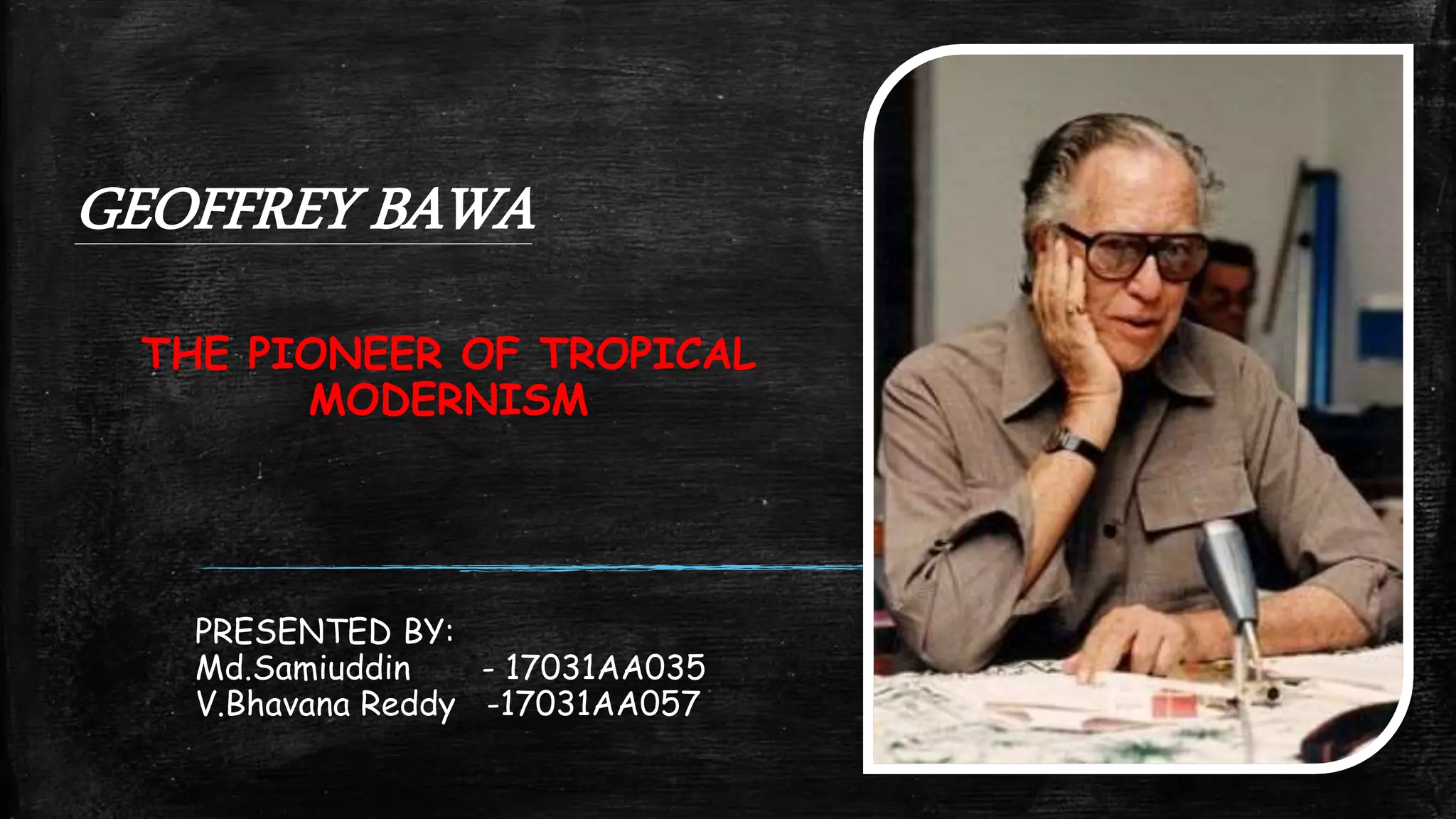
GEOFFREY BAWA
PRESENTED BY:
Md.Samiuddin - 17031AA035
V.Bhavana Reddy -17031AA057
THE PIONEER OF TROPICAL
MODERNISM
INTRODUCTION
▪ Geoffrey Manning Bawa was born on 23 JULY 1919 in Srilanka
▪ Educated at Royal College and Middle Temple,London and became a
Lawyer
▪ Studied Architecture in the Architectural Assocation,London in
1956.
▪ In 1957,at the age of 38,returned to Sri Lanka qualified as an
architect to take over Reid’s practice.
▪ His international standing was confirmed in 2001 when he received
the special chairman’s award in the eighth cycle of the Ada Khan
Award for Architecture , becoming only the third architect of
India.
HIS BELIEFS..
▪ Highly personal in his approach. evoking the pleasures of
the senses that go hand in hand with climate, landscape
and culture of ancient Ceylon(present day sri lanka).
▪ Brings together an appreciation of the western humanist
tradition in architecture with needs and lifestyles of his
own country.
▪ The principal force behind tropical modernism.
DESIGN STYLE
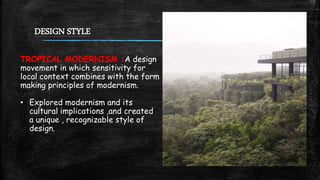
TROPICAL MODERNISM :A design
movement in which sensitivity for
local context combines with the form
making principles of modernism.
• Explored modernism and its
cultural implications ,and created
a unique , recognizable style of
design.
HIS CONCEPTS…
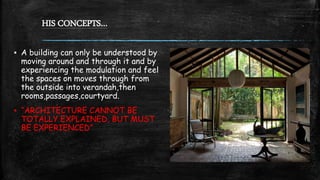
▪ A building can only be understood by
moving around and through it and by
experiencing the modulation and feel
the spaces on moves through from
the outside into verandah,then
rooms,passages,courtyard.
▪ “ARCHITECTURE CANNOT BE
TOTALLY EXPLAINED, BUT MUST
BE EXPERIENCED”
PHILOSOPHY..
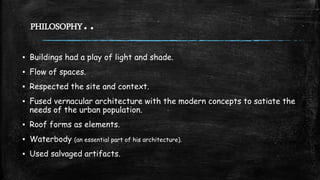
▪ Buildings had a play of light and shade.
▪ Flow of spaces.
▪ Respected the site and context.
▪ Fused vernacular architecture with the modern concepts to satiate the
needs of the urban population.
▪ Roof forms as elements.
▪ Waterbody (an essential part of his architecture).
▪ Used salvaged artifacts.
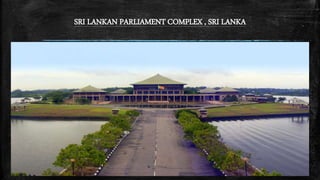
SRI LANKAN PARLIAMENT COMPLEX , SRI LANKA
PARLIAMENT OF SRILANKA
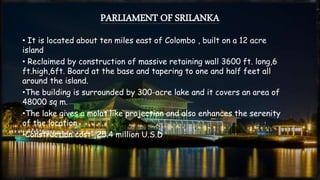
• It is located about ten miles east of Colombo , built on a 12 acre
island
• Reclaimed by construction of massive retaining wall 3600 ft. long,6
ft.high,6ft. Board at the base and tapering to one and half feet all
around the island.
•The building is surrounded by 300-acre lake and it covers an area of
48000 sq m.
•The lake gives a molat like projection and also enhances the serenity
of the location
•Construction cost- 25.4 million U.S.D
SITE CONTEXT
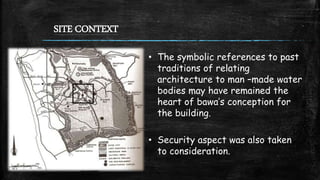
• The symbolic references to past
traditions of relating
architecture to man –made water
bodies may have remained the
heart of bawa’s conception for
the building.
• Security aspect was also taken
to consideration.
PLANNING
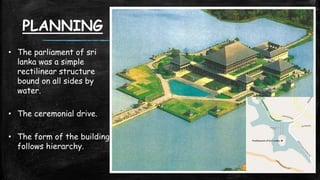
• The parliament of sri
lanka was a simple
rectilinear structure
bound on all sides by
water.
• The ceremonial drive.
• The form of the building
follows hierarchy.
CONCEPT
SKETCH
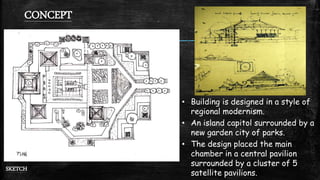
• Building is designed in a style of
regional modernism.
• An island capitol surrounded by a
new garden city of parks.
• The design placed the main
chamber in a central pavilion
surrounded by a cluster of 5
satellite pavilions.
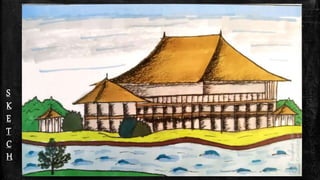
SKETCH
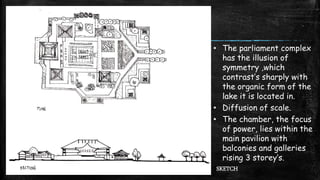
• The parliament complex
has the illusion of
symmetry ,which
contrast’s sharply with
the organic form of the
lake it is located in.
• Diffusion of scale.
• The chamber, the focus
of power, lies within the
main pavilion with
balconies and galleries
rising 3 storey’s.
SPACES
IN PARLIAMENT..
THE CHAMBER..
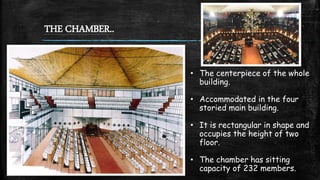
• The centerpiece of the whole
building.
• Accommodated in the four
storied main building.
• It is rectangular in shape and
occupies the height of two
floor.
• The chamber has sitting
capacity of 232 members.
THE LIBRARY
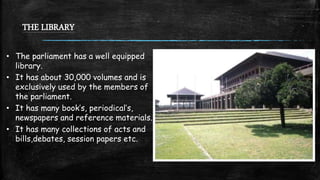
• The parliament has a well equipped
library.
• It has about 30,000 volumes and is
exclusively used by the members of
the parliament.
• It has many book’s, periodical’s,
newspapers and reference materials.
• It has many collections of acts and
bills,debates, session papers etc.
CONFERENCE AND COMMITTEE
ROOMS
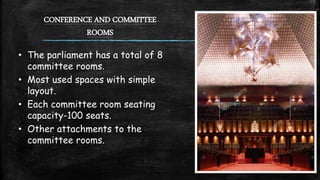
• The parliament has a total of 8
committee rooms.
• Most used spaces with simple
layout.
• Each committee room seating
capacity-100 seats.
• Other attachments to the
committee rooms.
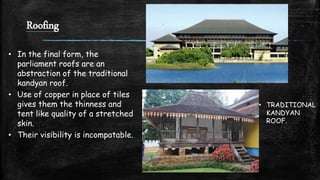
Roofing
• In the final form, the
parliament roofs are an
abstraction of the traditional
kandyan roof.
• Use of copper in place of tiles
gives them the thinness and
tent like quality of a stretched
skin.
• Their visibility is incompatable.
• TRADITIONAL
KANDYAN
ROOF.
OTHER ANCILLARY SPACES
• BANKS
• POST OFFICE
• DINING HALL
• MEDICAL CARE
• CENTRE CAFETERIA
• CANTEEN
• RESERVATION OFFICE
S
K
E
T
C
H
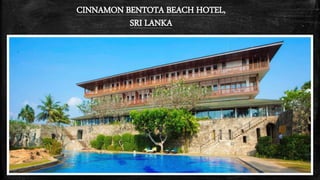
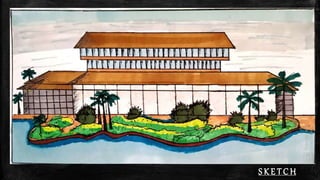
CINNAMON BENTOTA BEACH HOTEL,
SRI LANKA
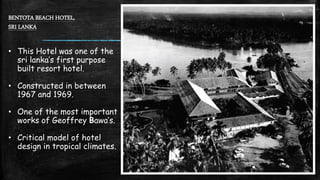
BENTOTA BEACH HOTEL,
SRI LANKA
• This Hotel was one of the
sri lanka’s first purpose
built resort hotel.
• Constructed in between
1967 and 1969.
• One of the most important
works of Geoffrey Bawa’s.
• Critical model of hotel
design in tropical climates.
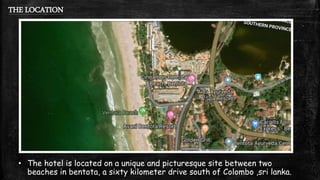
THE LOCATION
• The hotel is located on a unique and picturesque site between two
beaches in bentota, a sixty kilometer drive south of Colombo ,sri lanka.
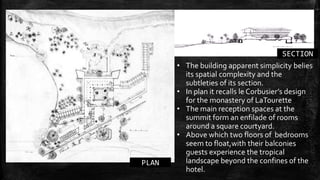
PLAN
SECTION
• The building apparent simplicity belies
its spatial complexity and the
subtleties of its section.
• In plan it recalls le Corbusier’s design
for the monastery of LaTourette
• The main reception spaces at the
summit form an enfilade of rooms
around a square courtyard.
• Above which two floors of bedrooms
seem to float,with their balconies
guests experience the tropical
landscape beyond the confines of the
hotel.
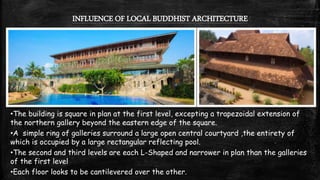
INFLUENCE OF LOCAL BUDDHIST ARCHITECTURE
•The building is square in plan at the first level, excepting a trapezoidal extension of
the northern gallery beyond the eastern edge of the square.
•A simple ring of galleries surround a large open central courtyard ,the entirety of
which is occupied by a large rectangular reflecting pool.
•The second and third levels are each L-Shaped and narrower in plan than the galleries
of the first level
•Each floor looks to be cantilevered over the other.
BUILDING ON DUTCH FOUNDATIONS…
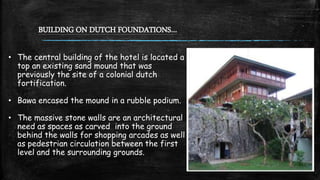
• The central building of the hotel is located a
top an existing sand mound that was
previously the site of a colonial dutch
fortification.
• Bawa encased the mound in a rubble podium.
• The massive stone walls are an architectural
need as spaces as carved into the ground
behind the walls for shopping arcades as well
as pedestrian circulation between the first
level and the surrounding grounds.
SINHALESE TRADITIONS OF WATER BODIES…
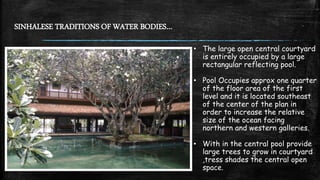
• The large open central courtyard
is entirely occupied by a large
rectangular reflecting pool.
• Pool Occupies approx one quarter
of the floor area of the first
level and it is located southeast
of the center of the plan in
order to increase the relative
size of the ocean facing
northern and western galleries.
• With in the central pool provide
large trees to grow in courtyard
,tress shades the central open
space.
THE LANDSCAPE….
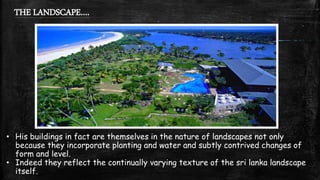
• His buildings in fact are themselves in the nature of landscapes not only
because they incorporate planting and water and subtly contrived changes of
form and level.
• Indeed they reflect the continually varying texture of the sri lanka landscape
itself.
THE ROOFSCAPE…..
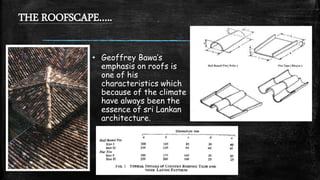
• Geoffrey Bawa’s
emphasis on roofs is
one of his
characteristics which
because of the climate
have always been the
essence of sri Lankan
architecture.
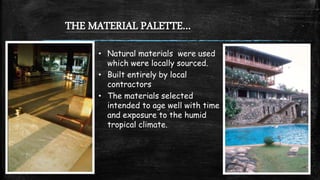
THE MATERIAL PALETTE…
• Natural materials were used
which were locally sourced.
• Built entirely by local
contractors
• The materials selected
intended to age well with time
and exposure to the humid
tropical climate.
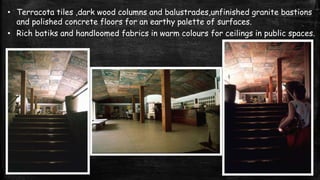
• Terracota tiles ,dark wood columns and balustrades,unfinished granite bastions
and polished concrete floors for an earthy palette of surfaces.
• Rich batiks and handloomed fabrics in warm colours for ceilings in public spaces.
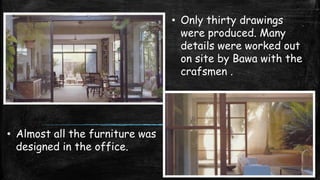
• Only thirty drawings
were produced. Many
details were worked out
on site by Bawa with the
crafsmen .
• Almost all the furniture was
designed in the office.
S K E T C H
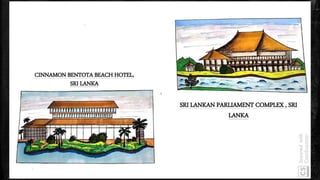
Add a Slide Title - 2
CINNAMON BENTOTA BEACH HOTEL,
SRI LANKA
SRI LANKAN PARLIAMENT COMPLEX , SRI
LANKA

Geoffrey bawa..

  • 1.
    GEOFFREY BAWA PRESENTED BY: Md.Samiuddin- 17031AA035 V.Bhavana Reddy -17031AA057 THE PIONEER OF TROPICAL MODERNISM
  • 2.
    INTRODUCTION ▪ Geoffrey ManningBawa was born on 23 JULY 1919 in Srilanka ▪ Educated at Royal College and Middle Temple,London and became a Lawyer ▪ Studied Architecture in the Architectural Assocation,London in 1956. ▪ In 1957,at the age of 38,returned to Sri Lanka qualified as an architect to take over Reid’s practice. ▪ His international standing was confirmed in 2001 when he received the special chairman’s award in the eighth cycle of the Ada Khan Award for Architecture , becoming only the third architect of India.
  • 3.
    HIS BELIEFS.. ▪ Highlypersonal in his approach. evoking the pleasures of the senses that go hand in hand with climate, landscape and culture of ancient Ceylon(present day sri lanka). ▪ Brings together an appreciation of the western humanist tradition in architecture with needs and lifestyles of his own country. ▪ The principal force behind tropical modernism.
  • 4.
    DESIGN STYLE TROPICAL MODERNISM:A design movement in which sensitivity for local context combines with the form making principles of modernism. • Explored modernism and its cultural implications ,and created a unique , recognizable style of design.
  • 5.
    HIS CONCEPTS… ▪ Abuilding can only be understood by moving around and through it and by experiencing the modulation and feel the spaces on moves through from the outside into verandah,then rooms,passages,courtyard. ▪ “ARCHITECTURE CANNOT BE TOTALLY EXPLAINED, BUT MUST BE EXPERIENCED”
  • 6.
    PHILOSOPHY.. ▪ Buildings hada play of light and shade. ▪ Flow of spaces. ▪ Respected the site and context. ▪ Fused vernacular architecture with the modern concepts to satiate the needs of the urban population. ▪ Roof forms as elements. ▪ Waterbody (an essential part of his architecture). ▪ Used salvaged artifacts.
  • 7.
    SRI LANKAN PARLIAMENTCOMPLEX , SRI LANKA
  • 8.
    PARLIAMENT OF SRILANKA •It is located about ten miles east of Colombo , built on a 12 acre island • Reclaimed by construction of massive retaining wall 3600 ft. long,6 ft.high,6ft. Board at the base and tapering to one and half feet all around the island. •The building is surrounded by 300-acre lake and it covers an area of 48000 sq m. •The lake gives a molat like projection and also enhances the serenity of the location •Construction cost- 25.4 million U.S.D
  • 9.
    SITE CONTEXT • Thesymbolic references to past traditions of relating architecture to man –made water bodies may have remained the heart of bawa’s conception for the building. • Security aspect was also taken to consideration.
  • 10.
    PLANNING • The parliamentof sri lanka was a simple rectilinear structure bound on all sides by water. • The ceremonial drive. • The form of the building follows hierarchy.
  • 11.
    CONCEPT SKETCH • Building isdesigned in a style of regional modernism. • An island capitol surrounded by a new garden city of parks. • The design placed the main chamber in a central pavilion surrounded by a cluster of 5 satellite pavilions.
  • 12.
    SKETCH • The parliamentcomplex has the illusion of symmetry ,which contrast’s sharply with the organic form of the lake it is located in. • Diffusion of scale. • The chamber, the focus of power, lies within the main pavilion with balconies and galleries rising 3 storey’s.
  • 13.
  • 14.
    THE CHAMBER.. • Thecenterpiece of the whole building. • Accommodated in the four storied main building. • It is rectangular in shape and occupies the height of two floor. • The chamber has sitting capacity of 232 members.
  • 15.
    THE LIBRARY • Theparliament has a well equipped library. • It has about 30,000 volumes and is exclusively used by the members of the parliament. • It has many book’s, periodical’s, newspapers and reference materials. • It has many collections of acts and bills,debates, session papers etc.
  • 16.
    CONFERENCE AND COMMITTEE ROOMS •The parliament has a total of 8 committee rooms. • Most used spaces with simple layout. • Each committee room seating capacity-100 seats. • Other attachments to the committee rooms.
  • 17.
    Roofing • In thefinal form, the parliament roofs are an abstraction of the traditional kandyan roof. • Use of copper in place of tiles gives them the thinness and tent like quality of a stretched skin. • Their visibility is incompatable. • TRADITIONAL KANDYAN ROOF.
  • 18.
    OTHER ANCILLARY SPACES •BANKS • POST OFFICE • DINING HALL • MEDICAL CARE • CENTRE CAFETERIA • CANTEEN • RESERVATION OFFICE
  • 19.
  • 20.
    CINNAMON BENTOTA BEACHHOTEL, SRI LANKA
  • 21.
    BENTOTA BEACH HOTEL, SRILANKA • This Hotel was one of the sri lanka’s first purpose built resort hotel. • Constructed in between 1967 and 1969. • One of the most important works of Geoffrey Bawa’s. • Critical model of hotel design in tropical climates.
  • 22.
    THE LOCATION • Thehotel is located on a unique and picturesque site between two beaches in bentota, a sixty kilometer drive south of Colombo ,sri lanka.
  • 23.
    PLAN SECTION • The buildingapparent simplicity belies its spatial complexity and the subtleties of its section. • In plan it recalls le Corbusier’s design for the monastery of LaTourette • The main reception spaces at the summit form an enfilade of rooms around a square courtyard. • Above which two floors of bedrooms seem to float,with their balconies guests experience the tropical landscape beyond the confines of the hotel.
  • 24.
    INFLUENCE OF LOCALBUDDHIST ARCHITECTURE •The building is square in plan at the first level, excepting a trapezoidal extension of the northern gallery beyond the eastern edge of the square. •A simple ring of galleries surround a large open central courtyard ,the entirety of which is occupied by a large rectangular reflecting pool. •The second and third levels are each L-Shaped and narrower in plan than the galleries of the first level •Each floor looks to be cantilevered over the other.
  • 25.
    BUILDING ON DUTCHFOUNDATIONS… • The central building of the hotel is located a top an existing sand mound that was previously the site of a colonial dutch fortification. • Bawa encased the mound in a rubble podium. • The massive stone walls are an architectural need as spaces as carved into the ground behind the walls for shopping arcades as well as pedestrian circulation between the first level and the surrounding grounds.
  • 26.
    SINHALESE TRADITIONS OFWATER BODIES… • The large open central courtyard is entirely occupied by a large rectangular reflecting pool. • Pool Occupies approx one quarter of the floor area of the first level and it is located southeast of the center of the plan in order to increase the relative size of the ocean facing northern and western galleries. • With in the central pool provide large trees to grow in courtyard ,tress shades the central open space.
  • 27.
    THE LANDSCAPE…. • Hisbuildings in fact are themselves in the nature of landscapes not only because they incorporate planting and water and subtly contrived changes of form and level. • Indeed they reflect the continually varying texture of the sri lanka landscape itself.
  • 28.
    THE ROOFSCAPE….. • GeoffreyBawa’s emphasis on roofs is one of his characteristics which because of the climate have always been the essence of sri Lankan architecture.
  • 29.
    THE MATERIAL PALETTE… •Natural materials were used which were locally sourced. • Built entirely by local contractors • The materials selected intended to age well with time and exposure to the humid tropical climate.
  • 30.
    • Terracota tiles,dark wood columns and balustrades,unfinished granite bastions and polished concrete floors for an earthy palette of surfaces. • Rich batiks and handloomed fabrics in warm colours for ceilings in public spaces.
  • 31.
    • Only thirtydrawings were produced. Many details were worked out on site by Bawa with the crafsmen . • Almost all the furniture was designed in the office.
  • 32.
    S K ET C H
  • 33.
    Add a SlideTitle - 2 CINNAMON BENTOTA BEACH HOTEL, SRI LANKA SRI LANKAN PARLIAMENT COMPLEX , SRI LANKA