TADAO ANDO
THE ARCHITECT OF LIGHT
PARSHWA SHAH
DIPL.ARCH.
BARDOLI.
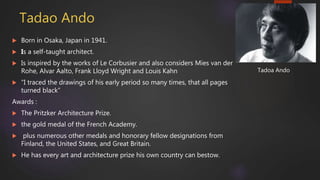
Tadao Ando
 Born in Osaka, Japan in 1941.
 Is a self-taught architect.
 Is inspired by the works of Le Corbusier and also considers Mies van der
Rohe, Alvar Aalto, Frank Lloyd Wright and Louis Kahn
 "I traced the drawings of his early period so many times, that all pages
turned black”
Awards :
 The Pritzker Architecture Prize.
 the gold medal of the French Academy.
 plus numerous other medals and honorary fellow designations from
Finland, the United States, and Great Britain.
 He has every art and architecture prize his own country can bestow.
Tadoa Ando
Philosophy
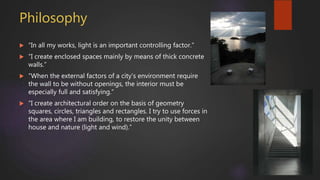
 “In all my works, light is an important controlling factor.”
 “I create enclosed spaces mainly by means of thick concrete
walls.”
 “When the external factors of a city’s environment require
the wall to be without openings, the interior must be
especially full and satisfying.”
 “I create architectural order on the basis of geometry
squares, circles, triangles and rectangles. I try to use forces in
the area where I am building, to restore the unity between
house and nature (light and wind).”
Philosophy
 Style - element of Light, Water, concrete and glass.
 Simplified, rectilinear forms.
 favors designing complex spatial circulation while maintaining the appearance of simplicity.
 Bare concrete walls that define the spaces within.
 Interior of the building are the form itself, ridicules the idea of masking it.
Church of the Light, 1999.
LOCATION: Ibaraki, Osaka, Japan
CONTEXT:
 Tightly-packed residential neighborhood
 Very small space
 Location influences form
 L-shaped wall separates church from busy surrounding.
 No good views, so the windows are minimal – only the
distinctive narrow cross window and a window opening into
the L-shaped wall
Church of the Light
 Entrance is from the
back.
 Must turn 180
degrees to face the
front of the
building
Church of the Light: Form
Form: Long, rectilinear plan
 “The building can be described simply as a bare concrete box with a wall cutting through it at
a 15 degree angle. “
 Proportion: 1:3 – rectangle can hold 3 spheres, each 5.9 meters in diameter
Light is the origin of all being. Light gives with each moment new
form to being and new interrelationship to things and architecture
condenses light to its most concise being. The creation of space in
architecture is simply the condensation and purification of the
power of light.
“I do not believe architecture should speak too much.
It should remain silent and let nature in the guise of
sunlight and wind speak”
Creates spaces that respond to human needs and
spirit juxtaposing powerful concrete walls with light
and nature, deep sense of peace, simple materials
and geometry.
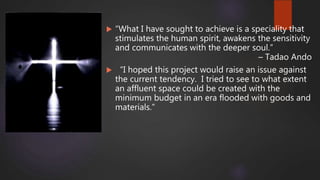
 “What I have sought to achieve is a speciality that
stimulates the human spirit, awakens the sensitivity
and communicates with the deeper soul.”
– Tadao Ando
 “I hoped this project would raise an issue against
the current tendency. I tried to see to what extent
an affluent space could be created with the
minimum budget in an era flooded with goods and
materials.”

Final tadao ando

  • 1.
    TADAO ANDO THE ARCHITECTOF LIGHT PARSHWA SHAH DIPL.ARCH. BARDOLI.
  • 2.
    Tadao Ando  Bornin Osaka, Japan in 1941.  Is a self-taught architect.  Is inspired by the works of Le Corbusier and also considers Mies van der Rohe, Alvar Aalto, Frank Lloyd Wright and Louis Kahn  "I traced the drawings of his early period so many times, that all pages turned black” Awards :  The Pritzker Architecture Prize.  the gold medal of the French Academy.  plus numerous other medals and honorary fellow designations from Finland, the United States, and Great Britain.  He has every art and architecture prize his own country can bestow. Tadoa Ando
  • 3.
    Philosophy  “In allmy works, light is an important controlling factor.”  “I create enclosed spaces mainly by means of thick concrete walls.”  “When the external factors of a city’s environment require the wall to be without openings, the interior must be especially full and satisfying.”  “I create architectural order on the basis of geometry squares, circles, triangles and rectangles. I try to use forces in the area where I am building, to restore the unity between house and nature (light and wind).”
  • 4.
    Philosophy  Style -element of Light, Water, concrete and glass.  Simplified, rectilinear forms.  favors designing complex spatial circulation while maintaining the appearance of simplicity.  Bare concrete walls that define the spaces within.  Interior of the building are the form itself, ridicules the idea of masking it.
  • 5.
    Church of theLight, 1999. LOCATION: Ibaraki, Osaka, Japan CONTEXT:  Tightly-packed residential neighborhood  Very small space  Location influences form  L-shaped wall separates church from busy surrounding.  No good views, so the windows are minimal – only the distinctive narrow cross window and a window opening into the L-shaped wall
  • 6.
    Church of theLight  Entrance is from the back.  Must turn 180 degrees to face the front of the building
  • 7.
    Church of theLight: Form Form: Long, rectilinear plan  “The building can be described simply as a bare concrete box with a wall cutting through it at a 15 degree angle. “  Proportion: 1:3 – rectangle can hold 3 spheres, each 5.9 meters in diameter
  • 9.
    Light is theorigin of all being. Light gives with each moment new form to being and new interrelationship to things and architecture condenses light to its most concise being. The creation of space in architecture is simply the condensation and purification of the power of light. “I do not believe architecture should speak too much. It should remain silent and let nature in the guise of sunlight and wind speak” Creates spaces that respond to human needs and spirit juxtaposing powerful concrete walls with light and nature, deep sense of peace, simple materials and geometry.
  • 10.
     “What Ihave sought to achieve is a speciality that stimulates the human spirit, awakens the sensitivity and communicates with the deeper soul.” – Tadao Ando  “I hoped this project would raise an issue against the current tendency. I tried to see to what extent an affluent space could be created with the minimum budget in an era flooded with goods and materials.”