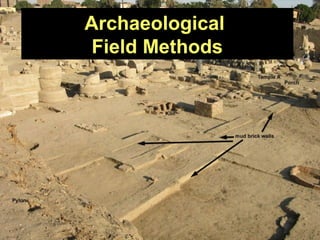
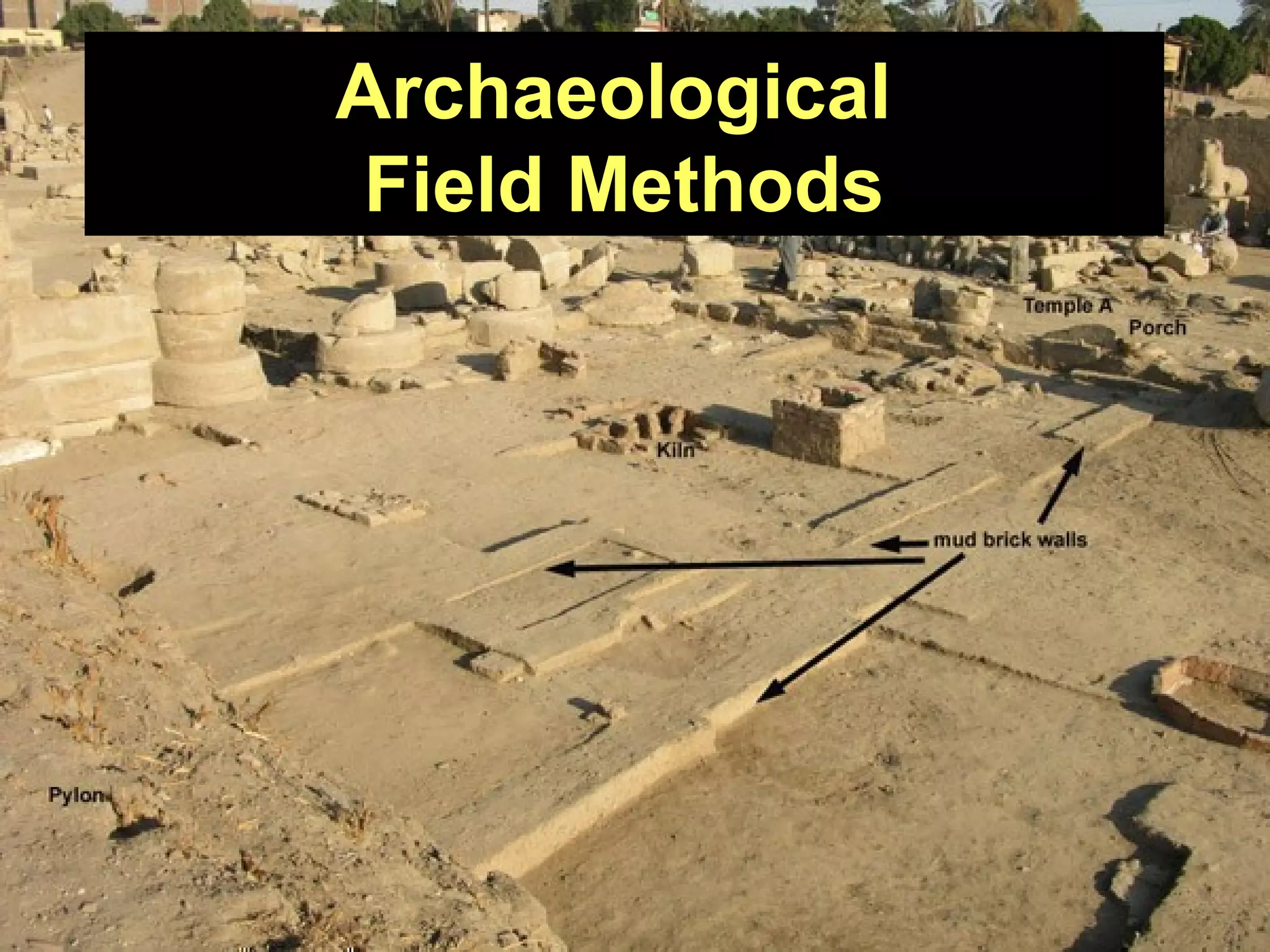
Archaeological
Field Methods
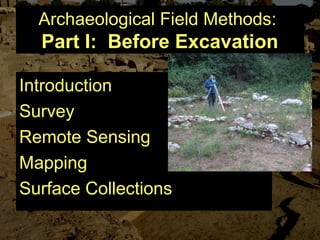
Archaeological Field Methods:
Part I: Before Excavation
Introduction
Survey
Remote Sensing
Mapping
Surface Collections
Before the Fieldwork Begins
• Permission or access to lands
• Necessary Research Permits
• International preparations if
necessary
• Talk to local community
• Prepare laboratory processing space
• Prepare adequate artifact storage
space
Preliminary Research
• Research any previous archaeology of the
region
• Consult historical record (written records,
old maps, etc.)
• Understand the landscape
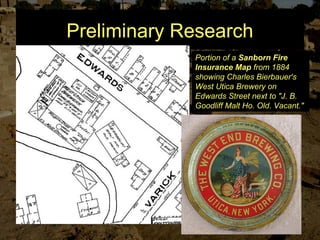
Preliminary Research
Portion of a Sanborn Fire
Insurance Map from 1884
showing Charles Bierbauer's
West Utica Brewery on
Edwards Street next to "J. B.
Goodliff Malt Ho. Old. Vacant."
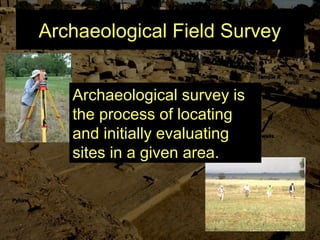
Archaeological Field Survey
Archaeological survey is
the process of locating
and initially evaluating
sites in a given area.
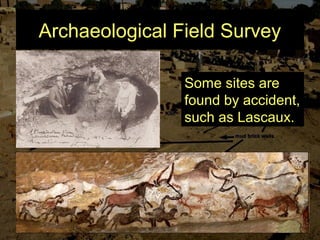
Archaeological Field Survey
Some sites are
found by accident,
such as Lascaux.
Archaeological Field Survey
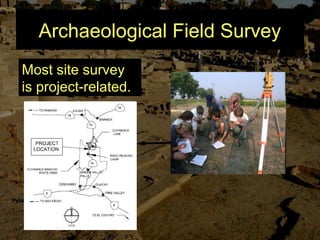
Most site survey
is project-related.
Methods of Survey
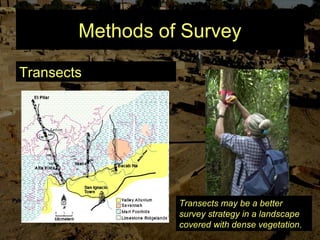
Transects
Transects may be a better
survey strategy in a landscape
covered with dense vegetation.
Methods of Survey
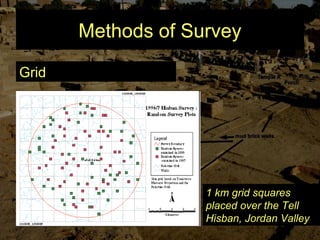
Grid
1 km grid squares
placed over the Tell
Hisban, Jordan Valley
Archaeological Sampling
Various techniques are employed during
many phases of archaeological investigation
to select a sample of the universe of
potential data.
Archaeological Sampling Strategies
Judgmental sampling: sampling where
you believe (based on judgement) sites
will be found
Probabilistic sampling: using a form of
scientific randomization
Archaeological Sampling Strategies
Probabilistic sampling: first, grid off your
entire area for analysis (this is the basis for
the sampling)
• Simple Random sampling: random selection
of squares from entire area
• Systematic sampling: sample every nth
square
• Stratified Random sampling: divide (stratify)
total area into different subsections, randomly
sample within each
• Stratified Unaligned sampling: random sample
taken within each predefined grid square
Survey Information Recovery
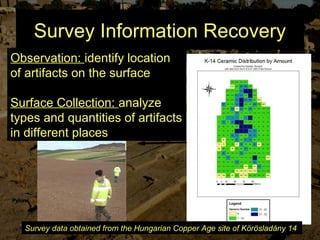
Observation: identify location
of artifacts on the surface
Surface Collection: analyze
types and quantities of artifacts
in different places
Survey data obtained from the Hungarian Copper Age site of Körösladány 14
Survey Information Recovery
Subsurface Sampling:
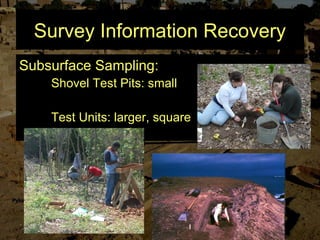
Shovel Test Pits: small
Test Units: larger, square
Survey Information Recovery
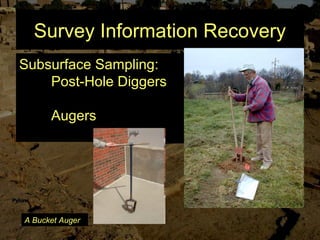
Subsurface Sampling:
Post-Hole Diggers
Augers
A Bucket Auger
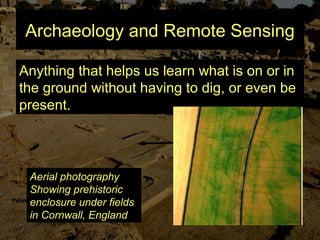
Archaeology and Remote Sensing
Anything that helps us learn what is on or in
the ground without having to dig, or even be
present.
Aerial photography
Showing prehistoric
enclosure under fields
in Cornwall, England
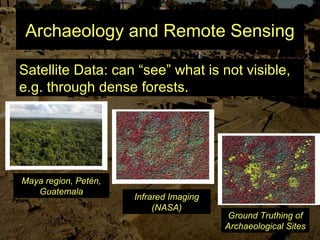
Archaeology and Remote Sensing
Satellite Data: can “see” what is not visible,
e.g. through dense forests.
Infrared Imaging
(NASA)
Maya region, Petén,
Guatemala
Ground Truthing of
Archaeological Sites
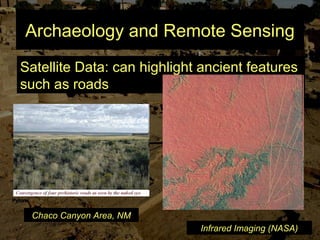
Archaeology and Remote Sensing
Satellite Data: can highlight ancient features
such as roads
Infrared Imaging (NASA)
Chaco Canyon Area, NM
Archaeology and Remote Sensing
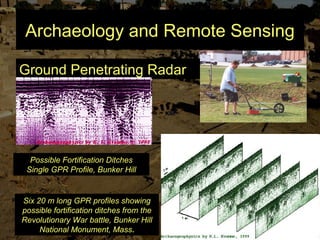
Ground Penetrating Radar
Possible Fortification Ditches
Single GPR Profile, Bunker Hill
Six 20 m long GPR profiles showing
possible fortification ditches from the
Revolutionary War battle, Bunker Hill
National Monument, Mass.
Archaeology and Remote Sensing
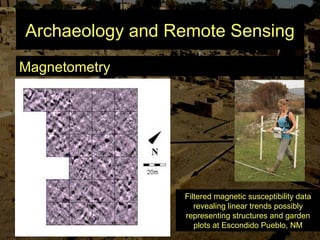
Magnetometry
Filtered magnetic susceptibility data
revealing linear trends possibly
representing structures and garden
plots at Escondido Pueblo, NM
Archaeology and Other
Modern Technology
Global Positioning Systems (GPS)
Reads signals bouncing off several satellites
to give exact locations in latitude/longitude
or other coordinates.
Geographic Information Systems (GIS)
Computerized ways of making maps of
different features that can be overlain to
show relationships of natural and cultural
features through time.
Archaeological Mapping
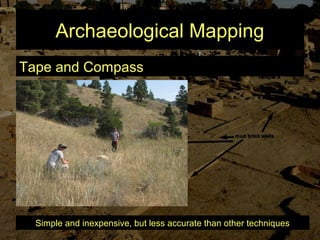
Tape and Compass
Simple and inexpensive, but less accurate than other techniques
Archaeological Mapping
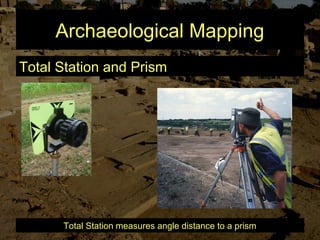
Total Station and Prism
Total Station measures angle distance to a prism
Archaeological Mapping
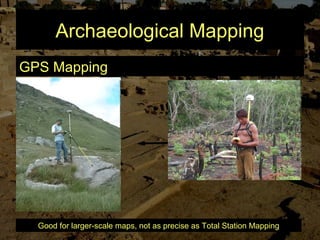
GPS Mapping
Good for larger-scale maps, not as precise as Total Station Mapping
Archaeological Mapping
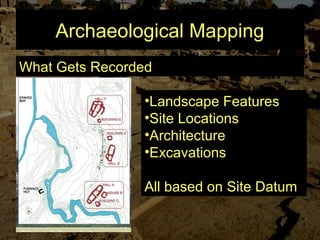
What Gets Recorded
•Landscape Features
•Site Locations
•Architecture
•Excavations
All based on Site Datum
After Mapping the Site
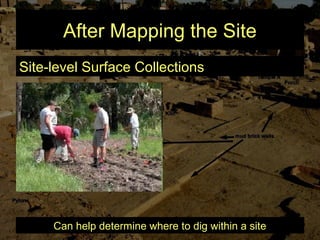
Site-level Surface Collections
Can help determine where to dig within a site
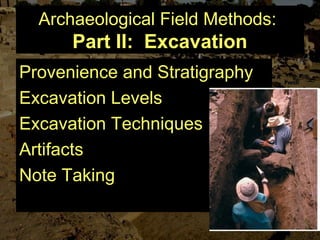
Archaeological Field Methods:
Part II: Excavation
Provenience and Stratigraphy
Excavation Levels
Excavation Techniques
Artifacts
Note Taking
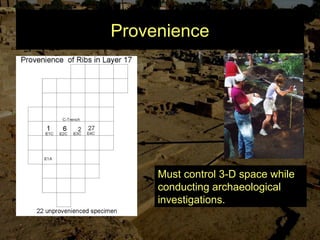
Provenience
Must control 3-D space while
conducting archaeological
investigations.
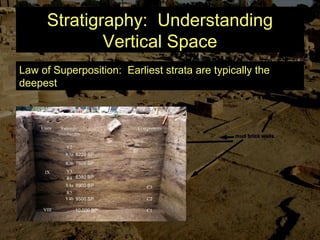
Stratigraphy: Understanding
Vertical Space
Law of Superposition: Earliest strata are typically the
deepest
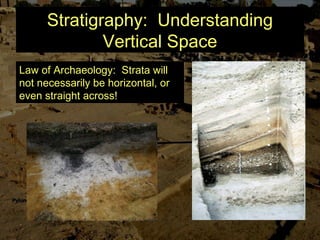
Stratigraphy: Understanding
Vertical Space
Law of Archaeology: Strata will
not necessarily be horizontal, or
even straight across!
Excavation Levels
Natural or Stratigraphic Levels: Excavation reverses the
natural order of deposition by proceeding downwards one
stratum at a time.
Contoured Arbitrary Levels: The archaeologist picks an
arbitrary depth (5 cm, 10 cm, etc.) to which the entire unit is
excavated, paralleling the natural slope of the ground
surface.
Simple Arbitrary Levels: Levels are defined by arbitrary
depths below datum. When a level is completed, all four
corners and the center of the unit will be the same depth
below datum.
Combined Natural and Arbitrary Levels.
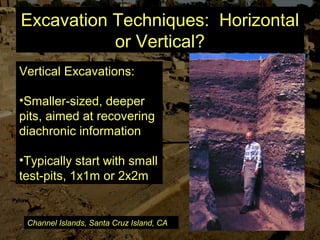
Excavation Techniques: Horizontal
or Vertical?
Vertical Excavations:
•Smaller-sized, deeper
pits, aimed at recovering
diachronic information
•Typically start with small
test-pits, 1x1m or 2x2m
Channel Islands, Santa Cruz Island, CA
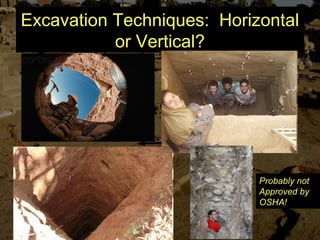
Excavation Techniques: Horizontal
or Vertical?
Probably not
Approved by
OSHA!
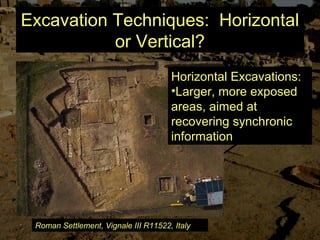
Excavation Techniques: Horizontal
or Vertical?
Horizontal Excavations:
•Larger, more exposed
areas, aimed at
recovering synchronic
information
Roman Settlement, Vignale III R11522, Italy
Excavation Techniques: Horizontal
or Vertical?
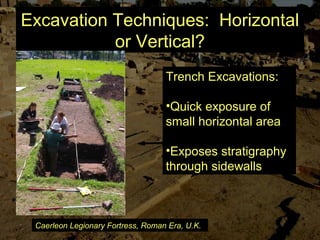
Trench Excavations:
•Quick exposure of
small horizontal area
•Exposes stratigraphy
through sidewalls
Caerleon Legionary Fortress, Roman Era, U.K.
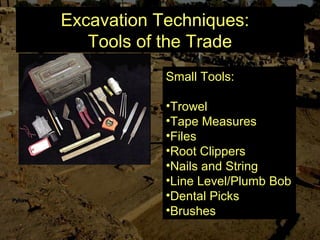
Excavation Techniques:
Tools of the Trade
Small Tools:
•Trowel
•Tape Measures
•Files
•Root Clippers
•Nails and String
•Line Level/Plumb Bob
•Dental Picks
•Brushes
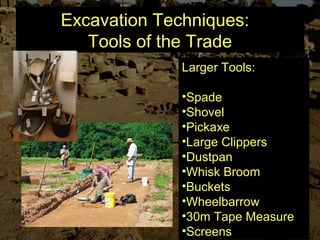
Excavation Techniques:
Tools of the Trade
Larger Tools:
•Spade
•Shovel
•Pickaxe
•Large Clippers
•Dustpan
•Whisk Broom
•Buckets
•Wheelbarrow
•30m Tape Measure
•Screens
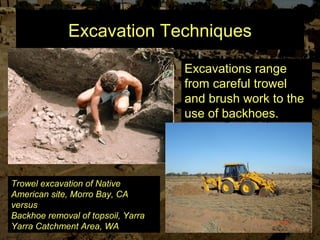
Excavation Techniques
Excavations range
from careful trowel
and brush work to the
use of backhoes.
Trowel excavation of Native
American site, Morro Bay, CA
versus
Backhoe removal of topsoil, Yarra
Yarra Catchment Area, WA
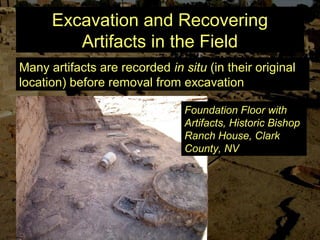
Excavation and Recovering
Artifacts in the Field
Many artifacts are recorded in situ (in their original
location) before removal from excavation
Foundation Floor with
Artifacts, Historic Bishop
Ranch House, Clark
County, NV
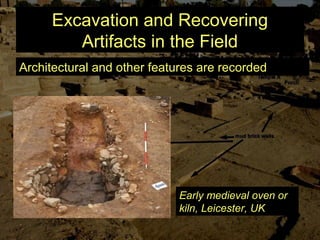
Excavation and Recovering
Artifacts in the Field
Architectural and other features are recorded
Early medieval oven or
kiln, Leicester, UK
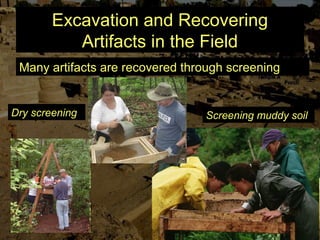
Excavation and Recovering
Artifacts in the Field
Many artifacts are recovered through screening
Screening muddy soilDry screening
Excavation and Recovering
Artifacts in the Field
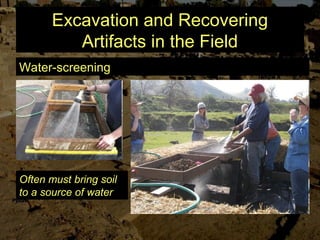
Water-screening
Often must bring soil
to a source of water
Excavation and Recovering
Artifacts in the Field
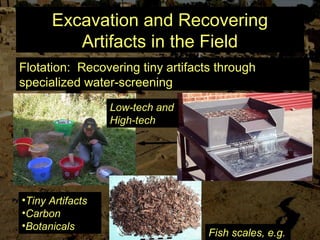
Flotation: Recovering tiny artifacts through
specialized water-screening
•Tiny Artifacts
•Carbon
•Botanicals
Low-tech and
High-tech
Fish scales, e.g.
Note-Taking in the Field
Forms: ensure archaeologists record
consistent information for the following…
•Features (within or cross-cutting units)
•Levels (within units, complete a new form with
each new level)
•Units (fill out when excavation unit is complete)
•Profile/Plan maps (profile all stratigraphy, draw
plan maps of the base of all excavation levels)
•Photo/Video Logs (document all finds and levels)

Archaeology Field Methods

  • 1.
  • 2.
    Archaeological Field Methods: PartI: Before Excavation Introduction Survey Remote Sensing Mapping Surface Collections
  • 3.
    Before the FieldworkBegins • Permission or access to lands • Necessary Research Permits • International preparations if necessary • Talk to local community • Prepare laboratory processing space • Prepare adequate artifact storage space
  • 4.
    Preliminary Research • Researchany previous archaeology of the region • Consult historical record (written records, old maps, etc.) • Understand the landscape
  • 5.
    Preliminary Research Portion ofa Sanborn Fire Insurance Map from 1884 showing Charles Bierbauer's West Utica Brewery on Edwards Street next to "J. B. Goodliff Malt Ho. Old. Vacant."
  • 6.
    Archaeological Field Survey Archaeologicalsurvey is the process of locating and initially evaluating sites in a given area.
  • 7.
    Archaeological Field Survey Somesites are found by accident, such as Lascaux.
  • 8.
    Archaeological Field Survey Mostsite survey is project-related.
  • 9.
    Methods of Survey Transects Transectsmay be a better survey strategy in a landscape covered with dense vegetation.
  • 10.
    Methods of Survey Grid 1km grid squares placed over the Tell Hisban, Jordan Valley
  • 11.
    Archaeological Sampling Various techniquesare employed during many phases of archaeological investigation to select a sample of the universe of potential data.
  • 12.
    Archaeological Sampling Strategies Judgmentalsampling: sampling where you believe (based on judgement) sites will be found Probabilistic sampling: using a form of scientific randomization
  • 13.
    Archaeological Sampling Strategies Probabilisticsampling: first, grid off your entire area for analysis (this is the basis for the sampling) • Simple Random sampling: random selection of squares from entire area • Systematic sampling: sample every nth square • Stratified Random sampling: divide (stratify) total area into different subsections, randomly sample within each • Stratified Unaligned sampling: random sample taken within each predefined grid square
  • 14.
    Survey Information Recovery Observation:identify location of artifacts on the surface Surface Collection: analyze types and quantities of artifacts in different places Survey data obtained from the Hungarian Copper Age site of Körösladány 14
  • 15.
    Survey Information Recovery SubsurfaceSampling: Shovel Test Pits: small Test Units: larger, square
  • 16.
    Survey Information Recovery SubsurfaceSampling: Post-Hole Diggers Augers A Bucket Auger
  • 17.
    Archaeology and RemoteSensing Anything that helps us learn what is on or in the ground without having to dig, or even be present. Aerial photography Showing prehistoric enclosure under fields in Cornwall, England
  • 18.
    Archaeology and RemoteSensing Satellite Data: can “see” what is not visible, e.g. through dense forests. Infrared Imaging (NASA) Maya region, Petén, Guatemala Ground Truthing of Archaeological Sites
  • 19.
    Archaeology and RemoteSensing Satellite Data: can highlight ancient features such as roads Infrared Imaging (NASA) Chaco Canyon Area, NM
  • 20.
    Archaeology and RemoteSensing Ground Penetrating Radar Possible Fortification Ditches Single GPR Profile, Bunker Hill Six 20 m long GPR profiles showing possible fortification ditches from the Revolutionary War battle, Bunker Hill National Monument, Mass.
  • 21.
    Archaeology and RemoteSensing Magnetometry Filtered magnetic susceptibility data revealing linear trends possibly representing structures and garden plots at Escondido Pueblo, NM
  • 22.
    Archaeology and Other ModernTechnology Global Positioning Systems (GPS) Reads signals bouncing off several satellites to give exact locations in latitude/longitude or other coordinates. Geographic Information Systems (GIS) Computerized ways of making maps of different features that can be overlain to show relationships of natural and cultural features through time.
  • 23.
    Archaeological Mapping Tape andCompass Simple and inexpensive, but less accurate than other techniques
  • 24.
    Archaeological Mapping Total Stationand Prism Total Station measures angle distance to a prism
  • 25.
    Archaeological Mapping GPS Mapping Goodfor larger-scale maps, not as precise as Total Station Mapping
  • 26.
    Archaeological Mapping What GetsRecorded •Landscape Features •Site Locations •Architecture •Excavations All based on Site Datum
  • 27.
    After Mapping theSite Site-level Surface Collections Can help determine where to dig within a site
  • 28.
    Archaeological Field Methods: PartII: Excavation Provenience and Stratigraphy Excavation Levels Excavation Techniques Artifacts Note Taking
  • 29.
    Provenience Must control 3-Dspace while conducting archaeological investigations.
  • 30.
    Stratigraphy: Understanding Vertical Space Lawof Superposition: Earliest strata are typically the deepest
  • 31.
    Stratigraphy: Understanding Vertical Space Lawof Archaeology: Strata will not necessarily be horizontal, or even straight across!
  • 32.
    Excavation Levels Natural orStratigraphic Levels: Excavation reverses the natural order of deposition by proceeding downwards one stratum at a time. Contoured Arbitrary Levels: The archaeologist picks an arbitrary depth (5 cm, 10 cm, etc.) to which the entire unit is excavated, paralleling the natural slope of the ground surface. Simple Arbitrary Levels: Levels are defined by arbitrary depths below datum. When a level is completed, all four corners and the center of the unit will be the same depth below datum. Combined Natural and Arbitrary Levels.
  • 33.
    Excavation Techniques: Horizontal orVertical? Vertical Excavations: •Smaller-sized, deeper pits, aimed at recovering diachronic information •Typically start with small test-pits, 1x1m or 2x2m Channel Islands, Santa Cruz Island, CA
  • 34.
    Excavation Techniques: Horizontal orVertical? Probably not Approved by OSHA!
  • 35.
    Excavation Techniques: Horizontal orVertical? Horizontal Excavations: •Larger, more exposed areas, aimed at recovering synchronic information Roman Settlement, Vignale III R11522, Italy
  • 36.
    Excavation Techniques: Horizontal orVertical? Trench Excavations: •Quick exposure of small horizontal area •Exposes stratigraphy through sidewalls Caerleon Legionary Fortress, Roman Era, U.K.
  • 37.
    Excavation Techniques: Tools ofthe Trade Small Tools: •Trowel •Tape Measures •Files •Root Clippers •Nails and String •Line Level/Plumb Bob •Dental Picks •Brushes
  • 38.
    Excavation Techniques: Tools ofthe Trade Larger Tools: •Spade •Shovel •Pickaxe •Large Clippers •Dustpan •Whisk Broom •Buckets •Wheelbarrow •30m Tape Measure •Screens
  • 39.
    Excavation Techniques Excavations range fromcareful trowel and brush work to the use of backhoes. Trowel excavation of Native American site, Morro Bay, CA versus Backhoe removal of topsoil, Yarra Yarra Catchment Area, WA
  • 40.
    Excavation and Recovering Artifactsin the Field Many artifacts are recorded in situ (in their original location) before removal from excavation Foundation Floor with Artifacts, Historic Bishop Ranch House, Clark County, NV
  • 41.
    Excavation and Recovering Artifactsin the Field Architectural and other features are recorded Early medieval oven or kiln, Leicester, UK
  • 42.
    Excavation and Recovering Artifactsin the Field Many artifacts are recovered through screening Screening muddy soilDry screening
  • 43.
    Excavation and Recovering Artifactsin the Field Water-screening Often must bring soil to a source of water
  • 44.
    Excavation and Recovering Artifactsin the Field Flotation: Recovering tiny artifacts through specialized water-screening •Tiny Artifacts •Carbon •Botanicals Low-tech and High-tech Fish scales, e.g.
  • 45.
    Note-Taking in theField Forms: ensure archaeologists record consistent information for the following… •Features (within or cross-cutting units) •Levels (within units, complete a new form with each new level) •Units (fill out when excavation unit is complete) •Profile/Plan maps (profile all stratigraphy, draw plan maps of the base of all excavation levels) •Photo/Video Logs (document all finds and levels)