RELATIVE DATING METHODS
IN ARCHAEOLOGY
Unraveling the Timeline of Human History
BY
Dr. Rajiv Kumar Jaiswal
Assistant Professor
Dept. of AIHC & Archaeology
Vasanta College for Women
KFI, Rajghat Fort
BHU, Varanasi
INTRODUCTION TO DATING METHODS
 The study of the past is to understand the human behavioural activities
and cultural progress in a sequential order based on tangible and
intangible evidences in a given socio-economic-cultural context.
 The Archaeological data has to be placed in a chronological order to
understand this sequential cultural process.
 For this, various dating methods are being used in the archaeological
investigations.
IMPORTANCE OF DATING METHODS IN
ARCHAEOLOGY
 Dating in archaeology is crucial for several reasons:
• Chronology Establishment: Dating allows archaeologists to establish the
chronological order of artifacts, sites, and cultural phenomena. This
chronological framework is essential for understanding the sequence of events
in human history and the development of cultures.
• Interpretation of Cultural Change: By dating artifacts and sites,
archaeologists can track changes in material culture over time. This helps in
interpreting shifts in technology, social organization, economy, and ideology,
providing insights into how societies evolve and interact.
CONT….
• Contextual Understanding: Dating helps archaeologists place
artifacts and sites within their historical and cultural context.
• Cross-Cultural Comparisons: Dating methods enable
archaeologists to compare the development of different cultures
and regions. By establishing timelines, researchers can identify
similarities, differences, and connections between various societies
DATING TECHNIQUES
 Dating techniques in archaeology are diverse, ranging from relative methods that
provide a sequence of events without precise dates to absolute methods that assign
specific chronological ages to artifacts and sites. Here's an introduction to some of
the key dating techniques:
1. Relative Dating Methods
2. Absolute Dating Methods
DATING TECHNIQUES
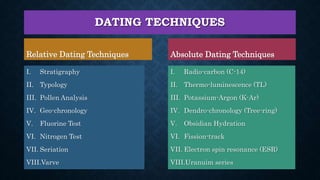
Relative Dating Techniques
I. Stratigraphy
II. Typology
III. Pollen Analysis
IV. Geo-chronology
V. Fluorine Test
VI. Nitrogen Test
VII. Seriation
VIII.Varve
Absolute Dating Techniques
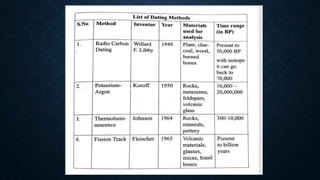
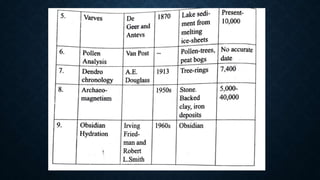
I. Radio-carbon (C-14)
II. Thermo-luminescence (TL)
III. Potassium-Argon (K-Ar)
IV. Dendro-chronology (Tree-ring)
V. Obsidian Hydration
VI. Fission-track
VII. Electron spin resonance (ESR)
VIII.Uranuim series
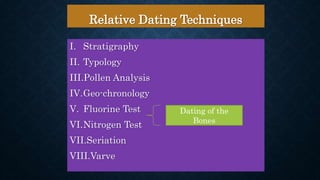
Relative Dating Techniques
I. Stratigraphy
II. Typology
III.Pollen Analysis
IV.Geo-chronology
V. Fluorine Test
VI.Nitrogen Test
VII.Seriation
VIII.Varve
Dating of the
Bones
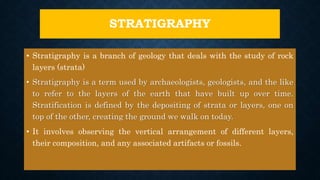
STRATIGRAPHY
• Stratigraphy is a branch of geology that deals with the study of rock
layers (strata)
• Stratigraphy is a term used by archaeologists, geologists, and the like
to refer to the layers of the earth that have built up over time.
Stratification is defined by the depositing of strata or layers, one on
top of the other, creating the ground we walk on today.
• It involves observing the vertical arrangement of different layers,
their composition, and any associated artifacts or fossils.
CONCEPT OF STRATIGRAPHY
• The concept of stratigraphy in geology was introduced by Sir Charles
Lyell in 1830 with the publication of his book “Principles of Geology”.
• Geological stratification is formed by a cyclic process of deposition or
denudation, the evolution of land or submergence beneath sea.
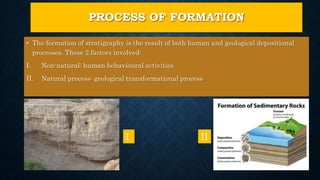
PROCESS OF FORMATION
• The formation of stratigraphy is the result of both human and geological depositional
processes. These 2 factors involved:
I. Non-natural: human behavioural activities
II. Natural process: geological transformational process
I II
GEOLOGICAL STRATIGRAPHY
• There are certain basic laws and notions that are followed in identifying
and studying Stratigraphy, they are:
1. Laws of Superposition
2. Laws of Original Horizontality
3. Laws of Lateral Continuity
4. Laws of Cross-cutting Relationship
5. Laws of Faunal Succession
TYPOLOGY
Typology is a method used in archaeology to organize artifacts into types based on
shared characteristics such as form, style, decoration, or function. While typology is
not a direct dating method in itself, it plays a crucial role in relative dating, where
artifacts are placed in sequence relative to each other based on their typological
similarities and differences. Typological analysis helps archaeologists establish
relative chronologies and understand the development and evolution of material
culture over time.
Stylistic Analysis
Cultural Classification
Functional Typology
POLLEN ANALYSIS
Pollen analysis, also known as palynology, is a dating method used in archaeology,
paleontology, and paleoecology to reconstruct past environments and landscapes. It
involves the study of pollen grains preserved in sedimentary deposits, such as lake or
bog sediments, archaeological sites, and soil profiles. Pollen analysis provides
valuable information about past vegetation, climate, and human activities, helping
archaeologists and researchers understand the dynamics of ancient ecosystems and
human-environment interactions.
The botanical samples are collected through a techniques called floatation
techniques.
GEOCHRONOLOGY
• Geochronology is the science of determining the ages of rocks, fossils, sediments,
and other geological or archaeological materials. It is a crucial discipline within
Earth sciences and archaeology, providing valuable information about the timing
of geological events, evolutionary processes, and human activities.
Geochronological techniques utilize various methods to establish the relative
ages of geological and archaeological materials.
• Geochronology plays a fundamental role in understanding Earth's history, the
evolution of life, and the timing of past events, providing essential context for
geological studies, evolutionary research, and archaeological investigations.
DATING OF THE BONES
The bones that are recovered from the archaeological investigations are
dated based on the following methods namely:
Amino acid method,
Fluorine method,
Nitrogen method and
Electron Spin Resonance (ESR) method.
FLUORINE METHOD
• The fluorine dating method is a relative dating technique used in archaeology to compare
the relative ages of fossils and artifacts based on the accumulation of fluorine in buried
bones and teeth.
• The principle behind fluorine dating is that bones and teeth buried in the ground
gradually absorb fluorine from the surrounding soil and groundwater over time.
• Over time, fluorine gradually infiltrates the bone or tooth structure, leading to an
increase in the fluorine content of the sample.
• By analyzing the fluorine content of different bones or teeth from the same
archaeological site or stratigraphic layer, archaeologists can compare their relative ages.
The basic premise is that older bones or teeth will have absorbed more fluorine than
younger ones because they have been buried for a longer period and have had more time
to accumulate fluorine.
NITROGEN METHOD
Bones are made up of calcium phosphate, fat and bone protein or
collagen. On death, the collagen decays at a uniform rate and turns
into nitrogen. Like fluorine method, the amount of presence of
nitrogen is measured and dated accordingly.
The rate of decay depends on physical and chemical composition of the
soil. However, one can differentiate the date of the bones collected
from a single deposit or from a single burial.
SERIATION
• Seriation is a relative dating method used in archaeology to arrange artifacts,
features, or sites into a chronological sequence based on their stylistic, typological,
or stratigraphic similarities and differences. The basic principle of seriation is that
artifacts change in style, form, or frequency over time, allowing archaeologists to
order them chronologically without needing absolute dates.
• It is broadly divided into two categories namely:
 Stylistic seriation: refers to a technique through which artefacts and attributes
are ordered according to similarity in style. Dish-on-stand, S-shaped jar,
perforated jar are some of the diagnostic style available in Harppan sites.
Frequency seriation: is more strictly oriented to chronological ordering of the
artifacts and assessing the origin, popularity and disuse of the artifacts. Painted
Grey Ware, Northern Black Polished Ware and Rouletted Ware were noticed in a
particular time range only.
VARVE ANALYSIS
• Streams flowing into still water bodies like lake commonly create silt deposit
in summer and clay deposit in winter.
• Varve analysis is a dating method used in geology and archaeology to
determine the age of sedimentary deposits, particularly those formed in
glacial or lacustrine environments. Varves are annual layers of sediment
deposited in bodies of water, such as lakes or glacial meltwater streams,
typically consisting of alternating layers of coarse and fine-grained
sediment. These layers form annually due to seasonal variations in sediment
input, often reflecting changes in precipitation, temperature, or glacial
activity.
Relative Dating Methods in Archaeology.pptx

Relative Dating Methods in Archaeology.pptx

  • 1.
    RELATIVE DATING METHODS INARCHAEOLOGY Unraveling the Timeline of Human History BY Dr. Rajiv Kumar Jaiswal Assistant Professor Dept. of AIHC & Archaeology Vasanta College for Women KFI, Rajghat Fort BHU, Varanasi
  • 2.
    INTRODUCTION TO DATINGMETHODS  The study of the past is to understand the human behavioural activities and cultural progress in a sequential order based on tangible and intangible evidences in a given socio-economic-cultural context.  The Archaeological data has to be placed in a chronological order to understand this sequential cultural process.  For this, various dating methods are being used in the archaeological investigations.
  • 3.
    IMPORTANCE OF DATINGMETHODS IN ARCHAEOLOGY  Dating in archaeology is crucial for several reasons: • Chronology Establishment: Dating allows archaeologists to establish the chronological order of artifacts, sites, and cultural phenomena. This chronological framework is essential for understanding the sequence of events in human history and the development of cultures. • Interpretation of Cultural Change: By dating artifacts and sites, archaeologists can track changes in material culture over time. This helps in interpreting shifts in technology, social organization, economy, and ideology, providing insights into how societies evolve and interact.
  • 4.
    CONT…. • Contextual Understanding:Dating helps archaeologists place artifacts and sites within their historical and cultural context. • Cross-Cultural Comparisons: Dating methods enable archaeologists to compare the development of different cultures and regions. By establishing timelines, researchers can identify similarities, differences, and connections between various societies
  • 5.
    DATING TECHNIQUES  Datingtechniques in archaeology are diverse, ranging from relative methods that provide a sequence of events without precise dates to absolute methods that assign specific chronological ages to artifacts and sites. Here's an introduction to some of the key dating techniques: 1. Relative Dating Methods 2. Absolute Dating Methods
  • 6.
    DATING TECHNIQUES Relative DatingTechniques I. Stratigraphy II. Typology III. Pollen Analysis IV. Geo-chronology V. Fluorine Test VI. Nitrogen Test VII. Seriation VIII.Varve Absolute Dating Techniques I. Radio-carbon (C-14) II. Thermo-luminescence (TL) III. Potassium-Argon (K-Ar) IV. Dendro-chronology (Tree-ring) V. Obsidian Hydration VI. Fission-track VII. Electron spin resonance (ESR) VIII.Uranuim series
  • 9.
    Relative Dating Techniques I.Stratigraphy II. Typology III.Pollen Analysis IV.Geo-chronology V. Fluorine Test VI.Nitrogen Test VII.Seriation VIII.Varve Dating of the Bones
  • 10.
    STRATIGRAPHY • Stratigraphy isa branch of geology that deals with the study of rock layers (strata) • Stratigraphy is a term used by archaeologists, geologists, and the like to refer to the layers of the earth that have built up over time. Stratification is defined by the depositing of strata or layers, one on top of the other, creating the ground we walk on today. • It involves observing the vertical arrangement of different layers, their composition, and any associated artifacts or fossils.
  • 11.
    CONCEPT OF STRATIGRAPHY •The concept of stratigraphy in geology was introduced by Sir Charles Lyell in 1830 with the publication of his book “Principles of Geology”. • Geological stratification is formed by a cyclic process of deposition or denudation, the evolution of land or submergence beneath sea.
  • 12.
    PROCESS OF FORMATION •The formation of stratigraphy is the result of both human and geological depositional processes. These 2 factors involved: I. Non-natural: human behavioural activities II. Natural process: geological transformational process I II
  • 13.
    GEOLOGICAL STRATIGRAPHY • Thereare certain basic laws and notions that are followed in identifying and studying Stratigraphy, they are: 1. Laws of Superposition 2. Laws of Original Horizontality 3. Laws of Lateral Continuity 4. Laws of Cross-cutting Relationship 5. Laws of Faunal Succession
  • 14.
    TYPOLOGY Typology is amethod used in archaeology to organize artifacts into types based on shared characteristics such as form, style, decoration, or function. While typology is not a direct dating method in itself, it plays a crucial role in relative dating, where artifacts are placed in sequence relative to each other based on their typological similarities and differences. Typological analysis helps archaeologists establish relative chronologies and understand the development and evolution of material culture over time. Stylistic Analysis Cultural Classification Functional Typology
  • 15.
    POLLEN ANALYSIS Pollen analysis,also known as palynology, is a dating method used in archaeology, paleontology, and paleoecology to reconstruct past environments and landscapes. It involves the study of pollen grains preserved in sedimentary deposits, such as lake or bog sediments, archaeological sites, and soil profiles. Pollen analysis provides valuable information about past vegetation, climate, and human activities, helping archaeologists and researchers understand the dynamics of ancient ecosystems and human-environment interactions. The botanical samples are collected through a techniques called floatation techniques.
  • 16.
    GEOCHRONOLOGY • Geochronology isthe science of determining the ages of rocks, fossils, sediments, and other geological or archaeological materials. It is a crucial discipline within Earth sciences and archaeology, providing valuable information about the timing of geological events, evolutionary processes, and human activities. Geochronological techniques utilize various methods to establish the relative ages of geological and archaeological materials. • Geochronology plays a fundamental role in understanding Earth's history, the evolution of life, and the timing of past events, providing essential context for geological studies, evolutionary research, and archaeological investigations.
  • 17.
    DATING OF THEBONES The bones that are recovered from the archaeological investigations are dated based on the following methods namely: Amino acid method, Fluorine method, Nitrogen method and Electron Spin Resonance (ESR) method.
  • 18.
    FLUORINE METHOD • Thefluorine dating method is a relative dating technique used in archaeology to compare the relative ages of fossils and artifacts based on the accumulation of fluorine in buried bones and teeth. • The principle behind fluorine dating is that bones and teeth buried in the ground gradually absorb fluorine from the surrounding soil and groundwater over time. • Over time, fluorine gradually infiltrates the bone or tooth structure, leading to an increase in the fluorine content of the sample. • By analyzing the fluorine content of different bones or teeth from the same archaeological site or stratigraphic layer, archaeologists can compare their relative ages. The basic premise is that older bones or teeth will have absorbed more fluorine than younger ones because they have been buried for a longer period and have had more time to accumulate fluorine.
  • 19.
    NITROGEN METHOD Bones aremade up of calcium phosphate, fat and bone protein or collagen. On death, the collagen decays at a uniform rate and turns into nitrogen. Like fluorine method, the amount of presence of nitrogen is measured and dated accordingly. The rate of decay depends on physical and chemical composition of the soil. However, one can differentiate the date of the bones collected from a single deposit or from a single burial.
  • 20.
    SERIATION • Seriation isa relative dating method used in archaeology to arrange artifacts, features, or sites into a chronological sequence based on their stylistic, typological, or stratigraphic similarities and differences. The basic principle of seriation is that artifacts change in style, form, or frequency over time, allowing archaeologists to order them chronologically without needing absolute dates. • It is broadly divided into two categories namely:  Stylistic seriation: refers to a technique through which artefacts and attributes are ordered according to similarity in style. Dish-on-stand, S-shaped jar, perforated jar are some of the diagnostic style available in Harppan sites. Frequency seriation: is more strictly oriented to chronological ordering of the artifacts and assessing the origin, popularity and disuse of the artifacts. Painted Grey Ware, Northern Black Polished Ware and Rouletted Ware were noticed in a particular time range only.
  • 21.
    VARVE ANALYSIS • Streamsflowing into still water bodies like lake commonly create silt deposit in summer and clay deposit in winter. • Varve analysis is a dating method used in geology and archaeology to determine the age of sedimentary deposits, particularly those formed in glacial or lacustrine environments. Varves are annual layers of sediment deposited in bodies of water, such as lakes or glacial meltwater streams, typically consisting of alternating layers of coarse and fine-grained sediment. These layers form annually due to seasonal variations in sediment input, often reflecting changes in precipitation, temperature, or glacial activity.