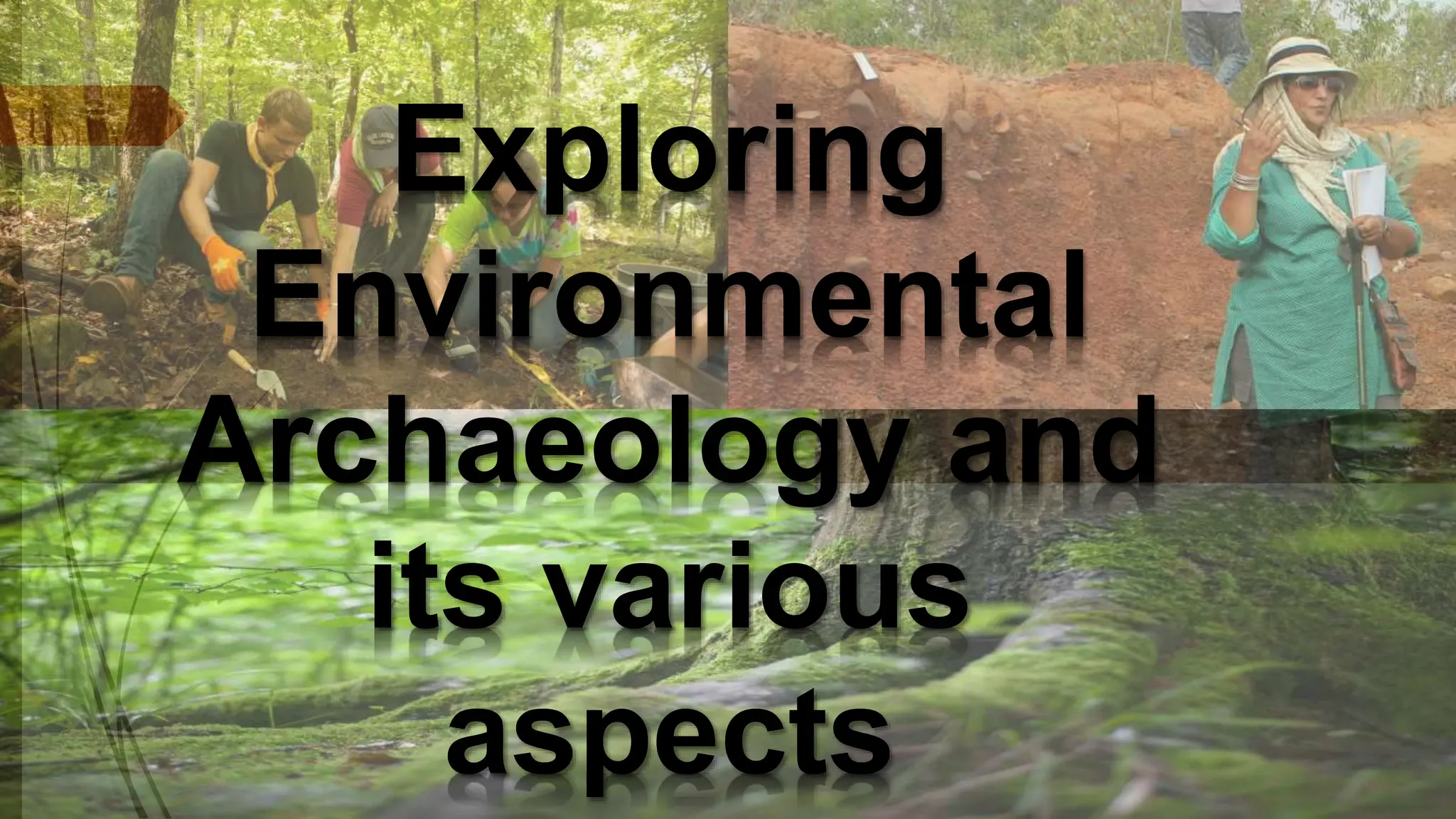
Exploring
Environmental
Archaeology and
its various
aspects
In this presentation, I’ll delve into
the interdisciplinary nature of
Environmental Archaeology and
its significance in understanding
past ecosystems and human
environment interactions.
Defining Environmental Archaeology
Environmental archaeology is a
field that combines archaeological
and environmental sciences to study
how humans interacted with and
influenced their environment in the
past. It examines the physical
remains of ancient civilizations,
such as plant and animal remains,
sediments, and artifacts, to
reconstruct past environments and
understand human-environment
relationships.
Its significance
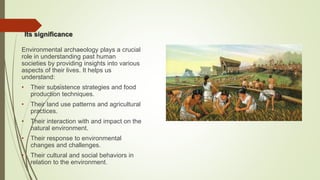
Environmental archaeology plays a crucial
role in understanding past human
societies by providing insights into various
aspects of their lives. It helps us
understand:
• Their subsistence strategies and food
production techniques.
• Their land use patterns and agricultural
practices.
• Their interaction with and impact on the
natural environment.
• Their response to environmental
changes and challenges.
• Their cultural and social behaviors in
relation to the environment.
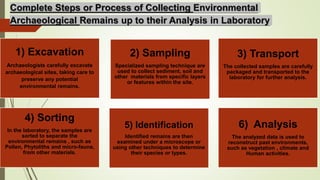
Complete Steps or Process of Collecting Environmental
Archaeological Remains up to their Analysis in Laboratory
1) Excavation
Archaeologists carefully excavate
archaeological sites, taking care to
preserve any potential
environmental remains.
2) Sampling
Specialized sampling technique are
used to collect sediment, soil and
other materials from specific layers
or features within the site.
3) Transport
The collected samples are carefully
packaged and transported to the
laboratory for further analysis.
4) Sorting
In the laboratory, the samples are
sorted to separate the
environmental remains , such as
Pollen, Phytoliths and micro-fauna,
from other materials.
5) Identification
Identified remains are then
examined under a microscope or
using other techniques to determine
their species or types.
6) Analysis
The analyzed data is used to
reconstruct past environments,
such as vegetation , climate and
Human activities.
Various Sub-fields of
Environmental
Archaeology
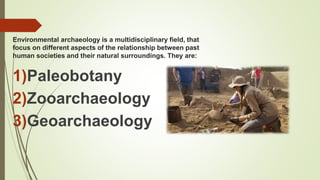
Environmental archaeology is a multidisciplinary field, that
focus on different aspects of the relationship between past
human societies and their natural surroundings. They are:
1)Paleobotany
2)Zooarchaeology
3)Geoarchaeology
Paleobotany
What is Palaeobotany?
Palaeobotany is the study of ancient plant remains. It involves the
analysis of plant fossils, pollen, and other botanical materials found in
archaeological sites. By examining these plant remains, researchers can
gain insights into the past environment, including the vegetation,
climate, and ecological conditions of ancient times.
How Paleobotany helps in understanding the past environment?
Palaeobotany plays a crucial role in understanding the past
environment by providing valuable information about the interactions
between plants and their surroundings. It helps researchers:
• Reconstruct ancient ecosystems and landscapes.
• Identify past climate changes and fluctuations.
• Study the adaptations of plants to different environmental
conditions.
• Understand the impact of human activities on the environment.
• Gain insights into the availability of resources and the use of plants
by ancient societies.
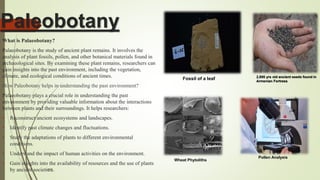
2,800 yrs old ancient seeds found in
Armenian Fortress
Wheat Phytoliths
Pollen Analysis
Fossil of a leaf
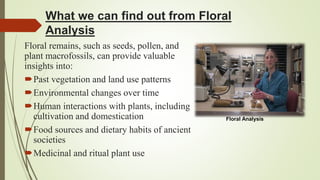
What we can find out from Floral
Analysis
Floral remains, such as seeds, pollen, and
plant macrofossils, can provide valuable
insights into:
Past vegetation and land use patterns
Environmental changes over time
Human interactions with plants, including
cultivation and domestication
Food sources and dietary habits of ancient
societies
Medicinal and ritual plant use
Floral Analysis
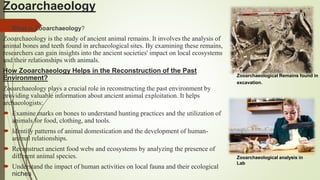
Zooarchaeology
 What is Zooarchaeology?
Zooarchaeology is the study of ancient animal remains. It involves the analysis of
animal bones and teeth found in archaeological sites. By examining these remains,
researchers can gain insights into the ancient societies' impact on local ecosystems
and their relationships with animals.
How Zooarchaeology Helps in the Reconstruction of the Past
Environment?
Zooarchaeology plays a crucial role in reconstructing the past environment by
providing valuable information about ancient animal exploitation. It helps
archaeologists:
 Examine marks on bones to understand hunting practices and the utilization of
animals for food, clothing, and tools.
 Identify patterns of animal domestication and the development of human-
animal relationships.
 Reconstruct ancient food webs and ecosystems by analyzing the presence of
different animal species.
 Understand the impact of human activities on local fauna and their ecological
niches
Zooarchaeological Remains found in
excavation.
Zooarchaeological analysis in
Lab
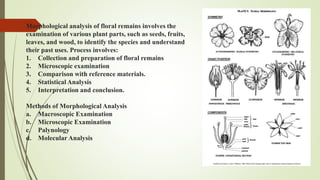
Morphological analysis of floral remains involves the
examination of various plant parts, such as seeds, fruits,
leaves, and wood, to identify the species and understand
their past uses. Process involves:
1. Collection and preparation of floral remains
2. Microscopic examination
3. Comparison with reference materials.
4. Statistical Analysis
5. Interpretation and conclusion.
Methods of Morphological Analysis
a. Macroscopic Examination
b. Microscopic Examination
c. Palynology
d. Molecular Analysis
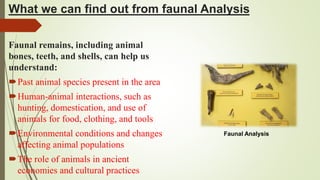
What we can find out from faunal Analysis
Faunal remains, including animal
bones, teeth, and shells, can help us
understand:
Past animal species present in the area
Human-animal interactions, such as
hunting, domestication, and use of
animals for food, clothing, and tools
Environmental conditions and changes
affecting animal populations
The role of animals in ancient
economies and cultural practices
Faunal Analysis
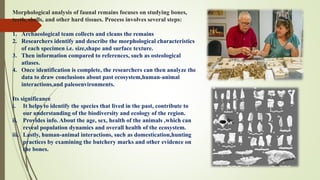
Morphological analysis of faunal remains focuses on studying bones,
teeth, shells, and other hard tissues. Process involves several steps:
1. Archaeological team collects and cleans the remains
2. Researchers identify and describe the morphological characteristics
of each specimen i.e. size,shape and surface texture.
3. Then information compared to references, such as osteological
atlases.
4. Once identification is complete, the researchers can then analyze the
data to draw conclusions about past ecosystem,human-animal
interactions,and paleoenvironments.
Its significance
i. It helps to identify the species that lived in the past, contribute to
our understanding of the biodiversity and ecology of the region.
ii. Provides info. About the age, sex, health of the animals ,which can
reveal population dynamics and overall health of the ecosystem.
iii. Lastly, human-animal interactions, such as domestication,hunting
practices by examining the butchery marks and other evidence on
the bones.
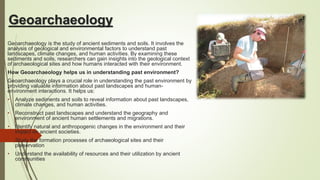
Geoarchaeology
Geoarchaeology is the study of ancient sediments and soils. It involves the
analysis of geological and environmental factors to understand past
landscapes, climate changes, and human activities. By examining these
sediments and soils, researchers can gain insights into the geological context
of archaeological sites and how humans interacted with their environment.
How Geoarchaeology helps us in understanding past environment?
Geoarchaeology plays a crucial role in understanding the past environment by
providing valuable information about past landscapes and human-
environment interactions. It helps us:
• Analyze sediments and soils to reveal information about past landscapes,
climate changes, and human activities.
• Reconstruct past landscapes and understand the geography and
environment of ancient human settlements and migrations.
• Identify natural and anthropogenic changes in the environment and their
impact on ancient societies.
• Study the formation processes of archaeological sites and their
preservation
• Understand the availability of resources and their utilization by ancient
communities
Conclusion
Environmental archaeology plays a crucial role in the field of archaeology, providing valuable insights into past
human-environment interactions. By studying environmental remains and analyzing their context, environmental
archaeologists contribute to our understanding of ancient civilizations, their ways of life, and the impact they had on
the natural world. Here are some key points that highlight the importance of environmental archaeology:
Reconstructing Past Environments:
Environmental archaeology helps reconstruct past environments by analyzing various types of environmental
remains, such as pollen, plant macrofossils, animal bones, and sediment samples. By examining these remains,
archaeologists can determine past climate conditions, vegetation patterns, and the availability of resources.
Understanding Human-Environment Interactions:
Environmental archaeology provides insights into how ancient societies interacted with and adapted to their
environments. By studying the relationship between cultural remains and environmental data, archaeologists can
understand how past societies utilized natural resources, practiced agriculture, managed landscapes, and responded
to environmental changes
Identifying Subsistence Strategies and Diet:
Through the analysis of plant and animal remains, environmental archaeology helps identify subsistence strategies
and reconstruct ancient diets. By studying the remains of crops, seeds, animal bones, and other food-related
materials, archaeologists can determine what people ate in the past, how they obtained their food, and how their diets
changed over time.
Tracing the Origins and Spread of Domesticated Plants and Animals:
Environmental archaeology contributes to our understanding of the origins and spread of domesticated plants and
animals. By analyzing plant and animal remains, archaeologists can identify the early stages of domestication, track
the movement of domesticated species across regions, and study the impact of domestication on human societies
The potential for future research and discoveries in the field of environmental archaeology is vast. With
advancements in scientific techniques and interdisciplinary approaches, we can expect further insights into ancient

Environmental archaeology and various aspects.pptx

  • 1.
  • 2.
    In this presentation,I’ll delve into the interdisciplinary nature of Environmental Archaeology and its significance in understanding past ecosystems and human environment interactions.
  • 3.
    Defining Environmental Archaeology Environmentalarchaeology is a field that combines archaeological and environmental sciences to study how humans interacted with and influenced their environment in the past. It examines the physical remains of ancient civilizations, such as plant and animal remains, sediments, and artifacts, to reconstruct past environments and understand human-environment relationships.
  • 4.
    Its significance Environmental archaeologyplays a crucial role in understanding past human societies by providing insights into various aspects of their lives. It helps us understand: • Their subsistence strategies and food production techniques. • Their land use patterns and agricultural practices. • Their interaction with and impact on the natural environment. • Their response to environmental changes and challenges. • Their cultural and social behaviors in relation to the environment.
  • 5.
    Complete Steps orProcess of Collecting Environmental Archaeological Remains up to their Analysis in Laboratory 1) Excavation Archaeologists carefully excavate archaeological sites, taking care to preserve any potential environmental remains. 2) Sampling Specialized sampling technique are used to collect sediment, soil and other materials from specific layers or features within the site. 3) Transport The collected samples are carefully packaged and transported to the laboratory for further analysis. 4) Sorting In the laboratory, the samples are sorted to separate the environmental remains , such as Pollen, Phytoliths and micro-fauna, from other materials. 5) Identification Identified remains are then examined under a microscope or using other techniques to determine their species or types. 6) Analysis The analyzed data is used to reconstruct past environments, such as vegetation , climate and Human activities.
  • 6.
  • 7.
    Environmental archaeology isa multidisciplinary field, that focus on different aspects of the relationship between past human societies and their natural surroundings. They are: 1)Paleobotany 2)Zooarchaeology 3)Geoarchaeology
  • 8.
    Paleobotany What is Palaeobotany? Palaeobotanyis the study of ancient plant remains. It involves the analysis of plant fossils, pollen, and other botanical materials found in archaeological sites. By examining these plant remains, researchers can gain insights into the past environment, including the vegetation, climate, and ecological conditions of ancient times. How Paleobotany helps in understanding the past environment? Palaeobotany plays a crucial role in understanding the past environment by providing valuable information about the interactions between plants and their surroundings. It helps researchers: • Reconstruct ancient ecosystems and landscapes. • Identify past climate changes and fluctuations. • Study the adaptations of plants to different environmental conditions. • Understand the impact of human activities on the environment. • Gain insights into the availability of resources and the use of plants by ancient societies. 2,800 yrs old ancient seeds found in Armenian Fortress Wheat Phytoliths Pollen Analysis Fossil of a leaf
  • 9.
    What we canfind out from Floral Analysis Floral remains, such as seeds, pollen, and plant macrofossils, can provide valuable insights into: Past vegetation and land use patterns Environmental changes over time Human interactions with plants, including cultivation and domestication Food sources and dietary habits of ancient societies Medicinal and ritual plant use Floral Analysis
  • 10.
    Zooarchaeology  What isZooarchaeology? Zooarchaeology is the study of ancient animal remains. It involves the analysis of animal bones and teeth found in archaeological sites. By examining these remains, researchers can gain insights into the ancient societies' impact on local ecosystems and their relationships with animals. How Zooarchaeology Helps in the Reconstruction of the Past Environment? Zooarchaeology plays a crucial role in reconstructing the past environment by providing valuable information about ancient animal exploitation. It helps archaeologists:  Examine marks on bones to understand hunting practices and the utilization of animals for food, clothing, and tools.  Identify patterns of animal domestication and the development of human- animal relationships.  Reconstruct ancient food webs and ecosystems by analyzing the presence of different animal species.  Understand the impact of human activities on local fauna and their ecological niches Zooarchaeological Remains found in excavation. Zooarchaeological analysis in Lab
  • 11.
    Morphological analysis offloral remains involves the examination of various plant parts, such as seeds, fruits, leaves, and wood, to identify the species and understand their past uses. Process involves: 1. Collection and preparation of floral remains 2. Microscopic examination 3. Comparison with reference materials. 4. Statistical Analysis 5. Interpretation and conclusion. Methods of Morphological Analysis a. Macroscopic Examination b. Microscopic Examination c. Palynology d. Molecular Analysis
  • 12.
    What we canfind out from faunal Analysis Faunal remains, including animal bones, teeth, and shells, can help us understand: Past animal species present in the area Human-animal interactions, such as hunting, domestication, and use of animals for food, clothing, and tools Environmental conditions and changes affecting animal populations The role of animals in ancient economies and cultural practices Faunal Analysis
  • 13.
    Morphological analysis offaunal remains focuses on studying bones, teeth, shells, and other hard tissues. Process involves several steps: 1. Archaeological team collects and cleans the remains 2. Researchers identify and describe the morphological characteristics of each specimen i.e. size,shape and surface texture. 3. Then information compared to references, such as osteological atlases. 4. Once identification is complete, the researchers can then analyze the data to draw conclusions about past ecosystem,human-animal interactions,and paleoenvironments. Its significance i. It helps to identify the species that lived in the past, contribute to our understanding of the biodiversity and ecology of the region. ii. Provides info. About the age, sex, health of the animals ,which can reveal population dynamics and overall health of the ecosystem. iii. Lastly, human-animal interactions, such as domestication,hunting practices by examining the butchery marks and other evidence on the bones.
  • 14.
    Geoarchaeology Geoarchaeology is thestudy of ancient sediments and soils. It involves the analysis of geological and environmental factors to understand past landscapes, climate changes, and human activities. By examining these sediments and soils, researchers can gain insights into the geological context of archaeological sites and how humans interacted with their environment. How Geoarchaeology helps us in understanding past environment? Geoarchaeology plays a crucial role in understanding the past environment by providing valuable information about past landscapes and human- environment interactions. It helps us: • Analyze sediments and soils to reveal information about past landscapes, climate changes, and human activities. • Reconstruct past landscapes and understand the geography and environment of ancient human settlements and migrations. • Identify natural and anthropogenic changes in the environment and their impact on ancient societies. • Study the formation processes of archaeological sites and their preservation • Understand the availability of resources and their utilization by ancient communities
  • 15.
    Conclusion Environmental archaeology playsa crucial role in the field of archaeology, providing valuable insights into past human-environment interactions. By studying environmental remains and analyzing their context, environmental archaeologists contribute to our understanding of ancient civilizations, their ways of life, and the impact they had on the natural world. Here are some key points that highlight the importance of environmental archaeology: Reconstructing Past Environments: Environmental archaeology helps reconstruct past environments by analyzing various types of environmental remains, such as pollen, plant macrofossils, animal bones, and sediment samples. By examining these remains, archaeologists can determine past climate conditions, vegetation patterns, and the availability of resources. Understanding Human-Environment Interactions: Environmental archaeology provides insights into how ancient societies interacted with and adapted to their environments. By studying the relationship between cultural remains and environmental data, archaeologists can understand how past societies utilized natural resources, practiced agriculture, managed landscapes, and responded to environmental changes Identifying Subsistence Strategies and Diet: Through the analysis of plant and animal remains, environmental archaeology helps identify subsistence strategies and reconstruct ancient diets. By studying the remains of crops, seeds, animal bones, and other food-related materials, archaeologists can determine what people ate in the past, how they obtained their food, and how their diets changed over time. Tracing the Origins and Spread of Domesticated Plants and Animals: Environmental archaeology contributes to our understanding of the origins and spread of domesticated plants and animals. By analyzing plant and animal remains, archaeologists can identify the early stages of domestication, track the movement of domesticated species across regions, and study the impact of domestication on human societies The potential for future research and discoveries in the field of environmental archaeology is vast. With advancements in scientific techniques and interdisciplinary approaches, we can expect further insights into ancient