Basic Elements of Religion
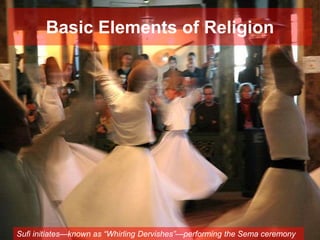
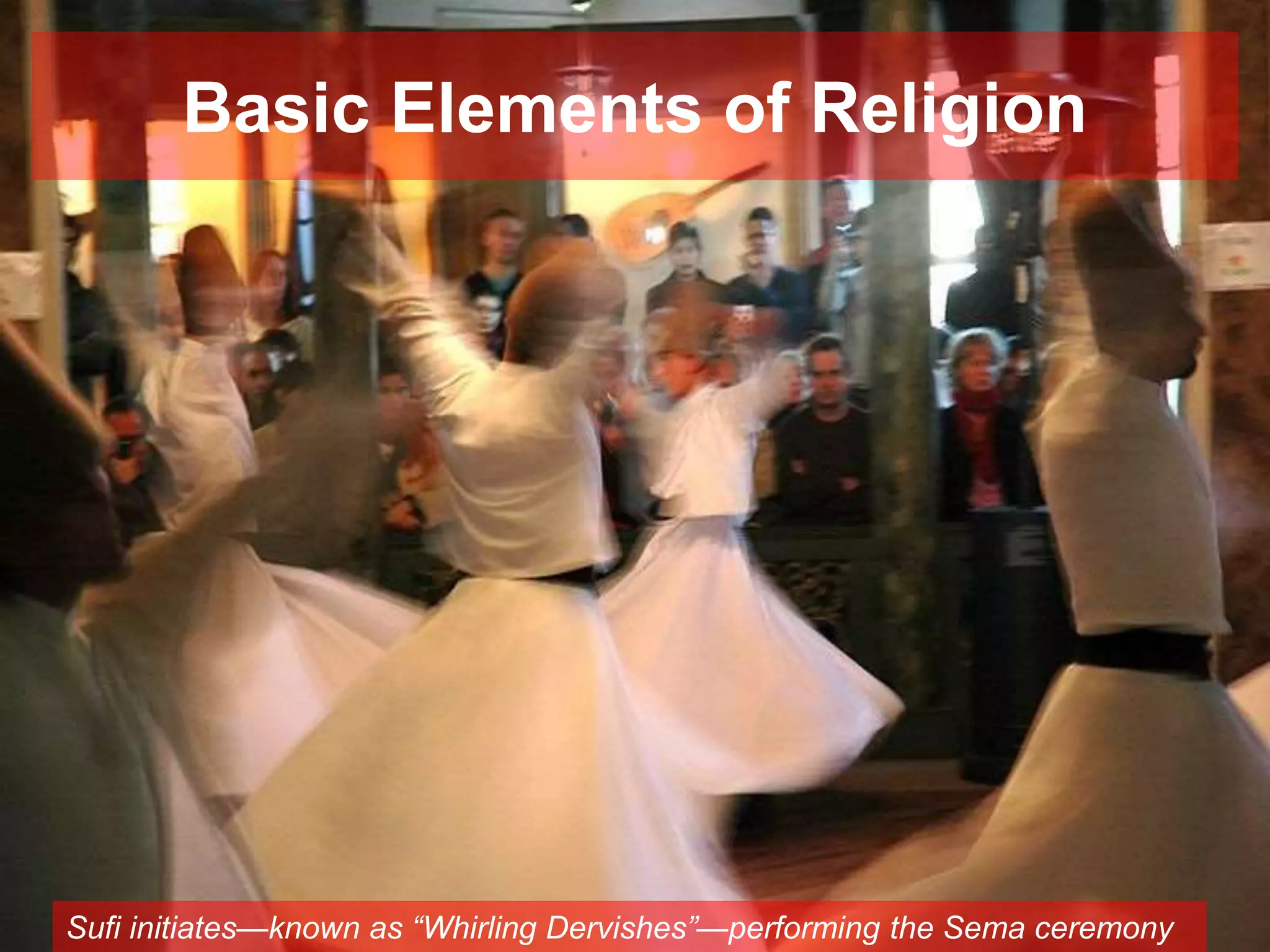
Sufi initiates—known as “Whirling Dervishes”—performing the Sema ceremony
Basic Elements of Religion
• Myths/Doctrines
• Rituals
• Religious Specialists
Myths/Doctrine
• Myths/Doctrine
– Religious narratives/stories providing a
framework for religious beliefs/practices
– Codify worldviews by providing:
• understanding of how the world works
• template for reality
• understanding the origin of humans
Myths
• Myths
– Usually oral tradition, often indirect messages
• Can change through time
• Recited or performed
– Common myths:
• Origin/creation
• Heroes
• Apocalypse
• Tricksters
Doctrine
• Direct statements about religious beliefs,
formalized and written
• Associated with state-level religions
– May be subject to analysis
– May be more stable through time
– Translations a source of change
– Many have roots in oral traditions
– Bible: many translations
– Qur’an: no translations
• Literal meaning: “the recitation”
Rituals
Ritual: a patterned, recurring sequence of
events
Situational Ritual
• Life-cycle rituals (Rites of Passage)
– E.g. birth, coming of age, marriage, death
• Three phases:
– Separation, Transition, Reintegration
Rituals
Periodic Ritual
• Pilgrimage
– E.g. the annual Hajj to Mecca
– Many others: Christian, Hindu, Buddhism,
Judaism, etc.
• Daily Prayers (Islam)
Religious Specialists
• Degree of religious specialization linked
with degree of social complexity
– Small-scale society: rituals performed by many
or all adults
– Large-scale society: rituals performed by
specialists
• Main types: Shaman vs. Priest
• Other types: Prophet, Diviner, Religious
Healers, etc.
Shaman
• Religious specialist with direct association with
supernaturals
– Receives power directly from the spirit world
• communication through altered states of consciousness
– Most associated with non-state societies, part-time
– “Called” to the profession
Priest
• Associated with states, full-time religious
specialists
• Formal training, given authority by formal
groups
– May come from priestly lineage
– Perform wider range of rituals
– Rituals reinforce belief systems, ethical codes
– Often associated with dedicated spaces
Diviners
• Answer questions or communicate with
supernatural using rituals
• Ancient practice
• Many forms:
– Astrology
– Taromancy
– Extispicy
– Auspicy
– Scapulamancy
– Tasseography
Prophets
• Prophets
– A living mouthpiece of the gods
• communicate the will of the gods
• an intermediary between the community and the
gods
• often have visions/dreams
• charismatic
• begin new religions

Basic elements of religion

  • 1.
    Basic Elements ofReligion Sufi initiates—known as “Whirling Dervishes”—performing the Sema ceremony
  • 2.
    Basic Elements ofReligion • Myths/Doctrines • Rituals • Religious Specialists
  • 3.
    Myths/Doctrine • Myths/Doctrine – Religiousnarratives/stories providing a framework for religious beliefs/practices – Codify worldviews by providing: • understanding of how the world works • template for reality • understanding the origin of humans
  • 4.
    Myths • Myths – Usuallyoral tradition, often indirect messages • Can change through time • Recited or performed – Common myths: • Origin/creation • Heroes • Apocalypse • Tricksters
  • 5.
    Doctrine • Direct statementsabout religious beliefs, formalized and written • Associated with state-level religions – May be subject to analysis – May be more stable through time – Translations a source of change – Many have roots in oral traditions – Bible: many translations – Qur’an: no translations • Literal meaning: “the recitation”
  • 6.
    Rituals Ritual: a patterned,recurring sequence of events Situational Ritual • Life-cycle rituals (Rites of Passage) – E.g. birth, coming of age, marriage, death • Three phases: – Separation, Transition, Reintegration
  • 7.
    Rituals Periodic Ritual • Pilgrimage –E.g. the annual Hajj to Mecca – Many others: Christian, Hindu, Buddhism, Judaism, etc. • Daily Prayers (Islam)
  • 8.
    Religious Specialists • Degreeof religious specialization linked with degree of social complexity – Small-scale society: rituals performed by many or all adults – Large-scale society: rituals performed by specialists • Main types: Shaman vs. Priest • Other types: Prophet, Diviner, Religious Healers, etc.
  • 9.
    Shaman • Religious specialistwith direct association with supernaturals – Receives power directly from the spirit world • communication through altered states of consciousness – Most associated with non-state societies, part-time – “Called” to the profession
  • 10.
    Priest • Associated withstates, full-time religious specialists • Formal training, given authority by formal groups – May come from priestly lineage – Perform wider range of rituals – Rituals reinforce belief systems, ethical codes – Often associated with dedicated spaces
  • 11.
    Diviners • Answer questionsor communicate with supernatural using rituals • Ancient practice • Many forms: – Astrology – Taromancy – Extispicy – Auspicy – Scapulamancy – Tasseography
  • 12.
    Prophets • Prophets – Aliving mouthpiece of the gods • communicate the will of the gods • an intermediary between the community and the gods • often have visions/dreams • charismatic • begin new religions