Conventions for Archaeological Stratigraphic
and Chronological Data
Presented by
Keith May FSA
Historic England
Visiting Prof at University of South Wales
@Keith_May
Dr James Taylor
University of York
Co-Field Director: Çatalhöyük
Ceri Binding
University of South Wales
Hypermedia Research Unit
Group
1
Group 2
Sub-Group
3.1
Group 3
Group 4
Sub-Group
2.1
Sub-Group
2.2
Phase 1
Phase 2
Phase 3
Phase 4
Phase 5
Phase 6
Sub-Group
3.2
CAA2023 Amsterdam
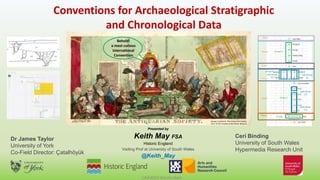
George Cruikshank. The Antiquarian Society.
1812. © The Trustees of the British Museum
Behold!
a most curious
International
Convention
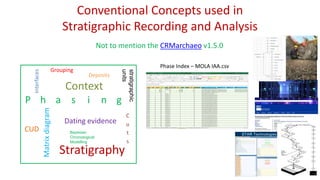
Conventional Concepts used in
Stratigraphic Recording and Analysis
Not to mention the CRMarchaeo v1.5.0
Phase Index – MOLA IAA.csv
CUD
Matrix
diagram
Dating evidence
Grouping
P h a s i n g
Stratigraphy
Bayesian
Chronological
Modelling
stratigraphic
units
Context
Deposits
Interfaces
C
u
t
s
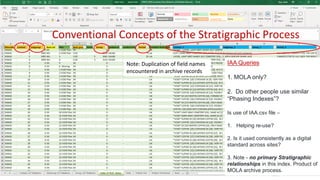
Conventional Concepts of the Stratigraphic Process
Note: Duplication of field names
encountered in archive records
IAA Queries
1. MOLA only?
2. Do other people use similar
“Phasing Indexes”?
Is use of IAA.csv file –
1. Helping re-use?
2. Is it used consistently as a digital
standard across sites?
3. Note - no primary Stratigraphic
relationships in this index. Product of
MOLA archive process.
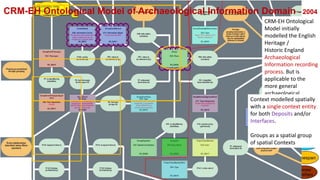
CRM-EH Ontological Model of Archaeological Information Domain - 2004
CRM-EH Ontological
Model initially
modelled the English
Heritage /
Historic England
Archaeological
Information recording
process. But is
applicable to the
more general
archaeological
methodology Single
Context Recording in
the UK (Harris Matrix)
Context modelled spatially
with a single context entity
for both Deposits and/or
Interfaces.
Groups as a spatial group
of spatial Contexts
CIDOC CRM - CRMarchaeo
“Archaeological Excavation Process” extension – followed on from CRM-EH
Fig. 4: Section drawing with A3 Stratigraphic Interfaces in square brackets [ ], A2 Stratigraphic Volume
Unit in round brackets (), the surfaces S1 and S2 created through A1 Excavation Process Units using
different methodologies and an A7 Embedding of a coin.
A1 Excavation Process Unit
A3 Stratigraphic Interface
A2 Stratigraphic Volume Unit
A7 Embedding
AP4 produced surface S1
with stratigraphic method
AP4 produced surface S2
with spit excavation method
CRMarchaeo v 1.4.8 (Feb 2019)
Image
Copyright
Lucasfilm
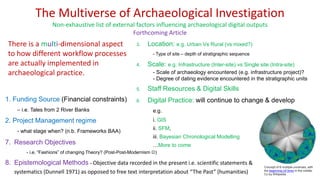
The Multiverse of Archaeological Investigation
Non-exhaustive list of external factors influencing archaeological digital outputs
Forthcoming Article
There is a multi-dimensional aspect
to how different workflow processes
are actually implemented in
archaeological practice.
1. Funding Source (Financial constraints)
– i.e. Tales from 2 River Banks
2. Project Management regime
- what stage when? (n.b. Frameworks BAA)
7. Research Objectives
- i.e. “Fashions” of changing Theory? (Post-Post-Modernism )
8. Epistemological Methods - Objective data recorded in the present i.e. scientific statements &
systematics (Dunnell 1971) as opposed to free text interpretation about “The Past” (humanities)
3. Location: e.g. Urban Vs Rural (vs mixed?)
- Type of site – depth of stratigraphic sequence
4. Scale: e.g. Infrastructure (Inter-site) vs Single site (Intra-site)
- Scale of archaeology encountered (e.g. infrastructure project)?
- Degree of dating evidence encountered in the stratigraphic units
5. Staff Resources & Digital Skills
6. Digital Practice: will continue to change & develop
e.g.
i. GIS
ii. SFM,
iii. Bayesian Chronological Modelling
…More to come
Concept of 8 multiple universes, with
the beginning (of time) in the middle.
Cc-by Wikipedia
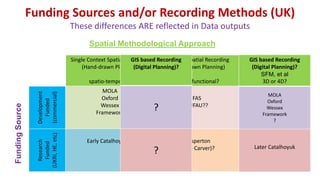
Funding Sources and/or Recording Methods (UK)
These differences ARE reflected in Data outputs
Spatial Methodological Approach
Single Context Spatial Recording
(Hand-drawn Planning)
spatio-temporal?
Features Spatial Recording
(Hand-drawn Planning)
Spatio-functional?
Funding
Source
Development
Funded
(commercial)
MOLA
Oxford
Wessex
Framework
FAS
BUFAU??
Research
Funded
(UKRI,
HE,
etc)
Early Catalhoyuk?? Wasperton
(FAS - Carver)?
GIS based Recording
(Digital Planning)?
?
?
GIS based Recording
(Digital Planning)?
SFM, et al
3D or 4D?
MOLA
Oxford
Wessex
Framework
?
Later Catalhoyuk
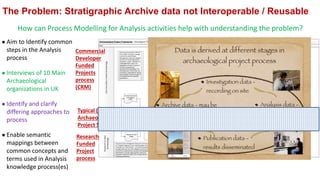
How can Process Modelling for Analysis activities help with understanding the problem?
● Aim to Identify common
steps in the Analysis
process
● Interviews of 10 Main
Archaeological
organizations in UK
● Identify and clarify
differing approaches to
process
● Enable semantic
mappings between
common concepts and
terms used in Analysis
knowledge process(es)
Research
Funded
Project
process
Commercial
Developer
Funded
Projects
process
(CRM)
Typical (UK)
Archaeology
Project Stages
Published
Stratigraphic
Data
Archived
Stratigraphic
Data
Excavation - Archived
Stratigraphic
Data
Analyzed
Stratigraphic
Data
Re-Use Previous
Excavations
Stratigraphic Data
The Problem: Stratigraphic Archive data not Interoperable / Reusable
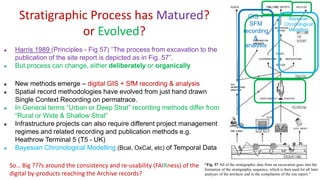
Stratigraphic Process has Matured?
or Evolved?
● Harris 1989 (Principles - Fig 57) “The process from excavation to the
publication of the site report is depicted as in Fig. 57”.
● But process can change, either deliberately or organically
● New methods emerge – digital GIS + SfM recording & analysis
● Spatial record methodologies have evolved from just hand drawn
Single Context Recording on permatrace.
● In General terms “Urban or Deep Strat” recording methods differ from
“Rural or Wide & Shallow Strat”
● Infrastructure projects can also require different project management
regimes and related recording and publication methods e.g.
Heathrow Terminal 5 (T5 - UK)
● Bayesian Chronological Modelling (Bcal, OxCal, etc) of Temporal Data
“Fig. 57 All of the stratigraphic data from an excavation goes into the
formation of the stratigraphic sequence, which is then used for all later
analyses of the artefacts and in the compilation of the site report.”
GIS +
SFM
recording
&
analysis
Bayesian
Chronological
Modelling
So… Big ???s around the consistency and re-usability (FAIRness) of the
digital by-products reaching the Archive records?
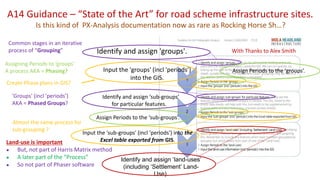
A14 Guidance – “State of the Art” for road scheme infrastructure sites.
Land-use is important
● But, not part of Harris Matrix method
● A later part of the “Process”
● So not part of Phaser software
Identify and assign ‘sub-groups’
for particular features.
Assign Periods to the 'groups’.
Input the 'groups' (incl 'periods’)
into the GIS.
Identify and assign 'groups'.
Assign Periods to the ‘sub-groups’.
Input the 'sub-groups' (incl 'periods') into the
Excel table exported from GIS.
Identify and assign ‘land-uses’
(including ‘Settlement’ Land-
Use).
Common stages in an iterative
process of “Grouping”
Assigning Periods to ‘groups’
A process AKA = Phasing?
'Groups' (incl 'periods’)
AKA = Phased Groups?
Create Phase plans in GIS?
Almost the same process for
sub-grouping ?
With Thanks to Alex Smith
Is this kind of PX-Analysis documentation now as rare as Rocking Horse Sh…?
P18
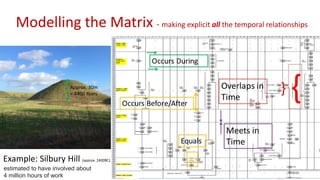
Modelling the Matrix - making explicit all the temporal relationships
Example: Silbury Hill (approx. 2400BC)
Approx. 30m
= 4400 Years
estimated to have involved about
4 million hours of work
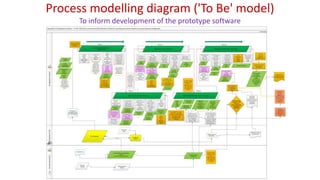
Process modelling diagram ('To Be' model)
To inform development of the prototype software
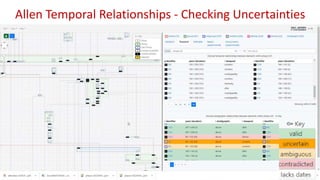
Allen Temporal Relationships - Checking Uncertainties
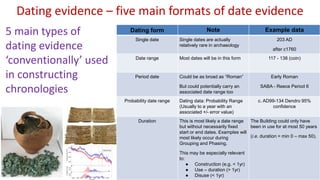
Dating evidence – five main formats of date evidence
Dating form Note Example data
Single date Single dates are actually
relatively rare in archaeology
203 AD
after c1760
Date range Most dates will be in this form 117 - 138 (coin)
Period date Could be as broad as “Roman”
But could potentially carry an
associated date range too
Early Roman
SABA - Reece Period 6
Probability date range Dating data: Probability Range
(Usually to a year with an
associated +/- error value)
c. AD99-134 Dendro 95%
confidence
Duration This is most likely a date range
but without necessarily fixed
start or end dates. Examples will
most likely occur during
Grouping and Phasing.
This may be especially relevant
to:
● Construction (e.g. < 1yr)
● Use – duration (> 1yr)
● Disuse (< 1yr)
The Building could only have
been in use for at most 50 years
(i.e. duration = min 0 – max 50).
5 main types of
dating evidence
‘conventionally’ used
in constructing
chronologies
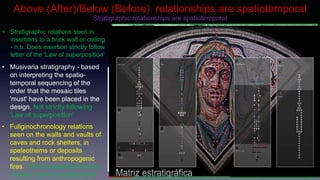
• Musivaria stratigraphy - based
on interpreting the spatio-
temporal sequencing of the
order that the mosaic tiles
'must' have been placed in the
design. Not strictly following
'Law of superposition'
• Stratigraphic relations seen in
insertions to a brick wall or ceiling
- n.b. Does insertion strictly follow
letter of the 'Law of superposition'
Above (After)/Below (Before) relationships are spatiotemporal
• Fuliginochronology relations
seen on the walls and vaults of
caves and rock shelters, in
speleothems or deposits
resulting from anthropogenic
fires. Strictly speaking follows
inverse 'Law of superposition'
Law of Superposition: ”The principle is taken from geology.
Deposits or strata of rock can be observed superimposed one on
another. The stratum at the bottom of a series will have been laid
down earliest and those above it successively through time from
bottom to top” (Browne 1975: 21).
Law of Stratigraphical Succession: any given unit of archaeological
stratification takes its place in the stratigraphic sequence of a site
from its position between the undermost of all units which lie above it
and the uppermost of all those units which lie below it and with which
it has a physical contact, all other superpositional relationships being
regarded as redundant. (Harris 1989)
Law of spatio-temporal succession?
Earliest smoke/carbon deposits on the roof of the cav
e are gravitationally above later smoke deposits.
Stratigraphic relationships are spatiotemporal
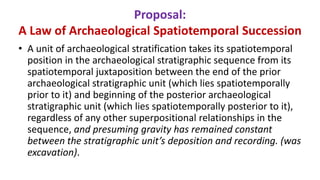
Proposal:
A Law of Archaeological Spatiotemporal Succession
• A unit of archaeological stratification takes its spatiotemporal
position in the archaeological stratigraphic sequence from its
spatiotemporal juxtaposition between the end of the prior
archaeological stratigraphic unit (which lies spatiotemporally
prior to it) and beginning of the posterior archaeological
stratigraphic unit (which lies spatiotemporally posterior to it),
regardless of any other superpositional relationships in the
sequence, and presuming gravity has remained constant
between the stratigraphic unit’s deposition and recording. (was
excavation).
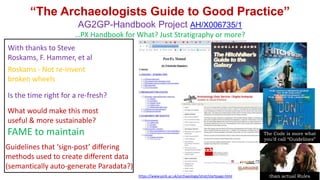
“The Archaeologists Guide to Good Practice”
AG2GP-Handbook Project AH/X006735/1
…PX Handbook for What? Just Stratigraphy or more?
https://www.york.ac.uk/archaeology/strat/startpage.html
With thanks to Steve
Roskams, F. Hammer, et al
Is the time right for a re-fresh?
Roskams - Not re-invent
broken wheels
What would make this most
useful & more sustainable?
FAME to maintain
Guidelines that ‘sign-post’ differing
methods used to create different data
(semantically auto-generate Paradata?)
The Code is more what
you’d call “Guidelines”
than actual Rules
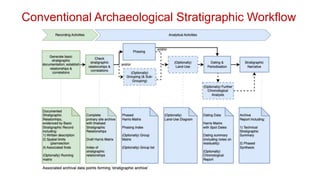
Conventional Archaeological Stratigraphic Workflow
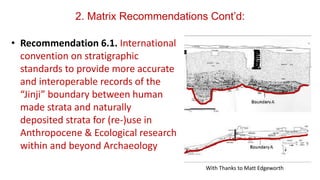
2. Matrix Recommendations Cont’d:
• Recommendation 6.1. International
convention on stratigraphic
standards to provide more accurate
and interoperable records of the
“Jinji” boundary between human
made strata and naturally
deposited strata for (re-)use in
Anthropocene & Ecological research
within and beyond Archaeology
With Thanks to Matt Edgeworth
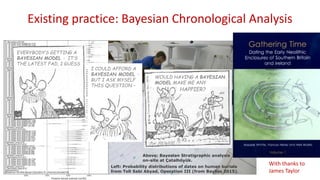
Existing practice: Bayesian Chronological Analysis
Left: Probability distributions of dates on human burials
from Tell Sabi Abyad, Operation III (from Bayliss 2015).
With thanks to
James Taylor
EVERYBODY’S GETTING A
BAYESIAN MODEL - IT’S
THE LATEST FAD, I GUESS
I COULD AFFORD A
BAYESIAN MODEL –
BUT I ASK MYSELF
THIS QUESTION –
WOULD HAVING A BAYESIAN
MODEL MAKE ME ANY
HAPPIER?
Above: Bayesian Stratigraphic analysis
on-site at Çatalhöyük.
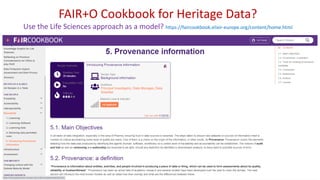
FAIR+O Cookbook for Heritage Data?
Use the Life Sciences approach as a model? https://faircookbook.elixir-europe.org/content/home.html
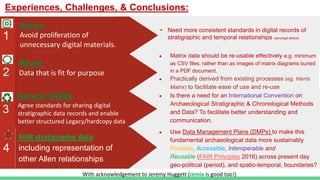
Experiences, Challenges, & Conclusions:
FAIR stratigraphic data
including representation of
other Allen relationships
4
● Use Data Management Plans (DMPs) to make this
fundamental archaeological data more sustainably
Findable, Accessible, Interoperable and
Reusable (FAIR Principles 2016) across present day
geo-political (period), and spatio-temporal, boundaries?
Recycle FAIRly
Agree standards for sharing digital
stratigraphic data records and enable
better structured Legacy/hardcopy data
3
● Is there a need for an International Convention on
Archaeological Stratigraphic & Chronological Methods
and Data? To facilitate better understanding and
communication.
Reuse
Data that is fit for purpose
2
● Matrix data should be re-usable effectively e.g. minimum
as CSV files, rather than as images of matrix diagrams buried
in a PDF document.
● Practically derived from existing processes (eg. Harris
Matrix) to facilitate ease of use and re-use
1
• Need more consistent standards in digital records of
stratigraphic and temporal relationships (amongst others)
Reduce
Avoid proliferation of
unnecessary digital materials.
With acknowledgement to Jeremy Huggett (remix is good too!)
References & Acknowledgments
● Allen, J.F. (1983) 'Maintaining Knowledge about Temporal Intervals'. Communications of the ACM 26, 11, 832-843.
● Binding, C. (2010) Implementing archaeological time periods using CIDOC CRM and SKOS .The Semantic Web: Research and Applications : 7th Extended
Semantic Web Conference, ESWC 2010.
● Bradley, R. 2006. ‘‘Bridging the Two Cultures. Commercial Archaeology and the Study of Prehistoric Britain,’’ Antiquaries Journal 86: 1–13.
● Carver, M. Archaeological Investigation. (2009)
● Cripps, P., Greenhalgh, A. Fellows, D., May, K., David Robinson, D. (2004) Ontological Modelling of the work of the Centre for Archaeology, CIDOC CRM
technical paper: pdf file. Also available: The CRM Diagram, pdf file.
● Davies, Dafydd. (2017) “The Development Of Archaeological Post-Excavation Within British Professional Archaeology” BAJR Guide 46
http://www.bajr.org/BAJRGuides/46_PostEx_Theory_Application/46%20Archaeological%20PostExcavation.pdf
● Dye, T.S. & Buck, C.E. (2015) Archaeological sequence diagrams and Bayesian chronological models.Journal of Archaeological Science, 63. 84 - 93. ISSN 0305-
4403
● Harris, E.C. (1979) Principles of Archaeological Stratigraphy (1st Edition). London: Academic Press.
● Huggett, J. Reuse remix recycle: repurposing archaeological digital data. Advances in Archaeological Practice (2018), doi:10.1017/aap.2018.1
● May, K., Taylor, J.S. (2023) Stratigraphic Analysis and The Matrix: connecting and reusing Archaeological Stratigraphic Records and Archives, Internet
Archaeology 61 https://doi.org/10.11141/ia.61.2
● May, K. 2020 The Matrix: Connecting Time and Space in Archaeological Stratigraphic Records and Archives, Internet
Archaeology 55. https://doi.org/10.11141/ia.55.8
● Papadakis, M., Doerr, M. and Plexousakis, D. "Fuzzy times on space-time volumes," eChallenges e-2014 Conference Proceedings, Belfast, 2014, pp. 1-11.
● Roskams, S. (2001) Excavation. Cambridge: Cambridge University Press.
● Taylor, J.S. (2016) Making Time For Space At Çatalhöyük: GIS as a tool for exploring intra-site spatiotemporality within complex stratigraphic sequences. PhD
thesis, University of York.
● Tudhope, D., May, K., Binding, C. and Vlachidis, A. (2011) 'Connecting Archaeological Data and Grey Literature via Semantic Cross Search', Internet
Archaeology 30. https://doi.org/10.11141/ia.30.5

Keith_May_S12_CAA2023_Amsterdam.pptx

  • 1.
    Conventions for ArchaeologicalStratigraphic and Chronological Data Presented by Keith May FSA Historic England Visiting Prof at University of South Wales @Keith_May Dr James Taylor University of York Co-Field Director: Çatalhöyük Ceri Binding University of South Wales Hypermedia Research Unit Group 1 Group 2 Sub-Group 3.1 Group 3 Group 4 Sub-Group 2.1 Sub-Group 2.2 Phase 1 Phase 2 Phase 3 Phase 4 Phase 5 Phase 6 Sub-Group 3.2 CAA2023 Amsterdam George Cruikshank. The Antiquarian Society. 1812. © The Trustees of the British Museum Behold! a most curious International Convention
  • 2.
    Conventional Concepts usedin Stratigraphic Recording and Analysis Not to mention the CRMarchaeo v1.5.0 Phase Index – MOLA IAA.csv CUD Matrix diagram Dating evidence Grouping P h a s i n g Stratigraphy Bayesian Chronological Modelling stratigraphic units Context Deposits Interfaces C u t s
  • 3.
    Conventional Concepts ofthe Stratigraphic Process Note: Duplication of field names encountered in archive records IAA Queries 1. MOLA only? 2. Do other people use similar “Phasing Indexes”? Is use of IAA.csv file – 1. Helping re-use? 2. Is it used consistently as a digital standard across sites? 3. Note - no primary Stratigraphic relationships in this index. Product of MOLA archive process.
  • 4.
    CRM-EH Ontological Modelof Archaeological Information Domain - 2004 CRM-EH Ontological Model initially modelled the English Heritage / Historic England Archaeological Information recording process. But is applicable to the more general archaeological methodology Single Context Recording in the UK (Harris Matrix) Context modelled spatially with a single context entity for both Deposits and/or Interfaces. Groups as a spatial group of spatial Contexts
  • 5.
    CIDOC CRM -CRMarchaeo “Archaeological Excavation Process” extension – followed on from CRM-EH Fig. 4: Section drawing with A3 Stratigraphic Interfaces in square brackets [ ], A2 Stratigraphic Volume Unit in round brackets (), the surfaces S1 and S2 created through A1 Excavation Process Units using different methodologies and an A7 Embedding of a coin. A1 Excavation Process Unit A1 Excavation Process Unit A3 Stratigraphic Interface A2 Stratigraphic Volume Unit A7 Embedding AP4 produced surface S1 with stratigraphic method AP4 produced surface S2 with spit excavation method CRMarchaeo v 1.4.8 (Feb 2019) Image Copyright Lucasfilm
  • 7.
    The Multiverse ofArchaeological Investigation Non-exhaustive list of external factors influencing archaeological digital outputs Forthcoming Article There is a multi-dimensional aspect to how different workflow processes are actually implemented in archaeological practice. 1. Funding Source (Financial constraints) – i.e. Tales from 2 River Banks 2. Project Management regime - what stage when? (n.b. Frameworks BAA) 7. Research Objectives - i.e. “Fashions” of changing Theory? (Post-Post-Modernism ) 8. Epistemological Methods - Objective data recorded in the present i.e. scientific statements & systematics (Dunnell 1971) as opposed to free text interpretation about “The Past” (humanities) 3. Location: e.g. Urban Vs Rural (vs mixed?) - Type of site – depth of stratigraphic sequence 4. Scale: e.g. Infrastructure (Inter-site) vs Single site (Intra-site) - Scale of archaeology encountered (e.g. infrastructure project)? - Degree of dating evidence encountered in the stratigraphic units 5. Staff Resources & Digital Skills 6. Digital Practice: will continue to change & develop e.g. i. GIS ii. SFM, iii. Bayesian Chronological Modelling …More to come Concept of 8 multiple universes, with the beginning (of time) in the middle. Cc-by Wikipedia
  • 8.
    Funding Sources and/orRecording Methods (UK) These differences ARE reflected in Data outputs Spatial Methodological Approach Single Context Spatial Recording (Hand-drawn Planning) spatio-temporal? Features Spatial Recording (Hand-drawn Planning) Spatio-functional? Funding Source Development Funded (commercial) MOLA Oxford Wessex Framework FAS BUFAU?? Research Funded (UKRI, HE, etc) Early Catalhoyuk?? Wasperton (FAS - Carver)? GIS based Recording (Digital Planning)? ? ? GIS based Recording (Digital Planning)? SFM, et al 3D or 4D? MOLA Oxford Wessex Framework ? Later Catalhoyuk
  • 9.
    How can ProcessModelling for Analysis activities help with understanding the problem? ● Aim to Identify common steps in the Analysis process ● Interviews of 10 Main Archaeological organizations in UK ● Identify and clarify differing approaches to process ● Enable semantic mappings between common concepts and terms used in Analysis knowledge process(es) Research Funded Project process Commercial Developer Funded Projects process (CRM) Typical (UK) Archaeology Project Stages Published Stratigraphic Data Archived Stratigraphic Data Excavation - Archived Stratigraphic Data Analyzed Stratigraphic Data Re-Use Previous Excavations Stratigraphic Data The Problem: Stratigraphic Archive data not Interoperable / Reusable
  • 10.
    Stratigraphic Process hasMatured? or Evolved? ● Harris 1989 (Principles - Fig 57) “The process from excavation to the publication of the site report is depicted as in Fig. 57”. ● But process can change, either deliberately or organically ● New methods emerge – digital GIS + SfM recording & analysis ● Spatial record methodologies have evolved from just hand drawn Single Context Recording on permatrace. ● In General terms “Urban or Deep Strat” recording methods differ from “Rural or Wide & Shallow Strat” ● Infrastructure projects can also require different project management regimes and related recording and publication methods e.g. Heathrow Terminal 5 (T5 - UK) ● Bayesian Chronological Modelling (Bcal, OxCal, etc) of Temporal Data “Fig. 57 All of the stratigraphic data from an excavation goes into the formation of the stratigraphic sequence, which is then used for all later analyses of the artefacts and in the compilation of the site report.” GIS + SFM recording & analysis Bayesian Chronological Modelling So… Big ???s around the consistency and re-usability (FAIRness) of the digital by-products reaching the Archive records?
  • 11.
    A14 Guidance –“State of the Art” for road scheme infrastructure sites. Land-use is important ● But, not part of Harris Matrix method ● A later part of the “Process” ● So not part of Phaser software Identify and assign ‘sub-groups’ for particular features. Assign Periods to the 'groups’. Input the 'groups' (incl 'periods’) into the GIS. Identify and assign 'groups'. Assign Periods to the ‘sub-groups’. Input the 'sub-groups' (incl 'periods') into the Excel table exported from GIS. Identify and assign ‘land-uses’ (including ‘Settlement’ Land- Use). Common stages in an iterative process of “Grouping” Assigning Periods to ‘groups’ A process AKA = Phasing? 'Groups' (incl 'periods’) AKA = Phased Groups? Create Phase plans in GIS? Almost the same process for sub-grouping ? With Thanks to Alex Smith Is this kind of PX-Analysis documentation now as rare as Rocking Horse Sh…? P18
  • 12.
    Modelling the Matrix- making explicit all the temporal relationships Example: Silbury Hill (approx. 2400BC) Approx. 30m = 4400 Years estimated to have involved about 4 million hours of work
  • 13.
    Process modelling diagram('To Be' model) To inform development of the prototype software
  • 14.
    Allen Temporal Relationships- Checking Uncertainties
  • 15.
    Dating evidence –five main formats of date evidence Dating form Note Example data Single date Single dates are actually relatively rare in archaeology 203 AD after c1760 Date range Most dates will be in this form 117 - 138 (coin) Period date Could be as broad as “Roman” But could potentially carry an associated date range too Early Roman SABA - Reece Period 6 Probability date range Dating data: Probability Range (Usually to a year with an associated +/- error value) c. AD99-134 Dendro 95% confidence Duration This is most likely a date range but without necessarily fixed start or end dates. Examples will most likely occur during Grouping and Phasing. This may be especially relevant to: ● Construction (e.g. < 1yr) ● Use – duration (> 1yr) ● Disuse (< 1yr) The Building could only have been in use for at most 50 years (i.e. duration = min 0 – max 50). 5 main types of dating evidence ‘conventionally’ used in constructing chronologies
  • 16.
    • Musivaria stratigraphy- based on interpreting the spatio- temporal sequencing of the order that the mosaic tiles 'must' have been placed in the design. Not strictly following 'Law of superposition' • Stratigraphic relations seen in insertions to a brick wall or ceiling - n.b. Does insertion strictly follow letter of the 'Law of superposition' Above (After)/Below (Before) relationships are spatiotemporal • Fuliginochronology relations seen on the walls and vaults of caves and rock shelters, in speleothems or deposits resulting from anthropogenic fires. Strictly speaking follows inverse 'Law of superposition' Law of Superposition: ”The principle is taken from geology. Deposits or strata of rock can be observed superimposed one on another. The stratum at the bottom of a series will have been laid down earliest and those above it successively through time from bottom to top” (Browne 1975: 21). Law of Stratigraphical Succession: any given unit of archaeological stratification takes its place in the stratigraphic sequence of a site from its position between the undermost of all units which lie above it and the uppermost of all those units which lie below it and with which it has a physical contact, all other superpositional relationships being regarded as redundant. (Harris 1989) Law of spatio-temporal succession? Earliest smoke/carbon deposits on the roof of the cav e are gravitationally above later smoke deposits. Stratigraphic relationships are spatiotemporal
  • 17.
    Proposal: A Law ofArchaeological Spatiotemporal Succession • A unit of archaeological stratification takes its spatiotemporal position in the archaeological stratigraphic sequence from its spatiotemporal juxtaposition between the end of the prior archaeological stratigraphic unit (which lies spatiotemporally prior to it) and beginning of the posterior archaeological stratigraphic unit (which lies spatiotemporally posterior to it), regardless of any other superpositional relationships in the sequence, and presuming gravity has remained constant between the stratigraphic unit’s deposition and recording. (was excavation).
  • 18.
    “The Archaeologists Guideto Good Practice” AG2GP-Handbook Project AH/X006735/1 …PX Handbook for What? Just Stratigraphy or more? https://www.york.ac.uk/archaeology/strat/startpage.html With thanks to Steve Roskams, F. Hammer, et al Is the time right for a re-fresh? Roskams - Not re-invent broken wheels What would make this most useful & more sustainable? FAME to maintain Guidelines that ‘sign-post’ differing methods used to create different data (semantically auto-generate Paradata?) The Code is more what you’d call “Guidelines” than actual Rules
  • 19.
  • 20.
    2. Matrix RecommendationsCont’d: • Recommendation 6.1. International convention on stratigraphic standards to provide more accurate and interoperable records of the “Jinji” boundary between human made strata and naturally deposited strata for (re-)use in Anthropocene & Ecological research within and beyond Archaeology With Thanks to Matt Edgeworth
  • 21.
    Existing practice: BayesianChronological Analysis Left: Probability distributions of dates on human burials from Tell Sabi Abyad, Operation III (from Bayliss 2015). With thanks to James Taylor EVERYBODY’S GETTING A BAYESIAN MODEL - IT’S THE LATEST FAD, I GUESS I COULD AFFORD A BAYESIAN MODEL – BUT I ASK MYSELF THIS QUESTION – WOULD HAVING A BAYESIAN MODEL MAKE ME ANY HAPPIER? Above: Bayesian Stratigraphic analysis on-site at Çatalhöyük.
  • 22.
    FAIR+O Cookbook forHeritage Data? Use the Life Sciences approach as a model? https://faircookbook.elixir-europe.org/content/home.html
  • 23.
    Experiences, Challenges, &Conclusions: FAIR stratigraphic data including representation of other Allen relationships 4 ● Use Data Management Plans (DMPs) to make this fundamental archaeological data more sustainably Findable, Accessible, Interoperable and Reusable (FAIR Principles 2016) across present day geo-political (period), and spatio-temporal, boundaries? Recycle FAIRly Agree standards for sharing digital stratigraphic data records and enable better structured Legacy/hardcopy data 3 ● Is there a need for an International Convention on Archaeological Stratigraphic & Chronological Methods and Data? To facilitate better understanding and communication. Reuse Data that is fit for purpose 2 ● Matrix data should be re-usable effectively e.g. minimum as CSV files, rather than as images of matrix diagrams buried in a PDF document. ● Practically derived from existing processes (eg. Harris Matrix) to facilitate ease of use and re-use 1 • Need more consistent standards in digital records of stratigraphic and temporal relationships (amongst others) Reduce Avoid proliferation of unnecessary digital materials. With acknowledgement to Jeremy Huggett (remix is good too!)
  • 24.
    References & Acknowledgments ●Allen, J.F. (1983) 'Maintaining Knowledge about Temporal Intervals'. Communications of the ACM 26, 11, 832-843. ● Binding, C. (2010) Implementing archaeological time periods using CIDOC CRM and SKOS .The Semantic Web: Research and Applications : 7th Extended Semantic Web Conference, ESWC 2010. ● Bradley, R. 2006. ‘‘Bridging the Two Cultures. Commercial Archaeology and the Study of Prehistoric Britain,’’ Antiquaries Journal 86: 1–13. ● Carver, M. Archaeological Investigation. (2009) ● Cripps, P., Greenhalgh, A. Fellows, D., May, K., David Robinson, D. (2004) Ontological Modelling of the work of the Centre for Archaeology, CIDOC CRM technical paper: pdf file. Also available: The CRM Diagram, pdf file. ● Davies, Dafydd. (2017) “The Development Of Archaeological Post-Excavation Within British Professional Archaeology” BAJR Guide 46 http://www.bajr.org/BAJRGuides/46_PostEx_Theory_Application/46%20Archaeological%20PostExcavation.pdf ● Dye, T.S. & Buck, C.E. (2015) Archaeological sequence diagrams and Bayesian chronological models.Journal of Archaeological Science, 63. 84 - 93. ISSN 0305- 4403 ● Harris, E.C. (1979) Principles of Archaeological Stratigraphy (1st Edition). London: Academic Press. ● Huggett, J. Reuse remix recycle: repurposing archaeological digital data. Advances in Archaeological Practice (2018), doi:10.1017/aap.2018.1 ● May, K., Taylor, J.S. (2023) Stratigraphic Analysis and The Matrix: connecting and reusing Archaeological Stratigraphic Records and Archives, Internet Archaeology 61 https://doi.org/10.11141/ia.61.2 ● May, K. 2020 The Matrix: Connecting Time and Space in Archaeological Stratigraphic Records and Archives, Internet Archaeology 55. https://doi.org/10.11141/ia.55.8 ● Papadakis, M., Doerr, M. and Plexousakis, D. "Fuzzy times on space-time volumes," eChallenges e-2014 Conference Proceedings, Belfast, 2014, pp. 1-11. ● Roskams, S. (2001) Excavation. Cambridge: Cambridge University Press. ● Taylor, J.S. (2016) Making Time For Space At Çatalhöyük: GIS as a tool for exploring intra-site spatiotemporality within complex stratigraphic sequences. PhD thesis, University of York. ● Tudhope, D., May, K., Binding, C. and Vlachidis, A. (2011) 'Connecting Archaeological Data and Grey Literature via Semantic Cross Search', Internet Archaeology 30. https://doi.org/10.11141/ia.30.5

Editor's Notes

  • #2 This paper will present work undertaken by The Matrix project [AH/T002093/1] which is addressing some of the current problems caused by the lack of standardized approaches to analysis and digital archives of archaeological stratigraphic and phasing data. The Matrix project (AHRC AH/T002093/1) is investigating how digital data from archaeological excavations can be made more consistent and useful thereby more interesting and cost-effective to a range of users and audiences. It is working towards a shared plan and methods to get such data more consistently recorded, analysed, disseminated and archived in a way that is Findable, Accessible, Interoperable and Re-useable (FAIR).   The Matrix project has four key areas of activity: 1) Digital Standards; 2) Characteristics of digital Heritage Data; 3) Stratigraphy Standards; 4) Research Tools;   Areas for investigation in the project include enhancing the recording of implicit and explicit spatio-temporal and temporal relationships in the digital stratigraphic records of archaeological investigations and the use of LOD vocabularies to deduce or make explicit dating and phasing records derived from temporal Periods and/or other types of reference data (e.g. LOD site types and periods from HeritageData.org). The project also reviews current stratigraphic matrix analysis activities, including stratigraphic and temporal recording and analysis processes, digital stratigraphic data archiving, and requirements for reuse of archaeological data by chronological modellers.   The Matrix project aims to address 2 major research questions: 1. How can we encourage the sharing, linking and interoperability of archaeological data and information, particularly information derived from the commercial development funded archaeology sector in order to maximise public value and enhance the research potential of archaeological data? 2. How can we ensure the consistent development, application and enforcement of existing technical information and data standards and their promotion to others?   The Matrix project is addressing the current problems caused by the lack of standardized approaches to digital archiving of archaeological data using the particular case study of stratigraphic and phasing data. Stratigraphic data form the backbone of all the related archaeological records from each excavated site and are essential for integrated analysis, wider synthesis and accessible archiving of the growing body of archaeological data and reports generated through the commercial archaeological sector in the UK and internationally. The stratigraphic record, usually in the form of a stratigraphic matrix, with associated relationships and data, acts as a primary, if not the primary piece of 'Evidence' for how, and in what order, the site was excavated. As such the stratigraphic matrix is the key mechanism that enables anyone less familiar with the site, to re-visit the excavation records, understand what data is most relevant for any particular research questions, or problems encountered, and piece together the underlying details of how the interpretations by the excavator(s) were actually arrived at. However, such records are often only held on paper or scanned copies of matrix diagrams that cannot easily be re-used with associated data. Often the key phasing data needed for synthesis work and interpretive understanding is not well documented or archived consistently, if at all, in written reports. This results in key records being unsearchable or remaining unconnected to other data and at best usually requires lengthy and wasteful re-keying if any one wishes to work with the archives from such sites. The focus of digital archives and museums is now switching from simply providing better access to digital archives, to questions of how users in commercial units, curatorial organizations and academia, along with the general public, can make best use of this growing body of digital information and data (May 2020).   A number of research projects in the last 10 years have attempted to draw together archaeological archives from different excavation teams to analyse the temporal sequences and use the stratigraphic relationships recorded on site to cross-search for artefacts and structures from related phases e.g. the STAR project (Tudhope et al. 2011). But a lack of consistent practice in digital deposition of such records has placed severe limitations on the amounts of archaeological records available for such analyses. For Chronological modelers of archaeological data these problems are exacerbated by a lack of standardized approaches to the archiving of stratigraphic data, often held in hard-copy matrix diagrams or inconsistently structured database tables. The outcomes of the Matrix project will help inform decisions on digital archiving standards and best practice for stratigraphic data deposition and re-use, so that such digital data can be held and re-used in a form most suitable as input for Bayesian calibration software such as BCal, OxCal, or Chronomodel. The use of such Bayesian chronological modelling techniques has become critical in the more accurate dating of archaeological sites and phases in the last 10 years, but the way such information is analysed is quite painstaking and often involves many hours of laborious manual data preparation for key staff involved (Dye and Buck 2015). The techniques this project develops will considerably reduce the inefficiencies in this process. Stratigraphic laws and principles underpin the archaeological records from excavated sites and are essential for integrated analysis, wider synthesis and accessible digital archiving of the growing body of archaeological data and reports generated through the commercial archaeological sector in the UK and internationally. On most excavated sites, the stratigraphic record, most often visualized, and to a degree quantifiable, in the form of a stratigraphic matrix, acts as a primary, if not the primary piece of evidence for how, and in what order, the site was excavated. As such the stratigraphic record is the key mechanism that enables anyone less familiar with the site, to re-visit the excavation records, understand what data is most relevant for any research questions, or problems encountered, and piece together the underlying details of how the interpretations by the excavator(s) were arrived at.   However, such primary records are often only held on paper or scanned copies of matrix diagrams that cannot easily be re-used with associated data. Often the key phasing data needed for re-use in synthesis work and interpretive understanding, let alone Bayesian Chronological modelling, is not consistently documented, if at all, in written reports. This results in key records being unsearchable or remaining unconnected and lacking interoperability with other data (unFAIR).   The focus of digital archives and museums is now switching from simply providing better access to digital archives, to questions of how users in commercial units, curatorial organizations and academia, along with the general public, are going to make best use of this growing body of digital information and data.   AHRC Leadership Fellow – The Matrix https://www.researchgate.net/project/The-Matrix-connecting-and-re-using-digital-records-and-archives-of-archaeological-investigations Analytics Department Policy & Evidence Historic England Keith.May@HistoricEngland.org.uk May, K. 2020 The Matrix: Connecting Time and Space in Archaeological Stratigraphic Records and Archives, Internet Archaeology 55. https://doi.org/10.11141/ia.55.8 The Matrix project web page: https://stratigraphic.github.io/matrix/
  • #3 For a long time there was some debate over whether it is appropriate to perform this higher level grouping on-site, or as a part of the post-excavation process (Carver 1987; Hammer 2002; Roskams 2001 244-46; Thorpe 2012, 36-40; Roskams 2013, 38-45). However what is clear from our consultations is that most archaeologists seem to be aware of conventional systems of higher order stratigraphic grouping associated with single context recording at least (in the tradition of the DUA) such as those outlined by Roskams (2001, 257-61), even if they do not consistently deploy them on less complex sites.
  • #5 4. Using the basic CRM entities, we developed this ontological model of the archaeological information domain spanning the work processes of our archaeological fieldwork and science teams. This model became known over the years in the UK & Europe - for better or worse - as the CRM-EH, an archaeological extension of the CIDOC CRM core ontology, and it maps directly to the core CIDOC CRM ISO. Paul Cripps, Anne Greenhalgh, Dave Fellows, Keith May, David Robinson Ontological Modelling of the work of the Centre for Archaeology, September 2004 Available: pdf file http://old.cidoc-crm.org/docs/Ontological_Modelling_Project_Report_%20Sep2004.pdf (207 Kb) Also available: The CRM Diagram, pdf file http://old.cidoc-crm.org/docs/AppendixA_DiagramV9.pdf (65 Kb) In very swift summary this CRM-EH model covers the process of how archaeological data is recorded from excavation, through post-excavation analysis, to publication and archive using the most common excavation methodology in the UK, known as “Single Context Recording, where each Stratigraphic Unit is given a single identifier and stratigraphic relations are often documented using the Harris Matrix method.   For the purposes of this talk I am only going to mention how we modelled the post-excavation analysis of stratigraphic and related data and the Phasing of such archaeological stratigraphy.   In the presentation I will fly you through the diagram to highlight the key areas for this presentation. Press to Advance Phasing is most commonly accomplished during PX Analysis using a process of Grouping of Stratigraphic Units. Press to Advance The Stratigraphic relationships are modelled using part of this set of temporal operators known as Allen Operators which I shall discuss more later on in this presentation. Press to Advance If we zoom into the section of the model representing the Grouping & Phasing process Press to Advance Contexts are modelled conceptually in CRM-EH as spatial (E53) “Places” with a single context entity (EH_E0007) for both Deposits and/or Interfaces. Groups (EH_E0005) are modelled as a spatial group of spatial Contexts We used this ontological model in a number of successful research projects developing Semantic Technologies for Archaeological Resources – The STAR project to demonstrate genuine Interoperability between a range of different archaeological data sets recorded using different database software by different archaeological contracting companies. But we noticed a number of issues in implementing the CRM-EH with real archaeological data and this led to more work on ontological modelling with the group that maintains the CIDIC CRM
  • #6 6. CRMarchaeo - This led to the creation of a further archaeological extension known as CRMarchaeo which enables the interoperability of archaeological data recorded under other methodologies (e.g. Planum, Locus) rather than single context methods. In short CRMarchaeo enables us to model and include data ad stratigraphic relationships for both stratigraphic deposits and cuts (Harris interfaces) along with other enhancements. It is also maintained more formally by the CIDOC CRM SIG as one of a growing suite of ISO extensions.
  • #9 The Matrix project is seeing differences in the nature of the data that gets digitally archived. There seem to be noticeable differences in the quantities and re-usability of data deposited as the result of commercially funded archaeological investigations as opposed to Research funded archaeological investigations (e.g. university or national agency funded).
  • #10  In 2015 I got copied into an email exchange between Caitlin Buck & Julian Richards at the Archaeology Data Service (ADS) at York University https://archaeologydataservice.ac.uk/ asking about how to get hold of examples of digitally archived stratigraphic data. One big issue for interoperability that had emerged from STAR was that the lack of a common approach to how people archive their data results from the Analysis. This results in digital outputs on the analysis process being very fragmented.   Tales From Two River Banks Commercial Vs Research Funded archaeological project data.   I decided I needed to look for commonalties of process and asked the question Would Process modelling for Analysis help? – The aim was three-fold: Identify common steps in the Analysis process Identify and clarify differing approaches to process Enable semantic mappings between common concepts and terms used in Analysis process(es)
  • #11 There also seem to be emerging differences and divergence in process, and therefore differing digital archive products, as GIS based technologies and more recently Structure from Motion (SFM) have become more prevalent in last 10-20 years, especially in large-scale infrastructure projects undertaken in non-urban, or less deeply stratified, sites.
  • #13 Silbury Matrix - What became clear as I worked on more of this was that the other Allen Operators were represented in the written reports and implicitly within the hardcopy versions of Harris Matrix diagrams that had gone through full PX Analysis processes, but unfortunately there was no formal way that such temporal reasoning and relationships between the data were included in the final project publications, and particularly not in the digital data sets in any way that would enable use by the semantic reason tools. Potential benefits if the stratigraphic records, including groups/phases were more consistently recorded in archive data. • Potential of more explicit Phasing data methodology approaches • Semantic opportunities of using Allen operators[KM1] to cross-search related data • Semantic search and e.g. for dated material - Bayesian potential enhanced by additional dating parameters from additional temporal relationships. [KM1]Slide of Silbury Hill matrix with Allen operators would work here
  • #14 Could this form of Phasing Index provide the basis for a more standardized approach to archiving stratigraphic grouping and phasing data? Do other organizations in the UK, or internationally, have equivalent forms of record, or only Museum of London Archaeology (MOLA)? Such data is crucial for anyone trying to re-visit and re-use the data in digital archives.
  • #20 Objective 1. Explore the feasibility, cost benefits, and business viability for a consortium of commercial archaeological practitioners to develop an online handbook for best practice in post-excavation and analysis methods along with online tools to support best practice and FAIR principles and promote a related Community of Practice across the UK heritage sector and internationally to maintain the online resources. This will be achieved by working in partnership with the Federation of Archaeological Managers and Employers (FAME) to hold a series of user requirements workshops and engagement events with key sectoral stakeholders from UK commercial archaeology and interested parties across the heritage sector. It will include presentations at FAME events and major conferences such as CIfA(2023), EAA2023 & EAC? SAA2023? ACRA? Others - esp Public Policy so HE and others (CBA ?) UK committee of archaeological heads of departments. In addition, the existing work on the Matrix prototype tool will be used as a test bed for gathering user requirements for the feasibility of sharing online tools and synchronous data exchange with a multiple range of registered organizations.
  • #22 The most important aspect of the declaration from the standpoint of this (Edgeworth et al’s) paper is the significance accorded to the lower bounding surface – marking the division between anthropogenically modified layers and natural geological deposits – that is known by Japanese geologists as the Jinji(人自) unconformity or discontinuity. The Chinese character for ‘Jin’ (人) means human being and that for ‘Ji’ (自) means ‘natural’. Although of particular relevance to the understanding of artificial ground in geologically unstable regions on the Japanese east coast, the boundary is also held to demarcate the lower bounding surface of humanly modified ground elsewhere in Japan and in other parts of the world. It marks the base of cultural layers of historic and ancient origin as well as heavily contaminated layers of the industrial age (Nirei et al., 2012). It is coincident with Boundary A, the lower boundary of the archaeosphere, as referred to in this paper and in Edgeworth (2014). (Diachronous beginnings of the Anthropocene: The lower bounding surface of anthropogenic deposits. Matt Edgeworth, Dan deB Richter, Colin Waters, Peter Haff, Cath Neal and Simon James Price Available from: https://www.researchgate.net/publication/272954203_Diachronous_beginnings_of_the_Anthropocene_The_lower_bounding_surface_of_anthropogenic_deposits [accessed Apr 01 2023].
  • #23 Are “The old ways” always the best? The chronological modelling of archaeological data is dependent upon access to, and re-use of, primary stratigraphic data and associated dating evidence, which should form a principle component of archaeological datasets.
  • #24 https://faircookbook.elixir-europe.org/content/recipes/introduction/FAIR-cookbook-audience.html
  • #25 Conclusions & Challenges Reduce - Need more consistent standards in digital records of stratigraphic and temporal relationships (amongst others) Reuse - Matrix data should be re-usable effectively e.g. minimum as CSV files, rather than as images of matrix diagrams buried in a PDF document. Recycle - Is there a need for an International Convention on Archaeological Stratigraphic & Chronological Methods and Data? To facilitate better understanding and communication. FAIR stratigraphic data standards - Make this fundamental archaeological data more sustainably Findable, Accessible, Interoperable and Reusable (FAIR Principles 2016) across present day geo-political (period), and spatio-temporal, boundaries?
  • #26 Paul Cripps, Anne Greenhalgh, Dave Fellows, Keith May, David Robinson Ontological Modelling of the work of the Centre for Archaeology, September 2004 Available: pdf file (207 Kb) Also available: The CRM Diagram, pdf file (65 Kb)