ARCHAEOLOGY ITS
CORRELATION WITH
OTHER SUBJECTS
DR.AGHALYA.,M.A.,M.ED.,M.PHIL.,PH.D.,
HEAD & ASST.PROFESSOR
DEPARTMENT OF HISTORY
BON SECOURS COLLEGE FOR WOMEN
THANJAVUR
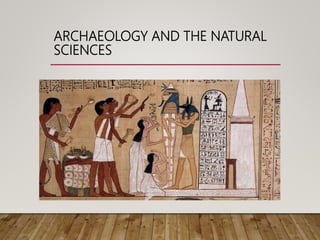
ARCHAEOLOGY AND THE NATURAL
SCIENCES
ARCHAEOLOGY AND THE
NATURAL SCIENCES
• The material objects that are recovered during excavations are
the archaeologists's historical "documents".
• It is therefore necessary to obtain as much material as possible
from the earth.
• Stone implements and other material objects are not sufficient
to enable us to arrive at an accurate reconstruction of a specific
culture.
• We also need to consider the environment, animals life, plant
life, climate - especially when we study the earliest history of
humans.
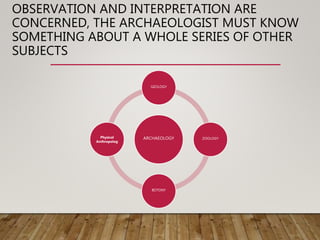
OBSERVATION AND INTERPRETATION ARE
CONCERNED, THE ARCHAEOLOGIST MUST KNOW
SOMETHING ABOUT A WHOLE SERIES OF OTHER
SUBJECTS
ARCHAEOLOGY
GEOLOGY
ZOOLOGY
BOTONY
Physical
Anthropolog
GEOLOGY
GEOLOGY
• A study of geological phenomena may shed light on the natural
environment in which prehistoric cultures occurred.
• The way in which geological layers were formed, for example by
aeolian or fluvial action, gives an indication of the climatic conditions
prevalent at the time of their formation.
• Furthermore, it is obvious that an knowledge of petrology, mineralogy
and crystallography is essential for an understanding of prehistoric
technology.
• It constitutes the basis for the study of all objects manufactured from
metal and stone.
ZOOLOGY AND ARCHAEOZOOLOGY
• Valuable insights into the relationship between prehistoric humans and their
environment have been gained through an analysis of faunal remains found in
archaeological sites (archaeozoology).
• Archaeozoology involves the identification and analysis of faunal species from
archaeological sites as an aid to the reconstruction of human diets and the
environment.
• This tells us, for example, whether the mode of subsistence of a given group
was based on hunting, on animal husbandry or on both.
• At the same time we can draw inferences about the climate and vegetation.
• These inferences are based on the assumption that the distribution of animal
species is determined by environmental conditions.
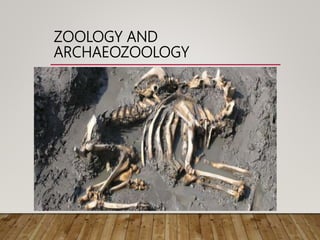
ZOOLOGY AND
ARCHAEOZOOLOGY
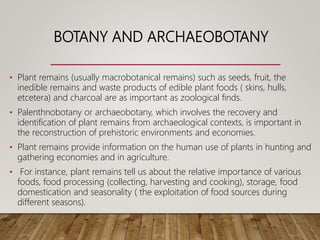
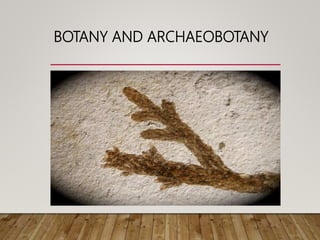
BOTANY AND ARCHAEOBOTANY
• Plant remains (usually macrobotanical remains) such as seeds, fruit, the
inedible remains and waste products of edible plant foods ( skins, hulls,
etcetera) and charcoal are as important as zoological finds.
• Palenthnobotany or archaeobotany, which involves the recovery and
identification of plant remains from archaeological contexts, is important in
the reconstruction of prehistoric environments and economies.
• Plant remains provide information on the human use of plants in hunting and
gathering economies and in agriculture.
• For instance, plant remains tell us about the relative importance of various
foods, food processing (collecting, harvesting and cooking), storage, food
domestication and seasonality ( the exploitation of food sources during
different seasons).
BOTANY AND ARCHAEOBOTANY
PALYNOLOGY
PALYNOLOGY
• Pollen analysis or polynology is the branch of science concerned with the
study of pollen, spores and similar palynomorphs, living and in the
archaeological record.
• In regions where the conditions are favourable for the preservation of
pollen, palynology plays an important part in the determination of
climate changes and ecological conditions.
PHYSICAL ANTHROPOLOGY
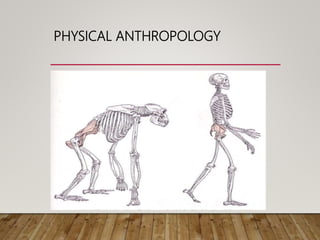
• This field of study focuses on human biological aspects.
• It includes a study of human biological evolution as well humanity's
current biological form and variation.
• Archaeologists are particularly interested in that section of physical
anthropology that covers the history of the early biological development
of the human species (human palaeontology).
PHYSICAL ANTHROPOLOGY
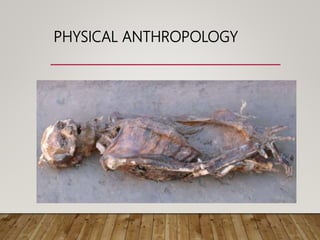
• The study of human fossils is usually the province of an expert.
• The archaeologist should, however, have an elementary knowledge
of human anatomy for work such as the accurate assembling of
bones found in a deposit.
• To understand how language could become an integral part of
culture, the archaeologist must be acquainted with the functions of
language and its physiological basis (for example, the functioning of
organs of speech).
ARCHAEOLOGY WITH OTHER
SOCIAL SCIENCE
JAI HIND

Archaeology its correlation with other subjects

  • 1.
    ARCHAEOLOGY ITS CORRELATION WITH OTHERSUBJECTS DR.AGHALYA.,M.A.,M.ED.,M.PHIL.,PH.D., HEAD & ASST.PROFESSOR DEPARTMENT OF HISTORY BON SECOURS COLLEGE FOR WOMEN THANJAVUR
  • 2.
    ARCHAEOLOGY AND THENATURAL SCIENCES
  • 3.
    ARCHAEOLOGY AND THE NATURALSCIENCES • The material objects that are recovered during excavations are the archaeologists's historical "documents". • It is therefore necessary to obtain as much material as possible from the earth. • Stone implements and other material objects are not sufficient to enable us to arrive at an accurate reconstruction of a specific culture. • We also need to consider the environment, animals life, plant life, climate - especially when we study the earliest history of humans.
  • 4.
    OBSERVATION AND INTERPRETATIONARE CONCERNED, THE ARCHAEOLOGIST MUST KNOW SOMETHING ABOUT A WHOLE SERIES OF OTHER SUBJECTS ARCHAEOLOGY GEOLOGY ZOOLOGY BOTONY Physical Anthropolog
  • 5.
  • 6.
    GEOLOGY • A studyof geological phenomena may shed light on the natural environment in which prehistoric cultures occurred. • The way in which geological layers were formed, for example by aeolian or fluvial action, gives an indication of the climatic conditions prevalent at the time of their formation. • Furthermore, it is obvious that an knowledge of petrology, mineralogy and crystallography is essential for an understanding of prehistoric technology. • It constitutes the basis for the study of all objects manufactured from metal and stone.
  • 7.
    ZOOLOGY AND ARCHAEOZOOLOGY •Valuable insights into the relationship between prehistoric humans and their environment have been gained through an analysis of faunal remains found in archaeological sites (archaeozoology). • Archaeozoology involves the identification and analysis of faunal species from archaeological sites as an aid to the reconstruction of human diets and the environment. • This tells us, for example, whether the mode of subsistence of a given group was based on hunting, on animal husbandry or on both. • At the same time we can draw inferences about the climate and vegetation. • These inferences are based on the assumption that the distribution of animal species is determined by environmental conditions.
  • 8.
  • 9.
    BOTANY AND ARCHAEOBOTANY •Plant remains (usually macrobotanical remains) such as seeds, fruit, the inedible remains and waste products of edible plant foods ( skins, hulls, etcetera) and charcoal are as important as zoological finds. • Palenthnobotany or archaeobotany, which involves the recovery and identification of plant remains from archaeological contexts, is important in the reconstruction of prehistoric environments and economies. • Plant remains provide information on the human use of plants in hunting and gathering economies and in agriculture. • For instance, plant remains tell us about the relative importance of various foods, food processing (collecting, harvesting and cooking), storage, food domestication and seasonality ( the exploitation of food sources during different seasons).
  • 10.
  • 11.
  • 12.
    PALYNOLOGY • Pollen analysisor polynology is the branch of science concerned with the study of pollen, spores and similar palynomorphs, living and in the archaeological record. • In regions where the conditions are favourable for the preservation of pollen, palynology plays an important part in the determination of climate changes and ecological conditions.
  • 13.
    PHYSICAL ANTHROPOLOGY • Thisfield of study focuses on human biological aspects. • It includes a study of human biological evolution as well humanity's current biological form and variation. • Archaeologists are particularly interested in that section of physical anthropology that covers the history of the early biological development of the human species (human palaeontology).
  • 14.
  • 15.
  • 16.
    PHYSICAL ANTHROPOLOGY • Thestudy of human fossils is usually the province of an expert. • The archaeologist should, however, have an elementary knowledge of human anatomy for work such as the accurate assembling of bones found in a deposit. • To understand how language could become an integral part of culture, the archaeologist must be acquainted with the functions of language and its physiological basis (for example, the functioning of organs of speech).
  • 17.
  • 18.