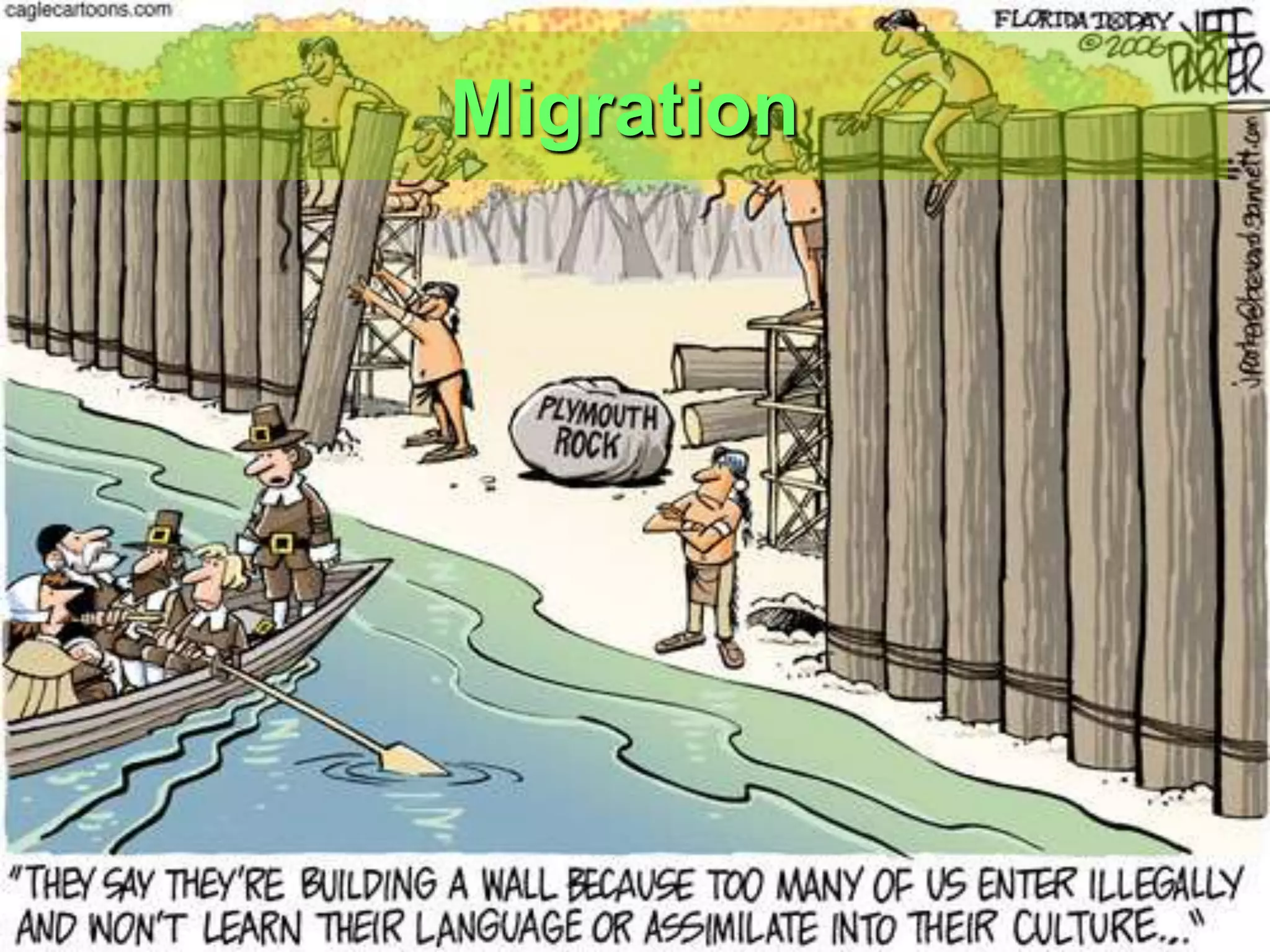
Migration
Migration: What Is It?
• Migration is
–The movement of a person or people
from one place to another
• Multiple causes
• Multiple consequences
Anthropological Study of Migration
• A challenge to traditional anthropological
work
• Multi-sited research often necessary
• Macro-micro factors
– Local versus global issues
• Categories of migration
– Based on geography
– Based on reason(s) for moving
Categories of Migration Based on
Spatial Boundaries
• Internal migration
• International migration
• Transnational migration
Internal Migration
• Rural-to-urban is the dominant form
• Push-pull theory:
– little opportunity at home in rural sector
– perceived quality-of-life factors, “rational
choice” that more options exist in the city
– concepts of where a better life can be achieved
International Migration
• Growing since 1945
• Work-related reasons important for
voluntary migrants
• Increasing involuntary international
migrants
– E.g. refugees from political violence, trafficked
persons
• Major political issue among nations
receiving refugees
Transnational Migration
• Where a person regularly moves back and
forth between two or more countries
• Often motivated by economic factors
• Importance of remittances: money sent
back to home country
Categories of Migration Based on
Reason for Moving
• Labor migrants
• Displaced persons
• Institutional migrants
Labor Migrants
• Wage labor migration
– Work period brief, no permanent residence
• Entrepreneurial migration
– Migrants moving to set up businesses and trade
– Has been occurring for centuries
• Professional migration
– Highly trained immigrants seeking jobs in more
developed countries
– “Brain drains” in less developed countries
Displaced Persons or
Involuntary Migrants
• Refugees: largest group of migrants
worldwide
• Internally displaced persons (IDPs)
Refugees
• A large/growing category of displaced
persons
• International displacement
• Roughly one of every 500 people in the
world
• Majority are women/children
• Causes: war, conflict, climate change
• Major political issue
Internally Displaced Persons (IDPs)
• Fastest-growing category of displaced
people
• Over 20 million people today
• Africa has the most IDPs
• Causes:
– Political violence
– Development projects (Development Induced
Displacement or DIDs) such as dams, roads,
other public works
Institutional Migrants
• People who move into a social institution
– Voluntary: e.g. going away to school, joining
the military
– Involuntary: e.g. going to jail, moving into a
retirement home
– Both have issues of adjustment to the new
cultural system
Environment and Migration
• Global environmental issues:
– Climate change
• Politically contested, scientifically accepted
– Indigenous, small-scale, marginalized societies
often the first to suffer consequences
• Rising sea levels in Kiribati, Island in Pacific; island
nation literally disappearing
• Glacier melt in Bolivia: source of water for indigenous
communities disappearing
– Migration is the cost of climate change in many
places worldwide, will only grow

Cult anth lecture migration

  • 1.
  • 2.
    Migration: What IsIt? • Migration is –The movement of a person or people from one place to another • Multiple causes • Multiple consequences
  • 3.
    Anthropological Study ofMigration • A challenge to traditional anthropological work • Multi-sited research often necessary • Macro-micro factors – Local versus global issues • Categories of migration – Based on geography – Based on reason(s) for moving
  • 4.
    Categories of MigrationBased on Spatial Boundaries • Internal migration • International migration • Transnational migration
  • 5.
    Internal Migration • Rural-to-urbanis the dominant form • Push-pull theory: – little opportunity at home in rural sector – perceived quality-of-life factors, “rational choice” that more options exist in the city – concepts of where a better life can be achieved
  • 6.
    International Migration • Growingsince 1945 • Work-related reasons important for voluntary migrants • Increasing involuntary international migrants – E.g. refugees from political violence, trafficked persons • Major political issue among nations receiving refugees
  • 7.
    Transnational Migration • Wherea person regularly moves back and forth between two or more countries • Often motivated by economic factors • Importance of remittances: money sent back to home country
  • 8.
    Categories of MigrationBased on Reason for Moving • Labor migrants • Displaced persons • Institutional migrants
  • 9.
    Labor Migrants • Wagelabor migration – Work period brief, no permanent residence • Entrepreneurial migration – Migrants moving to set up businesses and trade – Has been occurring for centuries • Professional migration – Highly trained immigrants seeking jobs in more developed countries – “Brain drains” in less developed countries
  • 10.
    Displaced Persons or InvoluntaryMigrants • Refugees: largest group of migrants worldwide • Internally displaced persons (IDPs)
  • 11.
    Refugees • A large/growingcategory of displaced persons • International displacement • Roughly one of every 500 people in the world • Majority are women/children • Causes: war, conflict, climate change • Major political issue
  • 12.
    Internally Displaced Persons(IDPs) • Fastest-growing category of displaced people • Over 20 million people today • Africa has the most IDPs • Causes: – Political violence – Development projects (Development Induced Displacement or DIDs) such as dams, roads, other public works
  • 13.
    Institutional Migrants • Peoplewho move into a social institution – Voluntary: e.g. going away to school, joining the military – Involuntary: e.g. going to jail, moving into a retirement home – Both have issues of adjustment to the new cultural system
  • 14.
    Environment and Migration •Global environmental issues: – Climate change • Politically contested, scientifically accepted – Indigenous, small-scale, marginalized societies often the first to suffer consequences • Rising sea levels in Kiribati, Island in Pacific; island nation literally disappearing • Glacier melt in Bolivia: source of water for indigenous communities disappearing – Migration is the cost of climate change in many places worldwide, will only grow