Digital Humanities
and Archaeology
By Noreen Whysel
LIS 657 Digital Humanities
Archaeology is…

 Material study

 A way to reconstruct history

 A way to supply evidence where there is no written
  record
Goals of Archaeology

 Find the material remains of our ancestors

 Unearth those remains in ways that maximize the
  information they can convey

 Interpret the evidence


                What about Preservation?
Archaeological Methods
 Excavation: the principal method of data acquisition in
   archaeology, involving the systematic uncovering of
   archaeological remains through the removal of the deposits of soil
   and the other material covering them and accompanying them.

 Surface survey: field-walking, i.e. scanning the ground along
   one's path and recording the location of artifacts and surface
   features. A systematic survey involves a grid system, such that the
   survey area is divided into sectors and these are walked
   systematically.

 Problem
    Both methods cause destruction of the site
    Both methods remove objects from physical context

 Solution
    Careful record keeping
Today‟s Topics

 Computing in Archaeology

 Archaeology‟s Digital Tools

 Preserving the Digital Record
Computing in Archaeology
Keeping Records

 The main occupation of a field archaeologist is
  record keeping
   Keeping good records is an important skill
   Computers are the best way to keep records
   Therefore, archaeologists should understand how to use
    computers


                        Sounds logical
Computing in Archaeology

 1950s
   Computers were large, expensive and complicated
   used more for statistical analysis and mathematical models
    than for record keeping

 1960s
   Data begins to be kept in large databanks
   Data processing required computer code
   Not many archaeologists had programming skills
   Not many projects had the budget to hire programmers
Computing in Archaeology

 1970s
   Microcomputers - Powerful data storage and retrieval
     dBase: database software, simple to learn and use
     Graphic rendering programs and rudimentary GIS
   New tools allow greater granularity of recorded data raising
    the standard for record keeping and demand for better and
    more powerful tools.
   First archaeological computing conferences
   First archaeological computing association
     Computer Applications and Quantitative Methods in
      Archaeology, University of Birmingham, UK (1974)
Computing in Archaeology

 1980s
   Personal Computing
   Computer Aided Design (CAD)
     Reconstructing
     Illustrating
     Envisioning
     3D Modeling
     Less often, simulation
   More professional archaeology associations addressing
    computing at annual meetings.
     Archeological Computing Newsletter (1984)
Computing In Archaeology

 Mid-1980s
   GIS: Geographic Information Systems
     Standard relational data tables (object data)
     Linked to coordinates on a map (points, lines)
     Linked to information derived from map data (grade,
      contours, boundaries)
     GIS allows archaeologists to analyze material remains in
      context of physical environment.
Computing in Archaeology

 1990s
   Usenet distributed internet discussion system
      alt.archaeology (earliest available article from
       1995)
sci.archaeology(earliest available article from
       1991)
       Mesopotamia)
sci.archaeology.mesoamerican
sci.arch
       aeology.moderated
      Archived at Google Groups since 2001
   CD-Rom
   World Wide Web
Computing in Archaeology

 1990s-2000s
   New surveying methods
      Photo: desktop photogrammetry, aerial photography,
       satellite imagery
      Geological: magnetometers, electrical resistance meters,
       ground-penetrating radar (GPR) and electromagnetic
       (EM) conductivity
      LiDAR Mapping: Light Detecting and Ranging
         Remote sensing technology
Archaeology‟s Digital Tools
Digital Elevation Rendering
Stanhope Topography showing Furnace Falls Dam at Lake Musconetcong, Stanhope, NJ


   Image courtesy of Joel W. Grossman, PhD
Satellite Imagery
Tanis, Egypt


  Sources: Sarah Parcak& Gregory Mumford,University Of Alabama At Birmingham; Digitalglobe
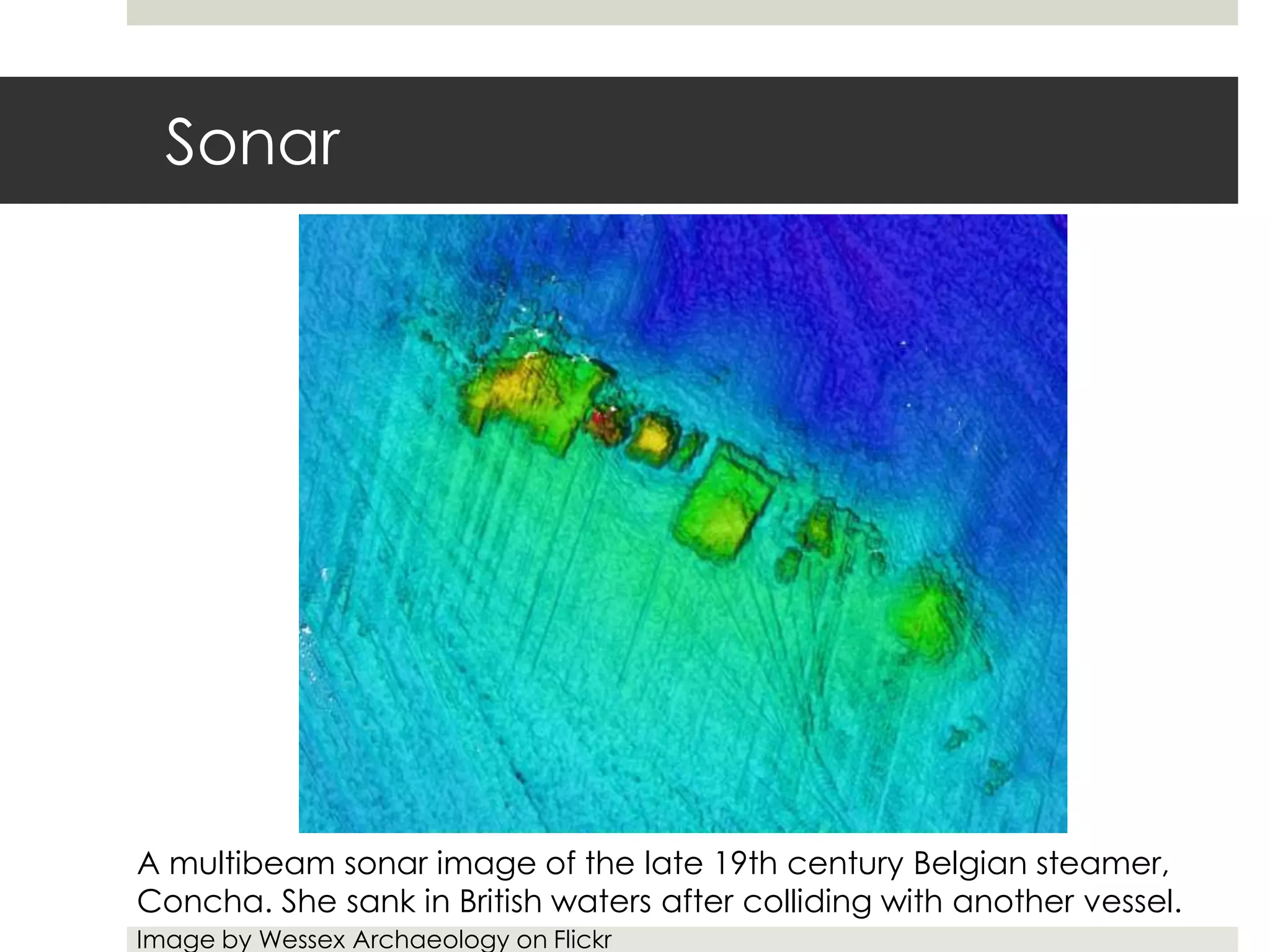
Sonar


A multibeam sonar image of the late 19th century Belgian steamer,
Concha. She sank in British waters after colliding with another vessel.
Image by Wessex Archaeology on Flickr
Ground Penetrating Radar
Radar depth slice (ca. 65-70cm) from Gokstad, Norway, acquired by a 16 channel 400 MhzMåla
Imaging Radar Array System (MIRA)


    Source: Petra Schneidhofer, Dissertation Abstract, University of Vienna, Initiative College for
    Archaeological Prospection
LiDAR
 LiDAR is a method of generating precise and directly
  geo-referenced spatial information about the shape and
  surface characteristics of the Earth.

 Used to examine natural and built environments across a
  wide range of scales with greater accuracy, precision,
  and flexibility than ever before

 Legacies of Resilience, SacapuAngamuco, Mexico
   http://www.resilientworld.com
   Chris Fisher, Colorado State University.

 Furnace Falls Dam Mitigation, Stanhope, NJ
   http://www.geospatialarchaeology.com/
   Joel Grossman, PhD, Army Corps of Engineers
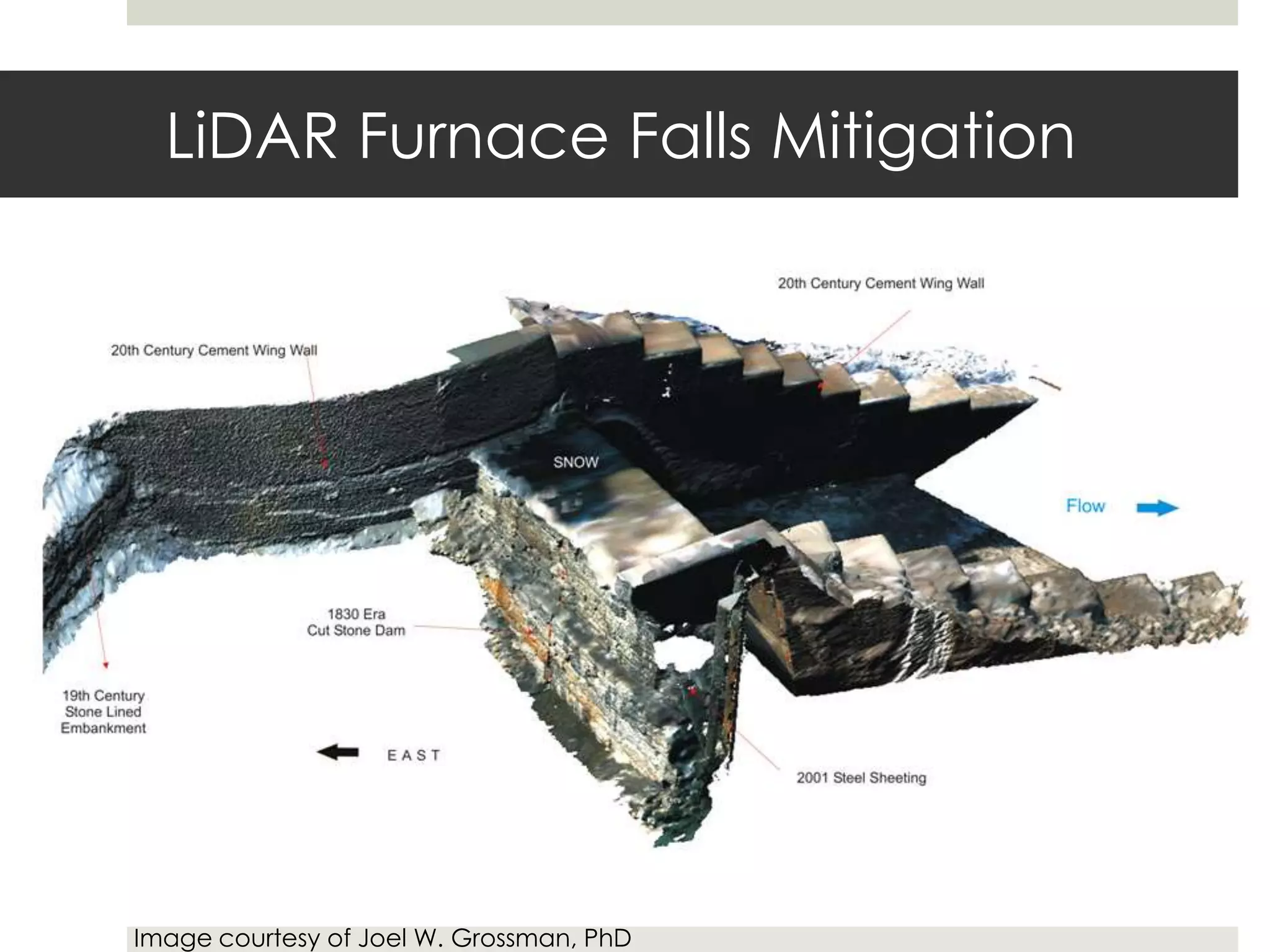
LiDAR Furnace Falls Mitigation


Image courtesy of Joel W. Grossman, PhD
LiDAR Furnace Falls Mitigation
                                  Furnace Falls, Stanhope, NJ
                                  Hi Res Dual Station GPS Team
                                  Sets Site Datum's - January 20, 2004
                                  Temp: 14 - 170 F.


                                              LIDAR Scan Position I
Image courtesy of Joel W. Grossman, PhD
LiDAR Furnace Falls Mitigation


Image courtesy of Joel W. Grossman, PhD
LiDAR Furnace Falls Mitigation


Image courtesy of Joel W. Grossman, PhD
Simulations


Image courtesy of Joel W. Grossman, PhD
Combined Visualizations


Image courtesy of Joel W. Grossman, PhD
Programs for Archaeology

 Bonn Archaeological Software Package (BASP)
   http://wings.buffalo.edu/anthropology/BASP/basp.html
   70+ functions for seriation, clustering, correspondence
    analysis, and mapping; includes programs for three
    dimensional display of data, finding rectangular structures in
    scanned excavation plans, and rectification of extremely
    oblique aerial photographs and their superimposition on
    large-scale scanned maps.

 TimeMap
   http://www.timemap.net/
   TimeMapTMJava is a novel mapping applet which
    generates complete interactive maps with a few simple lines
    of html.
Preserving the Digital Record
Archaeologists Profile

 Varied Background
   Historians
   Art historians
   Linguists
   Anthropologists

 Computer training
Publishing in Archaeology

 Electronic publishing
   CD, websites
   Web monographs, web journals like Internet Archaeology
   Better, cheaper color graphics
   Shorter lifespan, degrading technology, ephemeral web
    pages
   Need: e-published databases, CAD models, GIS databases


           Born digital artifacts are best stored digitally
E-Publishing and Archiving

 Hybrid print and digital projects
   Electronic data
   Analysis
   Synthesis
   Expository text
Online Libraries

 WWW Virtual Library Site for Archaeology
  http://archnet.asu.edu/

 ARGE - Archaeological Resource Guide for Europe
  http://odur.let.rug.nl/arge/

 VLMP - WWW Virtual Library for Museums
  http://icom.museum

 World Lecture Hall - Anthropology and Archaeology
  http://web.austin.utexas.edu/wlh/

 "the lithics site": a resource for archaeological lithic
  analysts (1999-)
  http://wings.buffalo.edu/anthropology/Lithics
Online Communities

 Arqueologia Digital - Brazilian online network for
  archaeology practitioners
  http://arqueologiadigital.com
Continued Problems

 Problems
   Specialization divides practitioners
   Few standards for
      Communication
      Tools
      Preservation of digital data
      Presentation of digital data
   Lack of Computer Training
Solutions - Communication

 Archaeological Data Service (UK)
   Repository for electronic project data.
   Provides guides and best practices for software and data
    tools like CAD and GIS
   Standards of software companies don't always cover the
    ways that archaeologists use them.
Solutions - Supercomputers
 Texas Advanced Computing Center (TACC), Institute of
  Classical Archaeology, University of Texas
   A leading partner with Extreme Science and Engineering
    Discovery Environment (XSEDE)

 “Digs that I‟ve participated in have produced information
  that is now digitally gone because the platforms and the
  storage mechanisms became obsolete, and that‟s in the
  space of ten years….”

 “When we look down the road and ask, „What will we leave
  for people 25 years from now, 100 years from now?‟ we‟re
  faced with a huge issue that people are just starting to
  confront. The use of new tools outpaced the concern about
  the future.
  --Dr. Adam Rabinowitz, Assistant Director
Solutions - Preservation

 Translatlantic Archaeology Gateway
   Multi-national Partnership
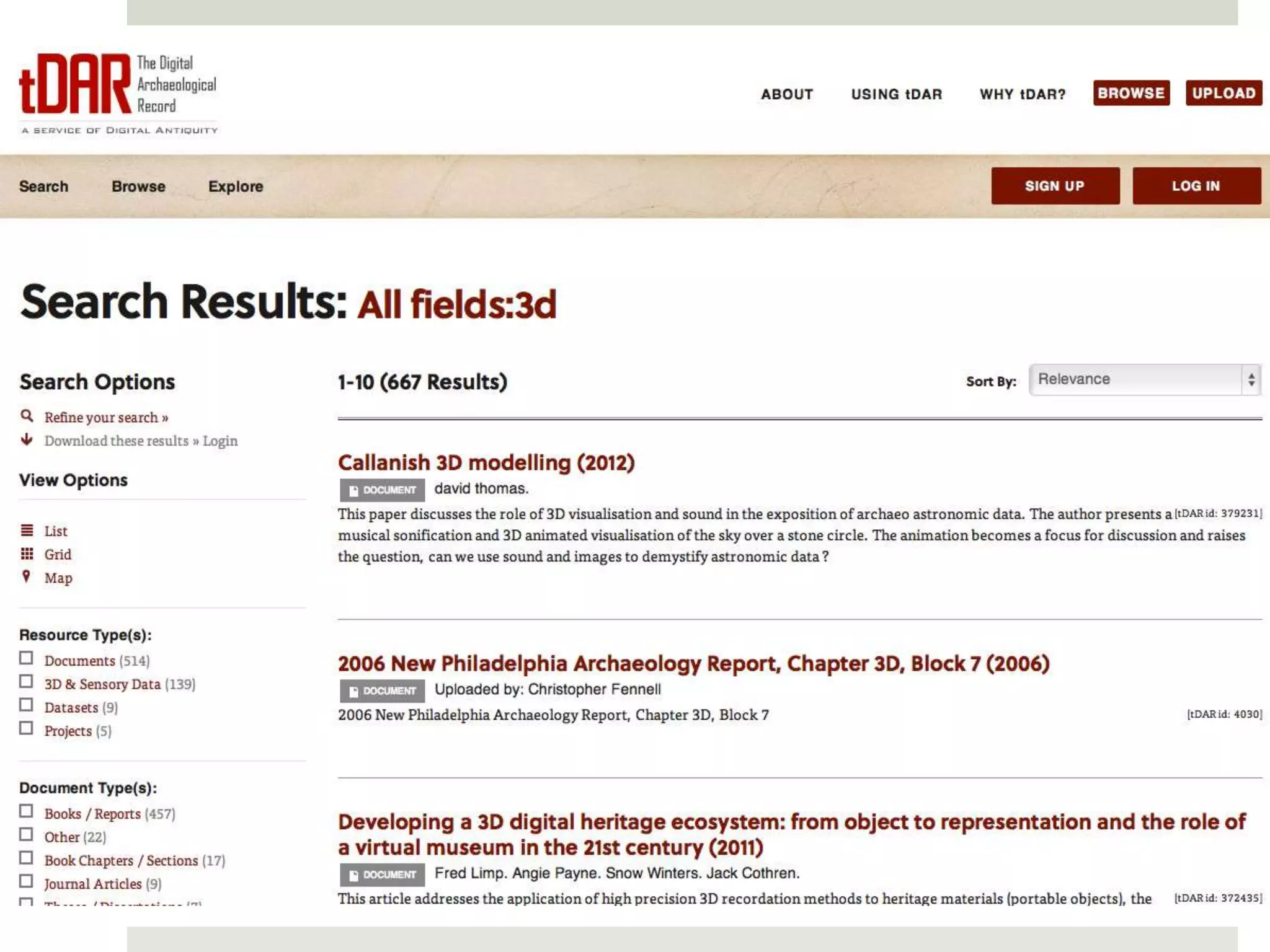
      The Digital Archaeological Record (tDAR) Arizona State
       University (USA) – Digital Antiquity
      Archaeological Data Service (UK)
   Mission
      Repository for electronic project data.
      Sustainable service for archaeological teaching, learning
       and research
   Funded by JISC and NEH
Solutions: Preservation

 Virtual World Heritage Laboratory
   University of Virginia
   http://vwhl.clas.virginia.edu


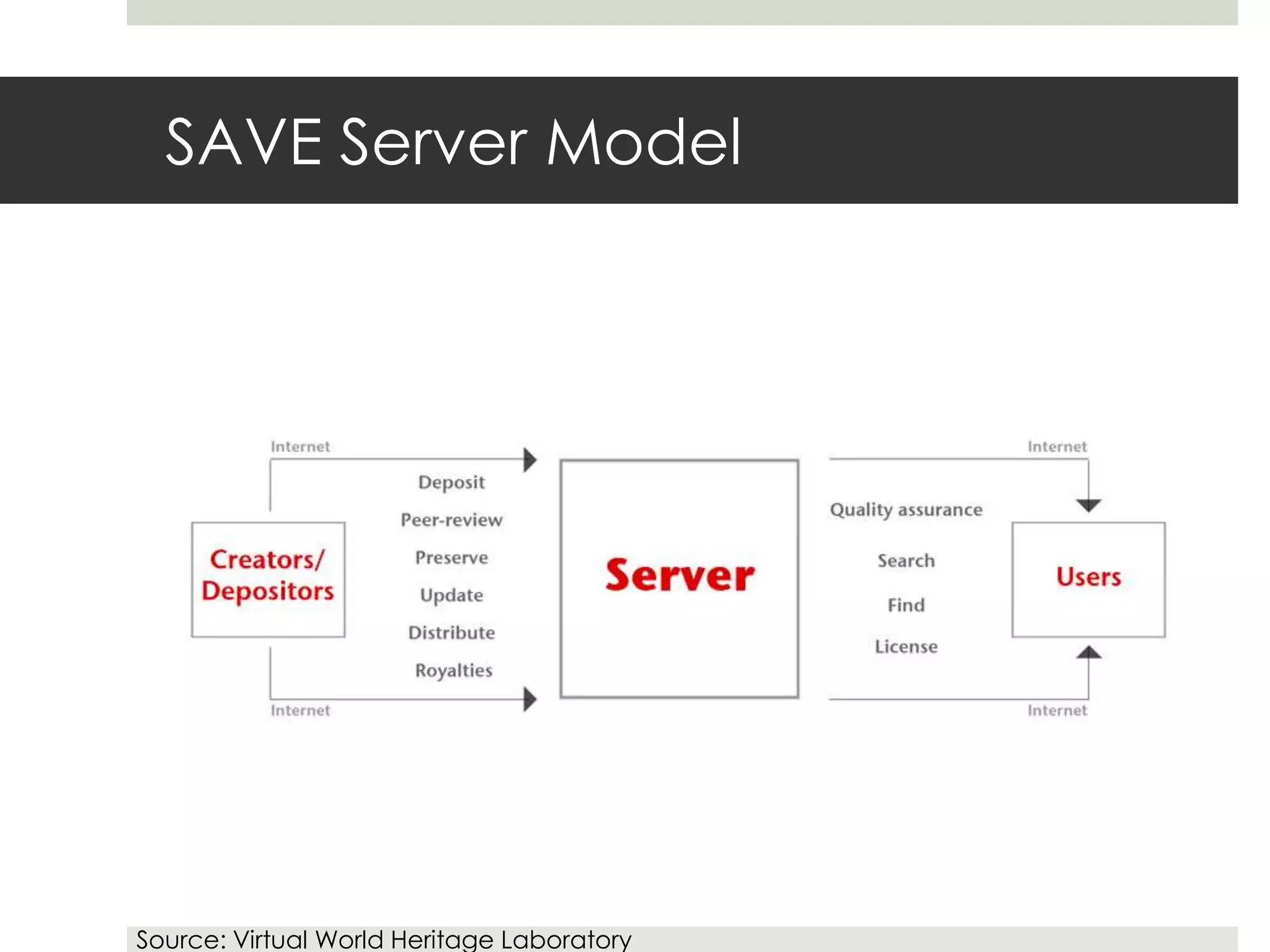
 SAVE: Serving and Archiving Virtual Environments
   “Several thousand scientific 3D digital models of cultural
    artifacts have been created over the past decade as digital
    humanists have embraced new 3D technologies. Ironically,
    the scholars who have worked so hard to preserve the
    world's cultural heritage have rarely paid attention to how
    their own contributions will survive in the coming decades.”
SAVE Server Model


Source: Virtual World Heritage Laboratory
Conferences
 CAA Conference, March 2013, Perth Australia
   http://caaconference.org
   Computer Applications and Quantitative Methods in
    Archaeology
   Archaeologists, mathematics and computer scientists

 DigiDoc 2012, Edinburgh Scotland
   http://www.digitaldocumentation.co.uk
   Cyark
   Archaeology, architecture, heritage and design

 TAG Conference, 2013, Chicago
   http://tag2013.uchicago.edu/cfp.html
   Theoretical Archaeology Group
   intersection of archaeology with critical theory, philosophy, and
    anthropology (especially visualizations)
Bibliography
 Archaeology Data Service. (n.d.) [website]. Retrieved from
  http://archaeologydataservice.ac.uk/archsearch/

 Blackwell, S. (2004). A Companion to Digital Humanities, ed. Susan
  Schreibman, Ray Siemens, John Unsworth. Oxford: Blackwell. Retrieved
  from http://www.digitalhumanities.org/companion/

 The Digital Archaeological Record tDAR. (n.d.) [website]. Retrieved
  from http://www.tdar.org

 Grossman J. W. (2008). “Human-landscape interactions.” In:
  Encyclopedia of Archaeology, ed. by Deborah M. Pearsall. © 2008,
  Academic Press, New York.

 Grossman J. W. (2008). “Toxic and hazardous environments.” In:
  Encyclopedia of Archaeology, ed. by Deborah M. Pearsall. Academic
  Press, New York.
Bibliography
 Hopkins, C. (March 10, 2012). “Indiana Jones goes geek: Laser-mapping
  LiDAR revolutionizes archaeology, Arstechnica [website] Retrieved from
  http://arstechnica.com/science/2012/03/indiana-jones-goes-geek-
  laser-mapping-lidar-revolutionizes-archaeology/

 National Oceanic and Atmospheric Administration (NOAA), Coastal
  Services Center. (November 2012). LiDAR 101: an introduction to LiDAR
  technology, data, and applications. Retrieved from
  http://www.csc.noaa.gov/digitalcoast/_/pdf/lidar101.pdf

 Texas Advanced Computing Center. (n.d.) Advanced Computing in
  the Humanities, Art and Social Sciences. [website] Retrieved from
  http://www.tacc.utexas.edu/education/humanities

Digital humanities-and-archaeology

  • 1.
    Digital Humanities and Archaeology ByNoreen Whysel LIS 657 Digital Humanities
  • 2.
    Archaeology is…  Materialstudy  A way to reconstruct history  A way to supply evidence where there is no written record
  • 3.
    Goals of Archaeology Find the material remains of our ancestors  Unearth those remains in ways that maximize the information they can convey  Interpret the evidence What about Preservation?
  • 4.
    Archaeological Methods  Excavation:the principal method of data acquisition in archaeology, involving the systematic uncovering of archaeological remains through the removal of the deposits of soil and the other material covering them and accompanying them.  Surface survey: field-walking, i.e. scanning the ground along one's path and recording the location of artifacts and surface features. A systematic survey involves a grid system, such that the survey area is divided into sectors and these are walked systematically.  Problem  Both methods cause destruction of the site  Both methods remove objects from physical context  Solution  Careful record keeping
  • 5.
    Today‟s Topics  Computingin Archaeology  Archaeology‟s Digital Tools  Preserving the Digital Record
  • 6.
  • 7.
    Keeping Records  Themain occupation of a field archaeologist is record keeping  Keeping good records is an important skill  Computers are the best way to keep records  Therefore, archaeologists should understand how to use computers Sounds logical
  • 8.
    Computing in Archaeology 1950s  Computers were large, expensive and complicated  used more for statistical analysis and mathematical models than for record keeping  1960s  Data begins to be kept in large databanks  Data processing required computer code  Not many archaeologists had programming skills  Not many projects had the budget to hire programmers
  • 9.
    Computing in Archaeology 1970s  Microcomputers - Powerful data storage and retrieval  dBase: database software, simple to learn and use  Graphic rendering programs and rudimentary GIS  New tools allow greater granularity of recorded data raising the standard for record keeping and demand for better and more powerful tools.  First archaeological computing conferences  First archaeological computing association  Computer Applications and Quantitative Methods in Archaeology, University of Birmingham, UK (1974)
  • 10.
    Computing in Archaeology 1980s  Personal Computing  Computer Aided Design (CAD)  Reconstructing  Illustrating  Envisioning  3D Modeling  Less often, simulation  More professional archaeology associations addressing computing at annual meetings.  Archeological Computing Newsletter (1984)
  • 11.
    Computing In Archaeology Mid-1980s  GIS: Geographic Information Systems  Standard relational data tables (object data)  Linked to coordinates on a map (points, lines)  Linked to information derived from map data (grade, contours, boundaries)  GIS allows archaeologists to analyze material remains in context of physical environment.
  • 12.
    Computing in Archaeology 1990s  Usenet distributed internet discussion system  alt.archaeology (earliest available article from 1995)
sci.archaeology(earliest available article from 1991) Mesopotamia)
sci.archaeology.mesoamerican
sci.arch aeology.moderated  Archived at Google Groups since 2001  CD-Rom  World Wide Web
  • 13.
    Computing in Archaeology 1990s-2000s  New surveying methods  Photo: desktop photogrammetry, aerial photography, satellite imagery  Geological: magnetometers, electrical resistance meters, ground-penetrating radar (GPR) and electromagnetic (EM) conductivity  LiDAR Mapping: Light Detecting and Ranging  Remote sensing technology
  • 14.
  • 15.
    Digital Elevation Rendering StanhopeTopography showing Furnace Falls Dam at Lake Musconetcong, Stanhope, NJ Image courtesy of Joel W. Grossman, PhD
  • 16.
    Satellite Imagery Tanis, Egypt Sources: Sarah Parcak& Gregory Mumford,University Of Alabama At Birmingham; Digitalglobe
  • 17.
    Sonar A multibeam sonarimage of the late 19th century Belgian steamer, Concha. She sank in British waters after colliding with another vessel. Image by Wessex Archaeology on Flickr
  • 18.
    Ground Penetrating Radar Radardepth slice (ca. 65-70cm) from Gokstad, Norway, acquired by a 16 channel 400 MhzMåla Imaging Radar Array System (MIRA) Source: Petra Schneidhofer, Dissertation Abstract, University of Vienna, Initiative College for Archaeological Prospection
  • 19.
    LiDAR  LiDAR isa method of generating precise and directly geo-referenced spatial information about the shape and surface characteristics of the Earth.  Used to examine natural and built environments across a wide range of scales with greater accuracy, precision, and flexibility than ever before  Legacies of Resilience, SacapuAngamuco, Mexico  http://www.resilientworld.com  Chris Fisher, Colorado State University.  Furnace Falls Dam Mitigation, Stanhope, NJ  http://www.geospatialarchaeology.com/  Joel Grossman, PhD, Army Corps of Engineers
  • 20.
    LiDAR Furnace FallsMitigation Image courtesy of Joel W. Grossman, PhD
  • 21.
    LiDAR Furnace FallsMitigation Furnace Falls, Stanhope, NJ Hi Res Dual Station GPS Team Sets Site Datum's - January 20, 2004 Temp: 14 - 170 F. LIDAR Scan Position I Image courtesy of Joel W. Grossman, PhD
  • 22.
    LiDAR Furnace FallsMitigation Image courtesy of Joel W. Grossman, PhD
  • 23.
    LiDAR Furnace FallsMitigation Image courtesy of Joel W. Grossman, PhD
  • 24.
    Simulations Image courtesy ofJoel W. Grossman, PhD
  • 25.
  • 26.
    Programs for Archaeology Bonn Archaeological Software Package (BASP)  http://wings.buffalo.edu/anthropology/BASP/basp.html  70+ functions for seriation, clustering, correspondence analysis, and mapping; includes programs for three dimensional display of data, finding rectangular structures in scanned excavation plans, and rectification of extremely oblique aerial photographs and their superimposition on large-scale scanned maps.  TimeMap  http://www.timemap.net/  TimeMapTMJava is a novel mapping applet which generates complete interactive maps with a few simple lines of html.
  • 27.
  • 28.
    Archaeologists Profile  VariedBackground  Historians  Art historians  Linguists  Anthropologists  Computer training
  • 29.
    Publishing in Archaeology Electronic publishing  CD, websites  Web monographs, web journals like Internet Archaeology  Better, cheaper color graphics  Shorter lifespan, degrading technology, ephemeral web pages  Need: e-published databases, CAD models, GIS databases Born digital artifacts are best stored digitally
  • 30.
    E-Publishing and Archiving Hybrid print and digital projects  Electronic data  Analysis  Synthesis  Expository text
  • 31.
    Online Libraries  WWWVirtual Library Site for Archaeology http://archnet.asu.edu/  ARGE - Archaeological Resource Guide for Europe http://odur.let.rug.nl/arge/  VLMP - WWW Virtual Library for Museums http://icom.museum  World Lecture Hall - Anthropology and Archaeology http://web.austin.utexas.edu/wlh/  "the lithics site": a resource for archaeological lithic analysts (1999-) http://wings.buffalo.edu/anthropology/Lithics
  • 32.
    Online Communities  ArqueologiaDigital - Brazilian online network for archaeology practitioners http://arqueologiadigital.com
  • 33.
    Continued Problems  Problems  Specialization divides practitioners  Few standards for  Communication  Tools  Preservation of digital data  Presentation of digital data  Lack of Computer Training
  • 34.
    Solutions - Communication Archaeological Data Service (UK)  Repository for electronic project data.  Provides guides and best practices for software and data tools like CAD and GIS  Standards of software companies don't always cover the ways that archaeologists use them.
  • 35.
    Solutions - Supercomputers Texas Advanced Computing Center (TACC), Institute of Classical Archaeology, University of Texas  A leading partner with Extreme Science and Engineering Discovery Environment (XSEDE)  “Digs that I‟ve participated in have produced information that is now digitally gone because the platforms and the storage mechanisms became obsolete, and that‟s in the space of ten years….”  “When we look down the road and ask, „What will we leave for people 25 years from now, 100 years from now?‟ we‟re faced with a huge issue that people are just starting to confront. The use of new tools outpaced the concern about the future. --Dr. Adam Rabinowitz, Assistant Director
  • 37.
    Solutions - Preservation Translatlantic Archaeology Gateway  Multi-national Partnership  The Digital Archaeological Record (tDAR) Arizona State University (USA) – Digital Antiquity  Archaeological Data Service (UK)  Mission  Repository for electronic project data.  Sustainable service for archaeological teaching, learning and research  Funded by JISC and NEH
  • 40.
    Solutions: Preservation  VirtualWorld Heritage Laboratory  University of Virginia  http://vwhl.clas.virginia.edu  SAVE: Serving and Archiving Virtual Environments  “Several thousand scientific 3D digital models of cultural artifacts have been created over the past decade as digital humanists have embraced new 3D technologies. Ironically, the scholars who have worked so hard to preserve the world's cultural heritage have rarely paid attention to how their own contributions will survive in the coming decades.”
  • 41.
    SAVE Server Model Source:Virtual World Heritage Laboratory
  • 42.
    Conferences  CAA Conference,March 2013, Perth Australia  http://caaconference.org  Computer Applications and Quantitative Methods in Archaeology  Archaeologists, mathematics and computer scientists  DigiDoc 2012, Edinburgh Scotland  http://www.digitaldocumentation.co.uk  Cyark  Archaeology, architecture, heritage and design  TAG Conference, 2013, Chicago  http://tag2013.uchicago.edu/cfp.html  Theoretical Archaeology Group  intersection of archaeology with critical theory, philosophy, and anthropology (especially visualizations)
  • 43.
    Bibliography  Archaeology DataService. (n.d.) [website]. Retrieved from http://archaeologydataservice.ac.uk/archsearch/  Blackwell, S. (2004). A Companion to Digital Humanities, ed. Susan Schreibman, Ray Siemens, John Unsworth. Oxford: Blackwell. Retrieved from http://www.digitalhumanities.org/companion/  The Digital Archaeological Record tDAR. (n.d.) [website]. Retrieved from http://www.tdar.org  Grossman J. W. (2008). “Human-landscape interactions.” In: Encyclopedia of Archaeology, ed. by Deborah M. Pearsall. © 2008, Academic Press, New York.  Grossman J. W. (2008). “Toxic and hazardous environments.” In: Encyclopedia of Archaeology, ed. by Deborah M. Pearsall. Academic Press, New York.
  • 44.
    Bibliography  Hopkins, C.(March 10, 2012). “Indiana Jones goes geek: Laser-mapping LiDAR revolutionizes archaeology, Arstechnica [website] Retrieved from http://arstechnica.com/science/2012/03/indiana-jones-goes-geek- laser-mapping-lidar-revolutionizes-archaeology/  National Oceanic and Atmospheric Administration (NOAA), Coastal Services Center. (November 2012). LiDAR 101: an introduction to LiDAR technology, data, and applications. Retrieved from http://www.csc.noaa.gov/digitalcoast/_/pdf/lidar101.pdf  Texas Advanced Computing Center. (n.d.) Advanced Computing in the Humanities, Art and Social Sciences. [website] Retrieved from http://www.tacc.utexas.edu/education/humanities