Introduction to Archaeological
Dating Techniques
Dating Techniques
Two major categories:
Relative Dating
Orders items from oldest to youngest
Does not give a specific date
Absolute Dating
Also called chronometric dating
Gives a date in terms of calendar year
Relative Dating
Analysis during Excavation:
Stratigraphy (layers of deposits, natural
and human made)
Law of Superposition
•Older materials are typically on the bottom,
younger materials on the top
•Except when they are not!—sometimes old
material is dug up and reused, natural
formation processes redeposit materials, etc.
•Why context is so important
Relative Dating
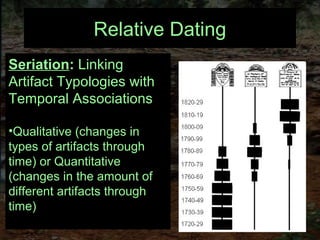
Seriation: Linking
Artifact Typologies with
Temporal Associations
•Qualitative (changes in
types of artifacts through
time) or Quantitative
(changes in the amount of
different artifacts through
time)
Relative Dating
Seriation
•Very important to maintain
context, understand relative
frequency of artifacts
•Charting time-sensitive
artifacts forms “Battleship
Curves”
•Shows change in relative
frequency of styles of artifact
through time
Relative Dating
One more Relative dating technique:
FUN Dating (Fluorine, Uranium and
Nitrogen)
•Buried bones slowly lose nitrogen and absorb
fluorine and uranium through time
•Amount of these elements in bones can be
compared to see which were buried longer
•Rates of absorption are locally specific, cannot
compare bones from different regions
Absolute Dating
Many different types:
•Dendrochronology—tree ring dating
•Radiometric techniques—based on
principles of radioactive decay
•And more!
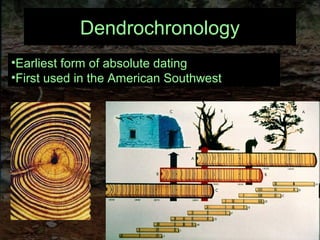
Dendrochronology
•Earliest form of absolute dating
•First used in the American Southwest
Dendrochronology
• Based on the annual growth of trees, each
ring representing a new year of growth
• Rings vary in thickness according to the
year, over time will have a distinct pattern
of rings
• Patterns of rings are matched from newer
to older trees
• Limited to areas where trees preserve,
only goes back a limited time, less than
10,000 years
Absolute Dating
Radiometric Dating Techniques
•Based on principles of atomic decay, where
radioactive parent isotopes decay into
daughter elements
•Rate of decay is known and is measurable
•When decay began is known
Radiometric Dating
Radiocarbon Dating: most common
•Must use organic materials, such as charcoal, bone,
or plant matter
•All organic life takes in carbon from their
surroundings
•14
C is an unstable carbon isotope; 12
C is a stable
carbon isotope
•When organism dies, only the 14
C begins to decay
•Half-life of 14
C (after death of organism) is
approximately 5,730 years—meaning after 5,730
years, half of the 14
C in the living organism is gone
Radiometric Dating
Radiocarbon Dating: Issues
•Amount of 14
C in the atmosphere has changed in
the past!
•Dates must be calibrated to reflect true date
•Must have adequate amount of sample material,
avoid contamination
•Older techniques needed 10-20 grams, newer AMS
technique need very small sample
•Technique limited to dates from 500 to 50,000
years—after 50,000 years, there’s not enough 14
C left
to measure
Radiometric Dating
Other Radiometric Dating Techniques
(see your textbook)
•Potassium-Argon: good for much older
samples, dates into the billions of years, uses
volcanic material
•Uranium: dates limestone cave deposits, useful
for “in-between” dates
•Fission-track: uses volcanic rocks or glass,
typically older dates
•Thermoluminescence: pottery and burned clay

Archaeological dating techniques

  • 1.
  • 2.
    Dating Techniques Two majorcategories: Relative Dating Orders items from oldest to youngest Does not give a specific date Absolute Dating Also called chronometric dating Gives a date in terms of calendar year
  • 3.
    Relative Dating Analysis duringExcavation: Stratigraphy (layers of deposits, natural and human made) Law of Superposition •Older materials are typically on the bottom, younger materials on the top •Except when they are not!—sometimes old material is dug up and reused, natural formation processes redeposit materials, etc. •Why context is so important
  • 4.
    Relative Dating Seriation: Linking ArtifactTypologies with Temporal Associations •Qualitative (changes in types of artifacts through time) or Quantitative (changes in the amount of different artifacts through time)
  • 5.
    Relative Dating Seriation •Very importantto maintain context, understand relative frequency of artifacts •Charting time-sensitive artifacts forms “Battleship Curves” •Shows change in relative frequency of styles of artifact through time
  • 6.
    Relative Dating One moreRelative dating technique: FUN Dating (Fluorine, Uranium and Nitrogen) •Buried bones slowly lose nitrogen and absorb fluorine and uranium through time •Amount of these elements in bones can be compared to see which were buried longer •Rates of absorption are locally specific, cannot compare bones from different regions
  • 7.
    Absolute Dating Many differenttypes: •Dendrochronology—tree ring dating •Radiometric techniques—based on principles of radioactive decay •And more!
  • 8.
    Dendrochronology •Earliest form ofabsolute dating •First used in the American Southwest
  • 9.
    Dendrochronology • Based onthe annual growth of trees, each ring representing a new year of growth • Rings vary in thickness according to the year, over time will have a distinct pattern of rings • Patterns of rings are matched from newer to older trees • Limited to areas where trees preserve, only goes back a limited time, less than 10,000 years
  • 10.
    Absolute Dating Radiometric DatingTechniques •Based on principles of atomic decay, where radioactive parent isotopes decay into daughter elements •Rate of decay is known and is measurable •When decay began is known
  • 11.
    Radiometric Dating Radiocarbon Dating:most common •Must use organic materials, such as charcoal, bone, or plant matter •All organic life takes in carbon from their surroundings •14 C is an unstable carbon isotope; 12 C is a stable carbon isotope •When organism dies, only the 14 C begins to decay •Half-life of 14 C (after death of organism) is approximately 5,730 years—meaning after 5,730 years, half of the 14 C in the living organism is gone
  • 12.
    Radiometric Dating Radiocarbon Dating:Issues •Amount of 14 C in the atmosphere has changed in the past! •Dates must be calibrated to reflect true date •Must have adequate amount of sample material, avoid contamination •Older techniques needed 10-20 grams, newer AMS technique need very small sample •Technique limited to dates from 500 to 50,000 years—after 50,000 years, there’s not enough 14 C left to measure
  • 13.
    Radiometric Dating Other RadiometricDating Techniques (see your textbook) •Potassium-Argon: good for much older samples, dates into the billions of years, uses volcanic material •Uranium: dates limestone cave deposits, useful for “in-between” dates •Fission-track: uses volcanic rocks or glass, typically older dates •Thermoluminescence: pottery and burned clay