
ARCH 417
Fall 15
Bauhaus
agenda 9.30.15
ungraded quiz on Monday's lecture. This is solely for
purposes of discussing appropriate evaluation in the
class.
embracing the machine: Le Corbusier was our prime
example in France
embracing the machine: Bauhaus will be our prime
example in Germany
Walter Gropius (1883-1969)
• born Berlin in a family of architects
• brief architectural training in Münich
• joined studio of Peter Behrens in 1908 (along with fellow
employees Le Corbusier and Mies van der Rohe).
• started his own practice with partner Adolf Meyer in 1910.
• practicing architect and lifelong
educator
• developed a detailed pedagogy of
design
another "maven"
Walter GROPIUS and Adolf MEYER
Fagus Factory
Alfed an der Leine, Germany
1913
Walter GROPIUS and Adolf MEYER
Fagus Factory 1913
• This was the first major
commission for Gropius and
Meyer and was an
acclaimed success.
• Program included 10
interrelated buildings. The
architects kept working on
the complex with this
manufacturer until 1925.
• Factory built shoe-lasts and
is still in operation.
• Gropius and Meyer
only designed the
façades.
• photo top: machining
lasts at the Fagus
Factory.
• photo bottom:
completed product at
the Fagus Factory.
Bauhaus (1919-1928)
Gropius was appointed Director
of the Academy of Fine Arts in
Weimar.
He merged it with School of Arts
and Crafts, believing that all arts
are governed by the same basic
principles.
“The Bauhaus strives to
combine...all the arts –
sculpture, painting, applied art
and visual art – as the
inseparable components of a
new architecture.”
In 1925, school moved to
bottom: map showing
Bauhaus locations
top: map showing Bauhaus
locations relative to DDR/BRD
borders; East German territory
is colored in red
WHERE was the Bauhaus?
first Bauhaus
Weimar, Germany
second Bauhaus
Dessau,
The Bauhaus compound in Dessau was a purpose-built structure for the school, housing
and providing classroom, workshop and office space. When people refer generically to th
Bauhaus, this location and architecture is what they mean.
last Bauhaus
Berlin, Germany
1932-33
The Bauhaus
school was
founded upon
a complete
approach to
architecture
and design.
Much like the
Russian
Constructivist
s, they
wanted to
merge art into
life, and to
make their
work part of
everyday life.
This was reflected in
the curriculum, the
subjects studied,
and most of all in
the way
of life pursued there.
The artist and the
craftsperson were
viewed as equal
collaborators.
Every Bauhaus
student was
required to major
in one fine art and
one craft.
Bauhaus curriculum
emphasis on properties
of materials and design
across disciplines
aesthetic principles:
• fidelity to materials
• economy of form
• appropriate to function
• instruction in technology
and techniques of mass
production
Oskar Schlemmer, Bauhaus Stairway, 1932
Just like their Soviet counterparts, Bauhaus designers wanted to contribute
functional objects to the new modes of everyday life.
Furniture design was also important.
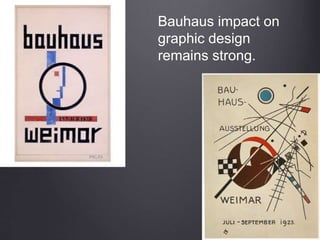
Bauhaus impact on
graphic design
remains strong.
The Bauhaus style had a profound impact on graphic design fields such as advertisin
cover design.
Bauhaus, Dessau
Interior, Workshop.
Bauhaus, Dessau
Interior, Corridor And Stairs
Bauhaus, Dessau. Interior, stairwell with Breuer chairs.
Bauhaus, Dessau. Interior, Student room.
Bauhaus, Dessau.
Interior, Auditorium
Irene Hecht Bayer
New Bauhaus Building, Balconies
on the Preller Building
Bauhaus Dessau, 1927
Bauhaus-Archiv Berlin
Erich Consemüller, Bauhaus Scene 1926
Consemüller was commissioned by Gropius to document Bauhaus products.
Featured: Marcel Breuer, B 3 tubular steel chair
Oskar Schlemmer, mask for performance
Lis Beyer, dress fabric woven in textile workshop
women
at the
Bauhaus
Lionel Feininger
Women on the Staircase
1927
New forms of bodily, sexual,
social,
and creative freedom were
played
with at the Bauhaus, and women
had a higher status inside than
outside its doors.
at the looms in the textile workshop, Bauhaus
Anni ALBERS,
textile design, 1926
Gunta Stözl was a Weimar
Bauhaus student who became
a master of the textile workshop
in Dessau.
Gunta Stözl
textile design
Women were
overrepresented in
traditionally female
craft fields
like weaving and
underrepresented
in other fields
perceived to be
more
masculine. Their
freedom relative to
their female peers
outside the
institution, however,
Theatrical design was a Bauhaus major and was put to good use in frequent productions
why did the Nazis dislike
the Bauhaus?
freedom of thought and experimental attitude
equality for women
modernist aesthetics and ideals
Adolf WISSEL (1894-1973)
Farm Family from Kahlenberg, 1939, oil on canvas
tea and needlework:
fitting occupations for
grandmother in Hitler's
Germany
Gropius in the USA
fled Germany in 1934 to England
was invited to Harvard Graduate School of Design in 1937
his student Marcel Breuer quickly followed to join Harvard
faculty as well
Harvard Graduate Center
Cambridge, MA
(1950)
exterior view detail of decoration, entrance hall
detail of decoration, brick
pattern mural
detail of decoration, mural in dining
room

ARCH417Class11

  • 1.
  • 2.
    agenda 9.30.15 ungraded quizon Monday's lecture. This is solely for purposes of discussing appropriate evaluation in the class. embracing the machine: Le Corbusier was our prime example in France embracing the machine: Bauhaus will be our prime example in Germany
  • 3.
    Walter Gropius (1883-1969) •born Berlin in a family of architects • brief architectural training in Münich • joined studio of Peter Behrens in 1908 (along with fellow employees Le Corbusier and Mies van der Rohe). • started his own practice with partner Adolf Meyer in 1910.
  • 4.
    • practicing architectand lifelong educator • developed a detailed pedagogy of design another "maven"
  • 5.
    Walter GROPIUS andAdolf MEYER Fagus Factory Alfed an der Leine, Germany 1913
  • 6.
    Walter GROPIUS andAdolf MEYER Fagus Factory 1913 • This was the first major commission for Gropius and Meyer and was an acclaimed success. • Program included 10 interrelated buildings. The architects kept working on the complex with this manufacturer until 1925. • Factory built shoe-lasts and is still in operation.
  • 7.
    • Gropius andMeyer only designed the façades. • photo top: machining lasts at the Fagus Factory. • photo bottom: completed product at the Fagus Factory.
  • 8.
    Bauhaus (1919-1928) Gropius wasappointed Director of the Academy of Fine Arts in Weimar. He merged it with School of Arts and Crafts, believing that all arts are governed by the same basic principles. “The Bauhaus strives to combine...all the arts – sculpture, painting, applied art and visual art – as the inseparable components of a new architecture.” In 1925, school moved to
  • 9.
    bottom: map showing Bauhauslocations top: map showing Bauhaus locations relative to DDR/BRD borders; East German territory is colored in red WHERE was the Bauhaus?
  • 10.
  • 11.
  • 12.
    The Bauhaus compoundin Dessau was a purpose-built structure for the school, housing and providing classroom, workshop and office space. When people refer generically to th Bauhaus, this location and architecture is what they mean.
  • 13.
  • 14.
    The Bauhaus school was foundedupon a complete approach to architecture and design. Much like the Russian Constructivist s, they wanted to merge art into life, and to make their work part of everyday life.
  • 15.
    This was reflectedin the curriculum, the subjects studied, and most of all in the way of life pursued there.
  • 16.
    The artist andthe craftsperson were viewed as equal collaborators. Every Bauhaus student was required to major in one fine art and one craft.
  • 17.
    Bauhaus curriculum emphasis onproperties of materials and design across disciplines aesthetic principles: • fidelity to materials • economy of form • appropriate to function • instruction in technology and techniques of mass production Oskar Schlemmer, Bauhaus Stairway, 1932
  • 18.
    Just like theirSoviet counterparts, Bauhaus designers wanted to contribute functional objects to the new modes of everyday life.
  • 19.
    Furniture design wasalso important.
  • 23.
    Bauhaus impact on graphicdesign remains strong.
  • 26.
    The Bauhaus stylehad a profound impact on graphic design fields such as advertisin cover design.
  • 27.
    Bauhaus, Dessau Interior, Workshop. Bauhaus,Dessau Interior, Corridor And Stairs
  • 28.
    Bauhaus, Dessau. Interior,stairwell with Breuer chairs.
  • 29.
    Bauhaus, Dessau. Interior,Student room. Bauhaus, Dessau. Interior, Auditorium
  • 30.
    Irene Hecht Bayer NewBauhaus Building, Balconies on the Preller Building Bauhaus Dessau, 1927 Bauhaus-Archiv Berlin
  • 31.
    Erich Consemüller, BauhausScene 1926 Consemüller was commissioned by Gropius to document Bauhaus products. Featured: Marcel Breuer, B 3 tubular steel chair Oskar Schlemmer, mask for performance Lis Beyer, dress fabric woven in textile workshop
  • 32.
    women at the Bauhaus Lionel Feininger Womenon the Staircase 1927 New forms of bodily, sexual, social, and creative freedom were played with at the Bauhaus, and women had a higher status inside than outside its doors.
  • 33.
    at the loomsin the textile workshop, Bauhaus
  • 34.
  • 35.
    Gunta Stözl wasa Weimar Bauhaus student who became a master of the textile workshop in Dessau.
  • 36.
    Gunta Stözl textile design Womenwere overrepresented in traditionally female craft fields like weaving and underrepresented in other fields perceived to be more masculine. Their freedom relative to their female peers outside the institution, however,
  • 37.
    Theatrical design wasa Bauhaus major and was put to good use in frequent productions
  • 38.
    why did theNazis dislike the Bauhaus? freedom of thought and experimental attitude equality for women modernist aesthetics and ideals
  • 39.
    Adolf WISSEL (1894-1973) FarmFamily from Kahlenberg, 1939, oil on canvas
  • 40.
    tea and needlework: fittingoccupations for grandmother in Hitler's Germany
  • 41.
    Gropius in theUSA fled Germany in 1934 to England was invited to Harvard Graduate School of Design in 1937 his student Marcel Breuer quickly followed to join Harvard faculty as well
  • 42.
  • 43.
    exterior view detailof decoration, entrance hall detail of decoration, brick pattern mural detail of decoration, mural in dining room