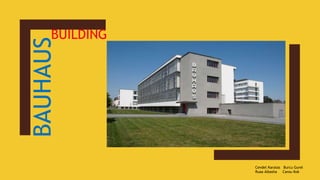
BAUHAUSBUILDING
Cevdet Karatas Burcu Gurel
Ruaa Albasha Cansu Kok
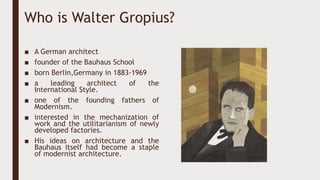
Who is Walter Gropius?
■ A German architect
■ founder of the Bauhaus School
■ born Berlin,Germany in 1883-1969
■ a leading architect of the
International Style.
■ one of the founding fathers of
Modernism.
■ interested in the mechanization of
work and the utilitarianism of newly
developed factories.
■ His ideas on architecture and the
Bauhaus itself had become a staple
of modernist architecture.
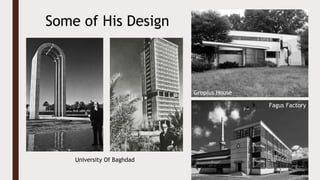
Some of His Design
Fagus Factory
Gropius House
University Of Baghdad
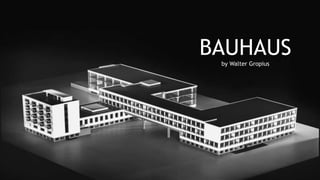
BAUHAUS
by Walter Gropius
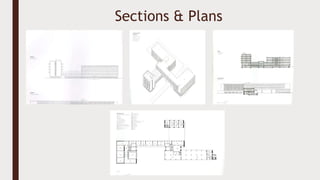
Sections & Plans
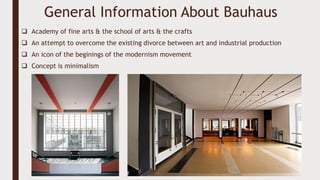
General Information About Bauhaus
 Academy of fine arts & the school of arts & the crafts
 An attempt to overcome the existing divorce between art and industrial production
 An icon of the beginings of the modernism movement
 Concept is minimalism
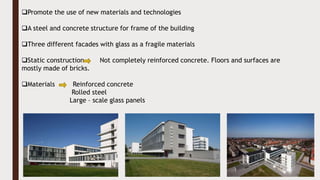
Promote the use of new materials and technologies
A steel and concrete structure for frame of the building
Three different facades with glass as a fragile materials
Static construction Not completely reinforced concrete. Floors and surfaces are
mostly made of bricks.
Materials Reinforced concrete
Rolled steel
Large – scale glass panels
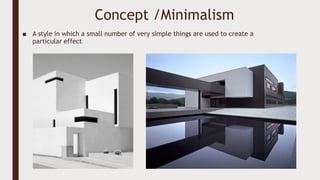
Concept /Minimalism
■ A style in which a small number of very simple things are used to create a
particular effect
Minimalism
in
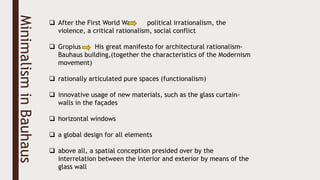
Bauhaus  After the First World War political irrationalism, the
violence, a critical rationalism, social conflict
 Gropius His great manifesto for architectural rationalism-
Bauhaus building,(together the characteristics of the Modernism
movement)
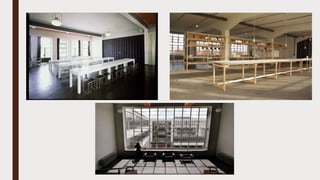
 rationally articulated pure spaces (functionalism)
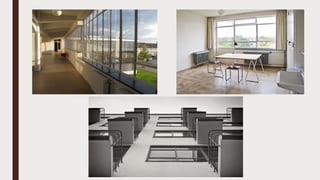
 innovative usage of new materials, such as the glass curtain-
walls in the façades
 horizontal windows
 a global design for all elements
 above all, a spatial conception presided over by the
interrelation between the interior and exterior by means of the
glass wall
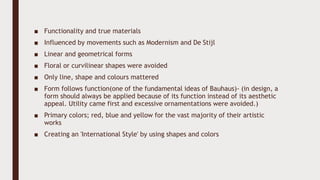
■ Functionality and true materials
■ Influenced by movements such as Modernism and De Stijl
■ Linear and geometrical forms
■ Floral or curvilinear shapes were avoided
■ Only line, shape and colours mattered
■ Form follows function(one of the fundamental ideas of Bauhaus)- (in design, a
form should always be applied because of its function instead of its aesthetic
appeal. Utility came first and excessive ornamentations were avoided.)
■ Primary colors; red, blue and yellow for the vast majority of their artistic
works
■ Creating an 'International Style' by using shapes and colors
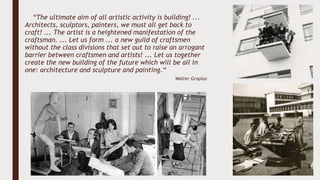
“The ultimate aim of all artistic activity is building! ...
Architects, sculptors, painters, we must all get back to
craft! ... The artist is a heightened manifestation of the
craftsman. ... Let us form ... a new guild of craftsmen
without the class divisions that set out to raise an arrogant
barrier between craftsmen and artists! ... Let us together
create the new building of the future which will be all in
one: architecture and sculpture and painting.“
Walter Gropius
■ https://www.bauhaus-dessau.de/en/architecture/bauhaus-building.html
■ https://www.architectweekly.com/2012/12/why-was-bauhaus-style-so-
important.html
■ https://www.stemgoods.com/blog/why_bauhaus_movement_was_so_important_for_
modern_design
■ https://www.theartstory.org/movement-bauhaus.htm
■ https://www.catawiki.com/stories/5263-5-characteristics-of-bauhaus-art-
architecture-and-design ?
■ https://www.widewalls.ch/bauhaus-architecture/
■ http://www.bbc.com/culture/story/20171109-the-endless-influence-of-the-bauhaus
■ https://www.britannica.com/topic/Bauhaus
■ https://www.archdaily.com/87728/ad-classics-dessau-bauhaus-walter-gropius
■ https://www.dezeen.com/2018/11/05/bauhaus-dessau-school-building-walter-
gropius-germany-architecture/
■ https://en.wikiarquitectura.com/building/bauhaus-building-in-dessau/
■ https://www.arkitektuel.com/dessau-bauhaus/
References

bauhaus.pptx

  • 1.
    BAUHAUSBUILDING Cevdet Karatas BurcuGurel Ruaa Albasha Cansu Kok
  • 2.
    Who is WalterGropius? ■ A German architect ■ founder of the Bauhaus School ■ born Berlin,Germany in 1883-1969 ■ a leading architect of the International Style. ■ one of the founding fathers of Modernism. ■ interested in the mechanization of work and the utilitarianism of newly developed factories. ■ His ideas on architecture and the Bauhaus itself had become a staple of modernist architecture.
  • 3.
    Some of HisDesign Fagus Factory Gropius House University Of Baghdad
  • 4.
  • 5.
  • 6.
    General Information AboutBauhaus  Academy of fine arts & the school of arts & the crafts  An attempt to overcome the existing divorce between art and industrial production  An icon of the beginings of the modernism movement  Concept is minimalism
  • 7.
    Promote the useof new materials and technologies A steel and concrete structure for frame of the building Three different facades with glass as a fragile materials Static construction Not completely reinforced concrete. Floors and surfaces are mostly made of bricks. Materials Reinforced concrete Rolled steel Large – scale glass panels
  • 8.
    Concept /Minimalism ■ Astyle in which a small number of very simple things are used to create a particular effect
  • 9.
    Minimalism in Bauhaus  Afterthe First World War political irrationalism, the violence, a critical rationalism, social conflict  Gropius His great manifesto for architectural rationalism- Bauhaus building,(together the characteristics of the Modernism movement)  rationally articulated pure spaces (functionalism)  innovative usage of new materials, such as the glass curtain- walls in the façades  horizontal windows  a global design for all elements  above all, a spatial conception presided over by the interrelation between the interior and exterior by means of the glass wall
  • 11.
    ■ Functionality andtrue materials ■ Influenced by movements such as Modernism and De Stijl ■ Linear and geometrical forms ■ Floral or curvilinear shapes were avoided ■ Only line, shape and colours mattered ■ Form follows function(one of the fundamental ideas of Bauhaus)- (in design, a form should always be applied because of its function instead of its aesthetic appeal. Utility came first and excessive ornamentations were avoided.) ■ Primary colors; red, blue and yellow for the vast majority of their artistic works ■ Creating an 'International Style' by using shapes and colors
  • 13.
    “The ultimate aimof all artistic activity is building! ... Architects, sculptors, painters, we must all get back to craft! ... The artist is a heightened manifestation of the craftsman. ... Let us form ... a new guild of craftsmen without the class divisions that set out to raise an arrogant barrier between craftsmen and artists! ... Let us together create the new building of the future which will be all in one: architecture and sculpture and painting.“ Walter Gropius
  • 14.
    ■ https://www.bauhaus-dessau.de/en/architecture/bauhaus-building.html ■ https://www.architectweekly.com/2012/12/why-was-bauhaus-style-so- important.html ■https://www.stemgoods.com/blog/why_bauhaus_movement_was_so_important_for_ modern_design ■ https://www.theartstory.org/movement-bauhaus.htm ■ https://www.catawiki.com/stories/5263-5-characteristics-of-bauhaus-art- architecture-and-design ? ■ https://www.widewalls.ch/bauhaus-architecture/ ■ http://www.bbc.com/culture/story/20171109-the-endless-influence-of-the-bauhaus ■ https://www.britannica.com/topic/Bauhaus ■ https://www.archdaily.com/87728/ad-classics-dessau-bauhaus-walter-gropius ■ https://www.dezeen.com/2018/11/05/bauhaus-dessau-school-building-walter- gropius-germany-architecture/ ■ https://en.wikiarquitectura.com/building/bauhaus-building-in-dessau/ ■ https://www.arkitektuel.com/dessau-bauhaus/ References