Welding
Welding
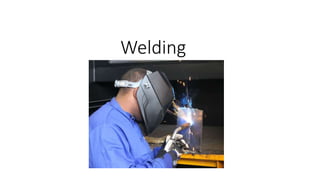
• Welding is a fabrication process that joins materials,
usually metals or thermoplastics, by causing coalescence. This is often
done by melting the workpieces and adding a filler material to form a
pool of molten material (the weld pool) that cools to become a strong
joint, with pressure sometimes used in conjunction with heat, or by
itself, to produce the weld.
Electric Arc welding
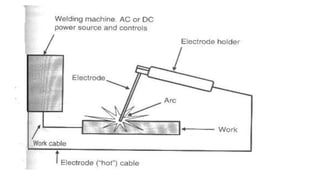
• Arc welding is a type of welding that uses a welding power supply to
create an electric arc between an electrode and the base material to
melt the metals at the welding point. They can use either direct (DC)
or alternating (AC) current, and consumable or non-consumable
electrodes.
Arc Welding(Consumable electrode)
• One of the most common types of arc welding is shielded metal arc
welding (SMAW), which is also known as manual metal arc welding
(MMAW) or stick welding.
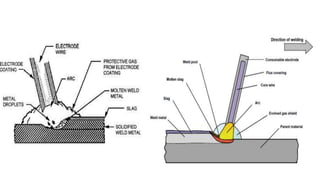
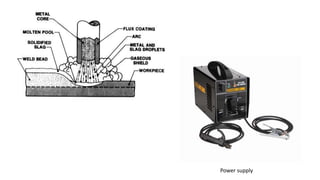
• An electric current is used to strike an arc between the base material
and a consumable electrode rod or stick.
• The electrode rod is made of a material that is compatible with the
base material being welded and is covered with a flux that gives off
vapors that serve as a shielding gas and provide a layer of slag, both
of which protect the weld area from atmospheric contamination.
Power supply
Non-consumable electrode methods
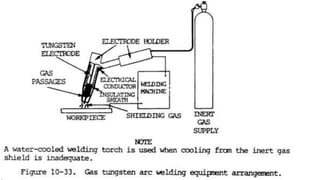
• Gas tungsten arc welding (GTAW), or tungsten/inert-gas (TIG)
welding, is a manual welding process that uses a non-consumable
electrode made of tungsten, an inert or semi-inert gas mixture, and a
separate filler material.
• Especially useful for welding thin materials, this method is
characterized by a stable arc and high quality welds, but it requires
significant operator skill and can only be accomplished at relatively low
speeds.
• It can be used on nearly all weldable metals, though it is most often
applied to stainless steel and light metals.
• It is often used when quality welds are extremely important, such as
in bicycle, aircraft and naval applications.
Gas Welding(Oxyacetylene Welding)
• Oxy-fuel welding (commonly called oxyacetylene welding, oxy
welding, or gas welding in the U.S.) and oxy-fuel cutting are
processes that use fuel gases and oxygen to weld and cut metals,
respectively.
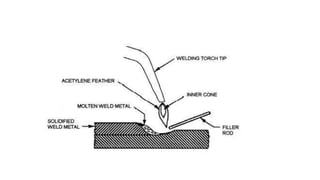
• In oxy-fuel welding, a welding torch is used to weld metals. Welding
metal results when two pieces are heated to a temperature that
produces a shared pool of molten metal.
• The molten pool is generally supplied with additional metal called
filler. Filler material depends upon the metals to be welded.
Apparatus
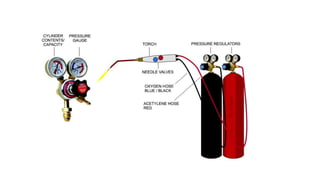
• The apparatus used in gas welding consists basically of an oxygen
source and a fuel gas source (usually cylinders),
two pressure regulators and two flexible hoses (one of each for each
cylinder), and a torch.

Welding

  • 1.
  • 2.
    Welding • Welding isa fabrication process that joins materials, usually metals or thermoplastics, by causing coalescence. This is often done by melting the workpieces and adding a filler material to form a pool of molten material (the weld pool) that cools to become a strong joint, with pressure sometimes used in conjunction with heat, or by itself, to produce the weld.
  • 3.
    Electric Arc welding •Arc welding is a type of welding that uses a welding power supply to create an electric arc between an electrode and the base material to melt the metals at the welding point. They can use either direct (DC) or alternating (AC) current, and consumable or non-consumable electrodes.
  • 4.
    Arc Welding(Consumable electrode) •One of the most common types of arc welding is shielded metal arc welding (SMAW), which is also known as manual metal arc welding (MMAW) or stick welding. • An electric current is used to strike an arc between the base material and a consumable electrode rod or stick. • The electrode rod is made of a material that is compatible with the base material being welded and is covered with a flux that gives off vapors that serve as a shielding gas and provide a layer of slag, both of which protect the weld area from atmospheric contamination.
  • 7.
  • 8.
    Non-consumable electrode methods •Gas tungsten arc welding (GTAW), or tungsten/inert-gas (TIG) welding, is a manual welding process that uses a non-consumable electrode made of tungsten, an inert or semi-inert gas mixture, and a separate filler material. • Especially useful for welding thin materials, this method is characterized by a stable arc and high quality welds, but it requires significant operator skill and can only be accomplished at relatively low speeds. • It can be used on nearly all weldable metals, though it is most often applied to stainless steel and light metals. • It is often used when quality welds are extremely important, such as in bicycle, aircraft and naval applications.
  • 10.
    Gas Welding(Oxyacetylene Welding) •Oxy-fuel welding (commonly called oxyacetylene welding, oxy welding, or gas welding in the U.S.) and oxy-fuel cutting are processes that use fuel gases and oxygen to weld and cut metals, respectively. • In oxy-fuel welding, a welding torch is used to weld metals. Welding metal results when two pieces are heated to a temperature that produces a shared pool of molten metal. • The molten pool is generally supplied with additional metal called filler. Filler material depends upon the metals to be welded.
  • 13.
    Apparatus • The apparatusused in gas welding consists basically of an oxygen source and a fuel gas source (usually cylinders), two pressure regulators and two flexible hoses (one of each for each cylinder), and a torch.