APFWMCA
Andhra Pradesh Farmers Water Management Association
“ Networking the water users “
http://fwmca.org/
Water Scenario –challenges & action in AP
India water shortage nation already , many villages
lack safe drinking water
India ranks a lowly 120 of 122 countries in world
rated on portable water quality
India has 4% of the world’s water, yet availability
shrinking rapidly
Estimated to become a water-stressed nation by
2020
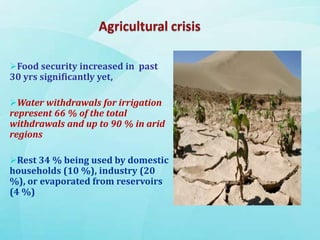
Food security increased in past
30 yrs significantly yet,
Water withdrawals for irrigation
represent 66 % of the total
withdrawals and up to 90 % in arid
regions
Rest 34 % being used by domestic
households (10 %), industry (20
%), or evaporated from reservoirs
(4 %)
Need of the hour-Water Security
Food security, Nutrition security, Energy security…!
Prime focus now needs to be …..?
“ Water security “
20th century…oil ruled the globe
21st century…water will rule the globe
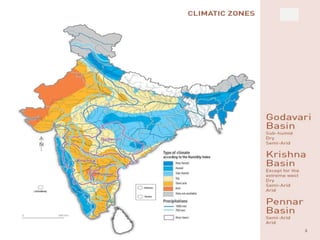
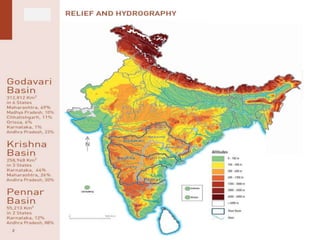
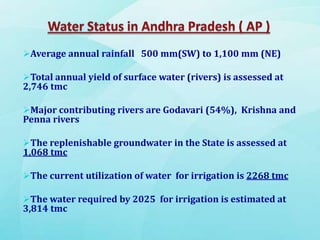
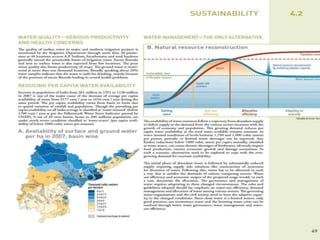
Average annual rainfall 500 mm(SW) to 1,100 mm (NE)
Total annual yield of surface water (rivers) is assessed at
2,746 tmc
Major contributing rivers are Godavari (54%), Krishna and
Penna rivers
The replenishable groundwater in the State is assessed at
1,068 tmc
The current utilization of water for irrigation is 2268 tmc
The water required by 2025 for irrigation is estimated at
3,814 tmc
Some Relevant Facts - AP
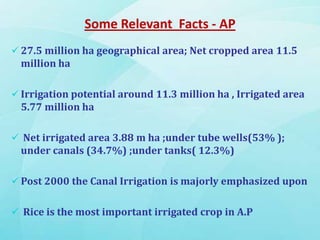
 27.5 million ha geographical area; Net cropped area 11.5
million ha
 Irrigation potential around 11.3 million ha , Irrigated area
5.77 million ha
 Net irrigated area 3.88 m ha ;under tube wells(53% );
under canals (34.7%) ;under tanks( 12.3%)
 Post 2000 the Canal Irrigation is majorly emphasized upon
 Rice is the most important irrigated crop in A.P
Constraints of Irrigatory Agriculture - AP
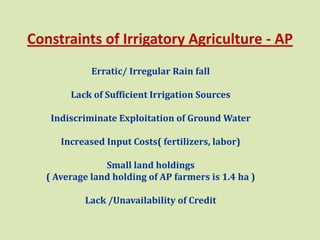
Erratic/ Irregular Rain fall
Lack of Sufficient Irrigation Sources
Indiscriminate Exploitation of Ground Water
Increased Input Costs( fertilizers, labor)
Small land holdings
( Average land holding of AP farmers is 1.4 ha )
Lack /Unavailability of Credit
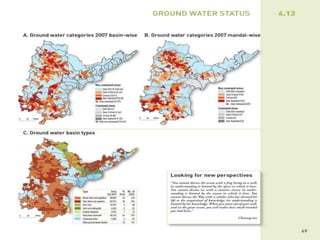
Ground Water Crisis - AP
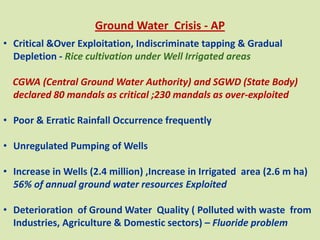
• Critical &Over Exploitation, Indiscriminate tapping & Gradual
Depletion - Rice cultivation under Well Irrigated areas
CGWA (Central Ground Water Authority) and SGWD (State Body)
declared 80 mandals as critical ;230 mandals as over-exploited
• Poor & Erratic Rainfall Occurrence frequently
• Unregulated Pumping of Wells
• Increase in Wells (2.4 million) ,Increase in Irrigated area (2.6 m ha)
56% of annual ground water resources Exploited
• Deterioration of Ground Water Quality ( Polluted with waste from
Industries, Agriculture & Domestic sectors) – Fluoride problem
Tanks
 The Major Irrigatory Water Source in 1960s & 1970s;
Complementary ground water recharge resource
 Share of Tanks decreased In 1980s and 1990s
 Severe Drought in mid-sixties ; growth of Well
Irrigation (2.4 million)
 Water Resources Depletion (Gradual disappearance of
Water Tanks, Ponds, Mangroves e.t.c )
 AP State Government launched “ A Massive 10 years
Watershed Program “ for development of all degraded
and waste lands during 1997 with an aim of treating 100
lakh ha of land
 AP State Government has constituted “Water
Conservation Mission “ during April 2001 with the prime
objective of conservation and utilization of water on a
sustainable basis
 There is 20-25% gap between Irrigation potential
created ( Planned command area) and Irrigation area
utilized (actual irrigated area)
 The Government of AP is undertaking Renovation of
Canals, Distribution , Field channel building to bridge
the gap
 Water User’s Association (WUA’s) for Administrative
Mechanism to Improve Water Use Efficiency and
Productivity
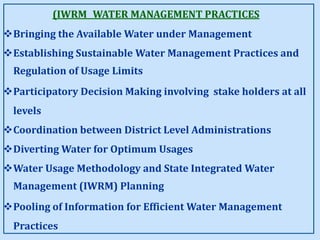
(IWRM WATER MANAGEMENT PRACTICES
Bringing the Available Water under Management
Establishing Sustainable Water Management Practices and
Regulation of Usage Limits
Participatory Decision Making involving stake holders at all
levels
Coordination between District Level Administrations
Diverting Water for Optimum Usages
Water Usage Methodology and State Integrated Water
Management (IWRM) Planning
Pooling of Information for Efficient Water Management
Practices
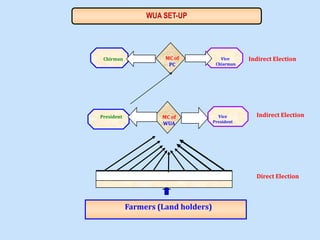
WUA SET-UP
Chirman Vice
Chiarman
MC of
PC
Elects Elects
Farmers (Land holders)
TC1 TC2 TC3 TC4 TC5 TC6 TC7 TC8 ……………TC12
President Vice
President
MC of
WUA
ElectsElects
Indirect Election
Indirect Election
Direct Election
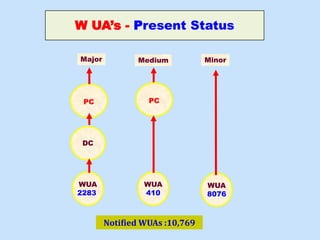
W UA’s - Present Status
PC
DC
WUA
2283
Major Medium Minor
PC
WUA
410
WUA
8076
Notified WUAs :10,769
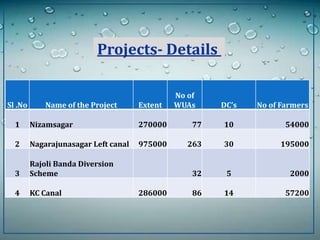
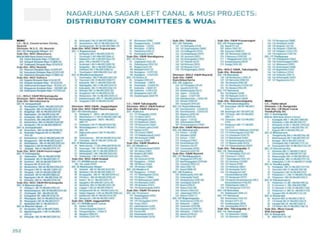
Sl .No Name of the Project Extent
No of
WUAs DC’s No of Farmers
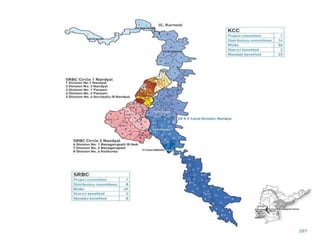
1 Nizamsagar 270000 77 10 54000
2 Nagarajunasagar Left canal 975000 263 30 195000
3
Rajoli Banda Diversion
Scheme 32 5 2000
4 KC Canal 286000 86 14 57200
Projects- Details
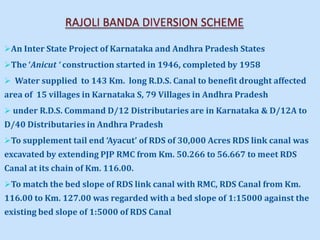
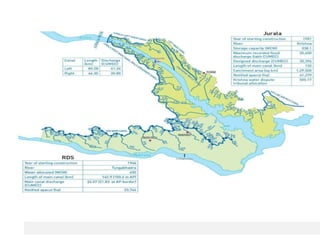
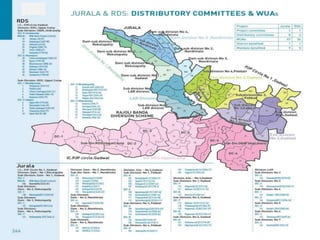
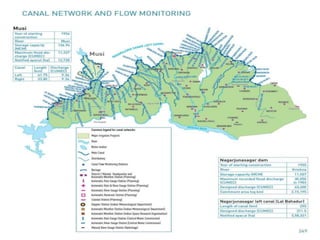
An Inter State Project of Karnataka and Andhra Pradesh States
The ‘Anicut ‘ construction started in 1946, completed by 1958
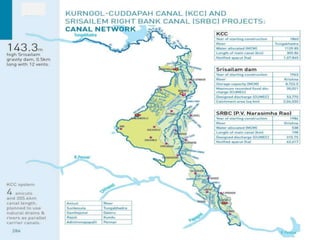
 Water supplied to 143 Km. long R.D.S. Canal to benefit drought affected
area of 15 villages in Karnataka S, 79 Villages in Andhra Pradesh
 under R.D.S. Command D/12 Distributaries are in Karnataka & D/12A to
D/40 Distributaries in Andhra Pradesh
To supplement tail end ‘Ayacut’ of RDS of 30,000 Acres RDS link canal was
excavated by extending PJP RMC from Km. 50.266 to 56.667 to meet RDS
Canal at its chain of Km. 116.00.
To match the bed slope of RDS link canal with RMC, RDS Canal from Km.
116.00 to Km. 127.00 was regarded with a bed slope of 1:15000 against the
existing bed slope of 1:5000 of RDS Canal
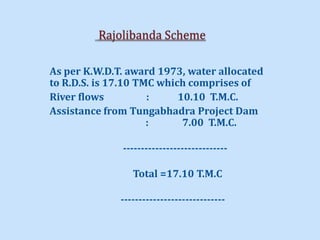
As per K.W.D.T. award 1973, water allocated
to R.D.S. is 17.10 TMC which comprises of
River flows : 10.10 T.M.C.
Assistance from Tungabhadra Project Dam
: 7.00 T.M.C.
-----------------------------
Total =17.10 T.M.C
-----------------------------
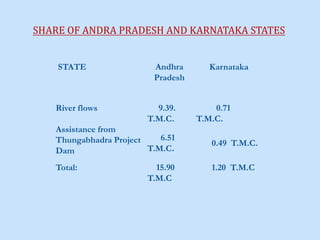
STATE Andhra
Pradesh
Karnataka
River flows 9.39.
T.M.C.
0.71
T.M.C.
Assistance from
Thungabhadra Project
Dam
6.51
T.M.C.
0.49 T.M.C.
Total: 15.90
T.M.C
1.20 T.M.C
SHARE OF ANDRA PRADESH AND KARNATAKA STATES
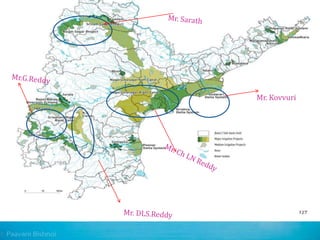
Mr. Kovvuri
Major Constraints of Farming - AP
Majorly Rainfall dependent Agriculture even today
Late ,irregular and insufficient rainfall ,when sufficient is for
a short span, Heavy downpour at times causes crop damage
Nearly 60 % Cropping land under Arid and semi arid zones
Small Land holdings
Human Resource scarcity(dependency on manual labor
inspite of increasing mechanization)
Gap between lab and land technologies and extension
Mono Cropping-Rice Majorly
Crop Diversification (Rice/Maize) and New
Technologies (System of Rice Intensification - SRI)
Better management of the Whole Production Chain
From Input supplies (seeds, Fertilizers, Pesticides) to
Methods (Precise Farming) to Harvest (Clean Harvest)
and Post-Harvest (storage) and Marketing and Value
Addition
Efficient Extension Systems,Mechanisation,Market
Linkages
Proper Irrigatory Sources provision & Efficient
Water management
Required measures
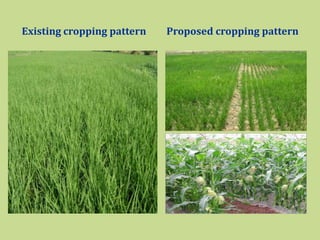
Existing cropping pattern Proposed cropping pattern
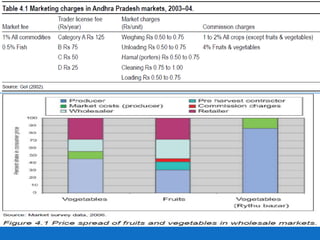
Marketing of Horticulture Products-Supply chain
Vegetables:
SUPPLY CHAIN 1
 Producer à Commission agent à Wholesaler à Retailler à
Consumer
SUPPLY CHAIN 2
 Producer à Commission agent à Primary wholesaler à Secondary
wholesaler à Retailer à Consumer
Fruits:
SUPPLY CHAIN 1
 Producer à Pré- Harvest contracter à Commission agent à
Wholesaler à Retailer
à Consumer
SUPPLY CHAIN 2
 Producer à Commission agent à Wholesaler à Retailer à
Consumer
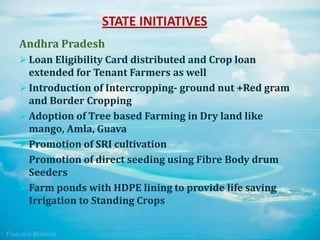
STATE INITIATIVES
Andhra Pradesh
 Loan Eligibility Card distributed and Crop loan
extended for Tenant Farmers as well
 Introduction of Intercropping- ground nut +Red gram
and Border Cropping
 Adoption of Tree based Farming in Dry land like
mango, Amla, Guava
 Promotion of SRI cultivation
 Promotion of direct seeding using Fibre Body drum
Seeders
 Farm ponds with HDPE lining to provide life saving
Irrigation to Standing Crops
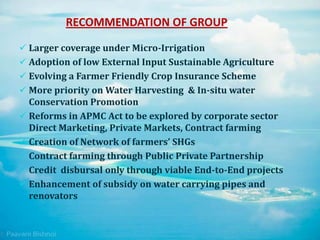
RECOMMENDATION OF GROUP
 Larger coverage under Micro-Irrigation
 Adoption of low External Input Sustainable Agriculture
 Evolving a Farmer Friendly Crop Insurance Scheme
 More priority on Water Harvesting & In-situ water
Conservation Promotion
 Reforms in APMC Act to be explored by corporate sector
Direct Marketing, Private Markets, Contract farming
 Creation of Network of farmers’ SHGs
 Contract farming through Public Private Partnership
 Credit disbursal only through viable End-to-End projects
 Enhancement of subsidy on water carrying pipes and
renovators
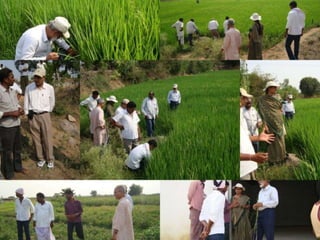
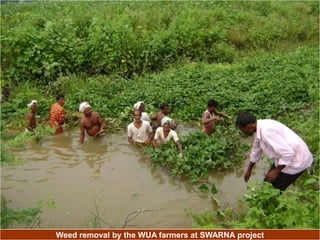
Weed removal by the WUA farmers at SWARNA project
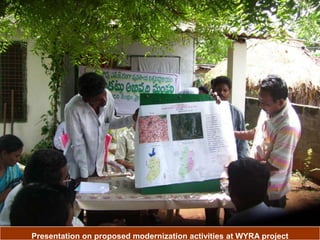
Presentation on proposed modernization activities at WYRA project
Questions from the farmers
How do farmers sell the Agriculture product?
What kind of value addition will do for their
agriculture product?
What kind of storage facilities do you have to store the
Agriculture product?
How farmers will manage the machinery /equipment?
Do they purchase or hire? If they pay rent, how do they
manage?
“Any progress is a result of collective efforts “
Thank you
Water is life's mater and matrix, mother and medium. There is no life without water

Aranya wua

  • 1.
    APFWMCA Andhra Pradesh FarmersWater Management Association “ Networking the water users “ http://fwmca.org/ Water Scenario –challenges & action in AP
  • 3.
    India water shortagenation already , many villages lack safe drinking water India ranks a lowly 120 of 122 countries in world rated on portable water quality India has 4% of the world’s water, yet availability shrinking rapidly Estimated to become a water-stressed nation by 2020
  • 6.
    Food security increasedin past 30 yrs significantly yet, Water withdrawals for irrigation represent 66 % of the total withdrawals and up to 90 % in arid regions Rest 34 % being used by domestic households (10 %), industry (20 %), or evaporated from reservoirs (4 %)
  • 7.
    Need of thehour-Water Security Food security, Nutrition security, Energy security…! Prime focus now needs to be …..? “ Water security “ 20th century…oil ruled the globe 21st century…water will rule the globe
  • 8.
    Average annual rainfall500 mm(SW) to 1,100 mm (NE) Total annual yield of surface water (rivers) is assessed at 2,746 tmc Major contributing rivers are Godavari (54%), Krishna and Penna rivers The replenishable groundwater in the State is assessed at 1,068 tmc The current utilization of water for irrigation is 2268 tmc The water required by 2025 for irrigation is estimated at 3,814 tmc
  • 9.
    Some Relevant Facts- AP  27.5 million ha geographical area; Net cropped area 11.5 million ha  Irrigation potential around 11.3 million ha , Irrigated area 5.77 million ha  Net irrigated area 3.88 m ha ;under tube wells(53% ); under canals (34.7%) ;under tanks( 12.3%)  Post 2000 the Canal Irrigation is majorly emphasized upon  Rice is the most important irrigated crop in A.P
  • 10.
    Constraints of IrrigatoryAgriculture - AP Erratic/ Irregular Rain fall Lack of Sufficient Irrigation Sources Indiscriminate Exploitation of Ground Water Increased Input Costs( fertilizers, labor) Small land holdings ( Average land holding of AP farmers is 1.4 ha ) Lack /Unavailability of Credit
  • 11.
    Ground Water Crisis- AP • Critical &Over Exploitation, Indiscriminate tapping & Gradual Depletion - Rice cultivation under Well Irrigated areas CGWA (Central Ground Water Authority) and SGWD (State Body) declared 80 mandals as critical ;230 mandals as over-exploited • Poor & Erratic Rainfall Occurrence frequently • Unregulated Pumping of Wells • Increase in Wells (2.4 million) ,Increase in Irrigated area (2.6 m ha) 56% of annual ground water resources Exploited • Deterioration of Ground Water Quality ( Polluted with waste from Industries, Agriculture & Domestic sectors) – Fluoride problem
  • 14.
    Tanks  The MajorIrrigatory Water Source in 1960s & 1970s; Complementary ground water recharge resource  Share of Tanks decreased In 1980s and 1990s  Severe Drought in mid-sixties ; growth of Well Irrigation (2.4 million)  Water Resources Depletion (Gradual disappearance of Water Tanks, Ponds, Mangroves e.t.c )
  • 15.
     AP StateGovernment launched “ A Massive 10 years Watershed Program “ for development of all degraded and waste lands during 1997 with an aim of treating 100 lakh ha of land  AP State Government has constituted “Water Conservation Mission “ during April 2001 with the prime objective of conservation and utilization of water on a sustainable basis
  • 16.
     There is20-25% gap between Irrigation potential created ( Planned command area) and Irrigation area utilized (actual irrigated area)  The Government of AP is undertaking Renovation of Canals, Distribution , Field channel building to bridge the gap  Water User’s Association (WUA’s) for Administrative Mechanism to Improve Water Use Efficiency and Productivity
  • 17.
    (IWRM WATER MANAGEMENTPRACTICES Bringing the Available Water under Management Establishing Sustainable Water Management Practices and Regulation of Usage Limits Participatory Decision Making involving stake holders at all levels Coordination between District Level Administrations Diverting Water for Optimum Usages Water Usage Methodology and State Integrated Water Management (IWRM) Planning Pooling of Information for Efficient Water Management Practices
  • 18.
    WUA SET-UP Chirman Vice Chiarman MCof PC Elects Elects Farmers (Land holders) TC1 TC2 TC3 TC4 TC5 TC6 TC7 TC8 ……………TC12 President Vice President MC of WUA ElectsElects Indirect Election Indirect Election Direct Election
  • 19.
    W UA’s -Present Status PC DC WUA 2283 Major Medium Minor PC WUA 410 WUA 8076 Notified WUAs :10,769
  • 20.
    Sl .No Nameof the Project Extent No of WUAs DC’s No of Farmers 1 Nizamsagar 270000 77 10 54000 2 Nagarajunasagar Left canal 975000 263 30 195000 3 Rajoli Banda Diversion Scheme 32 5 2000 4 KC Canal 286000 86 14 57200 Projects- Details
  • 25.
    An Inter StateProject of Karnataka and Andhra Pradesh States The ‘Anicut ‘ construction started in 1946, completed by 1958  Water supplied to 143 Km. long R.D.S. Canal to benefit drought affected area of 15 villages in Karnataka S, 79 Villages in Andhra Pradesh  under R.D.S. Command D/12 Distributaries are in Karnataka & D/12A to D/40 Distributaries in Andhra Pradesh To supplement tail end ‘Ayacut’ of RDS of 30,000 Acres RDS link canal was excavated by extending PJP RMC from Km. 50.266 to 56.667 to meet RDS Canal at its chain of Km. 116.00. To match the bed slope of RDS link canal with RMC, RDS Canal from Km. 116.00 to Km. 127.00 was regarded with a bed slope of 1:15000 against the existing bed slope of 1:5000 of RDS Canal
  • 26.
    As per K.W.D.T.award 1973, water allocated to R.D.S. is 17.10 TMC which comprises of River flows : 10.10 T.M.C. Assistance from Tungabhadra Project Dam : 7.00 T.M.C. ----------------------------- Total =17.10 T.M.C -----------------------------
  • 27.
    STATE Andhra Pradesh Karnataka River flows9.39. T.M.C. 0.71 T.M.C. Assistance from Thungabhadra Project Dam 6.51 T.M.C. 0.49 T.M.C. Total: 15.90 T.M.C 1.20 T.M.C SHARE OF ANDRA PRADESH AND KARNATAKA STATES
  • 35.
  • 36.
    Major Constraints ofFarming - AP Majorly Rainfall dependent Agriculture even today Late ,irregular and insufficient rainfall ,when sufficient is for a short span, Heavy downpour at times causes crop damage Nearly 60 % Cropping land under Arid and semi arid zones Small Land holdings Human Resource scarcity(dependency on manual labor inspite of increasing mechanization) Gap between lab and land technologies and extension Mono Cropping-Rice Majorly
  • 37.
    Crop Diversification (Rice/Maize)and New Technologies (System of Rice Intensification - SRI) Better management of the Whole Production Chain From Input supplies (seeds, Fertilizers, Pesticides) to Methods (Precise Farming) to Harvest (Clean Harvest) and Post-Harvest (storage) and Marketing and Value Addition Efficient Extension Systems,Mechanisation,Market Linkages Proper Irrigatory Sources provision & Efficient Water management Required measures
  • 38.
    Existing cropping patternProposed cropping pattern
  • 39.
    Marketing of HorticultureProducts-Supply chain Vegetables: SUPPLY CHAIN 1  Producer à Commission agent à Wholesaler à Retailler à Consumer SUPPLY CHAIN 2  Producer à Commission agent à Primary wholesaler à Secondary wholesaler à Retailer à Consumer Fruits: SUPPLY CHAIN 1  Producer à Pré- Harvest contracter à Commission agent à Wholesaler à Retailer à Consumer SUPPLY CHAIN 2  Producer à Commission agent à Wholesaler à Retailer à Consumer
  • 41.
    STATE INITIATIVES Andhra Pradesh Loan Eligibility Card distributed and Crop loan extended for Tenant Farmers as well  Introduction of Intercropping- ground nut +Red gram and Border Cropping  Adoption of Tree based Farming in Dry land like mango, Amla, Guava  Promotion of SRI cultivation  Promotion of direct seeding using Fibre Body drum Seeders  Farm ponds with HDPE lining to provide life saving Irrigation to Standing Crops
  • 42.
    RECOMMENDATION OF GROUP Larger coverage under Micro-Irrigation  Adoption of low External Input Sustainable Agriculture  Evolving a Farmer Friendly Crop Insurance Scheme  More priority on Water Harvesting & In-situ water Conservation Promotion  Reforms in APMC Act to be explored by corporate sector Direct Marketing, Private Markets, Contract farming  Creation of Network of farmers’ SHGs  Contract farming through Public Private Partnership  Credit disbursal only through viable End-to-End projects  Enhancement of subsidy on water carrying pipes and renovators
  • 47.
    Weed removal bythe WUA farmers at SWARNA project
  • 48.
    Presentation on proposedmodernization activities at WYRA project
  • 49.
    Questions from thefarmers How do farmers sell the Agriculture product? What kind of value addition will do for their agriculture product? What kind of storage facilities do you have to store the Agriculture product? How farmers will manage the machinery /equipment? Do they purchase or hire? If they pay rent, how do they manage?
  • 50.
    “Any progress isa result of collective efforts “ Thank you Water is life's mater and matrix, mother and medium. There is no life without water