NEPAL’S HISTORY OF WATER MANAGEMENT
INSTITUTIONS: IS THERE A ROLE FOR THEM IN
ADAPTING TO WATER SCARCITY?


                             Dr. Hari Krishna Shrestha
                             Nepal Engineering College
                                  hari@nec.edu.np

                       Water Security in Peri-Urban South Asia
                                Inception Workshop
                                August 16-20, 2010
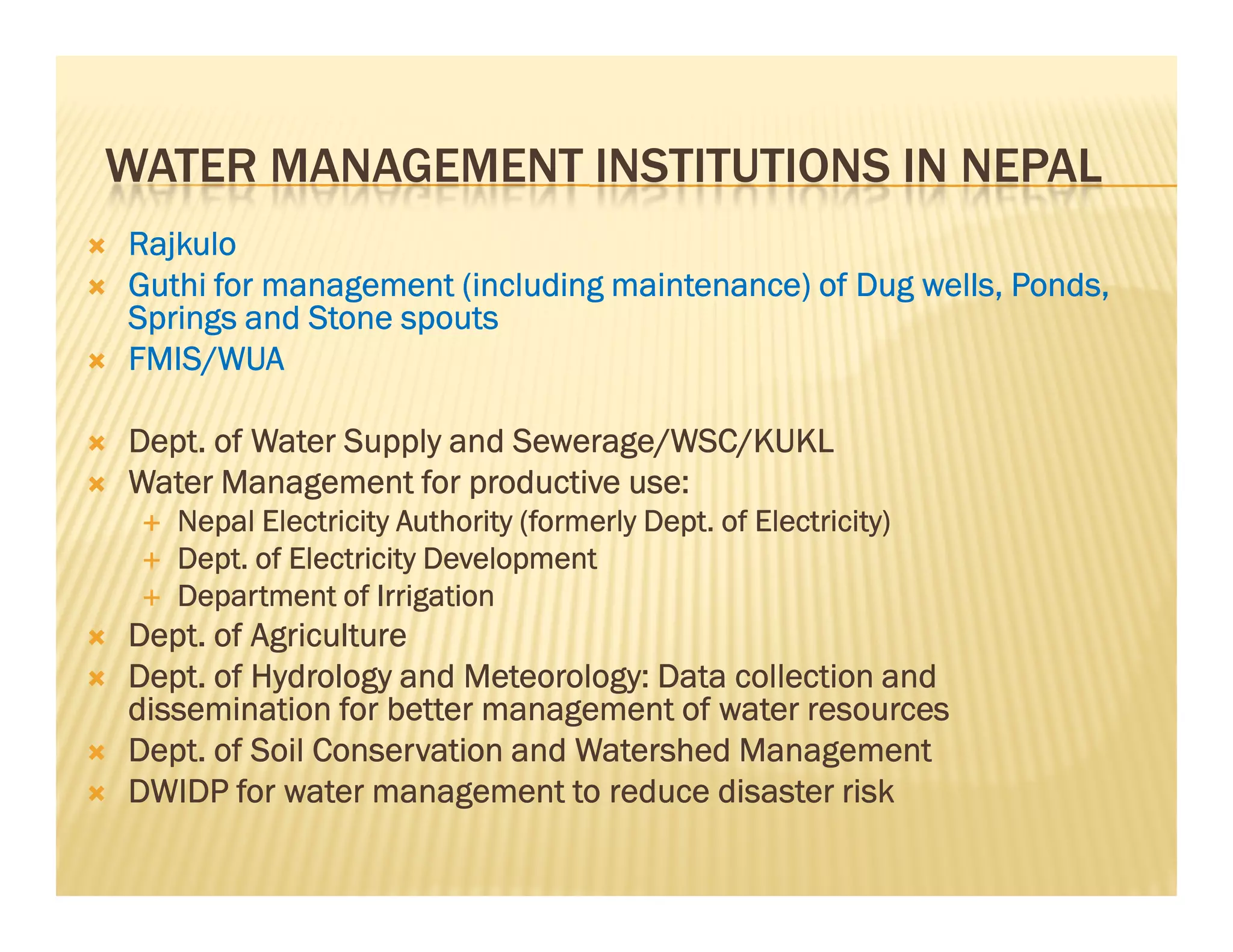
WATER MANAGEMENT INSTITUTIONS IN NEPAL
Rajkulo
Guthi for management (including maintenance) of Dug wells, Ponds,
Springs and Stone spouts
FMIS/WUA

Dept. of Water Supply and Sewerage/WSC/KUKL
Water Management for productive use:
   Nepal Electricity Authority (formerly Dept. of Electricity)
   Dept. of Electricity Development
   Department of Irrigation
Dept. of Agriculture
Dept. of Hydrology and Meteorology: Data collection and
dissemination for better management of water resources
Dept. of Soil Conservation and Watershed Management
DWIDP for water management to reduce disaster risk
WATER SCARCITY – A GROWING PROBLEM
   Is water scarcity real?
   Per capita water needed for agriculture, industry, energy, environment: 1700
   m3; less than 1000 m3 : water scarcity; less than 500 m3 : absolute scarcity
   (UNDP, 2006)
   Annual total water available: 207 km3
   Per capita water availability in Nepal: 7600 m3 (so how come scarcity?)

However,
  Per capita water consumption: less than 10% of availability
  Access to drinking water in Kathmandu: 57% wet, 32% dry (up to 89% nationwide)
  Load shedding due to water shortage in HEP plants
  Water requirement for irrigation: 50 km3 for all irrigable area (with current
   irrigation methods)
   Water available for irrigation: less than 20% of irrigable area

   Water scarcity despite water abundance? Economic water scarcity?
   Water shortage or water scarcity? Does it matter?
Regmi, A.R., 2007
Long water queue in a country
                     with abundant water


Boulton, C., 2010


  Matthew R., 2007
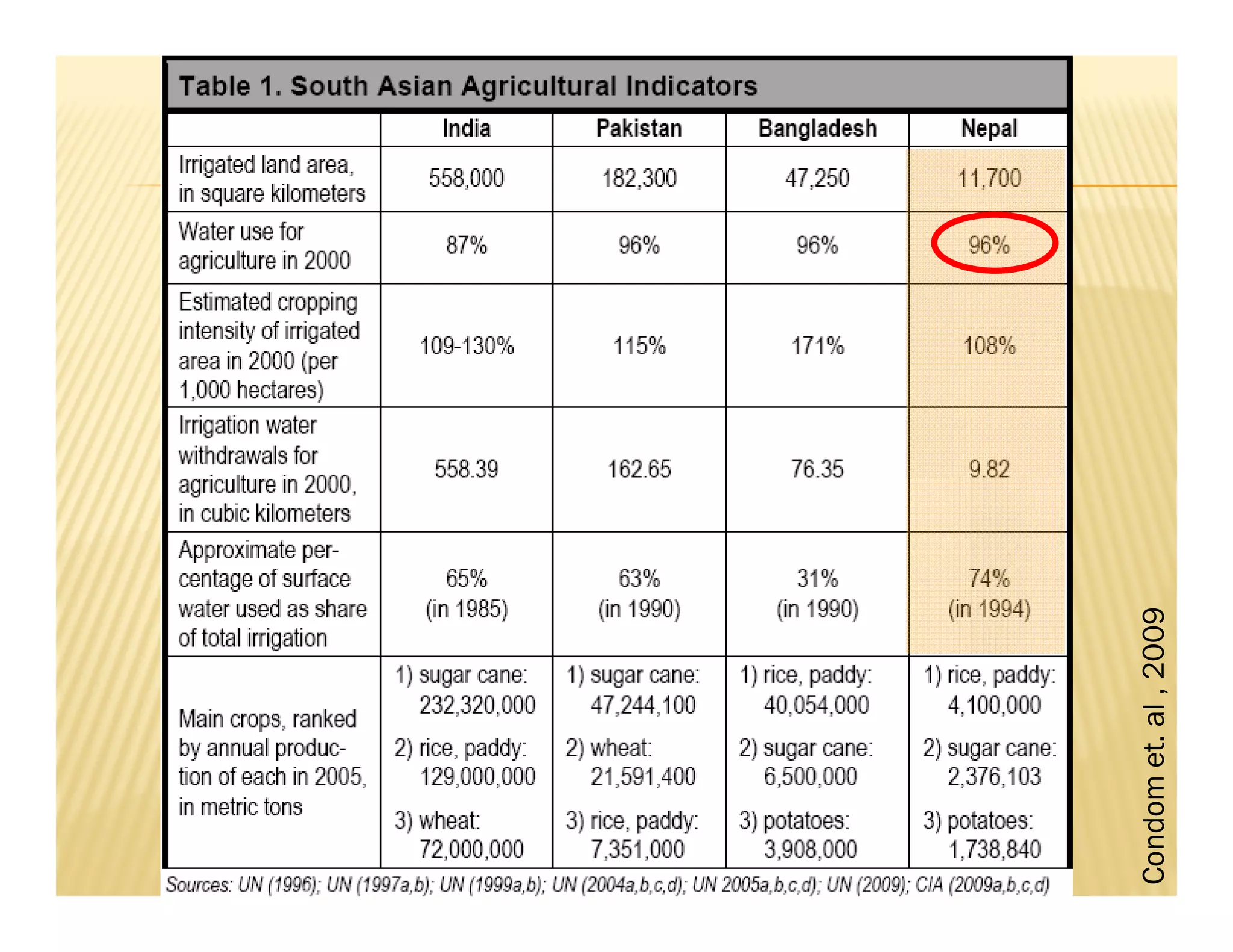
Condom et. al , 2009
Prospect of future water shortage


                                    Condom et. al , 2009
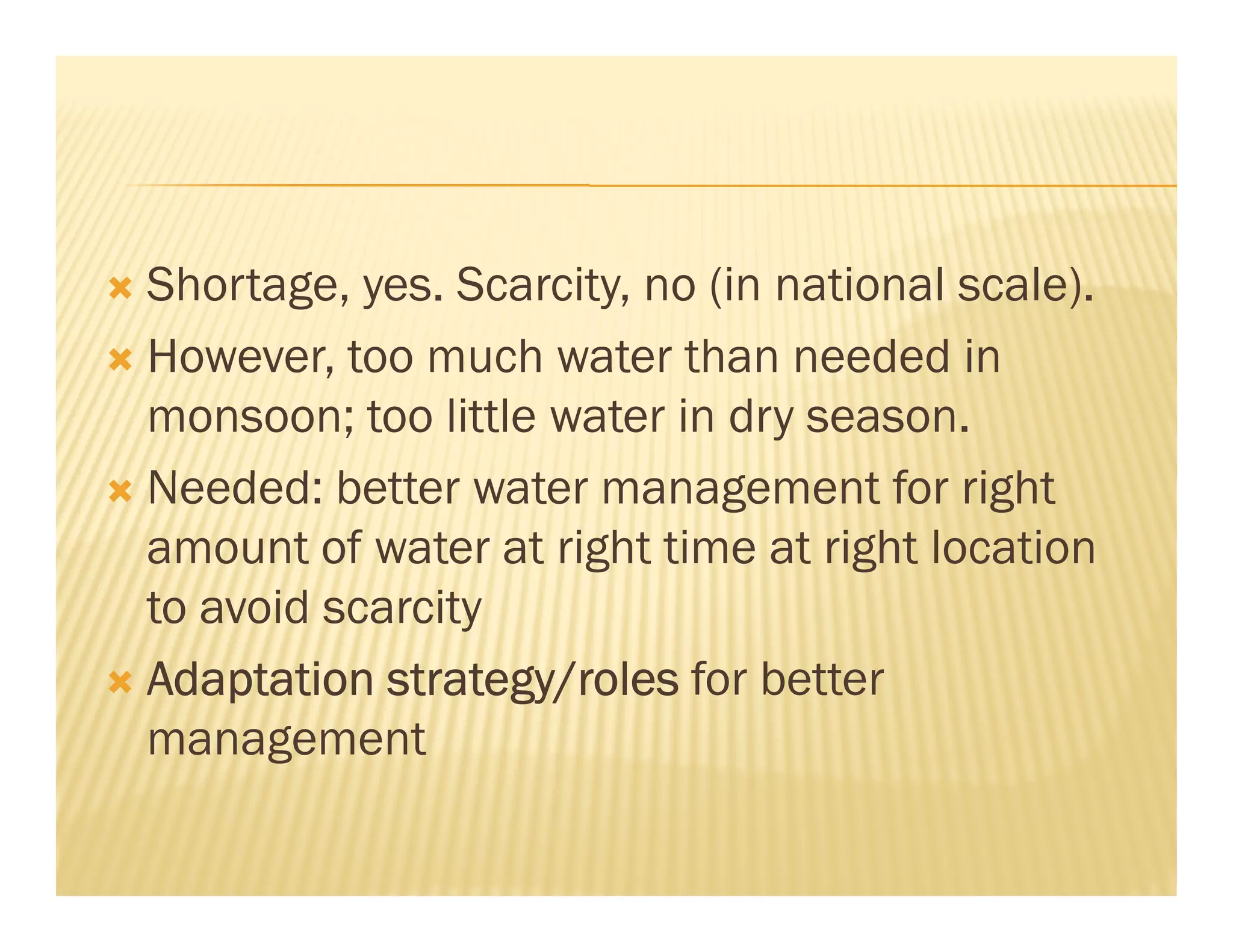
Shortage, yes. Scarcity, no (in national scale).
However, too much water than needed in
monsoon; too little water in dry season.
Needed: better water management for right
amount of water at right time at right location
to avoid scarcity
Adaptation strategy/roles for better
management
ADAPTATION ROLES OF TRADITIONAL
INSTITUTIONS
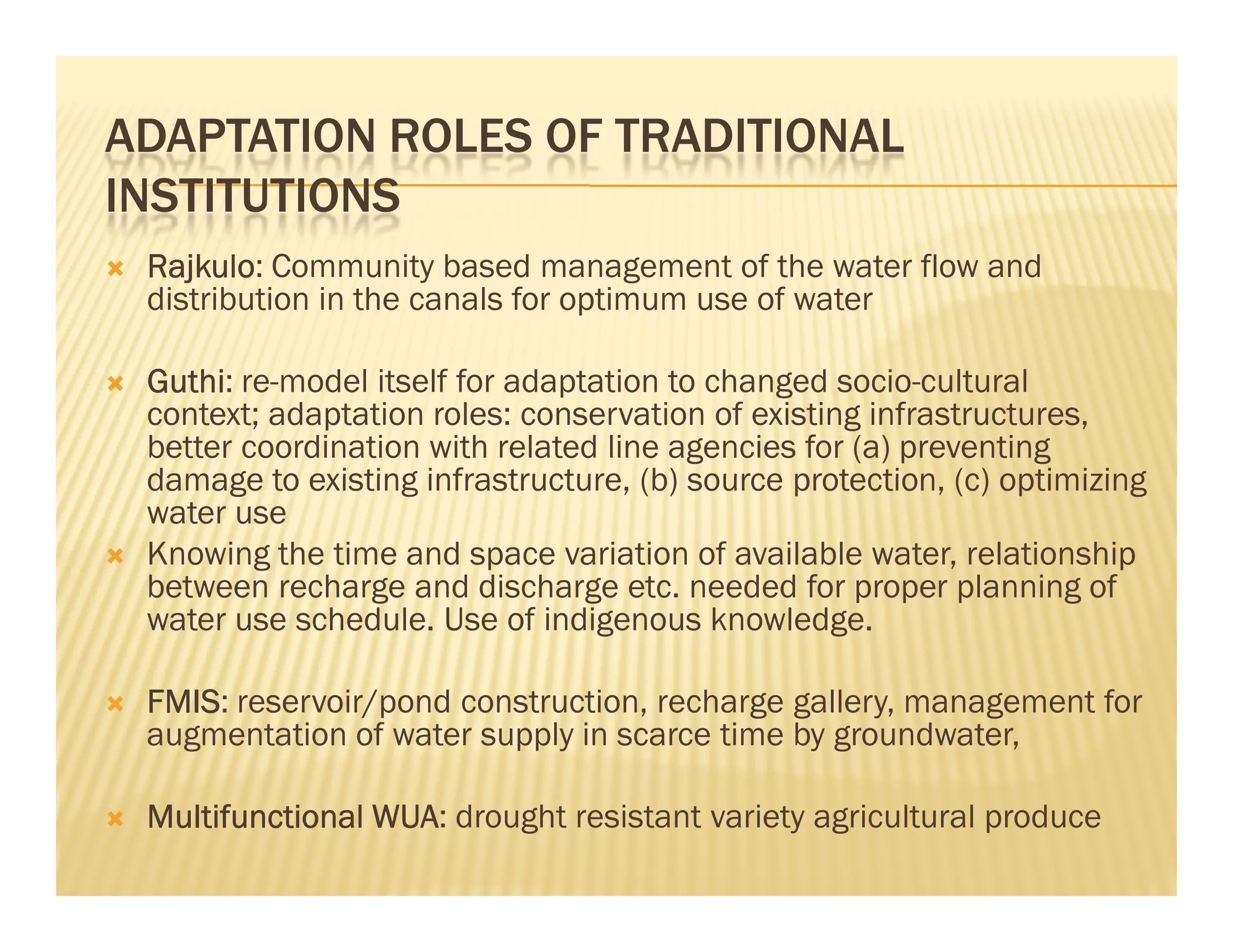
 Rajkulo:
 Rajkulo Community based management of the water flow and
 distribution in the canals for optimum use of water

 Guthi: re-model itself for adaptation to changed socio-cultural
 Guthi
 context; adaptation roles: conservation of existing infrastructures,
 better coordination with related line agencies for (a) preventing
 damage to existing infrastructure, (b) source protection, (c) optimizing
 water use
 Knowing the time and space variation of available water, relationship
 between recharge and discharge etc. needed for proper planning of
 water use schedule. Use of indigenous knowledge.

 FMIS:
 FMIS reservoir/pond construction, recharge gallery, management for
 augmentation of water supply in scarce time by groundwater,

 Multifunctional WUA: drought resistant variety agricultural produce
                 WUA
GENERAL ADAPTATION ROLES FOR FORMAL-
NEWER INSTITUTIONS
 Investment in management and efficiency
 Promotion of community water management
 Improvement of water management
 Proper value of water
 Promotion of water recycling
 Storage capacity expansion
 Improved crop planning
 PPP of local water utilities
INSTITUTIONS SPECIFIC ADAPTATION ROLES
 HIGHEST (96%) USE OF FRESHWATER IS IRRIGATION/AGRICULTURE

Dept. of Agriculture:
 Water Demand management through:                        1% ~ 30%
   Development of low water demanding crops
   Technology development: promotion of greenhouse based production
   Use of vertical space
   Development of better planting techniques
   Training and involvement of farmers in pre- and post-harvesting
   techniques
   Development of less water demanding food processing techniques
   Use of wetlands and waste lands for producing improved grass for cattle
   Weed control without flood irrigation
   Weed resistant crop variety
   Promotion of soil coverage with plastic film to reduce soil moisture
   evaporation and weed control
   Promotion of zero-till growing method
   Use of mulch for water conservation
Dept. of Irrigation                         1%     ~ 30%
   Development and promotion of more efficient irrigation
   techniques
   Promotion of drip irrigation
   Community based irrigation management
   Community/farmer-researcher (2-way) training on better use
   of water
   Waste water/grey water irrigation
   Bubble Irrigation
   “More from Less” Campaign
   Promote reduction in water leakage from irrigation canals
ADAPTATION ROLES FOR NEWER INSTITUTIONS
  BEHAVIOURAL CHANGE NEEDED TO REDUCE WATER MISUSE
DWSS/WSSC/KUKL:
  Reducing leakage (technical and non-technical)
  Promotion of motion detecting and/or time sensitive taps/faucets
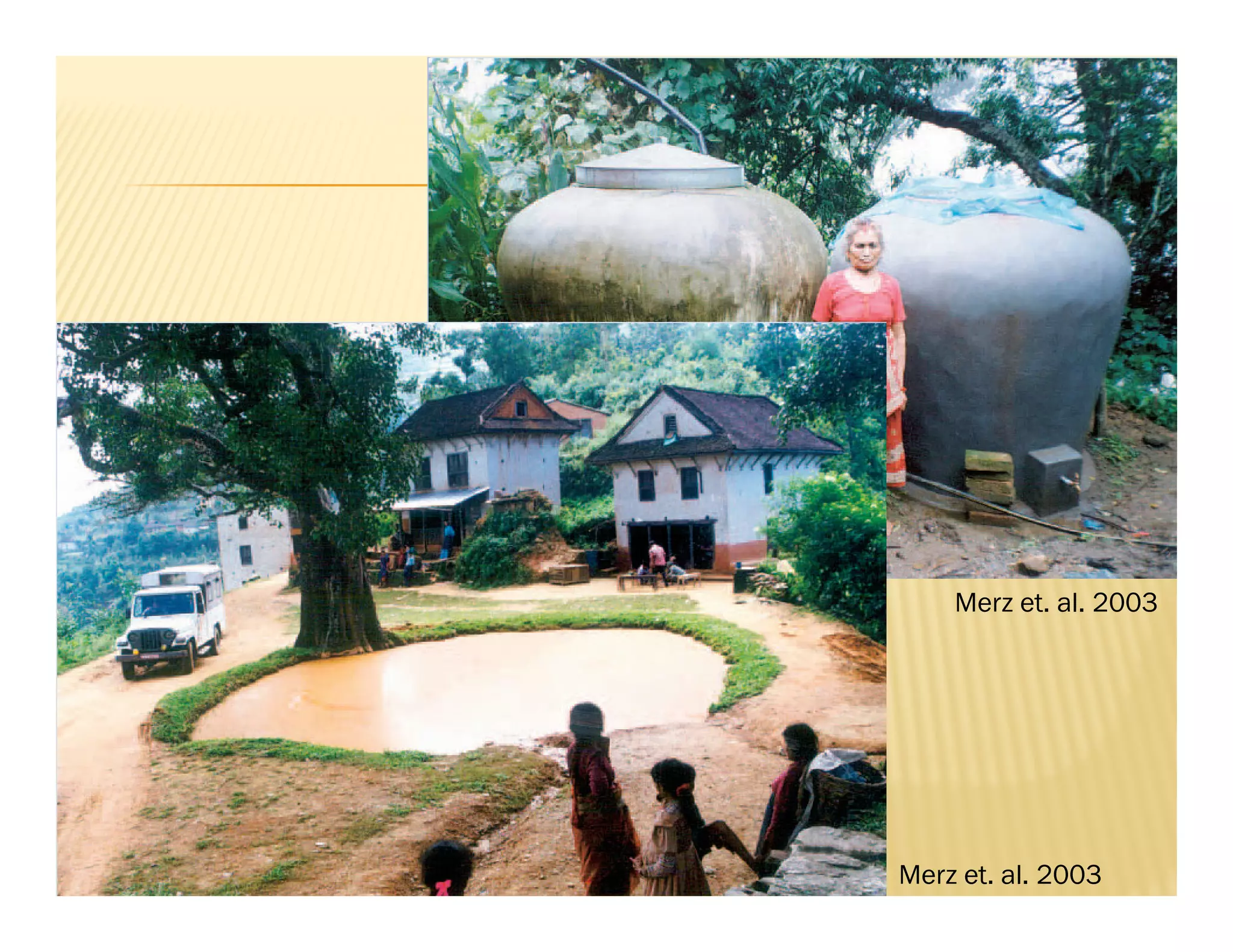
  Promotion of household rainwater harvesting
  Municipality based rainwater use
  Artificial recharge galleries/fields along river banks and designated
  areas: use of flood plains/ecotones as groundwater recharge area
  Cascade of reservoirs
  Differential/Equitable water tariff
  Promotion of small scale water treatment plants: personal or
  community ownership of plants
  Less water demanding sanitation techniques
  Promotion of Ecosan Toilets
Merz et. al. 2003


Merz et. al. 2003
ISRAEL EXPERIENCE
   Israel has a 75 percent water-recycling rate, making it the world's
   number one water recycler. The second-largest water recycler is
   Spain, with a rate of 12 percent.
   The Israeli-invented drip irrigation system has helped achieve one of
   the highest water efficiency rates in the world.
   The world's largest Seawater Reverse Osmosis (SWRO) desalination
   plant is in Israel, producing 100 million m3 at the cost of
   approximately $0.52 per m3 of water, making it also the most-cost
   efficient plant of its kind.
   Israel creates close to 25 percent of its consumed water.
   The country's total water consumption has remained the same since
   the 1960, despite a growing population, increasing water
   requirements, and growing agricultural production.
Israel has demonstrated the ability to adapt economically and socially to
   overcome many of water scarcity issues.


                                                       Arlosoroff, S. 2009
DSCWM
 Soil conservation practices to be linked to
 income generation for farmers
 Right of way as community based productive
 land for sustainability of right of way along
 highways
DHM
 Development of better long term weather
 prediction methodology and sharing the
 information with the farmers for better selection of
 the crops based on expected water availability
 Better estimation technology for snow melt runoff
 and sharing of information with farmers and
 hydropower developers in March/April for better
 selection of crops/turbine operation based on
 expected water availability in the streams
Glacial lakes as part of a solution to the water
scarcity problem rather than part of a problem
related to GLOF

Each of the adaptation role will play a small role in
solving water shortage problem.


              Thank you.

Nepal's history of water management_Dr. Hari Krishna Shreshtha

  • 1.
    NEPAL’S HISTORY OFWATER MANAGEMENT INSTITUTIONS: IS THERE A ROLE FOR THEM IN ADAPTING TO WATER SCARCITY? Dr. Hari Krishna Shrestha Nepal Engineering College hari@nec.edu.np Water Security in Peri-Urban South Asia Inception Workshop August 16-20, 2010
  • 2.
    WATER MANAGEMENT INSTITUTIONSIN NEPAL Rajkulo Guthi for management (including maintenance) of Dug wells, Ponds, Springs and Stone spouts FMIS/WUA Dept. of Water Supply and Sewerage/WSC/KUKL Water Management for productive use: Nepal Electricity Authority (formerly Dept. of Electricity) Dept. of Electricity Development Department of Irrigation Dept. of Agriculture Dept. of Hydrology and Meteorology: Data collection and dissemination for better management of water resources Dept. of Soil Conservation and Watershed Management DWIDP for water management to reduce disaster risk
  • 3.
    WATER SCARCITY –A GROWING PROBLEM Is water scarcity real? Per capita water needed for agriculture, industry, energy, environment: 1700 m3; less than 1000 m3 : water scarcity; less than 500 m3 : absolute scarcity (UNDP, 2006) Annual total water available: 207 km3 Per capita water availability in Nepal: 7600 m3 (so how come scarcity?) However, Per capita water consumption: less than 10% of availability Access to drinking water in Kathmandu: 57% wet, 32% dry (up to 89% nationwide) Load shedding due to water shortage in HEP plants Water requirement for irrigation: 50 km3 for all irrigable area (with current irrigation methods) Water available for irrigation: less than 20% of irrigable area Water scarcity despite water abundance? Economic water scarcity? Water shortage or water scarcity? Does it matter?
  • 4.
  • 5.
    Long water queuein a country with abundant water Boulton, C., 2010 Matthew R., 2007
  • 6.
  • 7.
  • 8.
    Prospect of futurewater shortage Condom et. al , 2009
  • 9.
    Shortage, yes. Scarcity,no (in national scale). However, too much water than needed in monsoon; too little water in dry season. Needed: better water management for right amount of water at right time at right location to avoid scarcity Adaptation strategy/roles for better management
  • 10.
    ADAPTATION ROLES OFTRADITIONAL INSTITUTIONS Rajkulo: Rajkulo Community based management of the water flow and distribution in the canals for optimum use of water Guthi: re-model itself for adaptation to changed socio-cultural Guthi context; adaptation roles: conservation of existing infrastructures, better coordination with related line agencies for (a) preventing damage to existing infrastructure, (b) source protection, (c) optimizing water use Knowing the time and space variation of available water, relationship between recharge and discharge etc. needed for proper planning of water use schedule. Use of indigenous knowledge. FMIS: FMIS reservoir/pond construction, recharge gallery, management for augmentation of water supply in scarce time by groundwater, Multifunctional WUA: drought resistant variety agricultural produce WUA
  • 11.
    GENERAL ADAPTATION ROLESFOR FORMAL- NEWER INSTITUTIONS Investment in management and efficiency Promotion of community water management Improvement of water management Proper value of water Promotion of water recycling Storage capacity expansion Improved crop planning PPP of local water utilities
  • 12.
    INSTITUTIONS SPECIFIC ADAPTATIONROLES HIGHEST (96%) USE OF FRESHWATER IS IRRIGATION/AGRICULTURE Dept. of Agriculture: Water Demand management through: 1% ~ 30% Development of low water demanding crops Technology development: promotion of greenhouse based production Use of vertical space Development of better planting techniques Training and involvement of farmers in pre- and post-harvesting techniques Development of less water demanding food processing techniques Use of wetlands and waste lands for producing improved grass for cattle Weed control without flood irrigation Weed resistant crop variety Promotion of soil coverage with plastic film to reduce soil moisture evaporation and weed control Promotion of zero-till growing method Use of mulch for water conservation
  • 13.
    Dept. of Irrigation 1% ~ 30% Development and promotion of more efficient irrigation techniques Promotion of drip irrigation Community based irrigation management Community/farmer-researcher (2-way) training on better use of water Waste water/grey water irrigation Bubble Irrigation “More from Less” Campaign Promote reduction in water leakage from irrigation canals
  • 14.
    ADAPTATION ROLES FORNEWER INSTITUTIONS BEHAVIOURAL CHANGE NEEDED TO REDUCE WATER MISUSE DWSS/WSSC/KUKL: Reducing leakage (technical and non-technical) Promotion of motion detecting and/or time sensitive taps/faucets Promotion of household rainwater harvesting Municipality based rainwater use Artificial recharge galleries/fields along river banks and designated areas: use of flood plains/ecotones as groundwater recharge area Cascade of reservoirs Differential/Equitable water tariff Promotion of small scale water treatment plants: personal or community ownership of plants Less water demanding sanitation techniques Promotion of Ecosan Toilets
  • 15.
    Merz et. al.2003 Merz et. al. 2003
  • 16.
    ISRAEL EXPERIENCE Israel has a 75 percent water-recycling rate, making it the world's number one water recycler. The second-largest water recycler is Spain, with a rate of 12 percent. The Israeli-invented drip irrigation system has helped achieve one of the highest water efficiency rates in the world. The world's largest Seawater Reverse Osmosis (SWRO) desalination plant is in Israel, producing 100 million m3 at the cost of approximately $0.52 per m3 of water, making it also the most-cost efficient plant of its kind. Israel creates close to 25 percent of its consumed water. The country's total water consumption has remained the same since the 1960, despite a growing population, increasing water requirements, and growing agricultural production. Israel has demonstrated the ability to adapt economically and socially to overcome many of water scarcity issues. Arlosoroff, S. 2009
  • 17.
    DSCWM Soil conservationpractices to be linked to income generation for farmers Right of way as community based productive land for sustainability of right of way along highways
  • 18.
    DHM Development ofbetter long term weather prediction methodology and sharing the information with the farmers for better selection of the crops based on expected water availability Better estimation technology for snow melt runoff and sharing of information with farmers and hydropower developers in March/April for better selection of crops/turbine operation based on expected water availability in the streams
  • 19.
    Glacial lakes aspart of a solution to the water scarcity problem rather than part of a problem related to GLOF Each of the adaptation role will play a small role in solving water shortage problem. Thank you.