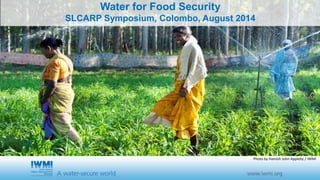
Water for Food Security 
SLCARP Symposium, Colombo, August 2014 
Photo by Hamish John Appleby / IWMI
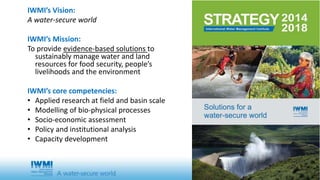
IWMI’s Vision: 
A water-secure world 
IWMI’s Mission: 
To provide evidence-based solutions to 
sustainably manage water and land 
resources for food security, people’s 
livelihoods and the environment 
IWMI’s core competencies: 
• Applied research at field and basin scale 
• Modelling of bio-physical processes 
• Socio-economic assessment 
• Policy and institutional analysis 
• Capacity development
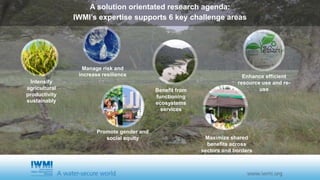
A solution orientated research agenda: 
IWMI’s expertise supports 6 key challenge areas 
Intensify 
agricultural 
productivity 
sustainably 
Manage risk and 
increase resilience 
Benefit from 
functioning 
ecosystems 
services 
Enhance efficient 
resource use and re-use 
Promote gender and 
social equity Maximize shared 
benefits across 
sectors and borders
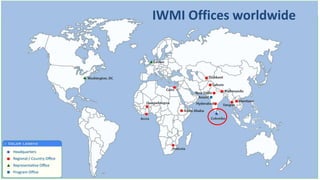
IWMI Offices worldwide
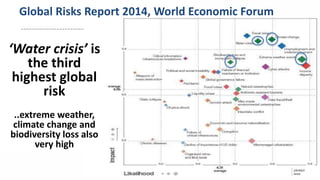
Global Risks Report 2014, World Economic Forum 
Uniting agriculture and nature for poverty reduction 
‘Water crisis’ is 
the third 
highest global 
risk 
..extreme weather, 
climate change and 
biodiversity loss also 
very high
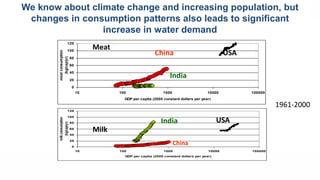
We know about climate change and increasing population, but 
changes in consumption patterns also leads to significant 
Uniting agriculture and nature for poverty reduction 
120 
100 
80 
60 
40 
20 
0 
10 100 1000 10000 100000 
GDP per capita (2000 constant dollars per year) 
meat consumption 
(kg/cap/yr) 
Meat 
China 
India 
120 
100 
80 
60 
40 
20 
0 
India USA 
10 100 1000 10000 100000 
GDP per capita (2000 constant dollars per year) 
milk consumption 
(kg/cap/yr) 
Milk 
China 
USA 
increase in water demand 
1961-2000
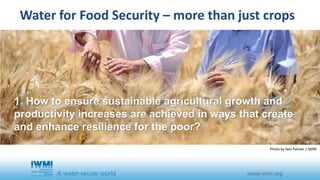
Water for Food Security – more than just crops 
1. How to ensure sustainable agricultural growth and 
productivity increases are achieved in ways that create 
and enhance resilience for the poor? 
Photo by Neil Palmer / IWMI
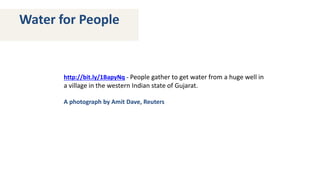
Water for People 
http://bit.ly/1BapyNq - People gather to get water from a huge well in 
a village in the western Indian state of Gujarat. 
A photograph by Amit Dave, Reuters
Water for a food-secure world 
www.iwmi.org 
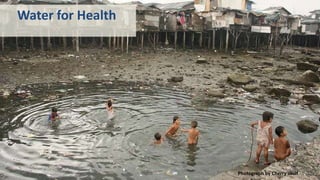
Water for Health 
Photograph by Cherry Wolf
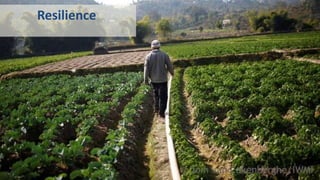
Resilience
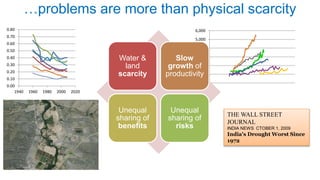
…problems are more than physical scarcity 
6,000 
5,000 
4,000 
3,000 
2,000 
1,000 
0 
Water & 
land 
scarcity 
Slow 
growth of 
productivity 
Unequal 
sharing of 
benefits 
Unequal 
sharing of 
risks 
0.80 
0.70 
0.60 
0.50 
0.40 
0.30 
0.20 
0.10 
0.00 
1940 1960 1980 2000 2020 
THE WALL STREET 
JOURNAL 
INDIA NEWS CTOBER 1, 2009 
India's Drought Worst Since 
1972
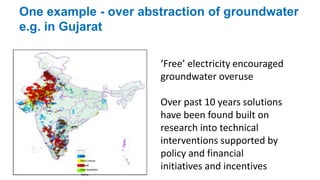
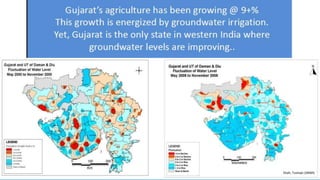
One example - over abstraction of groundwater 
e.g. in Gujarat 
Safe 
Semi-critical 
Critical 
Over exploited 
Saline 
‘Free’ electricity encouraged 
groundwater overuse 
Over past 10 years solutions 
have been found built on 
research into technical 
interventions supported by 
policy and financial 
initiatives and incentives
Shah, Tushaar (IWMI)
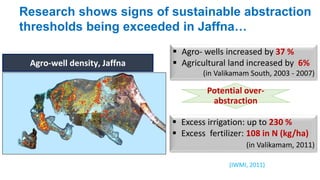
Research shows signs of sustainable abstraction 
thresholds being exceeded in Jaffna… 
Agro-well density, Jaffna 
 Agro- wells increased by 37 % 
 Agricultural land increased by 6% 
(in Valikamam South, 2003 - 2007) 
Potential over-abstraction 
 Excess irrigation: up to 230 % 
 Excess fertilizer: 108 in N (kg/ha) 
(in Valikamam, 2011) 
(IWMI, 2011)
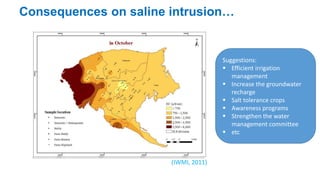
Consequences on saline intrusion… 
(IWMI, 2011) 
Suggestions: 
 Efficient irrigation 
management 
 Increase the groundwater 
recharge 
 Salt tolerance crops 
 Awareness programs 
 Strengthen the water 
management committee 
 etc
We know that: 
 in most cases resources are limited 
 pressure on agriculture from urban and industrial users will 
continue 
 the poor and marginalized suffer most in shortage situations 
So we need to: 
 enhance the productivity of water 
 adopt available supply and demand solutions, and research 
into new ones 
 ensure the right incentive frameworks are in place
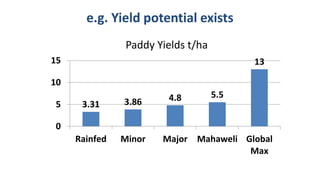
e.g. Yield potential exists 
3.31 3.86 4.8 5.5 
13 
15 
10 
5 
0 
Rainfed Minor Major Mahaweli Global 
Max 
Paddy Yields t/ha
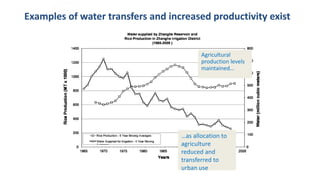
Examples of water transfers and increased productivity exist 
Agricultural 
production levels 
maintained… 
…as allocation to 
agriculture 
reduced and 
transferred to 
urban use
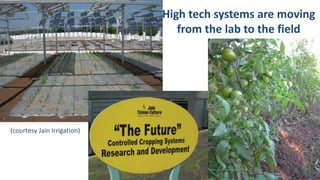
High tech systems are moving 
from the lab to the field 
(courtesy Jain Irrigation)
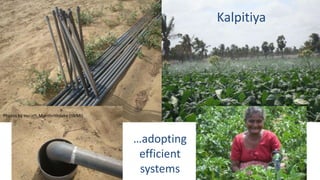
…adopting 
efficient 
systems 
Kalpitiya 
Photos by Herath Manthrithilake (IWMI)
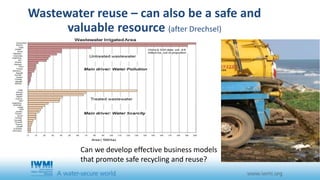
Wastewater reuse – can also be a safe and 
valuable resource (after Drechsel) 
Can we develop effective business models 
that promote safe recycling and reuse?
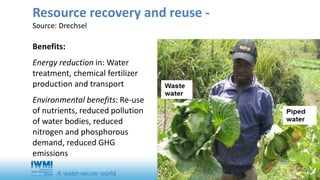
Resource recovery and reuse - 
Source: Drechsel 
Benefits: 
Energy reduction in: Water 
treatment, chemical fertilizer 
production and transport 
Environmental benefits: Re-use 
of nutrients, reduced pollution 
of water bodies, reduced 
nitrogen and phosphorous 
demand, reduced GHG 
emissions
Water for Food Security – resilience to shocks 
2. How can we plan for variable climates? 
Photo by Hamish John Appleby / IWMI
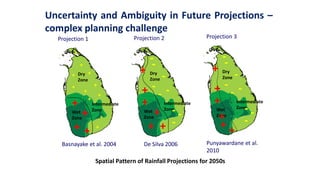
Uncertainty and Ambiguity in Future Projections – 
complex planning challenge 
Projection 1 Projection 2 
De Silva, 2006 
+ 
+ 
+ 
+ 
+ 
- 
- 
- 
- 
- 
- - - 
+ 
Projection 3 
- 
- 
- 
- - - 
+ 
+ 
+ 
+ 
+ + 
Spatial Pattern of Rainfall Projections for 2050s 
+ 
+ 
Dry 
Zone 
+ 
+ 
Wet 
Zone 
Intermediate 
Zone 
Dry 
Zone 
Wet 
Zone 
Intermediate 
Zone 
+ 
+ 
Basnayake et al. 2004 De Silva 2006 
- 
+ 
+ 
+ 
+ 
+ 
+ + 
+ 
+ 
De Silva, 2006 
Dry 
Zone 
Wet 
Zone 
Intermediate 
Zone 
- 
- 
- 
Punyawardane et al. 
2010
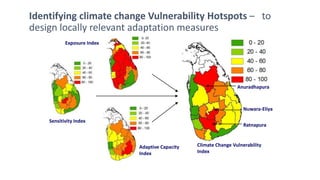
Identifying climate change Vulnerability Hotspots – to 
design locally relevant adaptation measures 
Anuradhapura 
Nuwara-Eliya 
Ratnapura 
Climate Change Vulnerability 
Index 
Exposure Index 
Sensitivity Index 
Adaptive Capacity 
Index
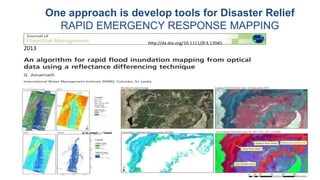
One approach is develop tools for Disaster Relief 
RAPID EMERGENCY RESPONSE MAPPING 
http://dx.doi.org/10.1111/jfr3.12045 
2013
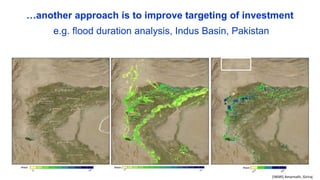
…another approach is to improve targeting of investment 
e.g. flood duration analysis, Indus Basin, Pakistan 
(IWMI) Amarnath, Giriraj
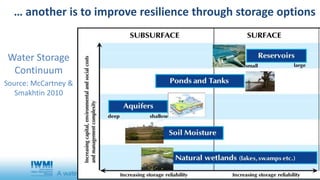
… another is to improve resilience through storage options 
Water Storage 
Continuum 
Source: McCartney & 
Smakhtin 2010
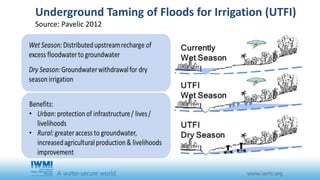
Underground Taming of Floods for Irrigation (UTFI) 
Source: Pavelic 2012
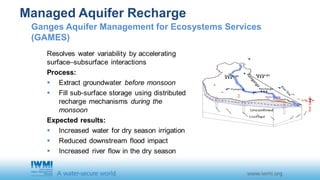
Managed Aquifer Recharge 
Ganges Aquifer Management for Ecosystems Services 
(GAMES)
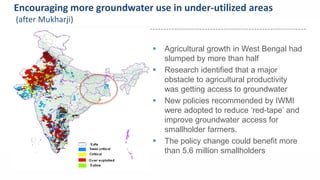
Encouraging more groundwater use in under-utilized areas 
(after Mukharji) 
 Agricultural growth in West Bengal had 
slumped by more than half 
 Research identified that a major 
obstacle to agricultural productivity 
was getting access to groundwater 
 New policies recommended by IWMI 
were adopted to reduce ‘red-tape’ and 
improve groundwater access for 
smallholder farmers. 
Uniting agriculture and nature for poverty reduction 
 The policy change could benefit more 
than 5.6 million smallholders
Challenges and opportunities 
 Competition for water is increasing 
 Variability and extremes are a reality 
 80-90% of increased production will have to 
come from investments in existing land 
 Innovative solutions exist at various scales and 
across sectors – room for optimism 
 New technology offers new opportunities 
 Research has an important part to play n 
developing a range of viable technical, 
management, institutional and policy solutions
iwmi.org 
CGIAR Research Program on Water, Land and Ecosystems 
wle.cgiar.org

Water for food security

  • 1.
    Water for FoodSecurity SLCARP Symposium, Colombo, August 2014 Photo by Hamish John Appleby / IWMI
  • 2.
    IWMI’s Vision: Awater-secure world IWMI’s Mission: To provide evidence-based solutions to sustainably manage water and land resources for food security, people’s livelihoods and the environment IWMI’s core competencies: • Applied research at field and basin scale • Modelling of bio-physical processes • Socio-economic assessment • Policy and institutional analysis • Capacity development
  • 3.
    A solution orientatedresearch agenda: IWMI’s expertise supports 6 key challenge areas Intensify agricultural productivity sustainably Manage risk and increase resilience Benefit from functioning ecosystems services Enhance efficient resource use and re-use Promote gender and social equity Maximize shared benefits across sectors and borders
  • 4.
  • 5.
    Global Risks Report2014, World Economic Forum Uniting agriculture and nature for poverty reduction ‘Water crisis’ is the third highest global risk ..extreme weather, climate change and biodiversity loss also very high
  • 6.
    We know aboutclimate change and increasing population, but changes in consumption patterns also leads to significant Uniting agriculture and nature for poverty reduction 120 100 80 60 40 20 0 10 100 1000 10000 100000 GDP per capita (2000 constant dollars per year) meat consumption (kg/cap/yr) Meat China India 120 100 80 60 40 20 0 India USA 10 100 1000 10000 100000 GDP per capita (2000 constant dollars per year) milk consumption (kg/cap/yr) Milk China USA increase in water demand 1961-2000
  • 7.
    Water for FoodSecurity – more than just crops 1. How to ensure sustainable agricultural growth and productivity increases are achieved in ways that create and enhance resilience for the poor? Photo by Neil Palmer / IWMI
  • 8.
    Water for People http://bit.ly/1BapyNq - People gather to get water from a huge well in a village in the western Indian state of Gujarat. A photograph by Amit Dave, Reuters
  • 9.
    Water for afood-secure world www.iwmi.org Water for Health Photograph by Cherry Wolf
  • 10.
  • 11.
    …problems are morethan physical scarcity 6,000 5,000 4,000 3,000 2,000 1,000 0 Water & land scarcity Slow growth of productivity Unequal sharing of benefits Unequal sharing of risks 0.80 0.70 0.60 0.50 0.40 0.30 0.20 0.10 0.00 1940 1960 1980 2000 2020 THE WALL STREET JOURNAL INDIA NEWS CTOBER 1, 2009 India's Drought Worst Since 1972
  • 12.
    One example -over abstraction of groundwater e.g. in Gujarat Safe Semi-critical Critical Over exploited Saline ‘Free’ electricity encouraged groundwater overuse Over past 10 years solutions have been found built on research into technical interventions supported by policy and financial initiatives and incentives
  • 13.
  • 14.
    Research shows signsof sustainable abstraction thresholds being exceeded in Jaffna… Agro-well density, Jaffna  Agro- wells increased by 37 %  Agricultural land increased by 6% (in Valikamam South, 2003 - 2007) Potential over-abstraction  Excess irrigation: up to 230 %  Excess fertilizer: 108 in N (kg/ha) (in Valikamam, 2011) (IWMI, 2011)
  • 15.
    Consequences on salineintrusion… (IWMI, 2011) Suggestions:  Efficient irrigation management  Increase the groundwater recharge  Salt tolerance crops  Awareness programs  Strengthen the water management committee  etc
  • 16.
    We know that:  in most cases resources are limited  pressure on agriculture from urban and industrial users will continue  the poor and marginalized suffer most in shortage situations So we need to:  enhance the productivity of water  adopt available supply and demand solutions, and research into new ones  ensure the right incentive frameworks are in place
  • 17.
    e.g. Yield potentialexists 3.31 3.86 4.8 5.5 13 15 10 5 0 Rainfed Minor Major Mahaweli Global Max Paddy Yields t/ha
  • 18.
    Examples of watertransfers and increased productivity exist Agricultural production levels maintained… …as allocation to agriculture reduced and transferred to urban use
  • 19.
    High tech systemsare moving from the lab to the field (courtesy Jain Irrigation)
  • 20.
    …adopting efficient systems Kalpitiya Photos by Herath Manthrithilake (IWMI)
  • 21.
    Wastewater reuse –can also be a safe and valuable resource (after Drechsel) Can we develop effective business models that promote safe recycling and reuse?
  • 22.
    Resource recovery andreuse - Source: Drechsel Benefits: Energy reduction in: Water treatment, chemical fertilizer production and transport Environmental benefits: Re-use of nutrients, reduced pollution of water bodies, reduced nitrogen and phosphorous demand, reduced GHG emissions
  • 23.
    Water for FoodSecurity – resilience to shocks 2. How can we plan for variable climates? Photo by Hamish John Appleby / IWMI
  • 24.
    Uncertainty and Ambiguityin Future Projections – complex planning challenge Projection 1 Projection 2 De Silva, 2006 + + + + + - - - - - - - - + Projection 3 - - - - - - + + + + + + Spatial Pattern of Rainfall Projections for 2050s + + Dry Zone + + Wet Zone Intermediate Zone Dry Zone Wet Zone Intermediate Zone + + Basnayake et al. 2004 De Silva 2006 - + + + + + + + + + De Silva, 2006 Dry Zone Wet Zone Intermediate Zone - - - Punyawardane et al. 2010
  • 25.
    Identifying climate changeVulnerability Hotspots – to design locally relevant adaptation measures Anuradhapura Nuwara-Eliya Ratnapura Climate Change Vulnerability Index Exposure Index Sensitivity Index Adaptive Capacity Index
  • 26.
    One approach isdevelop tools for Disaster Relief RAPID EMERGENCY RESPONSE MAPPING http://dx.doi.org/10.1111/jfr3.12045 2013
  • 27.
    …another approach isto improve targeting of investment e.g. flood duration analysis, Indus Basin, Pakistan (IWMI) Amarnath, Giriraj
  • 28.
    … another isto improve resilience through storage options Water Storage Continuum Source: McCartney & Smakhtin 2010
  • 29.
    Underground Taming ofFloods for Irrigation (UTFI) Source: Pavelic 2012
  • 30.
    Managed Aquifer Recharge Ganges Aquifer Management for Ecosystems Services (GAMES)
  • 31.
    Encouraging more groundwateruse in under-utilized areas (after Mukharji)  Agricultural growth in West Bengal had slumped by more than half  Research identified that a major obstacle to agricultural productivity was getting access to groundwater  New policies recommended by IWMI were adopted to reduce ‘red-tape’ and improve groundwater access for smallholder farmers. Uniting agriculture and nature for poverty reduction  The policy change could benefit more than 5.6 million smallholders
  • 32.
    Challenges and opportunities  Competition for water is increasing  Variability and extremes are a reality  80-90% of increased production will have to come from investments in existing land  Innovative solutions exist at various scales and across sectors – room for optimism  New technology offers new opportunities  Research has an important part to play n developing a range of viable technical, management, institutional and policy solutions
  • 33.
    iwmi.org CGIAR ResearchProgram on Water, Land and Ecosystems wle.cgiar.org