◦ HAMDARD UNIVERSITY, FACULTY OF
PHARMACY
◦ RESEARCH TOPIC:
◦ “PROCESS MECHANISM OF AQUEOUS FILM
COATING”
AUTHOR:
DR. MUHAMMAD AHMER KHAN
• INTRODUCTION:
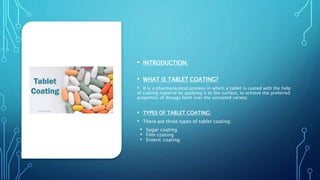
• WHAT IS TABLET COATING?
• It is a pharmaceutical process in which a tablet is coated with the help
of coating material by applying it to the surface, to achieve the preferred
properties of dosage form over the uncoated variety.
• TYPES OF TABLET COATING:
• There are three types of tablet coating:
• Sugar coating
• Film coating
• Enteric coating
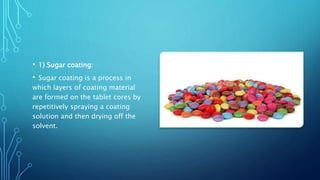
• 1) Sugar coating:
• Sugar coating is a process in
which layers of coating material
are formed on the tablet cores by
repetitively spraying a coating
solution and then drying off the
solvent.
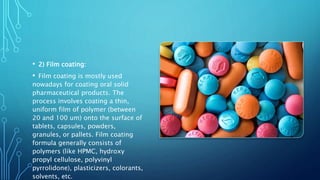
• 2) Film coating:
• Film coating is mostly used
nowadays for coating oral solid
pharmaceutical products. The
process involves coating a thin,
uniform film of polymer (between
20 and 100 um) onto the surface of
tablets, capsules, powders,
granules, or pallets. Film coating
formula generally consists of
polymers (like HPMC, hydroxy
propyl cellulose, polyvinyl
pyrrolidone), plasticizers, colorants,
solvents, etc.
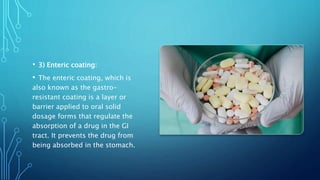
• 3) Enteric coating:
• The enteric coating, which is
also known as the gastro-
resistant coating is a layer or
barrier applied to oral solid
dosage forms that regulate the
absorption of a drug in the GI
tract. It prevents the drug from
being absorbed in the stomach.
• AQUEOUS FILM COATING:
• Aqueous film coating is the deposition
of a thin film of polymer onto the surface
of a tablet.
• OBJECTIVES OF AQUEOUS FILM
COATING:
• To protect the tablet from light,
temperature, and moisture
• To mask undesirable taste or odor
• To improve the appearance and to
provide tablet identity
• To facilitate swallowing i.e., improve
patient compliance
• To control or modify the release of
drug
COMPARISON OF FILM COATING WITH SUGAR COATING:
•Film coating involves a single-stage process that is rapid, and it results in 2-3% minimal weight gain as
compared to sugar coating, which increases by 60 to 80%.
•In film coating, tablets usually retain the figure of the original core, and it is not as shiny as compared to
sugar coating, in which tablets are rounded with a high degree of polish.
•Logo or “break lines” are possible in film coating while in sugar coating, they are not possible.
•In film coating, operator training is not so difficult as compared to sugar coating, which requires a highly
skilled worker.
•Adaptability to Good Manufacturing Practice (GMP) is high in film coating while difficulty may arise in sugar
coating.
•In film coating, the typical batch coating time is 1.5 - 2 hours while in sugar coating, it is 8 hours or longer.
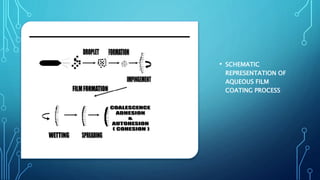
• SCHEMATIC
REPRESENTATION OF
AQUEOUS FILM
COATING PROCESS
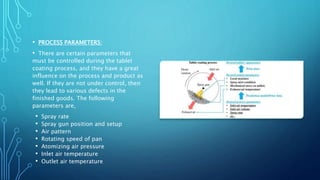
• PROCESS PARAMETERS:
• There are certain parameters that
must be controlled during the tablet
coating process, and they have a great
influence on the process and product as
well. If they are not under control, then
they lead to various defects in the
finished goods. The following
parameters are,
• Spray rate
• Spray gun position and setup
• Air pattern
• Rotating speed of pan
• Atomizing air pressure
• Inlet air temperature
• Outlet air temperature
• SPRAY RATE (FLOW RATE OF THE COATING SOLUTION):
• Spray rate is a very important parameter because it has impact on the moisture content of the coating
and ultimately on the quality and uniformity of the formed film.
• For the successful aqueous film coating, the flow rate of the coating liquid must be equal to the rate
of evaporation of water from the coated tablet’s surface.
• High flow rate permits a greater number of droplets to be sprayed on the tablet bed per unit time
which increases the droplet size, it results in over-wetting of the tablet surface and subsequent
problems such as picking and sticking.
• However, a low flow rate causes incomplete coalescence of the polymer due to insufficient wetting
which could result in brittle films.
• The optimum value should be set between 80 and 150 ml/min. The recommended level is 80 ml/min
per gun if the gun-to-bed distance is 8 inches while 120 ml/min per gun would be for the gun-to-bed
distance of 10 inches.
• SPRAY GUN POSITION AND SETUP:
• The position of the spray gun is very important during tablet coating. If
more than one gun is used, gun-to-gun and gun-to-bed distances are very
important to achieve the required width.
• If guns are very near, spray width would be thin, resulting in the non-
uniform coating.
• On the other hand, if the guns and the spray width are too widespread,
there would be an overlap of the spray area and some spray hit on drum walls.
It leads to waste of the coating solution and other problems such as sticking
and picking.
• The spray gun’s ideal position is 6-10 inches from the bed of tablets at a
45-degree angle.
• AIR PATTERN:
• The air pattern is an important factor in aqueous film coating.
• Its levels must always be carefully set along with air pressure.
• If the air pattern is great, it flattens the cone and can result in overspray,
over wetting, and picking.
• While too little air pattern concentrates the cone in a small area resulting in
tablet erosion and picking.
• Air pattern is fixed in some systems while in others, it is variable and set by
the operator.
• ROTATING SPEED OF PAN:
• The pan speed affects the time the tablets spend on the spraying zone and,
subsequently, the homogeneous distribution of the coating solution on each
tablet surface throughout the batch.
• High pan speed decreases the thickness variation while enhancing the
uniformity of coating.
• Very high rotating speed of pan cause tablets to undergo attrition and
breakage which is unnecessary.
• The optimum range for the rotating speed of the pan is 10-12 rpm in the
neocota coating machine for special-shaped tablets.
• ATOMIZING AIR PRESSURE (SPRAYING AIR PRESSURE):
• The spraying air pressure scatters the liquid which is to be coated into droplets and
affects droplet size distribution and subsequently the droplet spreading and penetration on
the surface of the tablet.
• For the adhesive film coat, the atomized droplets completely spread over the tablet’s
surface.
• Simply, if spraying air pressure increases, it decreases the surface roughness of tablets
resulting in thinner film.
• However, if spraying pressure is very high, spray loss is great, and the resultant droplets
are very fine and would spray dry before reaching the tablet surface and incomplete droplet
spreading and coalescence.
• Low spraying air pressure over wet tablets and causes sticking because of the production
of large droplets.
• The optimum range of atomizing air pressure for round, standard concave 6.5 mm tablets
is 0.8-1.6 Kg/cm².
during coating because it evaporates solvent, so
maintain a limit to prevent tablets from being
over dry or over wet.
• Several factors affect required inlet air
temperature including spray rate, inlet air flow
rate, and percent solids in the coating solution.
• It affects the evaporation of water from the
coating pan.
• High temperature increases the drying of
aqueous film coating and decreases aqueous
penetration in tablets, minimizing porosity. Too
high temperature is not feasible, and the
outcome is the orange peel effect or reduction in
weight gain.
• While very low temperatures cause twinning,
picking, and sticking of tablets.
• The optimum inlet air temperature range for
round shape, standard concave 6.5 mm tablets is
50-60 °C.
OUTLET AIR TEMPERATURE:
It is also a very significant parameter. Outlet air
temperature is always less than inlet air
temperature by 10-20 degrees due to the heat
exchange mechanism.
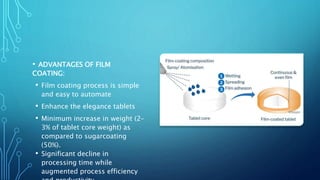
• ADVANTAGES OF FILM
COATING:
• Film coating process is simple
and easy to automate
• Enhance the elegance tablets
• Minimum increase in weight (2–
3% of tablet core weight) as
compared to sugarcoating
(50%).
• Significant decline in
processing time while
augmented process efficiency
REFERENCE:
BOOK:
Aulton’s Pharmaceutics: The design and manufacture of medicines
5th edition
ARTICLES:
• Parmar Krutin, D., Pandya Kirtan, B., Gajjar Alpesh, M., Zala Shivraj, D.,
Kela Amit, N. and Nathani Hitesh, S., 2012. An overview: aqueous film
coating technology on tablets. Int. j. pharm. chem. biol. sci, 1(3), pp.994-
1001.
• Saikh, M.A.A., 2021. Aqueous film coating the current trend. Journal of
Drug Delivery and Therapeutics, 11(4-S), pp.212-224.
• Sheth, N., Shah, S., Potdar, A. and Shah, A., 2009. Studies in optimization
of aqueous film coating parameters. International Journal of
Pharmaceutical Sciences and Nanotechnology, 2(3), pp.621-626.
• Ruotsalainen, M., 2003. Studies on aqueous film coating of tablets
performed in a side-vented pan coater.
• Porter, S.C., 2021. Coating of pharmaceutical dosage forms. In Remington
(pp. 551-564). Academic Press.
• Bharadia, P.D. and Pandya, V.M., 2014. A review on aqueous film coating
technology. Indian Journal of Pharmacy and Pharmacology, 1(1), pp.64-
THANK YOU

AQUEOUS FILM COATING AND PROCESS PARAMETERS

  • 1.
    ◦ HAMDARD UNIVERSITY,FACULTY OF PHARMACY ◦ RESEARCH TOPIC: ◦ “PROCESS MECHANISM OF AQUEOUS FILM COATING” AUTHOR: DR. MUHAMMAD AHMER KHAN
  • 2.
    • INTRODUCTION: • WHATIS TABLET COATING? • It is a pharmaceutical process in which a tablet is coated with the help of coating material by applying it to the surface, to achieve the preferred properties of dosage form over the uncoated variety. • TYPES OF TABLET COATING: • There are three types of tablet coating: • Sugar coating • Film coating • Enteric coating
  • 3.
    • 1) Sugarcoating: • Sugar coating is a process in which layers of coating material are formed on the tablet cores by repetitively spraying a coating solution and then drying off the solvent.
  • 4.
    • 2) Filmcoating: • Film coating is mostly used nowadays for coating oral solid pharmaceutical products. The process involves coating a thin, uniform film of polymer (between 20 and 100 um) onto the surface of tablets, capsules, powders, granules, or pallets. Film coating formula generally consists of polymers (like HPMC, hydroxy propyl cellulose, polyvinyl pyrrolidone), plasticizers, colorants, solvents, etc.
  • 5.
    • 3) Entericcoating: • The enteric coating, which is also known as the gastro- resistant coating is a layer or barrier applied to oral solid dosage forms that regulate the absorption of a drug in the GI tract. It prevents the drug from being absorbed in the stomach.
  • 6.
    • AQUEOUS FILMCOATING: • Aqueous film coating is the deposition of a thin film of polymer onto the surface of a tablet. • OBJECTIVES OF AQUEOUS FILM COATING: • To protect the tablet from light, temperature, and moisture • To mask undesirable taste or odor • To improve the appearance and to provide tablet identity • To facilitate swallowing i.e., improve patient compliance • To control or modify the release of drug
  • 7.
    COMPARISON OF FILMCOATING WITH SUGAR COATING: •Film coating involves a single-stage process that is rapid, and it results in 2-3% minimal weight gain as compared to sugar coating, which increases by 60 to 80%. •In film coating, tablets usually retain the figure of the original core, and it is not as shiny as compared to sugar coating, in which tablets are rounded with a high degree of polish. •Logo or “break lines” are possible in film coating while in sugar coating, they are not possible. •In film coating, operator training is not so difficult as compared to sugar coating, which requires a highly skilled worker. •Adaptability to Good Manufacturing Practice (GMP) is high in film coating while difficulty may arise in sugar coating. •In film coating, the typical batch coating time is 1.5 - 2 hours while in sugar coating, it is 8 hours or longer.
  • 8.
  • 9.
    • PROCESS PARAMETERS: •There are certain parameters that must be controlled during the tablet coating process, and they have a great influence on the process and product as well. If they are not under control, then they lead to various defects in the finished goods. The following parameters are, • Spray rate • Spray gun position and setup • Air pattern • Rotating speed of pan • Atomizing air pressure • Inlet air temperature • Outlet air temperature
  • 10.
    • SPRAY RATE(FLOW RATE OF THE COATING SOLUTION): • Spray rate is a very important parameter because it has impact on the moisture content of the coating and ultimately on the quality and uniformity of the formed film. • For the successful aqueous film coating, the flow rate of the coating liquid must be equal to the rate of evaporation of water from the coated tablet’s surface. • High flow rate permits a greater number of droplets to be sprayed on the tablet bed per unit time which increases the droplet size, it results in over-wetting of the tablet surface and subsequent problems such as picking and sticking. • However, a low flow rate causes incomplete coalescence of the polymer due to insufficient wetting which could result in brittle films. • The optimum value should be set between 80 and 150 ml/min. The recommended level is 80 ml/min per gun if the gun-to-bed distance is 8 inches while 120 ml/min per gun would be for the gun-to-bed distance of 10 inches.
  • 11.
    • SPRAY GUNPOSITION AND SETUP: • The position of the spray gun is very important during tablet coating. If more than one gun is used, gun-to-gun and gun-to-bed distances are very important to achieve the required width. • If guns are very near, spray width would be thin, resulting in the non- uniform coating. • On the other hand, if the guns and the spray width are too widespread, there would be an overlap of the spray area and some spray hit on drum walls. It leads to waste of the coating solution and other problems such as sticking and picking. • The spray gun’s ideal position is 6-10 inches from the bed of tablets at a 45-degree angle.
  • 12.
    • AIR PATTERN: •The air pattern is an important factor in aqueous film coating. • Its levels must always be carefully set along with air pressure. • If the air pattern is great, it flattens the cone and can result in overspray, over wetting, and picking. • While too little air pattern concentrates the cone in a small area resulting in tablet erosion and picking. • Air pattern is fixed in some systems while in others, it is variable and set by the operator.
  • 13.
    • ROTATING SPEEDOF PAN: • The pan speed affects the time the tablets spend on the spraying zone and, subsequently, the homogeneous distribution of the coating solution on each tablet surface throughout the batch. • High pan speed decreases the thickness variation while enhancing the uniformity of coating. • Very high rotating speed of pan cause tablets to undergo attrition and breakage which is unnecessary. • The optimum range for the rotating speed of the pan is 10-12 rpm in the neocota coating machine for special-shaped tablets.
  • 14.
    • ATOMIZING AIRPRESSURE (SPRAYING AIR PRESSURE): • The spraying air pressure scatters the liquid which is to be coated into droplets and affects droplet size distribution and subsequently the droplet spreading and penetration on the surface of the tablet. • For the adhesive film coat, the atomized droplets completely spread over the tablet’s surface. • Simply, if spraying air pressure increases, it decreases the surface roughness of tablets resulting in thinner film. • However, if spraying pressure is very high, spray loss is great, and the resultant droplets are very fine and would spray dry before reaching the tablet surface and incomplete droplet spreading and coalescence. • Low spraying air pressure over wet tablets and causes sticking because of the production of large droplets. • The optimum range of atomizing air pressure for round, standard concave 6.5 mm tablets is 0.8-1.6 Kg/cm².
  • 15.
    during coating becauseit evaporates solvent, so maintain a limit to prevent tablets from being over dry or over wet. • Several factors affect required inlet air temperature including spray rate, inlet air flow rate, and percent solids in the coating solution. • It affects the evaporation of water from the coating pan. • High temperature increases the drying of aqueous film coating and decreases aqueous penetration in tablets, minimizing porosity. Too high temperature is not feasible, and the outcome is the orange peel effect or reduction in weight gain. • While very low temperatures cause twinning, picking, and sticking of tablets. • The optimum inlet air temperature range for round shape, standard concave 6.5 mm tablets is 50-60 °C. OUTLET AIR TEMPERATURE: It is also a very significant parameter. Outlet air temperature is always less than inlet air temperature by 10-20 degrees due to the heat exchange mechanism.
  • 16.
    • ADVANTAGES OFFILM COATING: • Film coating process is simple and easy to automate • Enhance the elegance tablets • Minimum increase in weight (2– 3% of tablet core weight) as compared to sugarcoating (50%). • Significant decline in processing time while augmented process efficiency
  • 17.
    REFERENCE: BOOK: Aulton’s Pharmaceutics: Thedesign and manufacture of medicines 5th edition ARTICLES: • Parmar Krutin, D., Pandya Kirtan, B., Gajjar Alpesh, M., Zala Shivraj, D., Kela Amit, N. and Nathani Hitesh, S., 2012. An overview: aqueous film coating technology on tablets. Int. j. pharm. chem. biol. sci, 1(3), pp.994- 1001. • Saikh, M.A.A., 2021. Aqueous film coating the current trend. Journal of Drug Delivery and Therapeutics, 11(4-S), pp.212-224. • Sheth, N., Shah, S., Potdar, A. and Shah, A., 2009. Studies in optimization of aqueous film coating parameters. International Journal of Pharmaceutical Sciences and Nanotechnology, 2(3), pp.621-626. • Ruotsalainen, M., 2003. Studies on aqueous film coating of tablets performed in a side-vented pan coater. • Porter, S.C., 2021. Coating of pharmaceutical dosage forms. In Remington (pp. 551-564). Academic Press. • Bharadia, P.D. and Pandya, V.M., 2014. A review on aqueous film coating technology. Indian Journal of Pharmacy and Pharmacology, 1(1), pp.64-
  • 18.