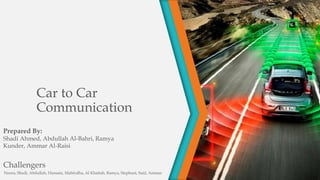
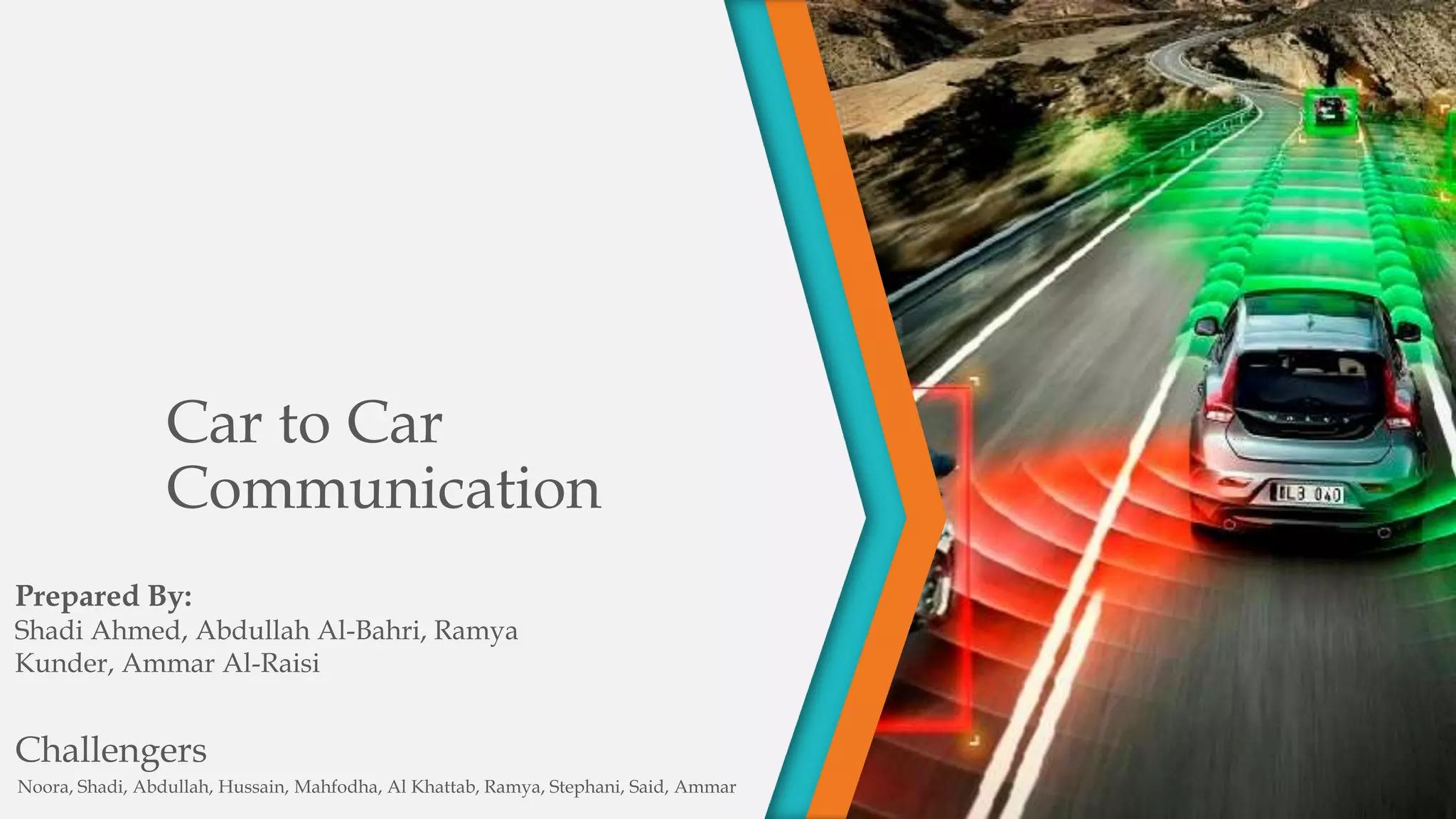
Car to Car
Communication
Challengers
Noora, Shadi, Abdullah, Hussain, Mahfodha, Al Khattab, Ramya, Stephani, Said, Ammar
Prepared By:
Shadi Ahmed, Abdullah Al-Bahri, Ramya
Kunder, Ammar Al-Raisi
Learning Outcomes
• What’s Car to Car Communication technology?
• Benefits to Car to Car Communication technology.
• Applications of Car to Car communication technology.
• Challenges that faces Car to Car Communication technology.
• Future impact of Car to Car Communication technology.
What’s Car to Car Communication?
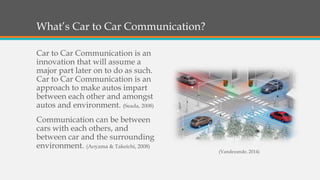
Car to Car Communication is an
innovation that will assume a
major part later on to do as such.
Car to Car Communication is an
approach to make autos impart
between each other and amongst
autos and environment. (Seada, 2008)
Communication can be between
cars with each others, and
between car and the surrounding
environment. (Aoyama & Takeichi, 2008)
(Vandezande, 2014)
Advantages of Car to Car Communication
There is a great deal of advantages of
Car to Car Communication. The
fundamental advantage is enhancing
wellbeing and reducing accidents by
utilizing a few advancements, for
example:-
• Adaptive Cruise Control (ACC)
• Lane-Keeping Assist System
(LKAS)
• Overtaking Assistance System
(OAS)
Adaptive Cruise Control (ACC)
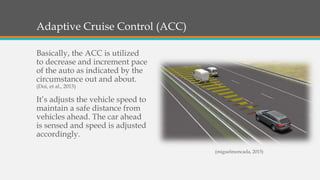
Basically, the ACC is utilized
to decrease and increment pace
of the auto as indicated by the
circumstance out and about.
(Doi, et al., 2013)
It’s adjusts the vehicle speed to
maintain a safe distance from
vehicles ahead. The car ahead
is sensed and speed is adjusted
accordingly.
(miguelmoncada, 2015)
Lane-Keeping Assist System (LKAS)
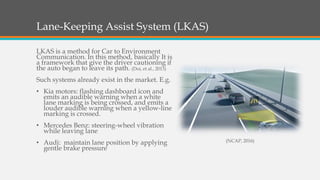
LKAS is a method for Car to Environment
Communication. In this method, basically It is
a framework that give the driver cautioning if
the auto began to leave its path. (Doi, et al., 2013)
Such systems already exist in the market. E.g.
• Kia motors: flashing dashboard icon and
emits an audible warning when a white
lane marking is being crossed, and emits a
louder audible warning when a yellow-line
marking is crossed.
• Mercedes Benz: steering-wheel vibration
while leaving lane
• Audi: maintain lane position by applying
gentle brake pressure
(NCAP, 2016)
Overtaking Assistance System (OAS)
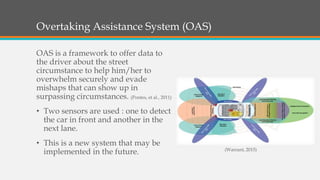
OAS is a framework to offer data to
the driver about the street
circumstance to help him/her to
overwhelm securely and evade
mishaps that can show up in
surpassing circumstances. (Pontes, et al., 2011)
• Two sensors are used : one to detect
the car in front and another in the
next lane.
• This is a new system that may be
implemented in the future. (Warrant, 2015)
Challenges of Car to Car Communication
Car to Car Communication is
another arena, which having
various challenges that makes
this innovation require more
examines and tests. Some of these
difficulties as takes after:
• Diverse kind of
correspondence
• Specialized gadgets
• Association or connection
delay
Diverse kind of correspondence
Car to Car Communication is more
perplexing than whatever other
interchanges, for example, cell phones
correspondence. Cell phones are
imparting to each other by utilizing
settled stations that oversee
correspondence strategies, while in
Car to Car Communication the auto is
progressing and it ought to assume
two parts, administrator and client of
the correspondence. (Aoyama & Takeichi, 2008)
Specialized gadgets
To build up any correspondence,
there is a need of gadgets to get and
transmit information. In autos, there
is a test of recognizing the spots and
the quantity of these gadgets, since a
few spots on the body of the
consideration may bring about
diffusing of the association waves.
(Diez, et al., 2015)
Association or connection delay
Association or connection postponement is the principle challenge in
Car to Car correspondence. Dormancy of building up association,
sending and accepting information won't help in staying away from
mishaps when autos on fast. (Shah, et al., 2008)
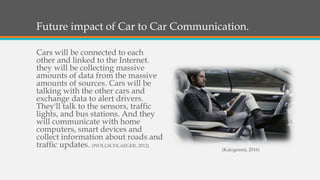
Future impact of Car to Car Communication.
Cars will be connected to each
other and linked to the Internet.
they will be collecting massive
amounts of data from the massive
amounts of sources. Cars will be
talking with the other cars and
exchange data to alert drivers.
They'll talk to the sensors, traffic
lights, and bus stations. And they
will communicate with home
computers, smart devices and
collect information about roads and
traffic updates. (WOLLSCHLAEGER, 2012)
(Kalogianni, 2016)
References
• Aoyama, M. & Takeichi, H., 2008. Adaptive Self-Organizing Overlay Network for Car-to-Car Communications. Software Engineering, Artificial Intelligence,
Networking, and Parallel/Distributed Computing, pp. 605-610.
• Diez, M. B., Plitt, P., Pascher, W. & Lindenmeier, S., 2015. Antenna placement and wave propagation for Car-to-Car communication. EuMC, pp. 207-210.
• Doi, M. et al., 2013. Steering-assist control system on curved road using car-to-car communication. IEEE, pp. 1-6.
• Hontani, H. & Higuchi, Y., 2008. Vehicle positioning method with car-to-car communications in consideration of communication delay. Networked Sensing
Systems INSS, pp. 219-222.
• Kalogianni, A., 2016. The next 10 years in car tech will make the last 30 look like just a warm-up. [Online]
Available at: http://www.digitaltrends.com/cars/the-future-of-car-tech-a-10-year-timeline/
[Accessed 18 October 2016].
• miguelmoncada, 2015. Autonomous cars. [Online]
Available at: http://miguelmoncada.tumblr.com/
[Accessed 14 October 2016].
• NCAP, E., 2016. Lane Support. [Online]
Available at: http://www.euroncap.com/en/vehicle-safety/the-ratings-explained/safety-assist/lane-support/
[Accessed 15 October 2016].
• Pontes, J., Reichardt, L. & Zwick, T., 2011. Investigation on Antenna Systems for Car-to-Car Communication. IEEE, Volume 29, pp. 7-14.
• Seada, K., 2008. Insights from a freeway car-to-car real-world experiment. ACM, pp. 49-56.
• Shah, N., Bastani, F., Kumar, S. & Yen, I.-L., 2008. Real-time car-to-car communication protocol for intersecting roads," ITS Telecommunications. ITST, pp. 412-
417.
• Vandezande, L., 2014. NHTSA Moving Ahead With Car-to-Car Communication. [Online]
Available at: http://www.autoguide.com/auto-news/2014/02/nhtsa-moving-ahead-car-car-communication.html
[Accessed 13 October 2016].
• Warrant, J., 2015. Read Our Guide To Advanced Driver Assist Systems. [Online]
Available at: http://www.panelcraft.co.uk/read-our-guide-to-advanced-driver-assist-systems/
[Accessed 12 October 2016].
• WOLLSCHLAEGER, D., 2012. What’s Next? V2V (Vehicle-to-Vehicle) Communication With Connected Cars. [Online]
Available at: https://www.wired.com/insights/2014/09/connected-cars/
[Accessed 19 October 2016].

Car to Car Communication (8)

  • 1.
    Car to Car Communication Challengers Noora,Shadi, Abdullah, Hussain, Mahfodha, Al Khattab, Ramya, Stephani, Said, Ammar Prepared By: Shadi Ahmed, Abdullah Al-Bahri, Ramya Kunder, Ammar Al-Raisi
  • 2.
    Learning Outcomes • What’sCar to Car Communication technology? • Benefits to Car to Car Communication technology. • Applications of Car to Car communication technology. • Challenges that faces Car to Car Communication technology. • Future impact of Car to Car Communication technology.
  • 3.
    What’s Car toCar Communication? Car to Car Communication is an innovation that will assume a major part later on to do as such. Car to Car Communication is an approach to make autos impart between each other and amongst autos and environment. (Seada, 2008) Communication can be between cars with each others, and between car and the surrounding environment. (Aoyama & Takeichi, 2008) (Vandezande, 2014)
  • 4.
    Advantages of Carto Car Communication There is a great deal of advantages of Car to Car Communication. The fundamental advantage is enhancing wellbeing and reducing accidents by utilizing a few advancements, for example:- • Adaptive Cruise Control (ACC) • Lane-Keeping Assist System (LKAS) • Overtaking Assistance System (OAS)
  • 5.
    Adaptive Cruise Control(ACC) Basically, the ACC is utilized to decrease and increment pace of the auto as indicated by the circumstance out and about. (Doi, et al., 2013) It’s adjusts the vehicle speed to maintain a safe distance from vehicles ahead. The car ahead is sensed and speed is adjusted accordingly. (miguelmoncada, 2015)
  • 6.
    Lane-Keeping Assist System(LKAS) LKAS is a method for Car to Environment Communication. In this method, basically It is a framework that give the driver cautioning if the auto began to leave its path. (Doi, et al., 2013) Such systems already exist in the market. E.g. • Kia motors: flashing dashboard icon and emits an audible warning when a white lane marking is being crossed, and emits a louder audible warning when a yellow-line marking is crossed. • Mercedes Benz: steering-wheel vibration while leaving lane • Audi: maintain lane position by applying gentle brake pressure (NCAP, 2016)
  • 7.
    Overtaking Assistance System(OAS) OAS is a framework to offer data to the driver about the street circumstance to help him/her to overwhelm securely and evade mishaps that can show up in surpassing circumstances. (Pontes, et al., 2011) • Two sensors are used : one to detect the car in front and another in the next lane. • This is a new system that may be implemented in the future. (Warrant, 2015)
  • 8.
    Challenges of Carto Car Communication Car to Car Communication is another arena, which having various challenges that makes this innovation require more examines and tests. Some of these difficulties as takes after: • Diverse kind of correspondence • Specialized gadgets • Association or connection delay
  • 9.
    Diverse kind ofcorrespondence Car to Car Communication is more perplexing than whatever other interchanges, for example, cell phones correspondence. Cell phones are imparting to each other by utilizing settled stations that oversee correspondence strategies, while in Car to Car Communication the auto is progressing and it ought to assume two parts, administrator and client of the correspondence. (Aoyama & Takeichi, 2008)
  • 10.
    Specialized gadgets To buildup any correspondence, there is a need of gadgets to get and transmit information. In autos, there is a test of recognizing the spots and the quantity of these gadgets, since a few spots on the body of the consideration may bring about diffusing of the association waves. (Diez, et al., 2015)
  • 11.
    Association or connectiondelay Association or connection postponement is the principle challenge in Car to Car correspondence. Dormancy of building up association, sending and accepting information won't help in staying away from mishaps when autos on fast. (Shah, et al., 2008)
  • 12.
    Future impact ofCar to Car Communication. Cars will be connected to each other and linked to the Internet. they will be collecting massive amounts of data from the massive amounts of sources. Cars will be talking with the other cars and exchange data to alert drivers. They'll talk to the sensors, traffic lights, and bus stations. And they will communicate with home computers, smart devices and collect information about roads and traffic updates. (WOLLSCHLAEGER, 2012) (Kalogianni, 2016)
  • 13.
    References • Aoyama, M.& Takeichi, H., 2008. Adaptive Self-Organizing Overlay Network for Car-to-Car Communications. Software Engineering, Artificial Intelligence, Networking, and Parallel/Distributed Computing, pp. 605-610. • Diez, M. B., Plitt, P., Pascher, W. & Lindenmeier, S., 2015. Antenna placement and wave propagation for Car-to-Car communication. EuMC, pp. 207-210. • Doi, M. et al., 2013. Steering-assist control system on curved road using car-to-car communication. IEEE, pp. 1-6. • Hontani, H. & Higuchi, Y., 2008. Vehicle positioning method with car-to-car communications in consideration of communication delay. Networked Sensing Systems INSS, pp. 219-222. • Kalogianni, A., 2016. The next 10 years in car tech will make the last 30 look like just a warm-up. [Online] Available at: http://www.digitaltrends.com/cars/the-future-of-car-tech-a-10-year-timeline/ [Accessed 18 October 2016]. • miguelmoncada, 2015. Autonomous cars. [Online] Available at: http://miguelmoncada.tumblr.com/ [Accessed 14 October 2016]. • NCAP, E., 2016. Lane Support. [Online] Available at: http://www.euroncap.com/en/vehicle-safety/the-ratings-explained/safety-assist/lane-support/ [Accessed 15 October 2016]. • Pontes, J., Reichardt, L. & Zwick, T., 2011. Investigation on Antenna Systems for Car-to-Car Communication. IEEE, Volume 29, pp. 7-14. • Seada, K., 2008. Insights from a freeway car-to-car real-world experiment. ACM, pp. 49-56. • Shah, N., Bastani, F., Kumar, S. & Yen, I.-L., 2008. Real-time car-to-car communication protocol for intersecting roads," ITS Telecommunications. ITST, pp. 412- 417. • Vandezande, L., 2014. NHTSA Moving Ahead With Car-to-Car Communication. [Online] Available at: http://www.autoguide.com/auto-news/2014/02/nhtsa-moving-ahead-car-car-communication.html [Accessed 13 October 2016]. • Warrant, J., 2015. Read Our Guide To Advanced Driver Assist Systems. [Online] Available at: http://www.panelcraft.co.uk/read-our-guide-to-advanced-driver-assist-systems/ [Accessed 12 October 2016]. • WOLLSCHLAEGER, D., 2012. What’s Next? V2V (Vehicle-to-Vehicle) Communication With Connected Cars. [Online] Available at: https://www.wired.com/insights/2014/09/connected-cars/ [Accessed 19 October 2016].