Kitchen Ventilation

Revac Systems
83, PadmaNagar Phase II
Chintal
Hyderabad 500054
Mobile No +91- 9246 377 652

1
Buildings with Kitchens

 Hotels
 Restaurants
 Hospitals
 Canteens
 Retail Malls
 Residences
 Jails

2
System Design for Kitchens

 Air Conditioning
 Ventilation
 Fire Safety
 Building Pressurization
 Refrigeration
 Air Distribution
 Food Service Equipment

3
Basic Purpose of Kitchen Ventilation
 To provide a comfortable environment in the kitchen
 To ensure the safety of the people working in the
kitchen and other building occupants by:
-Effective Removal of Effluents which may
include gaseous, liquid and solid
contaminants produced by the cooking
process and products of fuel & food
combustion.
Effluents can be life threatening and flammable

4
Effluent Generation in Kitchens

 Heat is a primary ingredient of kitchen
effluents
 50% to 90% of the appliance energy input is
released in the form of a rising thermal plume
(convective). Balance is released into
surrounding space through radiation.
 This plume also contains most of the food
and fuel generated effluents.

5
 Primary objective of kitchen ventilation is to
capture and remove the air and effluents that
constitute the plume through an effective
exhaust system.
 Heat radiated into space form the appliance
must be addressed by the space airconditioning system.

6
A Commercial Kitchen

7
Typical Kitchen Exhaust System

600x600
5600 CFM
1500 FPM
VCD

VCD
600x400

600x400

HOOD (8'x4'6") with Baffle Filter
Velocity Across Hood - 150 FPM

ESP
ESP
TRION Air Cleaner
Model T2002
Velocity Across
Air Cleaner 450 FPM

Centrifugal Fan (Exhaust)
6000 CFM 60mm SP 5hp motor

Kitchen Exhaust System
Schematic Diagram

8
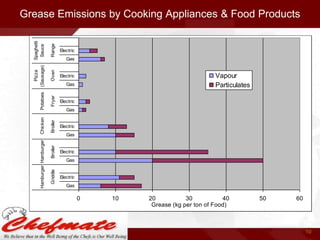
Grease Emissions

 Amount of grease in vapour phase varies
from 30 to 90% by mass. This is an important
factor in designing the grease removal
system.
 CO, CO2 and NOx emissions are present in
gas and not electrical appliances.

9
Spaghetti
Sauce

Range

Pizza
(Sausage)

Oven

Potatoes

Fryer
Broiler

Electric
Gas

Vapour
Particulates

Electric
Gas

Electric
Gas

Electric

Broiler

Gas

Electric
Gas

Griddle

Hamburger Hamburger

Chicken

Grease Emissions by Cooking Appliances & Food Products

Electric
Gas

0

10

20
30
40
Grease (kg per ton of Food)

50

60

10
Behavior of Hot Effluent Plume
 In the absence of cross-drafts, a heated plume rises
vertically, entraining the ambient air which enlarges
the plume, cools it and slows it down.
 An Exhaust Hood, generally located above the
appliance, guides this plume into a ducted exhaust
system.
 The exhaust system flow rate must be slightly higher
than the plume volume rate. Extra exhaust capacity
may be required to resist cross-drafts.
 The concept of capture velocity is not applicable to
kitchen exhaust if a hood of sufficient size is placed
at the correct height.
 If the appliance and hood are placed against a
backwall, the plume is drawn towards the wall by the
“Coanda effect”.
11
Spaghetti
Sauce

Range

Pizza
(Sausage)

Oven

Potatoes

Fryer
Broiler

Electric
Gas

Electric
Gas

Electric
Gas

Electric

Broiler

Gas

Electric
Gas

Griddle

Hamburger Hamburger

Chicken

Effluent Plume Flow Rates

Electric
Gas

0

200

400

600

CFM

800

1000

1200

1400

12
An Exhaust Hood

 The Centre Piece of any Kitchen Ventilation
System (KVS)
 Not just a sheet metal box but a critical
component of a well engineered system
 Much greater awareness today about the
need for an effective KVS
 Issues are health, safety, efficiency and
energy savings
13
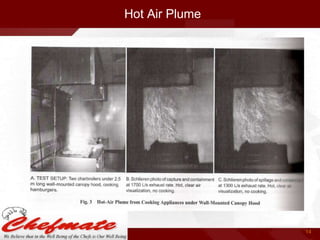
Hot Air Plume

14
Exhaust Hoods

 Type I – for removing grease & smoke : used
for cooking appliances
 Type II – for steam, vapour, heat & odour
when grease is not present : used for
dishwashers, steam tables, etc.

15
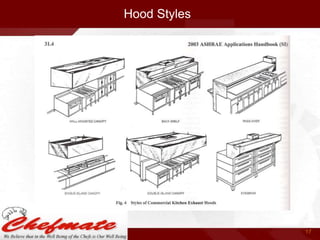
Basic Styles of Type I Hoods

 Wall Mounted Canopy
 Single Island
 Double Island
 Back Shelf or Proximity
 Pass Over
 Eyebrow

16
Hood Styles

17
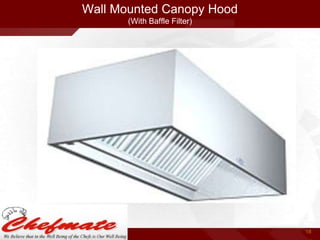
Wall Mounted Canopy Hood
(With Baffle Filter)

18
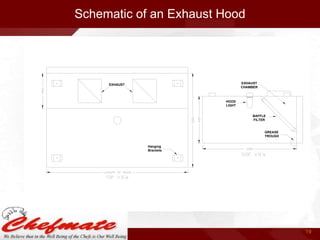
Schematic of an Exhaust Hood

EXHAUST
CHAMBER

EXHAUST

HOOD
LIGHT
BAFFLE
FILTER

GREASE
TROUGH
Hanging
Brackets

19
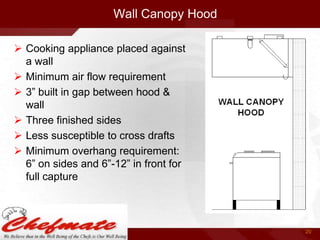
Wall Canopy Hood
 Cooking appliance placed against
a wall
 Minimum air flow requirement
 3” built in gap between hood &
wall
 Three finished sides
 Less susceptible to cross drafts
 Minimum overhang requirement:
6” on sides and 6”-12” in front for
full capture

20
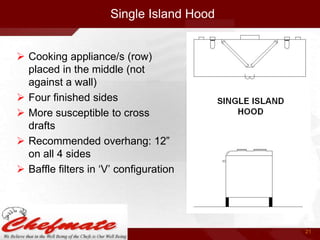
Single Island Hood
 Cooking appliance/s (row)
placed in the middle (not
against a wall)
 Four finished sides
 More susceptible to cross
drafts
 Recommended overhang: 12”
on all 4 sides
 Baffle filters in „V‟ configuration

21
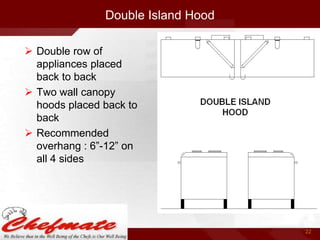
Double Island Hood
 Double row of
appliances placed
back to back
 Two wall canopy
hoods placed back to
back
 Recommended
overhang : 6”-12” on
all 4 sides

22
Basic Styles of Type II hoods

Oven Hoods
Condensate Hoods

23
Type II Hood – OVEN Hood
 Removal of Heat & Odour
 Canopy hood with no filters
 Hood size determined with oven door open

24
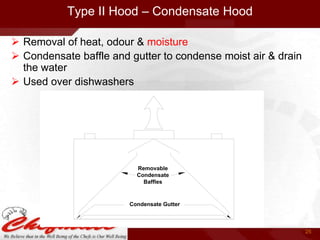
Type II Hood – Condensate Hood
 Removal of heat, odour & moisture
 Condensate baffle and gutter to condense moist air & drain
the water
 Used over dishwashers

Removable
Condensate
Baffles

Condensate Gutter

25
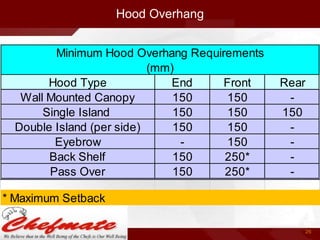
Hood Overhang
Minimum Hood Overhang Requirements
(mm)
Hood Type
End
Front
Wall Mounted Canopy
150
150
Single Island
150
150
Double Island (per side)
150
150
Eyebrow
150
Back Shelf
150
250*
Pass Over
150
250*

Rear
150
-

* Maximum Setback
26
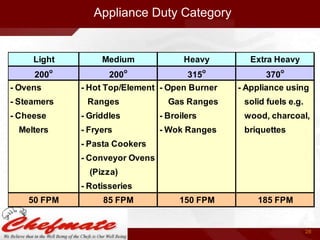
Exhaust Flow Rate
 Calculation of proper exhaust flow rate very
critical for effective operation of a KVS
 The upward velocity of the effluent thermal
currents is mainly a function of the
temperature of the cooking surface and
varies from 16 FPM over steam equipment to
160 FPM over charcoal broilers.
 Appliances categorized in 4 groups by
cooking duty

27
Appliance Duty Category

Light
200
- Ovens

o

- Steamers
- Cheese
Melters

Medium

Heavy

o

o

200
315
- Hot Top/Element - Open Burner
Ranges

Gas Ranges

Extra Heavy
o

370
- Appliance using
solid fuels e.g.

- Griddles

- Broilers

wood, charcoal,

- Fryers

- Wok Ranges

briquettes

- Pasta Cookers
- Conveyor Ovens
(Pizza)
- Rotisseries
50 FPM

85 FPM

150 FPM

185 FPM

28
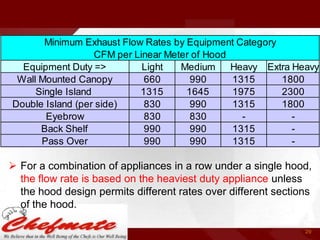
Minimum Exhaust Flow Rates by Equipment Category
CFM per Linear Meter of Hood
Equipment Duty =>
Light
Medium
Heavy Extra Heavy
Wall Mounted Canopy
660
990
1315
1800
Single Island
1315
1645
1975
2300
Double Island (per side)
830
990
1315
1800
Eyebrow
830
830
Back Shelf
990
990
1315
Pass Over
990
990
1315
-

 For a combination of appliances in a row under a single hood,
the flow rate is based on the heaviest duty appliance unless
the hood design permits different rates over different sections
of the hood.
29
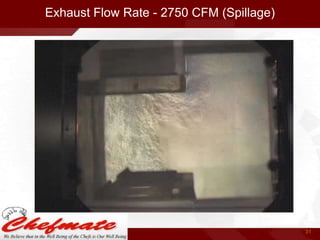
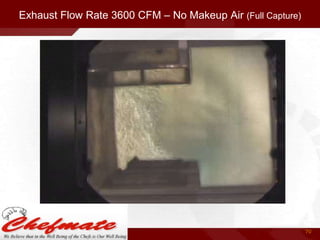
Schlieren Optical Imaging

 Shows an optical image of the heat and flow
pattern
 Very useful tool in kitchen ventilation
research

30
Exhaust Flow Rate - 2750 CFM (Spillage)

31
Exhaust Flow Rates- 3600 CFM (Full Capture)

32
Baffle Filter

 The primary device for grease removal
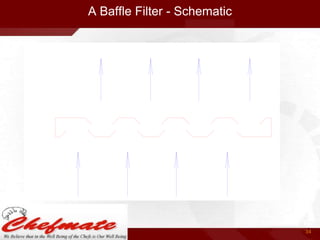
 Series of vertical baffles designed to capture
and drain the grease into a container
 Made of stainless steel or aluminium
 Air stream is made to rotate and centrifugal
force throws the heavier grease particles out
of the exhaust air stream.
 Filters are normally removable and are
cleaned by hot water.

33
A Baffle Filter - Schematic

34
Hood Pressure Drop

Pressure Drop across a Hood with Baffle Filters
A General Guide
Exhaust Flow Rate per Linear Meter
Ps
(CFM)
(mm)
530 - 850
6 - 12
850 - 1150
12 - 19
1150 - 1500
19 - 26
>1500
>26

35
More Effective Grease Removal
 Clean air considerations have led to the need
for higher efficiency (HE) grease extraction
systems.
 Mechanical filters (e.g. baffle) are not
effective in removing small grease particles or
grease in vapour form.
 More effective devices reduce grease buildup
downstream of the hood, lowering duct
cleaning frequency and improving fire safety.

36
Electrostatic Precipitators (ESPs)
 Used in the exhaust stream downstream of
the hood and the most common HE device.
 By high voltage ionization, particles are
collected on flat electrostatic plates.
 Efficiency may drop as the ionizer section
becomes dirty and effective surface area is
reduced.
 Under heavy loading condition, unit may shut
down because of voltage drop.

37
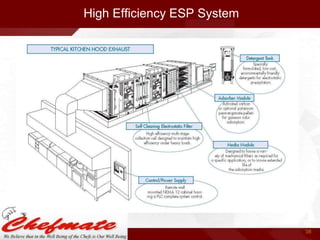
High Efficiency ESP System

38
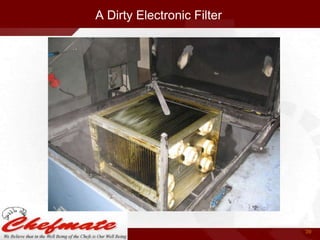
A Dirty Electronic Filter

39
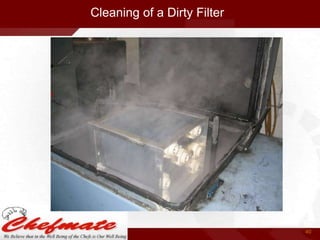
Cleaning of a Dirty Filter

40
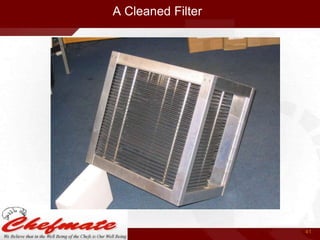
A Cleaned Filter

41
Ultra-Violet (UV) Destruction

 UV light chemically converts grease into an inert
substance.
 Adequate exposure time for chemical reaction is
required.
 High intensity UV lamps must be shielded from
eyes.
 Some forms of UV may generate ozone . It is
imperative to have the exhaust on while UV
lights are on.
 UV lamps need to be replaced periodically.

42
Water Mist Scrubber and Water Bath
 Passing the effluent through water entraps
particulates and condenses grease vapour
 Static pressure drops are high
 Grease laden water tends to clog drains.
 Water hardness a consideration in spray
nozzle system

43
Exhaust Duct Design
Kitchen exhaust ductwork carry hot grease laden air.
The following general guidelines should be followed in their design:
 Ducts can be Round or Rectangular
 Must be grease tight : should be free of traps that can hold
grease.
 Min. sheet gauge should be 16g steel or 18g ss.
 Horizontal dust runs should pitch towards the hood for
continuous drainage. The slope should be 2% for runs under 75‟.
For higher runs, refer to local codes.
 NFPA Standard F96 (US) sets minimum duct velocity of 7.5 m/s
(1500 FPM) for exhaust ducts.
 Maximum velocities are limited by pressure drop & noise and
normally do not exceed 12.5 m/s (2500 FPM).

44
Duct Design Considerations
 ASHRAE research finds no evidence to support the NFPA
minimum of 7.5 m/s, but recommends it be reduced to 2.5
m/s (500 FPM). This allows flexibility in design of variable
speed exhaust systems and retrofitting.
 For new single speed systems, a design velocity of 7.5
m/s (1500 FPM) is appropriate. Duct velocities above 2000
FPM cause noise and at less than 1000 FPM, ducts become
large and expensive.
 Straight GI ducts, at duct velocity of 1500 FPM, will have a
pressure loss of about 0.15 mm per meter length. This
pressure loss is proportional to square of duct velocity.
 The total pressure loss is the sum of the loss across the
hood, Y/T connections, bends, straight duct length &
convergent/divergent sections
45
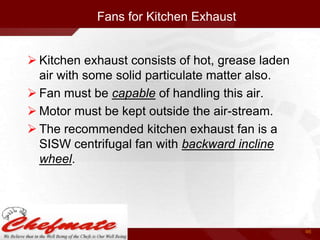
Fans for Kitchen Exhaust
 Kitchen exhaust consists of hot, grease laden
air with some solid particulate matter also.
 Fan must be capable of handling this air.
 Motor must be kept outside the air-stream.
 The recommended kitchen exhaust fan is a
SISW centrifugal fan with backward incline
wheel.

46
Condition of a FC Impeller used in Kitchen Exhaust

47
Advantages of Backward Inclined Fans
 Self cleaning properties
 Higher efficiency
 Limit load characteristics
 Can work without scroll housing
(Plug/Plenum Fan)

48
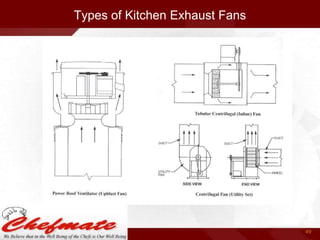
Types of Kitchen Exhaust Fans

49
Plug Type Kitchen Exhaust Fan

50
SISW BI Impeller

51
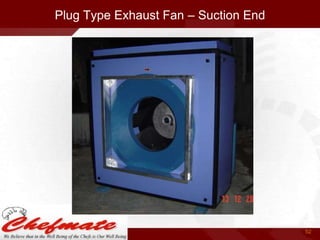
Plug Type Exhaust Fan – Suction End

52
Plug Type Exhaust Fan – Drive End

53
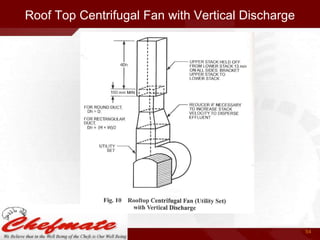
Roof Top Centrifugal Fan with Vertical Discharge

54
Terminations of Kitchen Exhaust Systems

 Roof Top
 Outside Wall

55
Roof Top Terminations

Preferred choice
 Fan at the end of termination
 Accessibility
 Discharge directed away from building
Precautions
 Discharge direction such to minimize re-entry into
fresh air intake. Knowledge of prevailing winds.
 Grease to be collected and drained to a closed
container : a fire safety precaution
 Rainwater to be kept out of the grease container

56
Outside Wall Termination
 Fan may or may not be at the terminal
 Precautions
- Discharge direction such to minimize reentry into fresh air intake.
- Away from combustibles
- Horizontal duct sections to pitch towards
the hood for grease collection
- Discharge not to be directed downward
or towards pedestrian areas.

57
Makeup Air Considerations
 Exhaust air volume must be replaced with
clean outside air.
 Negative pressure in the kitchen to prevent
odours migrating to outside. Not to exceed 5
Pa as per NFPA Standard 96. Excessive
negative pressure prevents proper drafting of
direct vent appliances.
 Proper design of make up air system ensures
hoods operate as per design.
 IAQ and thermal comfort are also important
considerations in designing a make up air
system.
58
IAQ : ASHRAE Standard 62
Outside Air per Person
(CFM)
1. Restaurant Dining Area
(max. 75 persons/100 sq.m)
2. Cafeteria/Fast Food Dining Area
(max. 108 persons/100 sq.m)
3. Bars/ Cocktail Lounges
(Max.108 persons/100 sq.m)
4. Kitchens
(Max. 22 persons/100 sq.m)

21
21
30
15

59
Replacement Air Categories
Makeup air for kitchen ventilation must integrate into
the total building fresh air system design
There are three sources of makeup air:
Supply Air : Outside air brought in by the HVAC system
dedicated to comfort conditioning of kitchen space.
Make up Air : Outside air brought in to provide
replacement air specifically for the hood. May or may not
be conditioned & is typically delivered close to the hood.
Transfer Air :Outside air brought into the kitchen but
introduced in the building by the HVAC system dedicated
to the space adjacent to the kitchen.

60
Replacement Air Distribution
 Design to eliminate high velocities, eddies, swirls & crossdrafts that can interfere with the natural vertical rising of the
effluent plume.
 Deliver replacement air to the hood
- At proper velocity
- Uniformly from all directions
 For conditioned air, non-directional perforated ceiling diffusers
are the best option. They can distribute large mount of air
throughout the kitchen at low discharge velocities.
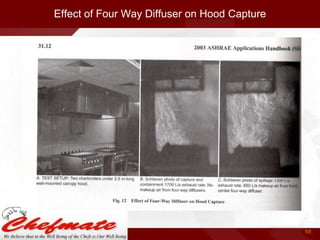
 Four-way ceiling diffusers near the hood are not
recommended.

61
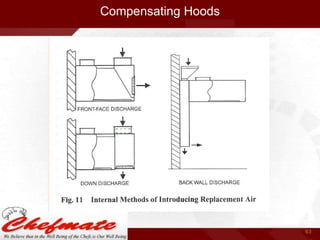
Compensating Hoods
Hoods with built in (integral) replacement air supply

 Air Curtain (Down Discharge)
 Back Wall Discharge
 Front Face Discharge
 External Supply Plenum
 Combination of above

62
Compensating Hoods

63
Air Curtain (Down Discharge)





Used for spot cooling of cooking staff
Along the perimeter of the hood (front and/or side)
Uses conditioned air
Can be used to keep un-conditioned air close to the hood at
the cost of comfort.
 Replacement air supply – 10% to 50%
 Discharge velocity a critical factor affecting hood
performance – at too low a value, air enters the hood
directly & at too high a value, it will entrain the exhaust
plume and spill it in the room.
 Recommended design supply rate is 65 cfm per foot. Max.
can be 125 cfm/ft. under ideal conditions.
64
Back Wall Discharge

 Makeup air plenum between back wall and hood (about 6”
deep).
 Extends about 6” below cooking surface.
 Runs along the entire length of the hood.
 Very effective way of supplying un-conditioned make-up air
near the hood.
 Recommended design supply rate @ 150 cfm/ft, although
max. can be up to 250 cfm/ft.

65
Front Face Discharge

 To throw supply air across the room.
 Used to supply conditioned air in a conditioned kitchen or
conversely for non-conditioned air into a non-conditioned
kitchen.
 Replacement air supply – 40% to 80%.
 Not recommended for conditioned hot air in cold climates.
 Face velocity at discharge should be less than 150 fpm.
 Recommended design rate @150 cfm/ft. Max. can be 250
cfm/ft.

66
External Supply Plenum
 Plenum mounted at the ceiling
or the top front edge of the
hood along its full length.
 Supplies air close to the hood.
 Can be used for conditioned or
un-conditioned air.
 Advantages over air curtain
hood – permits higher
discharge velocity.
 Max. supply rate can be 180
cfm/ft. Recommended rate 110
cfm/ft.
67
Effect of Four Way Diffuser on Hood Capture

68
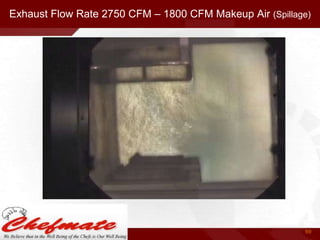
Exhaust Flow Rate 2750 CFM – 1800 CFM Makeup Air (Spillage)

69
Exhaust Flow Rate 3600 CFM – No Makeup Air (Full Capture)

70
Makeup Air – Conditioned or Unconditioned?

 If the objective is comfort, use conditioned air.
 If the objective is low cost, use un-conditioned
air.
 Both can be used, provided their distribution
is designed to minimize cost, maximize
comfort and optimize hood performance.

71
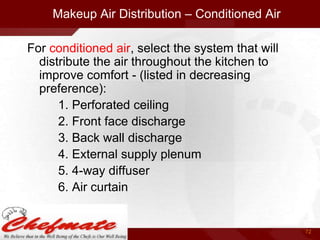
Makeup Air Distribution – Conditioned Air
For conditioned air, select the system that will
distribute the air throughout the kitchen to
improve comfort - (listed in decreasing
preference):
1. Perforated ceiling
2. Front face discharge
3. Back wall discharge
4. External supply plenum
5. 4-way diffuser
6. Air curtain

72
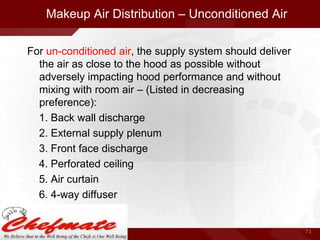
Makeup Air Distribution – Unconditioned Air
For un-conditioned air, the supply system should deliver
the air as close to the hood as possible without
adversely impacting hood performance and without
mixing with room air – (Listed in decreasing
preference):
1. Back wall discharge
2. External supply plenum
3. Front face discharge
4. Perforated ceiling
5. Air curtain
6. 4-way diffuser

73
Integration and Balance
 Supply air system must integrate & balance with the
exhaust system
 Balancing using controls and flow adjustments
optimizes system performance
 Every kitchen should be slightly negatively
pressurized compared to surrounding area to contain
the grease vapors, odors and hotter kitchen air within
the kitchen
 In a stand alone restaurant, the overall building
should be at slightly positive pressure compared to
outside to prevent infiltration of heat, dirt, dust and
insects.

74
Thank You

75

Kitchen Exhaust India

  • 1.
    Kitchen Ventilation Revac Systems 83,PadmaNagar Phase II Chintal Hyderabad 500054 Mobile No +91- 9246 377 652 1
  • 2.
    Buildings with Kitchens Hotels  Restaurants  Hospitals  Canteens  Retail Malls  Residences  Jails 2
  • 3.
    System Design forKitchens  Air Conditioning  Ventilation  Fire Safety  Building Pressurization  Refrigeration  Air Distribution  Food Service Equipment 3
  • 4.
    Basic Purpose ofKitchen Ventilation  To provide a comfortable environment in the kitchen  To ensure the safety of the people working in the kitchen and other building occupants by: -Effective Removal of Effluents which may include gaseous, liquid and solid contaminants produced by the cooking process and products of fuel & food combustion. Effluents can be life threatening and flammable 4
  • 5.
    Effluent Generation inKitchens  Heat is a primary ingredient of kitchen effluents  50% to 90% of the appliance energy input is released in the form of a rising thermal plume (convective). Balance is released into surrounding space through radiation.  This plume also contains most of the food and fuel generated effluents. 5
  • 6.
     Primary objectiveof kitchen ventilation is to capture and remove the air and effluents that constitute the plume through an effective exhaust system.  Heat radiated into space form the appliance must be addressed by the space airconditioning system. 6
  • 7.
  • 8.
    Typical Kitchen ExhaustSystem 600x600 5600 CFM 1500 FPM VCD VCD 600x400 600x400 HOOD (8'x4'6") with Baffle Filter Velocity Across Hood - 150 FPM ESP ESP TRION Air Cleaner Model T2002 Velocity Across Air Cleaner 450 FPM Centrifugal Fan (Exhaust) 6000 CFM 60mm SP 5hp motor Kitchen Exhaust System Schematic Diagram 8
  • 9.
    Grease Emissions  Amountof grease in vapour phase varies from 30 to 90% by mass. This is an important factor in designing the grease removal system.  CO, CO2 and NOx emissions are present in gas and not electrical appliances. 9
  • 10.
  • 11.
    Behavior of HotEffluent Plume  In the absence of cross-drafts, a heated plume rises vertically, entraining the ambient air which enlarges the plume, cools it and slows it down.  An Exhaust Hood, generally located above the appliance, guides this plume into a ducted exhaust system.  The exhaust system flow rate must be slightly higher than the plume volume rate. Extra exhaust capacity may be required to resist cross-drafts.  The concept of capture velocity is not applicable to kitchen exhaust if a hood of sufficient size is placed at the correct height.  If the appliance and hood are placed against a backwall, the plume is drawn towards the wall by the “Coanda effect”. 11
  • 12.
  • 13.
    An Exhaust Hood The Centre Piece of any Kitchen Ventilation System (KVS)  Not just a sheet metal box but a critical component of a well engineered system  Much greater awareness today about the need for an effective KVS  Issues are health, safety, efficiency and energy savings 13
  • 14.
  • 15.
    Exhaust Hoods  TypeI – for removing grease & smoke : used for cooking appliances  Type II – for steam, vapour, heat & odour when grease is not present : used for dishwashers, steam tables, etc. 15
  • 16.
    Basic Styles ofType I Hoods  Wall Mounted Canopy  Single Island  Double Island  Back Shelf or Proximity  Pass Over  Eyebrow 16
  • 17.
  • 18.
    Wall Mounted CanopyHood (With Baffle Filter) 18
  • 19.
    Schematic of anExhaust Hood EXHAUST CHAMBER EXHAUST HOOD LIGHT BAFFLE FILTER GREASE TROUGH Hanging Brackets 19
  • 20.
    Wall Canopy Hood Cooking appliance placed against a wall  Minimum air flow requirement  3” built in gap between hood & wall  Three finished sides  Less susceptible to cross drafts  Minimum overhang requirement: 6” on sides and 6”-12” in front for full capture 20
  • 21.
    Single Island Hood Cooking appliance/s (row) placed in the middle (not against a wall)  Four finished sides  More susceptible to cross drafts  Recommended overhang: 12” on all 4 sides  Baffle filters in „V‟ configuration 21
  • 22.
    Double Island Hood Double row of appliances placed back to back  Two wall canopy hoods placed back to back  Recommended overhang : 6”-12” on all 4 sides 22
  • 23.
    Basic Styles ofType II hoods Oven Hoods Condensate Hoods 23
  • 24.
    Type II Hood– OVEN Hood  Removal of Heat & Odour  Canopy hood with no filters  Hood size determined with oven door open 24
  • 25.
    Type II Hood– Condensate Hood  Removal of heat, odour & moisture  Condensate baffle and gutter to condense moist air & drain the water  Used over dishwashers Removable Condensate Baffles Condensate Gutter 25
  • 26.
    Hood Overhang Minimum HoodOverhang Requirements (mm) Hood Type End Front Wall Mounted Canopy 150 150 Single Island 150 150 Double Island (per side) 150 150 Eyebrow 150 Back Shelf 150 250* Pass Over 150 250* Rear 150 - * Maximum Setback 26
  • 27.
    Exhaust Flow Rate Calculation of proper exhaust flow rate very critical for effective operation of a KVS  The upward velocity of the effluent thermal currents is mainly a function of the temperature of the cooking surface and varies from 16 FPM over steam equipment to 160 FPM over charcoal broilers.  Appliances categorized in 4 groups by cooking duty 27
  • 28.
    Appliance Duty Category Light 200 -Ovens o - Steamers - Cheese Melters Medium Heavy o o 200 315 - Hot Top/Element - Open Burner Ranges Gas Ranges Extra Heavy o 370 - Appliance using solid fuels e.g. - Griddles - Broilers wood, charcoal, - Fryers - Wok Ranges briquettes - Pasta Cookers - Conveyor Ovens (Pizza) - Rotisseries 50 FPM 85 FPM 150 FPM 185 FPM 28
  • 29.
    Minimum Exhaust FlowRates by Equipment Category CFM per Linear Meter of Hood Equipment Duty => Light Medium Heavy Extra Heavy Wall Mounted Canopy 660 990 1315 1800 Single Island 1315 1645 1975 2300 Double Island (per side) 830 990 1315 1800 Eyebrow 830 830 Back Shelf 990 990 1315 Pass Over 990 990 1315 -  For a combination of appliances in a row under a single hood, the flow rate is based on the heaviest duty appliance unless the hood design permits different rates over different sections of the hood. 29
  • 30.
    Schlieren Optical Imaging Shows an optical image of the heat and flow pattern  Very useful tool in kitchen ventilation research 30
  • 31.
    Exhaust Flow Rate- 2750 CFM (Spillage) 31
  • 32.
    Exhaust Flow Rates-3600 CFM (Full Capture) 32
  • 33.
    Baffle Filter  Theprimary device for grease removal  Series of vertical baffles designed to capture and drain the grease into a container  Made of stainless steel or aluminium  Air stream is made to rotate and centrifugal force throws the heavier grease particles out of the exhaust air stream.  Filters are normally removable and are cleaned by hot water. 33
  • 34.
    A Baffle Filter- Schematic 34
  • 35.
    Hood Pressure Drop PressureDrop across a Hood with Baffle Filters A General Guide Exhaust Flow Rate per Linear Meter Ps (CFM) (mm) 530 - 850 6 - 12 850 - 1150 12 - 19 1150 - 1500 19 - 26 >1500 >26 35
  • 36.
    More Effective GreaseRemoval  Clean air considerations have led to the need for higher efficiency (HE) grease extraction systems.  Mechanical filters (e.g. baffle) are not effective in removing small grease particles or grease in vapour form.  More effective devices reduce grease buildup downstream of the hood, lowering duct cleaning frequency and improving fire safety. 36
  • 37.
    Electrostatic Precipitators (ESPs) Used in the exhaust stream downstream of the hood and the most common HE device.  By high voltage ionization, particles are collected on flat electrostatic plates.  Efficiency may drop as the ionizer section becomes dirty and effective surface area is reduced.  Under heavy loading condition, unit may shut down because of voltage drop. 37
  • 38.
  • 39.
  • 40.
    Cleaning of aDirty Filter 40
  • 41.
  • 42.
    Ultra-Violet (UV) Destruction UV light chemically converts grease into an inert substance.  Adequate exposure time for chemical reaction is required.  High intensity UV lamps must be shielded from eyes.  Some forms of UV may generate ozone . It is imperative to have the exhaust on while UV lights are on.  UV lamps need to be replaced periodically. 42
  • 43.
    Water Mist Scrubberand Water Bath  Passing the effluent through water entraps particulates and condenses grease vapour  Static pressure drops are high  Grease laden water tends to clog drains.  Water hardness a consideration in spray nozzle system 43
  • 44.
    Exhaust Duct Design Kitchenexhaust ductwork carry hot grease laden air. The following general guidelines should be followed in their design:  Ducts can be Round or Rectangular  Must be grease tight : should be free of traps that can hold grease.  Min. sheet gauge should be 16g steel or 18g ss.  Horizontal dust runs should pitch towards the hood for continuous drainage. The slope should be 2% for runs under 75‟. For higher runs, refer to local codes.  NFPA Standard F96 (US) sets minimum duct velocity of 7.5 m/s (1500 FPM) for exhaust ducts.  Maximum velocities are limited by pressure drop & noise and normally do not exceed 12.5 m/s (2500 FPM). 44
  • 45.
    Duct Design Considerations ASHRAE research finds no evidence to support the NFPA minimum of 7.5 m/s, but recommends it be reduced to 2.5 m/s (500 FPM). This allows flexibility in design of variable speed exhaust systems and retrofitting.  For new single speed systems, a design velocity of 7.5 m/s (1500 FPM) is appropriate. Duct velocities above 2000 FPM cause noise and at less than 1000 FPM, ducts become large and expensive.  Straight GI ducts, at duct velocity of 1500 FPM, will have a pressure loss of about 0.15 mm per meter length. This pressure loss is proportional to square of duct velocity.  The total pressure loss is the sum of the loss across the hood, Y/T connections, bends, straight duct length & convergent/divergent sections 45
  • 46.
    Fans for KitchenExhaust  Kitchen exhaust consists of hot, grease laden air with some solid particulate matter also.  Fan must be capable of handling this air.  Motor must be kept outside the air-stream.  The recommended kitchen exhaust fan is a SISW centrifugal fan with backward incline wheel. 46
  • 47.
    Condition of aFC Impeller used in Kitchen Exhaust 47
  • 48.
    Advantages of BackwardInclined Fans  Self cleaning properties  Higher efficiency  Limit load characteristics  Can work without scroll housing (Plug/Plenum Fan) 48
  • 49.
    Types of KitchenExhaust Fans 49
  • 50.
    Plug Type KitchenExhaust Fan 50
  • 51.
  • 52.
    Plug Type ExhaustFan – Suction End 52
  • 53.
    Plug Type ExhaustFan – Drive End 53
  • 54.
    Roof Top CentrifugalFan with Vertical Discharge 54
  • 55.
    Terminations of KitchenExhaust Systems  Roof Top  Outside Wall 55
  • 56.
    Roof Top Terminations Preferredchoice  Fan at the end of termination  Accessibility  Discharge directed away from building Precautions  Discharge direction such to minimize re-entry into fresh air intake. Knowledge of prevailing winds.  Grease to be collected and drained to a closed container : a fire safety precaution  Rainwater to be kept out of the grease container 56
  • 57.
    Outside Wall Termination Fan may or may not be at the terminal  Precautions - Discharge direction such to minimize reentry into fresh air intake. - Away from combustibles - Horizontal duct sections to pitch towards the hood for grease collection - Discharge not to be directed downward or towards pedestrian areas. 57
  • 58.
    Makeup Air Considerations Exhaust air volume must be replaced with clean outside air.  Negative pressure in the kitchen to prevent odours migrating to outside. Not to exceed 5 Pa as per NFPA Standard 96. Excessive negative pressure prevents proper drafting of direct vent appliances.  Proper design of make up air system ensures hoods operate as per design.  IAQ and thermal comfort are also important considerations in designing a make up air system. 58
  • 59.
    IAQ : ASHRAEStandard 62 Outside Air per Person (CFM) 1. Restaurant Dining Area (max. 75 persons/100 sq.m) 2. Cafeteria/Fast Food Dining Area (max. 108 persons/100 sq.m) 3. Bars/ Cocktail Lounges (Max.108 persons/100 sq.m) 4. Kitchens (Max. 22 persons/100 sq.m) 21 21 30 15 59
  • 60.
    Replacement Air Categories Makeupair for kitchen ventilation must integrate into the total building fresh air system design There are three sources of makeup air: Supply Air : Outside air brought in by the HVAC system dedicated to comfort conditioning of kitchen space. Make up Air : Outside air brought in to provide replacement air specifically for the hood. May or may not be conditioned & is typically delivered close to the hood. Transfer Air :Outside air brought into the kitchen but introduced in the building by the HVAC system dedicated to the space adjacent to the kitchen. 60
  • 61.
    Replacement Air Distribution Design to eliminate high velocities, eddies, swirls & crossdrafts that can interfere with the natural vertical rising of the effluent plume.  Deliver replacement air to the hood - At proper velocity - Uniformly from all directions  For conditioned air, non-directional perforated ceiling diffusers are the best option. They can distribute large mount of air throughout the kitchen at low discharge velocities.  Four-way ceiling diffusers near the hood are not recommended. 61
  • 62.
    Compensating Hoods Hoods withbuilt in (integral) replacement air supply  Air Curtain (Down Discharge)  Back Wall Discharge  Front Face Discharge  External Supply Plenum  Combination of above 62
  • 63.
  • 64.
    Air Curtain (DownDischarge)     Used for spot cooling of cooking staff Along the perimeter of the hood (front and/or side) Uses conditioned air Can be used to keep un-conditioned air close to the hood at the cost of comfort.  Replacement air supply – 10% to 50%  Discharge velocity a critical factor affecting hood performance – at too low a value, air enters the hood directly & at too high a value, it will entrain the exhaust plume and spill it in the room.  Recommended design supply rate is 65 cfm per foot. Max. can be 125 cfm/ft. under ideal conditions. 64
  • 65.
    Back Wall Discharge Makeup air plenum between back wall and hood (about 6” deep).  Extends about 6” below cooking surface.  Runs along the entire length of the hood.  Very effective way of supplying un-conditioned make-up air near the hood.  Recommended design supply rate @ 150 cfm/ft, although max. can be up to 250 cfm/ft. 65
  • 66.
    Front Face Discharge To throw supply air across the room.  Used to supply conditioned air in a conditioned kitchen or conversely for non-conditioned air into a non-conditioned kitchen.  Replacement air supply – 40% to 80%.  Not recommended for conditioned hot air in cold climates.  Face velocity at discharge should be less than 150 fpm.  Recommended design rate @150 cfm/ft. Max. can be 250 cfm/ft. 66
  • 67.
    External Supply Plenum Plenum mounted at the ceiling or the top front edge of the hood along its full length.  Supplies air close to the hood.  Can be used for conditioned or un-conditioned air.  Advantages over air curtain hood – permits higher discharge velocity.  Max. supply rate can be 180 cfm/ft. Recommended rate 110 cfm/ft. 67
  • 68.
    Effect of FourWay Diffuser on Hood Capture 68
  • 69.
    Exhaust Flow Rate2750 CFM – 1800 CFM Makeup Air (Spillage) 69
  • 70.
    Exhaust Flow Rate3600 CFM – No Makeup Air (Full Capture) 70
  • 71.
    Makeup Air –Conditioned or Unconditioned?  If the objective is comfort, use conditioned air.  If the objective is low cost, use un-conditioned air.  Both can be used, provided their distribution is designed to minimize cost, maximize comfort and optimize hood performance. 71
  • 72.
    Makeup Air Distribution– Conditioned Air For conditioned air, select the system that will distribute the air throughout the kitchen to improve comfort - (listed in decreasing preference): 1. Perforated ceiling 2. Front face discharge 3. Back wall discharge 4. External supply plenum 5. 4-way diffuser 6. Air curtain 72
  • 73.
    Makeup Air Distribution– Unconditioned Air For un-conditioned air, the supply system should deliver the air as close to the hood as possible without adversely impacting hood performance and without mixing with room air – (Listed in decreasing preference): 1. Back wall discharge 2. External supply plenum 3. Front face discharge 4. Perforated ceiling 5. Air curtain 6. 4-way diffuser 73
  • 74.
    Integration and Balance Supply air system must integrate & balance with the exhaust system  Balancing using controls and flow adjustments optimizes system performance  Every kitchen should be slightly negatively pressurized compared to surrounding area to contain the grease vapors, odors and hotter kitchen air within the kitchen  In a stand alone restaurant, the overall building should be at slightly positive pressure compared to outside to prevent infiltration of heat, dirt, dust and insects. 74
  • 75.