CHILLED BEAM
GUIDED BY:
Ms. Meera G Mohan
Assistant Professor(Civil)
SBCE
PRESENTED BY:
Neelima Suresh J
Roll No : 39
1
OVERVIEW
 Introduction
 Literature review
 Components of chilled beam
 Types of chilled beam
 Advantages of chilled beam
 Disadvantages of chilled beam
 Case study 1
 Case study 2
 Conclusion
2
INTRODUCTION
 A chilled beam is a type of convection HVAC system
designed to heat or cool large buildings
 Developed in Norway in 1975
 Emerging technology in the U.S. as an alternative to
conventional systems such as VAV
 Primarily used in locations where the humidity can be
controlled
3
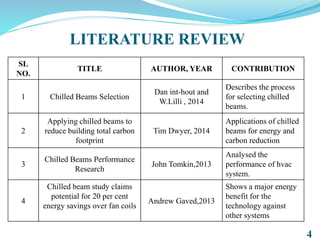
LITERATURE REVIEW
SL
NO.
TITLE AUTHOR, YEAR CONTRIBUTION
1 Chilled Beams Selection
Dan int-hout and
W.Lilli , 2014
Describes the process
for selecting chilled
beams.
2
Applying chilled beams to
reduce building total carbon
footprint
Tim Dwyer, 2014
Applications of chilled
beams for energy and
carbon reduction
3
Chilled Beams Performance
Research
John Tomkin,2013
Analysed the
performance of hvac
system.
4
Chilled beam study claims
potential for 20 per cent
energy savings over fan coils
Andrew Gaved,2013
Shows a major energy
benefit for the
technology against
other systems
4
COMPONENTS OF CHILLED BEAM
1) Air handling units
 Major component within any chilled beam or chilled ceiling
system
 Role - to clean and condition the air as it enters the building
 Distribute it through the terminal devices
5
2) Mixing boxes
 Dampers are used in mixing boxes to regulate the mixture
of fresh air and re-circulated air
3) Coils
 Heat exchangers designed to transfer the energy from a
medium (usually water) to the air
 Individual coils for heating and cooling
6
COMPONENTS OF CHILLED BEAM
(contd..)
TYPES OF CHILLED BEAMS
 Active chilled beams
 Passive chilled beams
 Multi purpose chilled beams
7
ACTIVE CHILLED BEAMS
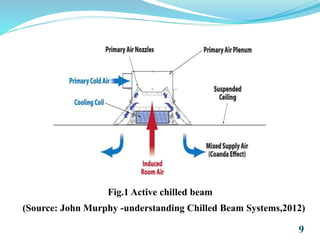
 Have ductwork supplied to them
 Through duct work specific amount of primary air is
provided to the pressurized plenum within the device
 The air is discharged through induction nozzles
 Mix with entrained air, and ventilate the room
8
9
Fig.1 Active chilled beam
(Source: John Murphy -understanding Chilled Beam Systems,2012)
OPERATION OF ACTIVE CHILLED
BEAM
 Fresh air from the air handler via duct work is supplied
into the pressure chamber
 Pressure in the chamber causes the air to rush out
through the nozzles at a high velocity into the mixing
chamber
 Due to nature of the nozzles, a low pressure system is
created above the coil
10
 Inducing more air through the coil into the mixing
chamber
 Conditioned air from the space mixes with the fresh air
 Supplied back into the room through linear slots located
along the casing of the beam
 The air gets supplied back to the space through the
linear slots at a higher velocity and at its coldest state
11
OPERATION OF ACTIVE CHILLED
BEAM (contd…)
12
Fig .2. Gordon House renovated using chilled beam
(Source: claremoorearchitect.blogspot)
PASSIVE CHILLED BEAMS
 Chilled beams work using natural convection
 Good air circulation is essential for the operation of
passive chilled beams
 Good solution to provide sensible cooling in labs or
other spaces where processes generate high heat
13
14
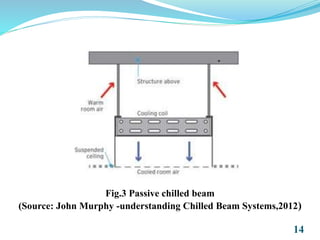
Fig.3 Passive chilled beam
(Source: John Murphy -understanding Chilled Beam Systems,2012)
OPERATION OF PASSIVE CHILLED
BEAM
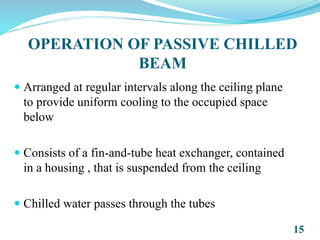
 Arranged at regular intervals along the ceiling plane
to provide uniform cooling to the occupied space
below
 Consists of a fin-and-tube heat exchanger, contained
in a housing , that is suspended from the ceiling
 Chilled water passes through the tubes
15
 Warm air from the space rises toward the ceiling
 The air surrounding the chilled beam is cooled
 It descend back toward the floor
 This allows a passive chilled beam to provide space
cooling without the use of a fan
16
OPERATION OF PASSIVE CHILLED
BEAM (contd…)
Fig .4 Peabody Hall renovated with passive chilled beam
(Source: Chilled beams maintain comfort, look of historic hall-
SEMCO)
17
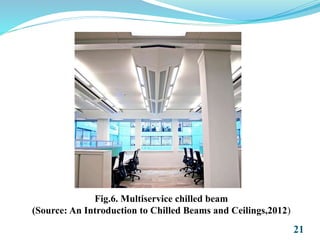
MULTI-SERVICE CHILLED BEAMS
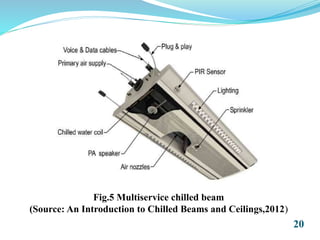
 Comes in both passive and active types
 Incorporate other building systems into the beam in a
prefabricated unit
 This prefabricated unit can be brought to the project site
 Reduces the amount of time required to install all the
building systems
18
MULTI-SERVICE CHILLED BEAMS
(Contd…)
 Light fixtures and controls, speakers, occupancy sensors,
smoke detectors, and even fire sprinklers can be incorporated
into the beam
 The site delivery can be regulated to site requirements
 Reduces the total amount of space required for onsite storage
 Enables rapid installation and services connections with a
major saving in onsite time
19
20
Fig.5 Multiservice chilled beam
(Source: An Introduction to Chilled Beams and Ceilings,2012)
21
Fig.6. Multiservice chilled beam
(Source: An Introduction to Chilled Beams and Ceilings,2012)
ADVANTAGES OF CHILLED BEAM
 Quieter than air based HVAC systems due to the lack of
moving parts and slower air velocities
 Maintenance is also reduced due to the lack of moving
parts
 High indoor air quality resulting from air recirculated
within the zone versus mixed air from other zones
 Lower energy consumption
22
 Space savings resulting from reduced ductwork size
 This air conditioning unit provides excellent thermal
comfort with good energy efficiency
 Lower operation costs throughout the lifecycle of the
building
23
ADVANTAGES OF CHILLED BEAM
(Contd…)
DISADVANTAGES OF CHILLED BEAM
 Initial cost of chilled beams is typically higher than
when compared to other all air systems
 Chilled beams require more ceiling area than diffusers
of a conventional system
24
CASE STUDY 1
RENOVATION OF AN INDUCTION SYSTEM
WITH ACTIVE CHILLED BEAMS
25
CASE STUDY 1(contd…)
 250 S. Wacker in Chicago is a multi-tenant 15 story
office tower
 The first and top floors had dedicated HVAC systems
separate from the system serving the 2nd through 14th
floors
 These intermediate floors had a floor-mounted induction
perimeter system and a constant volume-variable
temperature interior system
26
CASE STUDY 1(contd…)
 The existing induction units and enclosures would have
to be replaced as they were at the end of their useful life
27
Fig.7. 250 S. Wacker chicago
(Source: Renovation of an induction system with active chilled beams,
air/pro associates)
28
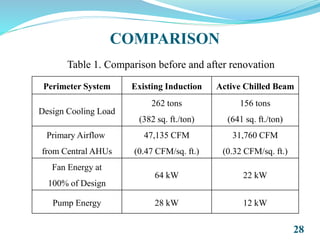
COMPARISON
Perimeter System Existing Induction Active Chilled Beam
Design Cooling Load
262 tons
(382 sq. ft./ton)
156 tons
(641 sq. ft./ton)
Primary Airflow
from Central AHUs
47,135 CFM
(0.47 CFM/sq. ft.)
31,760 CFM
(0.32 CFM/sq. ft.)
Fan Energy at
100% of Design
64 kW 22 kW
Pump Energy 28 kW 12 kW
Table 1. Comparison before and after renovation
CASE STUDY 2
UC DAVIS SEGUNDO STUDENT SERVICES
CENTER
29
CASE STUDY 2(contd…)
 It is a new 34,500 square foot community center/
administrative center
 Located within the Segundo Precinct of the University of
California – Davis campus
30
CASE STUDY 2(contd…)
ENERGY EFFICIENCY
 The project was able to achieve 42.3% energy savings
 Heat recovery and direct evaporative cooling systems
on the main air handling unit
 Chilled beam-VAV system: AHU was used to provide
primary air to the chilled beams for the perimeter
spaces
31
CASE STUDY 2(contd…)
ENERGY EFFICIENCY (contd…)
 Demand control ventilation strategy which was possible
by having a VAV box upstream of the chilled beams
 High performance glazing systems with integrated
shading systems
 Thermally broken insulating wall system
32
CASE STUDY 2(contd…)
 INDOOR AIR QUALITY
 The chilled beam system operates close to the outdoor air
requirements for occupancy
 This allowed the design to be based on 100% outside air
 The internal spaces had their cooling airflows close to the
outdoor air requirement which allowed them to be fed from
the same unit
33
CASE STUDY 2(contd…)
 COST EFFECTIVENESS
 The energy efficiency measures and innovative systems
selected proved to be very cost effective
 ENVIRONMENTAL IMPACT
 The Segundo Service Center was able to reduce invasive
piping and energy consumption
34
CASE STUDY 2(contd…)
 ENVIRONMENTAL IMPACT (contd..)
 The building was able to achieve an annual CO2
reduction of 241.8 metric tons
35
36
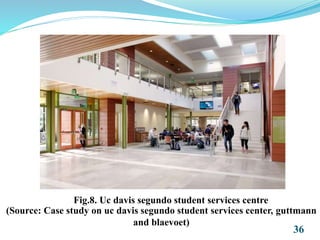
Fig.8. Uc davis segundo student services centre
(Source: Case study on uc davis segundo student services center, guttmann
and blaevoet)
CONCLUSION
 Chilled beams remove large amounts of sensible heat
 Active chilled beam reduces primary air flow requirement
 The lifecycle cost of chilled beam system is lower than in
other cooling systems
 The energy consumption of beam system is low
 The chilled beam system reduces carbon dioxide emission
to a greater extent
37
REFERENCES
 Chilled Beam System Market by Design (Active, Passive, &
Multi-Service) worth $406.8 Million by 2020, digital journal,
June 2015.
 Dan int-hout and W.Lilli , Chilled Beams Selection, ASHRAE
Journal, November 2014, Vol. 56 Issue 11, page58.
 Chilled Beams Performance Research- Ceiling the Deal, CIBSE
Journal, November 2013, page 21.
 CBCA article on An Introduction to Chilled Beams and
Ceilings, RAC Journal February2013, page 16.
 Chilled beam study claims potential for 20% energy savings
over fan coils - RAC Journal, Augest2013
38
39

CHILLED BEAM

  • 1.
    CHILLED BEAM GUIDED BY: Ms.Meera G Mohan Assistant Professor(Civil) SBCE PRESENTED BY: Neelima Suresh J Roll No : 39 1
  • 2.
    OVERVIEW  Introduction  Literaturereview  Components of chilled beam  Types of chilled beam  Advantages of chilled beam  Disadvantages of chilled beam  Case study 1  Case study 2  Conclusion 2
  • 3.
    INTRODUCTION  A chilledbeam is a type of convection HVAC system designed to heat or cool large buildings  Developed in Norway in 1975  Emerging technology in the U.S. as an alternative to conventional systems such as VAV  Primarily used in locations where the humidity can be controlled 3
  • 4.
    LITERATURE REVIEW SL NO. TITLE AUTHOR,YEAR CONTRIBUTION 1 Chilled Beams Selection Dan int-hout and W.Lilli , 2014 Describes the process for selecting chilled beams. 2 Applying chilled beams to reduce building total carbon footprint Tim Dwyer, 2014 Applications of chilled beams for energy and carbon reduction 3 Chilled Beams Performance Research John Tomkin,2013 Analysed the performance of hvac system. 4 Chilled beam study claims potential for 20 per cent energy savings over fan coils Andrew Gaved,2013 Shows a major energy benefit for the technology against other systems 4
  • 5.
    COMPONENTS OF CHILLEDBEAM 1) Air handling units  Major component within any chilled beam or chilled ceiling system  Role - to clean and condition the air as it enters the building  Distribute it through the terminal devices 5
  • 6.
    2) Mixing boxes Dampers are used in mixing boxes to regulate the mixture of fresh air and re-circulated air 3) Coils  Heat exchangers designed to transfer the energy from a medium (usually water) to the air  Individual coils for heating and cooling 6 COMPONENTS OF CHILLED BEAM (contd..)
  • 7.
    TYPES OF CHILLEDBEAMS  Active chilled beams  Passive chilled beams  Multi purpose chilled beams 7
  • 8.
    ACTIVE CHILLED BEAMS Have ductwork supplied to them  Through duct work specific amount of primary air is provided to the pressurized plenum within the device  The air is discharged through induction nozzles  Mix with entrained air, and ventilate the room 8
  • 9.
    9 Fig.1 Active chilledbeam (Source: John Murphy -understanding Chilled Beam Systems,2012)
  • 10.
    OPERATION OF ACTIVECHILLED BEAM  Fresh air from the air handler via duct work is supplied into the pressure chamber  Pressure in the chamber causes the air to rush out through the nozzles at a high velocity into the mixing chamber  Due to nature of the nozzles, a low pressure system is created above the coil 10
  • 11.
     Inducing moreair through the coil into the mixing chamber  Conditioned air from the space mixes with the fresh air  Supplied back into the room through linear slots located along the casing of the beam  The air gets supplied back to the space through the linear slots at a higher velocity and at its coldest state 11 OPERATION OF ACTIVE CHILLED BEAM (contd…)
  • 12.
    12 Fig .2. GordonHouse renovated using chilled beam (Source: claremoorearchitect.blogspot)
  • 13.
    PASSIVE CHILLED BEAMS Chilled beams work using natural convection  Good air circulation is essential for the operation of passive chilled beams  Good solution to provide sensible cooling in labs or other spaces where processes generate high heat 13
  • 14.
    14 Fig.3 Passive chilledbeam (Source: John Murphy -understanding Chilled Beam Systems,2012)
  • 15.
    OPERATION OF PASSIVECHILLED BEAM  Arranged at regular intervals along the ceiling plane to provide uniform cooling to the occupied space below  Consists of a fin-and-tube heat exchanger, contained in a housing , that is suspended from the ceiling  Chilled water passes through the tubes 15
  • 16.
     Warm airfrom the space rises toward the ceiling  The air surrounding the chilled beam is cooled  It descend back toward the floor  This allows a passive chilled beam to provide space cooling without the use of a fan 16 OPERATION OF PASSIVE CHILLED BEAM (contd…)
  • 17.
    Fig .4 PeabodyHall renovated with passive chilled beam (Source: Chilled beams maintain comfort, look of historic hall- SEMCO) 17
  • 18.
    MULTI-SERVICE CHILLED BEAMS Comes in both passive and active types  Incorporate other building systems into the beam in a prefabricated unit  This prefabricated unit can be brought to the project site  Reduces the amount of time required to install all the building systems 18
  • 19.
    MULTI-SERVICE CHILLED BEAMS (Contd…) Light fixtures and controls, speakers, occupancy sensors, smoke detectors, and even fire sprinklers can be incorporated into the beam  The site delivery can be regulated to site requirements  Reduces the total amount of space required for onsite storage  Enables rapid installation and services connections with a major saving in onsite time 19
  • 20.
    20 Fig.5 Multiservice chilledbeam (Source: An Introduction to Chilled Beams and Ceilings,2012)
  • 21.
    21 Fig.6. Multiservice chilledbeam (Source: An Introduction to Chilled Beams and Ceilings,2012)
  • 22.
    ADVANTAGES OF CHILLEDBEAM  Quieter than air based HVAC systems due to the lack of moving parts and slower air velocities  Maintenance is also reduced due to the lack of moving parts  High indoor air quality resulting from air recirculated within the zone versus mixed air from other zones  Lower energy consumption 22
  • 23.
     Space savingsresulting from reduced ductwork size  This air conditioning unit provides excellent thermal comfort with good energy efficiency  Lower operation costs throughout the lifecycle of the building 23 ADVANTAGES OF CHILLED BEAM (Contd…)
  • 24.
    DISADVANTAGES OF CHILLEDBEAM  Initial cost of chilled beams is typically higher than when compared to other all air systems  Chilled beams require more ceiling area than diffusers of a conventional system 24
  • 25.
    CASE STUDY 1 RENOVATIONOF AN INDUCTION SYSTEM WITH ACTIVE CHILLED BEAMS 25
  • 26.
    CASE STUDY 1(contd…) 250 S. Wacker in Chicago is a multi-tenant 15 story office tower  The first and top floors had dedicated HVAC systems separate from the system serving the 2nd through 14th floors  These intermediate floors had a floor-mounted induction perimeter system and a constant volume-variable temperature interior system 26
  • 27.
    CASE STUDY 1(contd…) The existing induction units and enclosures would have to be replaced as they were at the end of their useful life 27 Fig.7. 250 S. Wacker chicago (Source: Renovation of an induction system with active chilled beams, air/pro associates)
  • 28.
    28 COMPARISON Perimeter System ExistingInduction Active Chilled Beam Design Cooling Load 262 tons (382 sq. ft./ton) 156 tons (641 sq. ft./ton) Primary Airflow from Central AHUs 47,135 CFM (0.47 CFM/sq. ft.) 31,760 CFM (0.32 CFM/sq. ft.) Fan Energy at 100% of Design 64 kW 22 kW Pump Energy 28 kW 12 kW Table 1. Comparison before and after renovation
  • 29.
    CASE STUDY 2 UCDAVIS SEGUNDO STUDENT SERVICES CENTER 29
  • 30.
    CASE STUDY 2(contd…) It is a new 34,500 square foot community center/ administrative center  Located within the Segundo Precinct of the University of California – Davis campus 30
  • 31.
    CASE STUDY 2(contd…) ENERGYEFFICIENCY  The project was able to achieve 42.3% energy savings  Heat recovery and direct evaporative cooling systems on the main air handling unit  Chilled beam-VAV system: AHU was used to provide primary air to the chilled beams for the perimeter spaces 31
  • 32.
    CASE STUDY 2(contd…) ENERGYEFFICIENCY (contd…)  Demand control ventilation strategy which was possible by having a VAV box upstream of the chilled beams  High performance glazing systems with integrated shading systems  Thermally broken insulating wall system 32
  • 33.
    CASE STUDY 2(contd…) INDOOR AIR QUALITY  The chilled beam system operates close to the outdoor air requirements for occupancy  This allowed the design to be based on 100% outside air  The internal spaces had their cooling airflows close to the outdoor air requirement which allowed them to be fed from the same unit 33
  • 34.
    CASE STUDY 2(contd…) COST EFFECTIVENESS  The energy efficiency measures and innovative systems selected proved to be very cost effective  ENVIRONMENTAL IMPACT  The Segundo Service Center was able to reduce invasive piping and energy consumption 34
  • 35.
    CASE STUDY 2(contd…) ENVIRONMENTAL IMPACT (contd..)  The building was able to achieve an annual CO2 reduction of 241.8 metric tons 35
  • 36.
    36 Fig.8. Uc davissegundo student services centre (Source: Case study on uc davis segundo student services center, guttmann and blaevoet)
  • 37.
    CONCLUSION  Chilled beamsremove large amounts of sensible heat  Active chilled beam reduces primary air flow requirement  The lifecycle cost of chilled beam system is lower than in other cooling systems  The energy consumption of beam system is low  The chilled beam system reduces carbon dioxide emission to a greater extent 37
  • 38.
    REFERENCES  Chilled BeamSystem Market by Design (Active, Passive, & Multi-Service) worth $406.8 Million by 2020, digital journal, June 2015.  Dan int-hout and W.Lilli , Chilled Beams Selection, ASHRAE Journal, November 2014, Vol. 56 Issue 11, page58.  Chilled Beams Performance Research- Ceiling the Deal, CIBSE Journal, November 2013, page 21.  CBCA article on An Introduction to Chilled Beams and Ceilings, RAC Journal February2013, page 16.  Chilled beam study claims potential for 20% energy savings over fan coils - RAC Journal, Augest2013 38
  • 39.