SUPPLY AIR DUCT SYSTEM
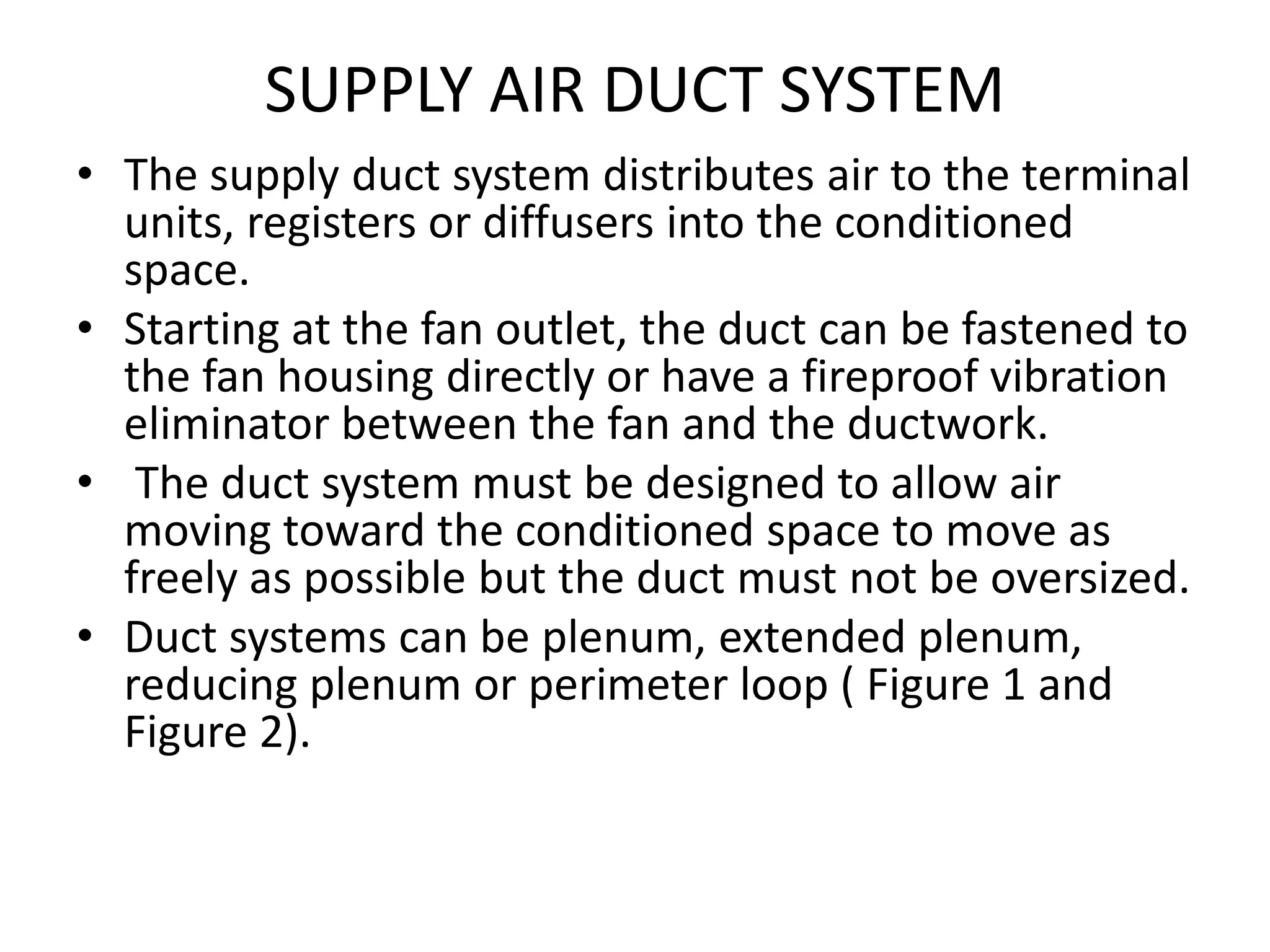
• The supply duct system distributes air to the terminal
units, registers or diffusers into the conditioned
space.
• Starting at the fan outlet, the duct can be fastened to
the fan housing directly or have a fireproof vibration
eliminator between the fan and the ductwork.
• The duct system must be designed to allow air
moving toward the conditioned space to move as
freely as possible but the duct must not be oversized.
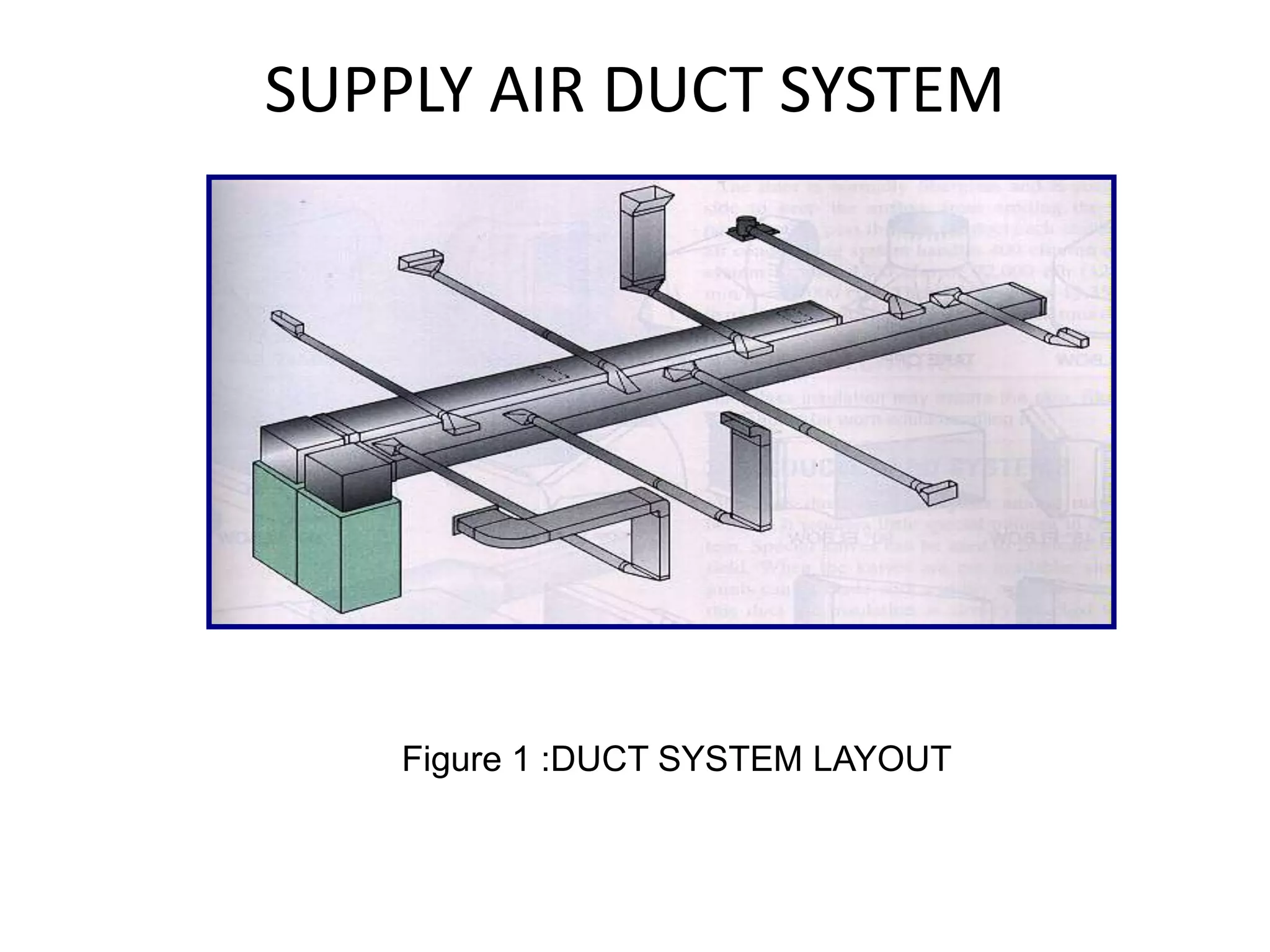
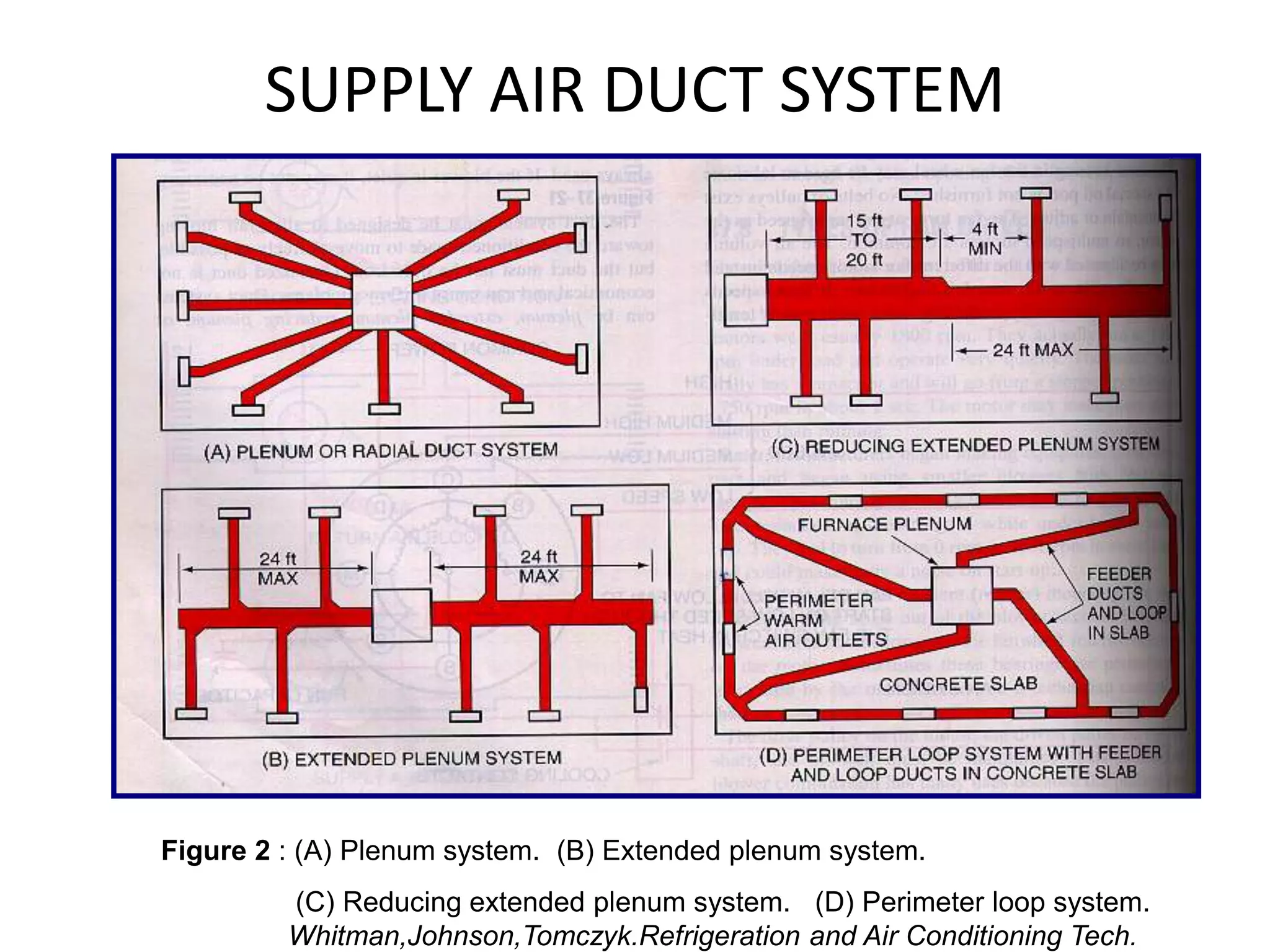
• Duct systems can be plenum, extended plenum,
reducing plenum or perimeter loop ( Figure 1 and
Figure 2).
SUPPLY AIR DUCT SYSTEM
Figure 1 :DUCT SYSTEM LAYOUT
SUPPLY AIR DUCT SYSTEM
Figure 2 : (A) Plenum system. (B) Extended plenum system.
(C) Reducing extended plenum system. (D) Perimeter loop system.
Whitman,Johnson,Tomczyk.Refrigeration and Air Conditioning Tech.
PLENUM SYSTEM
• It has an individual supply system that makes it
well suited for a job in which the room outlets are
all close to the unit (Figure 2A).
• This system is economical from a first cost
standpoint and can be installed easily with
minimum experience.
• The supply diffusers are normally located on the
inside walls and are used for heating system with
very warm or hot air as the heating source.
• The return air system can be a single return
located at the air handler which makes materials
economical.
EXTENDED PLENUM SYSTEM
• This system can be applied to a long structure
such as the ranch-style house.
• This system takes the plenum closer to the
farthest point.
• The extended plenum is called the trunk duct
and can be round, square or rectangular
(Figure 2B).
• The system uses small ducts called branches
to complete the connection to the terminal
units.
REDUCING PLENUM SYSTEM
• The reducing plenum system reduces the
trunk duct size as branch ducts are added.
• This system has the advantage of saving
materials and keeping the same pressure from
one end of the duct system to the other when
it is properly sized.
• This ensures that each branch duct has
approximately the same pressure and velocity
pushing air into its takeoff from the trunk duct
(Figure 2C).
PERIMETER LOOP SYSTEM
• The perimeter loop duct system is particularly
well suited for installation in a concrete floor
in a colder climate.
• The loop can be run under the slab close to
the outer walls with the outlets next to the
wall.
• The loop has a constant pressure around the
system and provides the same pressure to all
outlets (Figure 2D).
RETURN AIR DUCT
• The return air duct is constructed in much the
same manner as the supply duct except that
some installations are built with central returns
instead of individual room returns.
• Individual return air systems have a return air
grille in each room that has a supply diffuser.
• The individual return air system will give the most
positive return air system, but they are expensive.
The return air duct is normally sized at least
slightly larger than the supply duct so there is less
resistance to the airflow in the return system
than in the supply system.
AIR FILTERS
• The purpose of an air filter is to free the air of as
much of the airborne contaminants as is
practicable.
• The main types of filters are :
• Dry : in which the contaminants are collected in
the filter medium
• Viscous or Impingement : in which the
contaminants adhere to a special type of oil.
• Electrostatic : in which the contaminants are
positively charged with electricity and collected
on negative earthed plates.
DRY FILTERS
• These use materials such as cotton wool,
glass fiber, cotton fabric, treated paper,
foamed polyurethane as the cleaning
medium.
• The efficiency of the filter depends
largely upon the area of medium offered
to the air stream and for this reason the
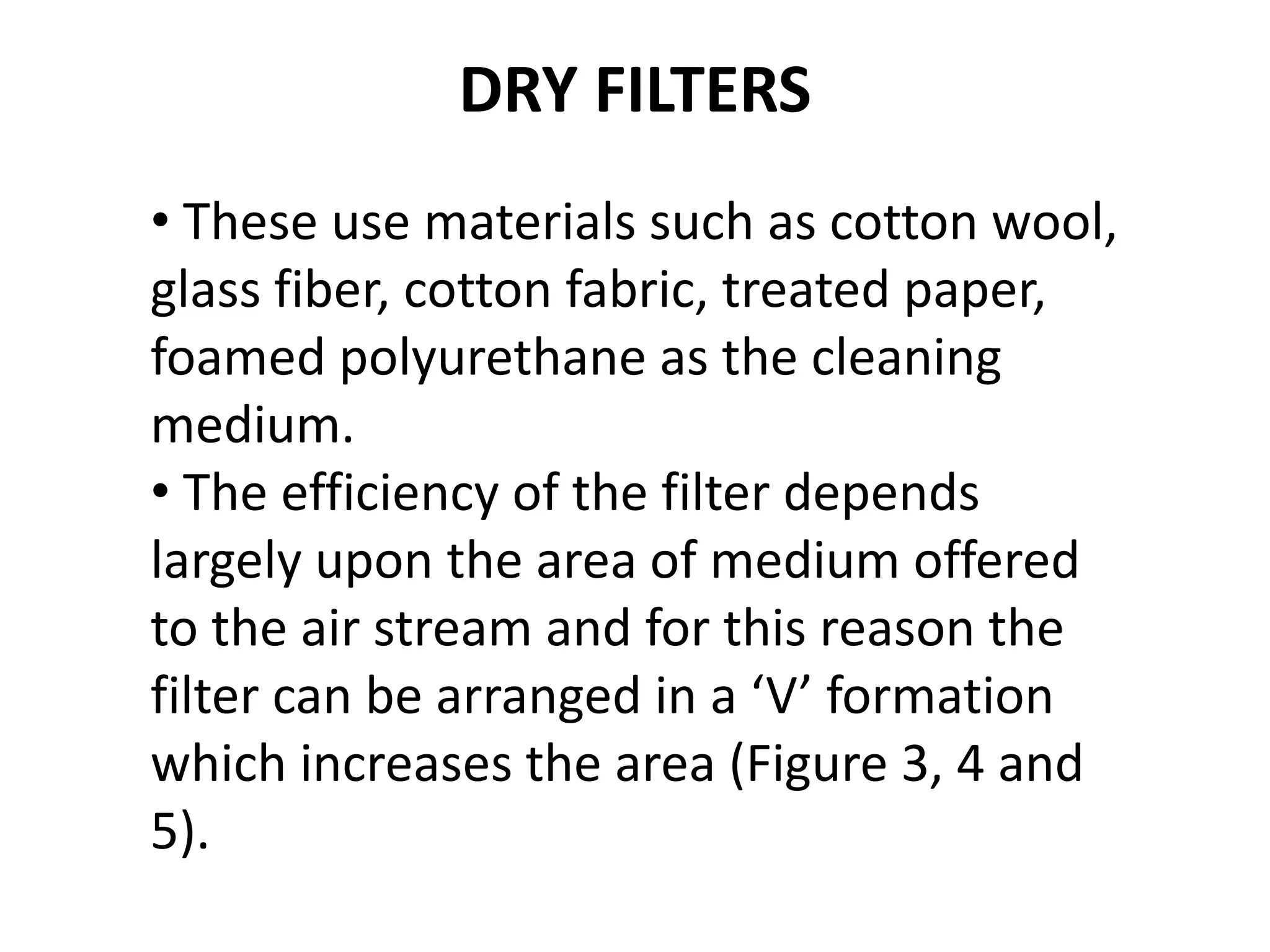
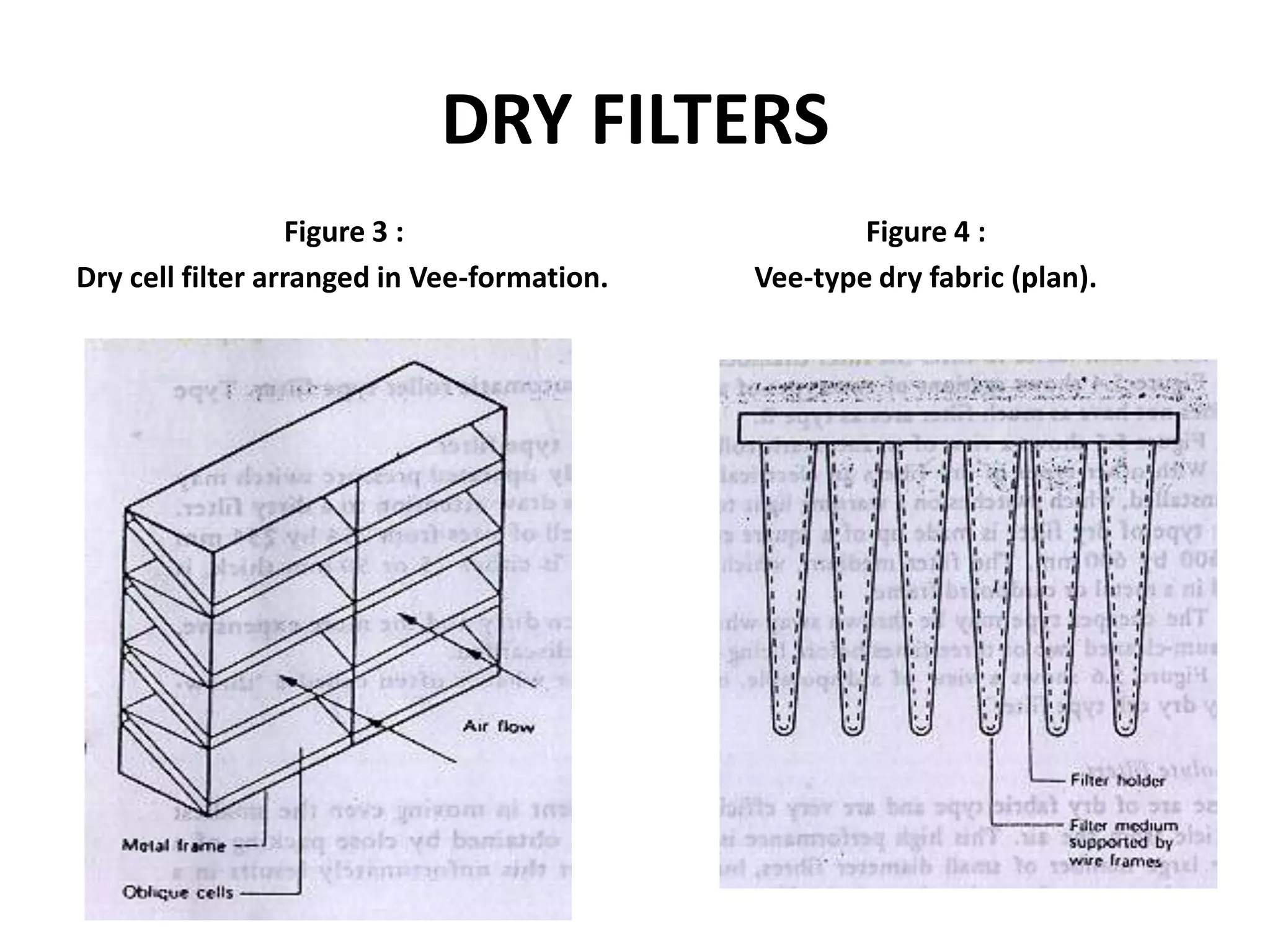
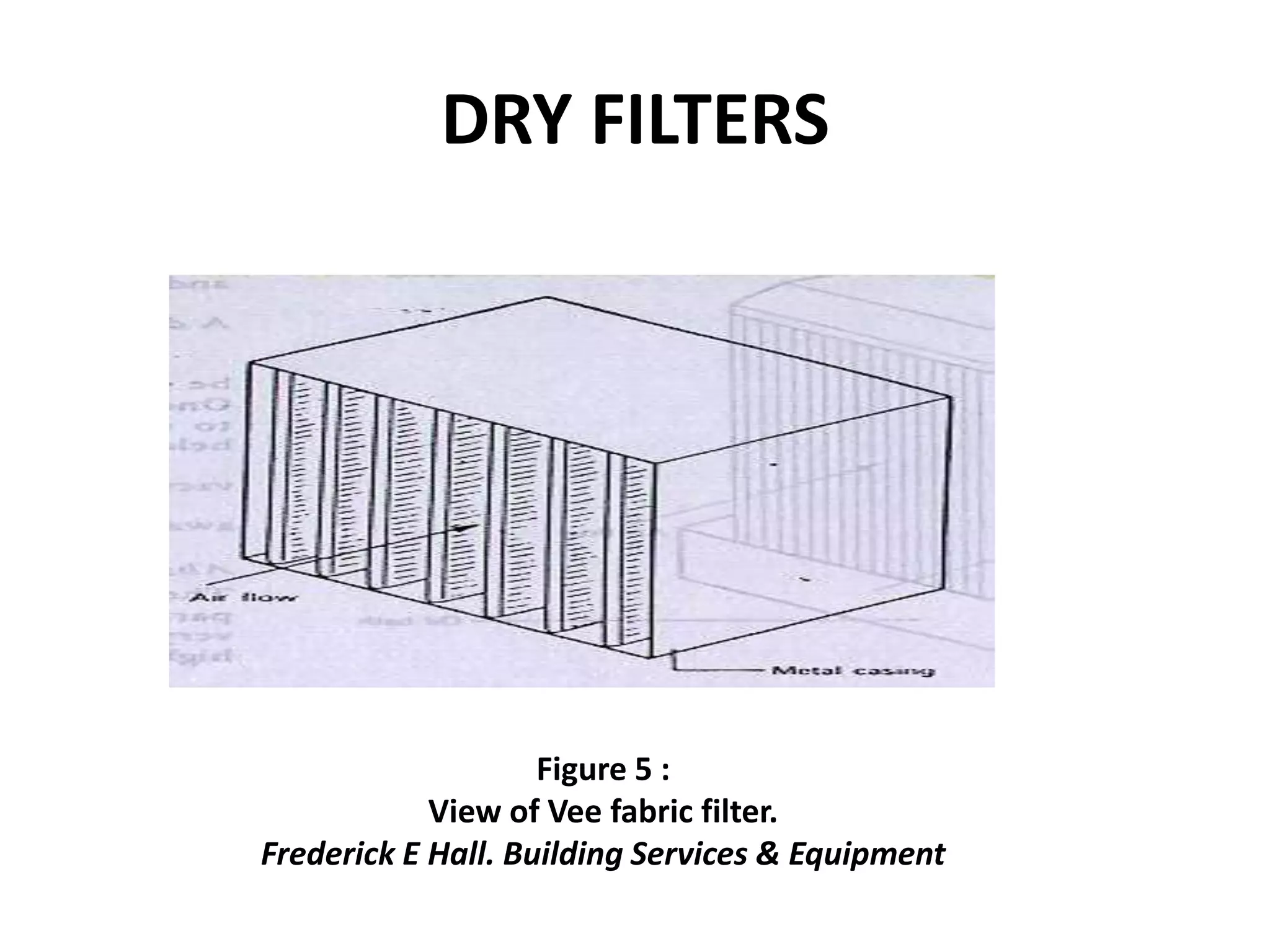
filter can be arranged in a ‘V’ formation
which increases the area (Figure 3, 4 and
5).
DRY FILTERS
Figure 3 :
Dry cell filter arranged in Vee-formation.
Figure 4 :
Vee-type dry fabric (plan).
DRY FILTERS
Figure 5 :
View of Vee fabric filter.
Frederick E Hall. Building Services & Equipment
DRY FILTERS
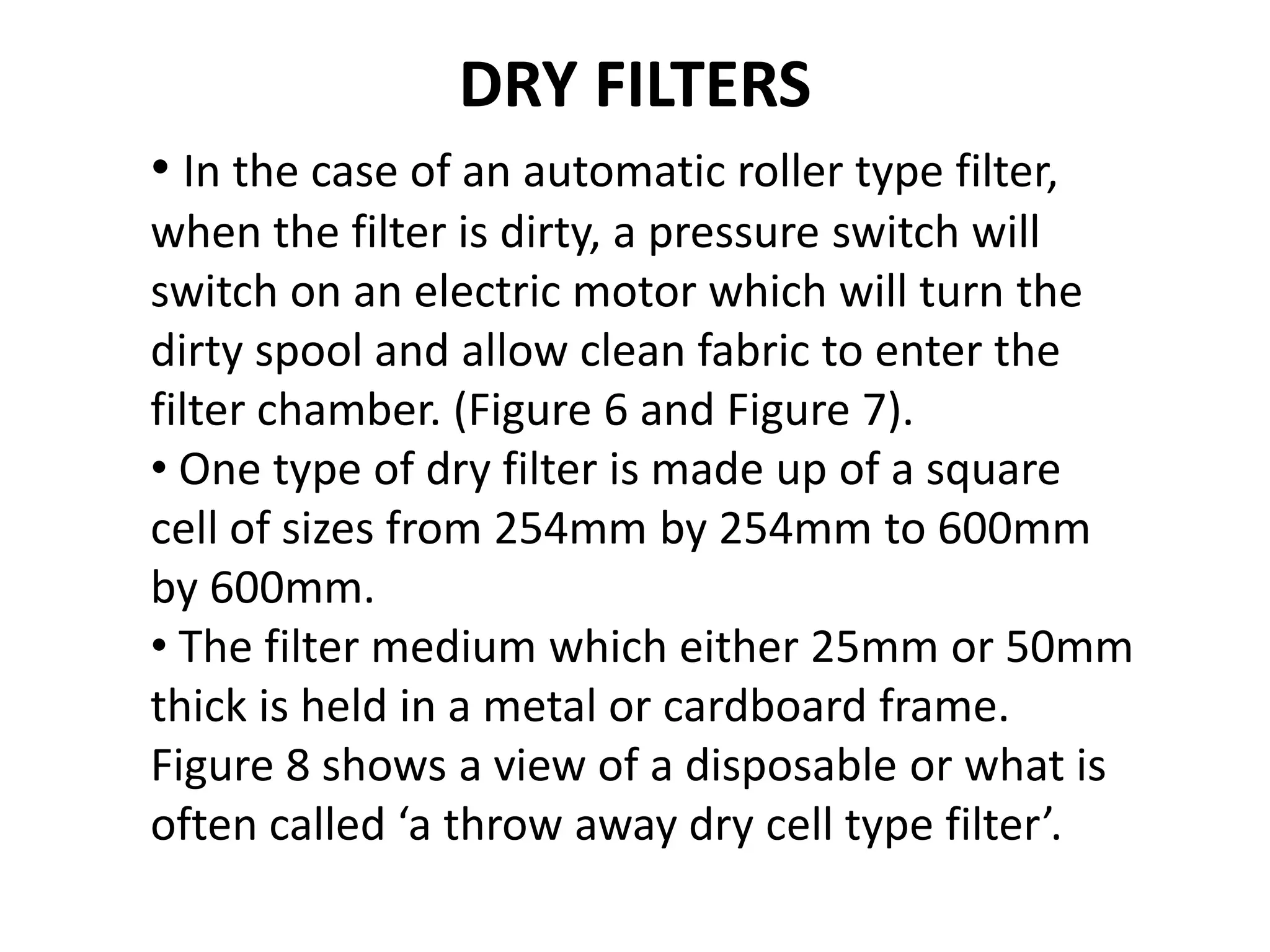
• In the case of an automatic roller type filter,
when the filter is dirty, a pressure switch will
switch on an electric motor which will turn the
dirty spool and allow clean fabric to enter the
filter chamber. (Figure 6 and Figure 7).
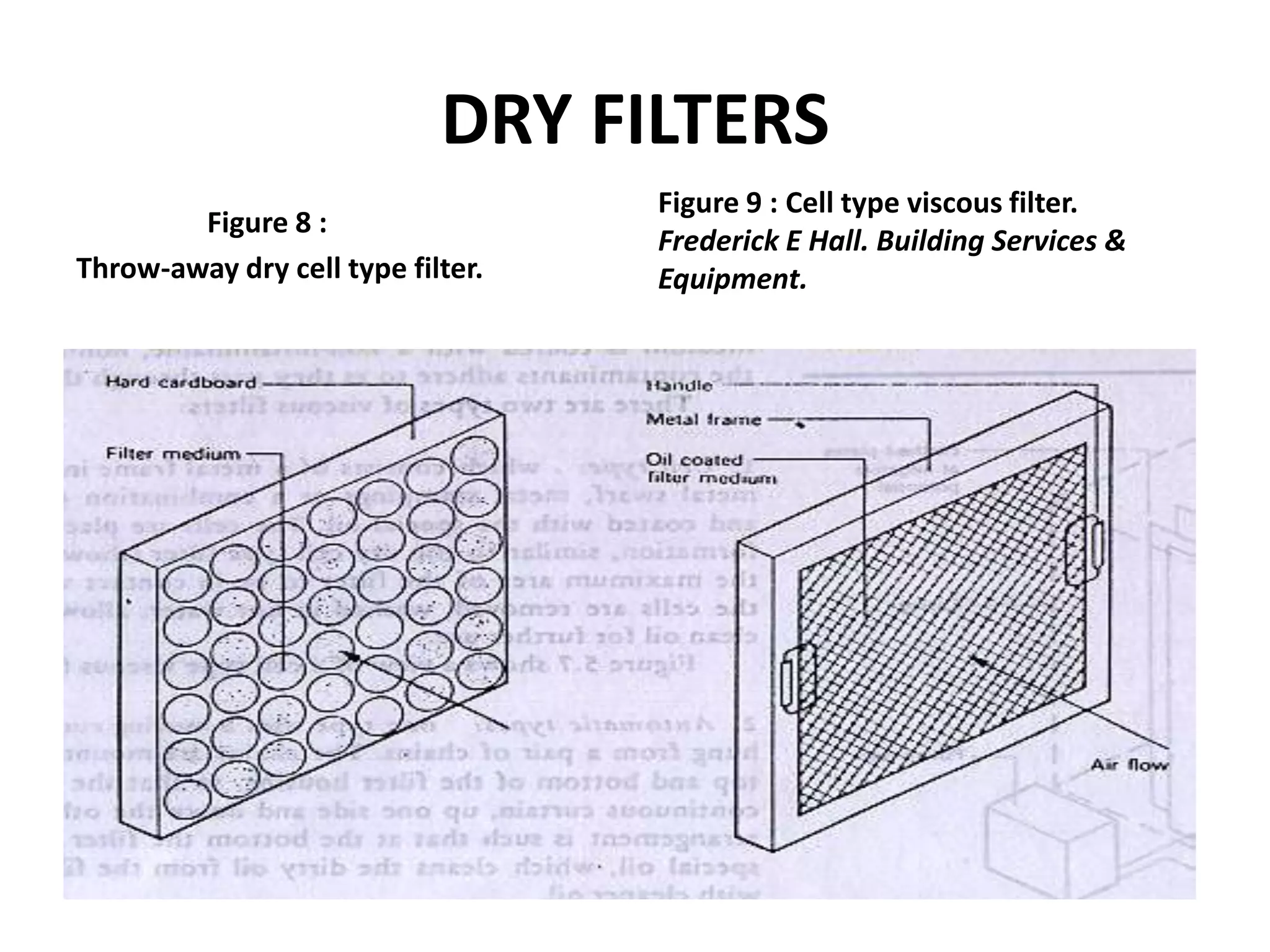
• One type of dry filter is made up of a square
cell of sizes from 254mm by 254mm to 600mm
by 600mm.
• The filter medium which either 25mm or 50mm
thick is held in a metal or cardboard frame.
Figure 8 shows a view of a disposable or what is
often called ‘a throw away dry cell type filter’.
DRY FILTERS
Figure 6 : Vertical sections of automatic
roll type filter.
Figure 7: View of automatic roll type
filter
DRY FILTERS
Figure 8 :
Throw-away dry cell type filter.
Figure 9 : Cell type viscous filter.
Frederick E Hall. Building Services &
Equipment.
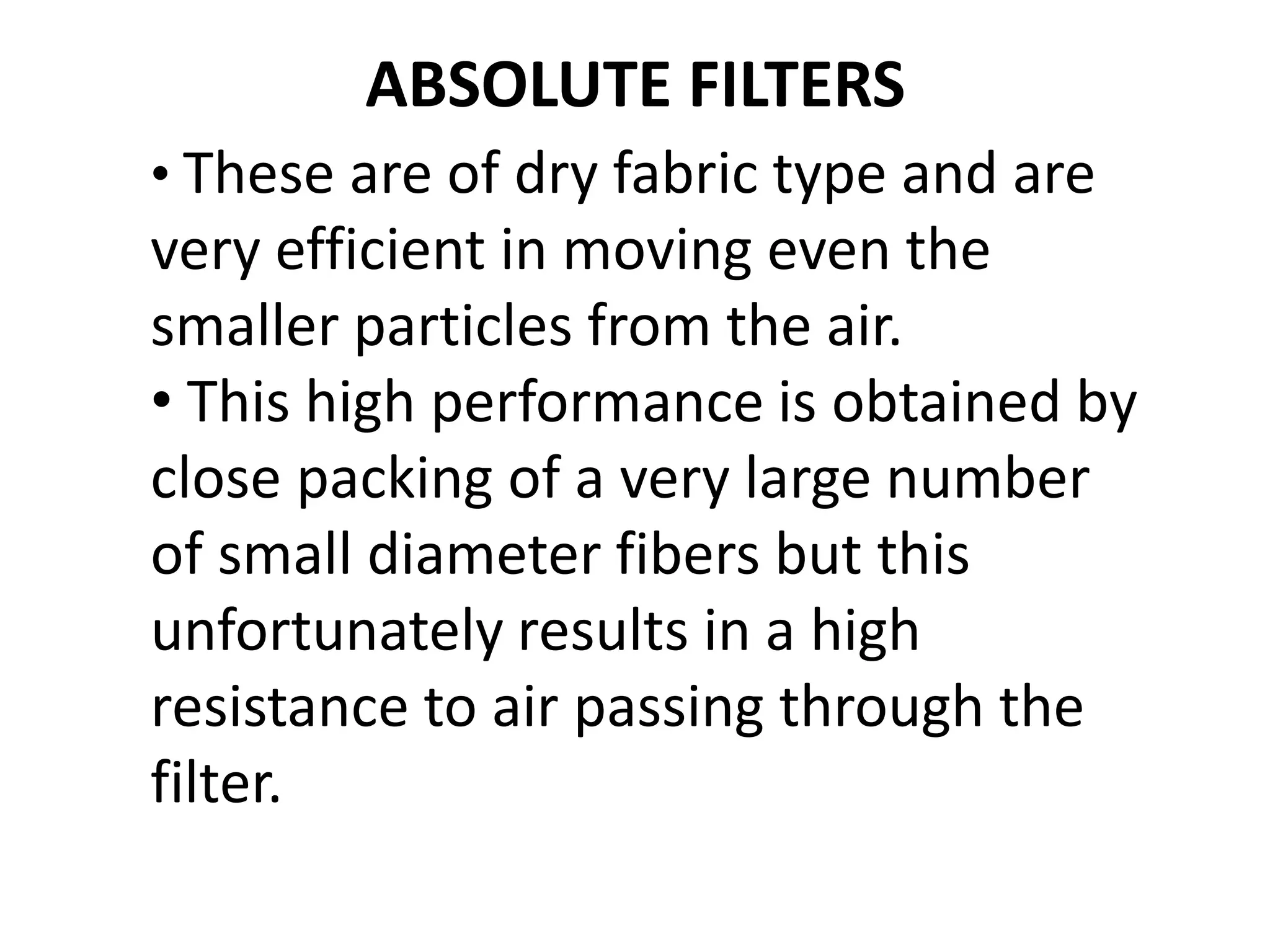
ABSOLUTE FILTERS
• These are of dry fabric type and are
very efficient in moving even the
smaller particles from the air.
• This high performance is obtained by
close packing of a very large number
of small diameter fibers but this
unfortunately results in a high
resistance to air passing through the
filter.
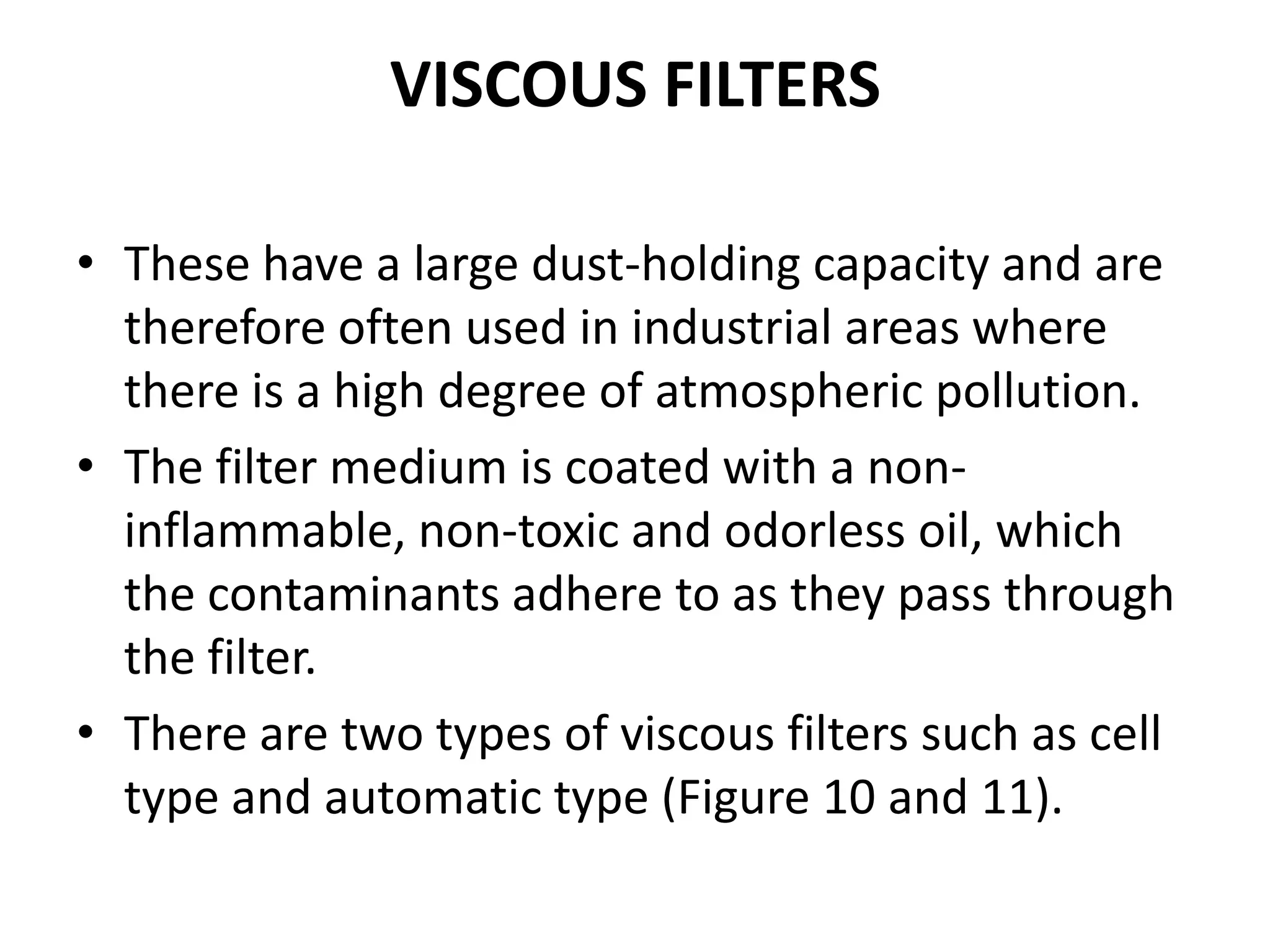
VISCOUS FILTERS
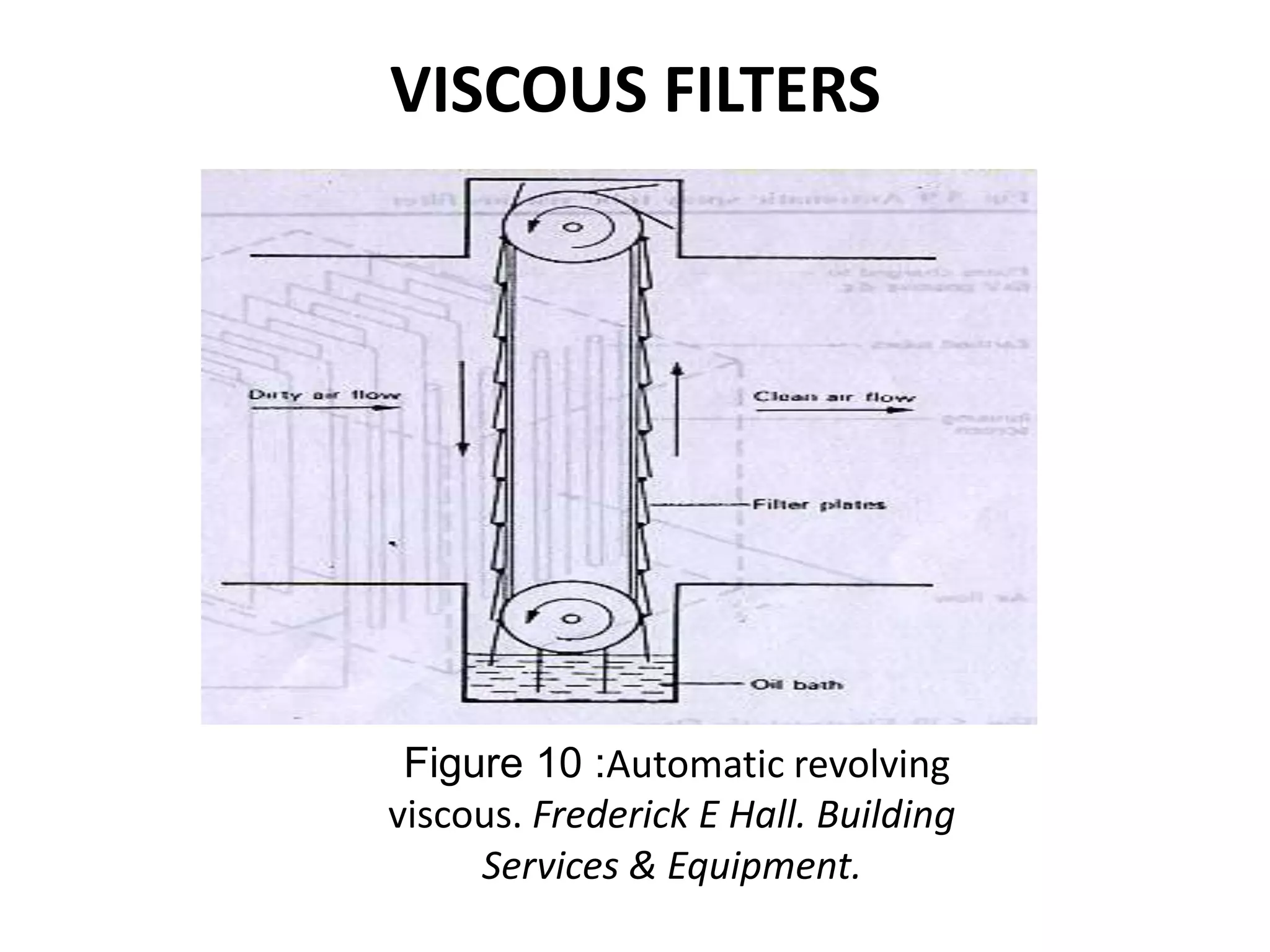
• These have a large dust-holding capacity and are
therefore often used in industrial areas where
there is a high degree of atmospheric pollution.
• The filter medium is coated with a non-
inflammable, non-toxic and odorless oil, which
the contaminants adhere to as they pass through
the filter.
• There are two types of viscous filters such as cell
type and automatic type (Figure 10 and 11).
VISCOUS FILTERS
Figure 10 :Automatic revolving
viscous. Frederick E Hall. Building
Services & Equipment.
Electrostatic Filters
• These types of filters have three main
components : ionizer, metal collector and
electrostatic power pack.
• The various air contaminants are given a
positive electrostatic charge by an ionizer
screen which is the first part of the filter.
• The screen consists of a series of fine wires
possessing an electrostatic charge produced
by a direct current potential of 13 kV.
• The wires are spaced alternatively with rods or
tubes which are at earth potential.
Electrostatic Filters
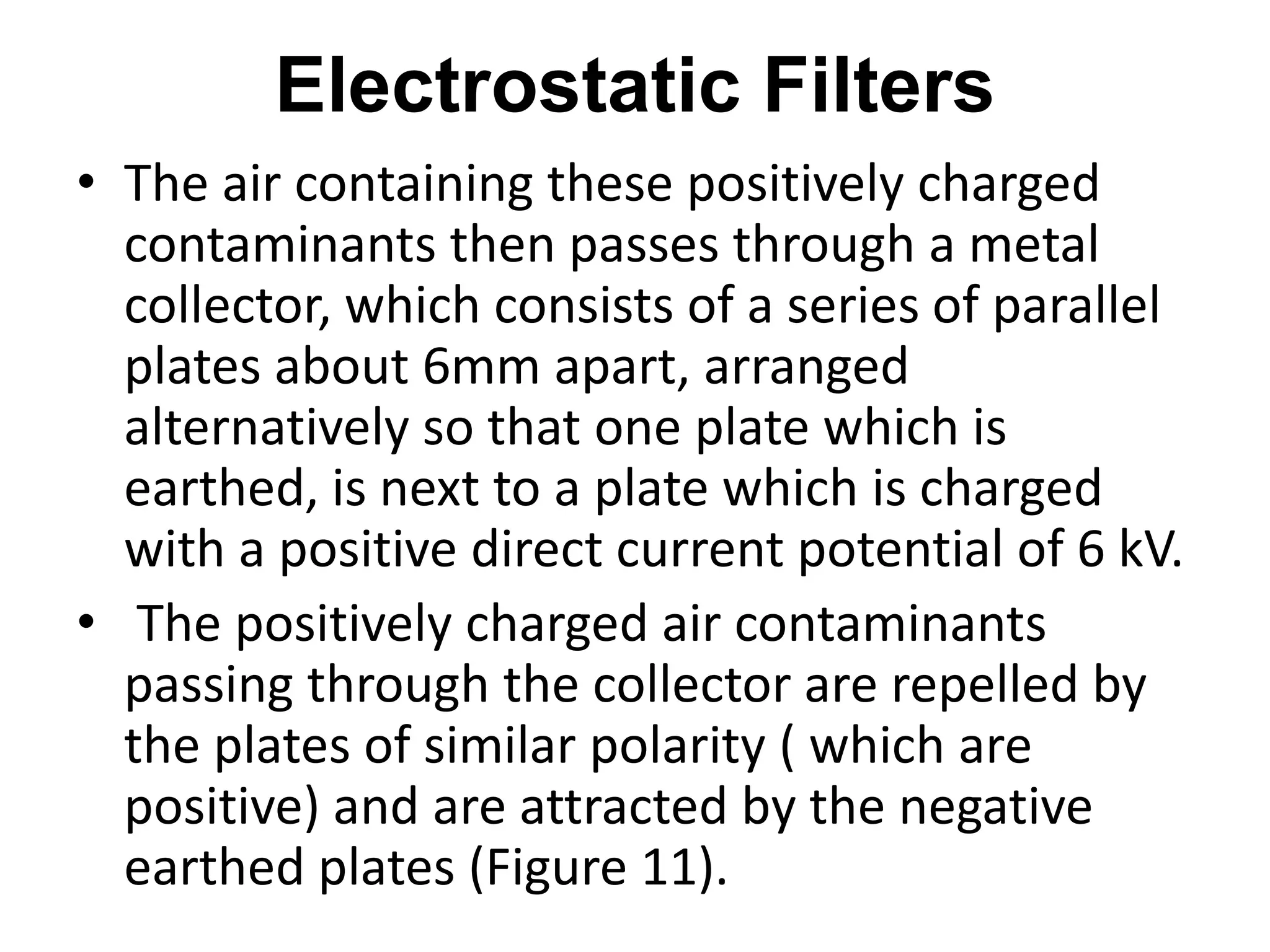
• The air containing these positively charged
contaminants then passes through a metal
collector, which consists of a series of parallel
plates about 6mm apart, arranged
alternatively so that one plate which is
earthed, is next to a plate which is charged
with a positive direct current potential of 6 kV.
• The positively charged air contaminants
passing through the collector are repelled by
the plates of similar polarity ( which are
positive) and are attracted by the negative
earthed plates (Figure 11).
VISCOUS FILTERS
Figure 11 : Electrostatic filter.
Frederick E Hall. Building Services
& Equipment.
BALANCING DAMPERS
• A well-designed system will have balancing
dampers in the branch ducts to balance the air
in the various parts of the system.
• Balancing the air with dampers enables the
technician to direct the correct volume of air
to the correct run of duct for better room
temperature control.
BALANCING DAMPERS
• The dampers should be located as close as
practical to the trunk line, with the damper
handles uncovered if the duct is insulated.
• The place to balance the air is near the trunk so if
there is any air velocity noise, it will be absorbed
in the branch duct before it enters the room.
• A damper consists of a piece of metal shaped like
the inside of the duct with a handle protruding
through the side of the duct. The handle allows
the damper to be turned at an angle to the air
stream to slow the air down.
ROOM AIR DISTRIBUTION
• The supply air enters a room either through a
grille, register or diffuser.
• A supply grille has adjustable vanes for
controlling the direction of the air entering a
room.
• A register is a grille that also has a damper
behind it so that the amount as well as the
direction of the air entering a room can be
controlled.
ROOM AIR DISTRIBUTION
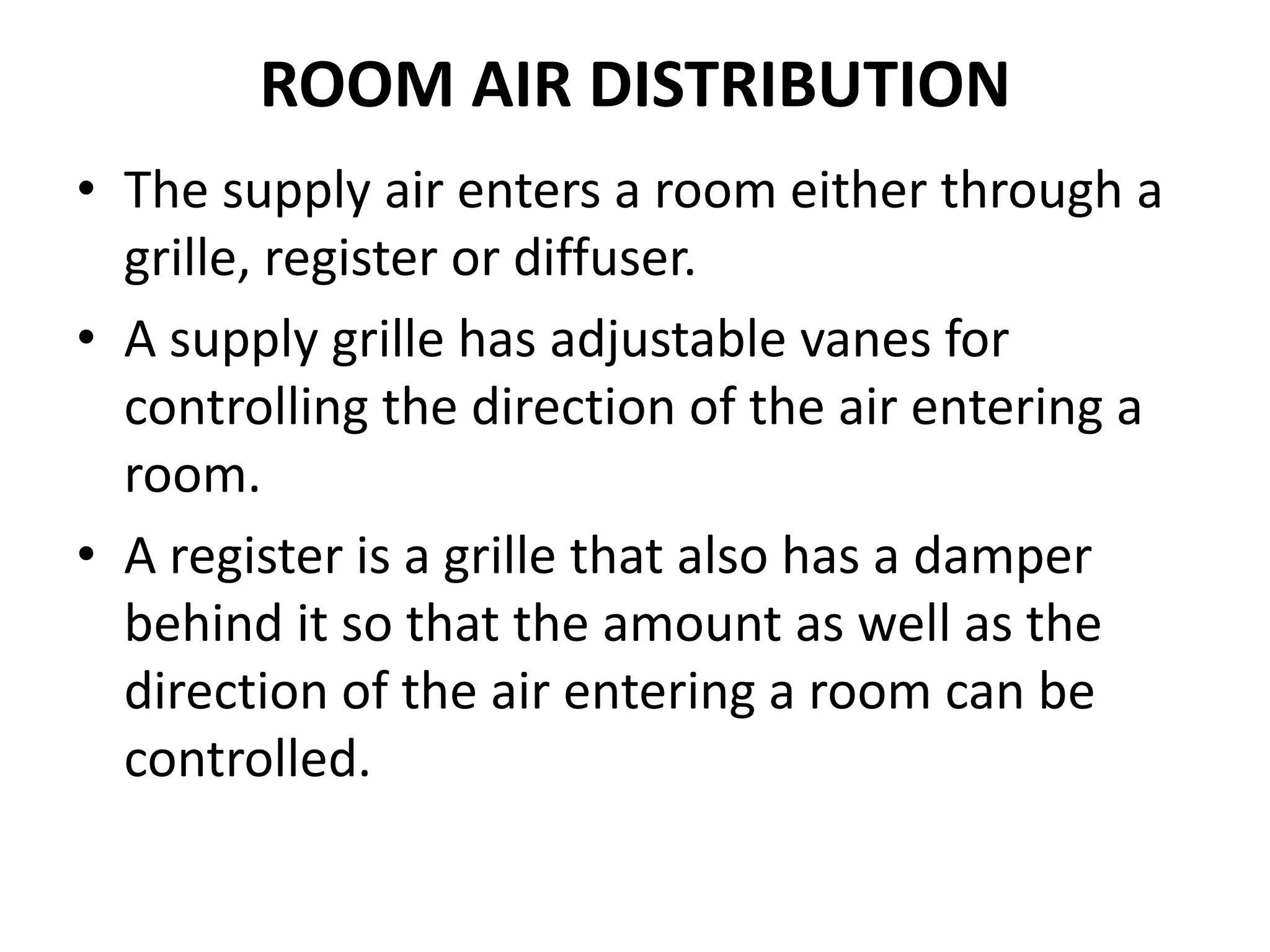
• When registers are mounted on upper walls, they
are designed to throw the air about three-
quarters the distance across the room (Figure 12).
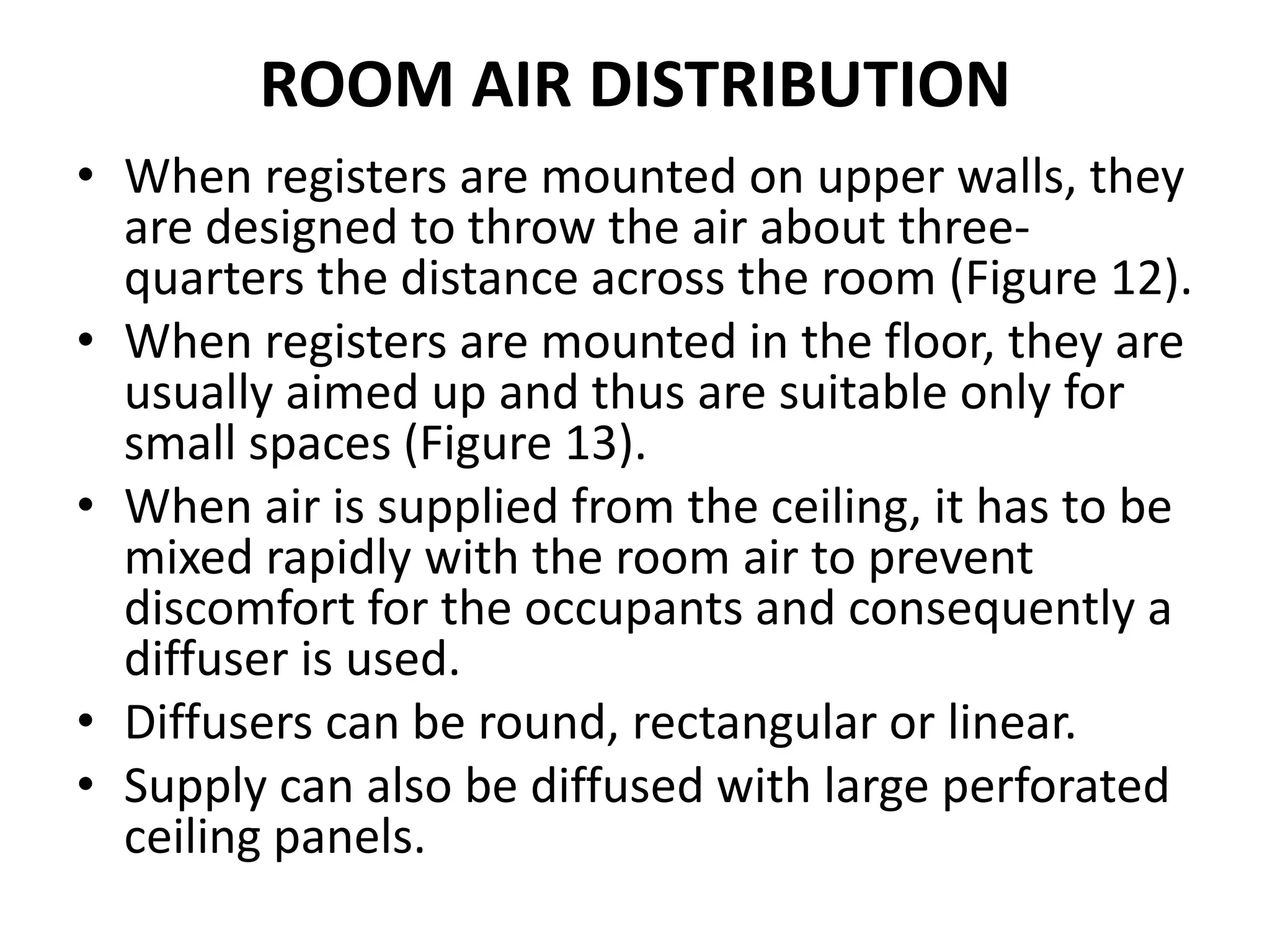
• When registers are mounted in the floor, they are
usually aimed up and thus are suitable only for
small spaces (Figure 13).
• When air is supplied from the ceiling, it has to be
mixed rapidly with the room air to prevent
discomfort for the occupants and consequently a
diffuser is used.
• Diffusers can be round, rectangular or linear.
• Supply can also be diffused with large perforated
ceiling panels.
ROOM AIR DISTRIBUTION
Figure 12 : Cooling air distribution
through upside wall.
Figure 13 :
Diffusers spread and distribute the air
through the floor
ROOM AIR DISTRIBUTION
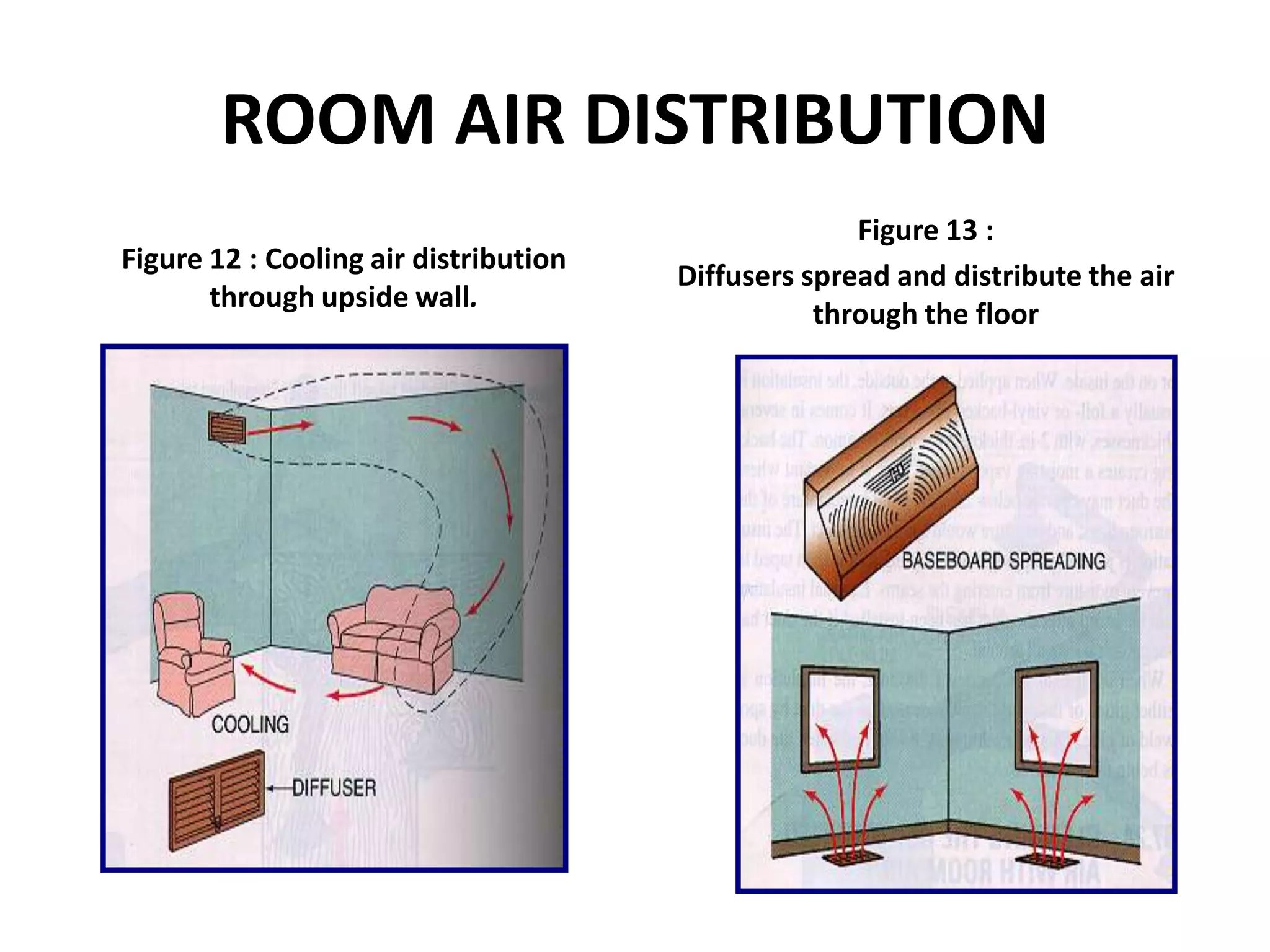
Figure 14 : Heating air distribution through low side
wall. Whitman,Johnson,Tomczyk. Refrigeration and Air
Conditioning Tech.
ROOM AIR DISTRIBUTION
• The location of supply air outlets is very
important for the comfort of the occupants.
• The goal is to gently circulate all of the air in a
room so that there are neither stagnant nor
draftly areas.
• Make sure too that beams or other objects do
not block the air supply from reaching all parts of
a room.
• Where heating is the major problem, the outlets
should be paced lower (Figure 14).
• In large theaters good airflow is often achieved by
supplying air all across the ceiling and returning it
all across the floor under the seats.
ROOM AIR DISTRIBUTION
Return air generally leaves a room through a
grille but it can also leave through lighting
fixtures, perforated ceiling panels or undercut
doors (Figure 15). The location of the return
air grille has almost no effect on room air
motion if supply outlets are properly located
(Figure 16). However, to prevent short-
circuiting of the air, do not place return
openings right next to supply outlets. Also
avoid floor return grilles because dirt and
small objects fall into them.
ROOM AIR DISTRIBUTION
Figure 15 : Different types of grills.
Figure 16 : : Diffusers and registers.
Whitman, Johnson, Tomczyk. Refrigeration
and Air Conditioning Tech.
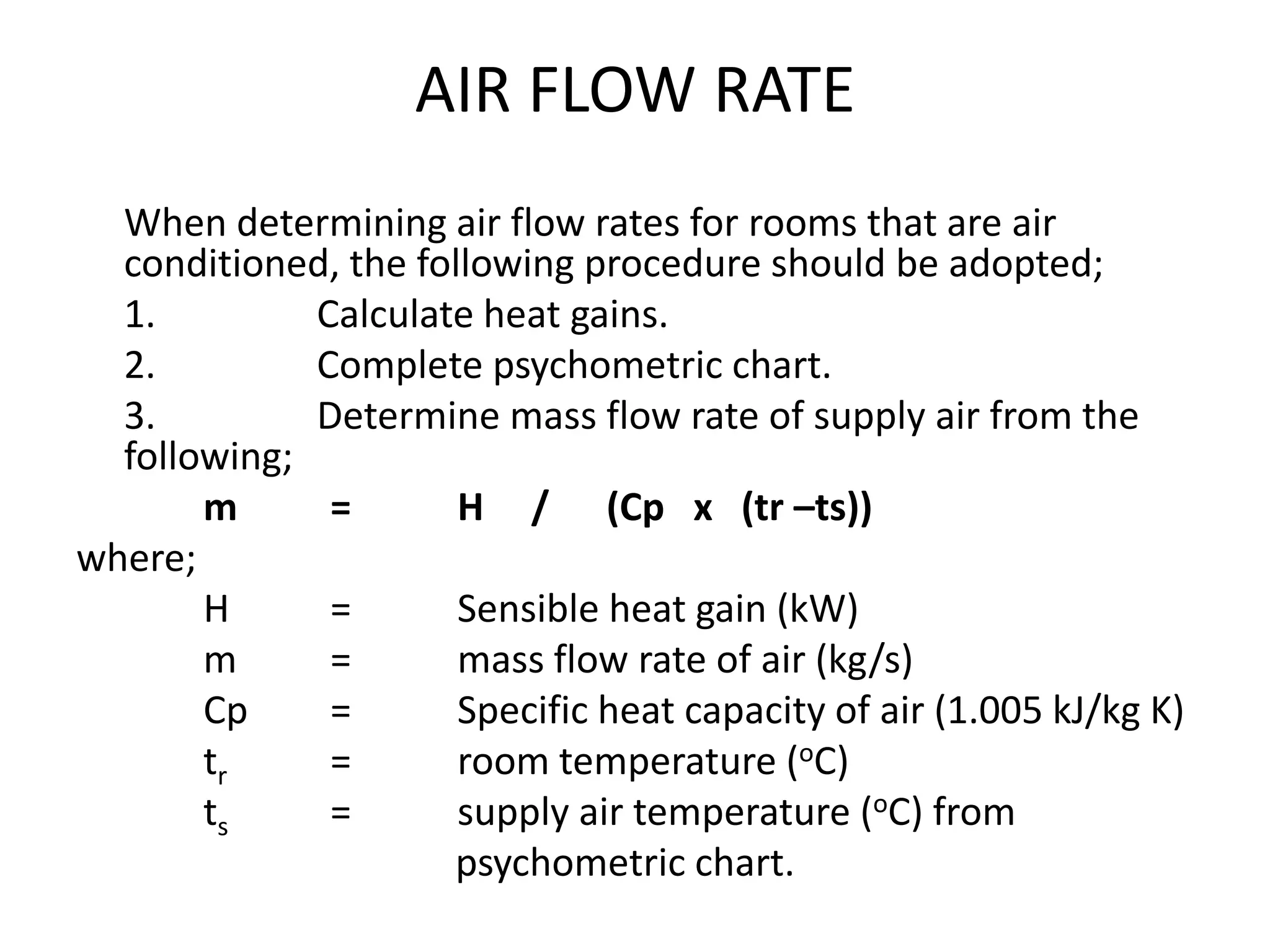
AIR FLOW RATE
When determining air flow rates for rooms that are air
conditioned, the following procedure should be adopted;
1. Calculate heat gains.
2. Complete psychometric chart.
3. Determine mass flow rate of supply air from the
following;
m = H / (Cp x (tr –ts))
where;
H = Sensible heat gain (kW)
m = mass flow rate of air (kg/s)
Cp = Specific heat capacity of air (1.005 kJ/kg K)
tr = room temperature (oC)
ts = supply air temperature (oC) from
psychometric chart.
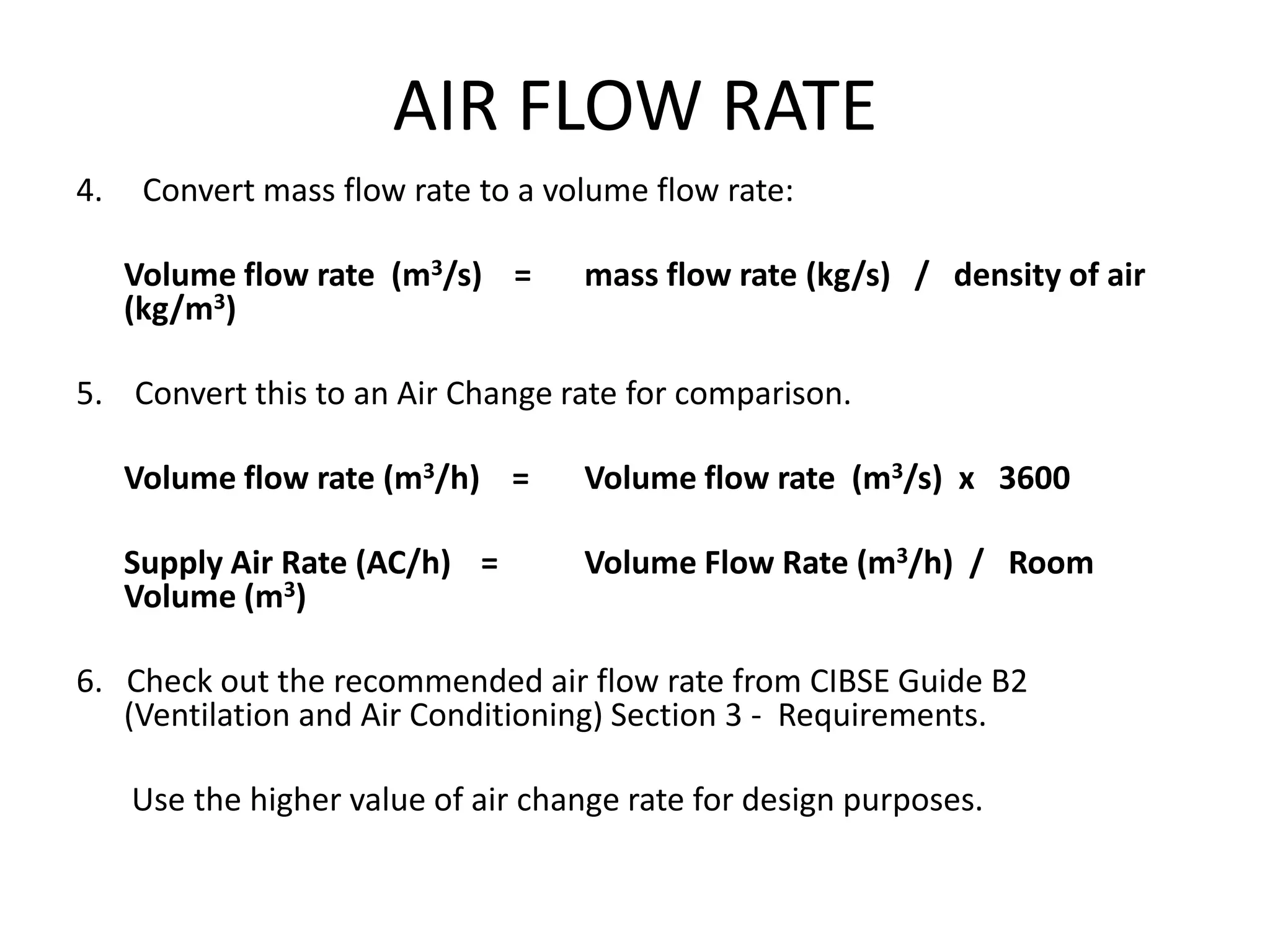
AIR FLOW RATE
4. Convert mass flow rate to a volume flow rate:
Volume flow rate (m3/s) = mass flow rate (kg/s) / density of air
(kg/m3)
5. Convert this to an Air Change rate for comparison.
Volume flow rate (m3/h) = Volume flow rate (m3/s) x 3600
Supply Air Rate (AC/h) = Volume Flow Rate (m3/h) / Room
Volume (m3)
6. Check out the recommended air flow rate from CIBSE Guide B2
(Ventilation and Air Conditioning) Section 3 - Requirements.
Use the higher value of air change rate for design purposes.

S3 Lec 7 (air flow rate)

  • 1.
    SUPPLY AIR DUCTSYSTEM • The supply duct system distributes air to the terminal units, registers or diffusers into the conditioned space. • Starting at the fan outlet, the duct can be fastened to the fan housing directly or have a fireproof vibration eliminator between the fan and the ductwork. • The duct system must be designed to allow air moving toward the conditioned space to move as freely as possible but the duct must not be oversized. • Duct systems can be plenum, extended plenum, reducing plenum or perimeter loop ( Figure 1 and Figure 2).
  • 2.
    SUPPLY AIR DUCTSYSTEM Figure 1 :DUCT SYSTEM LAYOUT
  • 3.
    SUPPLY AIR DUCTSYSTEM Figure 2 : (A) Plenum system. (B) Extended plenum system. (C) Reducing extended plenum system. (D) Perimeter loop system. Whitman,Johnson,Tomczyk.Refrigeration and Air Conditioning Tech.
  • 4.
    PLENUM SYSTEM • Ithas an individual supply system that makes it well suited for a job in which the room outlets are all close to the unit (Figure 2A). • This system is economical from a first cost standpoint and can be installed easily with minimum experience. • The supply diffusers are normally located on the inside walls and are used for heating system with very warm or hot air as the heating source. • The return air system can be a single return located at the air handler which makes materials economical.
  • 5.
    EXTENDED PLENUM SYSTEM •This system can be applied to a long structure such as the ranch-style house. • This system takes the plenum closer to the farthest point. • The extended plenum is called the trunk duct and can be round, square or rectangular (Figure 2B). • The system uses small ducts called branches to complete the connection to the terminal units.
  • 6.
    REDUCING PLENUM SYSTEM •The reducing plenum system reduces the trunk duct size as branch ducts are added. • This system has the advantage of saving materials and keeping the same pressure from one end of the duct system to the other when it is properly sized. • This ensures that each branch duct has approximately the same pressure and velocity pushing air into its takeoff from the trunk duct (Figure 2C).
  • 7.
    PERIMETER LOOP SYSTEM •The perimeter loop duct system is particularly well suited for installation in a concrete floor in a colder climate. • The loop can be run under the slab close to the outer walls with the outlets next to the wall. • The loop has a constant pressure around the system and provides the same pressure to all outlets (Figure 2D).
  • 8.
    RETURN AIR DUCT •The return air duct is constructed in much the same manner as the supply duct except that some installations are built with central returns instead of individual room returns. • Individual return air systems have a return air grille in each room that has a supply diffuser. • The individual return air system will give the most positive return air system, but they are expensive. The return air duct is normally sized at least slightly larger than the supply duct so there is less resistance to the airflow in the return system than in the supply system.
  • 9.
    AIR FILTERS • Thepurpose of an air filter is to free the air of as much of the airborne contaminants as is practicable. • The main types of filters are : • Dry : in which the contaminants are collected in the filter medium • Viscous or Impingement : in which the contaminants adhere to a special type of oil. • Electrostatic : in which the contaminants are positively charged with electricity and collected on negative earthed plates.
  • 10.
    DRY FILTERS • Theseuse materials such as cotton wool, glass fiber, cotton fabric, treated paper, foamed polyurethane as the cleaning medium. • The efficiency of the filter depends largely upon the area of medium offered to the air stream and for this reason the filter can be arranged in a ‘V’ formation which increases the area (Figure 3, 4 and 5).
  • 11.
    DRY FILTERS Figure 3: Dry cell filter arranged in Vee-formation. Figure 4 : Vee-type dry fabric (plan).
  • 12.
    DRY FILTERS Figure 5: View of Vee fabric filter. Frederick E Hall. Building Services & Equipment
  • 13.
    DRY FILTERS • Inthe case of an automatic roller type filter, when the filter is dirty, a pressure switch will switch on an electric motor which will turn the dirty spool and allow clean fabric to enter the filter chamber. (Figure 6 and Figure 7). • One type of dry filter is made up of a square cell of sizes from 254mm by 254mm to 600mm by 600mm. • The filter medium which either 25mm or 50mm thick is held in a metal or cardboard frame. Figure 8 shows a view of a disposable or what is often called ‘a throw away dry cell type filter’.
  • 14.
    DRY FILTERS Figure 6: Vertical sections of automatic roll type filter. Figure 7: View of automatic roll type filter
  • 15.
    DRY FILTERS Figure 8: Throw-away dry cell type filter. Figure 9 : Cell type viscous filter. Frederick E Hall. Building Services & Equipment.
  • 16.
    ABSOLUTE FILTERS • Theseare of dry fabric type and are very efficient in moving even the smaller particles from the air. • This high performance is obtained by close packing of a very large number of small diameter fibers but this unfortunately results in a high resistance to air passing through the filter.
  • 17.
    VISCOUS FILTERS • Thesehave a large dust-holding capacity and are therefore often used in industrial areas where there is a high degree of atmospheric pollution. • The filter medium is coated with a non- inflammable, non-toxic and odorless oil, which the contaminants adhere to as they pass through the filter. • There are two types of viscous filters such as cell type and automatic type (Figure 10 and 11).
  • 18.
    VISCOUS FILTERS Figure 10:Automatic revolving viscous. Frederick E Hall. Building Services & Equipment.
  • 19.
    Electrostatic Filters • Thesetypes of filters have three main components : ionizer, metal collector and electrostatic power pack. • The various air contaminants are given a positive electrostatic charge by an ionizer screen which is the first part of the filter. • The screen consists of a series of fine wires possessing an electrostatic charge produced by a direct current potential of 13 kV. • The wires are spaced alternatively with rods or tubes which are at earth potential.
  • 20.
    Electrostatic Filters • Theair containing these positively charged contaminants then passes through a metal collector, which consists of a series of parallel plates about 6mm apart, arranged alternatively so that one plate which is earthed, is next to a plate which is charged with a positive direct current potential of 6 kV. • The positively charged air contaminants passing through the collector are repelled by the plates of similar polarity ( which are positive) and are attracted by the negative earthed plates (Figure 11).
  • 21.
    VISCOUS FILTERS Figure 11: Electrostatic filter. Frederick E Hall. Building Services & Equipment.
  • 22.
    BALANCING DAMPERS • Awell-designed system will have balancing dampers in the branch ducts to balance the air in the various parts of the system. • Balancing the air with dampers enables the technician to direct the correct volume of air to the correct run of duct for better room temperature control.
  • 23.
    BALANCING DAMPERS • Thedampers should be located as close as practical to the trunk line, with the damper handles uncovered if the duct is insulated. • The place to balance the air is near the trunk so if there is any air velocity noise, it will be absorbed in the branch duct before it enters the room. • A damper consists of a piece of metal shaped like the inside of the duct with a handle protruding through the side of the duct. The handle allows the damper to be turned at an angle to the air stream to slow the air down.
  • 24.
    ROOM AIR DISTRIBUTION •The supply air enters a room either through a grille, register or diffuser. • A supply grille has adjustable vanes for controlling the direction of the air entering a room. • A register is a grille that also has a damper behind it so that the amount as well as the direction of the air entering a room can be controlled.
  • 25.
    ROOM AIR DISTRIBUTION •When registers are mounted on upper walls, they are designed to throw the air about three- quarters the distance across the room (Figure 12). • When registers are mounted in the floor, they are usually aimed up and thus are suitable only for small spaces (Figure 13). • When air is supplied from the ceiling, it has to be mixed rapidly with the room air to prevent discomfort for the occupants and consequently a diffuser is used. • Diffusers can be round, rectangular or linear. • Supply can also be diffused with large perforated ceiling panels.
  • 26.
    ROOM AIR DISTRIBUTION Figure12 : Cooling air distribution through upside wall. Figure 13 : Diffusers spread and distribute the air through the floor
  • 27.
    ROOM AIR DISTRIBUTION Figure14 : Heating air distribution through low side wall. Whitman,Johnson,Tomczyk. Refrigeration and Air Conditioning Tech.
  • 28.
    ROOM AIR DISTRIBUTION •The location of supply air outlets is very important for the comfort of the occupants. • The goal is to gently circulate all of the air in a room so that there are neither stagnant nor draftly areas. • Make sure too that beams or other objects do not block the air supply from reaching all parts of a room. • Where heating is the major problem, the outlets should be paced lower (Figure 14). • In large theaters good airflow is often achieved by supplying air all across the ceiling and returning it all across the floor under the seats.
  • 29.
    ROOM AIR DISTRIBUTION Returnair generally leaves a room through a grille but it can also leave through lighting fixtures, perforated ceiling panels or undercut doors (Figure 15). The location of the return air grille has almost no effect on room air motion if supply outlets are properly located (Figure 16). However, to prevent short- circuiting of the air, do not place return openings right next to supply outlets. Also avoid floor return grilles because dirt and small objects fall into them.
  • 30.
    ROOM AIR DISTRIBUTION Figure15 : Different types of grills. Figure 16 : : Diffusers and registers. Whitman, Johnson, Tomczyk. Refrigeration and Air Conditioning Tech.
  • 31.
    AIR FLOW RATE Whendetermining air flow rates for rooms that are air conditioned, the following procedure should be adopted; 1. Calculate heat gains. 2. Complete psychometric chart. 3. Determine mass flow rate of supply air from the following; m = H / (Cp x (tr –ts)) where; H = Sensible heat gain (kW) m = mass flow rate of air (kg/s) Cp = Specific heat capacity of air (1.005 kJ/kg K) tr = room temperature (oC) ts = supply air temperature (oC) from psychometric chart.
  • 32.
    AIR FLOW RATE 4.Convert mass flow rate to a volume flow rate: Volume flow rate (m3/s) = mass flow rate (kg/s) / density of air (kg/m3) 5. Convert this to an Air Change rate for comparison. Volume flow rate (m3/h) = Volume flow rate (m3/s) x 3600 Supply Air Rate (AC/h) = Volume Flow Rate (m3/h) / Room Volume (m3) 6. Check out the recommended air flow rate from CIBSE Guide B2 (Ventilation and Air Conditioning) Section 3 - Requirements. Use the higher value of air change rate for design purposes.