District Cooling Power & Cost savings
January 2011
Designing for Life
District Cooling
Power & Cost Saving
District Cooling Power & Cost savings
District Cooling Power
and Cost savings
Main
Heading
Table of
Contents
01. District Cooling
02. Case Studies
03. Animation
District Cooling Power & Cost Savings
District
Cooling
01
District Cooling Power & Cost savings
Description
Involves the provision of cooling for multiple buildings
or facilities from one or more central plant via a pipe network.
District
Cooling
History
Large District Cooling applications started in the 1930s for
the Rockefeller Center and United States Capitol Complex.
District Cooling Power & Cost savings
District
Cooling
Piping
Distribution
DC Plant
Pipes
Valve Chamber ETS
District Cooling Power & Cost savings
District
Cooling
Pipes in
Tunnel
Pipes in Trench Pipes in Tunnel
Pipes in Tunnel with Branch-out
District Cooling Power & Cost savings
District
Cooling
Valve
Chamber
District Cooling Power & Cost savings
District
Cooling
Energy
Transfer
Station
Heat Exchanger
Schematic - Energy Transfer Station with Heat Exchanger to Apartment Block
District Cooling Power & Cost savings
District
Cooling
District
Plant
Chiller Plant at Ground Level Pumps in BasementCooling Tower at Roof Level
Vertical Arrangement
DC Plant – Verticle Arrangement
District Cooling Power & Cost savings
District
Cooling
District
Plant
Cooling Towers – Horizontal Arrangement
Kuwait University
District Cooling Power & Cost savings
District
Cooling
District
Plant
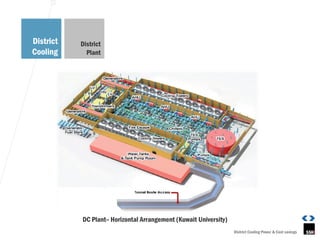
DC Plant– Horizontal Arrangement (Kuwait University)
District Cooling Power & Cost savings
Ice Storage Tank
District
Cooling
Thermal
Storage
1. Chilled Water
2. Ice
3. Eutectic Salts
Pre-stressed Concrete Tank Thermal Energy Storage
District Cooling Power & Cost savings
District
Cooling
District
Plant
District Cooling Plant – Architecture
District Cooling Power & Cost Savings
Case
Study
02
• Residential Areas
• Inner-City
District Cooling Power & Cost savings
Residential Area Case Study based
on Jaber Al-Ahmad City
(Areas B & A5)
District Cooling Power & Cost savings
Residential
Area-
Design
Basis
Case
Study
Cooling Loads – Estimation Basis
District Cooling Power & Cost savings
Case
Study
Residential
Areas
Number of Houses = 1836
Estimated built up area of housing = 1,560,600 m2
(95% of total Built up area)
Total Built up area including Mosques, Schools,
Clinic, Shopping centre, Bank, Office Buildings etc. = 1,645,438 m2
Chiller plant capacity = 36,790 TR
Thermal Storage = 4879.6 TR (11.7% of total)
TOTAL DISTRICT COOLING PLANT CAPACITY = 41,670 TR
District Cooling Power & Cost savings
Case
Study
Residential
Areas
Plant Arrangement
&
Chilled Water Distribution
District Cooling Power & Cost savings
Residential
Areas
Case
Study
Roof Plan
Overall Area = 136m x 40m
Foot Print = 7.66 M2/TR
District Cooling Power & Cost savings
Residential
Areas
Case
Study
Ground Floor Plan
District Cooling Power & Cost savings
Residential
Areas
Case
Study
Enlarged view
Basement Floor Plan
District Cooling Power & Cost savings
Residential
Areas
Case
Study
Enlarged View - Basement Plan
District Cooling Power & Cost savings
Residential
Areas
Case
Study
Site Plan - Chilled Water Distribution
Enlarged view
District Cooling Power & Cost savings
Residential
Areas
Case
Study
Site Plan Enlarged view - Chilled Water Distribution
District Cooling Power & Cost savings
Residential
Areas
Case
Study
Chilled Water Network Flow Simulation
District Cooling Power & Cost savings
Residential
Areas
Case
Study
Typical Cross Section of Local Road with Bldg. Connection
District Cooling Power & Cost savings
Chilled Water Pipe Network
• System Static Pressure - 6 bar
• Pressure difference between closest and furthest node is 24m.
Residential
Areas
Case
Study
District Cooling Power & Cost savings
Chilled Water Temperature Increase
• Calculations indicate that water temperature increase over the
longest route is 0.3 deg-C
• The calculations were based on Supply at 5.0 Deg-C, Return at
14.0 Deg-C
• Loss in thermal energy due to pipe-work distribution is
approximately 1 % overall
Residential
Areas
Case
Study
District Cooling Power & Cost savings
Case
Study
Residential
Area
Power & Energy
District Cooling Power & Cost savings
Case
Study
Residential
Area-
Cooling
Load
District Cooling Power & Cost savings
Case
Study
Residential
Area-
Cooling
Load
District Cooling Power & Cost savings
Case
Study
Discharging Mode
Charging Mode
Charging / Discharging Mode (TES Tank)
Residential
Areas
District Cooling Power & Cost savings
Case
Study
Residential
Area-
Cooling
Load
District Cooling Efficiency
With TES = 0.86 KW/TR
Without TES = 1.00 KW/TR
Based on R-134a Refrigerant
Conventional Air Cooled Systems (excluding Indoor Units)
Efficiency = 1.6 - 1.8 KW/TR (peak load/peak cooling)
Assume Air Distribution Equipment Efficiency = 0.2 KW/TR
Based on R22 Refrigerant and
equivalent diverse electrical load
PEAK POWER SAVING = 50% (on average)
District Cooling Power & Cost savings
Case
Study
Residential
Area-
Cooling
Load
Annual DCS
Energy Demand = 101.9 GWh
Annual Air Cooled System
Energy Demand = 182.2 GWh
Yearly Energy Saving = 40% on average
when compared with conventional
Air-cooled systems (1.6-1.8 kW/TR)
District Cooling vs. Air cooled Energy Demand
District Cooling Power & Cost savings
Peak Daily Demand
Total Demand = 7048 m3
Yearly Demand
Fresh Water Demand = 1,156,000 m3
If TSE is utilized = 1,502,800m3
Sea Water can be utilized for installations near the sea
Case
Study
Residential
Area-
Water
Demand
District Cooling Power & Cost savings
CODE OF PRACTICE MEW/R-6 (Revised)
• Clause 8.8 District Cooling states
"District cooling shall be applied for new townships, university
campuses and similar neighborhood, in view of its proven
advantage for energy saving and peak load shaving. HVAC design
report shall include detailed feasibility study highlighting energy
savings potential and cost effectiveness over a 30 year life for plant
and equipment”
Residential
Areas
Case
Study
District Cooling Power & Cost savings
Residential
Areas
Case
Study
Electicity Cost VS Fuel Cost
0
10
20
30
40
50
60
70
80
90
0
20
40
60
80
100
120
Barrel of Oil Cost ($)
ElectricityUnitCost(Fills/KW-Hr)
Fuel Cost
Transmission Cost
Opportunity Costs
District Cooling Power & Cost savings
Residential
Areas
Case
Study
Power Plant Savings
SavedPower (50% saving) 39,586 KW
Capital Costs
Power Generation 400 KD/KW 15,834,400
Distribution Saving 50 KD/KW 1,979,300
Total KD 17,813,700
Annual Energy Saving (40% on average) 73 GW-HR
Power Generation & Distribution 60 Fils/Unit 4,138,000
Total KD 4,138,000
District Cooling Power & Cost savings
Residential
Areas
Case
Study
Water Generation Costs Cost (KD)
Plant Capital Cost
Peak Day Water Requirement 7048 M3
Desalination Cost - RO Plant @ 820 KD/m3 5,779,360
Production & Distribution
Annual Water Requirement 1,156,000 M3
Fresh Water Cost @ 768
(3,494)
Fils/M3
(1000 Gal)
887,808
District Cooling Power & Cost savings
Capital and Running Cost Savings
Potential Savings in Capital Cost = KD12,034,340
Potential Savings (Opportunity) = KD 3,250,192/year
@ 90$ US/barrel
Case Study
Case
Study
Residential
Areas
District Cooling Power & Cost savings
Case
Study
Residential
Areas
Extract from MEW R-6
“HVAC design report shall include detailed feasibility study highlighting energy savings potential and cost
effectiveness over a 30 year life for plant and equipment”
Suggested incentives to achieve cost effectiveness
 Passover some of the savings by Government to the DC Provider
 Pass over some of the capital savings by:
 Covering cost of chilled water pipe installation (same as other piped
utilities)
 Provide land (as for sub-stations)
 Set chilled water generation charges based on ‘unsubsidized rates’ with
incentives linked to production efficiencies
District Cooling Power & Cost savings
Residential
Areas
Case
Study
The Main Environmental Benefits
• Smaller Carbon Emission Foot Print
• Energy Conservation
• Less Noise From Air- Cooled Units
• Less Thermal Impact on Local Environment
• Better usage of built space (roof garden etc.)
• More Efficient Temperature Control
District Cooling Power & Cost savings
Residential
Areas
Case
Study
Carbon Emission Savings
• Every MW-Hr Demand Produces 0.788 Tons of CO2
• 41,700TR DC Plant Reduces CO2 Emission by 65,800 Tons per Year
District Cooling Power & Cost savings
Inner-City
Inner-City Area Design
Case Study based on
Abdullah Al-Ahmed Street
District Cooling Power & Cost savings
Inner-City
Case
Study
Perspective – Abdullah Al-Ahmed Street
District Cooling Power & Cost savings
Inner-City
Case
Study
District Cooling Power & Cost savings
Building Type Built Up Area (m2)
Residential 124,630
Offices 436,800
Commercial 133,463
Total 694,463
Inner-City
Case
Study
District Cooling Power & Cost savingsDC Plant integrated in Car Park Building to optimize on Parcel Usage
Inner-City
Case
Study
District Cooling Power & Cost savings
Inner-City
Case
Study
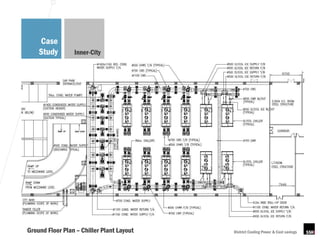
Ground Floor Plan – Chiller Plant Layout
District Cooling Power & Cost savings
Inner-City
Case
Study
Basement Plan – Pump Room Layout
Detail view
District Cooling Power & Cost savings
Inner-City
Case
Study
Ice Storage Tank Lay-out Schematic – Detail view
Images
District Cooling Power & Cost savings
Inner-City
Case
Study
Charging / Discharging Mode (Internal Melt Ice Storage)
Charging Mode
Discharging Mode
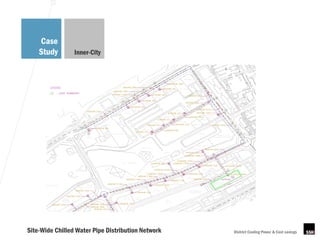
District Cooling Power & Cost savingsSite-Wide Chilled Water Pipe Distribution Network
Inner-City
Case
Study
District Cooling Power & Cost savings
Case
Study Inner-City
Power & Energy
District Cooling Power & Cost savings
Inner-City
Case
Study
District Cooling Power & Cost savings
Inner-City
Case
Study
District Cooling Power & Cost savings
Plant Item Plant Cooling Capacity
KWh Ton-hr KW TR
Water Cooled Chillers 1,270,880 361,363 54,162 15,400
Glycol Chiller Capacity 419,920 119,387 30,950 8,800
Thermal Ice Storage 144,860 41,189 23,145 6,581
Total DC Plant Capacity 1,835,660 521,939 108,257 30781
Plant Efficiency – KW/TR 0.805
Inner-City
Case
Study
District Cooling Power & Cost savings
Energy Demand Profile (DCS Ice Storage vs.
Conventional Water-Cooled System)
Inner-City
Case
Study
District Cooling Power & Cost savings
Inner-City
Case
Study
Energy Demand Profile (DCS Ice Storage vs. A mix of 70% Capacity
Conventional Water-Cooled System & 30 % Air Cooled
District Cooling Power & Cost savings
Inner-City
Case
Study
District Cooling Power & Cost savings
Case
Study
Economical Consideration
&
Sustainable Design
Inner-City
District Cooling Power & Cost savings
Inner-City
Case
Study
EXCERPTS FROM LATEST MEW/R-6 REGULATION (2010)
• Clause 8.5 Use of Partial Cool Storage (Chilled Water Storage)
“Building with part-day occupancy pattern and chilled water systems serving
building peak load of 100 RT or above, partial cool storage is mandatory.
Some examples of building with part-day occupancy are: commercial offices,
community centers, schools, public offices, banks, games and sports
centers, gymnasiums, clubs etc.”
District Cooling Power & Cost savings
Inner-City
Case
Study
why District Cooling?
• Larger chiller plant better efficiency (less power)
• Better energy management through better qualified staff
• Reduces building construction cost by removing central plant and improving building
net-to-gross efficiency
• Can help improve building aesthetics
• Allows End User to better focus on core business.
• Less noise generation
District Cooling Power & Cost savings
Incentive Factors
• Pass over savings in central plant and building costs by the developer to the DC
Provider (capacity and connection charges)
• Pass over running costs savings (operation, maintenance, consumables)
• Introduce Government incentives to offset capital costs –
 allow integration of DC plants within multistory car parks or provide land
 allow incentive schemes based on DC plant efficiencies (KW/TR)
Case
Study Inner-City
District Cooling Power & Cost savings
Inner-City
Case
Study
• Match capacity of the central chiller plant with the buildings
• Select pipe sizes & material based on economical factors
• Match Primary & Secondary flow arrangements (variable flow)
• Install controls with good response times
• Provide thermal storage to help operate plant at optimum condition
• Maintain highest Chilled water ΔT possible
• Maintain highest chilled water flow temperature possible
• Use high efficiency motors
• Consider Variable speed cooling tower fans
• Use Water conservation and backwash recovery
Sustainable Design Considerations
District Cooling Power & Cost Savings
Animation
03
District Cooling Power & Cost savings
Animation
District
Cooling
District Cooling Power & Cost savings
Thank you

District cooling design & case study

  • 1.
    District Cooling Power& Cost savings January 2011 Designing for Life District Cooling Power & Cost Saving
  • 2.
    District Cooling Power& Cost savings District Cooling Power and Cost savings Main Heading Table of Contents 01. District Cooling 02. Case Studies 03. Animation
  • 3.
    District Cooling Power& Cost Savings District Cooling 01
  • 4.
    District Cooling Power& Cost savings Description Involves the provision of cooling for multiple buildings or facilities from one or more central plant via a pipe network. District Cooling History Large District Cooling applications started in the 1930s for the Rockefeller Center and United States Capitol Complex.
  • 5.
    District Cooling Power& Cost savings District Cooling Piping Distribution DC Plant Pipes Valve Chamber ETS
  • 6.
    District Cooling Power& Cost savings District Cooling Pipes in Tunnel Pipes in Trench Pipes in Tunnel Pipes in Tunnel with Branch-out
  • 7.
    District Cooling Power& Cost savings District Cooling Valve Chamber
  • 8.
    District Cooling Power& Cost savings District Cooling Energy Transfer Station Heat Exchanger Schematic - Energy Transfer Station with Heat Exchanger to Apartment Block
  • 9.
    District Cooling Power& Cost savings District Cooling District Plant Chiller Plant at Ground Level Pumps in BasementCooling Tower at Roof Level Vertical Arrangement DC Plant – Verticle Arrangement
  • 10.
    District Cooling Power& Cost savings District Cooling District Plant Cooling Towers – Horizontal Arrangement Kuwait University
  • 11.
    District Cooling Power& Cost savings District Cooling District Plant DC Plant– Horizontal Arrangement (Kuwait University)
  • 12.
    District Cooling Power& Cost savings Ice Storage Tank District Cooling Thermal Storage 1. Chilled Water 2. Ice 3. Eutectic Salts Pre-stressed Concrete Tank Thermal Energy Storage
  • 13.
    District Cooling Power& Cost savings District Cooling District Plant District Cooling Plant – Architecture
  • 14.
    District Cooling Power& Cost Savings Case Study 02 • Residential Areas • Inner-City
  • 15.
    District Cooling Power& Cost savings Residential Area Case Study based on Jaber Al-Ahmad City (Areas B & A5)
  • 16.
    District Cooling Power& Cost savings Residential Area- Design Basis Case Study Cooling Loads – Estimation Basis
  • 17.
    District Cooling Power& Cost savings Case Study Residential Areas Number of Houses = 1836 Estimated built up area of housing = 1,560,600 m2 (95% of total Built up area) Total Built up area including Mosques, Schools, Clinic, Shopping centre, Bank, Office Buildings etc. = 1,645,438 m2 Chiller plant capacity = 36,790 TR Thermal Storage = 4879.6 TR (11.7% of total) TOTAL DISTRICT COOLING PLANT CAPACITY = 41,670 TR
  • 18.
    District Cooling Power& Cost savings Case Study Residential Areas Plant Arrangement & Chilled Water Distribution
  • 19.
    District Cooling Power& Cost savings Residential Areas Case Study Roof Plan Overall Area = 136m x 40m Foot Print = 7.66 M2/TR
  • 20.
    District Cooling Power& Cost savings Residential Areas Case Study Ground Floor Plan
  • 21.
    District Cooling Power& Cost savings Residential Areas Case Study Enlarged view Basement Floor Plan
  • 22.
    District Cooling Power& Cost savings Residential Areas Case Study Enlarged View - Basement Plan
  • 23.
    District Cooling Power& Cost savings Residential Areas Case Study Site Plan - Chilled Water Distribution Enlarged view
  • 24.
    District Cooling Power& Cost savings Residential Areas Case Study Site Plan Enlarged view - Chilled Water Distribution
  • 25.
    District Cooling Power& Cost savings Residential Areas Case Study Chilled Water Network Flow Simulation
  • 26.
    District Cooling Power& Cost savings Residential Areas Case Study Typical Cross Section of Local Road with Bldg. Connection
  • 27.
    District Cooling Power& Cost savings Chilled Water Pipe Network • System Static Pressure - 6 bar • Pressure difference between closest and furthest node is 24m. Residential Areas Case Study
  • 28.
    District Cooling Power& Cost savings Chilled Water Temperature Increase • Calculations indicate that water temperature increase over the longest route is 0.3 deg-C • The calculations were based on Supply at 5.0 Deg-C, Return at 14.0 Deg-C • Loss in thermal energy due to pipe-work distribution is approximately 1 % overall Residential Areas Case Study
  • 29.
    District Cooling Power& Cost savings Case Study Residential Area Power & Energy
  • 30.
    District Cooling Power& Cost savings Case Study Residential Area- Cooling Load
  • 31.
    District Cooling Power& Cost savings Case Study Residential Area- Cooling Load
  • 32.
    District Cooling Power& Cost savings Case Study Discharging Mode Charging Mode Charging / Discharging Mode (TES Tank) Residential Areas
  • 33.
    District Cooling Power& Cost savings Case Study Residential Area- Cooling Load District Cooling Efficiency With TES = 0.86 KW/TR Without TES = 1.00 KW/TR Based on R-134a Refrigerant Conventional Air Cooled Systems (excluding Indoor Units) Efficiency = 1.6 - 1.8 KW/TR (peak load/peak cooling) Assume Air Distribution Equipment Efficiency = 0.2 KW/TR Based on R22 Refrigerant and equivalent diverse electrical load PEAK POWER SAVING = 50% (on average)
  • 34.
    District Cooling Power& Cost savings Case Study Residential Area- Cooling Load Annual DCS Energy Demand = 101.9 GWh Annual Air Cooled System Energy Demand = 182.2 GWh Yearly Energy Saving = 40% on average when compared with conventional Air-cooled systems (1.6-1.8 kW/TR) District Cooling vs. Air cooled Energy Demand
  • 35.
    District Cooling Power& Cost savings Peak Daily Demand Total Demand = 7048 m3 Yearly Demand Fresh Water Demand = 1,156,000 m3 If TSE is utilized = 1,502,800m3 Sea Water can be utilized for installations near the sea Case Study Residential Area- Water Demand
  • 36.
    District Cooling Power& Cost savings CODE OF PRACTICE MEW/R-6 (Revised) • Clause 8.8 District Cooling states "District cooling shall be applied for new townships, university campuses and similar neighborhood, in view of its proven advantage for energy saving and peak load shaving. HVAC design report shall include detailed feasibility study highlighting energy savings potential and cost effectiveness over a 30 year life for plant and equipment” Residential Areas Case Study
  • 37.
    District Cooling Power& Cost savings Residential Areas Case Study Electicity Cost VS Fuel Cost 0 10 20 30 40 50 60 70 80 90 0 20 40 60 80 100 120 Barrel of Oil Cost ($) ElectricityUnitCost(Fills/KW-Hr) Fuel Cost Transmission Cost Opportunity Costs
  • 38.
    District Cooling Power& Cost savings Residential Areas Case Study Power Plant Savings SavedPower (50% saving) 39,586 KW Capital Costs Power Generation 400 KD/KW 15,834,400 Distribution Saving 50 KD/KW 1,979,300 Total KD 17,813,700 Annual Energy Saving (40% on average) 73 GW-HR Power Generation & Distribution 60 Fils/Unit 4,138,000 Total KD 4,138,000
  • 39.
    District Cooling Power& Cost savings Residential Areas Case Study Water Generation Costs Cost (KD) Plant Capital Cost Peak Day Water Requirement 7048 M3 Desalination Cost - RO Plant @ 820 KD/m3 5,779,360 Production & Distribution Annual Water Requirement 1,156,000 M3 Fresh Water Cost @ 768 (3,494) Fils/M3 (1000 Gal) 887,808
  • 40.
    District Cooling Power& Cost savings Capital and Running Cost Savings Potential Savings in Capital Cost = KD12,034,340 Potential Savings (Opportunity) = KD 3,250,192/year @ 90$ US/barrel Case Study Case Study Residential Areas
  • 41.
    District Cooling Power& Cost savings Case Study Residential Areas Extract from MEW R-6 “HVAC design report shall include detailed feasibility study highlighting energy savings potential and cost effectiveness over a 30 year life for plant and equipment” Suggested incentives to achieve cost effectiveness  Passover some of the savings by Government to the DC Provider  Pass over some of the capital savings by:  Covering cost of chilled water pipe installation (same as other piped utilities)  Provide land (as for sub-stations)  Set chilled water generation charges based on ‘unsubsidized rates’ with incentives linked to production efficiencies
  • 42.
    District Cooling Power& Cost savings Residential Areas Case Study The Main Environmental Benefits • Smaller Carbon Emission Foot Print • Energy Conservation • Less Noise From Air- Cooled Units • Less Thermal Impact on Local Environment • Better usage of built space (roof garden etc.) • More Efficient Temperature Control
  • 43.
    District Cooling Power& Cost savings Residential Areas Case Study Carbon Emission Savings • Every MW-Hr Demand Produces 0.788 Tons of CO2 • 41,700TR DC Plant Reduces CO2 Emission by 65,800 Tons per Year
  • 44.
    District Cooling Power& Cost savings Inner-City Inner-City Area Design Case Study based on Abdullah Al-Ahmed Street
  • 45.
    District Cooling Power& Cost savings Inner-City Case Study Perspective – Abdullah Al-Ahmed Street
  • 46.
    District Cooling Power& Cost savings Inner-City Case Study
  • 47.
    District Cooling Power& Cost savings Building Type Built Up Area (m2) Residential 124,630 Offices 436,800 Commercial 133,463 Total 694,463 Inner-City Case Study
  • 48.
    District Cooling Power& Cost savingsDC Plant integrated in Car Park Building to optimize on Parcel Usage Inner-City Case Study
  • 49.
    District Cooling Power& Cost savings Inner-City Case Study Ground Floor Plan – Chiller Plant Layout
  • 50.
    District Cooling Power& Cost savings Inner-City Case Study Basement Plan – Pump Room Layout Detail view
  • 51.
    District Cooling Power& Cost savings Inner-City Case Study Ice Storage Tank Lay-out Schematic – Detail view Images
  • 52.
    District Cooling Power& Cost savings Inner-City Case Study Charging / Discharging Mode (Internal Melt Ice Storage) Charging Mode Discharging Mode
  • 53.
    District Cooling Power& Cost savingsSite-Wide Chilled Water Pipe Distribution Network Inner-City Case Study
  • 54.
    District Cooling Power& Cost savings Case Study Inner-City Power & Energy
  • 55.
    District Cooling Power& Cost savings Inner-City Case Study
  • 56.
    District Cooling Power& Cost savings Inner-City Case Study
  • 57.
    District Cooling Power& Cost savings Plant Item Plant Cooling Capacity KWh Ton-hr KW TR Water Cooled Chillers 1,270,880 361,363 54,162 15,400 Glycol Chiller Capacity 419,920 119,387 30,950 8,800 Thermal Ice Storage 144,860 41,189 23,145 6,581 Total DC Plant Capacity 1,835,660 521,939 108,257 30781 Plant Efficiency – KW/TR 0.805 Inner-City Case Study
  • 58.
    District Cooling Power& Cost savings Energy Demand Profile (DCS Ice Storage vs. Conventional Water-Cooled System) Inner-City Case Study
  • 59.
    District Cooling Power& Cost savings Inner-City Case Study Energy Demand Profile (DCS Ice Storage vs. A mix of 70% Capacity Conventional Water-Cooled System & 30 % Air Cooled
  • 60.
    District Cooling Power& Cost savings Inner-City Case Study
  • 61.
    District Cooling Power& Cost savings Case Study Economical Consideration & Sustainable Design Inner-City
  • 62.
    District Cooling Power& Cost savings Inner-City Case Study EXCERPTS FROM LATEST MEW/R-6 REGULATION (2010) • Clause 8.5 Use of Partial Cool Storage (Chilled Water Storage) “Building with part-day occupancy pattern and chilled water systems serving building peak load of 100 RT or above, partial cool storage is mandatory. Some examples of building with part-day occupancy are: commercial offices, community centers, schools, public offices, banks, games and sports centers, gymnasiums, clubs etc.”
  • 63.
    District Cooling Power& Cost savings Inner-City Case Study why District Cooling? • Larger chiller plant better efficiency (less power) • Better energy management through better qualified staff • Reduces building construction cost by removing central plant and improving building net-to-gross efficiency • Can help improve building aesthetics • Allows End User to better focus on core business. • Less noise generation
  • 64.
    District Cooling Power& Cost savings Incentive Factors • Pass over savings in central plant and building costs by the developer to the DC Provider (capacity and connection charges) • Pass over running costs savings (operation, maintenance, consumables) • Introduce Government incentives to offset capital costs –  allow integration of DC plants within multistory car parks or provide land  allow incentive schemes based on DC plant efficiencies (KW/TR) Case Study Inner-City
  • 65.
    District Cooling Power& Cost savings Inner-City Case Study • Match capacity of the central chiller plant with the buildings • Select pipe sizes & material based on economical factors • Match Primary & Secondary flow arrangements (variable flow) • Install controls with good response times • Provide thermal storage to help operate plant at optimum condition • Maintain highest Chilled water ΔT possible • Maintain highest chilled water flow temperature possible • Use high efficiency motors • Consider Variable speed cooling tower fans • Use Water conservation and backwash recovery Sustainable Design Considerations
  • 66.
    District Cooling Power& Cost Savings Animation 03
  • 67.
    District Cooling Power& Cost savings Animation District Cooling
  • 68.
    District Cooling Power& Cost savings Thank you