Civil and Environmental Research                                                                         www.iiste.org
ISSN 2222-1719 (Paper) ISSN 2222-2863 (Online)
Vol 2, No.2, 2012


Research on the Concrete Dam Damage and Failure Rule under the
                 Action of Fluid-Solid Coupling
                                                 Ke Ming Sun, Moj Raj Bagale
                           Liaoning Technical University, Fuxin, Liaoning province P.R China
                       Emails of the authors: sskkmm11@163.com, mojrajbagale@yahoo.com

Abstract
This paper evaluates the stability of concrete dam under the action of fluid-solid coupling in the two working
conditions of water level raising and rainfall intensity increasing with the method of strength reduction, and the
conclusions are revealed as follows: The unstable failure of dam always starts from the slope base, the crack on the
slope top and the creep slip in the slop base developed, which led to the gradual destruction of the dam and formed
the slip surfaces through the dam; the safety factor of the concrete dam reduced and the potential slip surfaces
moved to the inside of the dam with the water level raising; the more rainfall intensity, the larger plastic yield region
and the lower safety factor will be, and the dam slip surfaces transferred from the base of slope to the inside of the
slope top gradually.

Keywords: Fluid-Solid Coupling; Damage Failure; Rainfall Intensity; Concrete Dam; Creep Slip; Safety Factor


1. Introduction
At present, landslide phenomenon caused by slope instability has become one of the three severe geological
disasters in the world. According to statistics, the loss caused by landslide is as much as hundreds of millions of
dollars every year, and harm the people's safety and property seriously. The main problem of landslide is the seepage
failure for the embankment, rivers and reservoirs bank slope and the earth-rock dam. The main factor induced to
slope instability is the action of water. So, it has important engineering value to analyze the dam slope stability under
the interaction of fluid-solid coupling.


2. Concrete Dam Body Seepage Field And Stress Field Coupling Mathematical Model
The dam seepage field and stress field is a mutual influence, interaction of the organic whole, the two are coupling .

2.1 The Dam Body Stress Field Mathematical Model
Take a feature in the infinitesimal body in the dam, if the volume force is only considering the gravity and fluid
penetration, z direction and the gravity direction, stress to pressure.
(1) Balance Equation

                                                '
                                              σ ij j + ∇p + fi = 0
                                                  ,
                                                                                                                      (1)
                       '
Where: p , f and σ ij are the hydrostatic seepage pressure, seepage force vector and effective stress respectively.
(2) Constitutive Equation

                       τ f = c ' + (σ − p ) tan ϕ ' = c ' + σ ' tan ϕ '                                               (2)
           '                                                                          '
Where: c is soil cohesion,        ϕ ' is   soil effective angle of internal friction, σ is effect of shear surface in the

effective normal stress.
(3) Geometrical Equations


                                                              1
Civil and Environmental Research                                                                                    www.iiste.org
ISSN 2222-1719 (Paper) ISSN 2222-2863 (Online)
Vol 2, No.2, 2012

                                                                1
                                                       ε ij =     (ui ,j + uj .i )                                              (3)
                                                                2
Where: ε ij is the strain[1-3].
(4) Stress Boundary Condition

                                     σ ij Lj = s i(x ,y ,z ) , (x ,y ,z ) ∈ S 1
                                                                                          ,                                     (4)
                                     u i = g i(x ,y ,z ,t ) ,          (x ,y ,z ) ∈ S 2
Where,   g i(x ,y ,z ,t )        is the surface displacement on the boundary          S2      of known function.   s i(x ,y ,z ) is
the surface forces on the boundary           S1   of known function.


2.2 Mathematical model of the dam seepage

In practical engineering, often have to consider water, pumping, rainfall and evaporation conditions. We can add in

the basic equations to be considered the source and sink items I can get:

(1) Seepage Continuity Equation


                                 ∂( ρv x ) ∂( ρv y ) ∂( ρv z )        ∂ρn
                                          +         +          +I = −                                                           (5)
                                    ∂x        ∂y        ∂z             ∂t
(2) Initial Conditions

Initial conditions in a given time (usually expressed as t = 0) the D value of each point of the head, namely:


                          H (x ,y ,z ,t )t = 0 = H 0(x ,y ,z ),(x ,y ,z ) ∈ D                                                   (6)


Where,   H0   is on   D   , the known functions.

(3) Boundary Conditions[4-6]


                           H (x , y ,z ,t ) S = H ∗(x , y ,z ,t ),(x , y ,z ) ∈ S 1                                             (7)
                                                   1


Where    H (x ,y ,z ,t )        indicates    S1    point on the boundary (x, y, z) at time the head,        H ∗(x ,y ,z ,t ) is a
known function on     S1    .

                                      ∂H
                                kn                = q ∗ (x , y ,z ,t ),(x , y ,z ) ∈ S 2                                        (8)
                                      ∂n    S2

Where,   kn   is the boundary normal direction of the permeability coefficient, n is the boundary normal direction,

q ∗ (x , y ,z ,t ) is on the S 2           known functions.


                                                                       2
Civil and Environmental Research                                                                           www.iiste.org
ISSN 2222-1719 (Paper) ISSN 2222-2863 (Online)
Vol 2, No.2, 2012

                                                          ∂H
                                                             + αH = β                                                (9)
                                                          ∂n
Where, α   β    are known functions on the boundary, the second boundary known as the third type of boundary or

mixed border.


3 Model establishment and analysis of concrete dam

A reservoir staunch that is shown as fig.1 is built of concrete materials. There is no crack instability and signs

including no bad geological process.


3.1 Calculation related conditions

We set the horizontal and vertical two constraints in the bottom of the dam foundation. In contact with water on the

boundary of the added pore pressure boundary, through to the definition of drainage boundary, it can satisfy the face

completely saturated area and unsaturated area in the boundary, the pore pressure is zero [7-9]. The concrete material

parameters are shown in table 1.


                                  Table 1 Basic mechanics parameters of the dam

                      ρ [ Kg / m 3 ]      E[GPa]             µ         k[cm/s]   γ w [ kN / m 3 ]   e

                         2500                  30           0.35       1E-007         9.8           1


                                Water


                                                    55m
                53m                     Dam
                                                            Water

                         17m            Base
                                                            12m
                                       146m


                         Fig. 1 Slope of the dam                       Fig. 2 Computational grid diagram

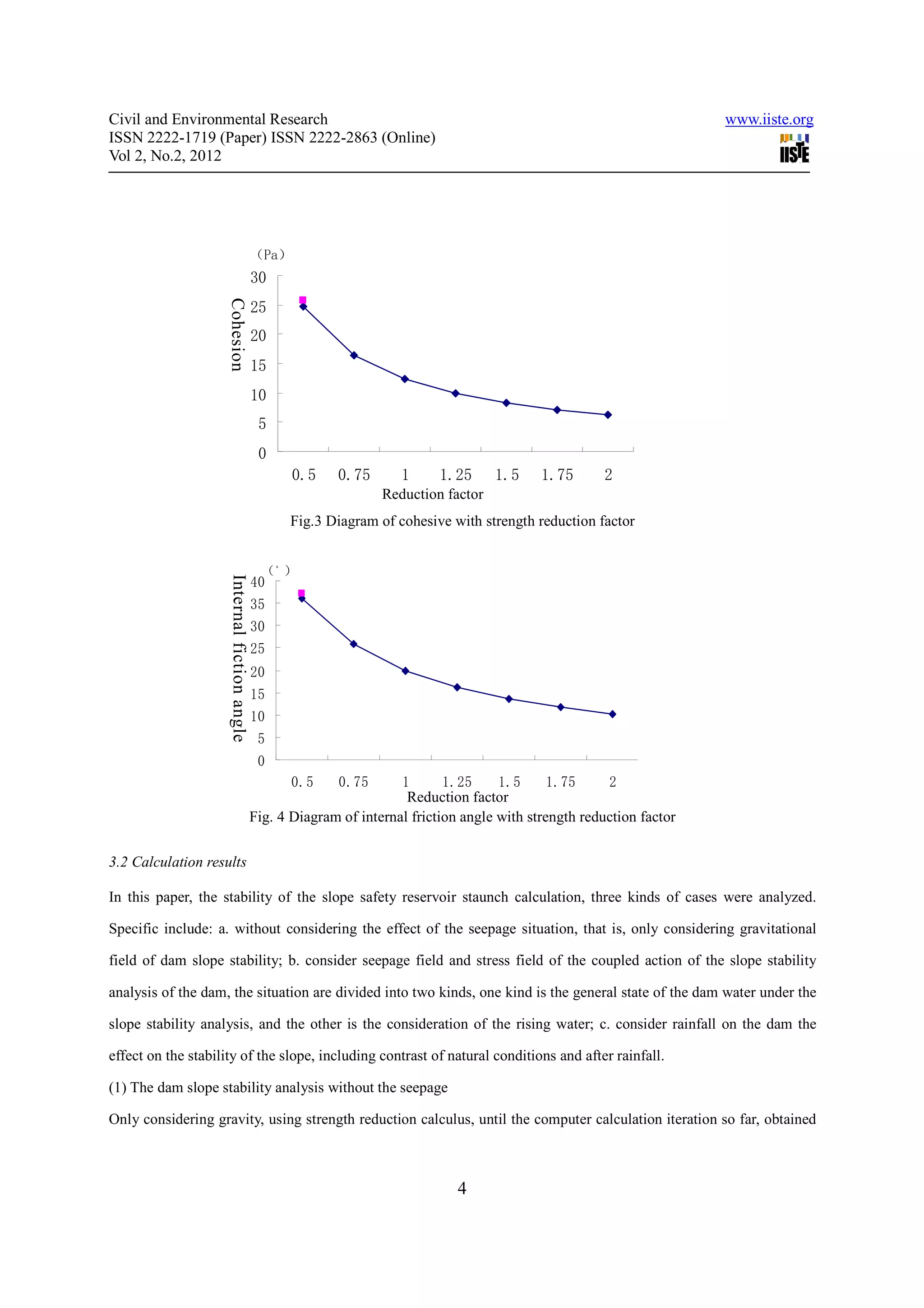
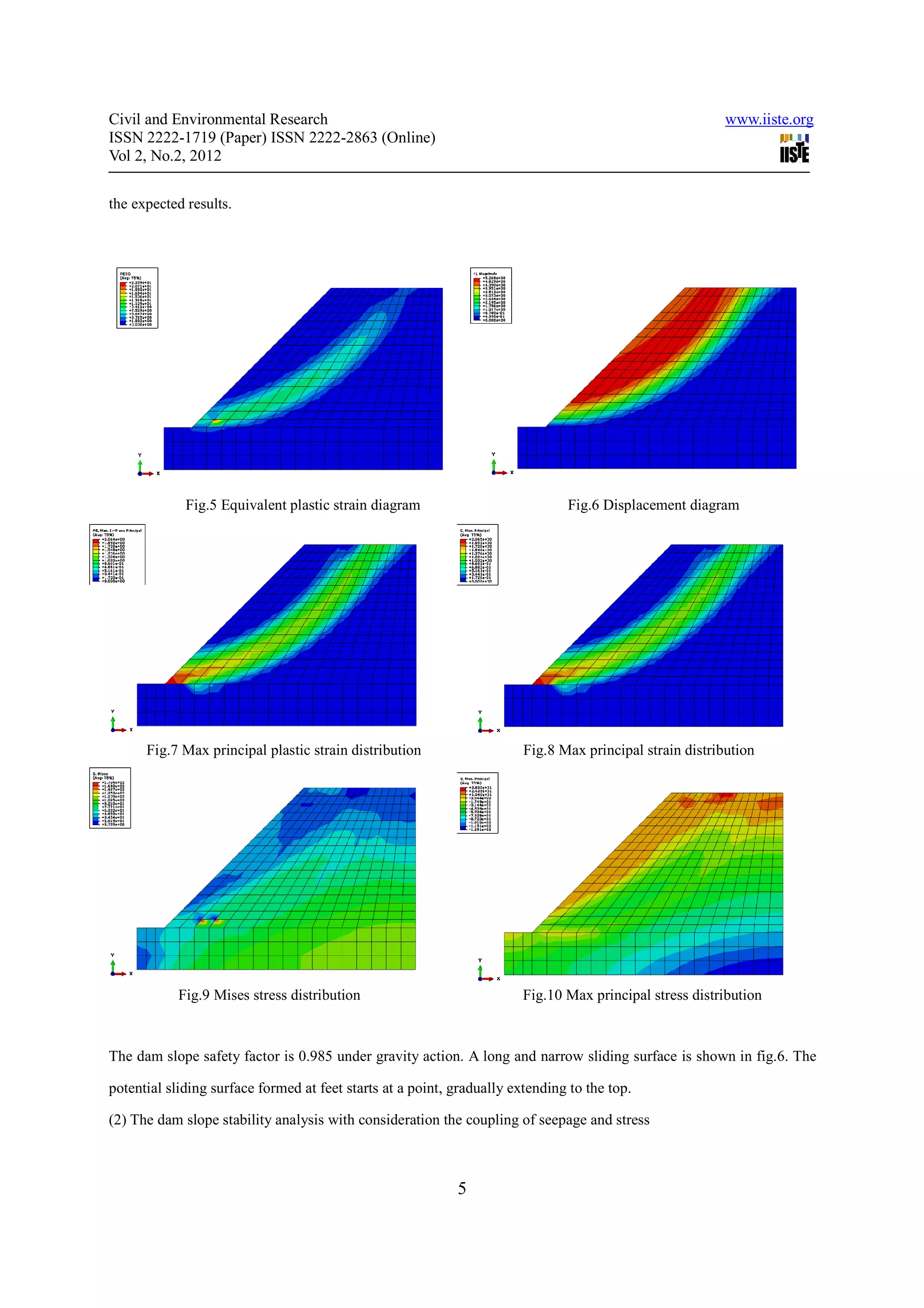
The cohesion and inner friction angle with the reduction coefficient function is shown below.


                                                                   3
Civil and Environmental Research                                                                                         www.iiste.org
ISSN 2222-1719 (Paper) ISSN 2222-2863 (Online)
Vol 2, No.2, 2012


                                              (Pa)
                                              30
                     Cohesion


                                              25
                                              20
                    粘聚力


                                              15
                                              10
                                               5
                                               0
                                                       0.5    0.75       1     1.25     1.5    1.75       2
                                                                     Reduction factor
                                                                           折减系数
                                                       Fig.3 Diagram of cohesive with strength reduction factor

                                                   。
                                                ( )
                                              40
                     Internal fiction angle


                                              35
                                              30
                                              25
                     内摩擦角


                                              20
                                              15
                                              10
                                               5
                                               0
                                                       0.5    0.75     1       1.25     1.5      1.75     2
                                                                             折减系数
                                                                        Reduction factor
                                              Fig. 4 Diagram of internal friction angle with strength reduction factor

3.2 Calculation results

In this paper, the stability of the slope safety reservoir staunch calculation, three kinds of cases were analyzed.

Specific include: a. without considering the effect of the seepage situation, that is, only considering gravitational

field of dam slope stability; b. consider seepage field and stress field of the coupled action of the slope stability

analysis of the dam, the situation are divided into two kinds, one kind is the general state of the dam water under the

slope stability analysis, and the other is the consideration of the rising water; c. consider rainfall on the dam the

effect on the stability of the slope, including contrast of natural conditions and after rainfall.

(1) The dam slope stability analysis without the seepage

Only considering gravity, using strength reduction calculus, until the computer calculation iteration so far, obtained


                                                                                  4
Civil and Environmental Research                                                                          www.iiste.org
ISSN 2222-1719 (Paper) ISSN 2222-2863 (Online)
Vol 2, No.2, 2012

the expected results.


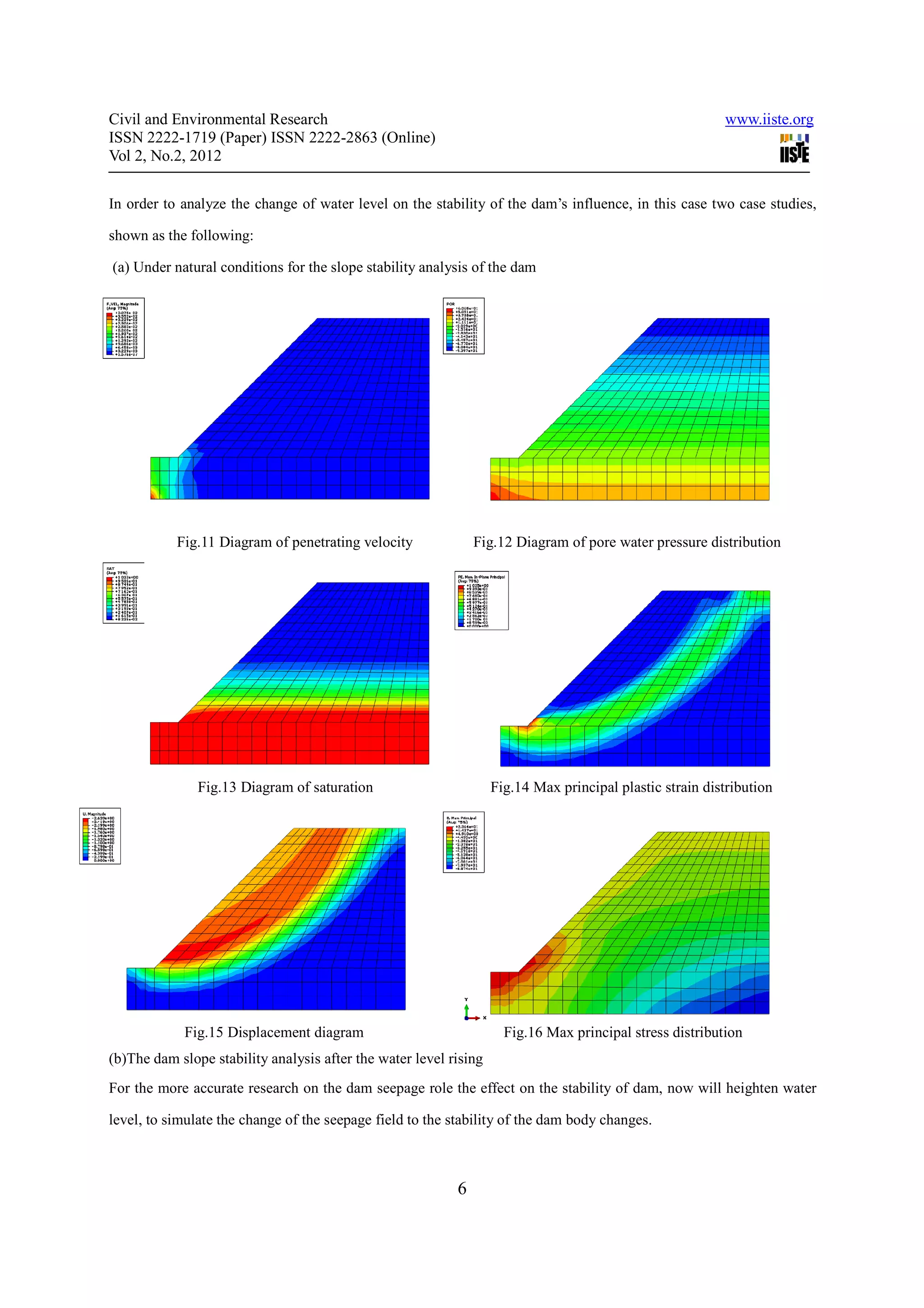
             Fig.5 Equivalent plastic strain diagram                           Fig.6 Displacement diagram


      Fig.7 Max principal plastic strain distribution                   Fig.8 Max principal strain distribution


            Fig.9 Mises stress distribution                             Fig.10 Max principal stress distribution


The dam slope safety factor is 0.985 under gravity action. A long and narrow sliding surface is shown in fig.6. The

potential sliding surface formed at feet starts at a point, gradually extending to the top.

(2) The dam slope stability analysis with consideration the coupling of seepage and stress


                                                            5
Civil and Environmental Research                                                                          www.iiste.org
ISSN 2222-1719 (Paper) ISSN 2222-2863 (Online)
Vol 2, No.2, 2012

In order to analyze the change of water level on the stability of the dam’s influence, in this case two case studies,

shown as the following:

(a) Under natural conditions for the slope stability analysis of the dam


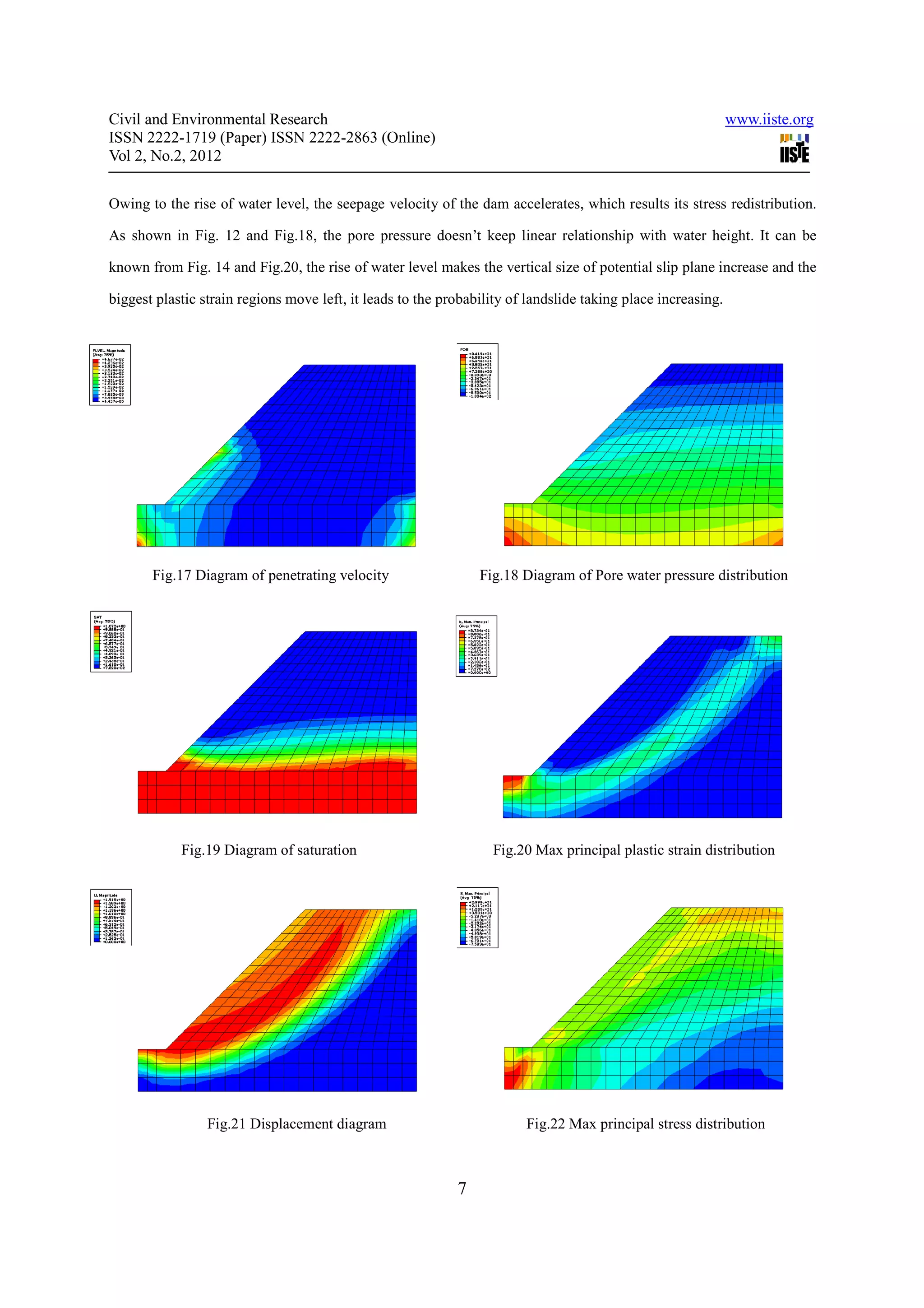
           Fig.11 Diagram of penetrating velocity              Fig.12 Diagram of pore water pressure distribution


               Fig.13 Diagram of saturation                        Fig.14 Max principal plastic strain distribution


            Fig.15 Displacement diagram                              Fig.16 Max principal stress distribution
(b)The dam slope stability analysis after the water level rising
For the more accurate research on the dam seepage role the effect on the stability of dam, now will heighten water

level, to simulate the change of the seepage field to the stability of the dam body changes.


                                                           6
Civil and Environmental Research                                                                              www.iiste.org
ISSN 2222-1719 (Paper) ISSN 2222-2863 (Online)
Vol 2, No.2, 2012

Owing to the rise of water level, the seepage velocity of the dam accelerates, which results its stress redistribution.

As shown in Fig. 12 and Fig.18, the pore pressure doesn’t keep linear relationship with water height. It can be

known from Fig. 14 and Fig.20, the rise of water level makes the vertical size of potential slip plane increase and the

biggest plastic strain regions move left, it leads to the probability of landslide taking place increasing.


       Fig.17 Diagram of penetrating velocity                   Fig.18 Diagram of Pore water pressure distribution


            Fig.19 Diagram of saturation                          Fig.20 Max principal plastic strain distribution


                 Fig.21 Displacement diagram                            Fig.22 Max principal stress distribution


                                                            7
Civil and Environmental Research                                                                        www.iiste.org
ISSN 2222-1719 (Paper) ISSN 2222-2863 (Online)
Vol 2, No.2, 2012


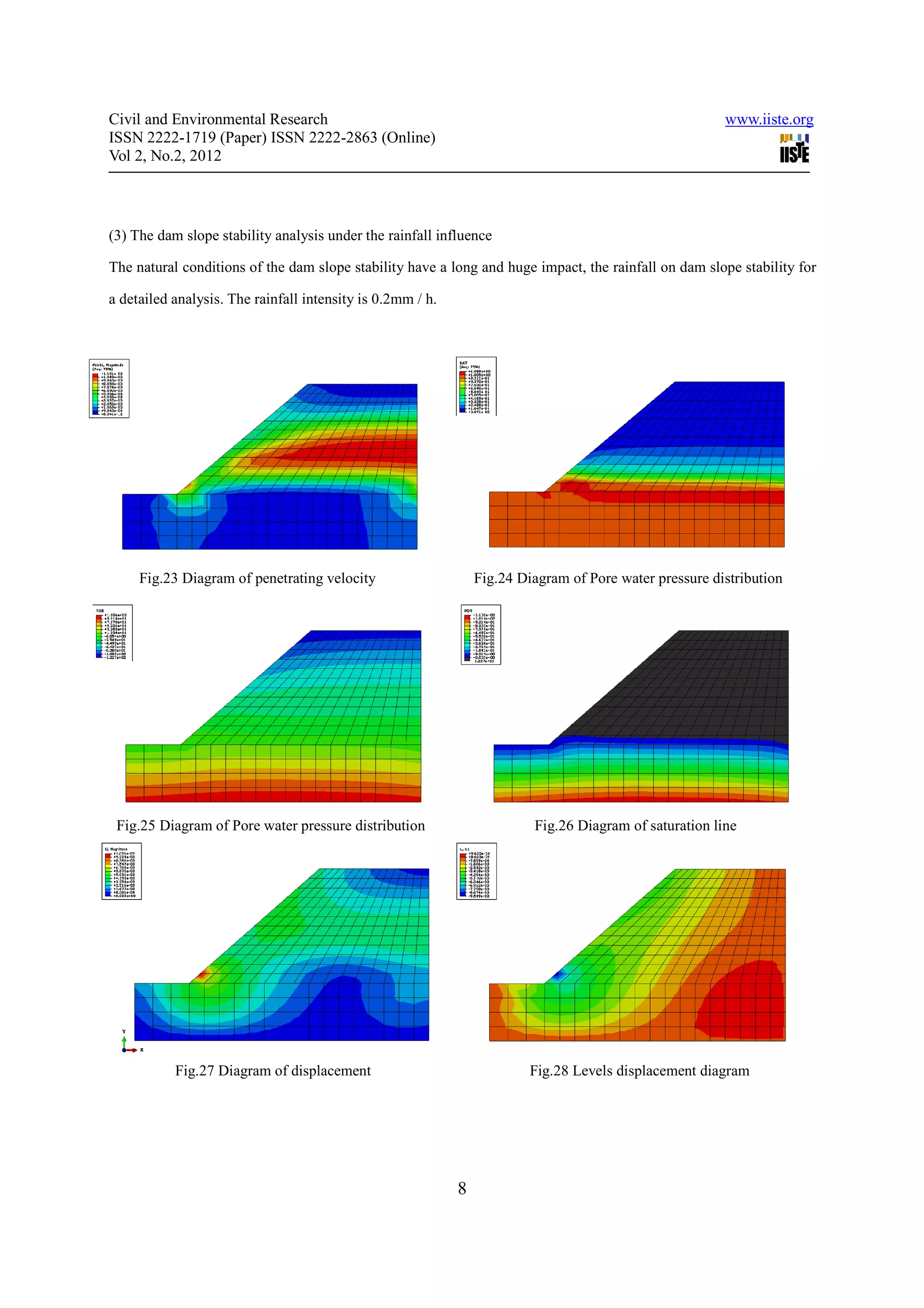
(3) The dam slope stability analysis under the rainfall influence

The natural conditions of the dam slope stability have a long and huge impact, the rainfall on dam slope stability for

a detailed analysis. The rainfall intensity is 0.2mm / h.


     Fig.23 Diagram of penetrating velocity                     Fig.24 Diagram of Pore water pressure distribution


 Fig.25 Diagram of Pore water pressure distribution                      Fig.26 Diagram of saturation line


           Fig.27 Diagram of displacement                                Fig.28 Levels displacement diagram


                                                            8
Civil and Environmental Research                                                                       www.iiste.org
ISSN 2222-1719 (Paper) ISSN 2222-2863 (Online)
Vol 2, No.2, 2012


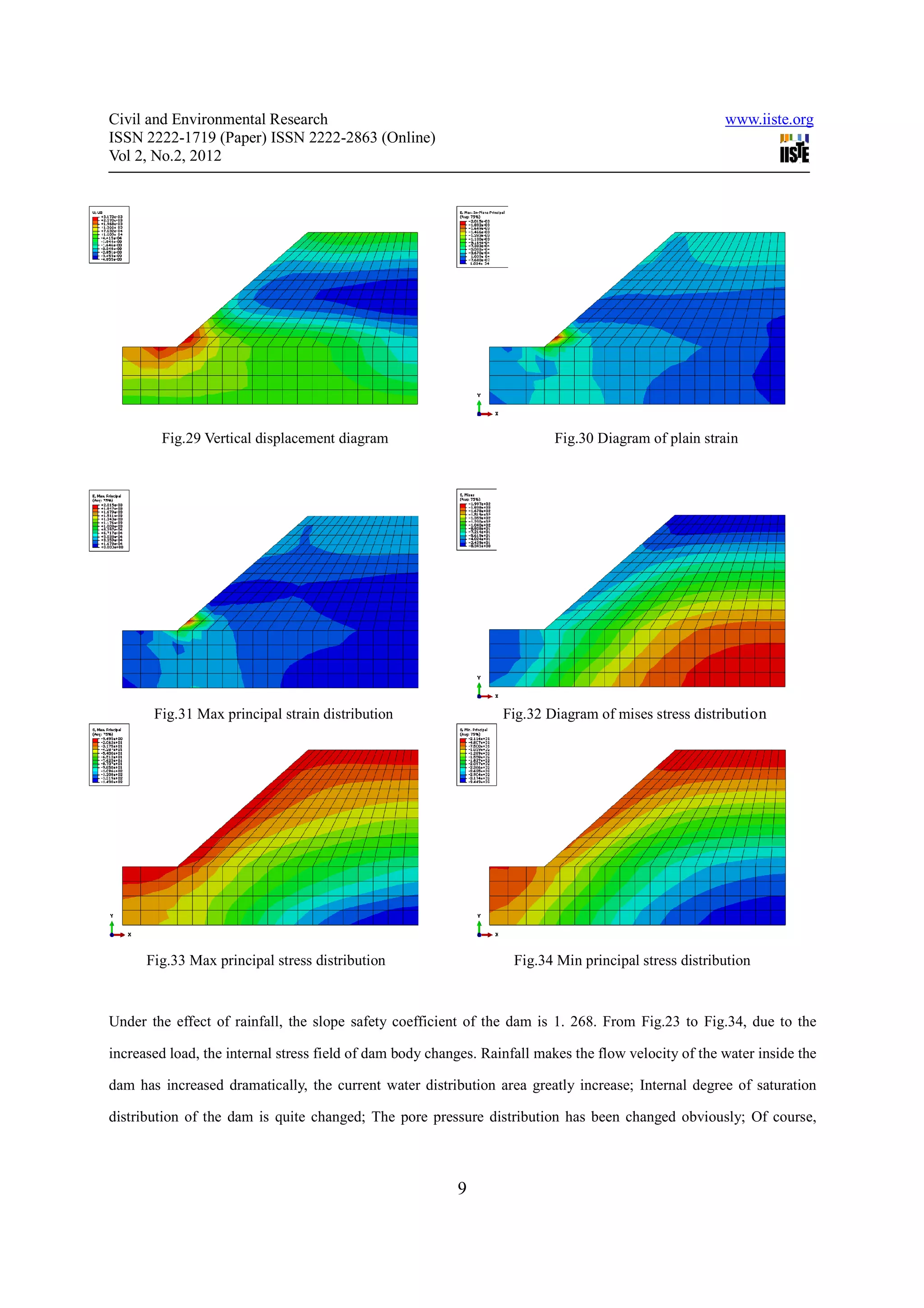
        Fig.29 Vertical displacement diagram                              Fig.30 Diagram of plain strain


       Fig.31 Max principal strain distribution                   Fig.32 Diagram of mises stress distribution


      Fig.33 Max principal stress distribution                      Fig.34 Min principal stress distribution


Under the effect of rainfall, the slope safety coefficient of the dam is 1. 268. From Fig.23 to Fig.34, due to the

increased load, the internal stress field of dam body changes. Rainfall makes the flow velocity of the water inside the

dam has increased dramatically, the current water distribution area greatly increase; Internal degree of saturation

distribution of the dam is quite changed; The pore pressure distribution has been changed obviously; Of course,


                                                          9
Civil and Environmental Research                                                                        www.iiste.org
ISSN 2222-1719 (Paper) ISSN 2222-2863 (Online)
Vol 2, No.2, 2012

infiltrating the position of the line also have outstanding change. This shows that rainfall makes dam of internal

seepage field generate a large changes. So the conclusion is: the internal stress field of dam body changes on the

seepage field has very big effect.


4. Summary

By analyzing the static simulation of the dam , we get the rules shown as follows:

a) The most dangerous part of the dam is the base of slope. General speaking, dam’s slope instability starts with the

base of the slope. With the development of the slope top’s tension crack and the base of slope’s creep slip, the

destruction is produced in the dam gradually. The landslide will happen when the potential sliding surface is run

through. And the more the external loads are, the easier the dam will be instability and failure, and the larger the

failure surface will be;

b) The water level has a great influence on the slope stability of the dam. The higher the water level is, the more

strong the seepage effect in the dam, the larger the deformation of the dam skeleton, the stress and the strain in the

dam is. The dam body is easier to be instable. The most dangerous point of the base of slope moves towards the left

with the rising of the water level;

c) The rainfall has a great influence on the slope stability of the dam. The rainfall impact will cause the great change

of the seepage field and the stress field, influences the stress and strain distribution of the dam, and changes the

situation of the dam skeleton’s deformation, causes the instable failure of the dam finally.


References
[1] D.G. Fredlund, A. Xing, M.D. Frudlund, et al. The relationship of the unsaturated soil shear strennth function to
the soil-water characteristic curve[J]. Canadian Geotechnical Journal. 1995
[2] D.G. Fredlund, A. Xing, S. Huang. Predicting the permeability function for unsaturated soils using the soil-water
characteristic curve. Canadian Geotechnical Journal[J]. 1994
[3] Z.Y. Chen. Analysis Methodprinciple on soil slope stability[J]. 2000
[4] H.C. Tan and A.K. Chopra. Dam-foundation rock interaction effects in frequency-response function of arch dams.
Earthquake Engineering and Structural Dynamics[J] . 1995
[5] J.W. Chavez and G.L. Fenves. Earthquake analysis of concrete gravity dams including base sliding. Earthquake
Engineering and Structural Dynamics [J]. 1995
[6] K.L. Fok and A.K.Chopra. Earthquake analysis of arch dams including dam-water interaction, reservoir
boundary absorption and foundation flexibility. Earthquake Engineering and Structural Dynamics [J]. 1986
[7] T. Touhei and T. Ohmachi. A FE-BE method for dynamic analysis of dam-foundation-reservoir system in the
time domain. Earthquake Engineering and Structural Dynamics [J]. 1993
[8] X.L. Du, J.L.Wang and T.K. Hung. Effects of sediment on the dynamic pressure of water and sediment on dams.
Chinese Science[J] . 2001


                                                          10
Civil and Environmental Research                                                                    www.iiste.org
ISSN 2222-1719 (Paper) ISSN 2222-2863 (Online)
Vol 2, No.2, 2012

[9] Q.Yang*, Y.R. Liu, Y,R. Chen and W.Y. Zhou. State Key Laboratory of Hydroscience and Hydraulic Engineering,
Tsinghua University, Beijing, 100084, China. Stability and reinforcement analyses of high arch dams by
considering deformation effects[J]. Journal of Rock Mechanics and Geotechnical Engineering. 2010(04)


Acknowledgement
Firstly, I am Moj Raj Bagale, an Author, grateful with the Chinese government for providing government
scholarship for me and secondly department of engineering mechanics of Liaoning technical university for peaceful
laboratory and sophisticated library with full of resources for research . Thirdly, I like to give thanks to highly
renowned professor sun keming who always dedicated for my thesis and this paper. Lastly, I like to say thanks to my
colleagues for their priceless help for me .
Thanks for the natural science foundation supporting whose codes are 5087405 and 11072103.


                                                       11
This academic article was published by The International Institute for Science,
Technology and Education (IISTE). The IISTE is a pioneer in the Open Access
Publishing service based in the U.S. and Europe. The aim of the institute is
Accelerating Global Knowledge Sharing.

More information about the publisher can be found in the IISTE’s homepage:
http://www.iiste.org


The IISTE is currently hosting more than 30 peer-reviewed academic journals and
collaborating with academic institutions around the world. Prospective authors of
IISTE journals can find the submission instruction on the following page:
http://www.iiste.org/Journals/

The IISTE editorial team promises to the review and publish all the qualified
submissions in a fast manner. All the journals articles are available online to the
readers all over the world without financial, legal, or technical barriers other than
those inseparable from gaining access to the internet itself. Printed version of the
journals is also available upon request of readers and authors.

IISTE Knowledge Sharing Partners

EBSCO, Index Copernicus, Ulrich's Periodicals Directory, JournalTOCS, PKP Open
Archives Harvester, Bielefeld Academic Search Engine, Elektronische
Zeitschriftenbibliothek EZB, Open J-Gate, OCLC WorldCat, Universe Digtial
Library , NewJour, Google Scholar

Research on the concrete dam damage and failure rule under the action of fluid solid coupling

  • 1.
    Civil and EnvironmentalResearch www.iiste.org ISSN 2222-1719 (Paper) ISSN 2222-2863 (Online) Vol 2, No.2, 2012 Research on the Concrete Dam Damage and Failure Rule under the Action of Fluid-Solid Coupling Ke Ming Sun, Moj Raj Bagale Liaoning Technical University, Fuxin, Liaoning province P.R China Emails of the authors: sskkmm11@163.com, mojrajbagale@yahoo.com Abstract This paper evaluates the stability of concrete dam under the action of fluid-solid coupling in the two working conditions of water level raising and rainfall intensity increasing with the method of strength reduction, and the conclusions are revealed as follows: The unstable failure of dam always starts from the slope base, the crack on the slope top and the creep slip in the slop base developed, which led to the gradual destruction of the dam and formed the slip surfaces through the dam; the safety factor of the concrete dam reduced and the potential slip surfaces moved to the inside of the dam with the water level raising; the more rainfall intensity, the larger plastic yield region and the lower safety factor will be, and the dam slip surfaces transferred from the base of slope to the inside of the slope top gradually. Keywords: Fluid-Solid Coupling; Damage Failure; Rainfall Intensity; Concrete Dam; Creep Slip; Safety Factor 1. Introduction At present, landslide phenomenon caused by slope instability has become one of the three severe geological disasters in the world. According to statistics, the loss caused by landslide is as much as hundreds of millions of dollars every year, and harm the people's safety and property seriously. The main problem of landslide is the seepage failure for the embankment, rivers and reservoirs bank slope and the earth-rock dam. The main factor induced to slope instability is the action of water. So, it has important engineering value to analyze the dam slope stability under the interaction of fluid-solid coupling. 2. Concrete Dam Body Seepage Field And Stress Field Coupling Mathematical Model The dam seepage field and stress field is a mutual influence, interaction of the organic whole, the two are coupling . 2.1 The Dam Body Stress Field Mathematical Model Take a feature in the infinitesimal body in the dam, if the volume force is only considering the gravity and fluid penetration, z direction and the gravity direction, stress to pressure. (1) Balance Equation ' σ ij j + ∇p + fi = 0 , (1) ' Where: p , f and σ ij are the hydrostatic seepage pressure, seepage force vector and effective stress respectively. (2) Constitutive Equation τ f = c ' + (σ − p ) tan ϕ ' = c ' + σ ' tan ϕ ' (2) ' ' Where: c is soil cohesion, ϕ ' is soil effective angle of internal friction, σ is effect of shear surface in the effective normal stress. (3) Geometrical Equations 1
  • 2.
    Civil and EnvironmentalResearch www.iiste.org ISSN 2222-1719 (Paper) ISSN 2222-2863 (Online) Vol 2, No.2, 2012 1 ε ij = (ui ,j + uj .i ) (3) 2 Where: ε ij is the strain[1-3]. (4) Stress Boundary Condition σ ij Lj = s i(x ,y ,z ) , (x ,y ,z ) ∈ S 1 , (4) u i = g i(x ,y ,z ,t ) , (x ,y ,z ) ∈ S 2 Where, g i(x ,y ,z ,t ) is the surface displacement on the boundary S2 of known function. s i(x ,y ,z ) is the surface forces on the boundary S1 of known function. 2.2 Mathematical model of the dam seepage In practical engineering, often have to consider water, pumping, rainfall and evaporation conditions. We can add in the basic equations to be considered the source and sink items I can get: (1) Seepage Continuity Equation ∂( ρv x ) ∂( ρv y ) ∂( ρv z ) ∂ρn + + +I = − (5) ∂x ∂y ∂z ∂t (2) Initial Conditions Initial conditions in a given time (usually expressed as t = 0) the D value of each point of the head, namely: H (x ,y ,z ,t )t = 0 = H 0(x ,y ,z ),(x ,y ,z ) ∈ D (6) Where, H0 is on D , the known functions. (3) Boundary Conditions[4-6] H (x , y ,z ,t ) S = H ∗(x , y ,z ,t ),(x , y ,z ) ∈ S 1 (7) 1 Where H (x ,y ,z ,t ) indicates S1 point on the boundary (x, y, z) at time the head, H ∗(x ,y ,z ,t ) is a known function on S1 . ∂H kn = q ∗ (x , y ,z ,t ),(x , y ,z ) ∈ S 2 (8) ∂n S2 Where, kn is the boundary normal direction of the permeability coefficient, n is the boundary normal direction, q ∗ (x , y ,z ,t ) is on the S 2 known functions. 2
  • 3.
    Civil and EnvironmentalResearch www.iiste.org ISSN 2222-1719 (Paper) ISSN 2222-2863 (Online) Vol 2, No.2, 2012 ∂H + αH = β (9) ∂n Where, α β are known functions on the boundary, the second boundary known as the third type of boundary or mixed border. 3 Model establishment and analysis of concrete dam A reservoir staunch that is shown as fig.1 is built of concrete materials. There is no crack instability and signs including no bad geological process. 3.1 Calculation related conditions We set the horizontal and vertical two constraints in the bottom of the dam foundation. In contact with water on the boundary of the added pore pressure boundary, through to the definition of drainage boundary, it can satisfy the face completely saturated area and unsaturated area in the boundary, the pore pressure is zero [7-9]. The concrete material parameters are shown in table 1. Table 1 Basic mechanics parameters of the dam ρ [ Kg / m 3 ] E[GPa] µ k[cm/s] γ w [ kN / m 3 ] e 2500 30 0.35 1E-007 9.8 1 Water 55m 53m Dam Water 17m Base 12m 146m Fig. 1 Slope of the dam Fig. 2 Computational grid diagram The cohesion and inner friction angle with the reduction coefficient function is shown below. 3
  • 4.
    Civil and EnvironmentalResearch www.iiste.org ISSN 2222-1719 (Paper) ISSN 2222-2863 (Online) Vol 2, No.2, 2012 (Pa) 30 Cohesion 25 20 粘聚力 15 10 5 0 0.5 0.75 1 1.25 1.5 1.75 2 Reduction factor 折减系数 Fig.3 Diagram of cohesive with strength reduction factor 。 ( ) 40 Internal fiction angle 35 30 25 内摩擦角 20 15 10 5 0 0.5 0.75 1 1.25 1.5 1.75 2 折减系数 Reduction factor Fig. 4 Diagram of internal friction angle with strength reduction factor 3.2 Calculation results In this paper, the stability of the slope safety reservoir staunch calculation, three kinds of cases were analyzed. Specific include: a. without considering the effect of the seepage situation, that is, only considering gravitational field of dam slope stability; b. consider seepage field and stress field of the coupled action of the slope stability analysis of the dam, the situation are divided into two kinds, one kind is the general state of the dam water under the slope stability analysis, and the other is the consideration of the rising water; c. consider rainfall on the dam the effect on the stability of the slope, including contrast of natural conditions and after rainfall. (1) The dam slope stability analysis without the seepage Only considering gravity, using strength reduction calculus, until the computer calculation iteration so far, obtained 4
  • 5.
    Civil and EnvironmentalResearch www.iiste.org ISSN 2222-1719 (Paper) ISSN 2222-2863 (Online) Vol 2, No.2, 2012 the expected results. Fig.5 Equivalent plastic strain diagram Fig.6 Displacement diagram Fig.7 Max principal plastic strain distribution Fig.8 Max principal strain distribution Fig.9 Mises stress distribution Fig.10 Max principal stress distribution The dam slope safety factor is 0.985 under gravity action. A long and narrow sliding surface is shown in fig.6. The potential sliding surface formed at feet starts at a point, gradually extending to the top. (2) The dam slope stability analysis with consideration the coupling of seepage and stress 5
  • 6.
    Civil and EnvironmentalResearch www.iiste.org ISSN 2222-1719 (Paper) ISSN 2222-2863 (Online) Vol 2, No.2, 2012 In order to analyze the change of water level on the stability of the dam’s influence, in this case two case studies, shown as the following: (a) Under natural conditions for the slope stability analysis of the dam Fig.11 Diagram of penetrating velocity Fig.12 Diagram of pore water pressure distribution Fig.13 Diagram of saturation Fig.14 Max principal plastic strain distribution Fig.15 Displacement diagram Fig.16 Max principal stress distribution (b)The dam slope stability analysis after the water level rising For the more accurate research on the dam seepage role the effect on the stability of dam, now will heighten water level, to simulate the change of the seepage field to the stability of the dam body changes. 6
  • 7.
    Civil and EnvironmentalResearch www.iiste.org ISSN 2222-1719 (Paper) ISSN 2222-2863 (Online) Vol 2, No.2, 2012 Owing to the rise of water level, the seepage velocity of the dam accelerates, which results its stress redistribution. As shown in Fig. 12 and Fig.18, the pore pressure doesn’t keep linear relationship with water height. It can be known from Fig. 14 and Fig.20, the rise of water level makes the vertical size of potential slip plane increase and the biggest plastic strain regions move left, it leads to the probability of landslide taking place increasing. Fig.17 Diagram of penetrating velocity Fig.18 Diagram of Pore water pressure distribution Fig.19 Diagram of saturation Fig.20 Max principal plastic strain distribution Fig.21 Displacement diagram Fig.22 Max principal stress distribution 7
  • 8.
    Civil and EnvironmentalResearch www.iiste.org ISSN 2222-1719 (Paper) ISSN 2222-2863 (Online) Vol 2, No.2, 2012 (3) The dam slope stability analysis under the rainfall influence The natural conditions of the dam slope stability have a long and huge impact, the rainfall on dam slope stability for a detailed analysis. The rainfall intensity is 0.2mm / h. Fig.23 Diagram of penetrating velocity Fig.24 Diagram of Pore water pressure distribution Fig.25 Diagram of Pore water pressure distribution Fig.26 Diagram of saturation line Fig.27 Diagram of displacement Fig.28 Levels displacement diagram 8
  • 9.
    Civil and EnvironmentalResearch www.iiste.org ISSN 2222-1719 (Paper) ISSN 2222-2863 (Online) Vol 2, No.2, 2012 Fig.29 Vertical displacement diagram Fig.30 Diagram of plain strain Fig.31 Max principal strain distribution Fig.32 Diagram of mises stress distribution Fig.33 Max principal stress distribution Fig.34 Min principal stress distribution Under the effect of rainfall, the slope safety coefficient of the dam is 1. 268. From Fig.23 to Fig.34, due to the increased load, the internal stress field of dam body changes. Rainfall makes the flow velocity of the water inside the dam has increased dramatically, the current water distribution area greatly increase; Internal degree of saturation distribution of the dam is quite changed; The pore pressure distribution has been changed obviously; Of course, 9
  • 10.
    Civil and EnvironmentalResearch www.iiste.org ISSN 2222-1719 (Paper) ISSN 2222-2863 (Online) Vol 2, No.2, 2012 infiltrating the position of the line also have outstanding change. This shows that rainfall makes dam of internal seepage field generate a large changes. So the conclusion is: the internal stress field of dam body changes on the seepage field has very big effect. 4. Summary By analyzing the static simulation of the dam , we get the rules shown as follows: a) The most dangerous part of the dam is the base of slope. General speaking, dam’s slope instability starts with the base of the slope. With the development of the slope top’s tension crack and the base of slope’s creep slip, the destruction is produced in the dam gradually. The landslide will happen when the potential sliding surface is run through. And the more the external loads are, the easier the dam will be instability and failure, and the larger the failure surface will be; b) The water level has a great influence on the slope stability of the dam. The higher the water level is, the more strong the seepage effect in the dam, the larger the deformation of the dam skeleton, the stress and the strain in the dam is. The dam body is easier to be instable. The most dangerous point of the base of slope moves towards the left with the rising of the water level; c) The rainfall has a great influence on the slope stability of the dam. The rainfall impact will cause the great change of the seepage field and the stress field, influences the stress and strain distribution of the dam, and changes the situation of the dam skeleton’s deformation, causes the instable failure of the dam finally. References [1] D.G. Fredlund, A. Xing, M.D. Frudlund, et al. The relationship of the unsaturated soil shear strennth function to the soil-water characteristic curve[J]. Canadian Geotechnical Journal. 1995 [2] D.G. Fredlund, A. Xing, S. Huang. Predicting the permeability function for unsaturated soils using the soil-water characteristic curve. Canadian Geotechnical Journal[J]. 1994 [3] Z.Y. Chen. Analysis Methodprinciple on soil slope stability[J]. 2000 [4] H.C. Tan and A.K. Chopra. Dam-foundation rock interaction effects in frequency-response function of arch dams. Earthquake Engineering and Structural Dynamics[J] . 1995 [5] J.W. Chavez and G.L. Fenves. Earthquake analysis of concrete gravity dams including base sliding. Earthquake Engineering and Structural Dynamics [J]. 1995 [6] K.L. Fok and A.K.Chopra. Earthquake analysis of arch dams including dam-water interaction, reservoir boundary absorption and foundation flexibility. Earthquake Engineering and Structural Dynamics [J]. 1986 [7] T. Touhei and T. Ohmachi. A FE-BE method for dynamic analysis of dam-foundation-reservoir system in the time domain. Earthquake Engineering and Structural Dynamics [J]. 1993 [8] X.L. Du, J.L.Wang and T.K. Hung. Effects of sediment on the dynamic pressure of water and sediment on dams. Chinese Science[J] . 2001 10
  • 11.
    Civil and EnvironmentalResearch www.iiste.org ISSN 2222-1719 (Paper) ISSN 2222-2863 (Online) Vol 2, No.2, 2012 [9] Q.Yang*, Y.R. Liu, Y,R. Chen and W.Y. Zhou. State Key Laboratory of Hydroscience and Hydraulic Engineering, Tsinghua University, Beijing, 100084, China. Stability and reinforcement analyses of high arch dams by considering deformation effects[J]. Journal of Rock Mechanics and Geotechnical Engineering. 2010(04) Acknowledgement Firstly, I am Moj Raj Bagale, an Author, grateful with the Chinese government for providing government scholarship for me and secondly department of engineering mechanics of Liaoning technical university for peaceful laboratory and sophisticated library with full of resources for research . Thirdly, I like to give thanks to highly renowned professor sun keming who always dedicated for my thesis and this paper. Lastly, I like to say thanks to my colleagues for their priceless help for me . Thanks for the natural science foundation supporting whose codes are 5087405 and 11072103. 11
  • 12.
    This academic articlewas published by The International Institute for Science, Technology and Education (IISTE). The IISTE is a pioneer in the Open Access Publishing service based in the U.S. and Europe. The aim of the institute is Accelerating Global Knowledge Sharing. More information about the publisher can be found in the IISTE’s homepage: http://www.iiste.org The IISTE is currently hosting more than 30 peer-reviewed academic journals and collaborating with academic institutions around the world. Prospective authors of IISTE journals can find the submission instruction on the following page: http://www.iiste.org/Journals/ The IISTE editorial team promises to the review and publish all the qualified submissions in a fast manner. All the journals articles are available online to the readers all over the world without financial, legal, or technical barriers other than those inseparable from gaining access to the internet itself. Printed version of the journals is also available upon request of readers and authors. IISTE Knowledge Sharing Partners EBSCO, Index Copernicus, Ulrich's Periodicals Directory, JournalTOCS, PKP Open Archives Harvester, Bielefeld Academic Search Engine, Elektronische Zeitschriftenbibliothek EZB, Open J-Gate, OCLC WorldCat, Universe Digtial Library , NewJour, Google Scholar