DMU, IOT, Civil Engineering A/P 2023/24
Soil Mechanics II Page 1 of 17
CHAPTER FOUR
STRESS DISTRIBUTION IN SOILS
4.1. Introduction
Estimation of vertical stresses at any point in a soil-mass due to external vertical loadings are
of great significance in the prediction of settlements of buildings, bridges, embankments and many
other structures. Equations have been developed to compute stresses at any point in a soil mass on
the basis of the theory of elasticity. According to elastic theory, constant ratios exist between
stresses and strains. For the theory to be applicable, the real requirement is not that the material
necessarily be elastic, but there must be constant ratios between stresses and the corresponding
strains. Therefore, in non-elastic soil masses, the elastic theory may be assumed to hold so long as
the stresses induced in the soil mass are relatively small. Since the stresses in the subsoil of a
structure having adequate factor of safety against shear failure are relatively small in comparison
with the ultimate strength of the material, the soil may be assumed to behave elastically under such
stresses.
When a load is applied to the soil surface, it increases the vertical stresses within the soil mass.
The increased stresses are greatest directly under the loaded area, but extend indefinitely in all
directions. Many formulas based on the theory of elasticity have been used to compute stresses in
soils. They are all similar and differ only in the assumptions made to represent the elastic
conditions of the soil mass. The formulas that are most widely used are the Boussinesq and
Westergaard formulas. These formulas were first developed for point loads acting at the surface.
These formulas have been integrated to give stresses below uniform strip loads and rectangular
loads.
The loads at the surface may act on flexible or rigid footings. The stress conditions in the elastic
layer below vary according to the rigidity of the footings and the thickness of the elastic layer. All
the external loads considered are vertical loads only as the vertical loads are of practical importance
for computing settlements of foundations.
DMU, IOT, Civil Engineering A/P 2023/24
Soil Mechanics II Page 2 of 17
4.2 Boussinesq’s formula for point loads
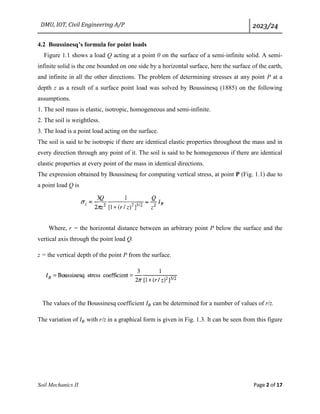
Figure 1.1 shows a load Q acting at a point 0 on the surface of a semi-infinite solid. A semi-
infinite solid is the one bounded on one side by a horizontal surface, here the surface of the earth,
and infinite in all the other directions. The problem of determining stresses at any point P at a
depth z as a result of a surface point load was solved by Boussinesq (1885) on the following
assumptions.
1. The soil mass is elastic, isotropic, homogeneous and semi-infinite.
2. The soil is weightless.
3. The load is a point load acting on the surface.
The soil is said to be isotropic if there are identical elastic properties throughout the mass and in
every direction through any point of it. The soil is said to be homogeneous if there are identical
elastic properties at every point of the mass in identical directions.
The expression obtained by Boussinesq for computing vertical stress, at point P (Fig. 1.1) due to
a point load Q is
Where, r = the horizontal distance between an arbitrary point P below the surface and the
vertical axis through the point load Q.
z = the vertical depth of the point P from the surface.
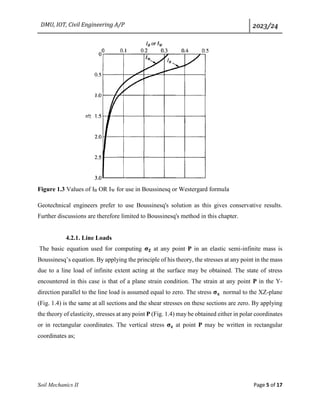
The values of the Boussinesq coefficient 𝐼𝐵 can be determined for a number of values of r/z.
The variation of 𝐼𝐵 with r/z in a graphical form is given in Fig. 1.3. It can be seen from this figure
DMU, IOT, Civil Engineering A/P 2023/24
Soil Mechanics II Page 3 of 17
Figure 1.1 Vertical stresses with in an earth mass
Stress Distribution in Soils due to Surface Loads that IB has a maximum value of 0.48 at r/z = 0,
i.e., indicating thereby that the stress is a maximum below the point load. The variation of vertical
stress due to point load with depth and horizontal distance from the point of application of the load
is shown in figure below.
Figure 1.2 a) Variation of stress with depth b) Stress distribution on horizontal
planes
Westergard's formula for point loads
DMU, IOT, Civil Engineering A/P 2023/24
Soil Mechanics II Page 4 of 17
Boussinesq assumed that the soil is elastic, isotropic and homogeneous for the development of
a point load formula. However, the soil is neither isotropic nor homogeneous. The most common
type of soils that are met in nature is the water deposited sedimentary soils. When the soil particles
are deposited in water, typical clay strata usually have their lenses of coarser materials within them.
The soils of this type can be assumed as laterally reinforced by numerous, closely spaced,
horizontal sheets of negligible thickness but of infinite rigidity, which prevent the mass as a whole
from undergoing lateral movement of soil grains. Westergaard, a British Scientist, proposed (1938)
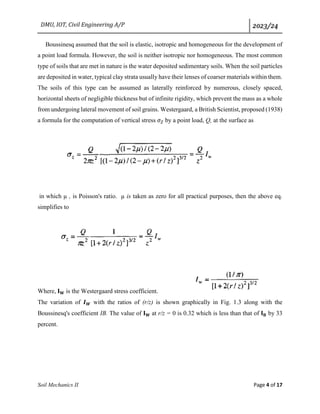
a formula for the computation of vertical stress 𝜎𝑍 by a point load, Q, at the surface as
in which µ , is Poisson's ratio. µ is taken as zero for all practical purposes, then the above eq.
simplifies to
Where, 𝐈𝐖 is the Westergaard stress coefficient.
The variation of 𝑰𝑾 with the ratios of (r/z) is shown graphically in Fig. 1.3 along with the
Boussinesq's coefficient IB. The value of 𝐈𝐖 at r/z = 0 is 0.32 which is less than that of 𝐈𝐁 by 33
percent.
DMU, IOT, Civil Engineering A/P 2023/24
Soil Mechanics II Page 5 of 17
Figure 1.3 Values of IB OR IW for use in Boussinesq or Westergard formula
Geotechnical engineers prefer to use Boussinesq's solution as this gives conservative results.
Further discussions are therefore limited to Boussinesq's method in this chapter.
4.2.1. Line Loads
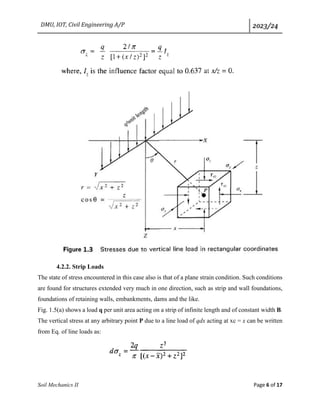
The basic equation used for computing 𝛔𝐙 at any point P in an elastic semi-infinite mass is
Boussinesq’s equation. By applying the principle of his theory, the stresses at any point in the mass
due to a line load of infinite extent acting at the surface may be obtained. The state of stress
encountered in this case is that of a plane strain condition. The strain at any point P in the Y-
direction parallel to the line load is assumed equal to zero. The stress 𝛔𝐱 normal to the XZ-plane
(Fig. 1.4) is the same at all sections and the shear stresses on these sections are zero. By applying
the theory of elasticity, stresses at any point P (Fig. 1.4) may be obtained either in polar coordinates
or in rectangular coordinates. The vertical stress 𝛔𝐳 at point P may be written in rectangular
coordinates as;
DMU, IOT, Civil Engineering A/P 2023/24
Soil Mechanics II Page 6 of 17
4.2.2. Strip Loads
The state of stress encountered in this case also is that of a plane strain condition. Such conditions
are found for structures extended very much in one direction, such as strip and wall foundations,
foundations of retaining walls, embankments, dams and the like.
Fig. 1.5(a) shows a load q per unit area acting on a strip of infinite length and of constant width B.
The vertical stress at any arbitrary point P due to a line load of qdx acting at xc = x can be written
from Eq. of line loads as:
DMU, IOT, Civil Engineering A/P 2023/24
Soil Mechanics II Page 7 of 17
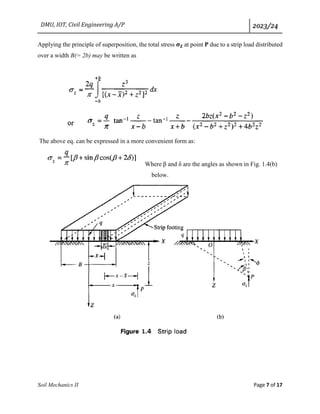
Applying the principle of superposition, the total stress 𝛔𝐙 at point P due to a strip load distributed
over a width B(= 2b) may be written as
The above eq. can be expressed in a more convenient form as:
Where β and δ are the angles as shown in Fig. 1.4(b)
below.
DMU, IOT, Civil Engineering A/P 2023/24
Soil Mechanics II Page 8 of 17
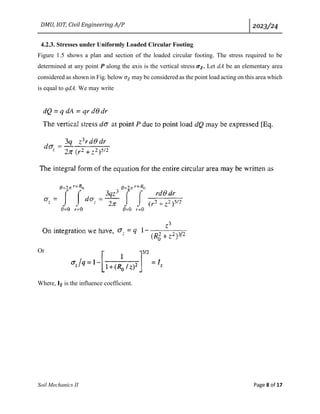
4.2.3. Stresses under Uniformly Loaded Circular Footing
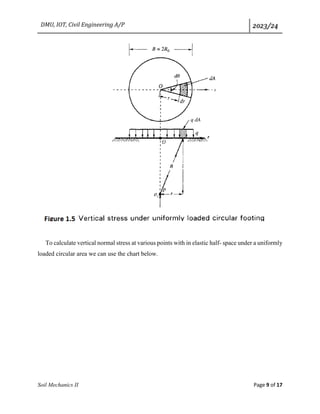
Figure 1.5 shows a plan and section of the loaded circular footing. The stress required to be
determined at any point P along the axis is the vertical stress 𝝈𝒁. Let dA be an elementary area
considered as shown in Fig. below 𝜎𝑍 may be considered as the point load acting on this area which
is equal to qdA. We may write
Or
Where, 𝐈𝐙 is the influence coefficient.
DMU, IOT, Civil Engineering A/P 2023/24
Soil Mechanics II Page 9 of 17
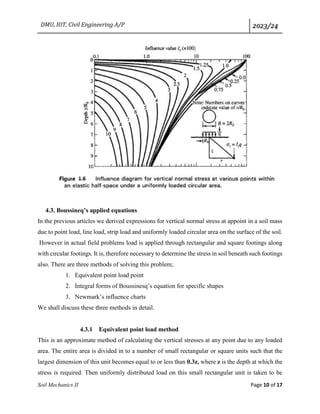
To calculate vertical normal stress at various points with in elastic half- space under a uniformly
loaded circular area we can use the chart below.
DMU, IOT, Civil Engineering A/P 2023/24
Soil Mechanics II Page 10 of 17
4.3. Boussineq’s applied equations
In the previous articles we derived expressions for vertical normal stress at appoint in a soil mass
due to point load, line load, strip load and uniformly loaded circular area on the surface of the soil.
However in actual field problems load is applied through rectangular and square footings along
with circular footings. It is, therefore necessary to determine the stress in soil beneath such footings
also. There are three methods of solving this problem;
1. Equivalent point load point
2. Integral forms of Boussinesq’s equation for specific shapes
3. Newmark’s influence charts
We shall discuss these three methods in detail.
4.3.1 Equivalent point load method
This is an approximate method of calculating the vertical stresses at any point due to any loaded
area. The entire area is divided in to a number of small rectangular or square units such that the
largest dimension of this unit becomes equal to or less than 0.3z, where z is the depth at which the
stress is required. Then uniformly distributed load on this small rectangular unit is taken to be
DMU, IOT, Civil Engineering A/P 2023/24
Soil Mechanics II Page 11 of 17
acting as a concentrated load through its center of gravity. Then radial distances of CG’s of this
small units from the vertical axis passing through the point at which stress is to be calculated are
computed (r1, r2, r3,..). Then for various 𝑟1 𝑧
⁄ , 𝑟2 𝑧
⁄ , 𝑟3 𝑧
⁄ ...corresponding 𝐼𝐵1, 𝐼𝐵2, 𝐼𝐵3,...are
obtained from ready rocken. The vertical normal stress 𝜎𝑧 is given as
𝜎𝑧 =( 𝑄1 𝑧2
⁄ )( 𝐼𝐵1) + (𝑄2 𝑧2
⁄ )(𝐼𝐵2) + (𝑄3 𝑧2
⁄ )(𝐼𝐵3) + (𝑄4 𝑧2
⁄ )(𝐼𝐵4)
=(1 𝑧2
⁄ ){𝑄1𝐼𝐵1 + 𝑄2𝐼𝐵2+𝑄3𝐼𝐵3 + ⋯ }
Where 𝑄1, 𝑄2, 𝑄3, are equivalent concentrated loads acting through unit area 1,2,3,... and 𝑄1
= 𝑄𝐴1, 𝑄2 = 𝑄𝐴2, 𝑄3 = 𝑄𝐴3...where Q is the uniformly distributed load over entire area and 𝐴1,
𝐴2, 𝐴3,...are areas of small unit areas 1,2,3...respectively. For example if the normal stress at a
depth z below the center of rectangular footing, of dimension L & B Shown in fig.1.7, is to be
computed, then we proceed as follows
Figure 1.7 Q units/ unit area
𝑟1 = √[
𝐿
4
]2 + [
𝐵
4
]2
Q1=Q2=Q3=Q4=Q4=Q (L/2) (B/2)
Calculate 0.3z. Then divide whole area in to smaller units of dimensions less than 0.3z. let in this
example L/2 AND B/2<0.3z, then we can divide the rectangle in to four smaller units of
dimensions L/2*B/2 as shown in fig. computation of A1, A2, A2, A4 and Q1, Q2, Q3 and Q4 and
DMU, IOT, Civil Engineering A/P 2023/24
Soil Mechanics II Page 12 of 17
r1, r2, r3 and r4 are shown in fig knowing r1/z, r2/z, r3/z and r4/z Boussinesq’s influence factor
𝐼𝐵1, 𝐼𝐵2,𝐼𝐵3 , and 𝐼𝐵4 are obtained from ready reckon or calculated using the equation
Then 𝜎𝑍 at pint ‘A’ at a depth ‘z’ on the line passing through center of the shown area is
𝜎𝑍=(Q1/z2
)(𝐼𝐵1)+(Q2/z2
)( 𝐼𝐵2)+(Q3/z2
)+( 𝐼𝐵3)+ (Q4/z2
)( 𝐼𝐵4)
4.3.2 Integral forms of Boussinesq’s equation for specific shapes
For rectangular load areas, which are the common form of footing loads, in actual field,
Boussineq’s equation for point loads has been integrated by Prof. Fadum. The solution
obtained is little difficult mathematically and it is usually used with the help of charts.
The mathematical solution as obtained for comparing at a corner of a rectangular footing of
dimensions mz and nz at a depth z carrying a uniform load intensity q units/unit area can be
written in the form
𝝈𝒁=q𝑰𝑹
Where IR is another influence factor and is given by
IR =
1
4
[
2mn(m2+n2+1)
1 2
⁄
m2+n2+m2n2+1
m2+n2+2
m2+n2+1
+ tan−1 2mn(m2+n2+1)
1 2
⁄
m2+n2−m2n2+1
]
Values of IR for different values of log m and different values of n are plotted in the figure
given below. The values of IR can be easily read from the graph and hence 𝝈𝒁 can be
effortlessly calculated for this particular type of problems.
DMU, IOT, Civil Engineering A/P 2023/24
Soil Mechanics II Page 13 of 17
4.3.3 Newmark’s Influence Charts
We know that for a circularly loaded area of radius r the value at a point at a depth z vertical
line passing through center of loaded area is given by
𝝈𝒁=q[𝟏 − {
𝟏
𝟏+(𝑹/𝒛)𝟐
}
𝟑/𝟐
]
If we rearrange this equation and solve for r/z and take the positive root we get
DMU, IOT, Civil Engineering A/P 2023/24
Soil Mechanics II Page 14 of 17
𝐫/𝐳 = √(𝟏 − (
𝛔𝐳
𝐐
)
−
𝟐
𝟑
− 𝟏
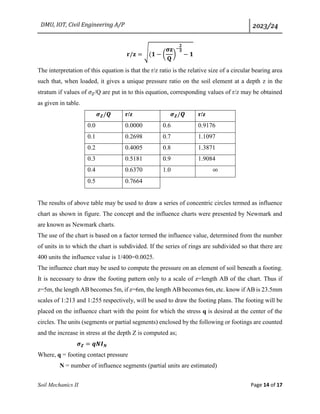
The interpretation of this equation is that the r/z ratio is the relative size of a circular bearing area
such that, when loaded, it gives a unique pressure ratio on the soil element at a depth z in the
stratum if values of 𝜎𝑍/Q are put in to this equation, corresponding values of r/z may be obtained
as given in table.
𝝈𝒁/𝑸 r/z 𝝈𝒁/𝑸 r/z
0.0 0.0000 0.6 0.9176
0.1 0.2698 0.7 1.1097
0.2 0.4005 0.8 1.3871
0.3 0.5181 0.9 1.9084
0.4 0.6370 1.0 ∞
0.5 0.7664
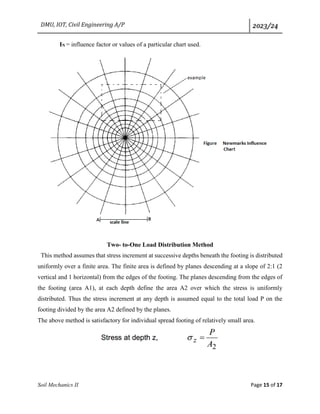
The results of above table may be used to draw a series of concentric circles termed as influence
chart as shown in figure. The concept and the influence charts were presented by Newmark and
are known as Newmark charts.
The use of the chart is based on a factor termed the influence value, determined from the number
of units in to which the chart is subdivided. If the series of rings are subdivided so that there are
400 units the influence value is 1/400=0.0025.
The influence chart may be used to compute the pressure on an element of soil beneath a footing.
It is necessary to draw the footing pattern only to a scale of z=length AB of the chart. Thus if
z=5m, the length AB becomes 5m, if z=6m, the length AB becomes 6m, etc. know if AB is 23.5mm
scales of 1:213 and 1:255 respectively, will be used to draw the footing plans. The footing will be
placed on the influence chart with the point for which the stress q is desired at the center of the
circles. The units (segments or partial segments) enclosed by the following or footings are counted
and the increase in stress at the depth Z is computed as;
𝝈𝒁 = 𝒒𝑵𝑰𝑵
Where, q = footing contact pressure
N = number of influence segments (partial units are estimated)
DMU, IOT, Civil Engineering A/P 2023/24
Soil Mechanics II Page 15 of 17
IN = influence factor or values of a particular chart used.
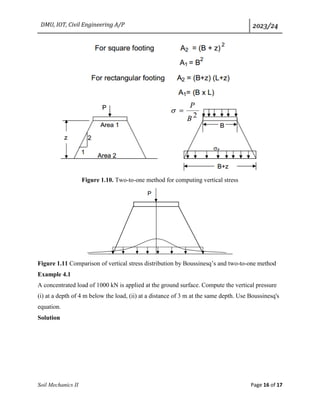
Two- to-One Load Distribution Method
This method assumes that stress increment at successive depths beneath the footing is distributed
uniformly over a finite area. The finite area is defined by planes descending at a slope of 2:1 (2
vertical and 1 horizontal) from the edges of the footing. The planes descending from the edges of
the footing (area A1), at each depth define the area A2 over which the stress is uniformly
distributed. Thus the stress increment at any depth is assumed equal to the total load P on the
footing divided by the area A2 defined by the planes.
The above method is satisfactory for individual spread footing of relatively small area.
DMU, IOT, Civil Engineering A/P 2023/24
Soil Mechanics II Page 16 of 17
Figure 1.10. Two-to-one method for computing vertical stress
Figure 1.11 Comparison of vertical stress distribution by Boussinesq’s and two-to-one method
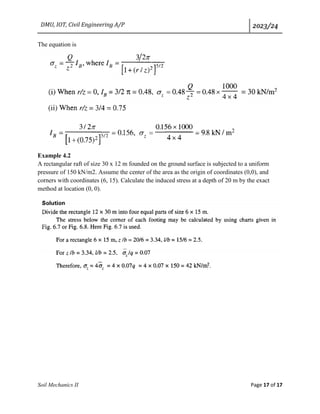
Example 4.1
A concentrated load of 1000 kN is applied at the ground surface. Compute the vertical pressure
(i) at a depth of 4 m below the load, (ii) at a distance of 3 m at the same depth. Use Boussinesq's
equation.
Solution
DMU, IOT, Civil Engineering A/P 2023/24
Soil Mechanics II Page 17 of 17
The equation is
Example 4.2
A rectangular raft of size 30 x 12 m founded on the ground surface is subjected to a uniform
pressure of 150 kN/m2. Assume the center of the area as the origin of coordinates (0,0), and
corners with coordinates (6, 15). Calculate the induced stress at a depth of 20 m by the exact
method at location (0, 0).

4.Chapter FOUR- Stres. ses In Soils.pdf

  • 1.
    DMU, IOT, CivilEngineering A/P 2023/24 Soil Mechanics II Page 1 of 17 CHAPTER FOUR STRESS DISTRIBUTION IN SOILS 4.1. Introduction Estimation of vertical stresses at any point in a soil-mass due to external vertical loadings are of great significance in the prediction of settlements of buildings, bridges, embankments and many other structures. Equations have been developed to compute stresses at any point in a soil mass on the basis of the theory of elasticity. According to elastic theory, constant ratios exist between stresses and strains. For the theory to be applicable, the real requirement is not that the material necessarily be elastic, but there must be constant ratios between stresses and the corresponding strains. Therefore, in non-elastic soil masses, the elastic theory may be assumed to hold so long as the stresses induced in the soil mass are relatively small. Since the stresses in the subsoil of a structure having adequate factor of safety against shear failure are relatively small in comparison with the ultimate strength of the material, the soil may be assumed to behave elastically under such stresses. When a load is applied to the soil surface, it increases the vertical stresses within the soil mass. The increased stresses are greatest directly under the loaded area, but extend indefinitely in all directions. Many formulas based on the theory of elasticity have been used to compute stresses in soils. They are all similar and differ only in the assumptions made to represent the elastic conditions of the soil mass. The formulas that are most widely used are the Boussinesq and Westergaard formulas. These formulas were first developed for point loads acting at the surface. These formulas have been integrated to give stresses below uniform strip loads and rectangular loads. The loads at the surface may act on flexible or rigid footings. The stress conditions in the elastic layer below vary according to the rigidity of the footings and the thickness of the elastic layer. All the external loads considered are vertical loads only as the vertical loads are of practical importance for computing settlements of foundations.
  • 2.
    DMU, IOT, CivilEngineering A/P 2023/24 Soil Mechanics II Page 2 of 17 4.2 Boussinesq’s formula for point loads Figure 1.1 shows a load Q acting at a point 0 on the surface of a semi-infinite solid. A semi- infinite solid is the one bounded on one side by a horizontal surface, here the surface of the earth, and infinite in all the other directions. The problem of determining stresses at any point P at a depth z as a result of a surface point load was solved by Boussinesq (1885) on the following assumptions. 1. The soil mass is elastic, isotropic, homogeneous and semi-infinite. 2. The soil is weightless. 3. The load is a point load acting on the surface. The soil is said to be isotropic if there are identical elastic properties throughout the mass and in every direction through any point of it. The soil is said to be homogeneous if there are identical elastic properties at every point of the mass in identical directions. The expression obtained by Boussinesq for computing vertical stress, at point P (Fig. 1.1) due to a point load Q is Where, r = the horizontal distance between an arbitrary point P below the surface and the vertical axis through the point load Q. z = the vertical depth of the point P from the surface. The values of the Boussinesq coefficient 𝐼𝐵 can be determined for a number of values of r/z. The variation of 𝐼𝐵 with r/z in a graphical form is given in Fig. 1.3. It can be seen from this figure
  • 3.
    DMU, IOT, CivilEngineering A/P 2023/24 Soil Mechanics II Page 3 of 17 Figure 1.1 Vertical stresses with in an earth mass Stress Distribution in Soils due to Surface Loads that IB has a maximum value of 0.48 at r/z = 0, i.e., indicating thereby that the stress is a maximum below the point load. The variation of vertical stress due to point load with depth and horizontal distance from the point of application of the load is shown in figure below. Figure 1.2 a) Variation of stress with depth b) Stress distribution on horizontal planes Westergard's formula for point loads
  • 4.
    DMU, IOT, CivilEngineering A/P 2023/24 Soil Mechanics II Page 4 of 17 Boussinesq assumed that the soil is elastic, isotropic and homogeneous for the development of a point load formula. However, the soil is neither isotropic nor homogeneous. The most common type of soils that are met in nature is the water deposited sedimentary soils. When the soil particles are deposited in water, typical clay strata usually have their lenses of coarser materials within them. The soils of this type can be assumed as laterally reinforced by numerous, closely spaced, horizontal sheets of negligible thickness but of infinite rigidity, which prevent the mass as a whole from undergoing lateral movement of soil grains. Westergaard, a British Scientist, proposed (1938) a formula for the computation of vertical stress 𝜎𝑍 by a point load, Q, at the surface as in which µ , is Poisson's ratio. µ is taken as zero for all practical purposes, then the above eq. simplifies to Where, 𝐈𝐖 is the Westergaard stress coefficient. The variation of 𝑰𝑾 with the ratios of (r/z) is shown graphically in Fig. 1.3 along with the Boussinesq's coefficient IB. The value of 𝐈𝐖 at r/z = 0 is 0.32 which is less than that of 𝐈𝐁 by 33 percent.
  • 5.
    DMU, IOT, CivilEngineering A/P 2023/24 Soil Mechanics II Page 5 of 17 Figure 1.3 Values of IB OR IW for use in Boussinesq or Westergard formula Geotechnical engineers prefer to use Boussinesq's solution as this gives conservative results. Further discussions are therefore limited to Boussinesq's method in this chapter. 4.2.1. Line Loads The basic equation used for computing 𝛔𝐙 at any point P in an elastic semi-infinite mass is Boussinesq’s equation. By applying the principle of his theory, the stresses at any point in the mass due to a line load of infinite extent acting at the surface may be obtained. The state of stress encountered in this case is that of a plane strain condition. The strain at any point P in the Y- direction parallel to the line load is assumed equal to zero. The stress 𝛔𝐱 normal to the XZ-plane (Fig. 1.4) is the same at all sections and the shear stresses on these sections are zero. By applying the theory of elasticity, stresses at any point P (Fig. 1.4) may be obtained either in polar coordinates or in rectangular coordinates. The vertical stress 𝛔𝐳 at point P may be written in rectangular coordinates as;
  • 6.
    DMU, IOT, CivilEngineering A/P 2023/24 Soil Mechanics II Page 6 of 17 4.2.2. Strip Loads The state of stress encountered in this case also is that of a plane strain condition. Such conditions are found for structures extended very much in one direction, such as strip and wall foundations, foundations of retaining walls, embankments, dams and the like. Fig. 1.5(a) shows a load q per unit area acting on a strip of infinite length and of constant width B. The vertical stress at any arbitrary point P due to a line load of qdx acting at xc = x can be written from Eq. of line loads as:
  • 7.
    DMU, IOT, CivilEngineering A/P 2023/24 Soil Mechanics II Page 7 of 17 Applying the principle of superposition, the total stress 𝛔𝐙 at point P due to a strip load distributed over a width B(= 2b) may be written as The above eq. can be expressed in a more convenient form as: Where β and δ are the angles as shown in Fig. 1.4(b) below.
  • 8.
    DMU, IOT, CivilEngineering A/P 2023/24 Soil Mechanics II Page 8 of 17 4.2.3. Stresses under Uniformly Loaded Circular Footing Figure 1.5 shows a plan and section of the loaded circular footing. The stress required to be determined at any point P along the axis is the vertical stress 𝝈𝒁. Let dA be an elementary area considered as shown in Fig. below 𝜎𝑍 may be considered as the point load acting on this area which is equal to qdA. We may write Or Where, 𝐈𝐙 is the influence coefficient.
  • 9.
    DMU, IOT, CivilEngineering A/P 2023/24 Soil Mechanics II Page 9 of 17 To calculate vertical normal stress at various points with in elastic half- space under a uniformly loaded circular area we can use the chart below.
  • 10.
    DMU, IOT, CivilEngineering A/P 2023/24 Soil Mechanics II Page 10 of 17 4.3. Boussineq’s applied equations In the previous articles we derived expressions for vertical normal stress at appoint in a soil mass due to point load, line load, strip load and uniformly loaded circular area on the surface of the soil. However in actual field problems load is applied through rectangular and square footings along with circular footings. It is, therefore necessary to determine the stress in soil beneath such footings also. There are three methods of solving this problem; 1. Equivalent point load point 2. Integral forms of Boussinesq’s equation for specific shapes 3. Newmark’s influence charts We shall discuss these three methods in detail. 4.3.1 Equivalent point load method This is an approximate method of calculating the vertical stresses at any point due to any loaded area. The entire area is divided in to a number of small rectangular or square units such that the largest dimension of this unit becomes equal to or less than 0.3z, where z is the depth at which the stress is required. Then uniformly distributed load on this small rectangular unit is taken to be
  • 11.
    DMU, IOT, CivilEngineering A/P 2023/24 Soil Mechanics II Page 11 of 17 acting as a concentrated load through its center of gravity. Then radial distances of CG’s of this small units from the vertical axis passing through the point at which stress is to be calculated are computed (r1, r2, r3,..). Then for various 𝑟1 𝑧 ⁄ , 𝑟2 𝑧 ⁄ , 𝑟3 𝑧 ⁄ ...corresponding 𝐼𝐵1, 𝐼𝐵2, 𝐼𝐵3,...are obtained from ready rocken. The vertical normal stress 𝜎𝑧 is given as 𝜎𝑧 =( 𝑄1 𝑧2 ⁄ )( 𝐼𝐵1) + (𝑄2 𝑧2 ⁄ )(𝐼𝐵2) + (𝑄3 𝑧2 ⁄ )(𝐼𝐵3) + (𝑄4 𝑧2 ⁄ )(𝐼𝐵4) =(1 𝑧2 ⁄ ){𝑄1𝐼𝐵1 + 𝑄2𝐼𝐵2+𝑄3𝐼𝐵3 + ⋯ } Where 𝑄1, 𝑄2, 𝑄3, are equivalent concentrated loads acting through unit area 1,2,3,... and 𝑄1 = 𝑄𝐴1, 𝑄2 = 𝑄𝐴2, 𝑄3 = 𝑄𝐴3...where Q is the uniformly distributed load over entire area and 𝐴1, 𝐴2, 𝐴3,...are areas of small unit areas 1,2,3...respectively. For example if the normal stress at a depth z below the center of rectangular footing, of dimension L & B Shown in fig.1.7, is to be computed, then we proceed as follows Figure 1.7 Q units/ unit area 𝑟1 = √[ 𝐿 4 ]2 + [ 𝐵 4 ]2 Q1=Q2=Q3=Q4=Q4=Q (L/2) (B/2) Calculate 0.3z. Then divide whole area in to smaller units of dimensions less than 0.3z. let in this example L/2 AND B/2<0.3z, then we can divide the rectangle in to four smaller units of dimensions L/2*B/2 as shown in fig. computation of A1, A2, A2, A4 and Q1, Q2, Q3 and Q4 and
  • 12.
    DMU, IOT, CivilEngineering A/P 2023/24 Soil Mechanics II Page 12 of 17 r1, r2, r3 and r4 are shown in fig knowing r1/z, r2/z, r3/z and r4/z Boussinesq’s influence factor 𝐼𝐵1, 𝐼𝐵2,𝐼𝐵3 , and 𝐼𝐵4 are obtained from ready reckon or calculated using the equation Then 𝜎𝑍 at pint ‘A’ at a depth ‘z’ on the line passing through center of the shown area is 𝜎𝑍=(Q1/z2 )(𝐼𝐵1)+(Q2/z2 )( 𝐼𝐵2)+(Q3/z2 )+( 𝐼𝐵3)+ (Q4/z2 )( 𝐼𝐵4) 4.3.2 Integral forms of Boussinesq’s equation for specific shapes For rectangular load areas, which are the common form of footing loads, in actual field, Boussineq’s equation for point loads has been integrated by Prof. Fadum. The solution obtained is little difficult mathematically and it is usually used with the help of charts. The mathematical solution as obtained for comparing at a corner of a rectangular footing of dimensions mz and nz at a depth z carrying a uniform load intensity q units/unit area can be written in the form 𝝈𝒁=q𝑰𝑹 Where IR is another influence factor and is given by IR = 1 4 [ 2mn(m2+n2+1) 1 2 ⁄ m2+n2+m2n2+1 m2+n2+2 m2+n2+1 + tan−1 2mn(m2+n2+1) 1 2 ⁄ m2+n2−m2n2+1 ] Values of IR for different values of log m and different values of n are plotted in the figure given below. The values of IR can be easily read from the graph and hence 𝝈𝒁 can be effortlessly calculated for this particular type of problems.
  • 13.
    DMU, IOT, CivilEngineering A/P 2023/24 Soil Mechanics II Page 13 of 17 4.3.3 Newmark’s Influence Charts We know that for a circularly loaded area of radius r the value at a point at a depth z vertical line passing through center of loaded area is given by 𝝈𝒁=q[𝟏 − { 𝟏 𝟏+(𝑹/𝒛)𝟐 } 𝟑/𝟐 ] If we rearrange this equation and solve for r/z and take the positive root we get
  • 14.
    DMU, IOT, CivilEngineering A/P 2023/24 Soil Mechanics II Page 14 of 17 𝐫/𝐳 = √(𝟏 − ( 𝛔𝐳 𝐐 ) − 𝟐 𝟑 − 𝟏 The interpretation of this equation is that the r/z ratio is the relative size of a circular bearing area such that, when loaded, it gives a unique pressure ratio on the soil element at a depth z in the stratum if values of 𝜎𝑍/Q are put in to this equation, corresponding values of r/z may be obtained as given in table. 𝝈𝒁/𝑸 r/z 𝝈𝒁/𝑸 r/z 0.0 0.0000 0.6 0.9176 0.1 0.2698 0.7 1.1097 0.2 0.4005 0.8 1.3871 0.3 0.5181 0.9 1.9084 0.4 0.6370 1.0 ∞ 0.5 0.7664 The results of above table may be used to draw a series of concentric circles termed as influence chart as shown in figure. The concept and the influence charts were presented by Newmark and are known as Newmark charts. The use of the chart is based on a factor termed the influence value, determined from the number of units in to which the chart is subdivided. If the series of rings are subdivided so that there are 400 units the influence value is 1/400=0.0025. The influence chart may be used to compute the pressure on an element of soil beneath a footing. It is necessary to draw the footing pattern only to a scale of z=length AB of the chart. Thus if z=5m, the length AB becomes 5m, if z=6m, the length AB becomes 6m, etc. know if AB is 23.5mm scales of 1:213 and 1:255 respectively, will be used to draw the footing plans. The footing will be placed on the influence chart with the point for which the stress q is desired at the center of the circles. The units (segments or partial segments) enclosed by the following or footings are counted and the increase in stress at the depth Z is computed as; 𝝈𝒁 = 𝒒𝑵𝑰𝑵 Where, q = footing contact pressure N = number of influence segments (partial units are estimated)
  • 15.
    DMU, IOT, CivilEngineering A/P 2023/24 Soil Mechanics II Page 15 of 17 IN = influence factor or values of a particular chart used. Two- to-One Load Distribution Method This method assumes that stress increment at successive depths beneath the footing is distributed uniformly over a finite area. The finite area is defined by planes descending at a slope of 2:1 (2 vertical and 1 horizontal) from the edges of the footing. The planes descending from the edges of the footing (area A1), at each depth define the area A2 over which the stress is uniformly distributed. Thus the stress increment at any depth is assumed equal to the total load P on the footing divided by the area A2 defined by the planes. The above method is satisfactory for individual spread footing of relatively small area.
  • 16.
    DMU, IOT, CivilEngineering A/P 2023/24 Soil Mechanics II Page 16 of 17 Figure 1.10. Two-to-one method for computing vertical stress Figure 1.11 Comparison of vertical stress distribution by Boussinesq’s and two-to-one method Example 4.1 A concentrated load of 1000 kN is applied at the ground surface. Compute the vertical pressure (i) at a depth of 4 m below the load, (ii) at a distance of 3 m at the same depth. Use Boussinesq's equation. Solution
  • 17.
    DMU, IOT, CivilEngineering A/P 2023/24 Soil Mechanics II Page 17 of 17 The equation is Example 4.2 A rectangular raft of size 30 x 12 m founded on the ground surface is subjected to a uniform pressure of 150 kN/m2. Assume the center of the area as the origin of coordinates (0,0), and corners with coordinates (6, 15). Calculate the induced stress at a depth of 20 m by the exact method at location (0, 0).