ASSESSMENT PURPOSES
AND APPROACHES
By
Anik Aniqoh (S200160042)
Khoirul Bariyyah (S200160037)
Ma’rifatun Umi (S200160038)
Overview of Assessment
It is an integral part of instruction, as it determines whether
or not the goals of education are being met.
3 criteria of assessment
• Validity
• Reliability
• Practicality
(Farhady,2012)
Assessment
Assessment information is needed by administrators,
teachers, staff developers, students, and parents to assist
in determining appropriate program placements and
instructional activities as well as in monitoring student
progress. (O’Malley,1994)
Assessment Purposes of ELL Students
• Screening and identification
• Placement
• Reclassification or exit
• Monitoring Student Progress
• Program Evaluation
• Accountability
(O’Malley,1994)
Role of Standardized tests
• To compare individual or group performance with an
external normative group
• To identify relative strengths and weaknesses in skill
areas
• To monitor annual growth in skills
• For program evaluation
(Hoover,1995)
Assessment Purposes
For Students
a. Identify what students know and needs
b. Determine appropriate placement
c. Select appropriate curricula
For Families
a. Communicate with parents to provide information about
students’ progress and learning
b. Relate school activities to home activities and
experiences
Continued…
For Teachers and Administrators
• Identify students’ needs, skills, and abilities
• Make lesson plan, do classroom activity, and set goals
• Report to parents about students’ achievements and
status
• Monitor and improve teaching –learning process
Continued…
For Public
• Inform the public regarding students’ achievement
• Provide information relating to student’s school-wide
achievement
• Provide a basis for public policy (e.g. recommendation)
APPROACHES TO
LANGUAGE TESTING
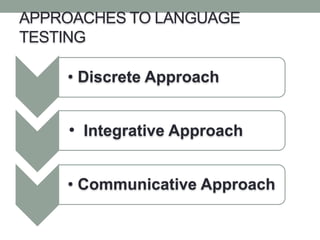
APPROACHES TO LANGUAGE
TESTING
• Discrete Approach
• Integrative Approach
• Communicative Approach
Discrete Approach
• Discrete-Point are constructed on the assumption
that language can be broken down into its
component parts and that those parts can be
tested successfully.
• These components are the skills of listening,
speaking, reading, and writing, and various units of
language (discrete points) of
phonology/graphology, morphology, lexicon,
syntax, and discourse.
• Types of Test
Discrete point tests are always indirect, types of
this test is Diagnostic tests of grammar
The Integrative Approach
Characteristics and Types of Tests in
IntegrativeApproach
This approach involves the testing of language in
context and is thus concerned primarily with
meaning and the total communicative effect of
discourse.
Integrative tests are concerned with a global view of
proficiency.
The use of cloze test, dictation, oral interview,
translation and essay writing are included in many
integrative tests.
Strengths of IntegrativeApproach
• Total communicative effect of discourse will be very
useful for students in testing.
• This approach can view students’ proficiency with a
global view.
• A model cloze test used in this approach measures the
reader’s ability to decode ‘interrupted’ and ‘mutilated’
messages by making the most acceptable substitutions
from all the contextual clues available..
• Dictation, another type using this approach, was
regarded solely as a means of measuring students’ skills
of listening comprehension.
Weakness of IntegrativeApproach
• The measuring integrated skills is better, sometimes
there is a need to consider the importance of
measuring skills based on students’ need, such as
writing only, speaking only, etc.
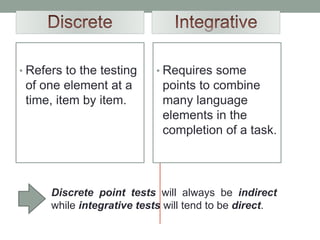
• Refers to the testing
of one element at a
time, item by item.
• Requires some
points to combine
many language
elements in the
completion of a task.
Discrete point tests will always be indirect
while integrative tests will tend to be direct.
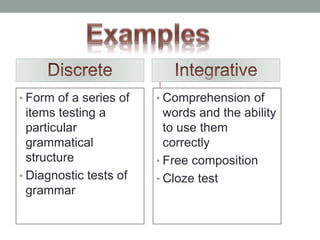
• Form of a series of
items testing a
particular
grammatical
structure
• Diagnostic tests of
grammar
• Comprehension of
words and the ability
to use them
correctly
• Free composition
• Cloze test
The Communicative Approach
Characteristics and Types of Tests in
Communicative Approach
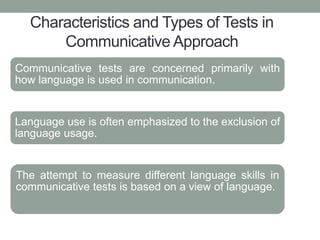
Communicative tests are concerned primarily with
how language is used in communication.
Language use is often emphasized to the exclusion of
language usage.
The attempt to measure different language skills in
communicative tests is based on a view of language.
Characteristics and Types of Tests in
Communicative Approach
The test content should totally be relevant
for a particular group of examinees and the
tasks set should relate to real-life situation.
Communicative testing introduces the
concept of qualitative modes of
assessment.
Strengths of Communicative Approach
• Communicative tests are able to measure all integrated
skills of students.
• The tests using this approach face students in real life
so it will be very useful for them.
• Because a communicative test can measure all
language skills, it can help students in getting the score.
• Detailed statements of each performance level serve to
increase the reliability of the scoring by enabling the
examiner to make decisions according to carefully
drawn-up and well-established criteria.
Weaknesses of Communicative Approach
This approach does not emphasize learning
structural grammar, it difficult to achieve
communicative competence without a
considerable mastery of the grammar of a
language.
It is possible for cultural to affect the reliability of
the tests being administered.
Performance-based assessment
• performance-based assessment is “an approach to
assessment that seeks to measure student learning
based on how well the learner can perform on a practical
real task
Implementing PBA in EFL classroom
• Represent a set of strategies for the application of
knowledge, skills and work habits through the
performance of task.
• This type of assessment provides the teacher with
information about how students understand and applies
knowledge.
• Students apply their knowledge and skills in context.
Designing PBA
• -What am I trying to assess?
• -What do my students need to know?
• -What prerequisite skills do my students need to have?
• -At what level do my pupils need to perform?
• -Will it the same level of performance be required of all
my students?
• -What type of knowledge is being assessed: reasoning,
memory, or process?
Advantages and disadvantages
Advantages
• It can promote student motivation
• Engages student in active learning
• Promote students' creativity
Disadvantages
• Time consuming
• Rating can be subjective
• Requires careful training of rater
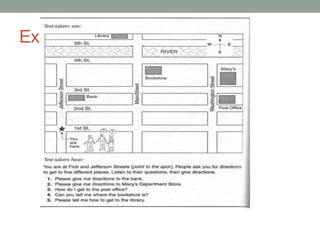
Example
Conclusion
• Assessment is important to know how good TEFL activity
is done and to know what to fix to improve the result. It
could be discrete-point, communicative and performance
based assessment. It depends on what to assess.

Assessment purposes and approaches

  • 1.
    ASSESSMENT PURPOSES AND APPROACHES By AnikAniqoh (S200160042) Khoirul Bariyyah (S200160037) Ma’rifatun Umi (S200160038)
  • 2.
    Overview of Assessment Itis an integral part of instruction, as it determines whether or not the goals of education are being met.
  • 3.
    3 criteria ofassessment • Validity • Reliability • Practicality (Farhady,2012)
  • 4.
    Assessment Assessment information isneeded by administrators, teachers, staff developers, students, and parents to assist in determining appropriate program placements and instructional activities as well as in monitoring student progress. (O’Malley,1994)
  • 5.
    Assessment Purposes ofELL Students • Screening and identification • Placement • Reclassification or exit • Monitoring Student Progress • Program Evaluation • Accountability (O’Malley,1994)
  • 6.
    Role of Standardizedtests • To compare individual or group performance with an external normative group • To identify relative strengths and weaknesses in skill areas • To monitor annual growth in skills • For program evaluation (Hoover,1995)
  • 7.
    Assessment Purposes For Students a.Identify what students know and needs b. Determine appropriate placement c. Select appropriate curricula For Families a. Communicate with parents to provide information about students’ progress and learning b. Relate school activities to home activities and experiences
  • 8.
    Continued… For Teachers andAdministrators • Identify students’ needs, skills, and abilities • Make lesson plan, do classroom activity, and set goals • Report to parents about students’ achievements and status • Monitor and improve teaching –learning process
  • 9.
    Continued… For Public • Informthe public regarding students’ achievement • Provide information relating to student’s school-wide achievement • Provide a basis for public policy (e.g. recommendation)
  • 10.
  • 11.
    APPROACHES TO LANGUAGE TESTING •Discrete Approach • Integrative Approach • Communicative Approach
  • 12.
    Discrete Approach • Discrete-Pointare constructed on the assumption that language can be broken down into its component parts and that those parts can be tested successfully. • These components are the skills of listening, speaking, reading, and writing, and various units of language (discrete points) of phonology/graphology, morphology, lexicon, syntax, and discourse. • Types of Test Discrete point tests are always indirect, types of this test is Diagnostic tests of grammar
  • 13.
  • 14.
    Characteristics and Typesof Tests in IntegrativeApproach This approach involves the testing of language in context and is thus concerned primarily with meaning and the total communicative effect of discourse. Integrative tests are concerned with a global view of proficiency. The use of cloze test, dictation, oral interview, translation and essay writing are included in many integrative tests.
  • 15.
    Strengths of IntegrativeApproach •Total communicative effect of discourse will be very useful for students in testing. • This approach can view students’ proficiency with a global view. • A model cloze test used in this approach measures the reader’s ability to decode ‘interrupted’ and ‘mutilated’ messages by making the most acceptable substitutions from all the contextual clues available.. • Dictation, another type using this approach, was regarded solely as a means of measuring students’ skills of listening comprehension.
  • 16.
    Weakness of IntegrativeApproach •The measuring integrated skills is better, sometimes there is a need to consider the importance of measuring skills based on students’ need, such as writing only, speaking only, etc.
  • 17.
    • Refers tothe testing of one element at a time, item by item. • Requires some points to combine many language elements in the completion of a task. Discrete point tests will always be indirect while integrative tests will tend to be direct.
  • 18.
    • Form ofa series of items testing a particular grammatical structure • Diagnostic tests of grammar • Comprehension of words and the ability to use them correctly • Free composition • Cloze test
  • 19.
  • 20.
    Characteristics and Typesof Tests in Communicative Approach Communicative tests are concerned primarily with how language is used in communication. Language use is often emphasized to the exclusion of language usage. The attempt to measure different language skills in communicative tests is based on a view of language.
  • 21.
    Characteristics and Typesof Tests in Communicative Approach The test content should totally be relevant for a particular group of examinees and the tasks set should relate to real-life situation. Communicative testing introduces the concept of qualitative modes of assessment.
  • 22.
    Strengths of CommunicativeApproach • Communicative tests are able to measure all integrated skills of students. • The tests using this approach face students in real life so it will be very useful for them. • Because a communicative test can measure all language skills, it can help students in getting the score. • Detailed statements of each performance level serve to increase the reliability of the scoring by enabling the examiner to make decisions according to carefully drawn-up and well-established criteria.
  • 23.
    Weaknesses of CommunicativeApproach This approach does not emphasize learning structural grammar, it difficult to achieve communicative competence without a considerable mastery of the grammar of a language. It is possible for cultural to affect the reliability of the tests being administered.
  • 24.
    Performance-based assessment • performance-basedassessment is “an approach to assessment that seeks to measure student learning based on how well the learner can perform on a practical real task
  • 25.
    Implementing PBA inEFL classroom • Represent a set of strategies for the application of knowledge, skills and work habits through the performance of task. • This type of assessment provides the teacher with information about how students understand and applies knowledge. • Students apply their knowledge and skills in context.
  • 26.
    Designing PBA • -Whatam I trying to assess? • -What do my students need to know? • -What prerequisite skills do my students need to have? • -At what level do my pupils need to perform? • -Will it the same level of performance be required of all my students? • -What type of knowledge is being assessed: reasoning, memory, or process?
  • 27.
    Advantages and disadvantages Advantages •It can promote student motivation • Engages student in active learning • Promote students' creativity Disadvantages • Time consuming • Rating can be subjective • Requires careful training of rater
  • 28.
  • 29.
    Conclusion • Assessment isimportant to know how good TEFL activity is done and to know what to fix to improve the result. It could be discrete-point, communicative and performance based assessment. It depends on what to assess.