Approaches to Language
Testing
Aprilia wahyu Sasmita (20202003)
afi datul adiba (20202007)
ngasiku Laila (20202024)
GROUP 2
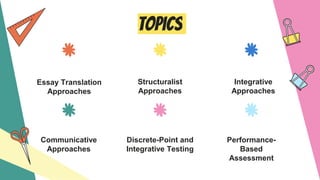
topics
Structuralist
Approaches
Discrete-Point and
Integrative Testing
Essay Translation
Approaches
Communicative
Approaches
Performance-
Based
Assessment
Integrative
Approaches
This approach is commonly referred to as
the pre-scientific stage of language
testing. No special skill or expertise in
testing is required and the subjective
judgement of the teacher is considered to
be of paramount importance.
Essay Translation Approaches
● This approach is commonly referred to as the pre-
scientific stage of language testing.
● No special skill or expertise in testing is required.
● Tests usually consist of essay writing, translation, and
grammatical analysis.
● Tests have a heavy literary and cultural bias.
Characteristics of Essay-Translation Approach
 Structural approach is an approach in the
study of language that emphasizes the
examination of language in very detailed
manner.
● This strategy, which is considered a
traditional approach, examines language
products such as sounds, morphemes,
words, sentences, and vocabulary, among
others.
Structuralist Approach
● This approach views that language
learning is chiefly concerned with a
systematic acquisition of a set ofhabits.
● Testing the skills of listening, speaking,
reading, and writing is separate from
another as much as possible.
Characteristics of the Structuralist Approach
● This approach involves the testing of
language in context and is thus concerned
primarily with meaning and the total
communicative effect of discourse.
● This approach stated that communicative
competence is so global that it requires the
integration of all linguistic abilities.
Integrative Approaches
● It primarily focuses on problem-solving.
● It is a compilation of assessment,
curriculum development, and faculty
development.
● Creativity, adaptability, critical reasoning,
and collaboration are the key features of
integrated learning.
Characteristics of Integrative Approaches
● Communicative language testing approach
is used to measure language learners’
ability to use the target language in
authentic situations.
● The approach beliefs that someone/a
student is considered successful in
learning the target language if she/he can
communicate or use knowledge and skills.
Communicative Approaches
● Discrete Point tests are constructed on the
assumption that language can be divided
into its components parts, and those parts
can be tested successfully.
● Testing Approach involves the testing of
language in context and is thus
concerned primarily with meaning and the
total communicative effect of discourse.
Descrete-point and Integrative Testing
● In general, a performance-based
assessment measures students' ability to
apply the skills and knowledge learned
from a unit or units of study.
● Typically, the task challenges students to
use their higher-order thinking skills to
create a product or complete a process.
Performance-Based Assessment
● Students are creating, performing, or
presenting work that is wholly their own based
on what they’ve learned.
● Can be structured to allow for students to
work together as well as alone.
Characteristics Of Performance Based
Assessment
Thank you

Approach to language testing

  • 1.
  • 2.
    Aprilia wahyu Sasmita(20202003) afi datul adiba (20202007) ngasiku Laila (20202024) GROUP 2
  • 3.
    topics Structuralist Approaches Discrete-Point and Integrative Testing EssayTranslation Approaches Communicative Approaches Performance- Based Assessment Integrative Approaches
  • 4.
    This approach iscommonly referred to as the pre-scientific stage of language testing. No special skill or expertise in testing is required and the subjective judgement of the teacher is considered to be of paramount importance. Essay Translation Approaches
  • 5.
    ● This approachis commonly referred to as the pre- scientific stage of language testing. ● No special skill or expertise in testing is required. ● Tests usually consist of essay writing, translation, and grammatical analysis. ● Tests have a heavy literary and cultural bias. Characteristics of Essay-Translation Approach
  • 6.
     Structural approachis an approach in the study of language that emphasizes the examination of language in very detailed manner. ● This strategy, which is considered a traditional approach, examines language products such as sounds, morphemes, words, sentences, and vocabulary, among others. Structuralist Approach
  • 7.
    ● This approachviews that language learning is chiefly concerned with a systematic acquisition of a set ofhabits. ● Testing the skills of listening, speaking, reading, and writing is separate from another as much as possible. Characteristics of the Structuralist Approach
  • 8.
    ● This approachinvolves the testing of language in context and is thus concerned primarily with meaning and the total communicative effect of discourse. ● This approach stated that communicative competence is so global that it requires the integration of all linguistic abilities. Integrative Approaches
  • 9.
    ● It primarilyfocuses on problem-solving. ● It is a compilation of assessment, curriculum development, and faculty development. ● Creativity, adaptability, critical reasoning, and collaboration are the key features of integrated learning. Characteristics of Integrative Approaches
  • 10.
    ● Communicative languagetesting approach is used to measure language learners’ ability to use the target language in authentic situations. ● The approach beliefs that someone/a student is considered successful in learning the target language if she/he can communicate or use knowledge and skills. Communicative Approaches
  • 11.
    ● Discrete Pointtests are constructed on the assumption that language can be divided into its components parts, and those parts can be tested successfully. ● Testing Approach involves the testing of language in context and is thus concerned primarily with meaning and the total communicative effect of discourse. Descrete-point and Integrative Testing
  • 12.
    ● In general,a performance-based assessment measures students' ability to apply the skills and knowledge learned from a unit or units of study. ● Typically, the task challenges students to use their higher-order thinking skills to create a product or complete a process. Performance-Based Assessment
  • 13.
    ● Students arecreating, performing, or presenting work that is wholly their own based on what they’ve learned. ● Can be structured to allow for students to work together as well as alone. Characteristics Of Performance Based Assessment
  • 14.